








Key takeaways:
-
- The cost to build an app like Swiggy ranges from $30,000 to $1,50,000+, depending on various factors. Major cost influencing factors are features, development team location, platform choice, tech-stack, and maintenance.
- The digital food delivery industry is projected to grow from 463.77 USD Billion in 2025 to 3897.35 USD Billion by 2035.
- When businesses develop apps like Swiggy, they have to think about many practical, legal, and security standards to make sure everything runs smoothly and there are no regulatory gaps.
- The key features of swiggy app include real-time chatbots, contactless delivery, voice search and ordering, live order tracking, and subscription and membership.
Just imagine: it’s midnight, you’re craving your favorite food, but cooking seems too troublesome. You took out your phone, and with just a few taps, your fresh, hot food is on the way! That’s the magic food delivery apps like Swiggy have created.
But behind this “tap-and-eat” convenience, there’s a powerful blend of advanced technology, seamless design, and real-time logistics working in sync. In 2026, swiggy clone app development isn’t limited to food delivery. But also delivering speed, personalization, and a delightful experience.
So, if you’ve ever wondered, “How to build an app like swiggy in 2026?”, you have landed on the right place. Read this blog and find out how you can turn your raw food delivery app idea into a successful digital business. Let’s dive in!
What is Swiggy?
Swiggy is a leading on-demand hyperlocal food delivery platform. launched in 2014, it’s known for its food delivery, grocery service (Instamart), and restaurant dining out services (Dineout). It provides services in 500 cities, connecting users with millions of restaurant partners through its app for instant deliveries.
It delivers food from top local restaurants with real-time tracking. It provides a service for pickup or drop-off of packages, documents, or essentials, initially launched as Swiggy Go.
Food Ordering App Market Insights
- The digital food delivery industry is projected to grow from 463.77 USD Billion in 2025 to 3897.35 USD Billion by 2035.
- The food delivery app market is expected to grow at a compound annual growth rate (CAGR) of 23.72% during the forecast period 2025 – 2035.
- North America is the largest market for digital food delivery, accounting for approximately 45% of the global market share.
- Countries like the UK and Germany are leading this trend, with the UK alone accounting for about 15% of the market.
Why Build an App Like Swiggy in 2026 and Beyond?
The food delivery market continues to expand with strong projections. But to build a future-ready app, you need to understand the underlying opportunities. The food delivery market is evolving very fast. They build a future-ready app.
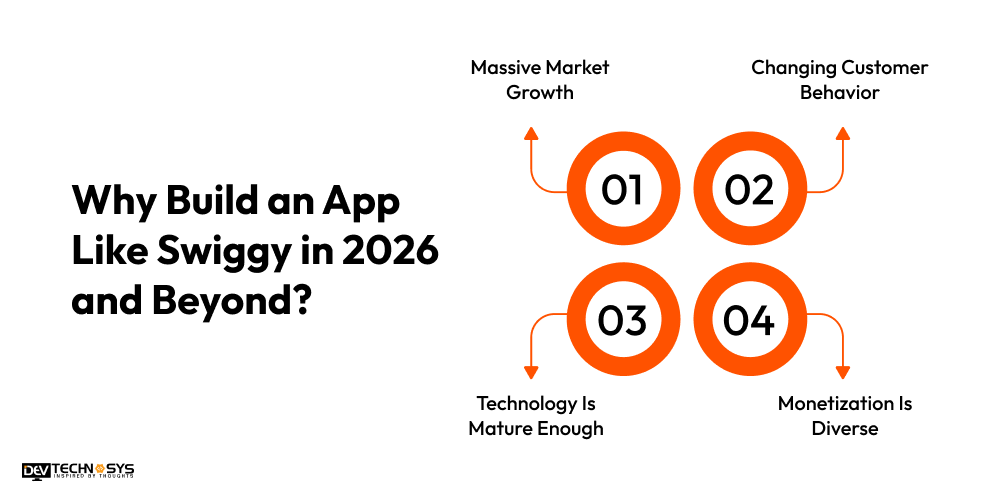
1. Massive Market Growth
The global online food delivery market is expected to grow consistently due to rising urbanization, increased working populations, and lifestyle shifts. This creates a fertile ground for new entrants, especially hyper-local platforms.
2. Changing Customer Behavior
Consumers are increasingly turning to mobile apps for convenience. From daily meals to late-night snacks, users expect fast access to food options with minimal friction. This makes food delivery apps a necessity rather than a luxury.
3. Technology Is Mature Enough
Developers create an app like Swiggy with modern technologies, such as AI, ML, cloud computing, real-time GPS, and automated delivery systems. It allows them to build reliable, scalable delivery platforms faster than ever. Even small startups can access powerful tools used by global giants.
4. Monetization Is Diverse
Apps like Swiggy don’t rely on a single income stream. Using the right monetization tactics ensures sustainable long-term growth, even with high operational costs. Revenue models include:
- Delivery charges
- Restaurant commissions
- Surge pricing
- Subscriptions
- In-app advertising
- Sponsored listings
- Cloud kitchens
How Does a Food Ordering App Like Swiggy Work?
A food delivery app like Swiggy connects users, restaurants, and delivery partners on a single digital platform. From placing an order to live order tracking and in-app chat and support, everything in Swiggy alternative App is powered by smart technology and automated workflows.
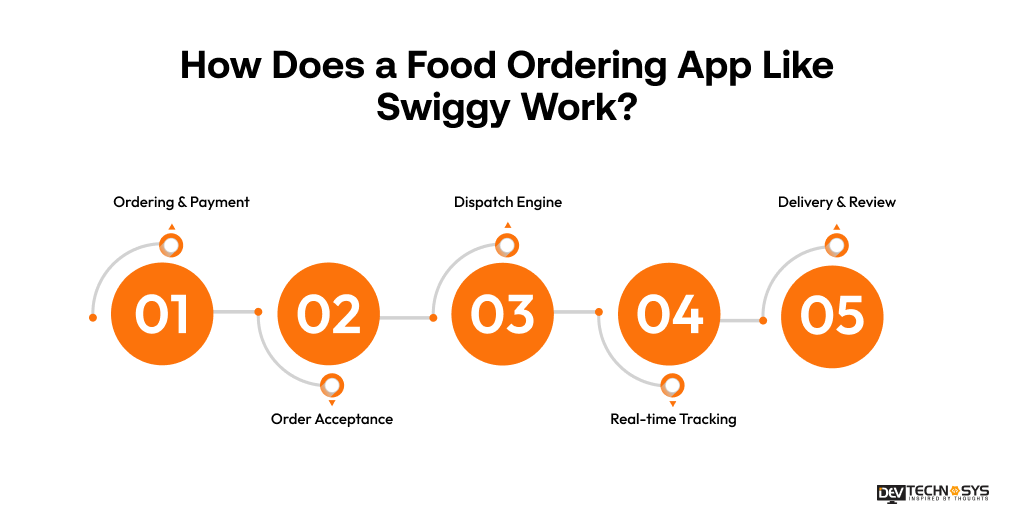
- Ordering & Payment: App like Seamless allow customers to browse restaurants, add items to the cart, and securely pay via UPI, cards, or digital wallets.
- Order Acceptance: The server sends the order to the restaurant app; once accepted, the restaurant prepares the food.
- Dispatch Engine: Apps like Zomato automatically alert nearby delivery partners. A partner accepts the order and travels to the restaurant.
- Real-time Tracking: AI-powered food delivery apps allow customers to track the delivery partner’s GPS location and receive status updates powered by Firebase/websockets.
- Delivery & Review: The partner picks up the order and delivers it, closing the order loop, after which the user can rate the experience.
What are the Key Components of a Food Ordering App?
A food ordering app combines user-friendly design with robust backend systems to deliver a seamless ordering experience. It integrates ordering, payments, and delivery tracking into one unified platform for customers and restaurants.
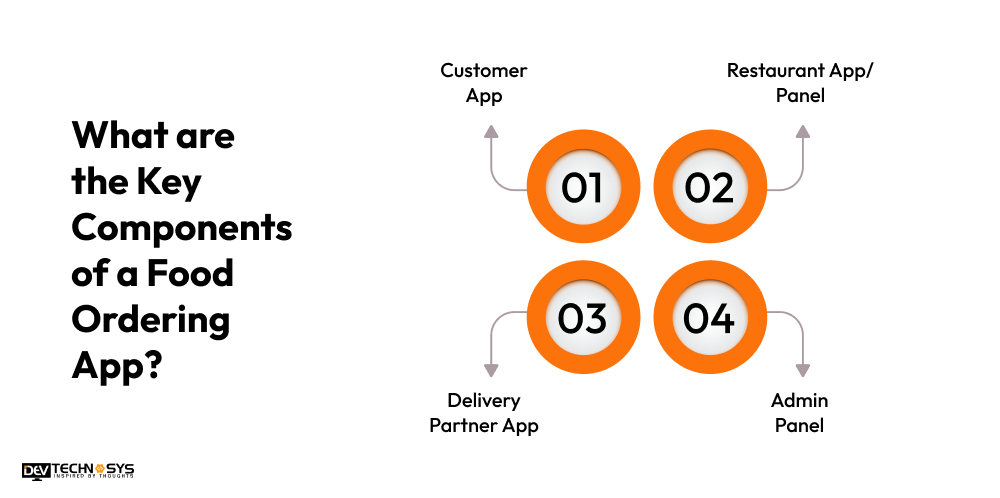
- Customer App: Allows users to register, search for restaurants by geolocation, filter by cuisine, view menus, pay, and track orders in real time.
- Restaurant App/Panel: Enables restaurants to manage menu items, pricing, operating hours, and receive orders.
- Delivery Partner App: Helps drivers receive order notifications, track pickup/delivery locations, and access navigation.
- Admin Panel: Quick commerce (Q-commerce) apps contain a central dashboard for managing users, payments, restaurants, and analyzing operational data.
Swiggy-Like App Architecture (3-App + Backend System Design)
A Swiggy alternative app works on a 3-app system connected through a powerful backend. Each app has a specific role, and the backend coordinates everything in real time.
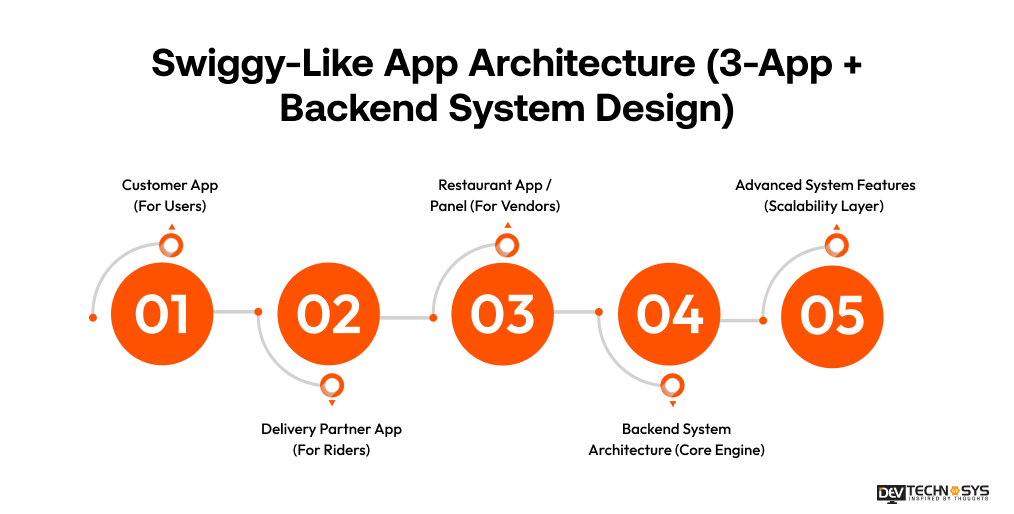
1. Customer App (For Users)
The customer app is used by users to order food online. The app shows the nearby open restaurants with their menus (dishes with images). It also allows users to add food to the cart and place orders. Besides handling online payments, it also tracks orders in real-time on a map. Basically, it serves as the ordering interface for customers.
2. Delivery Partner App (For Riders)
This is used by delivery agents in delivering food by showing new delivery requests. They show new delivery requests, allowing for accepting or rejecting orders. They help providers navigate using GPS. It updates the delivery status ( pickup, on the way, or delivered). They are the ones who manage delivery execution in real time.
3. Restaurant App / Panel (For Vendors)
This is used by restaurants to manage orders. It receives new orders from customers. Accepts or rejects orders, updates food preparation status, and manages menu, prices, and availability. Mainly, these platforms connect kitchen operations with the platform.
4. Backend System Architecture (Core Engine)
The backend of the food delivery startup app is the brain of the system, which controls everything behind the scenes. It is typically built using a microservices architecture:
What it does:
- API Gateway → Manages all app requests
- Order Management Service → Handles order lifecycle
- Dispatch Engine → Assigns delivery partners using AI + distance + traffic logic
- Payment Gateway Integration → Secure transactions
- Location Tracking Service → Real-time GPS updates
- Notification Service → SMS, push, email alerts
5. Advanced System Features (Scalability Layer)
- Microservices Architecture for independent scaling
- Load Balancers to handle peak traffic
- Caching (Redis) for faster restaurant/menu loading
- Event Streaming (Kafka) for real-time order updates
- Cloud Infrastructure (AWS/GCP) for global scalability
What are the Essential Steps to Build an App Like Swiggy?
Are you a business wondering how to build an app like Swiggy but don’t know where or how to begin? Don’t worry, we’ve got you covered. In this section, we will discuss food delivery app development step by step, covering every crucial factor. From market research to launch and promotion, every step of swiggy clone app development is discussed here.
1. Define Your Business Model
Start creating your on demand app development solutions by choosing the right business model: an aggregator, a single restaurant, or a cloud kitchen. Decide how your app will generate revenue through commissions, delivery fees, subscriptions, or advertisements.
A clear model helps you decide on scalable app architecture, features, operations, and long-term growth strategies effectively from the beginning. Swiggy business model explained:
Revenue Sources:
- Restaurant commissions (15–30%)
- Delivery charges
- Subscriptions (Swiggy One)
- Ads & promotions
Key Services:
- Food delivery
- Swiggy Instamart
- Swiggy Genie
2. Conduct Market Research
According to experts who provide Hybrid app development services, it is important to analyze your competitors, target audience behavior, and current food delivery trends. It is crucial to know the key differences, strengths, and points requiring improvement to stand out.
Research helps your app meet the expectations of your customers, align with your pricing strategies, and fulfill feature requirements, ensuring your app delivers a unique value proposition in a highly competitive market.
3. Plan Features & Functionality
To build a delivery service app, you need to define essential features for users, restaurants, delivery partners, and admins. Include functionalities like search filters, a real-time order tracking system, secure payments, order management, and notifications. A well-planned feature list is important to create an app like Swiggy. It ensures smooth app performance, enhances user experience, and supports scalability as your platform grows.
4. Design UI/UX
Create intuitive and visually appealing designs through wireframes and prototypes. Focus on simplicity, easy navigation, and fast ordering processes. A custom UI/UX design for food apps using Figma, Adobe XD, and A/B Testing improves user engagement, reduces drop-offs, and ensures customers can browse, order, and track deliveries effortlessly across different devices and platforms.

Industry Insights:
According to Grand View Research, the focus is on intuitive and engaging design to improve retention. Increasing smartphone penetration is a key growth driver, making seamless mobile experiences critical as more users rely on apps for daily food ordering.
5. Choose the Right Tech Stack
Experts who provide food delivery app development services will select technologies based on scalability, performance, and budget. Use frameworks such as Progressive Web Apps (PWAs), Microservice Architecture, React Native, or Flutter for the frontend.
Choose Node.js or Django, Spring Boot, RESTful APIs, and GraphQL for the backend. Choose reliable databases and cloud services to ensure high availability, fast performance, and seamless integration with third-party services like payments and maps.
Category |
Tech Options |
| Frontend | Flutter, React Native |
| Backend | Node.js, Django |
| Database | MongoDB, PostgreSQL |
| Cloud | AWS, Google Cloud |
| Payments | Stripe, Razorpay |
| Maps | Google Maps API |
| Real-Time | Firebase, WebSockets |
| Security | OAuth, JWT, SSL |
| Admin Panel | React.js, Angular |
6. Develop the App
Begin cloud-based app development services by building separate modules for customers, restaurants, delivery partners, and administrators. Follow agile methodology to release features in iterations and gather feedback.
Ensure clean coding practices, an AI-based recommendation engine, proper integration with testing, and a robust backend architecture to support real-time operations and high user traffic.
7. Integrate APIs & Third-Party Services
Build a food ordering app by integrating essential services like payment gateways, GPS tracking integration, push notifications, and SMS email systems. These integrations enhance functionality, enable real-time communication, and improve user convenience.
Proper API integration for food delivery apps ensures seamless interactions between app components and external services, making the platform efficient and reliable.
8. Testing & Quality Assurance
Conduct thorough testing to identify bugs, performance issues, and security vulnerabilities. Perform functional, usability, and load testing to ensure smooth operation under different conditions.
Adding security features is also crucial, such as OAuth 2.0, JWT Authentication, SSL/TLS Encryption, and PCI DSS Compliance. Quality assurance ensures your app delivers a stable, secure, and high-performing experience before launching to real users.
9. Launch the App
After testing, your food donation app development services providers will deploy your app to platforms like the Google Play Store and the Apple App Store. Optimize app descriptions, visuals, and keywords for better visibility.
Ensure compliance with platform guidelines and conduct final checks to provide users with a smooth installation and onboarding experience from day one. The time required to build a food delivery app (the entire process, from concept to promotion) may take 6 to 9 months.
10. Promote and Maintain
Promote your app through digital marketing strategies, including social media campaigns, referral programs, and discounts. Focus on user acquisition and retention through personalized offers and loyalty programs. Continuously improve the app by adding advanced features, optimizing performance, and expanding services to scale your business successfully.
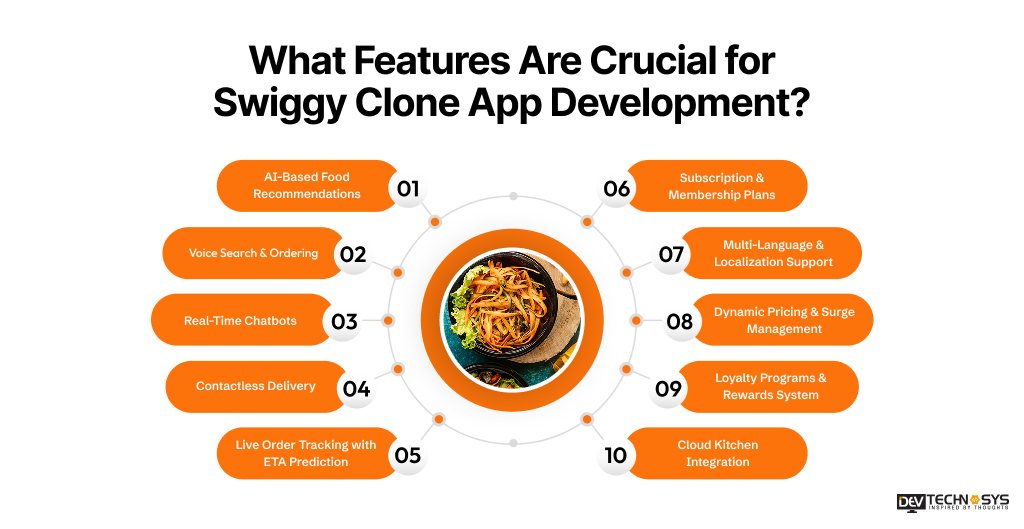
What Features Are Crucial for Swiggy Clone App Development?
Features play a key role in delivering a seamless experience. Building a successful app like Swiggy requires integrating essential features that ensure a smooth ordering, delivery, and management experience. Here are some key food delivery app features you need to include in an app like Swiggy.
Customer App |
Restaurant App |
Delivery Partner App |
Admin Panel |
| User Registration & Profile | Menu Management | Order Management | System Dashboard |
| Search & Filters | Order Management | GPS Navigation | Order Monitoring |
| Real-Time Order Tracking | Dashboard & Analytics | Earnings Tracking | User Management |
| Secure Payment Gateway | Inventory Management | Availability Toggle | Vendor Management |
| Ratings & Reviews | Offer & Discount Setup | Route Optimization | Commission Management |
| In-App Chat/Push Notification Integration | Order History | Delivery Status Updates | Revenue Reports |
| Order History | Profile Management | In-App Communication | Analytics & Insights |
1. AI-Based Food Recommendations
For swiggy app development, developers need to leverage machine learning algorithms to analyze user behavior, preferences, and past orders to suggest personalized dishes. It improves user engagement and satisfaction, and increases order frequency effectively.
Industry Insights:
According to Market.us, the AI-driven meal planning apps are projected to grow from USD 972.1 million in 2024 to USD 11.5 billion by 2034, with a CAGR of 28.10%.
2. Voice Search & Ordering
When you build an app like DoorDash, voice search features become crucial to incorporate. Voice search food ordering feature lets users search restaurants and place orders using voice commands, offering a hands-free, faster, and more accessible experience, especially beneficial for multitasking or visually impaired users.
3. Real-Time Chatbots
On-demand food delivery app development requires AI-powered chatbots. It provides instant assistance, handles customer queries, resolves complaints, and guides users throughout the ordering process, reducing dependency on human support and improving response time.
4. Contactless Delivery
Allows users to opt for safe delivery where orders are dropped at the doorstep, minimizing physical interaction and ensuring hygiene, which became essential after global health awareness trends.
5. Live Order Tracking with ETA Prediction
Combines GPS tracking with AI-based route optimization to provide accurate real-time location updates and estimated delivery times, enhancing transparency and improving overall customer experience.
6. Subscription & Membership Plans
Food delivery app like Seamless offer premium memberships with benefits like free delivery, priority service, and exclusive discounts, helping increase customer retention, recurring revenue, and long-term user engagement.
7. Multi-Language & Localization Support
Supports multiple languages and regional preferences, enabling businesses to reach a wider audience, improve accessibility, and provide a more personalized and culturally relevant user experience.
8. Dynamic Pricing & Surge Management
Automatically adjusts delivery fees based on demand, traffic, weather, and peak hours, helping businesses optimize revenue while maintaining efficient delivery operations and restaurant listing and menu management during high-demand periods.
9. Loyalty Programs & Rewards System
Delivery service app incorporates coupon and discount management features, reward points, cashback, and gamified incentives to encourage repeat purchases, boost user engagement, and build long-term customer loyalty through personalized offers and benefits.
10. Cloud Kitchen Integration
Enables seamless integration with virtual kitchens, allowing businesses to expand delivery operations without physical outlets, reduce operational costs, and increase menu variety and service coverage efficiently.
Industry Insights:
Based on a report by iMARC Group, Swiggy reported over 1.6 crore (16 million) Monthly Transacting Users (MTU) as of June 2024, demonstrating consistent demand for rapid delivery services.
Unit Economics of Food Delivery Apps (Swiggy vs Zomato Model)
Unit economics compares the amount of money made by an order to the amount of money it costs to run. Food delivery apps like Swiggy and Zomato need to have positive unit economics in order to keep growing and making money over the long run.
Zomato focuses on operational efficiency and a variety of income streams, such as advertising and memberships, while Swiggy focuses on logistics excellence and faster deliveries through a strong delivery infrastructure.
To improve their unit economics and make sure they can keep making money, both platforms are always looking for ways to cut down on transport costs, keep customers, and raise order values.
Metric |
Swiggy Model |
Zomato Model |
| Business Approach | Logistics-heavy, delivery-focused | Technology-driven, asset-light |
| Primary Revenue Sources | Restaurant commissions, delivery fees, subscriptions, and ads | Restaurant commissions, delivery fees, ads, memberships |
| Delivery Operations | Extensive in-house delivery network | Optimized delivery network with a focus on efficiency |
| Customer Acquisition Strategy | Discounts, offers, loyalty programs | Promotions, memberships, targeted marketing |
| Average Order Value (AOV) | Higher due to quick commerce and add-ons | Strong focus on food delivery orders |
| Major Cost Component | Delivery partner payouts and logistics | Customer acquisition and operational expenses |
| Advertising Revenue | Growing revenue stream | Significant contributor to profitability |
| Technology Utilization | Route optimization, AI dispatching | Demand forecasting, AI-driven optimization |
| Profitability Focus | Delivery efficiency and customer experience | Operational efficiency and revenue diversification |
| Key Challenge | High fulfillment and logistics costs | Maintaining growth while controlling acquisition costs |
Planning a Food Delivery Project?
Get a tailored development cost estimate in a few simple steps.
- 3 quick steps
- 100% free
- Reply in 1 business day
2 Minutes Read
Why Businesses Should Invest in an App like Swiggy?
Investing in an app like Swiggy helps businesses tap into the fast-growing food delivery market and reach customers more easily. It also creates new revenue opportunities while improving convenience, brand visibility, and customer loyalty.
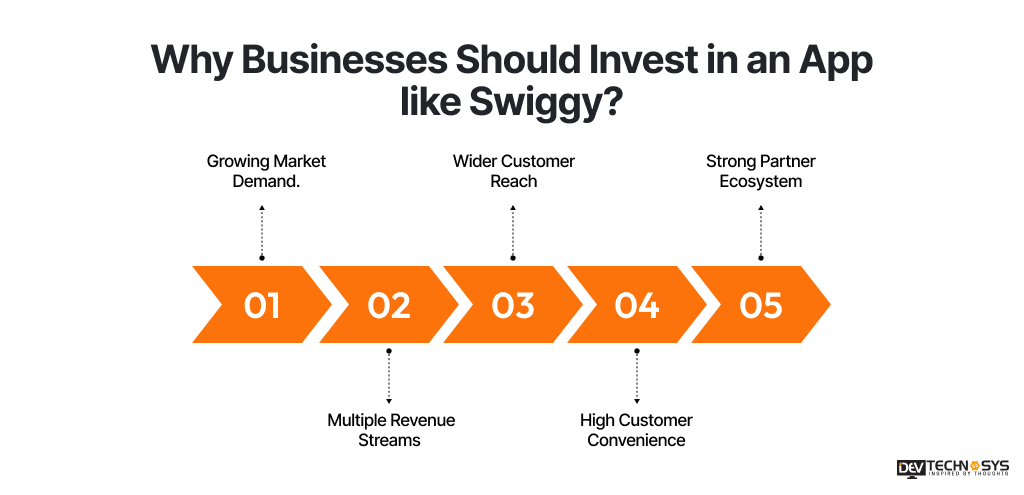
- Growing Market Demand: The online food delivery industry continues to expand globally, driven by changing lifestyles, convenience, and increasing smartphone usage, creating huge business opportunities.
- Multiple Revenue Streams: Businesses can earn through commissions, delivery fees, subscriptions, surge pricing, and in-app advertising, ensuring consistent and scalable income sources.
- Wider Customer Reach: A mobile app helps businesses reach a larger audience beyond physical locations, attracting more customers and increasing brand visibility.
- High Customer Convenience: Users enjoy seamless ordering, real-time tracking, and multiple payment options, which improve satisfaction and encourage repeat usage.
- Strong Partner Ecosystem: Collaborating with restaurants and delivery partners creates a scalable ecosystem that benefits all stakeholders and strengthens business growth.
What are the Top 10 Popular Swiggy App Alternatives to Consider in 2026?
Indeed, Swiggy is one of the leading food delivery apps, but it’s not the only one. Several other amazing food delivery apps to explore. All the alternatives mentioned in the list below provide reliable, fast, and convenient services worldwide, enhancing user experience.
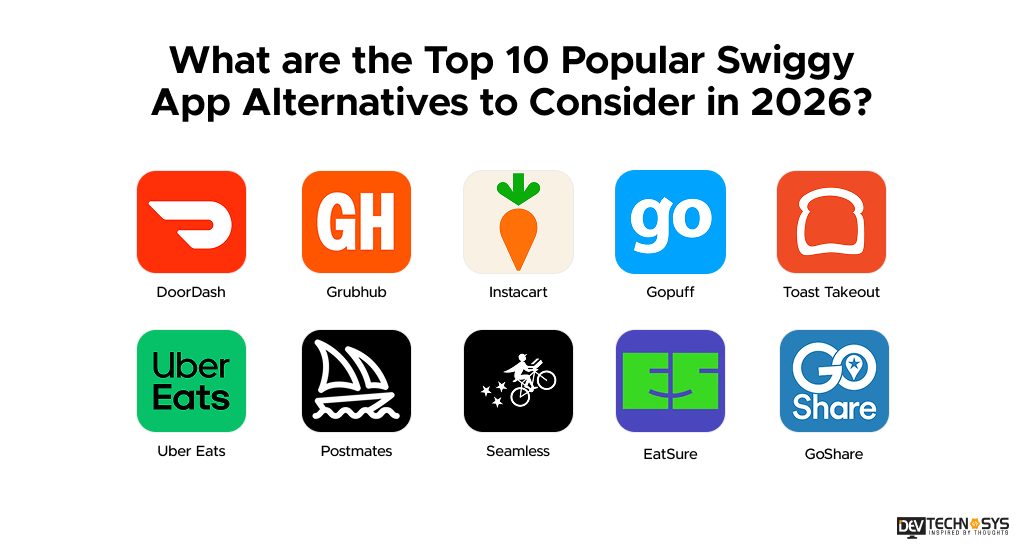
App Name |
Launch Year |
Ratings (Approx.) |
Platform Availability |
| DoorDash | 2013 | 4.6 | Android, iOS, Web |
| Uber Eats | 2014 | 4.5 | Android, iOS, Web |
| Grubhub | 2004 | 4.3 | Android, iOS, Web |
| Postmates | 2011 | 4.2 | Android, iOS |
| Instacart | 2012 | 4.5 | Android, iOS, Web |
| Seamless | 1999 | 4.4 | Android, iOS, Web |
| Gopuff | 2013 | 4.4 | Android, iOS |
| Toast Takeout | 2017 | 4.6 | Android, iOS |
| EatSure | 2020 | 4.3 | Android, iOS |
| GoShare | 2014 | 4.2 | Android, iOS, Web |
1. DoorDash ( $30K to $100K)
DoorDash is a food delivery platform that provides logistics and a wide network of restaurant partners. To develop a DoorDash-like app, hire top grocery delivery app development experts who focus on real-time tracking, subscription models like DashPass, and AI-based dispatch. Some of the key features include scheduled delivery, multiple payments, in-app chat, and an advanced admin dashboard for seamless operations.
2. Uber Eats ( $50K to $120K)
Uber Eats delivers food efficiently thanks to Uber’s logistics network. Uber Eats offers live-order tracking, robust API’s, and dynamic pricing, and location tracking through GPS, enhancing the food ordering and delivery experience.
Choose a top food delivery app development company to add features like Live order tracking, multi-payment gateways, personalized recommendations, and seamless UI/UX to improve customer and driver experience.
3. Grubhub ( $30K to $105K)
Grubhub connects users with local restaurants offering easy pickup and delivery. The hyperlocal delivery apps like this focus on restaurant aggregation, smooth payment systems, loyalty programs, and more.
To develop a food pickup and delivery app, you need an order scheduling feature, discounts, a robust backend, and ratings and reviews system to manage orders and customer data.
4. Postmates ($50K to $130K)
Postmates provides on-demand delivery for food, groceries, and essentials. To develop an app like Postmates, include multi-category delivery, route optimization, and real-time tracking.
Key features include flexible delivery options, instant notifications, secure payments, and an intuitive interface that ensures convenience for both users and delivery partners.
5. Instacart ($55K to $140K)
Instacart specializes in grocery delivery, partnering with major retailers. To develop an app like Instacart, implement inventory management, real-time order updates, and AI-based suggestions.
On-demand food delivery app development features include scheduled delivery, product search filters, a drone food delivery system, multiple payment options, and a user-friendly interface for smooth shopping experiences.
You can reach out anytime; we are available 24/7. Our team provides a quick response.

Legal and Compliance Requirements
When developing an app like Swiggy, businesses must consider various operational, legal, and security standards to ensure smooth operations and eliminate regulatory penalties. Here are the major legal and compliance requirements to consider.
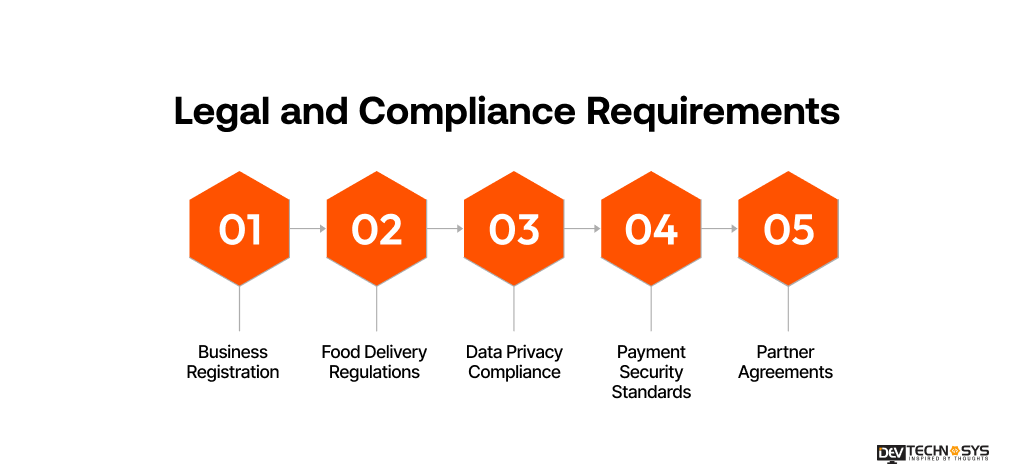
1. Business Registration
Businesses should register their company and obtain the much-needed licenses, tax registrations, and permits to operate legally. Legal registrations form legal legitimacy, enable partnerships with restaurants and payment providers, and prevent operational disruptions because of non-compliance.
2. Food Delivery Regulations
The platform should guarantee partner restaurants comply with food safety, hygiene, packaging, and local food service requirements. It reduces the danger of food safety and protects customers as well as the platform’s reputation and quality of service.
3. Data Privacy Compliance
Apps like GDPR, CCPA, and local data protection legislation, when they gather, store, and process user data. This particular step protects customer information, minimizes the likelihood of data breaches, and increases user trust in the platform.
4. Payment Security Standards
Secure payment systems must follow standards such as PCI-DSS and include encryption, fraud detection, and secure authentication mechanisms. Prevents payment fraud, safeguards financial transactions, and improves customer trust during checkout.
5. Partner Agreements
Clear agreements should define commission structures, service expectations, liability terms, and dispute resolution processes with restaurants and delivery partners. It creates operational transparency, minimizes conflicts, and ensures smooth collaboration across the delivery ecosystem.
Case Study
Wanna Eat is a food delivery and restaurant discovery platform developed for a UAE-based client by a team of 12 professionals over 24 weeks. The project leveraged React Native, Node.js, MongoDB, MySQL, Firebase, AWS, Google Maps API, and OpenAI APIs to deliver AI-powered meal recommendations, real-time order tracking, and secure payments. Key challenges included route optimization, dynamic menu synchronization, payment security, and backend scalability during peak traffic periods.
What is the Cost to Build an App Like Swiggy?
On average, the cost to develop a mobile app like Swiggy ranges from $30,000 to $1,50,000, depending on features, platform, UI/UX, tech stack, and the location of the developer team.
The cost of developing a basic MVP for a food delivery app will be around $30,000 to $80000. The cost to build an app like Swiggy with mid-level complexity can lie between $60,000 to $100,000. Here’s the table highlighting the cost to build a food delivery app like Swiggy based on app type.
App Complexity |
Development Timeline |
Estimated Cost (USD) |
| Basic App | 3–5 Months | $30,000 – $60,000 |
| Mid-Level App | 5–8 Months | $60,000 – $100,000 |
| Advanced App | 8–12 Months | $100,000 – $150,000+ |
However, if you plan to build an app like Swiggy, you would need advanced features and functionalities, such as GPS integration, digital wallet integration, artificial intelligence (AI), machine learning (ML), and chatbots & virtual assistants. The cost to develop a food delivery app like swiggy with advanced features and functionalities may exceed $1,50,000+.
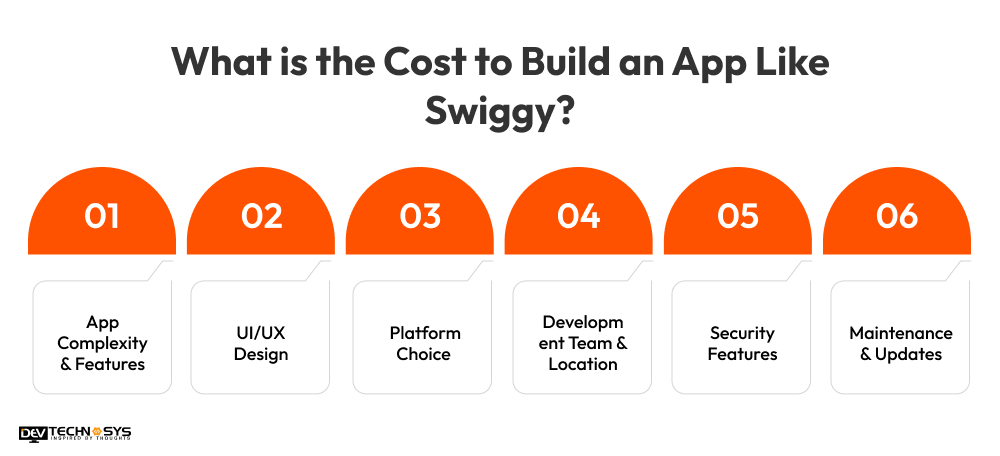
1. App Complexity & Features
The more advanced features you include, such as real-time tracking, AI-based recommendations, and multiple dashboards, the higher the food delivery app development cost. A basic MVP requires fewer resources, while a feature-rich application demands more time, expertise, and cost. Here’s the table highlighting the Swiggy app development cost in India.
2. UI/UX Design
Creating a custom, user-friendly, and visually appealing interface requires skilled designers and additional time. High-quality UI/UX enhances user engagement and retention but increases overall Swiggy-like app development cost through detailed design processes, prototyping, and continuous improvement.
3. Platform Choice
Choosing between the Android and iOS platforms significantly impacts the cost. Native development is generally more expensive, while cross-platform frameworks like Flutter or React Native help reduce cost to develop a food delivery app like swiggy by enabling a single codebase for multiple platforms.
4. Development Team & Location
The Swiggy app development cost depends on the team’s location and expertise. Hiring developers in North America or Europe is more expensive compared to India or Southeast Asia, while experienced teams may charge higher but deliver better quality and faster results.
5. Security Features
Implementing strong security measures like secure authentication, data encryption, and PCI-DSS compliance increases development costs. However, these features are essential for protecting user data, preventing cyber threats, and building trust among users on your platform.
6. Maintenance & Updates
Post-launch maintenance includes bug fixes, performance optimization, feature updates, and server management. These ongoing efforts require ongoing investment to ensure smooth functionality, security, and scalability as your app grows and user demands evolve.
Factor |
Estimated Cost (USD) |
Estimated Timeline |
| App Complexity & Features | $20,000 – $60,000 | 2–6 Months |
| UI/UX Design | $3,000 – $10,000 | 3–5 Weeks |
| Platform Choice | $5,000 – $25,000 | 1–3 Months |
| Development Team & Location | $5,000 – $30,000 | Throughout Project |
| Security Features | $2,000 – $15,000 | 2–6 Weeks |
| Maintenance & Updates (Annual) | $5,000 – $20,000 | Ongoing |
How to Monetize Your Food Delivery App Like Swiggy?
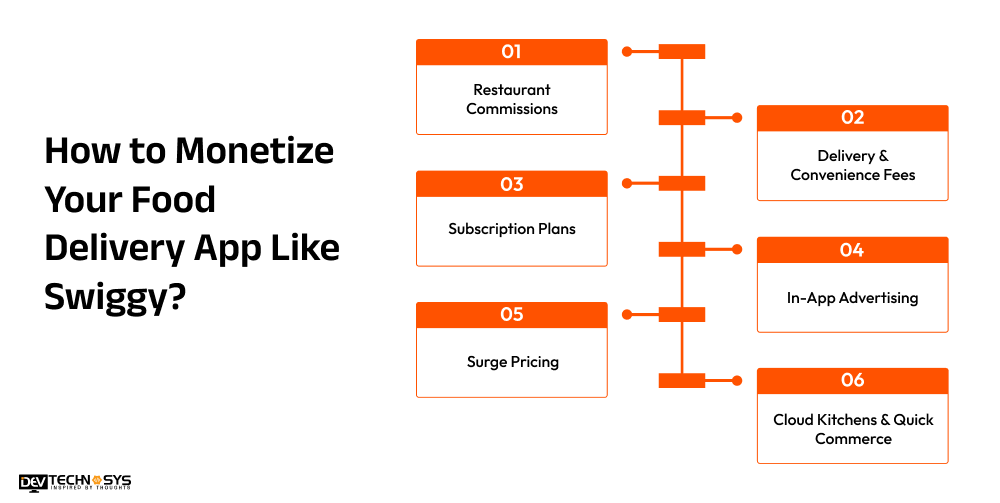
Monetizing a food delivery app like Swiggy involves multiple revenue streams that ensure steady growth and profitability. From commissions to subscriptions and ads, the right strategies can maximize earnings while delivering value to users and partners.
1. Restaurant Commissions
Platforms charge restaurants a commission on every order processed through the app, making it one of the largest revenue sources. Commission rates typically range from 15% to 30% per order, depending on services and market conditions.
2. Delivery & Convenience Fees
Customers pay delivery, platform, or convenience fees based on distance, demand, and order value. These fees help offset logistics costs and improve unit economics, especially in densely populated delivery zones. Dynamic pricing helps platforms improve margins during peak demand periods.
3. Subscription Plans
Premium plans such as Swiggy One encourage repeat purchases through free deliveries, exclusive discounts, and loyalty benefits. Subscription revenue improves customer retention and increases average order frequency.
4. In-App Advertising
Restaurants pay for sponsored listings, featured placements, and promotional campaigns to improve visibility. Advertising generates high-margin revenue because it requires minimal operational costs compared to delivery services.
5. Surge Pricing
Platforms implement dynamic pricing during periods of high demand, including weekends, festivals, lunch hours, and adverse weather conditions. Surge pricing helps balance supply and demand while maintaining delivery partner availability.
6. Cloud Kitchens & Quick Commerce
Many food delivery companies generate revenue by partnering with or operating cloud kitchens that exclusively serve online orders. This model provides higher margins by eliminating dine-in infrastructure costs while expanding restaurant options.
You can reach out anytime; we are available 24/7. Our team provides a quick response.
Conclusion
Building an app like Swiggy in 2026 is a promising business opportunity driven by the growing demand for convenience and on-demand services. By focusing on the right features, scalable technology, and user experience, businesses can build a competitive, profitable platform.
With continuous innovation and customer-centric improvements, your food delivery app can stand out in a rapidly evolving digital market. If you are a business looking forward to launching a successful app like Swiggy, then contact Dev Technosys, a leading mobile app development company in USA. Stay tuned with us for more details.
Frequently Asked Questions
Find answers to the most common questions related to this article.
The cost to build an app like Swiggy ranges from $30,000 to $1,50,000. The final cost depends on features, complexity, platform selection, and development team location. The MVP development cost for a simple version may not be much, but advanced apps that require higher investment in scalability and performance demand more.
The food delivery app development requires 3 to 6 months of time for a basic or mid-level version. However, swiggy app development timeline with complex features, integrations, and customizations may take 6 to 9 months or longer.
Popular technologies include Flutter or React Native for frontend development, Node.js or Django for backend, and cloud platforms like AWS or Google Cloud for hosting. These technologies ensure scalability, performance, and seamless user experience across devices.
Yes, starting with an MVP is a smart approach. It allows you to launch quickly with essential features, validate your business idea, gather real user feedback, and make improvements before investing in advanced functionalities.
Food delivery apps generate revenue through commissions from restaurants, delivery charges, subscription plans, in-app advertisements, and surge pricing. These multiple revenue streams help ensure consistent earnings and long-term business sustainability.
Yes, investing in a food delivery app is highly profitable due to increasing demand for convenience and online services. With the right business model, features, and marketing strategies, businesses can achieve strong growth and long-term success.