



















Key Takeaways
- To build a Lyft clone, you need distinct panels for drivers, passengers, and administrators that include functionalities such as location tracking, ride requests, driver matching, payment, reviews, safety utilities, and alerts.
- The worldwide market for ride-hailing services is valued at $55.1 billion in 2026 and can reach $181.5 billion in 2033, with a compound growth rate of 18.6%.
- The process of building an app similar to Lyft can cost from $30,000 to $60,000 if it’s a minimum viable product, while the more sophisticated version will cost between $80,000 and $150,000.
- Technologies such as Flutter, React Native, Node.js, cloud technologies, GPS APIs, WebSockets, and AI make it possible to create a scalable and effective ride-hailing service.
- Launching in a niche market with basic functionalities helps startups test the market, assemble the fleet of drivers, listen to users’ suggestions, and expand progressively.
The increased demand for comfortable on-demand transport continues to generate new opportunities for businesses that want to enter the ride-sharing market. However, to build an app like Lyft requires far more than merely having an app for booking rides. A successful solution needs to be complemented with a number of essential components like real-time matching of riders with drivers, GPS and navigation, secure payment processing, notifications, safety features, customer support, and an operational dashboard.
Generally speaking, most ride-sharing platforms will require three different interfaces for their clients (passengers), drivers, and administrators. The complexity lies in ensuring smooth operation by managing real-time data, fleet availability, pricing, and access to services. This guide explains how a Lyft-like app works, its essential features, technology stack, development process, estimated costs, major challenges, and practical strategies for launching a successful ride-hailing platform.
How Does an App Like Lyft Work?
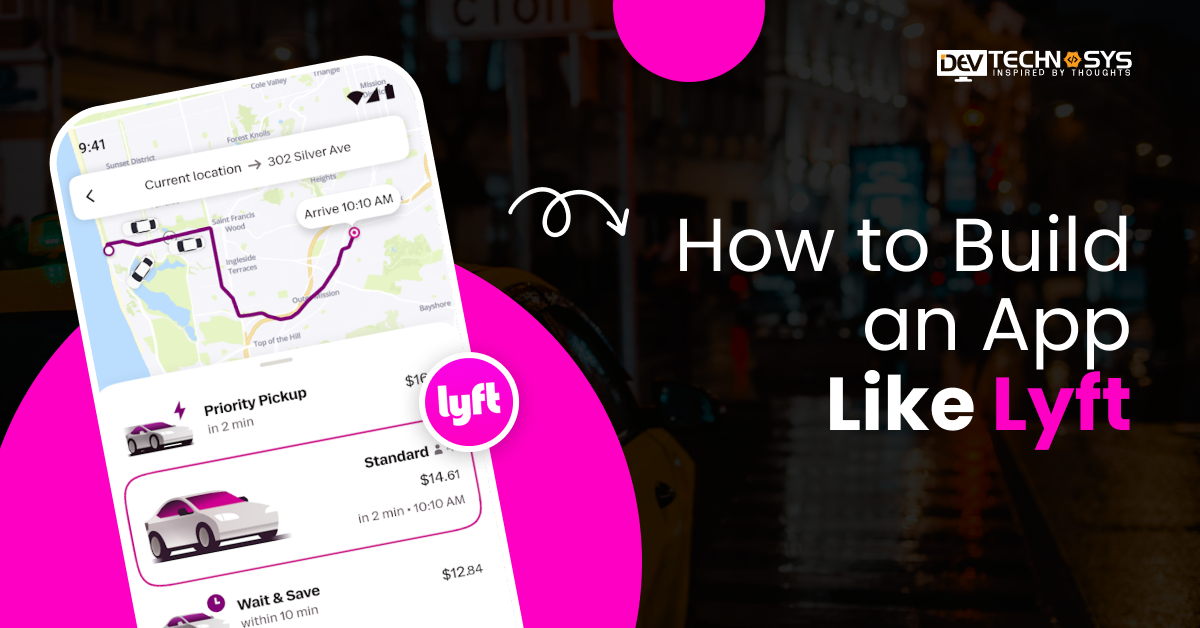
All ride-hailing apps connect passengers with the help of Lyft app tech stack by linking them with the cars available to them in their locality. In the first step, the customer needs to sign up on the app to have an account. Once the customer provides the pick-up location, chooses a destination, and specifies the type of ride, the app notifies the customer about the cost and provides options for available cars that can be hired in that location.
Once the car and driver accept the request, they can both see on-screen details of the trip. At the end of the ride, both the driver and passenger can leave their rating on the app.
Rider App → Ride Request → Matching Engine → Driver App → Trip → Payment → Rating
Business Model Behind an App Like Lyft
If you are wondering how to build an app like Lyft, then you should also understand its earning potential. Lyft acts as a marketplace that connects customers in need of transport with drivers. The ride-sharing app development company is compensated for its services by handling business transactions and the technology and operational processes involved in each trip.
Riders
Riders use a special app to find transport, request rides, track the driver, pay for the service, and send reviews. The rider experience relies heavily on service availability, price transparency, security, and comfort.
Drivers
Drivers utilize a separate app to maintain service availability, receive ride requests, drive to the assigned location, finish a ride, and control earnings. In order to maintain a sound supply chain of rides, efficient recruiting and retention of drivers is crucial.
Platform owner
The platform owner supervises the software, payments, customer support, pricing policy, safety processes, market analysis, and overall operations of the service.
The greatest problem is to maintain a balance between the demand for rides and the supply of drivers. The demand from customers might be high, but poor driver availability would lead to a bad experience. Otherwise, having too many drivers working can lead to low earnings and a poor retention rate.
Expert Insight
“One of the biggest mistakes startups make is copying Lyft feature for feature. The real opportunity is solving a specific mobility problem—corporate transport, airport rides, EV rides, or regional niches. A focused model is easier to validate and scale than a broad platform.”
Ride-Hailing App Market Statistics in 2026
The ride-hailing market presents enormous opportunities for newcomers to the field due to the growing popularity of on-demand app development company among clients who are fond of cashless payment options and the ability to track their rides in real time.
Market Statistic |
Key Insight |
Source |
| Global ride-hailing services market | Estimated at $55.1 billion in 2026 | Grand View Research |
| Market growth forecast | Expected to reach $181.5 billion by 2033, growing at a CAGR of 18.6% | Grand View Research Market Report |
| North American market share | North America accounted for approximately 35% of global revenue in 2025 | Grand View Research |
| U.S. ride-hailing market | Estimated at $15.9 billion in 2026 and projected to grow at a 17.9% CAGR through 2033 | Grand View Research U.S. Outlook |
| Global ride-hailing market | Estimated to reach $315.49 billion in 2026 under Fortune Business Insights’ broader market definition | Fortune Business Insights |
| Lyft platform activity | Lyft reported 945.5 million rides in 2025, up 14% year over year | Lyft 2025 Annual Report |
The figures show that ride-hailing is still one of the biggest and fastest-growing niches of digital mobility business. Different research organizations define ride-hailing, ride-sharing, and mobility services differently, which is the reason behind the discrepancies in estimates of the market size.
How to Build an App Like Lyft: Step-by-Step Development Process
Businesses researching how to build a Lyft clone app from scratch should follow a structured and efficiently organized development approach. From determining the business model and choosing the appropriate technology stack to creating user-friendly interfaces and incorporating real-time functionalities, each stage is important in ensuring the success of the platform itself.
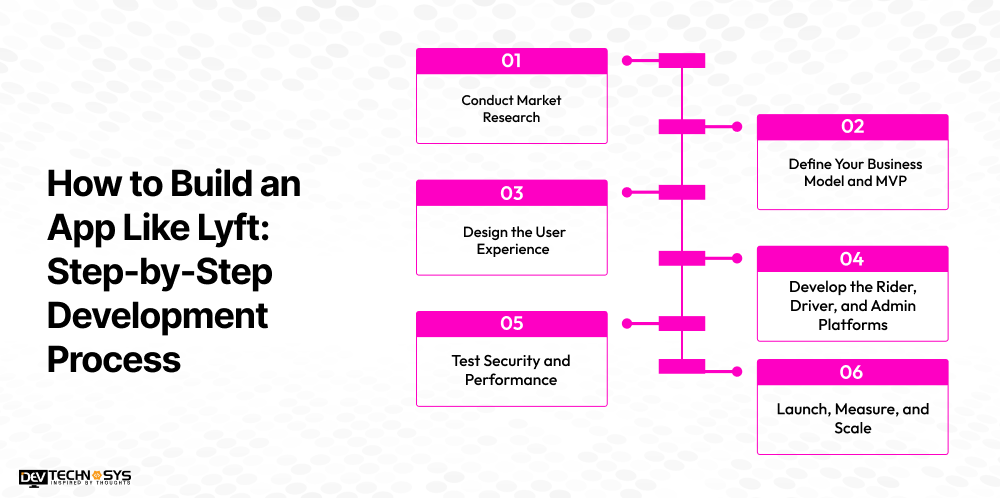
Step 1: Conduct Market Research
The first step in how to build a Lyft app involves determining the target market, possible customers, rivals, transport deficits, and local regulations. Instead of duplicating an existing platform, one should establish the precise problem it plans to solve. One should examine the availability of drivers, expectations of consumers, price sensitivity, and demand trends before creating the business plan.
Step 2: Define Your Business Model and MVP
The next step consists of establishing whether the platform will deal with standard transportation services, providing luxury rides, transfers from the airport, corporate transportation, car-sharing services, or something else. After that, define the minimum product. Define the very basic features needed by the app: registration, ordering a ride, GPS tracking, assigning a driver, payment, notifications, and rating.
Step 3: Design the User Experience
It is time to hire dedicated developers and create separate user journeys for passengers, drivers, administrators, and help desks while planning how to build an app similar to Lyft. The design must simplify the process of booking and accepting a ride. It should focus on easy navigation, clear information on the journey, transparent pricing, available security options, and a uniform experience on all devices.
Step 4: Develop the Rider, Driver, and Admin Platforms
Code the mobile applications, backend infrastructure, APIs, database, and admin dashboard. API integration for mapping, payments, notification systems, and real-time communication services. A modular architecture can assist in further improvements as the business moves to new areas and new functionalities are added.
Step 5: Test Security and Performance
Test the platform on multiple devices, operating systems, network environments, and challenging cases to ensure proper operation of the ride-hailing system. Check how GPS normalization works and test payments, notifications, user authentication, and information protection. Security and functionality testing is crucial since ride-hailing platforms deal with personal, location, and financial information.
Step 6: Launch, Measure, and Scale
Launch MVP in a specific geographic location instead of making a nationwide launch right away. Monitor how many rides were completed, the acceptance rate of drivers, the cancellation rate, and collect data from customers. Use the information to improve the platform before adding new features, going to other locations, and obtaining advanced AI capabilities.
Delivery Insight
“From a delivery view, define the MVP first. Adding too many features increases cost and delays launch. Start with core rider, driver, and admin features to launch faster, gather feedback, and iterate based on real needs.”
By Delivery Head, Naveen Rajpoot, Dev Technosys
Essential Features Required to Build an App Like Lyft
The key features to build Lyft app should be divided across various panels, including rider, driver, and admin panels. Startups should launch their app with the basic MVP features and then gradually start integrating the advanced features as the business grows.
Panel |
Core Features |
Advanced Features |
| Rider App | Registration, profile management, GPS location, ride booking, fare estimates, ride history, payments, ratings | Ride scheduling, multiple destinations, ride sharing, AI recommendations, voice assistance, emergency support |
| Driver App | Registration, profile, document upload, ride requests, navigation, availability status, earnings dashboard | Smart route suggestions, demand heat maps, predictive earnings, AI assistance, safety alerts |
| Admin Panel | User management, driver management, trip monitoring, payments, pricing controls, reports | AI analytics, demand forecasting, fraud detection, automated dispute management, business intelligence |
| Customer Support | Help center, ticket management, trip issue reporting | AI chatbot, automated query routing, sentiment analysis |
| Safety System | Profile verification, trip information, emergency assistance | Real-time risk monitoring, unusual route detection, automated safety alerts |
Technology Stack Required to Build an App Like Lyft
To build an app like Uber, a good Lyft technology stack is required for mobile development, payments, geolocation, real-time communication, data management, a maps API, and cloud infrastructure.
In the table below, we have provided the tech stack to build an app like Lyft along with their purpose in the app development process:
Technology Area |
Lyft Tech Stack |
Purpose |
| Mobile Development | Flutter, React Native, Swift, Kotlin | Build rider and driver applications |
| Backend Development | Node.js, Python, Java | Manage business logic, APIs, authentication, and ride operations |
| Database | PostgreSQL, MongoDB | Store user, driver, trip, and transaction data |
| Cloud Infrastructure | AWS, Google Cloud, Microsoft Azure | Provide scalable hosting and backend services |
| Maps and GPS | Google Maps Platform and mapping APIs | Location detection, route calculation, and navigation |
| Real-Time Communication | WebSockets, Firebase | Send live ride, location, and status updates |
| Payment Integration | Stripe, Braintree, PayPal | Process digital transactions |
| Push Notifications | Firebase Cloud Messaging, APNs | Deliver ride requests and trip updates |
| Analytics | Firebase Analytics, Mixpanel | Monitor user behavior and app performance |
| AI and Machine Learning | Python, TensorFlow, cloud AI services | Support forecasting, matching, automation, and analytics |
Tech Insight
“For ride-hailing apps, early tech choices impact scalability. Real-time tracking, matching, notifications, and payments require continuous data flow. Start with a modular, scalable architecture instead of a quick build that becomes hard to upgrade later.”
By Tech Head, Pramod Jangid, Dev Technosys
How Much Does It Cost to Build an App Like Lyft?
The mobile app development cost for developing a Lyft-like application are determined by the extent of the application and the technology that the app will require. The simplest MVP may only offer some booking and tracking functions, whereas the most sophisticated app will include artificial intelligence, analytics, automation, advanced safety features, and complex operational infrastructure.
App Version |
Estimated Cost |
| Basic MVP | $30,000-$60,000 |
| Medium-Complexity App | $60,000-$90,000 |
| Advanced Ride-Hailing Platform | $90,000-$150,000+ |
The final development cost to build a Lyft app can vary based on:
- Number of platforms
- Custom UI/UX requirements
- Real-time GPS functionality
- Payment integrations
- Backend complexity
- AI capabilities
- Third-party APIs
- Security requirements
- Development team location
- Testing and maintenance requirements
The best approach for most startups is to start with an MVP, then validate the customer demand in the market, and then only invest in advanced features after the platform starts growing.
Major Factors Affecting the Cost to Build an App Like Lyft
The cost to build a Lyft clone differs based on the functionalities, technical architecture, and business requirements. The following points can make a big difference in the final cost for businesses hiring developers to build a Lyft-like app:
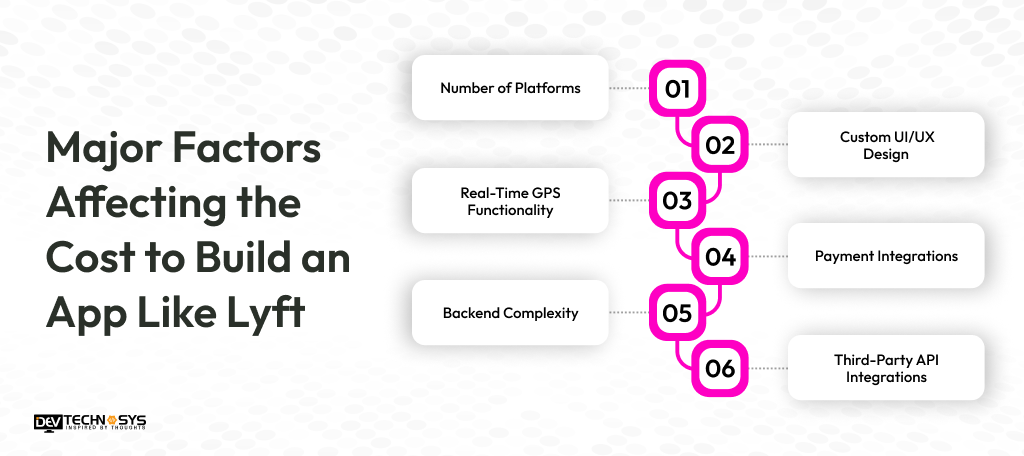
1. Number of Platforms
Creating different applications for passengers and drivers and building a web-based admin panel broadens the project scope. Having both iOS and Android apps will also influence development duration and cost.
2. Custom UI/UX Design
Making a custom interface requires a lot of research, wireframes, prototypes, and tests. More sophisticated client journeys, animations, personal dashboards, and accessibility requirements can thus lead to higher costs of design and front-end development.
3. Real-Time GPS Functionality
The functionality of the application will include the ability to track the location, calculate routes, get the ETA, and match the passenger with a driver. That will require using mapping APIs and processing real-time data.
4. Payment Integrations
The integration of many payment systems calls for safe and secure payment processing methods as well as a connection with third-party APIs. Ultimately, the price will depend on the number of payment gateways, the regions where the service can be used, the currency options to enable, and the requirements for payment security.
5. Backend Complexity
To develop an app like Grab, it involves the creation of backend solutions that have to work properly with all users and drivers as well as handle bookings, trips, payments, notifications, and other requests. The more complex the system is, the more complicated the infrastructure it requires to operate.
6. Third-Party API Integrations
The mapping, communication, authentication, payment, and analytics services require third-party APIs. The complexity of integrations and operating costs should be taken into account during the planning stage.
Security and Compliance Requirements for a Lyft-Like App
Apps that provide rideshare services manage information that is valuable, like the exact profile, location, payment details, ride history, and documents of the driver. Hence, safety and compliance must be taken into account while planning how to build a taxi booking app rather than being added after its debut. The specific conditions may differ based on different regions or countries.
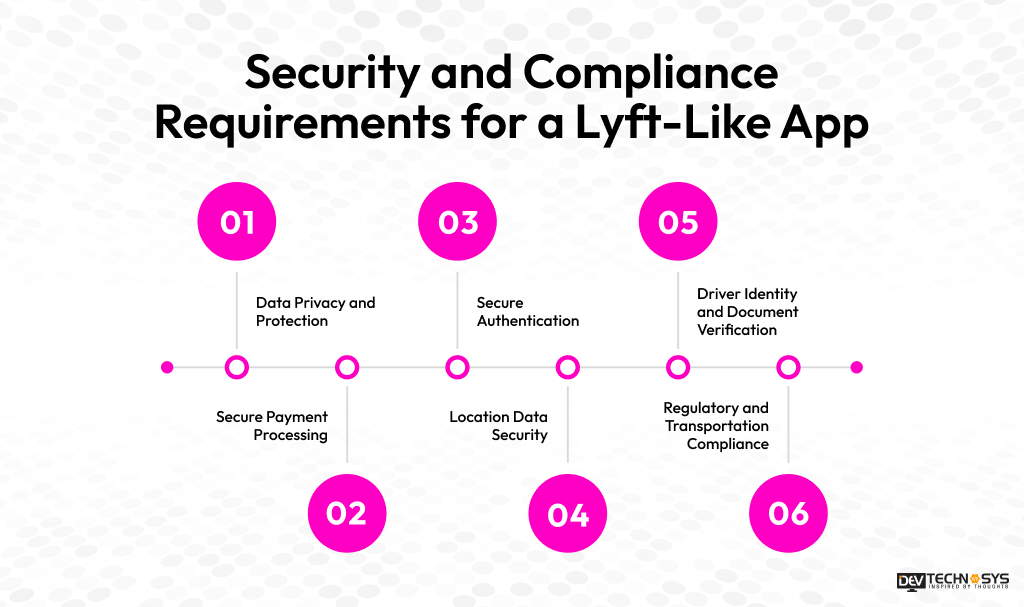
1. Data Privacy and Protection
The app should secure data of any type by means of proper collection, storage, and access practices. Depending on the region of operation, businesses may need to comply with regulations such as GDPR or CCPA, along with others.
2. Secure Payment Processing
Rideshare apps must implement efficient payment gateways for the processing of transactions. When dealing with credit cards, companies must be aware of the PCI DSS requirements and avoid storing sensitive payment details in their own file systems unnecessarily.
3. Secure Authentication
Robust authentication is a good way to secure the rider, driver, and admin accounts. Safeguards such as multi-factor authentication and a secure password policy, along with session management and a role-based access rights system, will help reduce the risk of unapproved entry to the account.
4. Location Data Security
To build a Lyft-like app, real-time location data is very sensitive. The platform should restrict access to location information, utilize encrypted methods of data transfer, and establish clear limitations on the duration of the provision of the location or trip data.
5. Driver Identity and Document Verification
To build a Lyft alternative, you must ensure that the procedures for verification of both the driver and the vehicle are suitable. Depending on the regional regulations, it may require background checks, driving record checks, insurance documents, and other requirements.
6. Regulatory and Transportation Compliance
To build an app similar to Lyft, transportation regulations can vary significantly from one nation to another, from one state to another, and from one city to another. Businesspeople have to check what licensing, insurance, driver eligibility, taxation, accessibility, passenger safety, and data protection requirements must be met before going into any market.
Now, if entrepreneurs pay attention to all of the above issues before starting a business, they will be able to minimize security threats and earn respect from customers and partners. As compliance terms often differ from one region to another, it is important to consult qualified specialists on legal and regulatory issues before launching the ride-hailing application.
Our Security Commitment
We follow secure development practices and industry-recognized standards, including ISO-certified processes, to build robust, privacy-focused ride-hailing applications that protect sensitive user and business data.
Dev Technosys
How Can AI Improve an App Like Lyft?
Carefully implemented AI technology can help taxi booking app development companies facilitate swift operational routines and enhance user experiences. Instead of relying solely on AI because of its popularity, businesses should look for applications of AI technologies that solve real market problems.
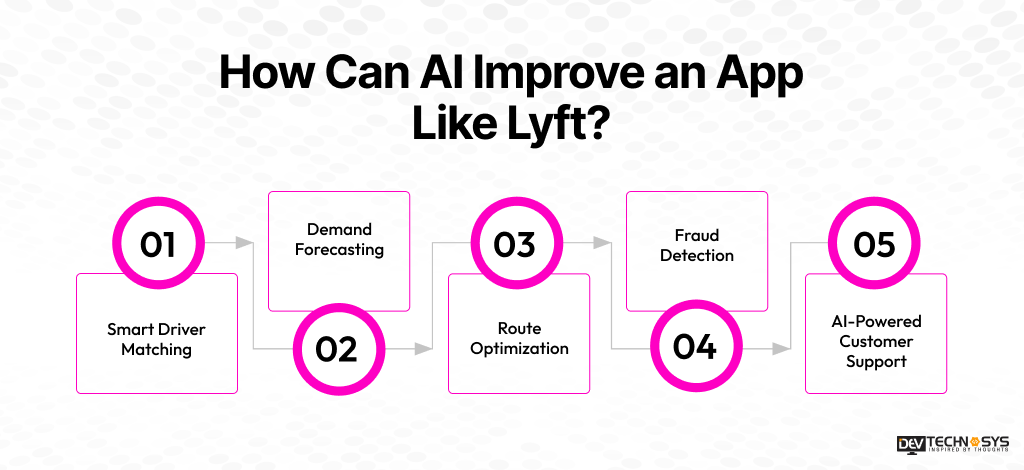
Smart Driver Matching
AI algorithms utilize data such as drivers’ location, availability, travel history, and ETA to skyrocket the success of matching ride requests to available drivers.
Demand Forecasting
The combination of historical travel data and existing conditions enables efficient prediction of places where transportation demand will increase, allowing better driver location and management.
Route Optimization
Modern AI technology can use traffic and mapping systems to provide customers with the most efficient route. This can significantly shorten passenger travel time and enhance the drivers’ working process.
Fraud Detection
Machine learning technologies are good for recognizing fraudulent behavior and questionable transactional activity. It is recommended to incorporate human screening as well as strict safety procedures into the broader fraud prevention system.
AI-Powered Customer Support
AI technologies can provide automatic replies to frequently asked customer inquiries related to reservations, payment, cancellation, and trip information. However, in case of complicated matters, customers will be forwarded to human support teams.
Challenges of Building a Ride-Hailing App
Creating taxi booking apps will face technical and marketplace hurdles, as a fully functional platform will still struggle if driver supply, operations, safety, or acquisition are not optimized.
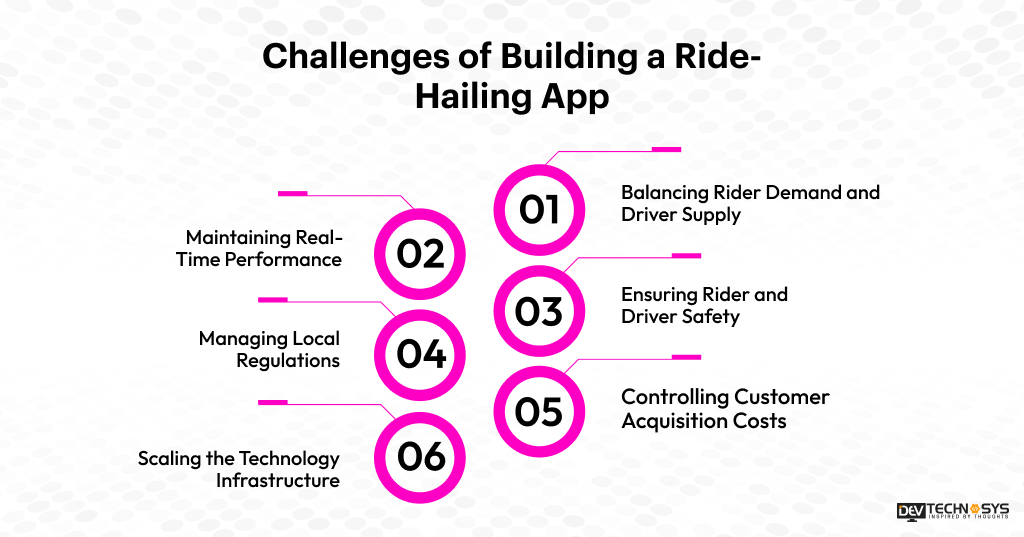
1. Balancing Rider Demand and Driver Supply
A good marketplace must have enough active drivers to satisfy riders’ requests without incurring unnecessary downtime. Flaws in supply-demand syncing may lead to long waiting times, cancellations, and low driver earnings.
2. Maintaining Real-Time Performance
A ride-hailing platform must deal with a constant stream of requests, real-time tracking, payment integration, push notifications, and status changes. A back-office solution must be capable enough to process those messages with high uptime even in peak hours when the number of platform users multiplies by dozens.
3. Ensuring Rider and Driver Safety
Safety means much more than just having an emergency button. A company must have working verification, reporting, driver tracking, navigation assistance, location services, and response protocols in place.
4. Managing Local Regulations
Regulations regarding transportation can differ depending on the area where a business operates. Businesses need to acquire knowledge about driver requirements, licensing requirements, and data requirements if they are to move to a new market.
5. Controlling Customer Acquisition Costs
Gaining customers may require significant expenditure on marketing campaigns. Startups should have a comprehensive marketing plan because it is impossible for a platform to operate effectively without creating supply and demand for its services at the same time.
6. Scaling the Technology Infrastructure
An app that operates appropriately in one city may need significant changes in infrastructure before being expanded. Growth in customers, drivers, payments, and real-time queries will definitely lead to new challenges in terms of performance and operational efficiency.
How to Launch a Successful Ride-Hailing App
A successful launch is not only about publishing an app in app stores: a startup not only needs to test its target audience but also needs to set up an operational system and improve the product based on real users’ experience.
Here are some of the tips for a taxi booking app development company while launching a Lyft-like app.
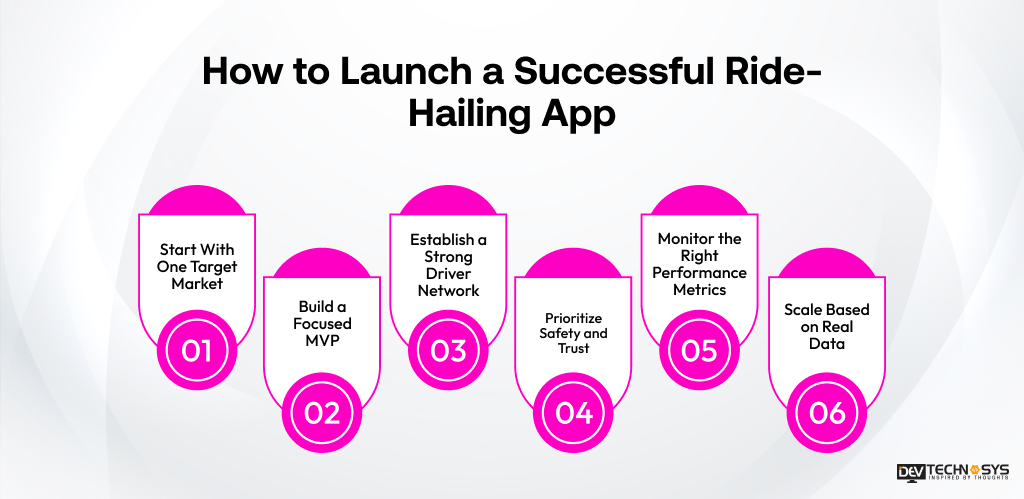
1. Start With One Target Market
It is better to start with a city or a region and use geofencing to manage operational boundaries and service availability. Doing so helps startups understand the demand, driver availability, customers’ behavior, competitors, and the operational process without spending too much on expansion.
2. Build a Focused MVP
It is better to concentrate on core booking, GPS tracking, fare calculation, ride matching, etc., as opposed to launching many features. A minimal viable product that works will prove or disprove the hypothesis as well as help collect feedback.
3. Establish a Strong Driver Network
The number of drivers available with reference to the location will dictate the customers’ waiting time and overall satisfaction. Therefore, it is necessary to work out an efficient onboarding process, explain all benefits of the platform, and create a system of monitoring rides and earnings.
4. Prioritize Safety and Trust
Establish a clear safety process from the very beginning. It is important to include verification and reporting tools, emergency support, information on trips, and effective customer service in order to create a trustworthy image.
5. Monitor the Right Performance Metrics
Make sure to monitor ride completion rates, cancellations, drivers’ acceptance rates, average waiting time, customer retention, and operational costs. All that data can illustrate the points where the application needs improvement.
6. Scale Based on Real Data
You should not expand the application; set priorities based on operational, revenue, and retention data. This is done to determine a new city, feature, or service category.
Conclusion
Establishing a software application such as Lyft entails a fusion of powerful technology, a solid marketplace model, and efficient operational practices. Start-ups must handle real-time location data, availability of drivers, payment, safety, user support, and scalable infrastructure while ensuring that users have an uncomplicated experience.
The ideal way to go about this is to start with a narrow MVP, test the market for the concept, and then expand it based on the data collected from users and operations. Organizations can develop a scalable transport application if they have the right technology partner and roadmap.
Do you plan on creating your ride book idea into a fully-fledged software product? Then Dev Technosys is a mobile app development company that hire developers to build an app like Lyft. We can also assist in planning, designing, and developing your customized on-demand transportation application in accordance with business needs.
Frequently Asked Questions
Find answers to the most common questions related to this article.
The cost to build a Lyft app is between $30,000 and over $150,000, depending on the complexity of the app. The final price depends on the app features, which platforms it works on, real-time processing capabilities, integrations, security level, artificial intelligence functions, and development complexity.
Businesses researching how to build a Lyft clone should expect an MVP to usually take three to five months to develop. While developing a sophisticated version takes six months or more. The duration depends on the number of apps being created, app features, integrations, testing required, and goals of the market.
Every business planning how to build a Lyft-like app usually requires three main platforms, namely the rider app, driver app, and admin panel. Bigger companies might decide to add more apps for customer service, fleet management, and analytics.
Main features include user signup, GPS tracking of rides, ride requests, matching drivers, providing directions, calculating taxi costs, making payments, notifying users, making assessments, and collecting information on customers. Advanced services will be able to use AI algorithms for matching and forecasting, scheduling, and providing automated customer support.
Yes. An MVP is recommended when learning how to build an app like Lyft from scratch. It helps startups measure market demand and get an idea of operational processes without spending too much money at first. Once the company has analyzed the responses, it can proceed with introducing special features and developing its service further.