




















Every business owner wants to know how much profit they gain in their business.
But what’s the technique?
Explore ROI(Return on Investment), it is the best way to measure success and make smart financial decisions.
In mobile app development, ROI can be easily calculated by analyzing the actual profit and the various ways to maximize the profit.
The ROI offers the basic formula that enables businesses to track their mobile app profit and also offers expert tips.
Get ready to explore the mobile app development ROI, factors that impact the profit, real-world examples of high-ROI apps, metrics to track ROI, and strategies to maximize ROI.
What is Mobile App Development ROI?
Mobile App Development ROI (Return on Investment) measures the financial return gained from investing in building a mobile app. It compares the total profits generated through revenue, user growth, or cost savings against the overall development and marketing costs.
A positive ROI indicates a successful investment. In 2025, mobile app development ROI also includes non-monetary value like brand visibility, user engagement, and customer retention, making it a crucial metric for app success measurement.
Simple App development ROI Formula:
ROI = (Net Profit/Total Investment) x 100
Real World Example:
Total Mobile App Development Investment = $50,000 (Launching and Maintenance)
Total Revenue Generated = $100,000
Net Profit: $100,000 – $50,000 = $50,000
ROI = ($50,000/$50,000) x 100 = 100%
Note: Businesses made 1.0x profit on total investment.
How to Calculate Mobile App ROI?
Learn how to calculate your mobile app’s ROI with this simple 7-step process. From tracking development and marketing costs to measuring revenue, engagement, and lifetime value, this guide helps you evaluate profitability and make smarter investment decisions in 2025’s competitive app market.
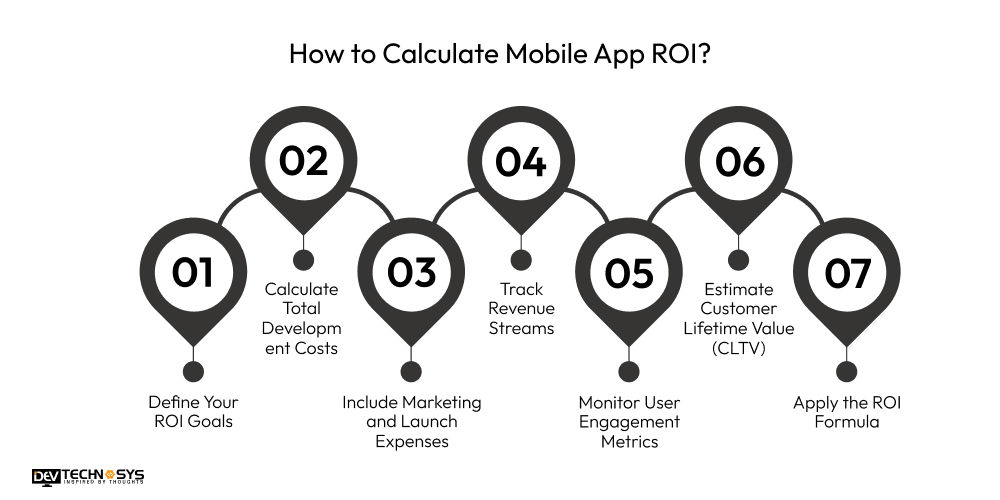
1. Define Your ROI Goals
Start by setting clear business objectives, whether it’s revenue generation, user growth, customer retention, or cost reduction. Knowing your end goals helps measure what “return” actually means for your app. Mobile app ROI calculation isn’t always monetary; align it with your KPIs to track both tangible and intangible value.
2. Calculate Total Development Costs
Add up all the costs associated with building your app, including design, development, testing, and project management. Don’t forget hidden expenses like tools, licenses, and third-party integrations.
If using an agency or freelancers, include those costs. A clear understanding of total investment is crucial for accurate mobile app development return on investment analysis.
3. Include Marketing and Launch Expenses
Factor in the full mobile app development cost, from pre-launch promotion to post-launch campaigns. This includes paid ads, app store optimization (ASO), influencer partnerships, and PR. User acquisition efforts often form a large portion of your investment and significantly impact your overall ROI of mobile app development.
4. Track Revenue Streams
Identify and measure all income sources, whether through in-app purchases, subscriptions, ads, or e-commerce. If your app supports enterprise functions, calculate operational savings.
For freemium models, project conversion rates. Accurately tracking revenue helps determine if your returns justify your total return on digital investments.
5. Monitor User Engagement Metrics
Track KPIs like downloads, retention rate, DAU/MAU, and session duration. Engaged users are more likely to convert and generate recurring revenue. These insights help assess the app’s long-term viability and inform feature improvements that can boost mobile app development ROI over time.
6. Estimate Customer Lifetime Value (CLTV)
CLTV measures how much a user will generate in revenue throughout their engagement with your app. Multiply the average purchase value by purchase frequency and retention duration. Comparing CLTV to acquisition costs helps determine if your user base is profitable and sustainable.
7. Apply the ROI Formula
Use the formula:
ROI = [(Total Return – Total Investment) / Total Investment] x 100
This gives you a percentage representing your app’s return. A positive ROI of mobile app development indicates profitability. Regularly recalculate ROI to reflect new data, ongoing costs, and app performance over time.
What are the Factors that Influence Return on Investment?
Understanding what impacts your app’s return on investment is key to maximizing app ROI. From app complexity and development approach to user experience, time to market, and app business growth strategy, each factor plays a critical role. Let’s explore the factors affecting mobile app ROI.
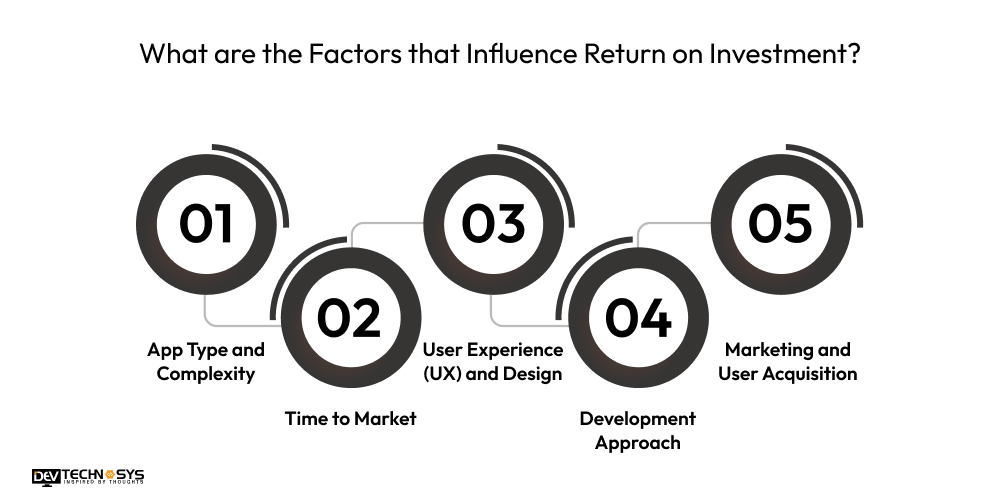
1. App Type and Complexity
The complexity and type of your app, basic, feature-rich, or enterprise-grade, greatly affect ROI. Advanced features like real-time syncing, AI integration, or AR increase Android and iPhone app development time and cost.
Simpler apps cost less and launch faster, potentially improving ROI, but may offer limited monetization or scalability options depending on your business goals.
2. Time to Market
Launching your app quickly can give you a competitive edge, especially in fast-moving industries. Delays increase costs and risk missing market opportunities.
A faster time to market helps start user acquisition and revenue generation sooner, which boosts mobile app development ROI. However, rushing development without testing can lead to higher long-term expenses.
3. User Experience (UX) and Design
A well-designed, intuitive user experience drives user satisfaction, retention, and positive reviews. Apps with poor UX often suffer high uninstall rates, reducing ROI.
Investing in professional UI/UX design improves usability, boosts engagement, and increases conversion rates, making design a major factor in maximizing your app’s profitability and long-term success.
4. Development Approach
Whether you choose in-house development, freelancers, or an agency affects cost, quality, and timeline. In-house teams offer better control but require higher ongoing investment.
Agencies provide expertise and scalability, while hire dedicated developers as freelancers is cost-effective but risks delays. The right approach balances cost, speed, and quality, directly influencing your app’s return.
5. Marketing and User Acquisition
Even the best app fails without users. Marketing costs, including ads, influencer outreach, and ASO, can be significant. A strong app investment strategy ensures your app reaches the right audience and converts users efficiently.
Optimizing your Cost Per Acquisition (CPA) and scaling growth channels effectively can dramatically improve your ROI of mobile app development.
Real ROI Examples for Mobile Apps
From ride-hailing to wellness, these mobile apps, Uber, WhatsApp, TikTok, Calm, and Duolingo, achieved massive returns through smart scaling, low overhead, and high user engagement.
Their success showcases how innovative app models can deliver exceptional ROI across diverse sectors like transport, communication, entertainment, health, and education.
1. Uber
Uber revolutionized transportation by connecting riders with drivers through a seamless mobile experience. With minimal infrastructure, it scaled globally, generating billions in revenue. Its app-driven model reduced operational costs while maximizing reach, creating an unmatched return on investment in the mobility sector.
2. WhatsApp
WhatsApp achieved massive global adoption with a lean team and minimal advertising. Its focus on fast, reliable messaging attracted over 2 billion users.
Acquired by Facebook for $19 billion in 2014, the app’s low operational cost and high user engagement delivered one of the tech industry’s highest ROI outcomes.
3. TikTok
TikTok disrupted social media by focusing on short-form video content, AI-driven recommendations, and user-generated content. Launched by ByteDance, the app saw exponential growth, especially among Gen Z. Its high engagement rates translated into massive ad revenue, making it a top performer in ROI for mobile apps in entertainment.
4. Calm
Calm monetized mindfulness with subscriptions for meditation, sleep, and relaxation content. With relatively low content production costs and high user retention, it reached unicorn status. Its simple, effective design and health-focused niche created a strong ROI, especially as wellness trends surged during the pandemic.
5. Duolingo
Duolingo offers gamified language learning, attracting millions of users worldwide. Its freemium model converts loyal users to paid plans, while ad revenue supports free access.
With minimal overhead and global scalability, Duolingo became the top-grossing education app, delivering strong ROI through user engagement and retention.
Best Ways to Maximize Mobile App ROI in 2025
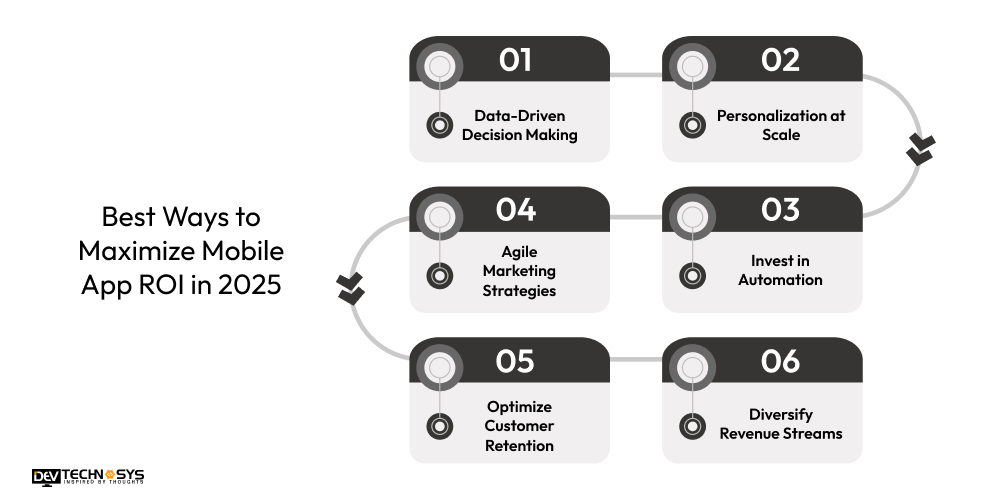
1. Data-Driven Decision Making
Leverage advanced analytics and AI to track performance metrics, customer behavior, and market trends. By making data-informed decisions, businesses can reduce waste, optimize operations, and tailor offerings, ultimately boosting ROI. Real-time insights provide a competitive edge in fast-changing environments.
2. Personalization at Scale
Use AI and machine learning to deliver highly personalized customer experiences across touchpoints. Personalized content, offers, and recommendations increase engagement, conversion rates, and lifetime value, significantly improving ROI. Automation tools now make it possible to scale personalization without increasing overhead.
3. Agile Marketing Strategies
Implement agile methodologies in marketing to test, iterate, and adapt campaigns quickly. This reduces time and budget waste, improves performance, and ensures faster response to market changes. Hire mobile app developers to focus on measurable outcomes, driving higher ROI through continuous improvement and rapid experimentation.
4. Invest in Automation
Automating repetitive tasks in sales, customer support, and operations reduces labor costs and human error. It boosts productivity and enables teams to focus on high-impact work. ROI increases as efficiency improves, especially with AI-powered automation tools becoming more accessible and cost-effective in 2025.
5. Optimize Customer Retention
It costs less to retain existing customers than to acquire new ones. Implement loyalty programs, regular follow-ups, and personalized service to increase retention. Higher customer lifetime value translates to better ROI, making retention strategies essential for sustainable growth in competitive markets.
6. Diversify Revenue Streams
Expand beyond core offerings by introducing complementary products, services, or subscriptions. This reduces dependency on a single income source and opens new profit avenues. In 2025, digital platforms will make it easier than ever to test and scale additional revenue channels efficiently.
Common ROI Pitfalls and How to Avoid Them
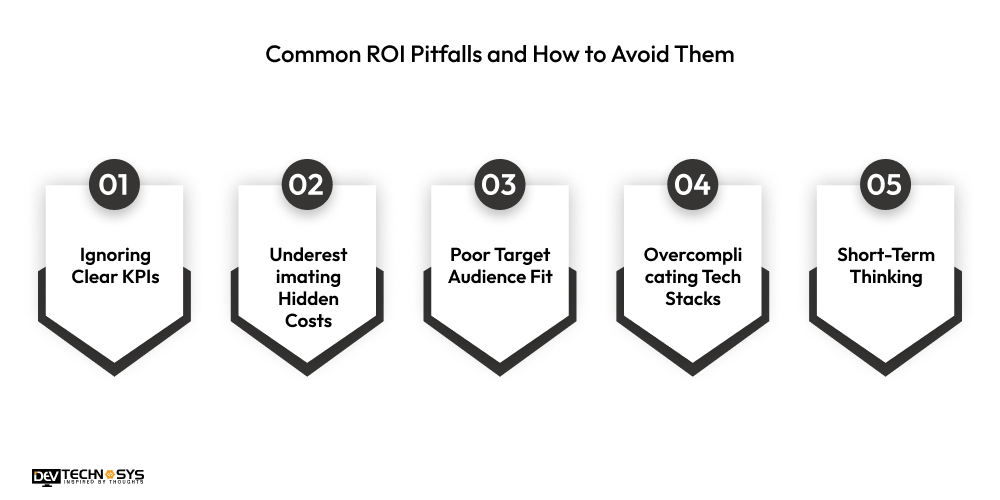
Many businesses lose ROI due to unclear KPIs, hidden costs, poor audience targeting, complex tech stacks, and short-term thinking. Recognizing and addressing these common pitfalls is essential for achieving sustainable growth and maximizing long-term returns.
1. Ignoring Clear KPIs
Without defined KPIs, measuring ROI becomes guesswork. Businesses must set specific, measurable goals aligned with strategy. Regularly tracking these indicators ensures progress is monitored, adjustments are made early, and ROI is accurately assessed, avoiding wasted resources and misaligned efforts.
2. Underestimating Hidden Costs
Focusing only on upfront expenses overlooks ongoing costs like maintenance, training, and updates. Hidden costs can erode ROI over time. Conduct thorough cost-benefit analyses before launch and budget for long-term needs to ensure a realistic and sustainable return.
3. Poor Target Audience Fit
Marketing to the wrong audience drains resources and delivers weak ROI. Understand your ideal customer through market research and analytics. Tailor messaging and offerings to fit their needs. According to the Android app development company, this ensures campaigns reach those most likely to convert and generate value.

4. Overcomplicating Tech Stacks
Using too many tools or platforms can lead to inefficiencies, redundancies, and high costs. Streamline your tech stack by choosing integrated solutions that serve multiple functions. A simplified, effective system enhances productivity and increases ROI by reducing operational friction.
5. Short-Term Thinking
Chasing quick wins may boost short-term ROI but harm long-term growth. Sustainable ROI requires balancing immediate gains with strategic investments. Focus on building brand equity, customer relationships, and scalable systems to ensure lasting app development profitability and business resilience.
Tools & Technologies to Help You Measure ROI
1. Google Analytics 4 (GA4)
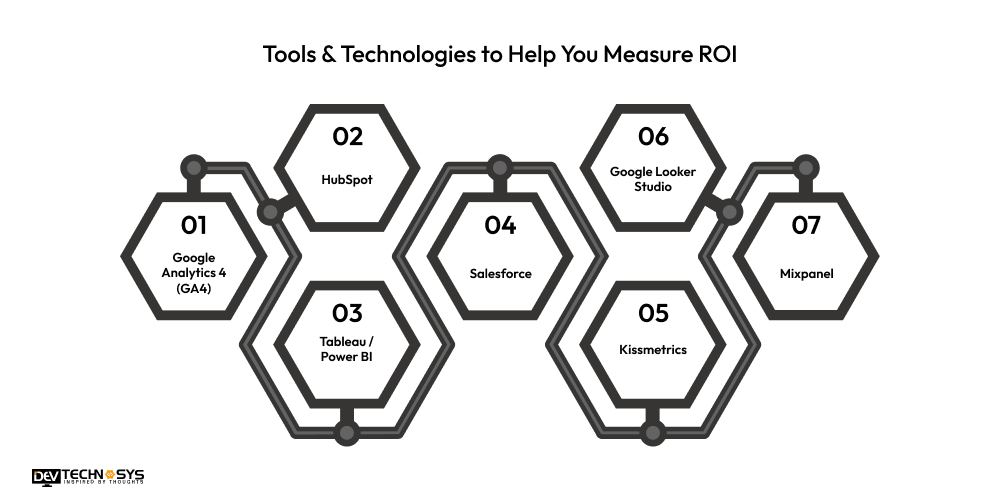
Tracks user behavior, conversions, and customer journeys across web and app. Offers deep insights into marketing campaign performance and attribution, helping you measure ROI from traffic sources.
2. HubSpot
A full-stack CRM and marketing automation platform. Tracks customer interactions, lead conversions, and campaign ROI. Its dashboards provide real-time visibility into sales and marketing effectiveness.
3. Tableau / Power BI
Advanced data visualization tools that connect with multiple data sources. They help analyze complex ROI data through customizable dashboards, making performance insights easy to interpret and share.
4. Salesforce
A leading CRM with ROI tracking features through sales funnel analysis, customer lifecycle insights, and campaign attribution. Integrates with multiple platforms for a complete ROI overview.
5. Kissmetrics
Focuses on customer behavior analytics. Tracks metrics like customer lifetime value (CLTV), churn rate, and conversion funnels, essential for measuring ROI in SaaS and e-commerce.
6. Google Looker Studio
A free tool that turns data from various platforms (Google Ads, GA4, etc.) into visual, shareable ROI reports. Ideal for small to medium businesses tracking campaign performance.
7. Mixpanel
Great for product-based businesses. Tracks feature usage, user engagement, and retention to measure the ROI of product updates or customer journeys.
Conclusion
Maximizing ROI in mobile app development requires a strategic blend of user-centric design, data-driven decisions, and smart technology investments.
By avoiding common pitfalls, leveraging the right tools, and focusing on long-term value, businesses can ensure sustainable returns. Partnering with an experienced mobile app development company is key to turning ideas into high-performing apps that deliver measurable results.
In 2025, success will belong to those who prioritize innovation, efficiency, and ROI from day one.
Frequently Asked Questions
1. Why Is Measuring ROI Important For Mobile Apps?
Measuring ROI for mobile apps is essential to assess profitability, justify development costs, and guide strategic decisions. It helps optimize performance, allocate resources effectively, and ensure long-term value and growth for the business.
2. How Long Does It Take To Achieve Positive ROI From An App?
Achieving positive ROI in mobile apps typically takes 6 to 12 months, depending on factors like app type, marketing strategy, user acquisition, and monetization. Strong planning and execution can accelerate the return timeline.
3. What Are The Best Monetization Strategies For Improving ROI?
The best app monetization strategies include in-app purchases, subscriptions, ads, freemium models, and transactional fees. Choosing the right mix based on your target audience and app type maximizes revenue and significantly improve app profitability.
4. How Can I Reduce Mobile App Development Costs Without Affecting Quality?
Reduce mobile app development costs by building a Minimum Viable Product (MVP), using cross-platform frameworks, hiring experienced developers, and applying agile methodologies. These approaches save time and money while maintaining high-quality performance and user experience.
5. What Technologies Improve Mobile App ROI In 2025?
Technologies boosting mobile app investment return in 2025 include AI and machine learning for personalization, automation for efficiency, cloud computing for scalability, cross-platform tools like Flutter, and advanced analytics platforms to optimize user engagement and decision-making.