











In today’s digitalized era, AI is transforming the way logistics teams handle everything. From shipment planning to fleet monitoring, AI is becoming important for modern logistics businesses. AI development in logistics is not just integrating a model into existing software. It is about finding a partner that turns operational data into reliable decisions that keep logistics moving. Here is a list of 12 AI development companies for logistics, including established technology providers and specialized development companies.
Why Is the Right AI Development Partner Important for Logistics?
Not every AI development company for logistics knows how the logistics industry works. Therefore, building a model is one thing, and making it work is another. Logistics operations include working with shipment data, fleet systems, warehouse processes, and changing delivery conditions.
The ideal development partner understands logistics workflows and can connect AI with TMS, WMS, ERP, GPS, and telematics platforms. They can turn scattered operational data into useful predictions, recommendations, and automated actions.
Whether developing route optimization, ETA prediction, demand forecasting, fleet maintenance, or warehouse management, AI development companies in logistics truly matter.
AI in Logistics Market Size, Growth, and Future Outlook
AI is becoming part of everyday logistics operations, from planning to warehouse operations. As logistics AI companies collect more operational data and look for ways to improve efficiency, investment in AI is expanding rapidly. According to Fortune Business Insights, here’s where the global AI in logistics market stands in 2025-2026.
$8.65 billion
Market Size Valued in 2025
Global AI in logistics market value in 2025.
$12.23 billion
Market Size By 2026
Expected global market value as AI adoption expands across logistics operations.
41.5%
CAGR (2026–2034)
Expected annual growth rate of the global AI in logistics market through 2034.
$196.61 billion
Expected Market Size in 2034
Expected global market value as AI adoption scales across logistics and transportation.
How We Selected the AI Software Development Companies for Logistics
Selecting a company specializing in AI development for logistics cannot be limited to browsing services pages. Our assessment was based on several criteria, including technical skills, logistics background, delivery capabilities, and client credibility.
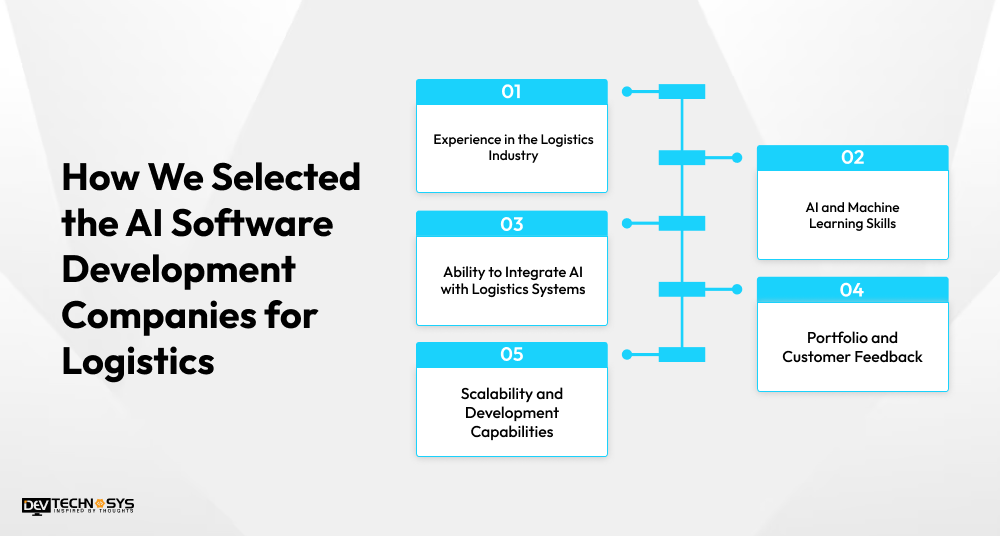
1. Experience in the Logistics Industry
Focus on companies with experience in logistics, transportation, warehousing, supply chains, and fleet management software development.
2. AI and Machine Learning Skills
Businsses should also consider capabilities in prediction, computer vision, NLP, generative AI, forecasting, optimization, and intelligent automation.
3. Ability to Integrate AI with Logistics Systems
You must analyze their ability to integrate AI with TMS, WMS, GPS, telematics, and ERP solutions for logistics and supply chain management.
4. Portfolio and Customer Feedback
We evaluated relevant projects, industries, customer feedback, and proof of successful AI implementation.
5. Scalability and Development Capabilities
We assessed whether firms can develop and deploy scalable AI systems to expand logistics processes and data.
Planning to Build an AI Development Project?
Get a quick cost estimate based on your AI features, integrations, and development scope.
- 3 Quick Steps
- 100% FREE
- Hear Back Within 1 Business Day
2 Minutes Read
Best AI Development Companies for Logistics: A Side-by-Side Comparison
Dev Technosys, Saritasa, Trigent, Cleveroad, and Intellectsoft are among the AI development companies for supply chain. This comparison covers services, AI capabilities, logistics expertise, and project fit. The table helps businesses quickly identify which provider best matches their AI, automation, and supply chain technology needs.
Company |
AI & Logistics Focus |
Key AI Capabilities |
Best For |
| Dev Technosys | Logistics, fleet, supply chain | Predictive analytics, AI automation, route optimization | End-to-end logistics platforms |
| NineTwoThree AI Studio | AI software solutions | Generative AI, ML, predictive analytics | AI-powered logistics applications |
| RTS Labs | AI & software development | ML, data engineering, AI automation | Custom AI solutions |
| Saritasa | Logistics & enterprise software | AI, IoT, automation, data analytics | Complex enterprise systems |
| Fingent | Supply chain & logistics | AI, ML, predictive analytics | Scalable business platforms |
| Trigent | Enterprise AI solutions | AI, ML, automation, analytics | Enterprise logistics software |
| Softeq | IoT, mobility & logistics | AI, IoT, computer vision, edge computing | Connected logistics systems |
| Orases | Custom software & AI | AI integration, automation, analytics | Custom logistics applications |
| Cleveroad | Logistics & transportation | AI, ML, predictive analytics | Digital logistics products |
| Six Feet Up | AI & data solutions | ML, data science, AI engineering | Data-driven logistics systems |
| Designli | Custom software & AI | AI integration, automation | MVPs and AI-powered apps |
| Intellectsoft | Enterprise logistics & AI | AI, blockchain, IoT, automation | Large-scale logistics platforms |
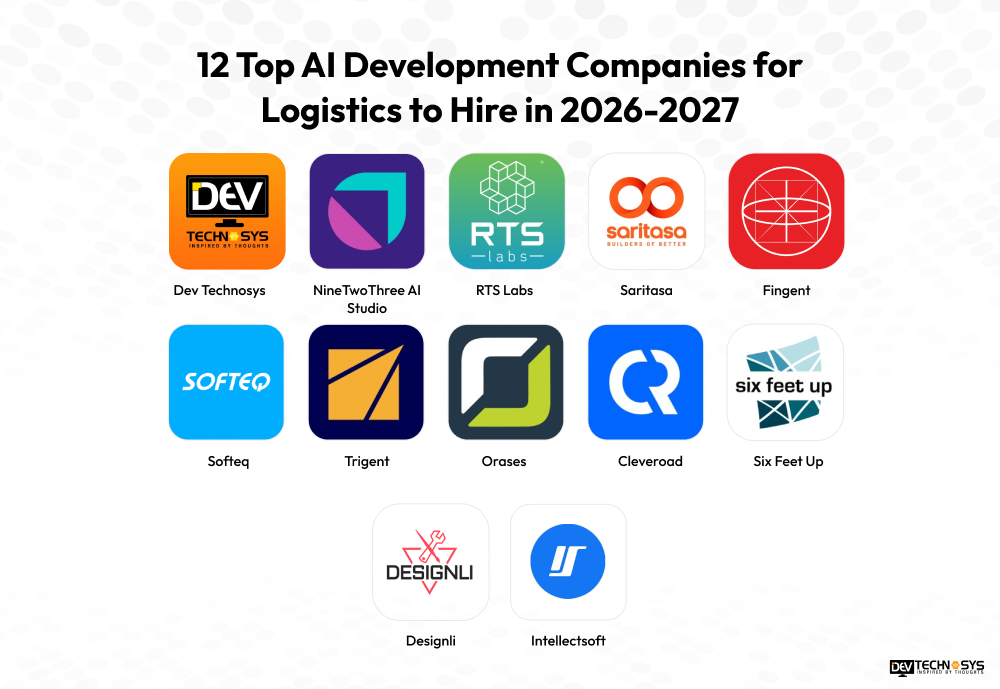
12 Top AI Development Companies for Logistics to Hire in 2026-2027
These AI development companies for logistics build solutions for route optimization, fleet management, demand forecasting, warehouse automation, and supply chain visibility. We have shortlisted 12 firms based on AI expertise, logistics experience, technical capabilities, and real-world project delivery.
1. Dev Technosys
Dev Technosys is one of the top AI solutions companies for logistics. It offers fleet management, route optimization, predictive analytics, warehouse management, and supply chain automation. Its logistics software development services include custom software, AI integration, mobile platforms, and connected logistics systems that revolve around operational workflows.
- Founded: 2000
- Headquarters: Jaipur
- Min. Project: $10K+
- Employees: 101–150
- Hourly Rate: 25–49/hr
2. NineTwoThree AI Studio
NineTwoThree is among the top AI development companies for supply chain and logistics. It creates production-ready AI solutions in logistics like route optimization, predictive maintenance, delivery intelligence, and workflow automation. It specializes in transforming operational data into actionable and impactful AI solutions for transportation, fleet, delivery, and supply-chain companies.
- Founded: 2013
- Headquarters: Danvers
- Min. Project: $100K+
- Employees: 50–249
- Hourly Rate: 100–149/hr
3. RTS Labs
RTS Labs builds tailor-made AI and software solutions for logistics, spanning automation, predictive analytics, data engineering, and system integration. It provides a way for transportation/supply chain teams to integrate AI into their processes and technology.
- Founded: 2012
- Headquarters: Glen Allen
- Min. Project: $5K+
- Employees: 10–49
- Hourly Rate: 25–49/hr
4. Saritasa
Saritasa is an all-in-one company that integrates IoT, cloud, and artificial intelligence in logistics & supply chain solutions. Its solutions help logistics businesses with integrated digital systems, including fleet visibility, connected devices, operational automation, and data-driven workflows.
- Founded: 2005
- Headquarters: Newport Beach
- Min. Project: $50K+
- Employees: 50–249
- Hourly Rate: 100–149/hr
5. Fingent
Fingent offers customized software, AI, mobility, and enterprise technology solutions for logistics & supply-chain operations. It offers transportation management, fleet workflows, automation, analytics, and connected platforms to enhance visibility and optimize processes.
- Founded: 2003
- Headquarters: New York
- Min. Project: $25K+
- Employees: 250–999
- Hourly Rate: 25–49/hr
6. Trigent
Trigent is listed among the AI Companies for logistics industry. It builds integrated AI, data engineering, cloud, and software solutions to help modernize logistics and supply chains. It handles workflow automation, predictive analytics, system integration, application development, and technology upgrades for enterprises dealing with complex operations.
- Founded: 1995
- Headquarters: Southborough
- Min. Project: $10K+
- Employees: 1,000–9,999
- Hourly Rate: 25–49/hr
7. Softeq
Softeq innovates AI, IoT, embedded, cloud, and software solutions for connected logistics environments. It powers fleet systems, warehouse automation, industrial applications, smart devices, and real-time data workflows in transportation and supply-chain operations. This logistics, supply chain, and fleet management app development company leverages its technology capabilities.
- Founded: 1997
- Headquarters: Houston
- Min. Project: $50K+
- Employees: 250–999
- Hourly Rate: Undisclosed
8. Orases
Orases develops tailored software for the top logistics AI companies, centered around operational transparency, workflow automation, data connectivity, and planning. Its development methodology is integrated with scalable platforms that enable transportation and supply-chain processes.
- Founded: 2000
- Headquarters: Frederick
- Min. Project: $75K+
- Employees: 50–249
- Hourly Rate: 150–199/hr
9. Cleveroad
Cleveroad builds logging software using AI, IoT, cloud, and data technologies, including route optimization, demand forecasting, warehouse automation, and supply-chain visibility. It has custom platforms that are optimized to integrate logistics workflows, operational data, and enterprise systems.
- Founded: 2011
- Headquarters: New York
- Min. Project: $10K+
- Employees: 250–999
- Hourly Rate: 25–49/hr
10. Six Feet Up
Six Feet Up focuses on Python, AI, data engineering, and cloud development solutions for data-driven applications. These capabilities suit logistics use cases like predictive analytics, operational automation, forecasting, and intelligent systems that rely on large, complex datasets.
- Founded: 2003
- Headquarters: Fishers
- Min. Project: $50K+
- Employees: 10–49
- Hourly Rate: 200–300/hr
11. Designli
Designli is a reliable import-export software development company that creates tailored software and AI-driven platforms for the logistics industry. Its product development philosophy is to build digital workflows around specific operational and business needs that are scalable.
- Founded: 2013
- Headquarters: Greenville
- Min. Project: $10K+
- Employees: 50–249
- Hourly Rate: 50–99/hr
12. Intellectsoft
Intellectsoft offers logistics organizations services in the fields of AI engineering, custom software, cloud, data, and enterprise integration. It helps enterprises with complex transportation and supply-chain operations through intelligent automation, predictive systems, and scalable digital infrastructure.
- Founded: 2007
- Headquarters: New York
- Min. Project: $50K+
- Employees: 50–249
- Hourly Rate: 50–99/hr
How to Choose the Right AI Development Company for Logistics?
When selecting an AI development company for supply chain and logistics solutions, reviewing their portfolio alone isn’t enough. Analyze logistics expertise, AI development skills, integration experience, data security, scalability, and the overall cost of the entire project.
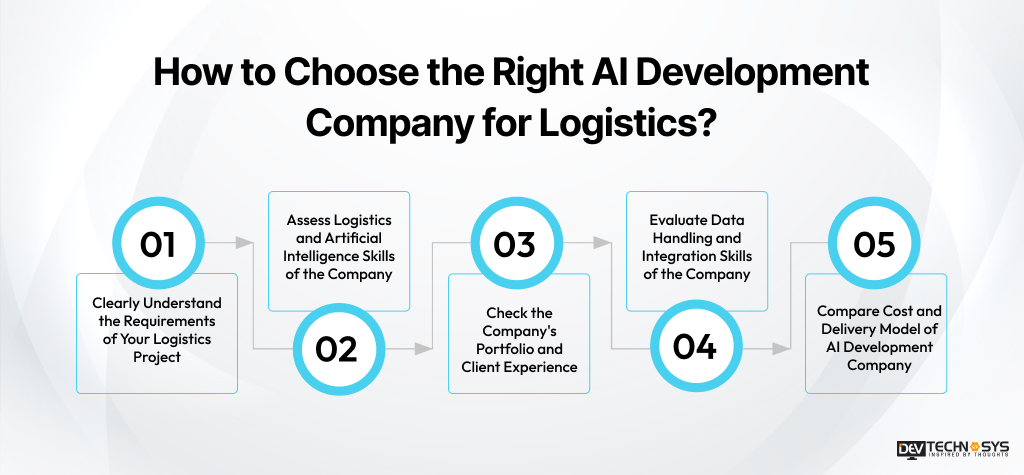
1. Clearly Understand the Requirements of Your Logistics Project
Define your workflows, users, AI implementation goals, data sources, integration needs, and desired outputs before reaching out to potential vendors.
2. Assess Logistics and Artificial Intelligence Skills of the Company
Confirm the company has experience implementing AI for route optimization, demand forecasting, fleet management, predictive analytics, computer vision, and other AI applications.
3. Check the Company’s Portfolio and Client Experience
Review the portfolio and case studies of completed logistics and transportation projects by the company and analyze clients’ feedback and results.
4. Evaluate Data Handling and Integration Skills of the Company
Understand how the company works with sensitive business data, API integration, cloud computing services, ERP/TMS/WMS software integrations, and AI model security.
5. Compare Cost and Delivery Model of AI Development Company
Compare quotes from different companies considering project scope, complexity of AI application, number of integrations, structure of the development team, and maintenance.
Free App Idea Reality Check: Let's Stress-Test Your Concept
Share your app idea with us. Within 3 business days, we'll uncover UX gaps, feature opportunities, and potential development challenges, so you can build with confidence. No strings attached.
Final Words
Choosing one among logistics AI development companies depends on your project scope, AI use cases, budget, integrations, and scalability needs. It is always suggested to compare a logistics and supply chain management software development company’s:
- Logistics experience
- Technical capabilities
- Security practices
- Delivery approach
Businesses should also request relevant case studies, clarify ownership, and maintenance terms from the selected company. They must ensure the team can support their logistics platform beyond initial development as business needs evolve.
Frequently Asked Questions
Find answers to the most common questions related to this article.
Any custom code, trained models, and personal operational data you create must be your own. Ensure this is signed in the contract prior to work, and ensure there is a clear handover. Don't work with partners that have proprietary systems that will bind you to their system for life.
No, but data should be sufficient, including shipments, routes, and delivery records. The best partner is one who performs a Data Audit first and informs you what is missing. When data is sparse, they should offer a smaller pilot, rather than an oversell.
Begin with a paid test that meets a business objective. This can be anything from reduced late deliveries to more efficient picking times in the warehouse or reduced fuel costs. Agree on success metrics upfront, so you can scale or stop with confidence.
Yes, as long as the partner doesn't replace all the tools, but rather works with your existing ones. Inquire what APIs and integrations they have already provided for logistics companies. Ask to have your integration plan in writing during discovery to prevent unexpected issues during development.
Request having a named project manager on staff and access to your project's primary developers. Support should include monitoring and retraining of AI models as they change over time. Always ask for and obtain written estimates of response times, update schedules, and maintenance periods before signing any contract.