













Key Takeaways:
-
- AI is transforming fintech through fraud detection, risk assessment, credit scoring, and automated compliance
- The right AI development partner should combine fintech expertise with strong AI/ML capabilities.
- Consider security, data privacy, and regulatory compliance from the beginning.
- Development costs vary based on AI complexity, integrations, features, and infrastructure requirements.
- Evaluate companies based on their portfolio, technology expertise, scalability, support, and relevant fintech experience.
Choosing an AI development company for fintech requires more than comparing technology stacks. The right partner must understand financial workflows, sensitive data, system integrations, model evaluation, and the operational risks involved in deploying AI in financial products.
AI can support fintech applications across fraud detection, credit risk assessment, transaction monitoring, financial document processing, customer service, and compliance workflows. However, not every AI development company has the same financial-services focus. Some specialize in custom product engineering, while others concentrate on enterprise banking transformation, data platforms, or AI infrastructure.
This guide compares 10 companies to help fintech startups, lenders, payment providers, and financial institutions identify potential development partners. Each profile focuses on the company’s publicly described capabilities and the types of projects those capabilities may suit. The list of AI development companies for fintech is just a practical shortlist, not an independently verified ranking of overall performance.
Before selecting a vendor, validate its relevant project experience, security practices, integration capabilities, engagement model, and ability to monitor AI systems after deployment.
How We Evaluated These AI Development Companies for Fintech
Selecting an AI development partner for financial services requires evaluating both technical capabilities and the demands of financial workflows. This shortlist considers the following factors:
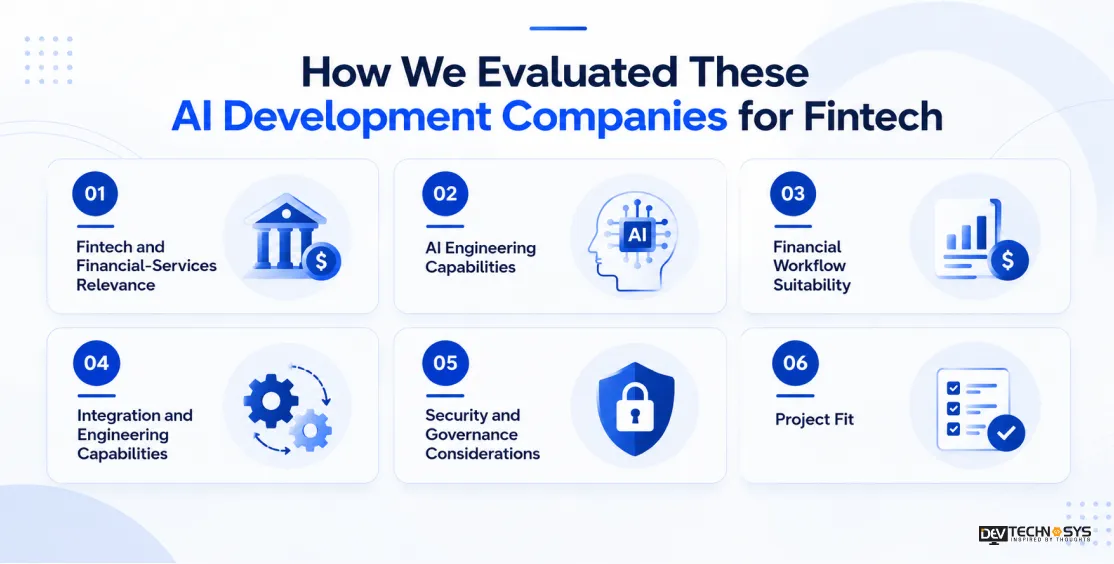
- Fintech and Financial-Services Relevance: Publicly described experience or services related to banking, payments, lending, insurance, wealth management, or financial platforms.
- AI Engineering Capabilities: Evidence of services involving machine learning, generative AI, predictive analytics, intelligent automation, or AI integration.
- Financial Workflow Suitability: The relevance of the company’s capabilities to use cases such as fraud monitoring, credit assessment, document processing, customer support, and transaction analysis.
- Integration and Engineering Capabilities: Publicly described expertise in application development, data engineering, cloud platforms, APIs, and integration with existing enterprise systems.
- Security and Governance Considerations: The ability to discuss access control, data protection, auditability, model evaluation, and applicable compliance requirements during vendor assessment.
- Project Fit: The types of organizations and projects for which the company’s publicly described services may be suitable, from custom fintech products to large-scale banking transformation.
Industry Insights
McKinsey analyzed more than 600 AI initiatives and found that fintechs represented about 40% of its fintech dataset but nearly 70% of the AI initiatives, indicating strong AI activity among fintech companies
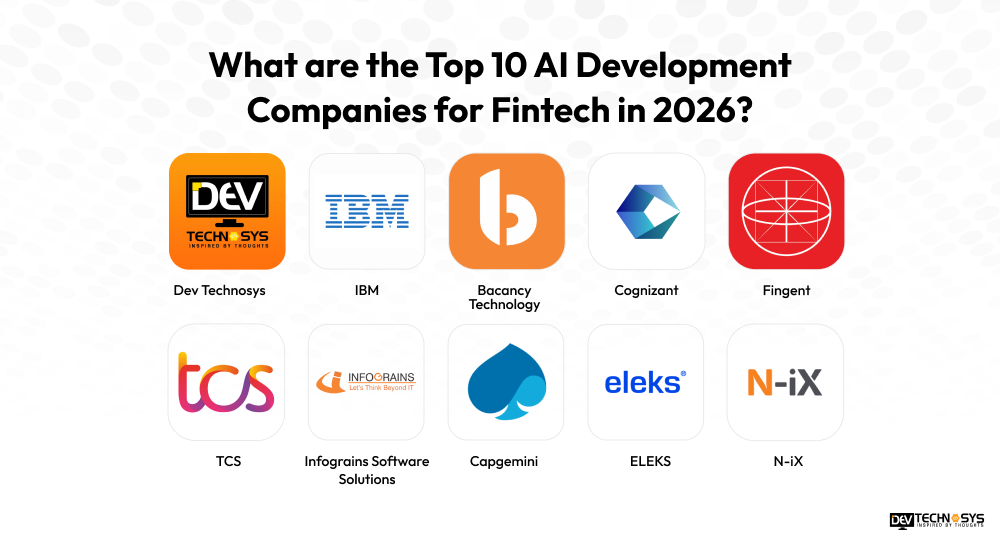
What are the Top 10 AI Development Companies for Fintech in 2026?
The fintech industry is increasingly using AI to automate financial processes and improve decision-making. Here are 10 AI development companies offering fintech-focused AI, ML, and software development expertise.
-
Dev Technosys
Dev Technosys is a leading AI development company founded in 2010. With 16+ years of experience developing AI-powered fintech, banking, payments, and lending blockchain solutions. The Fintech app development company uses AI and machine learning technology for fraud detection, credit scoring, risk analysis, predictive analytics, and individual-focused banking services.
Some reasons why businesses should consider Dev Technosys are its combination of AI capabilities that allow for the establishment of secure financial platforms. The company also highlights experience with AI/ML, TensorFlow, PyTorch, Python, OpenAI models, KYC/AML integration, PCI-DSS-aligned architectures, and fintech API integrations.
Key AI Services & Use Cases:
- AI-powered fraud detection
- Credit scoring and risk assessment
- Predictive Analytics in fintech
- Conversational AI and chatbots
- AI-powered financial recommendations
- Intelligent automation
Best For:
- Custom fintech applications with AI-enabled features.
- Integrating AI into existing web, mobile, or enterprise software.
- Prototyping and developing financial workflow automation.
What to verify before hiring: Ask for relevant fintech AI case studies, details of production deployments, model evaluation methods, security architecture, and experience integrating with payment or banking systems. Do not assume that general AI services establish experience in regulated financial AI.
-
IBM
IBM creates an AI-powered digital lending platform with Salesforce, combining enterprise AI with financial services expertise. It offers solutions for banking, customer service, fraud detection, asset management, and regulatory compliance. Among other solutions, AI development companies for fintech, such as IBM, offer machine learning-based offerings, generative AI, and data analytics systems, among others. This makes IBM a perfect choice for businesses seeking to implement AI in their operations.
Key AI Services & Use Cases:
- Fraud detection
- AI-powered customer service
- Wealth management
- Regulatory compliance
- Risk analysis
- Generative AI in fintech
Best For:
- Enterprise fraud investigation and financial-risk workflows.
- AI-enabled lending and financial decision support.
- AI initiatives involving complex data and enterprise integration.
What to verify before hiring: Confirm product availability, deployment options, licensing costs, supported integrations, implementation responsibilities, and whether the proposed solution meets the institution’s regulatory and data-residency requirements.
-
Bacancy Technology
Bacancy specializes in customized blockchain development services and fintech solutions for banking, lending, insurance, and asset management. It offers solutions for fraud detection, risk evaluation, and personalization to its customers. According to the company’s spokesperson, Bacancy delivers more than 250 AI fintech solutions and AI projects using various technologies, including TensorFlow, PyTorch, Google Cloud, AWS, and many others.
Key AI Services & Use Cases:
- Fraud detection
- Risk scoring
- AI assistants
- Financial personalization
- Intelligent automation
- Document processing
Best For:
- Custom lending and BNPL platforms.
- Embedded finance and payment integrations.
- AI-enabled risk scoring and workflow automation.
What to verify before hiring: Ask how models are evaluated, how lending decisions are reviewed, which financial integrations the team has implemented, and whether it can provide comparable production references.
Industry Insights
PwC‘s 2025 Financial Services Industry Survey found that 55% of banking executives identified GenAI or agentic AI as their leading investment priority for 2026.
-
Cognizant
Cognizant is among the best AI development companies for fintech that has adopted the strategy of applying Agentic AI In Finance and intelligent AI throughout the banking space. Among its banking solutions, Cognizant has developed applications to enhance the customer experience, streamline payments, optimize operations, and facilitate autonomous processes. Several solutions offered by Cognizant, such as Cognizant Neuro® AI or Agent Foundry, exemplify the corporate use of AI at the company.
Key AI Services & Use Cases:
- Generative AI
- Agentic banking
- Customer personalization
- Payment process automation
- AI assistants
- Intelligent operations
Best For:
- AI-enabled banking operations and customer service.
- Payments and lending workflow modernization.
- Enterprise generative AI implementation.
What to verify before hiring: Establish the proposed delivery team, project scope, implementation milestones, integration responsibilities, ongoing support arrangements, and measurable acceptance criteria.
-
Fingent
Fingent is a custom Agentic AI development specialist leveraging emerging technologies for the finance sector. The business can easily adapt its skills to developing financial analytics programs, intelligent decision-making systems, AI AML solutions, automation tools, and other financial applications. When companies need to integrate AI with comprehensive software development and fintech activities, they can consider partnering with this vendor
Key AI Services & Use Cases:
- Predictive analytics
- Intelligent automation
- Financial data analysis
- AI-powered applications
- Customer support automation
- Decision-support systems
Best For:
- Custom financial applications and internal business systems.
- AI-enabled workflow and document automation.
- Modernization of existing financial software.
What to Verify Before Hiring: Request a relevant financial-services portfolio, examples of AI features delivered to production, data-protection practices, and the team’s experience with the systems the new application must integrate with.
-
TCS
TCS is a leading generative AI development firm that has developed dedicated AI offerings for banking, financial services, and insurance through its AI Spectrum for BFSI. Its capabilities combine predictive AI and GenAI for financial-data analysis, customer service, and business decision-making. TCS also reports having 100,000+ AI-trained associates, supporting large-scale enterprise AI programs.
Key AI Services & Use Cases:
- GenAI for banking
- Smart contact centers
- Financial information analysis
- AI-powered decision support
- AI transaction monitoring
- AI agents
Best For:
- AI-enabled financial document processing and analysis.
- Enterprise generative AI and decision-support systems.
- Banking transformation involving multiple legacy platforms.
What to Verify Before Hiring: Clarify whether the proposed engagement uses a TCS platform, a custom solution, or a combination. Confirm data access, deployment architecture, model governance, implementation timelines, and total ownership costs.
Industry Insights
The U.S. Government Accountability Office reported that financial institutions were applying AI to automated trading and customer service, while regulators also used AI to identify risks and detect potentially illegal activity.
-
Infograins Software Solutions
Infograins approaches fintech AI through custom software engineering, automation, and intelligent enterprise systems. Its published work highlights AI engineering, predictive DevOps, intelligent observability, and scalable custom platforms, with fintech identified among the industries benefiting from these capabilities. This AI development company for financial services makes it relevant for businesses seeking AI combined with broader application modernization.
Key AI Services & Use Cases:
- AI engineering
- Predictive analytics
- Intelligent automation
- AI-powered observability
- Custom fintech platforms
- Enterprise modernization
Best For:
- Custom fintech product engineering.
- Integration of AI features into existing applications.
- Projects combining software development and workflow automation.
What to Verify Before Hiring: Obtain current fintech case studies, confirm which AI capabilities are delivered in-house, and ask for evidence of production deployments and relevant security controls.
-
Capgemini
Capgemini focuses on moving financial organizations from isolated AI experiments toward broader enterprise adoption. Its 2026 banking research highlights GenAI applications around productivity, smarter operations, and customer experiences. Its broader capabilities span AI, data, cloud, and digital transformation, making it relevant for financial institutions modernizing legacy technology alongside AI adoption.
Key AI Services & Use Cases:
- Generative AI
- Banking automation
- Fintech AI solutions
- Customer experience
- Data analytics
- AI voice assistant development
Best For:
- AI-enabled financial operations and customer onboarding.
- AI and data transformation across banking or insurance.
- Enterprise integration and AI adoption programs.
What to Verify Before Hiring: Ask which capabilities will be delivered directly by the project team, what implementation approach is proposed, and how the provider will measure production performance, governance, and business outcomes.
-
ELEKS
ELEKS combines AI engineering with specialized fintech development. Its financial-services AI applications include automated reconciliation, personalized financial advisors, compliance reporting, and LLM-based portfolio analysis. ELEKS is one of the AI development companies for fintech and also works with machine learning, MLOps, conversational AI, and generative AI. This makes it suitable for financial organizations looking for AI integrated into existing software ecosystems.
Key AI Services & Use Cases:
- Automated reconciliation
- AI financial advisors
- Compliance automation
- Portfolio analysis
- Fraud prevention
- Credit risk assessment
Best For:
- AI and machine learning integrated into financial applications.
- Data engineering and analytics initiatives.
- Intelligent automation and production AI operations.
What to Verify Before Hiring: Request examples of comparable financial projects, the team’s MLOps approach, model-monitoring arrangements, and evidence that the solution can meet the client’s performance and governance requirements.
-
N-iX
N-iX has a dedicated mobile banking app development company with years of practice in financial technology, covering banking, capital markets, insurance, and fintech. Its AI work includes fraud prevention, risk assessment, document processing, customer-service automation, and personalized financial services. N-iX reports 250+ successfully delivered finance projects and uses technologies such as AWS Kinesis, Apache Pulsar, Amazon Redshift, and cloud ML platforms.
Key AI Services & Use Cases:
- Fraud prevention
- Credit risk assessment
- AI chatbots
- Document processing
- Wealth management
- Generative AI
Best For:
- AI integration into existing financial software.
- Data-intensive application development and modernization.
- Projects requiring ongoing engineering and AI operations.
What to Verify Before Hiring: Request current financial-services case studies, clarify the team’s fintech domain experience, and review its approach to data access, deployment, model evaluation, and ongoing support.
Planning to Build an AI Development Project?
Get a quick cost estimate based on your AI features, integrations, and development scope.
- 3 Quick Steps
- 100% FREE
- Hear Back Within 1 Business Day
2 Minutes Read
AI Solutions Offered by Fintech Development Companies
AI is helping fintech companies automate financial operations, strengthen security, improve risk decisions, and deliver more personalized customer experiences. Key AI solutions include:
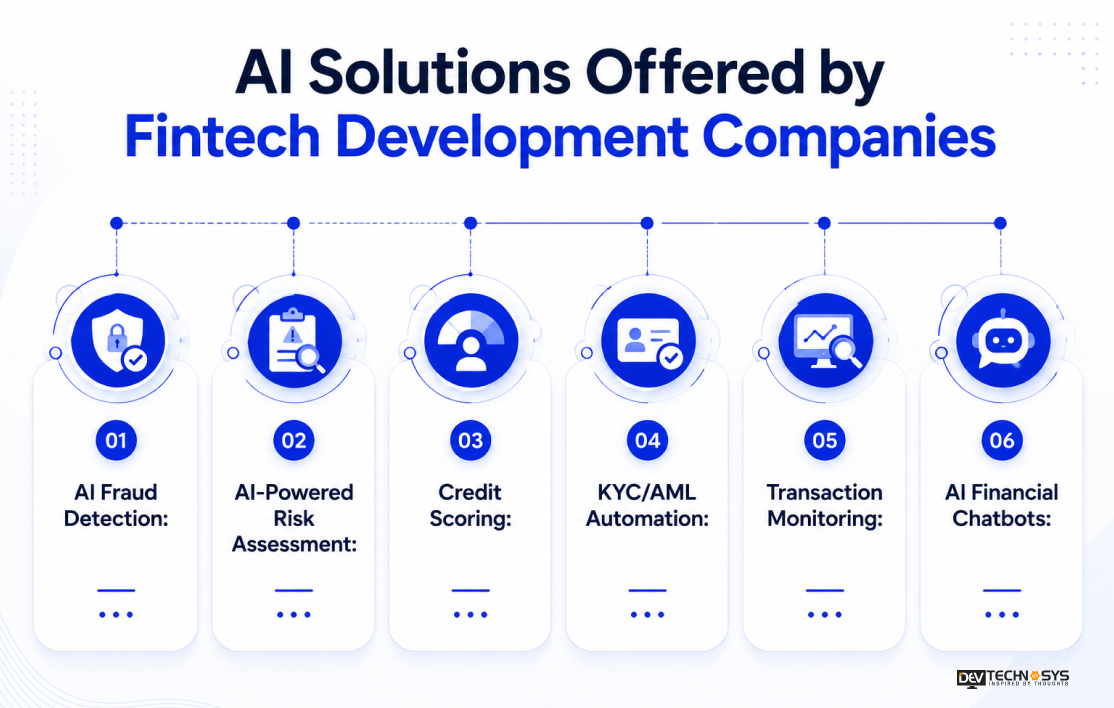
- AI Fraud Detection: Top companies that provide AI solutions for financial services identify suspicious transactions and unusual behavior in real time to help prevent financial fraud.
- AI-Powered Risk Assessment: Top DeFi development services providers will analyze financial and behavioral data to evaluate credit, operational, and transaction-related risks.
- Credit Scoring: Uses AI models to assess borrower data and support faster, data-driven lending decisions.
- KYC/AML Automation: Automates identity verification, customer screening, and suspicious-activity checks to streamline compliance workflows.
- Transaction Monitoring: Continuously analyzes transactions to detect anomalies, unusual patterns, and potentially fraudulent activity.
- AI Financial Chatbots: Provide automated customer support for account queries, payments, financial guidance, and routine banking tasks.
What is the Cost of AI Development for Fintech?
The starting cost of AI-powered fintech platforms is around $4,999, and it can exceed $ 100,000. However, it’s not a fixed cost. The actual cost to develop an AI-powered fintech solution depends on AI complexity, features, integrations, security requirements, data infrastructure, and compliance needs.
The key fintech app development cost-affecting factors include AI model complexity, data preparation, third-party API integrations, cloud infrastructure, security, regulatory compliance, UI/UX, testing, and ongoing model maintenance.
AI Fintech Solution |
Estimated Cost |
Development Complexity |
| AI Financial Chatbot | 4,999–15,000 | Basic |
| Credit Scoring System | 15,000–35,000 | Moderate |
| KYC/AML Automation | 20,000–50,000 | Moderate |
| AI Risk Assessment | 25,000–60,000 | Advanced |
| Fraud Detection System | 30,000–80,000 | Advanced |
| Comprehensive AI Fintech Platform | 50,000–100,000+ | High |
Key Security and Compliance Considerations for Fintech AI
Fintech AI systems handle sensitive financial data and high-impact decisions, making security and regulatory compliance essential. Key considerations include:
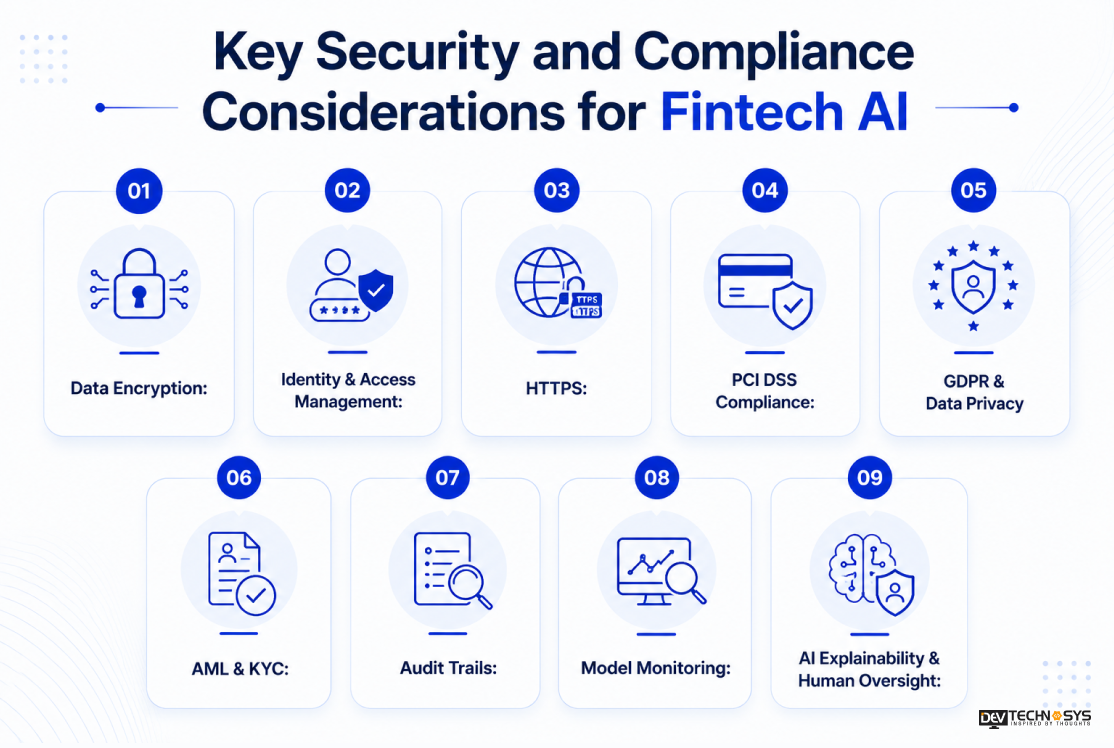
- Data Encryption: Encrypt crucial pieces of financial and personal information while it is being stored or exchanged in order to minimize unauthorized access and exposure of data.
- Identity & Access Management: Employ Role Based Access Control principles, secure authentication, and least privilege permissions to ensure data protection.
- HTTPS: When building applications, implement HTTPS technologies and secure APIs through authentication, authorization, and encryption processes, including continuous monitoring.
- PCI DSS Compliance: Comply with PCI DSS regulations when processing, storing, or transferring cardholder data in order to enhance security in payments.
- GDPR & Data Privacy: Ensure personal information is captured, processed, stored, and erased in line with established data privacy standards, while respecting users’ rights.
- AML & KYC: Apply automated verification of clients and their operations to comply with anti-money laundering regulations and identify potential money launderers.
- Audit Trails: Keep transcripts of transactions, data, system attempts, and AI conclusions to establish grounds for future investments, guarantees, as well as fairness.
- Model Monitoring: Keep watching over models to ensure that the conducted AI process is reliable, still efficient, and fair.
- AI Explainability & Human Oversight: Make high-impact AI decisions understandable and provide human review mechanisms for lending, credit, fraud, and other sensitive financial decisions.
Conclusion
AI is reshaping fintech through smarter fraud detection, automated compliance, faster risk assessment, and personalized financial services. The companies covered offer different combinations of AI expertise, fintech experience, security, and integration capabilities. Before choosing a reliable Fintech software development company, compare their relevant expertise, portfolio, technology stack, development cost, scalability, compliance knowledge, and post-launch support.
Frequently Asked Questions
Find answers to the most common questions related to this article.
Evaluate the company's experience with financial data pipelines, banking API integrations, fraud detection models, regulatory requirements, model explainability, and secure deployment. Ask how it handles model drift, auditability, and post-deployment monitoring.
Yes. AI developers can build models using supervised and unsupervised learning to identify suspicious transactions, detect abnormal spending patterns, and flag emerging fraud risks. Model performance depends on data quality, feature engineering, and continuous retraining.
Integration typically involves REST APIs, microservices, event-driven architectures, and secure data pipelines. Models can connect with payment gateways, core banking platforms, loan management systems, and transaction monitoring tools without replacing the entire infrastructure.
Ownership depends on the development agreement. Fintech businesses should clarify intellectual property rights, source code ownership, model artifacts, training data usage, third-party model licenses, and restrictions on vendor reuse before signing a contract.
They can implement model documentation, feature attribution, decision logs, version control, and human-review workflows. These controls help financial institutions understand model outputs, investigate decisions, and maintain audit trails.