


















Today, enterprises are competing with each other to adopt blockchain technology in their businesses. Given the complexity and rapid evolution of blockchain technology, launching a successful decentralized Blockchain platform requires a committed team, subject-matter knowledge, and the appropriate funding.
Sadly, even blockchain platforms frequently fall short. Having worked on several dApps and Blockchain platforms, we know that selecting the incorrect blockchain development platform is a fundamental factor in this failure.
Key takeaways:
-
- The global blockchain-as-a-service (BaaS) market is expected to reach $25.7 billion by 2027, due to the increasing demand for integration-ready platforms with API-first architecture.
- To choose the right blockchain for your business, understand your requirements. Whether you need a public, private, or consortium blockchain based on your business goals.
- Blockchain solutions are now used across finance (36%), supply chain (22%), and healthcare (12%) sectors.
- Identifying your use case helps narrow down the ideal type (public, private, or hybrid).
So, which blockchain should your business use in 2025? To prevent you from adding your name to the list of failed projects, we will examine several issues related to selecting the blockchain for business in this blog.
However, choosing the right blockchain platform for project development needs a deep understanding of the blockchain technology and awareness of project requirements and business. Keep reading to learn how to choose blockchain platform for your business. So. Let’s begin!
Market Overview of Blockchain
- The blockchain market size is expected to rise from USD 15.20 billion in 2024 to USD 776.47 billion by 2035, representing a CAGR of 42.98%, during the forecast period 2024–2035.
- According to a study, 80% of the time, blockchain technology is used for completely changing the existing business processes in enterprises

- North America’s blockchain technology market dominated globally in 2024, accounting for a 37.4% share of the global revenue.
- The blockchain technology market in the U.S. is expected to grow at a significant CAGR from 2025 to 2030.
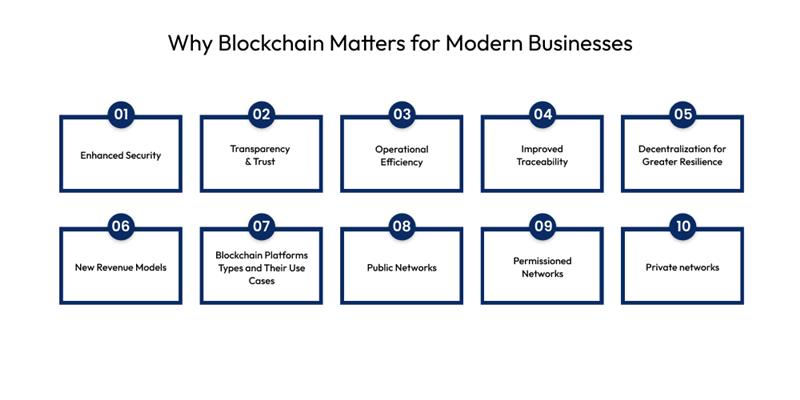
Why Blockchain Matters for Modern Businesses
In today’s digital-first economy, trust, transparency, and efficiency are critical pillars of business success. But why should businesses choose blockchain platform? Well, because traditional systems are not doing enough, burdened by intermediaries, fragmented data, and security vulnerabilities.
1. Enhanced Security
There are various blockchain benefits for business. It uses cryptographic techniques and distributed consensus to secure data. Once recorded, information on the blockchain cannot be altered, making it ideal for fraud prevention and secure transactions.
2. Transparency & Trust
Transactions are traceable and verifiable in real-time. Choose the right blockchain to build trust with customers, regulators, and partners, especially in sectors like finance, supply chain, and healthcare.
3. Operational Efficiency
According to a top smart contract development company, Smart contracts increase work efficiency by automating workflows and reducing dependency on intermediaries. Blockchain scalability leads to faster, error-free processes and lower operational costs.
4. Improved Traceability
Blockchain provides a tamper-proof audit trail. Blockchain for enterprise allows businesses to trace products from origin to sale, enhancing quality control and regulatory compliance, especially in food, pharmaceuticals, and logistics.
5. Decentralization for Greater Resilience
Companies providing blockchain development services know the greater resilience blockchain provides. blockchain reduces the risk of a single point of failure by distributing data across nodes. It makes networks more resilient and resistant to censorship.
6. New Revenue Models
Blockchain enables tokenization, decentralized finance (DeFi), and digital ownership (NFTs), unlocking new monetization opportunities across industries. Which is why it is crucial to choose the best blockchain for business.
Blockchain Platforms Types and Their Use Cases
There are three types of blockchain development platforms: private, permissioned, and public networks. Draw the blockchain network comparison and choose the right blockchain platform for your business.
1. Public Networks
Public Networks are decentralized networks in which anybody can participate in any capacity, exchanging tokens, mining cryptocurrencies, operating entire nodes, etc.
However, they are typically slower to use and more expensive. According to a Web3 development company, they aren’t usually regarded as a crucial Blockchain platform for entrepreneurs because of this.
2. Permissioned Networks
While drawing blockchain platform comparison, Permissioned networks are open to the public but restrict access to specific users. In comparison to public networks, they typically offer high storage capacities, minimal latency, and speed.
3. Private networks
While drawing differentiation between public vs private blockchain, private blockchain networks are those that are only accessible to a select group of reliable parties.
They have no latency and are pretty quick. The majority of private blockchain networks lack the immutability and security benefits of decentralized networks, as well as Bitcoin use.
In the table below, we will list the various blockchain use cases for businesses for Public, Permissioned, and Private networks to assist you in analyzing the key differences between the Blockchain systems.
Network Type |
Definition |
Blockchain use cases for businesses |
| Public Blockchain | Fully decentralized and open to anyone. All participants can read, write, and validate data. | – Used to develop a Crypto Payment Gateway (e.g., Bitcoin, Ethereum) – Decentralized Finance (DeFi) – NFTs & dApps |
| Permissioned Blockchain | Publicly visible but controlled participation (only verified users can transact or validate). | – choose blockchain platform for Supply chain transparency – Cross-border payments – Government registries |
| Private Blockchain | Access is limited to a trusted group of participants. Offers high speed but limited decentralization. | – Enterprise data sharing – Internal auditing – Healthcare record management – Banking systems |
How to Select the Right Blockchain for Your Business?
Whether it’s Ethereum vs Solana or Polygon vs Binance, it is important to evaluate each blockchain solution before choosing the right blockchain platform for your business. Here are the step-by-step evaluation checklist that can help you make right decision:
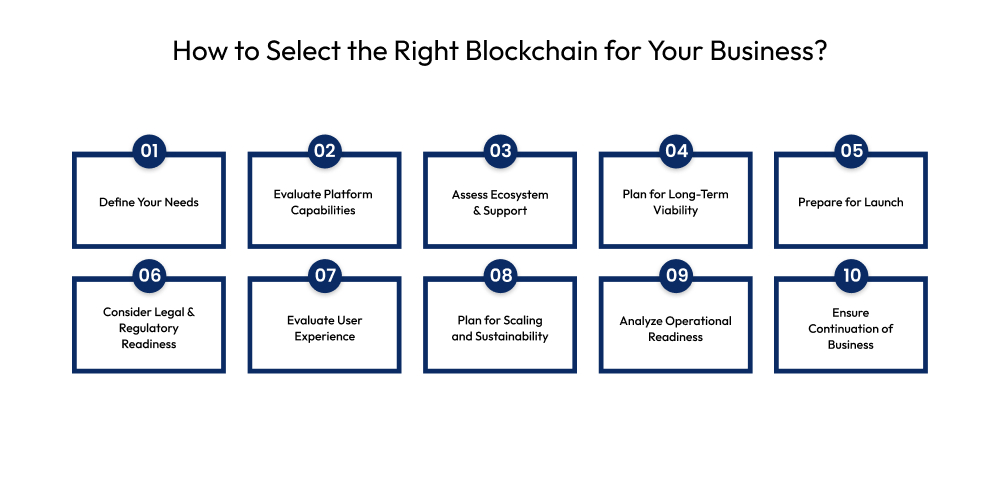
Phase 1: Define Your Needs
- Evaluate Use Case Clarity: What problem are you solving? (Public or private blockchain needed?)
- Evaluate Participants & Trust: Who are the users? How much trust is required among them?
- Evaluate Privacy & Compliance: How sensitive is the data? What regulations apply?
Phase 2: Evaluate Platform Capabilities
- Evaluate Performance: What TPS and latency do you need? Is it scalable for growth?
- Evaluate Security & Consensus: How secure is it? What consensus mechanism is used?
- Evaluate Smart Contracts: Are Smart Contracts Necessary? What languages are supported?
- Evaluate Integration: How well does it integrate with existing systems?
Phase 3: Assess Ecosystem & Support
- Evaluate the Developer Community: do they provide strong developer support and access to resources?
- Evaluate Maturity: What’s the platform’s track record and existing adoption?
- Evaluate Costs: What is the blockchain app development cost?
- Evaluate Governance: How are decisions made for platform updates?
Phase 4: Plan for Long-Term Viability
i. Evaluate Upgradability & Flexibility:
Can the right blockchain platform adjust to your growing business needs? Does it support seamless protocol upgrades or modular customization?
ii. Evaluate Interoperability:
When selecting blockchain for business, ask questions such as: Does it support cross-chain communication or integration with other blockchain networks, like Ethereum, Polkadot, or Cosmos?
Bonus Read: How to Develop a Decentralized Voting System Using Blockchain?
iii. Evaluate Hosting & Infrastructure Options:
Can you host it on the cloud, on-premises, or through Blockchain-as-a-Service (BaaS)? What infrastructure flexibility does it offer?
Phase 5: Prepare for Launch and Growth
i. Evaluate Testing & Dev Tools:
Does the platform offer robust dev environments, testnets, and debugging tools (e.g., Truffle, Remix, Hardhat)?
Read more: Top Blockchain Applications
ii. Evaluate Maintenance & Support Plans:
Is there any need for post-launch maintenance when using ?, Are updates, monitoring, and bug fixes managed by third-party vendors or internally?
Phase 6: Consider Legal & Regulatory Readiness
i. Evaluate Legal Jurisdiction & Compliance:
Does blockchain integration in business come with legal restrictions? Does the blockchain comply with data protection laws (e.g., GDPR, HIPAA)? Is its jurisdiction aligned with your business operations?
ii. Evaluate Tokenization & Asset Management Rules:
If your use case includes NFTs, what legal guidelines should you follow for issuing, selling, and managing them?
Phase 7: Evaluate User Experience & Adoption
- Evaluate User Accessibility: Can users easily interact with blockchain ? Are there friendly UIs, wallets, and onboarding flows?
- Evaluate Reputation & Industry Acceptance: Do mega businesses or institutions in your industry rely on this platform?
Phase 8: Plan for Scaling and Sustainability
- Evaluate Energy Efficiency: Does the platform use a sustainable consensus model (e.g., Proof of Stake)? Important for ESG-conscious businesses.
- Bonus Tip: Always prototype your solution on a testnet before committing to a full deployment. It reduces cost and prevents major missteps.
Phase 9: Analyze Operational Readiness
i. Evaluate Required Technical Skills:
Does your internal team possess the expertise to create and maintain a blockchain app? Is there a need to hire an in-house team or outsource the work?
ii. Evaluate Monitoring & Analytics Tools:
Does the platform support real-time monitoring, custom metrics, and an analytics dashboard for blockchain activity?
Phase 10: Ensure Continuation of Business & Risk Mitigation:
i. Evaluate Data Recovery & Backup Options:
What entails if a node or service crashes? Is there any built-in strategy for backup and recovery?
ii. Evaluate Vendor Lock-In Risks:
Are you tied to a single vendor or proprietary system, or is the platform open-source and modular enough to allow migration later?
Want a chatbot demo or pricing? Fill the form and talk to our experts today.
Pick what you need below — you can select more than one — then tap Get detail to continue.
-
Chatbot demo dashboard
-
Cost to develop an app
-
Industry report
-
Case study
Best Blockchain Solutions For Small and Medium Businesses
Here are some of the Top enterprise blockchains for secure business operations for small and medium businesses:
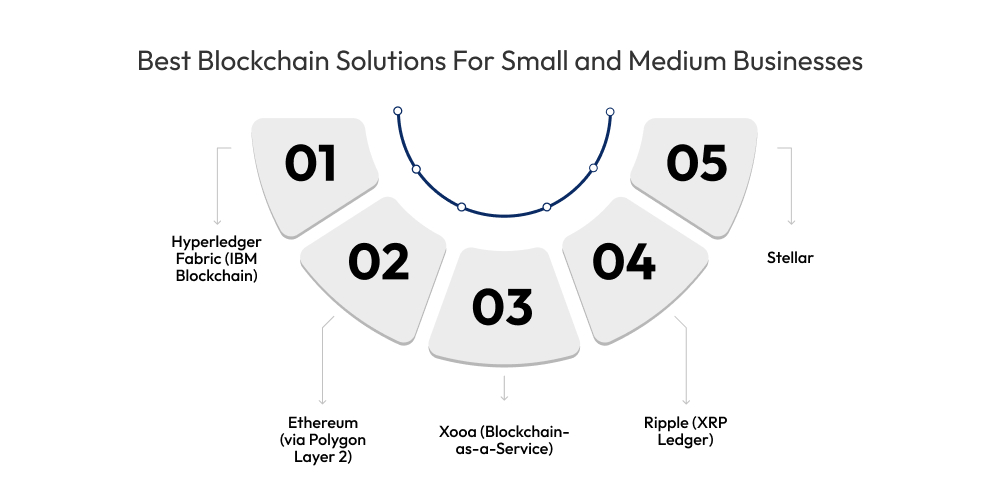
1. Hyperledger Fabric (IBM Blockchain)
Type: Permissioned (Private)
If you’re a small logistics company, healthcare provider, or manufacturer looking to securely share data internally or with trusted partners, Hyperledger Fabric is an ideal solution.
Choose blockchain platform like this that allows full control over who accesses your data, while still benefiting from blockchain’s immutability and transparency.
how dapps work for SMBs:
- Permissioned access = data control
- Ideal blockchain for supply chain, auditing, and contract management
- Supported by enterprise providers like IBM, with managed services
Note: Hyperledger Fabric works best with tech consulting or managed services for setup.
2. Ethereum (via Polygon Layer 2)
Type: Public (Layer 2 scalability)
Have a tech team expert in Ethereum development services who can help you build your own blockchain solution, like a rewards system, NFT project, or smart contract-driven workflow. Ethereum is the most supported public blockchain, and Polygon makes it affordable and scalable.
Choose blockchain platform like Ethereum for:
- Loyalty tokens
- Custom apps (dApps)
- Community platforms
3. Xooa (Blockchain-as-a-Service)
Type: BaaS (Supports Hyperledger, Ethereum)
If you’re a non-technical founder or small team, choose blockchain platform like Xooa. blockchain-as-a-service type like Xooa lets you launch blockchain apps without writing complex code.
If you are selecting blockchain for business or startups, BaaS type is perfect for pilots, MVPs, or internal projects like digital certificates or verifiable records.
Why it’s great:
- No-code/low-code interface
- Integrates with Google Sheets, Salesforce, etc.
- Build smart apps quickly
4. Ripple (XRP Ledger)
Type: Permissioned (Finance-focused)
Ripple is both a company and a blockchain-based payment protocol powered by the XRP Ledger. It’s primarily used by banks, fintechs, and enterprises for real-time gross settlement systems and liquidity management. According to the top companies that offer NFT marketplace development services, Ripple is the ideal solution for small-scale businesses.
Why SMBs choose Ripple:
- Choose blockchain platform like Ripple for high-speed, scalable payments.
- Banks and financial services trusts Ripple.
- Ideal for large international transfers & invoice settlements.
- XRP acts as a bridge currency for liquidity.
5. Stellar
Type: Public
Stellar is an open-source, decentralized blockchain network designed to facilitate cross-border payments and microtransactions. It focuses on connecting financial systems while being lightweight, fast, and cost-effective.
Steller is Best for:
- Microtransactions & global user payments.
- Fast & low-cost transactions (~2–5 seconds)
- Ideal for small payments, digital wallets, and remittances.
- Supports multiple currencies on-chain.
Note: Stellar blockchain is great for NGOs, freelancers, and global e-commerce.
Factors to Consider When Selecting a Blockchain for Business
Choosing the right blockchain platform is an important decision that can significantly impact the success and long-term viability of a project. There’s no one-size-fits-all solution, the best choice depends heavily on the specific use case, business requirements, and the desired balance of decentralization, security, and scalability.
Here are the key factors to consider when selecting a blockchain for business:
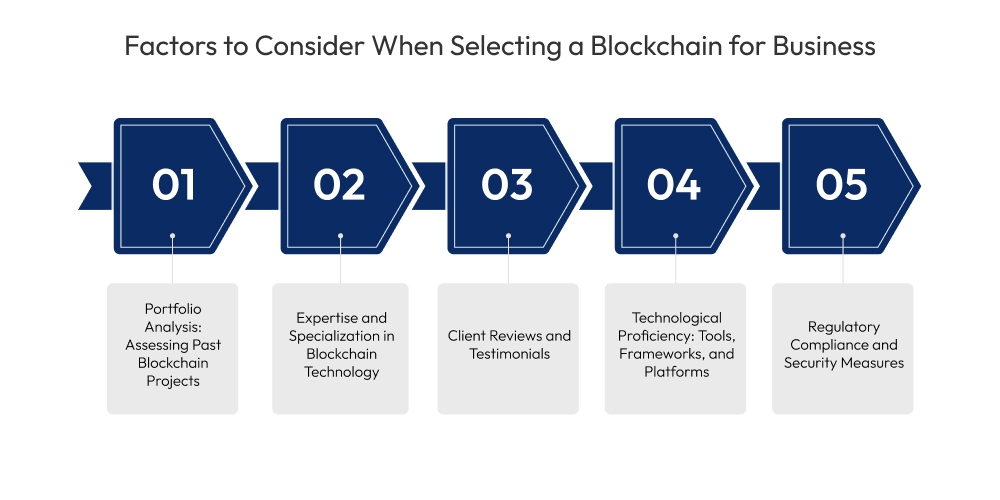
1. Portfolio Analysis: Assessing Past Blockchain Projects
According to firms offering cryptocurrency development services, a comprehensive review of the firm’s portfolio provides insights into its capabilities. Examine the diversity and complexity of past blockchain development projects, ensuring they align with your project’s scope and objectives.
2. Expertise and Specialization in Blockchain Technology
The foremost consideration is the firm’s expertise in blockchain development technology. Assess their proficiency in various blockchain development frameworks, consensus algorithms, and smart contract development.
Specialization in relevant domains, such as finance, healthcare, or supply chain management, adds value to your project.
3. Client Reviews and Testimonials
Client feedback offers invaluable perspectives on a development firm’s performance. Scrutinize reviews and testimonials to gauge client satisfaction, communication efficiency, and the Hyperledger blockchain development company’s ability to meet project deadlines.
4. Technological Proficiency: Tools, Frameworks, and Platforms
Evaluate the firm’s technological proficiency by examining the tools, frameworks, and platforms they employ. A robust understanding of the latest blockchain development technologies ensures the development of scalable and future-proof solutions.
5. Regulatory Compliance and Security Measures
In the dynamic landscape of blockchain app development services, it is crucial to follow every regulatory standard. Ensure the chosen Cardano blockchain development firm follows industry guidelines and includes robust security methods to protect your project against potential threats and vulnerabilities.

Pros & Cons of Blockchains Based on Use Case
While drawing blockchain platform comparison, keep in mind that all blockchain platforms have their advantages and drawbacks. Hire blockchain developers who are aware of the pros and cons of implementing blockchain technology into your project. Here are some of the pros and cons of blockchain based on the use cases. Let’s see what these pros and cons are:
1. Public Blockchain: Pros & Cons
Use Cases: Cryptocurrencies, DeFi, NFTs (require maximum decentralization & transparency)
Pros:
- High Trust & Security: Unparalleled decentralization and immutability.
- Transparency: All transactions are publicly visible.
- Open Innovation: Fosters broad community development.
Cons:
- Scalability Issues: Often slower transaction speeds and higher fees.
- No Privacy: All data is public (though pseudo-anonymous).
- Energy Use (PoW): Can be energy-intensive.
2. Private Blockchain: Pros & Cons
Use Cases: Supply chain, interbank, healthcare (require control, privacy & speed)
Pros:
- High Performance: Choose blockchain platform for faster transactions and better scalability.
- Privacy: Data is visible only to authorized participants.
- Cost-Efficient: Lower operational and transaction costs.
- Customization: Tailorable to specific business needs.
Cons:
- Less Decentralized: Control by a single entity or consortium.
- Requires Trust: Participants must trust the network operator.
- Limited Transparency: Data is not publicly auditable.
Mistakes to Avoid When Selecting a Blockchain
It is best to avoid the common mistakes like ignoring security measures, neglecting stability issues, and failing to understand the conscious mechanisms before choosing the Business-grade blockchain for your project. Let’s learn about these common mistakes in detail:
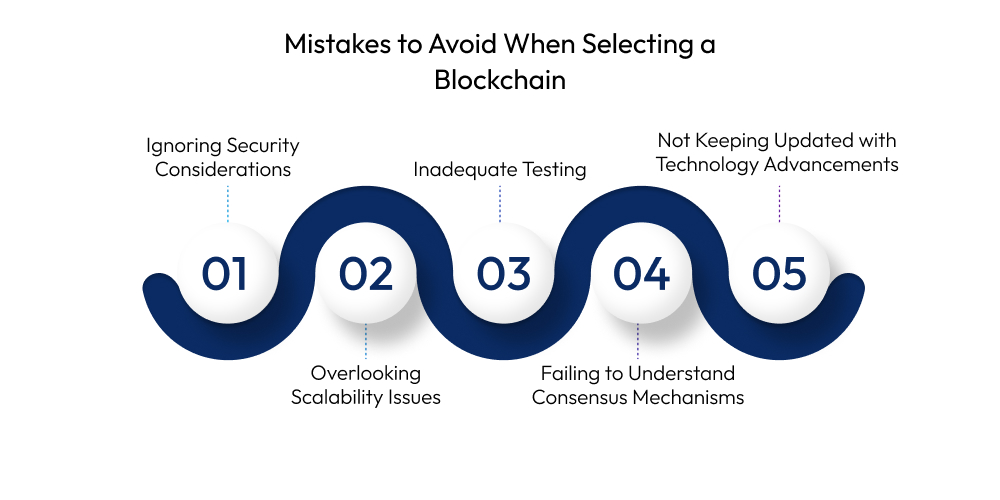
1. Ignoring Security Considerations
One of the biggest reasons to worry in blockchain development is security. Generally, for many developers, the center of focus is ensuring the smooth functionality of their application.
Bonus Read: how dapps work
Placing undivided focus on one aspect leads to neglecting another essential aspect, which is security. This neglect in security considerations can make your application susceptible to hacks and breaches.
Solution:
- Prioritize security from day one
- Adopt secure coding practices.
- Conduct regular code audits.
- Stay current with security advisories and updates.
2. Overlooking Scalability Issues
Blockchain scalability is a challenge known to everyone. congestion or slow performance is a common issue that occurs due to scalability limitations, some blockchain networks experience , which affects user experience and application efficiency.
Solution for scalability issues:
- Select scalable consensus mechanisms (e.g., Proof of Stake)
- Consider sidechains or Layer 2 solutions.
- Design with modular scalability in mind from the beginning.
3. Inadequate Testing
Failing to rigorously test blockchain applications is one of the most common mistakes people make. Given the irreversible nature of blockchain, a bug in smart contracts could lead to severe financial loss or data corruption.
Solution:
- Utilize testing frameworks such as Truffle, Hardhat, or Ganache.
- Perform unit, integration, and security testing
- Always deploy to testnets before going live
4. Failing to Understand Consensus Mechanisms
Any top blockchain development company understands the importance of consensus mechanisms. To develop an efficient blockchain app it is vital to understanding the consensus mechanisms that are essential for blockchain networks. Failing to comprehend consensus mechanisms can lead to inefficient and risky blockchain applications.
Solution:
- Study types of consensus: Proof of Work (POW), Proof of Stake (POS), DPoS, etc.
- Ensure the use cases align with the best suitable mechanism.
- Don’t blindly follow trends; understand the technical trade-offs.
5. Not Keeping Updated with Technology Advancements
According to firms that provide Solana blockchain development. The blockchain ecosystem is growing at a rapid rate, with new frameworks, improvements, and technologies emerging frequently. Stagnation can render your skills obsolete.
Solution:
- Follow tech blogs, attend blockchain events, and join developer forums.
- Subscribe to updates from major platforms (e.g., Ethereum, Solana, Polygon).
- Continuously upgrade your knowledge and toolset.
Conclusion
The above blog dissects the methods and key factors you need to consider before choosing the right blockchain for your business. In this blog, we discussed blockchain platform types, the key factors to consider, the common mistakes to avoid, when choosing blockchain for your project. We hope this blog help you in selecting the best blockchain solutions for small and medium businesses.
If you are a business looking for top tier blockchain platform development, then contact Dev technosys, a leading mobile app development agency, and stay tuned for more informative updates.
FAQs
Q1. What Is The Difference Between Public, Private, And Consortium Blockchains?
A. The difference between public, private, and consortium blockchain are:
- Public blockchains are open and decentralized (e.g., Ethereum).
- Private blockchains are restricted to trusted users (e.g., Hyperledger).
- Consortium blockchains are controlled by a group (e.g., Quorum).
Experts advise to choose based on your need for transparency vs. control.
Q2. Which Blockchain Is Best For A Small Or Medium Business (SMB)?
A. Platforms like Stellar, Hyperledger Fabric, or Polygon are great for small or medium businesses because they offer low fees, scalability, and ease of integration.
Q3. Do I Need To Know Coding To Use Blockchain In My Business?
A. No, you don’t always have to know coding to use blockchain. There are low-code/no-code platforms like Xooa or managed blockchain services (AWS, IBM) that simplify deployment.
Q4. How Do I Choose Between Ethereum And Other Blockchains Like Solana Or Cardano?
- Choose Ethereum for large ecosystems and DeFi apps.
- Go with Solana for high-speed, low-cost apps.
- Choose Cardano for secure, research-driven projects.
Base your decision on speed, cost, developer support, and community.
Q5. Is Blockchain Secure For Business Use?
A. Yes, if implemented correctly. Use well-established platforms, secure smart contract practices, and regular audits to reduce risk.
Q6. Can Blockchain Integrate With My Existing Systems like CRM, ERP?
A. Yes. Many blockchain platforms support APIs and middleware tools to integrate with systems like SAP, Salesforce, or Oracle.