





















Businesses aiming to take advantage of the quickly growing global hotel booking industry, with travelers now focusing on mobile-first reservations, check-in, and personalized guest stays, will be best positioned by building their own hotel booking apps.
This industry is expected to reach $500+ billion by 2030, driven by increased mobile phone ownership and the rise of digital tourism. Building such apps will enable businesses to deliver intuitive user experiences, offer tailored AI-powered recommendations, secure online payments, and display real-time room availability.
Although the cost to build a hotel booking app depends upon various factors like complexity, set of features, platform of development, design, and the tech stack used.
A clear insight into hotel booking app development costs (from the simplest booking service to an advanced travel destination) shows that a profitable, scalable app is required for the future. If you are interested in investing in this industry in 2026, this blog is for you.
How Much Does It Cost to Build A Hotel Booking App?
Hotel booking app development costs range from $8,000 to $28,000+, depending on the app’s features and complexity. While an app with elementary features like displaying hotel rooms, booking functionality and a payment gateway is estimated to be $8,000–$18,000, apps with added advanced features like detailed search filters, reviews, push notifications, analytics etc can go up to $18,000–$28,000, while an entire enterprise scale hotel booking application with features like AI personalization, CRM integration, multilingualism and real time inventory management costs more than $30,000. Also, the tech stack and development location will significantly affect the total cost of the hotel booking app.
App Complexity |
Estimated Hotel Booking App Development Cost |
| Basic Hotel Booking App | $8,000 – $18,000 |
| Medium Hotel Booking App | $18,000 – $28,000 |
| Complex/Enterprise Hotel Booking App | $30,000+ |
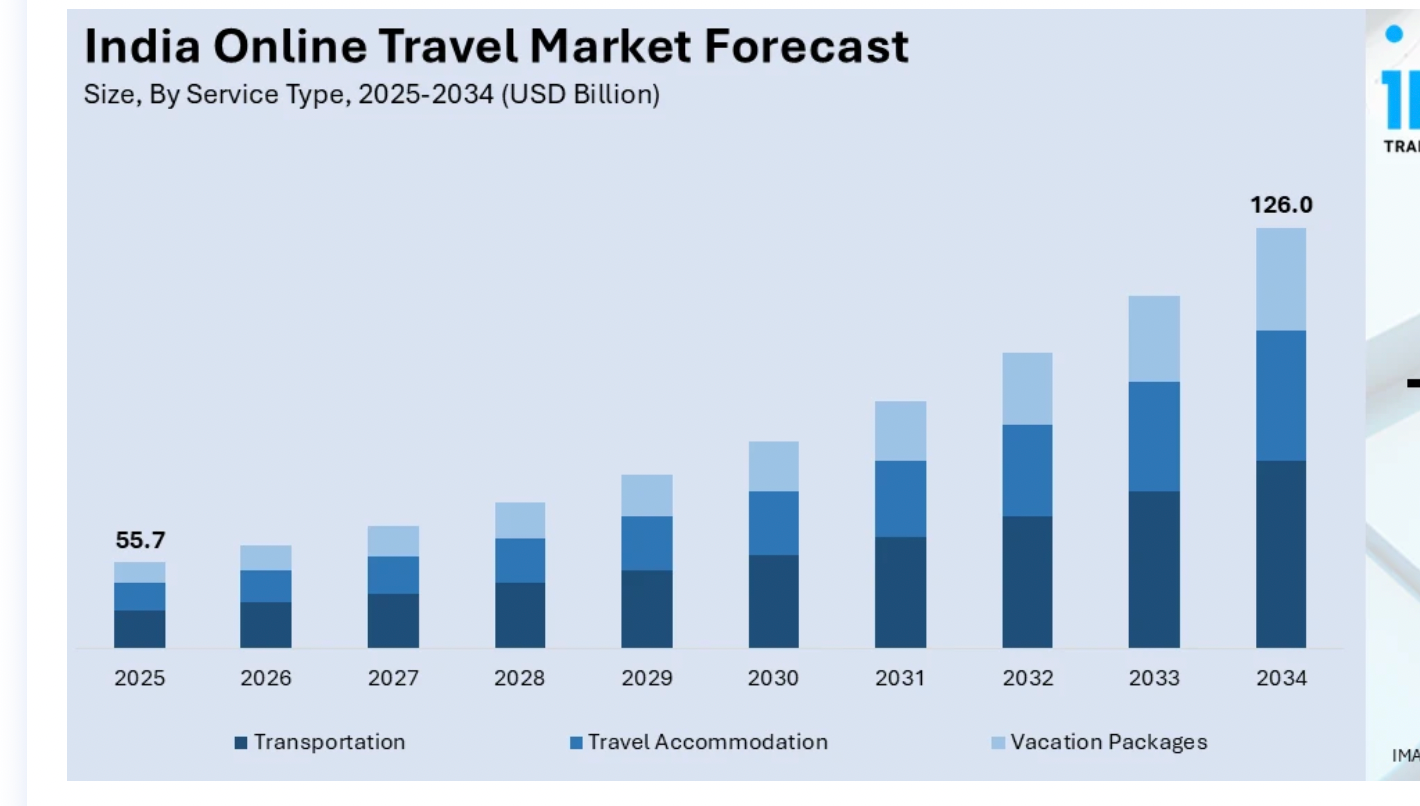
Hotel Booking App Market in India
https://www.imarcgroup.com/india-online-travel-market
- It is estimated that the online travel market in India will reach $126 billion by 2034, from $55.7 billion in 2025 (CAGR of 9.2%).
- With mobile booking accounting for 65.37% of the total bookings in the Indian online travel segment in 2025, the demand for mobile hotel booking apps is huge.
- The mobile hotel booking segment is expected to grow in India at a CAGR of 14.39% by 2031.
- The market is gaining momentum due to an increase in the adoption of smartphones and digital payments. OTAs (Online Travel Agencies) currently hold a market share of 81.74% in the Indian online travel segment, thereby indicating a potentially lucrative mobile hotel booking app business.
- Mobile-first applications such as Agoda, Booking.com and MakeMyTrip dominate the hotel booking industry based on mobile booking strategies and loyalty programs.
- In 2025, hotels and resorts will make up 47.58% of the online accommodation market share in India. Hotels booking apps are expanding to Tier-2 and Tier-3 Indian cities as cheap internet access andUPI payment facilities are rising, coupled with increasing tourism numbers.
8 Factors Affecting the Hotel Booking App Development Cost
Several factors related to technology, design, and operations can influence the hotel booking website development cost. Being aware of these factors can help businesses establish realistic budgets for creating scalable applications that meet their objectives and customer expectations.
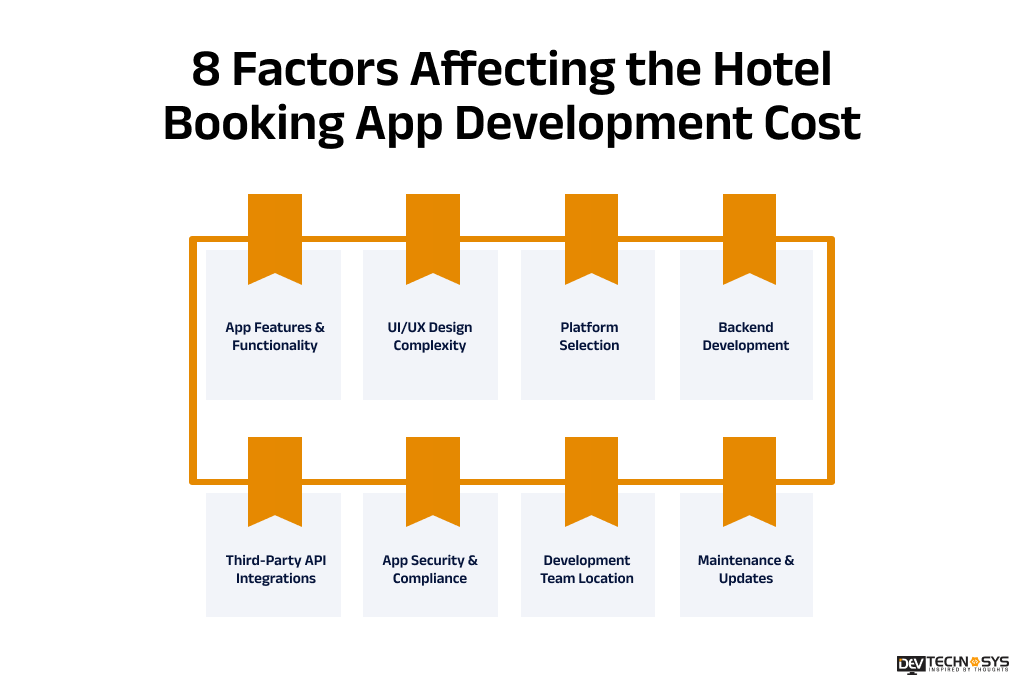
Cost Affecting Factor |
Estimated Cost Impact |
| App Features & Functionality | +$3,000 – $10,000 |
| UI/UX Design Complexity | +$2,000 – $6,000 |
| Platform Selection | +$4,000 – $12,000 |
| Backend Development | +$3,000 – $8,000 |
| Third-Party API Integrations | +$1,500 – $5,000 |
| App Security & Compliance | +$2,000 – $7,000 |
| Development Team Location | Varies by hourly rates and region |
| Maintenance & Updates | 15% – 25% of total app cost annually |
1. App Features & Functionality
The quantity of features strongly influences the hotel booking app development cost. For example, a set of essential functions such as listing hotels, booking, payment, and registering users are usual ways to hold down costs.
On the other hand, adding highly sophisticated features like AI recommendations, loyalty programs and live availability will raise the hotel booking app cost significantly, yet still within the $8, 000, $30, 000 range. Also, if you want to include an AI function, it will also impact the cost because it will require you to hire AI development services or providers.
2. UI/UX Design Complexity
If you go for a simple and minimalist UI, your expenses will be comparatively low. On the other hand, if you need a spectacular, highly-interactive and completely customized app, i.e., one with advanced animation, personalized dashboards and high-end user experience, then it obviously requires more design hours that will reflect in your overall hotel booking app development costs, which can range between $8, 000 and $30, 000.
3. Platform Selection
Whether an app is made for Android, iOS, or both platforms is another factor that modulates hotel booking app development pricing. An app targeting only one platform will be a cheaper option, whereas an app developed cross-platform or natively for multiple devices will definitely require more resources/to be a more expensive project. It is so that it can explain why the hotel booking app development costs are in the scope of the hotel booking app project budget range.
4. Backend Development
Bookings, hotel information, payments, and customer profiles are the major backend items. The hotel booking app development cost will be kept down with a straightforward backend design, while a feature-rich cloud-based network, real-time data sync, and top-notch security database systems will require a large amount of money, thus significantly impacting the final hotel booking app development pricing.
5. Third-Party API Integrations
There are a lot of hotel booking app features and aspects that require integration, such as payment gateways, maps, SMS notifications, analytics, and hotel inventory APIs.
Increasing the number of third-party services integrated in the platform leads to higher maintenance & online hotel reservation system development cost remaining within the projected $8, 000, $30, 000 budget.
6. App Security & Compliance
Encryption of payments, secure login systems, GDPR compliance, and data protection mechanisms are highly challenging development concepts. Spending on security is necessary not only to gain customer confidence but also for carrying out risk-free transactions, which in turn will affect the hotel booking app development cost.
7. Development Team Location
Besides the skill level, the hourly rates of a mobile application development company also vary by region. It is much cheaper to hire a hotel booking app development company from a country like India than from the US or Europe.
Offshore hotel booking app development services is a beneficial way for businesses to get the hotel booking app features that they need without increasing initial cost accommodation booking app development costs which range from $8, 000 $30, 000.
8. Maintenance & Updates
Continuous maintenance post-launch, fixing bugs, managing servers, and upgrading features are some of the recurring expenses. Performing updates at regular intervals not only enhances the overall app performance but also the user experience, which makes app maintenance a significant factor affecting the hotel booking app development cost and operational investment in the long term.
7 Hidden Charges in Hotel Booking App Development Cost
Besides the initial booking app development cost, companies also need to factor in hidden costs such as maintenance, API subscriptions, hosting, security upgrades, and marketing, which most probably will have a notable impact on the overall hotel booking app investment.
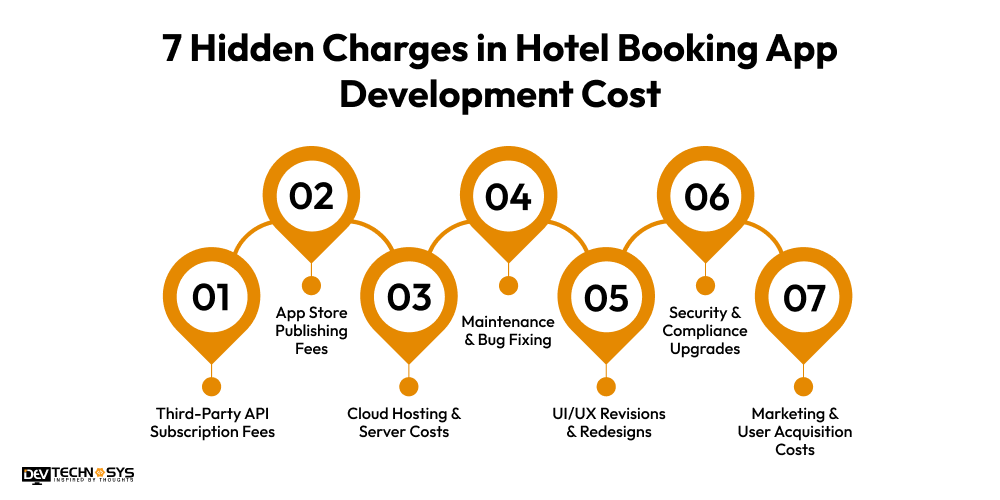
Hidden Charges |
Estimated Additional Cost |
| Third-Party API Subscription Fees | $500 – $5,000/year |
| App Store Publishing Fees | $25 – $100/year |
| Cloud Hosting & Server Costs | $200 – $3,000/month |
| Maintenance & Bug Fixing | 15% – 20% of total app cost annually |
| UI/UX Revisions & Redesigns | $1,000 – $5,000 |
| Security & Compliance Upgrades | $2,000 – $8,000 |
| Marketing & User Acquisition Costs | $3,000 – $15,000+ |
1. Third-Party API Subscription Fees
Some of the most common APIs hotel booking apps depend on include those that provide maps, payment gateways, hotel inventory, SMS alerts, and analytics. Most of the time, companies charge for their services on a monthly or yearly basis through subscriptions, and it is these subscription fees that many people tend to forget, even when planning their budgets.
2. App Store Publishing Fees
In order to publish an app on platforms such as Google Play and Apple App Store, one has to pay registration fees. Apple requires an iOS app development firm’s annual fees, while Google only requires a one-time payment. Although these expenses may be individually negligible, they do add up and can be accounted for in the cost to build a hotel booking app.
3. Cloud Hosting & Server Costs
For hotel booking apps, reliable cloud hosting is a must-have in order to efficiently handle bookings, user traffic, and real-time updates. Server costs will increase as the number of users grows.
Moreover, companies hardly ever consider in their initial travel and hotel booking app development pricing, including hosting, bandwidth, and storage.
4. Maintenance & Bug Fixing
Right after the launch, apps will need monitoring around the clock, performance enhancement, and bug fixing. Doing maintenance on a regular basis not only supports smooth functionality but also keeps up with security updates.
However, these continuous expenses are very often not taken into account during the budgeting phase, thus leading to unexpectedly heavy financial burdens for the owners of hotel booking apps.
5. UI/UX Revisions & Redesigns
While developing a project, companies usually want to make further design alterations in order to improve the user experience. Additional draft changes, animated features, or a complete rework of the interface will require more design hours, which will ultimately increase travel app development cost, thus making UI/UX changes one of the most frequent hidden development costs.
6. Security & Compliance Upgrades
Apart from upgrading security to protect customer details, enterprises also carry out other procedures like setting up secure payment methods, encrypting databases, and adhering to compliance requirements. These hotel booking website and app development costs are almost always neglected when the initial cost of building a hotel booking app is forecasted.
7. Marketing & User Acquisition Costs
Building a pool of app users also demands investment in marketing efforts such as app store optimization, paid ads, and promotional activities. The majority of the time, these user acquisition costs are not taken into account while preparing the hotel booking app development company budget. However, these costs to build a hotel booking app contribute significantly to download volumes, user engagement, and business expansion.
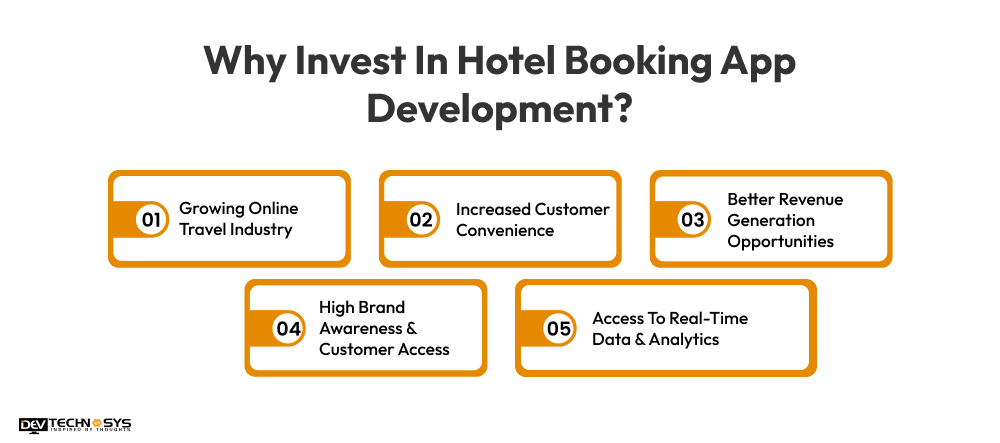
Why Invest In Hotel Booking App Development?
More people are booking their travel online and using their phones as their main device. If you want to build a hotel booking mobile app, you should know it will be a good move for businesses; it will not only offer them ways to enhance the customer experience, get more bookings done directly, and at the same time raise the brand visibility, but also open up new revenue streams for the long term in the hospitality sector.
1. Growing Online Travel Industry
Digitization is taking the travel and hospitality industry by storm, with mobile booking taking over other modes of booking, as per the survey of travelers.
Investing in hotel booking app development is the right decision for the business in this situation, as it will help the company reach a large number of people, get more bookings directly, and at the same time be prepared to compete with others in the growing online travel market.
2. Increased Customer Convenience
Hotel booking apps make it possible for users to perform hotel searches, price comparisons, room reservations, and payment transactions at any time from their cell phones.
This level of convenience by itself raises the level of satisfaction of the customers, promotes user engagement, and also increases the number of times customers book a hotel in the future. It is a way through which hospitality businesses stand to obtain higher long-term revenues.
3. Better Revenue Generation Opportunities
There are multiple profit channels generated by a hotel booking app, including commissions, premier listing, ads, subscriptions, and travel partner dealings.
With the ability to offer tailored deals and programs, provide unique promotions and customer loyalty schemes to potential customers, businesses can not only increase the popularity of a wider range but also can enormously boost the efficiency of their business in booking.
4. High Brand Awareness & Customer Access
The use of Mobile applications facilitates hotels and travel businesses to build a strong web identity and access customers across the world. Through push notifications, personalized offers and a smooth booking process, business firms can retain customers and increase brand awareness and also nurture relationships with travelers across regions of the world.
5. Access To Real-Time Data & Analytics
With the help of the hotel’s booking apps, the businesses get a complete picture regarding the information of the customers, booking behavior of the customers and customer interaction with the app.
Business organizations use this data to fine-tune pricing, optimize marketing strategies, deliver more relevant and individualized experiences to users and make profitable decisions that would ensure success for the hotel businesses.
5 Popular Hotel Booking App Development With Their Cost Breakdown
Leading hotel booking apps demonstrate the difficulty in development, the business model to consider, and the functions that are essential to them. Their approximate costs demonstrate how much it costs and what it entails to budget, scale, and provide effective functions to develop hotel booking apps.
Popular Hotel Booking App |
Estimated Development Cost |
| Agoda | $20,000 – $30,000 |
| Tripadvisor | $18,000 – $30,000 |
| Kayak | $20,000 – $30,000 |
| Booking.com | $22,000 – $30,000 |
| Airbnb | $25,000 – $30,000 |
1. Agoda
The cost to build a hotel booking app like Agoda will cost anything between $20,000-$30,000, packed with a hotel listings page, booking management, multiple language support, payment gateway integration, discount programs, and real-time availability of rooms. It helps travelers and accommodations around the world have a robust hotel booking app.
2. Tripadvisor
Building an app like Tripadvisor would cost around $18,000-$30,000, depending on what the client is expecting the app to do. What would need to be addressed is travel tips and reviews, a book engine, maps, user-generated content, and an AI search system, which could maximize customer satisfaction.
3. Kayak
The cost to develop a hotel booking app like Kayak is anywhere between $20,000- $30,000 depending on what would be added. It is a fairly complex and expensive app, as one of the highest costs is adding filters, comparison features, travel deals, and live booking, but it does allow travelers to compare different deals quickly.
4. Booking.com
To build an app like booking.com would cost approximately $22,000- $30,000 to build. This would involve making sure that the payment system has been made secure, inventory has been properly managed, and bookings can be easily confirmed and reviews left, as well as the need to support multiple languages. Personalized recommendations is another factor that could boost reservations.
5. Airbnb
The cost to build an app such as Airbnb could come in at approximately $25,000- $30,000. With travel app development and booking systems like this, it has the potential to be fairly complex; it would require user identification and a sophisticated system to ensure easy handling and payment of bookings, but it would be a great and useful addition to have.
5 Ways To Reduce The Hotel Booking App Development Cost
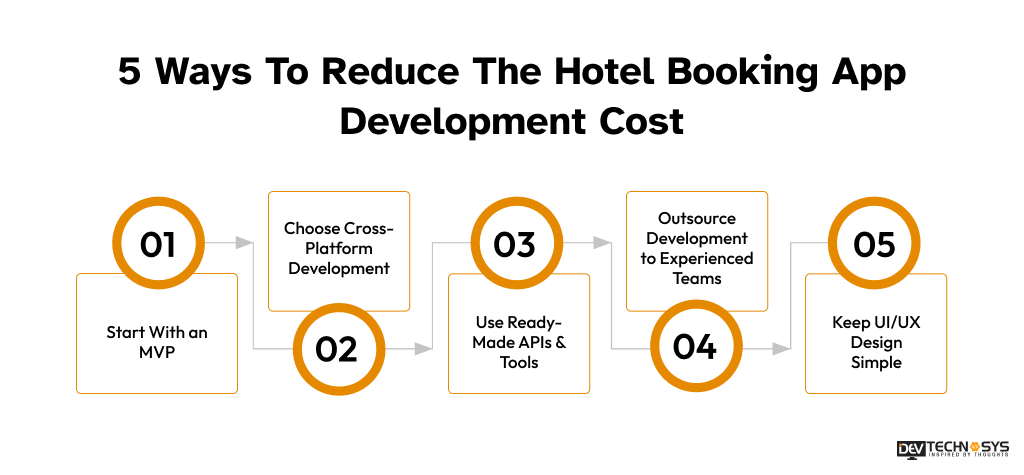
There are several ways through which a business can reduce the hotel booking mobile app development cost. Selecting the suitable technology stack, creating an MVP, offshore development, utilizing ready-made integrations, and focusing on core functionality during the initial development phase are a few ways that can be adopted.
1. Start With an MVP
By creating an MVP, you will be focusing only on the main functionality: the hotel listings, booking, and payment. You can lower your hotel booking mobile app development cost, shorten your time to market, and then later add additional advanced features depending on your users’ needs and preferences.
2. Choose Cross-Platform Development
By developing your Android and iOS app with cross-platform technologies such as Flutter or React Native, you reduce development time and resource needs considerably. Hence you also lower your overall hotel booking app development cost while ensuring high functionality and excellent performance.
3. Use Ready-Made APIs & Tools
Integrating ready-to-use APIs to add payment solutions, map integration, notification services, hotel inventory, etc. Reduces the coding needed on your part. By incorporating ready-made APIs you save both time and costs related to the hotel booking mobile app development cost and also maintain high efficiency.
4. Outsource Development to Experienced Teams
Hiring offshore hotel app development teams or a team of dedicated professionals from the more affordable locations in India can drastically cut your development costs. These experienced professionals help you create scalable hotel booking apps that maintain quality without burning your pockets.
5. Keep UI/UX Design Simple
The total cost to develop the hotel booking app will also significantly decrease with a clean and easy to navigate UI. The complex animated transitions and features of highly customized designs would only consume additional hours, money, and time for design, development, and testing while a user-friendly UI experience will easily win over your customers.
Essential Features Every Hotel Booking App Must Have With Development Cost
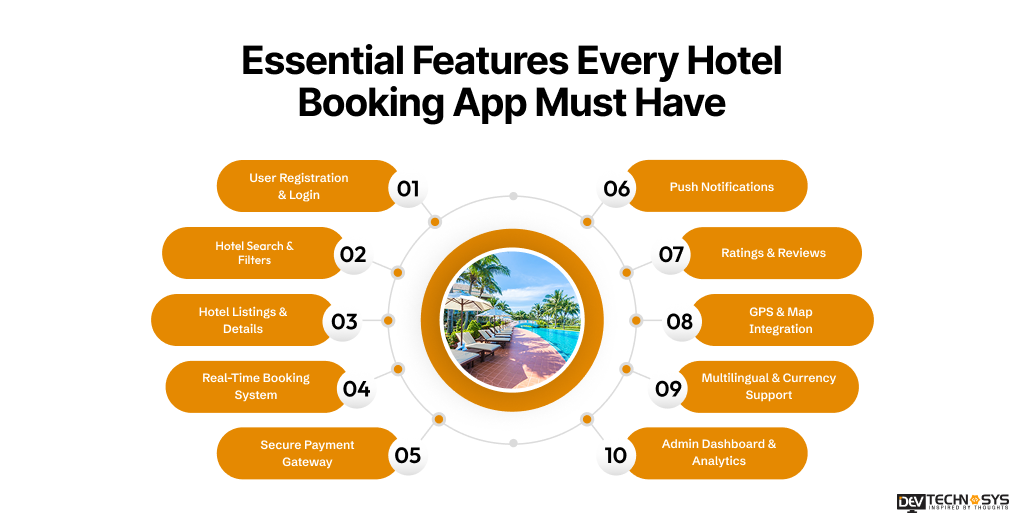
The core requirement of a successful hotel booking app is to present engaging and convenient features that make the booking experience better for the users and efficient for managing hotels, also increasing customer interaction. Right from secure payments to a real-time booking system, every feature impacts the cost and success of the hotel booking app development.
Essential Feature |
Estimated Development Cost |
| User Registration & Login | $500 – $1,000 |
| Hotel Search & Filters | $800 – $1,500 |
| Hotel Listings & Details | $700 – $1,200 |
| Real-Time Booking System | $1,000 – $2,500 |
| Secure Payment Gateway | $800 – $1,500 |
| Push Notifications | $400 – $800 |
| Ratings & Reviews | $500 – $1,000 |
| GPS & Map Integration | $600 – $1,200 |
| Multilingual & Currency Support | $700 – $1,500 |
| Admin Dashboard & Analytics | $1,000 – $2,000 |
1. User Registration & Login – Cost: $500–$1,000
Secure sign-up and login functionality for accessing personalized bookings and managing your hotel reservations seamlessly will impact the overall hotel app development cost estimate.
2. Hotel Search & Filters – Cost: $800–$1,500
Advanced filters will enable the search for hotels by location, price range, ratings, amenities, or room availability to quickly make booking decisions.
3. Hotel Listings & Details – Cost: $700–$1,200
With this feature, you can compare and choose the best hotels for your journey by viewing hotel details like room types, prices, amenities, descriptions, photos, and policies.

4. Real-Time Booking System – Cost: $1,000–$2,500
Make real-time room bookings for a hassle-free travel experience by checking the live availability of the rooms, getting instant booking confirmations, and receiving automated booking management.
5. Secure Payment Gateway – Cost: $800–$1,500
Allow the online booking of hotels without the stress of payment procedures using cards, wallets, net banking, and UPI transactions safely and conveniently.
6. Push Notifications – Cost: $400–$800
Send personalized push alerts to notify users about their booking status, promotions, discounts, travel updates, or reminders to drive user engagement and improve customer retention.
7. Ratings & Reviews – Cost: $500–$1,000
This is another feature that is essential, and impacts travel booking app development cost. Build customer trust and credibility for your platform by featuring genuine traveler reviews and ratings of the listed hotels.
8. GPS & Map Integration – Cost: $600–$1,200
Enhance user experience and planning for trips by offering them to view the exact locations of hotels and points of interest nearby while providing them with easy navigation support.
9. Multilingual & Currency Support – Cost: $700–$1,500
Offer enhanced global reach to customers across diverse geographical regions and languages by supporting multi-language and multi-currency services.
10. Admin Dashboard & Analytics – Cost: $1,000–$2,000
Admin, which takes a huge share in the list of functions, as it increases the hotel reservation app development cost. Allow them to efficiently manage all bookings, customer details, hotel listings, revenue figures, and analytical reports using a back-end admin panel.
5 Monetization Strategies For Hotel Booking App Development
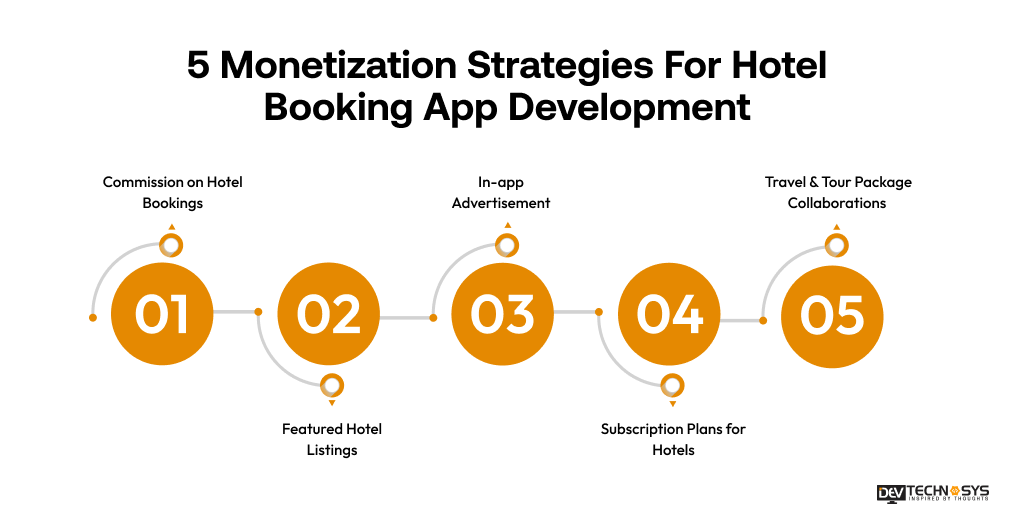
There are a variety of business strategies a hotel booking app can utilize to earn a constant stream of revenue. This selection of the right business strategy will assist the company in maximizing its earnings, improving user engagement, and building a strong, sustainable future in the competitive tourism market.
1. Commission on Hotel Bookings
By implementing commission-based monetization strategies, apps charge hotels a certain percentage of each successful reservation made through them. This provides the app with a stable revenue flow and allows hotels to broaden their client base by getting better bookings and accessibility to a vast network of travelers.
2. Featured Hotel Listings
Apps that offer featured listing solutions and give prominence in the search results for hotels will charge a price for those featured listing solutions. By taking a fee from businesses for preferred listing, the app will increase its revenue streams and, at the same time, provide a tremendous amount of visibility for hotels to generate many clients for them.
3. In-app Advertisement
Businesses from the travel sector can use the customer base available in the hotel booking app for displaying advertisements related to travel products or services.
An additional revenue can be generated from showing paid ads (on a pay-per-click or impression basis) to the customers without interfering with the booking purpose of the application.
4. Subscription Plans for Hotels
Hotels may purchase subscription plans from the hotel booking application and enjoy various additional benefits, such as an analytics dashboard, marketing tools, priority listing features, and customer feedback data.
The apps that provide various subscription plans for hotels can increase their revenue by charging monthly or yearly fees and, in return, boost the visibility for the hotel, leading to more bookings.
5. Travel & Tour Package Collaborations
Collaboration with travel agents and tour operators allows hotel booking apps to sell not only hotel rooms but also vacation packages, tour tickets, and transport options in and around the city.
Such applications get a commission from every purchase, and this, in turn, will increase the revenue stream of the app from various sources, rather than just booking rooms at hotels, increasing the business profitability of the app.
3 Challenges in Hotel Booking App Development
There are several technical and operational hurdles associated with the custom hotel booking app development solutions. Among them are the management of real-time inventory, ensuring payment security, and dealing with fierce market competition. Businesses need to work through such challenges in order to attain long-term success and offer consistent customer experiences.
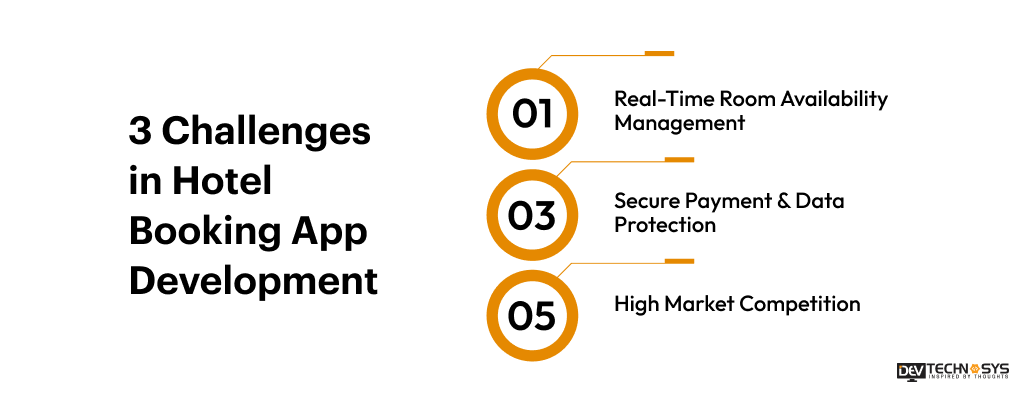
1. Real-Time Room Availability Management
Handling real-time hotel inventory, making pricing adjustments, and updating room availability across different hotel locations is quite a task. Any lag or synchronization error may result in double bookings, which lead to customer dissatisfaction and create operational difficulties for hotel booking platforms.
2. Secure Payment & Data Protection
Hotel booking apps store and process highly sensitive information regarding their customers and their payments. Therefore, security becomes a top priority.
Providing encrypted transactions, rejecting fraud attempts, and ensuring compliance with data protection laws are some of the factors that not only enhance the security of the app but also add to the overall intricacy of app development and maintenance.
3. High Market Competition
The hotel booking industry is fiercely competitive, with the biggest platforms controlling the lion’s share of the market. To grab the users’ attention and keep them coming back, businesses need to offer a variety of things, such as unique features making use of the latest technology, personalized experiences, and excellent, fast customer service, along with attractive pricing strategies.
How Dev Technosys Can Help You Build a Hotel Booking App In 2026 at an Affordable Cost?
Developing hotel booking apps is one of the most lucrative investments of the time if one is aiming to grow their business in the rising digital travel industry. Real-time booking systems, secure payments, AI-assisted recommendations, multilingual capabilities, etc are just a few features of a comprehensive app that can help enhance customers’ experience and add to one’s revenue.
However, one should understand that hotel booking software development costs, along with the hidden charges, features, and monetization models, play an important role in building a scalable and competitive platform in the travel industry today.
Dev Technosys is the go-to hotel booking app development service provider for businesses that want to develop hotel booking software using the latest tech, scalable architecture, and highly functional UX/UI designs. Having more than 15 years of combined experience, Dev Technosys can provide you with quality hotel booking app development solutions that match your business requirements.
Frequently Asked Questions
Find answers to the most common questions related to this article.
Generally, the hotel booking app building cost for startups is considered to be around $8,000 to $30, 000,. However, the travel booking app development cost is based on the features, hotel app developers' location, complexity of the app, one or multiple platforms to be developed, third-party integrations, and custom business requirements for scalability and growth, etc.
On average, creating a simple hotel booking app should take from 2 to 4 months; however, advanced platforms with AI features, live inventory, and custom integrations may require extended development and testing time before the launch.
Companies should consider incorporating hotel listings, booking engines, secure payment options, push notifications, customer reviews, multilingual capabilities, an analytics dashboard, and AI-powered recommendations to enhance the customer journey and have maximum engagement and revenue opportunities.
Hotel booking applications generate revenue through booking commissions, featured listings, subscription plans, ads, travel collaborations, and premium offerings, thus adding multiple sources of income, while enhancing customer loyalty and brand awareness in the hospitality sector.
Hire dedicated developers who have years of experience in delivering scalable architecture, secure integrations, top-notch technologies, and post-launch assistance, which enables businesses to develop dependable hotel booking apps that not only enhance operational efficiency and customer satisfaction but also lead to the overall growth of the business.