











Quick Summary:
The food delivery app development cost ranges from $30,000 to $1,50,000. The basic food delivery app development cost range is between $30,000 and $60,000. The mid-ranging apps can cost up to $60,000 to $100,000. An advanced food delivery platform may exceed $1,50,000, depending on real-time tracking, payment integrations, and scalability requirements.
cost Impacted by project or development complexity:
- Simple/MVP-Based Apps ($30,000 – $60,000): Meal delivery app development Include features like user registration & login, restaurant listings, menu browsing, cart system, basic order placement, and simple admin panel.
- Mid-Complex Apps ($60,000 – $100,000): Offer functionalities such as real-time order tracking, push notifications, restaurant POS integration, multiple payment gateways, ratings & reviews, and delivery management.
- Complex/Enterprise Applications ($1,50,000+): Include advanced features like AI-based recommendations, machine learning personalization, route optimization, multi-vendor support, live order tracking, and analytics dashboard.
Cost Based on Different Countries/Regions:
-
- North America: $40 – $90/hr
- Western Europe: $35 – $60/hr
- Eastern Europe: $40 – $70/hr
- India/Southeast Asia: $15 – $25/hr
Additional Cost:
-
- Maintenance Services: The maintenance cost of a single restaurant delivery app is approximately 15% to 20% of the initial development cost annually.
- Advanced Enterprise Exchange: 8 to 14+ months or more
The demand of food delivery apps are griowing rapidly, as a result of changing lifestyle of people. So much so, that the food delivery mobile application market is expected to continue growing at a CAGR of 13.39%, reaching USD 18.67 Billion by 2032, as stated by Research And Markets.
For Businesses, especially start-ups, it is the golden opportunity to set foot in this competitive yet lucrative industry. However, one aspect that they must consider before moving on with development, is the development cost.
Are you also a business wondering how much does food app development cost? The answer depends on the area you are creating the app in, the features you want to add to it, and the team you wish to choose to hire. Restaurant delivery app development costs can differ widely based on types, hourly development rates, technical expertise, and infrastructure.
In this guide, we break down the cost to build a food delivery app, helping startups and businesses plan smarter, avoid hidden expenses, and choose the right online food delivery app development strategy with confidence.
What is a Food Delivery App?
Food delivery apps are mobile platform that connects customers with local restaurant owners and retailers. Online food ordering apps allow users to browse multiple restaurants, search for their favorite restaurants, choose, customize, and pay for food all within one app.
These apps often manage the courier service using independent contractors, allowing restaurants without their own drivers to offer delivery. The best restaurant delivery app will provide live, GPS-based tracking of the driver and order progress. Popular food delivery apps include: DoorDash, Uber Eats, Grubhub, and Postmates.
Industry Insights:
Statista reports that the Global online food delivery revenue is projected to reach $1.39 trillion by 2026
What is the Average Cost to Build a Food Delivery App?
To tell the exact cost to build a food delivery app is difficult, as it depends on various factors like features, platform choice, development expertise, app type and complexity, and more.
In general, the restaurant mobile app development cost can range from $30,000 to $1,50,000. The development cost of a food delivery app with basic features and functionalities will range from $30,000 to $60,000. Food pickup and delivery apps with mid-level complexity is around $60,000 to $100,000.
On the other hand, the cost to develop a food delivery app will be higher in comparison due to the addition of advanced features, specialized developers, and more resources. The cost to develop a food delivery app with advanced features may exceeed $1,50,000+.
App Complexity |
Estimated Development Cost |
Development Timeline |
Best For |
| Basic (MVP) | $30,000 – $50,000 | 3–5 Months | Startups & MVPs |
| Medium Complexity | $50,000 – $90,000 | 5–8 Months | Growing Businesses |
| Advanced / Enterprise | $90,000 – $150,000+ | 8–12+ Months | Large Enterprises |
Want a chatbot demo or pricing? Fill the form and talk to our experts today.
Pick what you need below — you can select more than one — then tap Get detail to continue.
-
Chatbot demo dashboard
-
Cost to develop an app
-
Industry report
-
Case study
Why Budgeting is Crucial in Food Delivery App Development?
Budgeting is essential for on-demand delivery app development because it defines what you can realistically build, how fast you can launch, and how scalable your app will be in the future. Without a clear budget, projects often face delays, feature cuts, or unexpected cost overruns. A well-defined budget ensures faster launch, better performance, and sustainable growth in a highly competitive market.
- Helps define a clear MVP scope with essential features first
- Prevents unexpected cost overruns during development
- Guides proper selection of technology stack and architecture
- Ensures scalable backend planning for future growth
- Helps balance features, performance, and user experience
- Optimizes allocation of budget across design, development, and testing
- Reduces long-term maintenance and technical debt issues
- Supports faster and more structured app development and launch
How Does the Type of Food Delivery App Affect Development Cost?
The type of on-demand meal service app you choose plays a major role in shaping the overall food delivery and cloud kitchen app development cost. Each model requires different features, integrations, and infrastructure. As functionality and operational complexity increase, so does the development time, technical effort and cost.
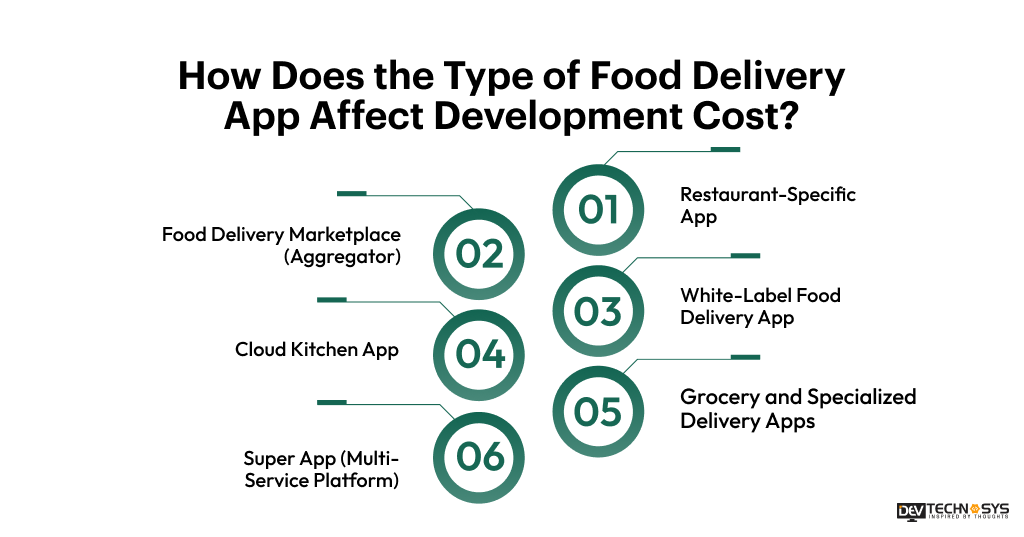
1. Restaurant-Specific App:
These restaurant specific food delivery app development cost with source code are needed by individual restaurant chains, like Domino’s or McDonald’s, allowing customers to order directly from the restaurant. They are generally more cost-effective for both the restaurant and the consumer.
Key Characteristics:
- Single restaurant or single brand system
- Simple ordering and checkout flow
- Basic admin dashboard for menu and orders
- Payment gateway integration
- Push notifications and order tracking
2. Food Delivery Marketplace (Aggregator)
Multi-vendor food delivery app development cost is around $60K to $120K. Platforms like DoorDash, Uber Eats, and Grubhub connect users with multiple restaurants and manage deliveries using their own courier network. These food delivery marketplace apps are more complex due to multi-restaurant support, live tracking, and payment integration.
Key Characteristics:
- Multi-vendor onboarding (restaurants + delivery partners)
- Real-time order tracking and dispatch system
- Advanced search and filtering for restaurants
- Commission-based revenue model
- Admin panel with analytics and controls
3. White-Label Food Delivery App
A white-label food delivery app is a pre-built solution that can be quickly customized with branding, colors, logo, and basic feature adjustments. It is mainly used by startups or small restaurants that want to launch quickly without building from scratch. The white label food delivery app cost varies based on features and functionalities.
Key Characteristics:
- Pre-built core system (customer app, admin panel, basic delivery flow)
- Limited customization flexibility
- Faster deployment and lower development risk
- Depends heavily on vendor/platform capabilities
4. Cloud Kitchen App
A cloud kitchen app is designed for delivery-only restaurant businesses that operate without dine-in facilities. It focuses on centralized kitchen operations, order management, and delivery optimization across multiple brands. The cost to build a cloud kitchen management software or app lies between $50K to $100K.
Key Characteristics:
- Multi-brand kitchen management system
- Real-time order routing and dispatch system
- Inventory and kitchen workflow tracking
- Integration with delivery partners or in-house fleet
- Analytics for demand forecasting and kitchen efficiency
5. Grocery and Specialized Delivery Apps:
Apps such as Seamless, Instacart, Getir, and GoPuff focus on delivering groceries, household essentials, and convenience items. They require inventory management, fast delivery logistics, and real-time stock updates. The grocery delivery app development cost ranges between $80K to $140K
Key Characteristics:
- Real-time inventory and stock management
- Multiple delivery categories (groceries, pharma, essentials)
- Advanced logistics and route optimization
- Dynamic pricing and offers system
- Warehouse or store-level integration
6. Super App (Multi-Service Platform)
A super app is a large-scale digital platform that combines multiple services like food delivery, grocery ordering, ride-hailing, payments, and more into a single ecosystem. It requires advanced architecture, strong scalability, and deep third-party integrations.
Key Characteristics:
- Multi-service ecosystem (food, grocery, transport, payments, etc.)
- Microservices-based backend architecture
- High scalability and load handling for millions of users
- Advanced user personalization and recommendation engine
- Integrated payment gateway, wallet, and loyalty system
- Real-time tracking across multiple services
Type of App |
Development Complexity |
Estimated Cost |
Real-World Examples |
| Restaurant-Specific App | Low | $35,000 to $80,000 | McDonald’s App, Domino’s App, Starbucks App |
| White-Label Food Delivery App | Low to Medium | $25,000 to $70,000 | GloriaFood, ChowNow-based apps, Toast TakeOut clones |
| Cloud Kitchen App | Medium | $50,000 to $100,000 | Rebel Foods (EatSure), Kitchen United |
| Food Delivery Marketplace (Aggregator) | High | $60,000 to $120,000 | Uber Eats, DoorDash, Zomato, Swiggy |
| Grocery +Specialized Delivery Apps | High | $80,000 to $140,000+ | Instacart, Gopuff, BigBasket |
| Super App (Multi-Service Platform) | Very High | $90,000 to $150,000+ | Gojek, Grab, Careem |
Industry Insights
According to Grand View Research Report: The restaurant to consumer segment is anticipated to grow at a CAGR of 5.8% during the forecast period, driven by the digitization of restaurant operations.
What Key Factors Influence Food Delivery App Development Cost?
Several factors determine the cost to develop a food delivery app, including features, platform choice, team location, and integrations. Understanding these key elements helps businesses plan budgets effectively and avoid unexpected expenses.
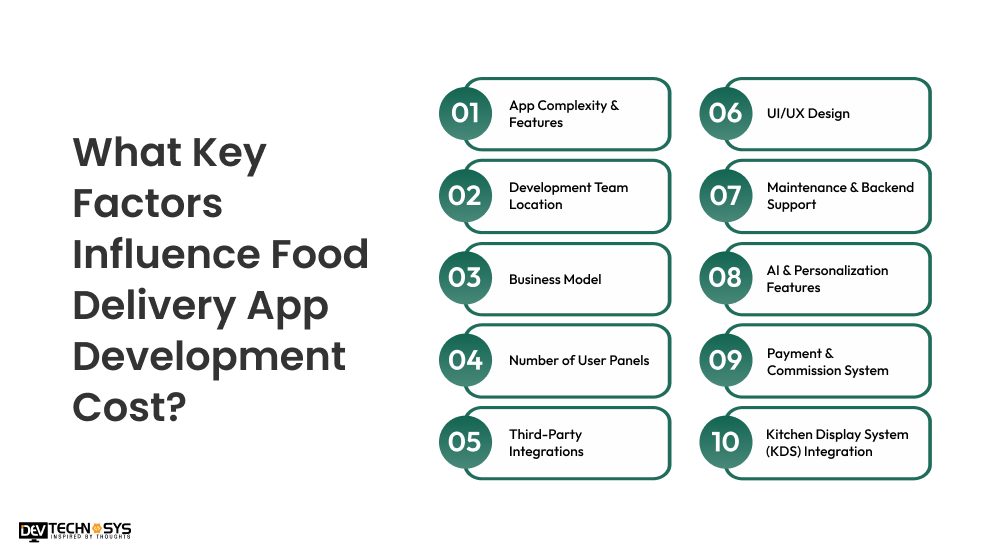
1. App Complexity & Features
The complexity of your mobile food ordering service app is one of the most significant factors affecting the cost. The more features you include, the higher the cost will be. Food delivery app like Glovo often include multiple user roles such as Customers, Drivers, Restaurant Owners, and Admins.
Each role requires a unique set of features, dashboards, and workflows. Advanced functionalities such as real-time order tracking, AI-powered recommendations, and loyalty programs add layers of complexity that directly increase the custom food delivery app development cost.
Estimated Cost Impact: +20%–40%
Complexity Level |
Estimated Cost |
Timeline |
Scope |
| Basic MVP | $30,000 – $50,000 | 2–4 Months | Core ordering, payments, basic tracking |
| Medium | $50,000 – $90,000 | 4–7 Months | Multi-role system, notifications, loyalty |
| Advanced | $90,000 – $150,000 | 7–12 Months | AI, real-time tracking, advanced analytics |
2. Development Team Location
The development team can impact how much does it cost to make a food delivery app in USA. Developers in North America and Western Europe typically charge premium rates due to higher living costs, whereas developers in Asia, Latin America, or Eastern Europe offer competitive pricing without necessarily compromising quality. The cost to hire mobile app developers varies from region to region, so plan the budget accordingly.
Strategic selection of a team based on location can help you balance budget constraints with development expertise, especially for startups or small businesses.
Estimated Cost Difference: 30%–60%
Region |
Estimated Cost Impact |
Timeline |
Notes |
| USA / Western Europe | $100,000 – $150,000 | 6–10 Months | Highest hourly rates, premium quality |
| Eastern Europe | $60,000 – $100,000 | 5–9 Months | Balanced cost & expertise |
| Asia (India, etc.) | $30,000 – $80,000 | 4–8 Months | Cost-effective, scalable teams |
Industry Insights:
Mordor Intelligence states that the Asia‑Pacific region accounts for the largest share of global food delivery activity (over 40%) and is expected to grow fastest through 2031. Stated by Motor Intelligence.
3. Business Model
The type of food delivery business you choose significantly affects food delivery app development costs. A restaurant-specific app is less expensive because it serves a single business, while marketplace platforms require vendor onboarding, commission management, and delivery coordination. Cloud kitchen and super apps demand even more complex workflows and scalable backend architecture.
Estimated Cost Impact: +20% to 45%
Model Type |
Estimated Cost |
Timeline |
Complexity |
| Restaurant App | $30,000 – $60,000 | 2–4 Months | Low |
| Marketplace (Uber Eats-like) | $60,000 – $120,000 | 5–9 Months | High |
| Cloud Kitchen | $50,000 – $100,000 | 4–8 Months | Medium–High |
| Super App | $120,000 – $150,000+ | 8–12+ Months | Very High |

4. Number of User Panels
Every user group requires its own interface, backend logic, and testing. A typical food delivery platform includes a Customer App, Restaurant Dashboard, Delivery Partner App, and Admin Panel. Enterprise solutions may also include vendor management portals, customer support dashboards, and analytics systems. The more panels you develop, the higher the overall MVP app development cost.
Estimated Cost Im[act: +15%–35%
Panels Included |
Estimated Cost |
Timeline |
Complexity |
| 1–2 Panels | $30,000 – $60,000 | 2–4 Months | Low |
| 3–4 Panels | $60,000 – $100,000 | 4–7 Months | Medium |
| 5+ Panels | $100,000 – $150,000 | 7–12 Months | High |
5. Third-Party Integrations
Food delivery app development process involves integrating external services into your app, which adds both functionality and cost. Common integrations include payment gateways, GPS and mapping services, SMS or email notifications, analytics tools, and social media logins.
Each integration requires additional development and testing time, and may include recurring subscription or usage fees. Proper integration in third-party food delivery app ensures smooth performance, security, and a better user experience.
Estimated Cost Impact: 10% to 15%
Integration Level |
Estimated Cost |
Timeline |
Examples |
| Basic | $30,000 – $50,000 | 2–4 Months | Payment gateway, maps |
| Moderate | $50,000 – $90,000 | 4–7 Months | SMS, analytics, wallet |
| Advanced | $90,000 – $150,000 | 7–10 Months | Multiple APIs, CRM, loyalty tools |
6. UI/UX Design
According to a top food delivery app development company, the design choice can directly affect user adoption and retention rates. User interface and experience design play a critical role in attracting and retaining users. Custom, high-end UI/UX designs tailored to your brand and target audience require more time, research, and iterations, increasing the cost to build a food delivery app.
On the other hand, template-based designs are more budget-friendly but may not provide the same level of engagement, personalization, or brand differentiation.
Estimated Cost Impact: +15%–25%
Design Type |
Estimated Cost |
Timeline |
Output |
| Template-Based | $30,000 – $45,000 | 1–2 Months | Basic UI |
| Custom Design | $50,000 – $90,000 | 2–4 Months | Branded UI/UX |
| Premium UX | $90,000 – $150,000 | 3–6 Months | High-end animations & flows |
7. Maintenance & Backend Support
Development doesn’t end at launch. Long-term food delivery app maintenance services impacts the cost as well. It include server hosting, backend management, bug fixes, security updates, and performance optimization. A robust backend ensures your app can handle high traffic, support real-time updates, and scale as your user base grows.
Failing to account for maintenance can lead to higher future costs due to performance issues or downtime. Including ongoing support in your budget is essential for sustainable growth. Here’s the table highlighting the food delivery app maintenance cost and coverage.
Estimated Annual Cost: 15%–20%
Support Level |
Estimated Cost |
Timeline |
Coverage |
| Basic | $30,000 – $50,000/year | Ongoing | Bug fixes, hosting |
| Standard | $50,000 – $90,000/year | Ongoing | Updates + monitoring |
| Advanced | $90,000 – $150,000/year | Ongoing | Scaling + DevOps + security |
8. AI & Personalization Features
AI-powered features can significantly enhance the user experience but also increase the cost to build a food delivery app due to advanced algorithms, machine learning models, and third-party AI integrations. Features such as personalized restaurant and dish recommendations, AI-powered search, smart chatbots, dynamic pricing, estimated delivery time predictions, and demand forecasting require additional backend development, data processing, and cloud infrastructure.
Estimated Cost Impact: 15%–30
AI Level |
Estimated Cost |
Timeline |
Features |
| Basic AI | $40,000 – $60,000 | 3–5 Months | Recommendations |
| Mid AI | $60,000 – $100,000 | 5–8 Months | Chatbots, search, ETA |
| Advanced AI | $100,000 – $150,000 | 7–12 Months | Forecasting, dynamic pricing |
9. Payment & Commission System
A robust payment and commission system is essential for ensuring secure and seamless transactions across customers, restaurants, and delivery partners. Supporting multiple payment methods, digital wallets, refund processing, tips, tax calculations, discount coupons, and automatic commission distribution requires complex financial logic and secure payment gateway integrations.
Estimated Cost Impact: 10%–20%
Payment Complexity |
Estimated Cost |
Timeline |
Features |
| Basic | $30,000 – $50,000 | 2–3 Months | Simple payments |
| Medium | $50,000 – $90,000 | 3–6 Months | Wallet, refunds, coupons |
| Advanced | $90,000 – $150,000 | 6–10 Months | Commission engine, tax logic |
10. Kitchen Display System (KDS) Integration
Integrating a Kitchen Display System (KDS) allows restaurant staff to receive and manage digital orders in real time, replacing traditional paper tickets. Because KDS integration requires real-time synchronization, API development, POS compatibility, and workflow automation, it adds to both development time and backend complexity.
Estimated Cost Impact: 10%–20%
Integration Level |
Estimated Cost |
Timeline |
Functionality |
| Basic | $40,000 – $60,000 | 3–5 Months | Order display system |
| Medium | $60,000 – $100,000 | 5–8 Months | Real-time sync + POS |
| Advanced | $100,000 – $150,000 | 7–10 Months | Full kitchen automation + analytics |
Planning a Food Delivery Project?
Get a tailored development cost estimate in a few simple steps.
- 3 quick steps
- 100% free
- Reply in 1 business day
2 Minutes Read
Feature-Wise Cost Breakdown for Food Delivery Apps
The on-demand delivery app features you choose have the greatest impact on the overall food delivery app development cost. The table below provides an estimated cost breakdown for integrating both essential and advanced features into your food delivery app.
-
Core Features and Their Development Cost
Core Feature |
Estimated Cost (USD) |
Development Time |
| User Registration & Login | $1,000 – $2,000 | 3–5 Days |
| Restaurant Listings & Search | $2,000 – $4,000 | 1–2 Weeks |
| Menu Management | $2,000 – $4,000 | 1–2 Weeks |
| Cart & Checkout | $2,500 – $5,000 | 1–2 Weeks |
| Multiple Payment Gateway Integration | $3,000 – $6,000 | 2–3 Weeks |
| Real-Time Order Tracking | $4,000 – $8,000 | 3–4 Weeks |
| Push Notifications | $1,500 – $3,000 | 4–7 Days |
| Ratings & Reviews | $1,500 – $3,000 | 4–7 Days |
| Order History | $1,500 – $2,500 | 4–6 Days |
| Admin Dashboard | $5,000 – $10,000 | 3–5 Weeks |
-
Advanced Features and Their Development Cost
Advanced Feature |
Estimated Cost (USD) |
Development Time |
| AI Food Recommendations | $6,000 – $12,000 | 3–5 Weeks |
| AI Chatbot Support | $4,000 – $8,000 | 2–4 Weeks |
| Route Optimization | $5,000 – $10,000 | 3–5 Weeks |
| Loyalty & Rewards Program | $3,000 – $7,000 | 2–3 Weeks |
| Dynamic Pricing Engine | $5,000 – $10,000 | 3–4 Weeks |
| Subscription & Membership Plans | $4,000 – $8,000 | 2–4 Weeks |
| Kitchen Display System (KDS) Integration | $5,000 – $12,000 | 3–5 Weeks |
| POS System Integration | $6,000 – $15,000 | 4–6 Weeks |
| Multi-Language & Multi-Currency | $3,000 – $7,000 | 2–3 Weeks |
| Advanced Analytics Dashboard | $5,000 – $10,000 | 3–4 Weeks |
Expert Insight
According to our food delivery app development expert Narayan Das, these are estimated costs for individual feature integration. The total food delivery app development cost typically ranges from $30,000 to $150,000+, depending on the number of features, app complexity, supported platforms, integrations, and scalability requirements.
Hidden Factors That Increases Food Delivery App Development Costs
Food delivery apps often go over budget because of unexpected technical challenges that appear during scaling and real-time operations. These hidden factors significantly impact performance, infrastructure, and overall cost to build a food delivery app is beyond initial estimates.
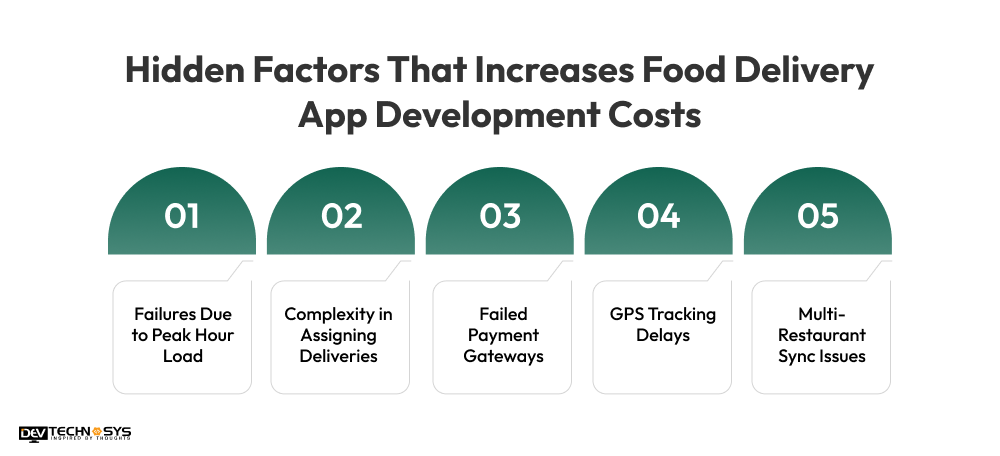
1. Failures Due to Peak Hour Load
Lunchtime and dinnertime peak traffic periods on food delivery applications cause them to experience some form of overload on their servers and possibly even crashes during these high-volume times. Infrastructure needs to be able to automatically scale in response to changes, while load balancing and caching systems should be able to maintain the performance of a system even at the peak of its pressure points.
Cost Impact: Increases overall food delivery website development cost by 15% to 30%
2. Complexity in Assigning Deliveries
These systems utilize an algorithm that is designed to make an assignment of who will actually pick up each of the deliveries from the various restaurants to be delivered to customers, by using different terms like travel distance and traffic conditions etc. Advanced versions of these days utilize AI algorithms that enable them to increase their overall productivity/efficiency, and maintain an even distribution of delivery loads among all drivers (or riders) in real-time.
Cost Impact: Adds 20% to 40% to development cost
3. Failed Payment Gateways
Food delivery applications have to deal with the failures that occur when a payment process fails to be completed as a result of various reasons, such as duplicate payment, refunds, etc. Your fintech software development experts need to create ab effective payment system that have logic built to retry transactions, provide encryption or other modes of transaction, and correct errors in order to protect the user’s financial information. It increases the trust factor in users.
Cost Impact: Increases cost by 10% to 25%.
You can reach out anytime; we are available 24/7. Our team provides a quick response.

4. GPS Tracking Delays
During food donation app development, constant GPS updates, a reliable network, and map API performance are required for real-time delivery tracking. Delays can affect ETAs and the user experience. For smooth live tracking, you need WebSockets, optimized polling, and efficient map integration. GPS integration in food deliver app involves live GPS telemetry, geospatial data processing, ETA prediction engine, driver dispatch engine, location streaming, and geofencing.
Cost Impact: Failed GPS tracking increases the food delivery app development time and cost by 15% to 35% .
5. Multi-Restaurant Sync Issues
Operating many restaurants means working out menus, pricing, availability, and orders on the fly. Without correct architecture, you get inconsistencies. Solutions need distributed databases, event-driven systems, and solid synchronization logic between services.
Cost Impact: Additional development costs of 10% to 20%
Hidden Factor |
What It Affects |
Cost Impact (%) |
Estimated Cost Impact (USD) |
| Peak-Hour Scaling Failures | Server performance, uptime, user experience | 15% – 30% | $4,500 – $45,000 |
| Delivery Assignment Complexity | Rider allocation, delivery speed, system efficiency | 20% – 40% | $6,000 – $60,000 |
| Payment Gateway Failures | Transactions, refunds, financial accuracy | 10% – 25% | $3,000 – $37,500 |
| GPS Tracking Delays | Real-time tracking, ETA accuracy | 15% – 35% | $4,500 – $52,500 |
| Multi-Restaurant Sync Issues | Menu updates, order consistency | 10% – 30% | $3,000 – $45,000 |
Industry Insights:
According to Global Newswire, the companies balance in-house logistics and third-party providers with customer pickup options, each influencing brand visibility, operational costs, and overall customer experience.
What are the 5 Ways to Reduce Food Delivery App Development Cost?
(before: Which Food Delivery Apps Are Setting New Trends in 2026?)
Food delivery app development cost 2026 depends on various factors, and montitzation models are one of them. Smart planning and strategic choices can help reduce dineout app development costs without compromising quality. Here, we explore the 5 best cost-saving strategies to launch an efficient, scalable app within budget.
1. Start with an MVP (Minimum Viable Product)
Launching a basic version of your app with core features, like ordering, payments, and basic tracking, helps you test the market without spending the full budget upfront. You can gradually add advanced food delivery app features like AI recommendations, subscriptions, and loyalty programs once your app gains traction.
2. Use Cross-Platform Development Frameworks
Instead of building separate iOS and Android apps, leverage Flutter or React Native. Cross-platform apps use a single codebase for multiple platforms, reducing development time and costs while maintaining a smooth user experience.
3. Opt for Pre-Built Modules or Templates
One of the best online food ordering app development cost saving strategiesis to use pre-build modules. Many meal ordering app development features, like payment gateways, push notifications, and restaurant menus,s can use pre-built SDKs or modules. This approach reduces development hours and lowers food delivery app cost without compromising functionality.
4. Outsource to Cost-Effective Development Teams
Hiring developers in Asia, Eastern Europe, or Latin America can significantly reduce the cost to build a food delivery app compared to North America or Western Europe, while still maintaining high-quality output. Ensure the team has experience in food delivery apps to avoid costly mistakes.
5. Prioritize Essential Features First
To cost to develop a food delivery app like doordash, focus on the core functionalities Instead of adding every possible feature at launch. Focusing on core functionalities drives user engagement and revenue. Features like AI recommendations, multi-location support, or advanced analytics can be added later to save costs.
Strategy |
Potential Cost Savings (USD) |
Estimated Savings |
| Start with an MVP | $15,000 – $45,000 | 30% to 50% |
| Use Cross-Platform Development | $10,000 – $30,000 | 25% to 40% |
| Leverage Pre-Built APIs & SDKs | $5,000 – $20,000 | 15% to 30% |
| Outsource to a Cost-Effective Development Team | $15,000 – $60,000 | 30% to 60% |
| Prioritize Essential Features First | $8,000 – $35,000 | 20% to 35% |
| Choose Cloud-Based Infrastructure | $5,000 – $20,000 | 15% to 25% |
| Adopt a Modular Development Approach | $4,000 – $15,000 | 10% to 20% |
| Use Third-Party Integrations | $3,000 – $12,000 | 10% to 20% |
| Implement Automated Testing | $3,000 – $10,000 | 10% to 15% |
| Plan a Scalable Architecture Early | $5,000 – $18,000 | 15% to 25% |
Food Delivery App Cost Based on System Architecture
According to a top restaurant app development company, the cost to build a food delivery app is never fixed. It varies widely based on the depth, scalability, and complexity of the underlying system architecture.
The more complicated and distributed your architecture is, the more it costs to build, in plain terms.
Food delivery platforms are usually divided into 3 main architectural types:
- Monolithic MVP System: A simple single backend application for startups and early-stage validation.
- Scalable Microservices-Based System: A modular, distributed architecture built to handle rising user bases and real-time activities.
- Enterprise-Grade (Uber Eats-Level) Architecture: A highly scalable, event-driven and AI-driven system for big scale worldwide operations.
Below is a module wise & architecture wise cost breakdown to assist you understand the contribution of each system component towards the overall flutter or react native food delivery app cost.
Architecture Type |
Description |
Estimated Cost |
| MVP Monolithic App | Basic ordering system, single backend | $10,000 – $15,000 |
| Modular Monolith | Separate modules but single deployment | $15,000 – $20,000 |
| Microservices Architecture | Scalable distributed system | $20,000 – $25,000+ |
| Enterprise Real-Time System | Uber Eats / DoorDash level | $25,000 – $30,000+ |
Top 5 Food Delivery App Examples to Inspire Your Business in 2026?
The market is filled with various meal delivery apps, but not all can leave a strong impression, such as Swiggy, Blinkit, Zomato, HelloFresh, and Talabat. Here are the top 10 food ordering mobile apps users can explore in 2026.
1. DoorDash
The DoorDash app is a leading on-demand, third-party delivery platform bridging the gap between users and local restaurants, grocery stores, and retail shops. Build an app like DoorDash is afood ordering app that offers on-demand, same-day delivery or scheduled orders.
It includes “leave at door” no-contact delivery options. It provides services in thousands of cities, and it lets users browse menus, order items, and pay directly through the App. The cost to develop a food ordering app like Doordash lies between $100,000 to $150,000+, but it can change depending on factors such as features and functionality. Take a look at the table showcasing the DoorDash clone app development cost based on type and scope.
Industry Facts:
According to Statista, DoorDash holds 60% US market share and 60% in convenience delivery.
2. Uber Eats
Uber Eats is a global online platform for food and item delivery. Operating in numerous countries, it allows users to browse menus, order, and track deliveries all through a single app. Key app features for Apps like Uber Eats are real-time tracking, pickup options, and the Uber One subscription service.
Uber Eats is available in numerous cities worldwide. Just mention your delivery address and explore restaurant and grocery delivery options near you. The cost of developing a food delivery app like Uber Eats will be around $110,000 to $150,000+. The basic app development is less expensive than the cost to build an app like Uber Eats with advanced features.
Industry Facts:
According to Business Of Apps, as of early 2026, Uber Eats has approximately 95 million users and over 1 million restaurants across 11,500+ cities.
3. Deliveroo
Deliveroo is an digital food ordering platform (app/website) connecting users with local restaurants and grocery stores for rapid delivery, typically with an estimated delivery time of 32 minutes. Developing a food delivery app like Deliveroo typically costs between $80,000 to $130,000.
Mostly, the Deliveroo app development cost depends on app complexity, feature set, and the development team’s location. It is best to hire app developers from a trusted agency with experience in food delivery app development. here’s the table highlighting the food delivery app pricing for apps like Deliveroo.
4. Talabat
Talabat is an on-demand meal delivery app that delivers food from local and international restaurants, as well as groceries, pharmaceuticals, flowers, and pet supplies. Its features include DineOut deals (up to 50% off), pickup options, and a rewards program.
But how much does it cost to make an app for a restaurant like Talabat? Developing a food delivery app like Talabat generally costs between $70,000 to $120,000 for a basic to mid-level version. At the same time, highly customized or feature-rich, enterprise-grade, multi-country applications can exceed $120,000+.
5. Grubhub
Grubhub is changing the food delivery game. Hundreds of thousands of restaurants, groceries, and exclusive deals for our regulars, one of which could be you. Whether you’re ordering for your family, hosting friends, or placing a group order, Grubhub makes it easier to order more without worrying about fees at checkout.
The cost to create a food delivery app relies on features, the platform (iOS/Android), and the developer’s location. A basic MVP (Minimum Viable Product) built by a top iPhone app development company starts around $70,000 to $120,000+.
Food Delivery App |
Estimated Development Cost (USD) |
Development Timeline |
Complexity Level |
Best For |
| DoorDash | $100,000–$150,000+ | 8–12 Months | Very High | Large Marketplaces |
| Uber Eats | $110,000–$150,000+ | 10–14 Months | Enterprise | Global Platforms |
| Deliveroo | $80,000–$130,000 | 7–10 Months | High | Cloud Kitchens |
| Talabat | $70,000–$120,000 | 6–9 Months | High | Regional Delivery |
| Grubhub | $90,000–$140,000 | 8–11 Months | Very High | Restaurant Chains |
Case Study: WannaEat – Food Delivery App Development
Client: Confidential, Saudi Arabia
Project: WannaEat – On-Demand Food Delivery Platform
Timeline: 28 Weeks
Budget: Estimated $40,000 – $140,000
Challenge
The client wanted to build a scalable food delivery platform that connected customers and delivery partners through a single ecosystem. The primary challenges included implementing real-time order tracking, intelligent.
Solution
Developed a cloud-native food delivery platform with separate customer, restaurant, delivery partner, and admin applications using a scalable microservices architecture. Integrated real-time GPS tracking, AI-based meal recommendations, secure payment gateways and cloud infrastructure for seamless ordering and delivery experiences
Results Client Achieved:
- 90.8% player engagement growth
- 30% lower development cost
- Launched in 28 weeks
- 4.2★ on App Store (1200+ downloads)
- Improved user engagement with AI-powered meal recommendations
Module-Wise Food Delivery App Development Cost Breakdown
Food delivery app development cost is best understood by splitting it into core system modules, each contributing differently based on complexity, scalability, and real-time requirements.
Module |
What It Includes |
Cost Range (USD) |
| Frontend Apps | Customer app, restaurant app, delivery app, admin panel | $8,000 – $40,000 |
| Backend System | APIs, authentication, order management, business logic | $10,000 – $50,000 |
| Delivery Management System | Rider assignment, route optimization, order dispatch logic | $5,000 – $30,000 |
| Real-Time Tracking System | Live GPS tracking, map integration, ETA updates | $8,000 – $35,000 |
| Payment Gateway System | Payments, wallets, refunds, multi-gateway integration | $5,000 – $25,000 |
| Notification System | Push notifications, SMS, email alerts | $3,000 – $10,000 |
| Database & Caching | SQL/NoSQL setup, Redis caching, data optimization | $5,000 – $20,000 |
| Cloud & DevOps | Hosting, CI/CD, scaling, load balancing | $5,000 – $30,000 |
| AI & Analytics (Optional) | Demand prediction, ETA optimization, fraud detection | $10,000 – $50,000+ |
Security Architecture of Food Delivery Apps: Payments, Users & Data Protection
A secure food delivery app requires multiple layers of protection to safeguard user data, payment transactions, APIs, and cloud infrastructure. Implementing industry-standard security technologies not only ensures regulatory compliance but also minimizes the risk of fraud, cyberattacks, and data breaches.
Security Layer |
Technology |
Security Standard |
Cost Impact |
Estimated Cost Impact |
| User Authentication | OAuth 2.0, JWT, MFA, Biometric Login | OAuth 2.0, OpenID Connect | 5%–10% | $1,500–$15,000 |
| Data Encryption | AES-256, SSL/TLS, HTTPS | TLS 1.3, AES-256 | 5%–8% | $1,500–$12,000 |
| Payment Security | Stripe, PayPal, Braintree, Tokenization | PCI DSS, 3D Secure 2.0 | 10%–20% | $3,000–$30,000 |
| Role-Based Access Control (RBAC) | IAM, Access Policies | NIST RBAC Guidelines | 3%–6% | $900–$9,000 |
| API Security | API Gateway, OAuth, Rate Limiting, WAF | OWASP API Security Top 10 | 5%–10% | $1,500–$15,000 |
| Database Security | PostgreSQL Encryption, MongoDB Atlas, Redis ACL | ISO/IEC 27001 | 4%–8% | $1,200–$12,000 |
| Fraud Detection | AI/ML Models, Risk Scoring, Transaction Monitoring | PCI DSS, AML Best Practices | 8%–15% | $2,400–$22,500 |
| Cloud & Infrastructure Security | AWS WAF, Cloudflare, Azure Security Center | ISO 27001, SOC 2 | 6%–12% | $1,800–$18,000 |
| Privacy & Compliance | Consent Management, Data Governance Tools | GDPR, CCPA, PCI DSS | 5%–10% | $1,500–$15,000 |
What Are the Most Profitable Ways to Monetize Food Delivery Apps?
The most successful restaurant ordering platforms use multiple monetization strategies simultaneously. It means combining commissions, delivery fees, subscriptions, advertising, and partnerships to maximize profitability without upsetting customers. Choosing the right mix depends on your target market, app scale, and business goals.
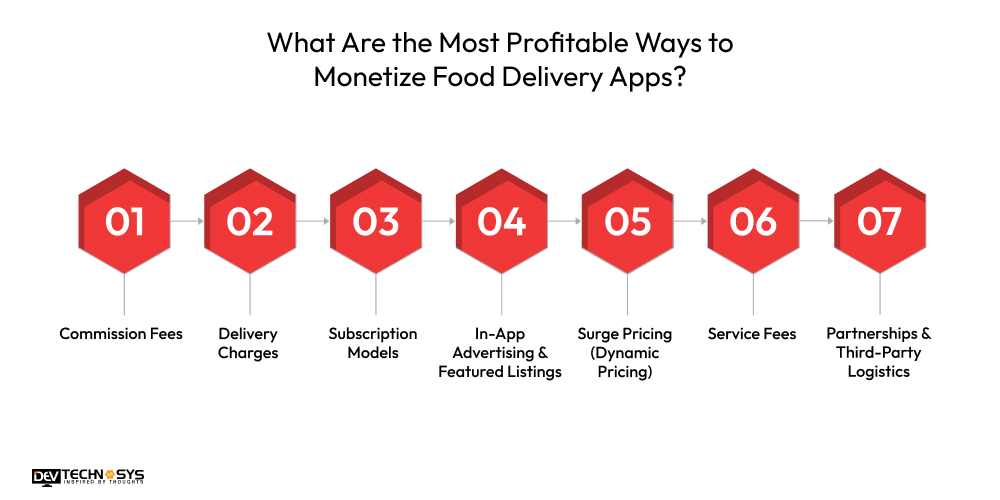
1. Commission Fees
One of the primary ways delivery meal apps earn revenue is through commission fees charged to restaurants. This is typically a percentage of each order, ranging from 15% to 30%, depending on the app and services provided.
The food delivery app monetization model like commission fee may vary based on restaurant size, popularity, or subscription tier. For example, Uber Eats and DoorDash charge partner restaurants a fee per order processed, allowing the apps to earn revenue without directly charging customers.
2. Delivery Charges
Customers often pay delivery fees to cover logistics, courier wages, and operational costs. These charges can be fixed per order or variable, depending on factors such as distance, order size, or demand. Many apps also use dynamic delivery pricing during peak hours or high-demand periods to ensure faster delivery while maintaining profitability.
3. Subscription Models
Subscription services like Uber One, DoorDash DashPass, and Grubhub+ provide customers with perks such as free delivery, priority service, and exclusive discounts.
These monthly or yearly programs create a consistent and predictable revenue stream for the app while encouraging customer loyalty and frequent ordering. Subscriptions also reduce dependence on individual order fees.
Industry Insights:
Subscription‑based revenue is scaling: by 2025, many top apps will report millions of paying premium members. For example, DoorDash alone had 22 million premium subscribers contributing to recurring revenue streams. Source: Business of Apps.
4. In-App Advertising & Featured Listings
Quick-serve food apps can generate revenue by offering restaurants and brands premium visibility through in-app advertising. Restaurants may pay to appear at the top of search results, get banner ads, or highlight special deals.
This strategy benefits restaurants by driving more orders and benefits the app by creating an additional revenue stream beyond commissions and delivery fees.
5. Surge Pricing (Dynamic Pricing)
Dynamic pricing is applied during high-demand periods, such as lunch and dinner rush hours, holidays, or bad weather. By temporarily increasing delivery or service fees, apps can balance supply and demand, incentivize more drivers to be active, and maximize revenue without compromising service quality. This approach is widely used by apps like Uber Eats during peak hours.
6. Service Fees
Apart from delivery charges, apps often charge a small, fixed service fee per order. These fees help cover platform maintenance, operational costs, customer support, and payment processing fees. While seemingly minor, service fees contribute significantly to the app’s overall profitability, especially as order volume scales.
7. Partnerships & Third-Party Logistics
Advanced food courier apps diversify revenue by offering logistics services or cloud kitchen operations to restaurants and businesses. For example, apps can provide white-label delivery solutions or handle deliveries for other vendors who don’t want to manage their own logistics. This creates new revenue streams outside of traditional customer-to-restaurant orders.
Food Delivery App Development Cost Based on Tech Stack
The technology stack you choose directly affects your on-demand food delivery app cost, scalability, performance, security, and maintenance expenses. Typically, a cloud-native microservices architecture is used for modern food delivery applications, usually leveraging a cross platform development technology (e.g., Flutter or React Native), a backend technology (NodeJS or Spring Boot), and data with PostgreSQL and Redis.
Infrastructure at scale via AWS or Google Cloud, along with real-time tracking using Google Maps Platform (or similar) are important aspects for most modern food delivery applications from 2026 and beyond.
Additionally, incorporating AI-based recommendation engines, automated dispatching solutions, Kubernetes (for orchestration) and Enterprise grade security will result in increased costs to develop the product because of the use of more sophisticated technologies, but will ultimately yield a greater level of scalability, reliability, and performance over the life of the product.
Tech Stack Layer |
Technologies |
Purpose |
Estimated Cost Impact |
| Frontend (Customer App) | Flutter, React Native, Swift, Kotlin | Cross-platform or native mobile app development | $8,000–$20,000 |
| Restaurant & Delivery Apps | Flutter, React Native, Kotlin, Swift | Restaurant dashboard and driver application | $10,000–$22,000 |
| Admin Panel | React.js, Angular, Vue.js | Business management dashboard, analytics, order management | $5,000–$10,000 |
| Backend Development | Node.js, NestJS, Java Spring Boot, .NET, Django | APIs, authentication, business logic, order processing | $15,000–$30,000 |
| Database | PostgreSQL, MongoDB, Redis | Data storage, caching, session management | $3,000–$10,000 |
| Cloud Infrastructure | AWS ECS / Amazon EKS, Google Kubernetes Engine (GKE), Google Cloud, Microsoft Azure | Hosting, auto scaling, storage, CDN, monitoring | $5,000–$20,000 |
| Maps & Location Services | Google Maps Platform, Mapbox, HERE Maps | Live tracking, route optimization, ETA calculation | $3,000–$12,000 |
| Payment Gateway Integration | Stripe, PayPal, Adyen, Braintree | Secure payments, refunds, subscriptions | $2,000–$8,000 |
| Real-Time Communication | WebSockets, Firebase, Socket.IO | Live order updates, driver tracking, notifications | $3,000–$10,000 |
| Push Notifications | Firebase Cloud Messaging (FCM), OneSignal | Promotional alerts and order notifications | $1,000–$4,000 |
| AI & Recommendation Engine | TensorFlow, OpenAI APIs, Vertex AI, Amazon Personalize | Predictive Demand Forecasting, Dynamic Pricing Engine, Intelligent Dispatch Algorithm, demand forecasting, chatbot | $10,000–$33,000+ |
| DevOps & CI/CD | Docker, Kubernetes, GitHub Actions, Jenkins, Terraform | Automated deployment, monitoring, infrastructure management | $5,000–$16,000 |
| Security & Compliance | PCI DSS v4.0 Compliance, End-to-End Encryption, AES-256 Encryptio, RBAC, PCI DSS, TLS, AES-256 | Tokenization
Secrets Management API Rate Limiting, Authentication, encryption, payment security |
$4,000–$10,000 |
Food Delivery App Cost: Clone vs Custom vs SaaS Platforms
Choosing the right development approach depends on your budget, customization needs, scalability goals, and time-to-market. While clone solutions and SaaS platforms offer faster deployment, custom development provides complete ownership, flexibility, and long-term scalability.
- Clone App: Best if you want to validate your idea quickly with a limited budget.
- Custom Development: Ideal for businesses planning to build a scalable platform with unique features, AI integration, and long-term growth.
- SaaS Platform: Suitable for restaurants that need an online ordering solution without investing in custom software development.
Development Approach |
Best For |
Development Time |
Estimated Cost |
Pros |
Cons |
| Clone App | Startups, MVPs | 2–4 Months | $30,000–$60,000 | Faster launch, lower cost, proven features | Limited customization, scalability constraints, similar UI/UX |
| Custom Development | Growing businesses, Enterprises | 4–8 Months | $60,000–$150,000+ | Full ownership, custom features, scalable architecture, better security | Higher upfront investment and longer development time |
| SaaS Platform | Small restaurants, Local businesses | 1–4 Weeks | $2,000–$10,000/yea | Quick deployment, minimal maintenance, subscription-based pricing | Limited branding, feature restrictions, vendor dependency |
Expert Tip
According to Dev Technosys’s tech-expert Mohit Nag, if your goal is to build a platform similar to Uber Eats or DoorDash, custom development offers the best return on investment by providing complete control over features, performance, scalability, and security.
Build vs Buy vs Development Partner: Which Option is Most Cost Effective?
Businesses can choose to build an in-house solution, purchase a ready-made platform, or hire a development partner. The comparison below highlights the cost, timeline, flexibility, and long-term value of each approach.
Which Option Offers the Best ROI?
- Build In-House: Best for enterprises requiring complete control, but it demands the highest investment and ongoing operational costs.
- Buy (Clone/SaaS): Ideal for quick market entry with a limited budget, though customization and scalability are restricted.
- Development Partner: Offers the best balance of cost, customization, scalability, and faster delivery, making it the most cost-effective choice for most businesses developing a custom food delivery app.
Factor |
Build In-House |
Buy (Clone/SaaS) |
Development Partner |
| Best For | Large Enterprises | Startups & Restaurants | Startups, SMEs & Enterprises |
| Development Cost | $100,000–$300,000+ | $5,000–$60,000(Clone) $100–$2,000/month (SaaS) | $30,000–$150,000 |
| Time to Launch | 8–12 Months | 1–8 Weeks | 3–6 Months |
| Customization | High | Limited | High |
| Scalability | Excellent | Moderate | Excellent |
| Ownership | Full Ownership | Vendor-Owned/License-Based | Full Ownership |
| Maintenance Cost | High | Included/Subscription-Based | Medium |
| Long-Term ROI | High (Large Investment Required) | Moderate | High (Best Value for Cost) |
| Overall Recommendation | Best for enterprises with dedicated development teams | Best for quick MVPs and small businesses | Most cost-effective for scalable custom food delivery apps |
Conclusion
Building a food delivery app in 2026 is a strategic investment, not just a technical project. Food delivery application development costs vary based on app type, features, platform choice, and team location. Businesses that plan features wisely, choose the right tech stack, and focus on scalability can significantly reduce long-term costs. Partnering with an experienced mobile app development company in USA like Dev Technosys to ensures faster delivery, better performance, and a future-ready food delivery platform.
Frequently Asked Questions
Find answers to the most common questions related to this article.
A combination is used:
PostgreSQL/MySQL: Orders & payments
MongoDB: Menus & logs
Redis: Caching & real-time updates
This hybrid approach ensures performance and scalability.
They use auto-scaling cloud infrastructure, load balancers, caching systems (Redis), and CDNs to manage peak-hour traffic without downtime.
Key security measures needed to develop a food delivery app includes:
JWT / OAuth authentication
SSL/TLS encryption
PCI-DSS compliance for payments
Role-Based Access Control (RBAC)
API security using gateways and rate limiting
Food delivery apps are expensive because they rely on real-time systems and complex backend architecture. Features like live tracking, intelligent delivery assignment, secure payment processing, cloud scaling, and multi-restaurant synchronization require advanced engineering and infrastructure, which significantly increases development cost.
Yes, food delivery apps can be built using SaaS platforms or ready-made solutions for faster deployment. However, these platforms usually offer limited customization, restricted scalability, and dependency on third-party providers, making them more suitable for MVPs or small restaurant businesses rather than large-scale platforms.