














“Secure your business future by creating a safe ERC223 token.”
Are you looking to offer a thrilling cryptographic experience to your users? Invest now in the ERC223 token development to get an improvised version of ERC20 token with enhanced security. The tokenomics of various digital assets is increasing that creates a huge impact on transaction and crypto exchange processes.
So, businesses can develop ERC223 token to enhance the security of existing tokens through integration of AI-powered tokenized digital assets. For this, they must know a certified development process that is reliable and deliver fast services.
In this blog, we will discuss the process to create ERC223 token along with cost, features, applications, and more aspects in detail.
What is ERC223 Token?
The Ethereum blockchain’s ERC223 token standard was created to fix the issues of ERC20 tokens. By keeping tokens far from disappearing when given to contracts that don’t handle them, it guarantees safer token transfers. Gas efficiency and security are enhanced by using token development services, which makes it more appropriate for decentralized contracts and applications.
- Ensures tokens aren’t lost when sent to incompatible contracts.
- Reduces gas consumption by consolidating token transfer functions.
- Utilizes the tokenFallback() function for safe contract-to-contract transfers.
Why Should Businesses Develop an ERC223 Token?
By fixing major problems with ERC20, it provides a safer growth of Ethereum token specifications. It improves security, effectiveness, and flexibility for businesses introducing blockchain-based solutions:
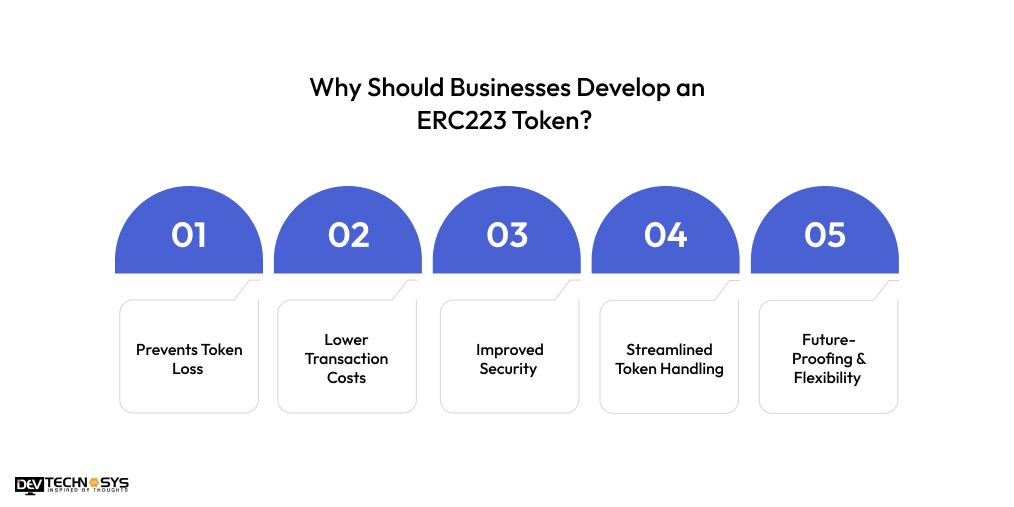
1. Prevents Token Loss
The tokenFallback() function in ERC223 provides a safety check to make sure tokens are only issued to contracts that can handle them. By doing this, ERC20’s significant flaw that tokens could be permanently lost is fixed. It protects investments and increases user trust.
2. Lower Transaction Costs
ERC223 lowers the number of steps carried out in a transaction by consolidating transfer logic into a single function. Lower gas use and operating expenses result from this. For high-volume systems, this efficiency eventually turns into a considerable financial benefit.
3. Improved Security
By requiring receiving contracts to handle incoming tokens explicitly, ERC223 lowers vulnerabilities. The possibility of harmful contract interactions and transactions is reduced by this additional control. Additionally, the use of utility token development services facilitates token safety verification.
4. Streamlined Token Handling
ERC223 token development streamlines administration process by providing a single transfer function for all recipient kinds, such as wallets or contracts. This reduces the likelihood of errors and speeds up development and integration. It is particularly advantageous in DeFi platforms and complicated dApps.
5. Future-Proofing & Flexibility
ERC223 is more in line with new developments in Ethereum and contemporary smart contract techniques. Future technology integration is made easier by its flexible framework. This guarantees that as the ecosystem changes, your token infrastructure will remain scalable and relevant.
Pick what you need below — you can select more than one — then tap Get detail to continue.Want a chatbot demo or pricing? Fill the form and talk to our experts today.
Chatbot demo dashboard
Cost to develop an app
Industry report
Case study
How AI is Transforming Token Development?
AI is transforming the creation of blockchain tokens by improving security, automating the creation of smart contracts, and maximizing efficiency. Throughout the token lifecycle, AI facilitates rational decision-making, speeds up deployment, and lowers human error through advanced data analysis and prediction tools.
Here, an AI token development company may help you to improve blockchain ecosystems’ scalability and dependability while streamlining development.
- Smart Contract Generation: AI can auto-generate optimized and error-resistant smart contract code.
- Security Auditing: Machine learning models detect vulnerabilities in token contracts before deployment.
- Gas Optimization: AI analyzes transaction patterns to minimize gas fees during token operations.
- Tokenomics Modeling: AI helps design and simulate sustainable economic models for token ecosystems.
- User Behavior Prediction: AI forecasts user trends for better token utility and engagement strategies.
How Entrepreneurs can Create ERC223 Token?
Let’s discuss the ERC223 token development process in this section. So, entrepreneurs can easily fix their budget and implement reliable money-making standards for growing their business:
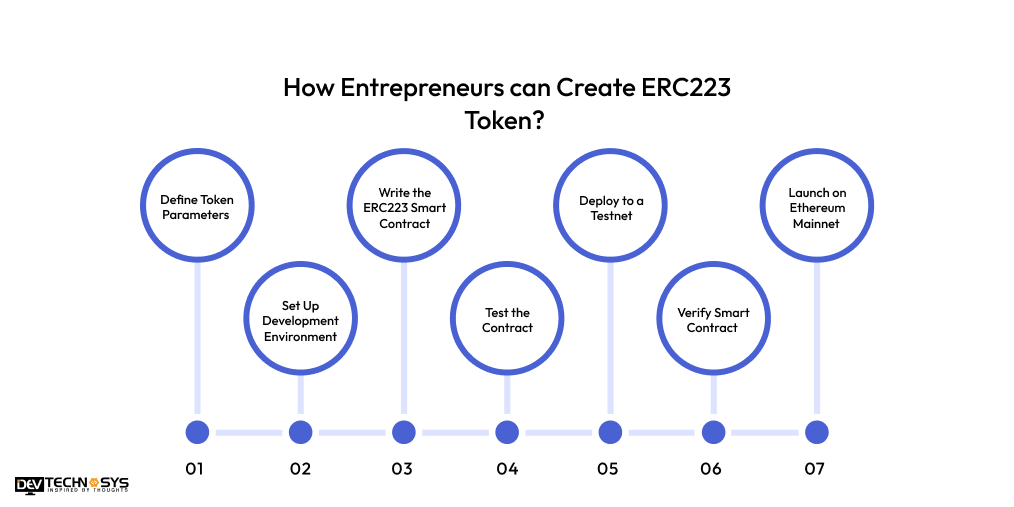
1. Define Token Parameters
Businesses should first understand and decide basic characteristics of tokens. Name, symbol, total supply, number of decimals, and whether the token is fixed, mintable, or burnable are all included in this. An ERC223 token development company ensures well-defined blockchain definitions.
Any unique use cases, transfer regulations, or governance elements should also be described. Before coding starts, it is essential to document these criteria.
2. Set Up Development Environment
To develop ERC223 Token and test with smart contracts, install programs like the Solidity compiler, Hardhat or Truffle, and Node.js. Additionally, you’ll need Ganache for local blockchain simulation and MetaMask to connect to Ethereum networks.
Create folders for contracts, scripts, and tests to help you keep your workspace organized. Make sure that both deployment and debugging are supported in your environment.
3. Write the ERC223 Smart Contract
Use smart contract development services to build ERC223 Token with advanced contract while adhering to the ERC223 standard. Make sure that both wallet and contract addresses are compatible by putting the transfer and tokenFallback() functions into practice.
Features like supply management, pausable functionality, and ownership may also be included. For security and dependability, if possible, use open-source libraries.
4. Test the Contract
Create unit tests to verify each function before deployment using frameworks such as Mocha, Chai, or Hardhat Test. Target real-world situations like unwanted access attempts, token transfers, and calls to fallback functions. You should hire ERC223 token developers for testing.
These tests aid in the early detection of defects, logical mistakes, or gas inefficiencies. A thoroughly tested contract lowers the possibility of weaknesses.

5. Deploy Testnet
You must deploy the Ethereum Testnet like Ropsten, Goerli, or Sepolia, after finishing the process to create ERC223 Token. Use the Hardhat or Truffle CLI with Infura or Alchemy as the node provider. This step makes sure that your contract operates as intended in a real-time blockchain environment.
Keep an eye on contract interactions, gas use, and transaction success. Get input and address any problems discovered during this stage.
6. Verify Smart Contract
To validate your smart contract on the testnet, use explorers like Etherscan. By making your source code publicly accessible, this procedure increases developer and user trust. It also makes things like contract interaction tabs possible and aids with debugging.
You can upload Solidity for verification with the help of a token development company. Verify that the deployed bytecode precisely corresponds to the verified code.
7. Launch on Ethereum Mainnet
You can make ERC223 Token popular by using Ethereum mainnet for successful testing and certification. Make sure you have enough Ethereum to pay for gas, particularly when there is a lot of network congestion. Businesses can launch coins, distribute them, and integrate with exchanges or wallets.
After going live, keep a close eye on contract activity and be prepared for any updates or fixes. For added protection and legitimacy, think about third-party audits.
Key Features of ERC223 Token
An Ethereum token standard called ERC223 fixes serious issues with ERC20. It keeps backward compatibility for broader adoption while improving security, effectiveness, and user experience:
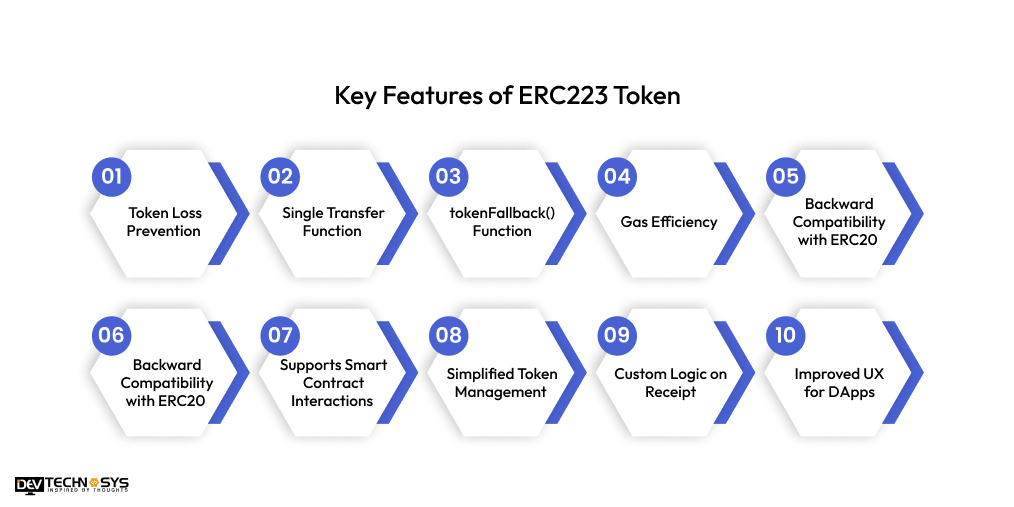
1. Token Loss Prevention
Tokens transmitted to incompatible smart contracts are protected from loss by ERC223. This protects developers and users against transfer errors that cannot be undone.
2. Single Transfer Function
ERC223 employs a single transfer() function rather than several transfer methods like ERC20. This lessens developer misunderstanding and streamlines token transfers.
3. tokenFallback() Function
By requiring a predetermined response, this function guarantees that tokens can be reliably received by smart contracts. It provides an extra degree of security when transferring tokens to contracts.
4. Gas Efficiency
ERC223 reduces gas consumption by condensing internal checks and activities into fewer steps. It is therefore economical for regular token transfers.
5. Backward Compatibility with ERC20
Integration with current wallets and exchanges is made possible through ERC223. Businesses can also create an ERC 721 token to facilitate adoption without interfering with the existing infrastructure.
6. Enhanced Security
ERC223 lowers risks like sending tokens to malicious or dead addresses by verifying receivers and upholding contract logic. It improves token security in general.
7. Supports Smart Contract Interactions
ERC223 is perfect for dApps and DeFi systems because it is made to interact flawlessly with contracts. It guarantees that tokens can be reliably received and processed by smart contracts.
8. Simplified Token Management
Coding complexity is decreased by the integrated recipient checks and uniform transfer logic. This facilitates more effective token management for developers.
9. Custom Logic on Receipt
TokenFallback() allows contracts to automatically initiate certain logic when they receive tokens. Advanced interactions like automatic logging or staking are made possible by this.
10. Improved UX for DApps
Sending tokens to the incorrect address type is not a concern for users. Interaction with decentralized apps becomes safer and more seamless as a result.

Applications of ERC223 Tokens
ERC223 tokens are appropriate for businesses as they are safe and provide effective interactions on the Ethereum network. Blockchain systems benefit from their safety and compatibility with smart contracts:
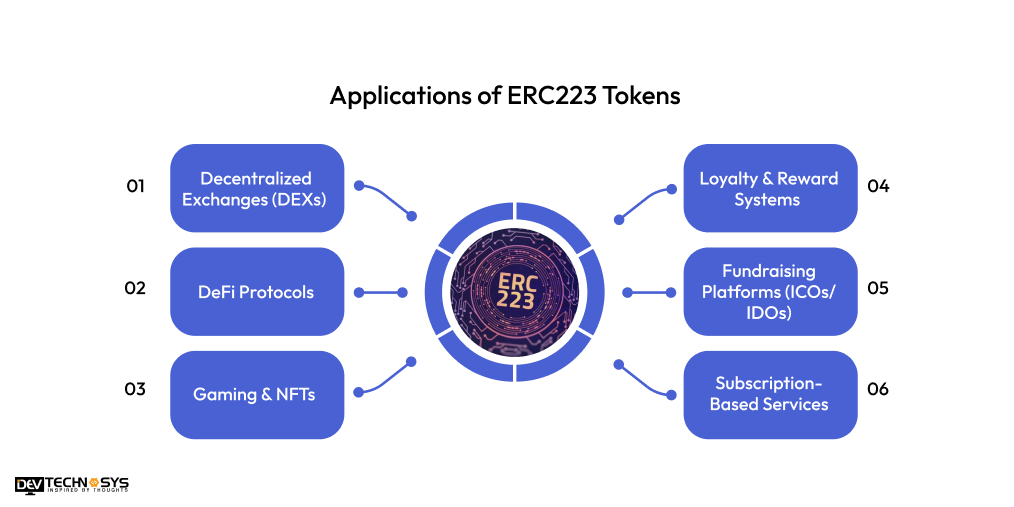
1. Decentralized Exchanges (DEXs)
There is no chance of unintentional token loss when trading ERC223 tokens on DEXs. Their compatibility and single transfer logic make it easier to integrate with exchange contracts and increase transaction dependability.
- Safer Token Transfers: Prevents accidental loss of tokens that enhance trust on DEX platforms.
- Streamlined Integration: Simplified single transfer method reduces development complexity.
2. DeFi Protocols
Because ERC223 tokens are more secure, DeFi systems employ them for lending, staking, and liquidity pools. Interactions with intricate smart contracts are seamless and gas-efficient because of the integrated token handling mechanism.
- Smart Contract Interactions: Lower gas costs and seamless handling of token operations.
- Enhanced Security: Built-in safety checks protect users and protocols from malicious transfers.
3. Gaming & NFTs
For in-game items or NFT-related currencies where smart contract interactions are common, ERC223 tokens are perfect. Their safe transfers and support for custom logic reduce asset loss. You can approach an NFT development company to boost earnings and user engagement.
- Secure Asset Handling: Prevents misrouted token transactions, ensuring currencies.
- Trigger Custom Events: tokenFallback() allows game logic or NFT minting for token receipts.
4. Loyalty & Reward Systems
ERC223 tokens can be distributed by brands as incentives, guaranteeing safe transactions and automated reactions when redeemed. This lowers the possibility of lost or unclaimed tokens while improving the user experience.
- Automated Redemption: Enables instant smart contract responses.
- Improved User Experience: Secure token transfers promote better adoption.
5. Fundraising Platforms (ICOs/IDOs)
The use of ERC223 token development Services saves gas and prevents token loss for startups launching initial coin offerings (ICOs) or initial distribution agreements (IDOs). It provides a more dependable and investor-friendly method of allocating tokens throughout fundraising initiatives.
- Investor Confidence: Reduced risk of lost tokens in public fundraising events.
- Lower Distribution Costs: Efficient transactions save gas fees.
6. Subscription-Based Services
In subscription models, ERC223 tokens can automate access control and recurring payments. Subscription logic can be simplified by using the tokenFallback() function, which enables smart contracts to react immediately upon receiving tokens.
- Payments Automation: Tokens can automatically renew access or subscriptions.
- Reduced Payment Errors: Secure transfers minimize failed transactions in billing cycles.
What is the ERC223 Token Development Cost?
A number of technical and commercial factors affect the ERC223 token development cost. Every element is important, from the developer’s experience to the intricacy of the design and security requirements. By understanding these factors, you can easily minimize the additional investment rates:
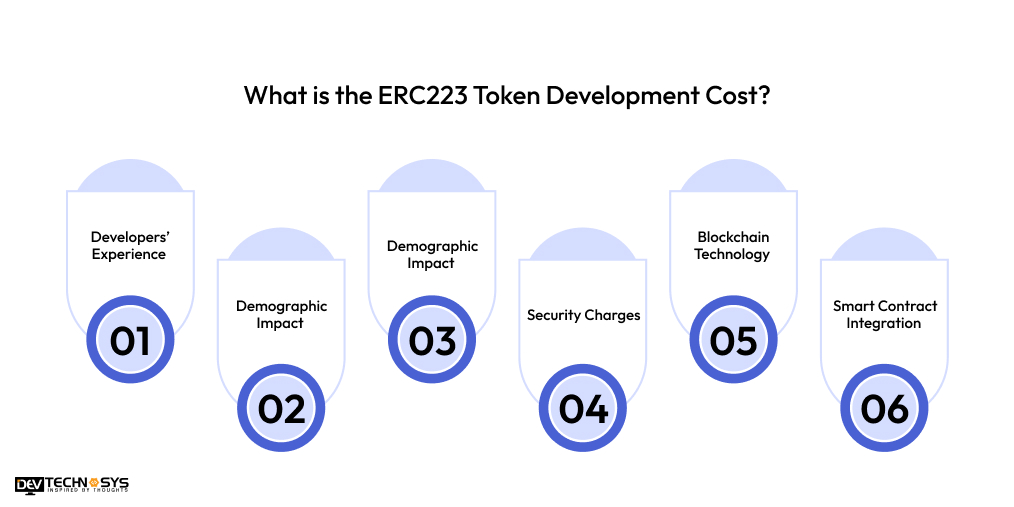
1. Developers’ Experience
Solidity and smart contract designs need more skills, so experienced blockchain developers charge more. Their proficiency guarantees effective coding, reduced errors, and enhanced security. Selecting the best talent affects the cost to develop ERC223 token as well as quality.
Experience Level |
Cost Estimation |
| Junior/Entry-Level | $1000-$3000 |
| Mid-Level/Experienced | $3000-$5000 |
| Senior/Expert | $5000-$8000 |
| Professional | $8000-$10000 |
2. Demographic Impact
The location of your development team may have a big impact on the cost to develop an ERC1155 token. It usually costs more to hire developers from Western Europe or North America than from Asia or Eastern Europe. Costs can be decreased by outsourcing to economically viable locations.
Demographic Impact |
Estimated Cost |
| USA | $15000-$20000 |
| Australia | $12000-$15000 |
| India | $3000-$5000 |
| UK | $10000-$12000 |
| UAE | $5000-$8000 |
| Brazil | $8000-$10000 |
3. Design Complexity
The ERC223 token development cost will increase if the cryptocurrency platform needs a unique user interface, branding, or dashboard integration. Resources are required in proportion to the UI/UX’s level of depth and interaction. This covers the price of both design software and front-end development.
Design Complexity |
Development Time |
Estimated Cost |
| Simple | 1-2 Weeks | $500-$1000 |
| Moderate | 2-3 Weeks | $1000-$3000 |
| Complex | 3-5 Weeks | $3000-$5000 |
| Premium | More than 5 Weeks | $5000-$8000 |

4. Security Charges
For any token to avoid vulnerabilities and hacker attempts, security audits are essential. The budget may be increased by using third-party audits and programs like MythX or CertiK. However, compromising security could eventually result in higher ERC223 token development rates.
Security Cost |
Estimated Cost |
| DDoS protection | $1,000-$2,000 |
| Crypto Authentication | $2,000-$3,000 |
| Digital Signature | $3,000-$5,000 |
5. Blockchain Technology
Using Ethereum for ERC223 is common, but compatibility and development time are impacted if you target other chains, such as BSC or Polygon. Different optimization procedures are needed for each blockchain, increasing the Soulbound token development cost and complexity.
Blockchain Technology |
Estimated Cost |
| Ethereum | $2,000-$3,000 |
| Binance Smart Chain | $3,000-$5,000 |
| Cosmos SDK | $5,000-$8,000 |
| Hyperledger Fabric | $8,000-$10,000 |
6. Smart Contract Integration
The cost to build ERC223 token increases if it needs to communicate with other smart contracts, such as DeFi, NFTs, or governance systems. It takes more effort and experienced development to test, debug, and ensure that the logic between contracts runs smoothly.
Smart Contract |
Estimated Cost |
| Key Generation | $1,500-$2,000 |
| Audit Governance | $2,000-$4,000 |
| 3-Way Handshake Model | $4,000-$8,000 |
Tech Stack Used for Developing ERC223 Like Tokens
A well-organized tech stack comprising blockchain programming tools, testing frameworks, and deployment platforms is necessary for creating ERC223 tokens. The stack makes sure that token creation and smart contract interaction are safe, effective, and scalable. In decentralized situations, using the appropriate technologies reduces development risks and enhances overall performance.
Component |
Tools |
Use |
| Smart Contract Language | Solidity | Primary programming language used to write ERC223 smart contracts. |
| IDE/Code Editor | Remix, Visual Studio Code | Platforms to write, test, and debug smart contract code. |
| Blockchain Network | Ethereum, Binance Smart Chain | Underlying networks where tokens are deployed and executed. |
| Testing Framework | Hardhat, Truffle, Ganache | Tools to simulate blockchain environments and test smart contracts. |
| Deployment Tool | Hardhat, Truffle, Remix | Used for deploying smart contracts to testnets and mainnets. |
| Wallet Integration | MetaMask, WalletConnect | Tools for interacting with smart contracts using crypto wallets. |
| Security Audit Tools | MythX, Slither, OpenZeppelin | Analyze code to detect vulnerabilities and ensure security compliance. |
| Node Provider | Infura, Alchemy, QuickNode | Provide blockchain access without running a full node locally. |
| Blockchain Explorer | Etherscan, BscScan | Track and verify token transactions and smart contract status. |
| Version Control | Git, GitHub | Manage and collaborate on source code for smart contract development. |
Challenges in Creating ERC223 Tokens
ERC223 is an advanced version of ERC20, thus providing challenges because of its technical complexity and lack of industry support. For a successful deployment, these obstacles must be removed:
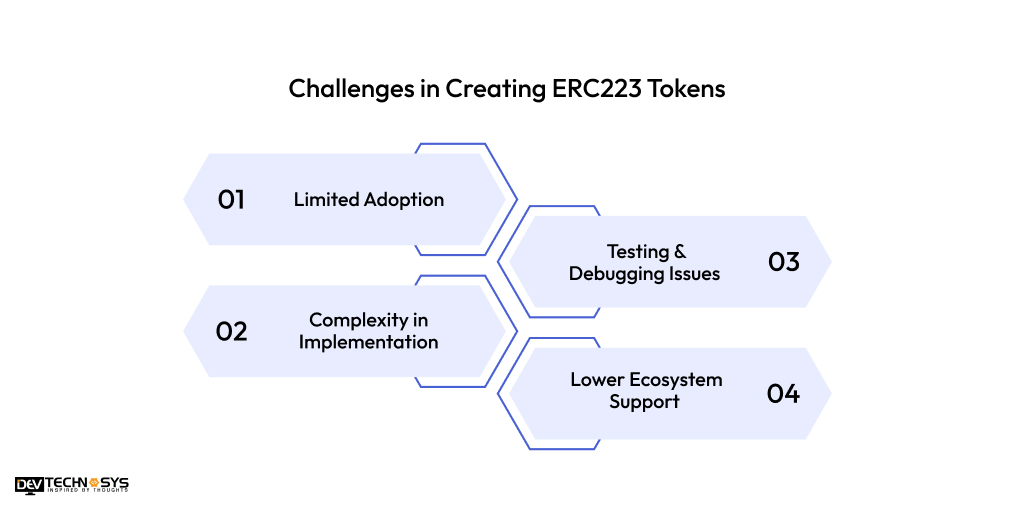
1. Limited Adoption
ERC223 has a lower adoption rate compared to ERC20 and has less interoperability with wallets, exchanges, and dApps. This may increase the cost to develop ERC223 token and limit the market reach.
Solution: Make sure your ERC223 implementation is backward compatible with ERC20. For wider integration, collaborate with platforms to support ERC223 or offer dual-token solutions.
2. Complexity in Implementation
The tokenFallback() function and contract logic must be handled carefully in ERC223, which makes development more difficult. Errors or token loss may arise from improper implementation.
Solution: Hire skilled Solidity developers and, if at all possible, use audited libraries and frameworks like OpenZeppelin. Observe best practices for modular code and smart contract design.
3. Testing & Debugging Issues
It is difficult to simulate fallback behavior and real-world smart contract interactions during testing. After deployment, minor bugs might lead to serious problems.
Solution: Use testnets like Goerli with reliable testing tools like Truffle or Hardhat. To guarantee stability, automate test cases for contract transitions and backup plans.
4. Lower Ecosystem Support
The lack of ERC223-optimized tools and third-party services restricts integration with SDKs, analytics platforms, and wallets. It prevents businesses to launch a social token for users.
Solution: Make thorough developer documentation and integration APIs available. Encourage developer communities to adopt ERC223 and create wrappers to fill in any gaps.

How to Earn Money by Developing an ERC223 Token?
By utilizing their advanced features, ERC223 tokens present a number of revenue opportunities. DeFi programs and token sales are two ways that companies and developers can make money:
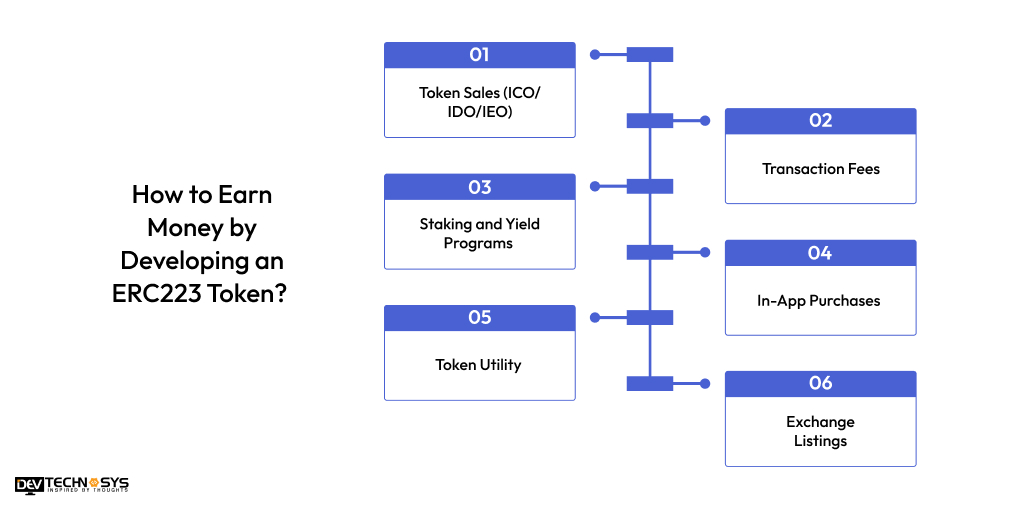
1. Token Sales (ICO/IDO/IEO)
Offering ERC223 tokens through initial coin offerings (ICOs), initial exchange offerings (IEOs), or initial DEX offerings (IDOs) is one way to raise money. These techniques enable token purchases by early investors in return for funding.
2. Transaction Fees
Establishing microtransaction fees for transfers or service use can result in consistent revenue. A tiny charge may be gathered each time a token is moved or used on a platform. The gas-efficient transfers of ERC223 increase the appeal and affordability of such machines.
3. Staking and Yield Programs
ERC223 tokens can be staked in yield farming pools or DeFi protocols to gradually earn rewards. In order to support the network or protocol and earn interest or more tokens, users lock their tokens. A cryptocurrency development company may help you to increase token demand and generate income.
4. In-App Purchases
ERC223 tokens can be used as a payment method for premium content, features, or upgrades in decentralized apps or games. Secure microtransactions are made possible by the tokens, which helps in balancing the cost to build ERC223 token. This strategy can generate steady revenue.
5. Token Utility
Usage and market value are increased by giving your ERC223 token actual utility, such as voting rights, service access, or special features. The price of the token rises in tandem with demand, providing both holders and developers with financial gains.
6. Exchange Listings
Trading opportunities arise when you list your ERC223 token on well-known centralized or decentralized exchanges. Value appreciation and listing-related fees rise in tandem with trading volume. Additionally, exchange visibility expands your ecosystem’s user and investor base.
Let’s Summarize!!
Are you ready to build ERC223 token and grow your business? If yes, then it is the right time for you to connect with a reliable and experienced IT consulting firm. Additionally, keep the below points in mind before making investment in the development process:
- Avail affordable ICO token development services in the USA for releasing the token.
- To target ERC223 token development solutions, contact skilled and dedicated developers at low cost.
- Try to make ERC223 token at least possible investment by implementing reducing methods.
- Execute specified money-making strategies to increase your brand value.
Surely, these points will help you to sail the virtual asset exchange business in a positive direction. You can increase user engagement and retention by launching tokens similar to ERC223.
Frequently Asked Questions
1. How Long Does it Take to Build ERC223 Tokens?
With standard features, creating a simple ERC223 token can take one to two weeks. It might take three to six weeks to create more complex tokens with advanced logic, security audits, and user interface interaction. Testing needs, developer experience, and complexity all affect the timeline.
2. How to Reduce the ERC223 Token Development Cost?
- List essential token features to minimize initial development cost.
- Use audited ERC223 templates from repositories like OpenZeppelin.
- Target experienced developers at lower hourly rates.
3. What is the Cost to Maintain ERC223 Tokens?
Monthly maintenance expenses usually fall between $200 and $1,000. This covers bug fixes, upgrades, smart contract monitoring, and hosting for any services that are connected. The volume of transactions and the stage of active development affect costs.
4. What is the Rate of Hiring Token Developers?
The typical hourly rate for freelance Ethereum token developers is between $10 and $80. Depending on geography and level of experience, full-time pay might range from $1,000 to $6,000 per month. Although hiring through agencies may be more expensive, they can offer help and audits.
5. Are ERC223 Token Safe to Use?
Indeed, ERC223 is intended to increase transaction security and guard against token loss. Unlike ERC20, it includes a tokenFallback() check when moving to contracts. Nonetheless, appropriate code and auditing are still necessary for smart contract security.
6. What Tools are Used for Developing ERC223 Like Tokens?
- Solidity: Used to write smart contracts.
- Remix IDE/Hardhat/Truffle: Ethereum development environments.
- MetaMask & Ganache: MetaMask for wallets; Ganache for Ethereum blockchain testing.