


















Key takeaways:
-
- In 2025, global crypto adoption in eCommerce surged, with over 30% of online stores exploring blockchain-based payments.
- Launching a crypto token involves choosing the right blockchain, creating a secure smart contract, and integrating it with your eCommerce platform.
- Development costs range from $8,000 to $25,000, based on token complexity, audits, and blockchain fees.
- Essential features include smart contract security, wallet integration, token utility design, marketing strategy, and a growing ecosystem for real-world use.
Did you ever think that one day you could use your own digital currency to run your online store, like Amazon or Flipkart do?
Feels like the future? What’s going on now is called a crypto token.
In today’s digital world, many smart eCommerce businesses are starting to create their own crypto tokens, not just for fun, but to grow faster, reward customers, and make payments super easy and secure.
You don’t have to know a lot about blockchain or technology to start.
Even a brand that is just starting out can use this strong technology with the right help.
In this guide, we walk you through how to launch a crypto token for ecommerce business, step by step, in a way that’s simple to understand and exciting to build.
Let’s dive into the future of online business, powered by your very own crypto token!
Market Statistics of Crypto Token for E-commerce Business
- The world retail and e-commerce segment made USD 478.4 million in 2024, and it’s forecast to make USD 1,074.7 million by 2030.
- According to Grand View Research, the market is likely to grow at a rate of 14.8% per year from 2025 to 2030.

- When it came to regions, Asia-Pacific was the most profitable market in 2024.
- Between 2025 and 2030, Canada is projected to have the biggest CAGR of any country.
What is a Crypto Token?
A crypto token is a digital asset built on an existing blockchain, such as Ethereum or BNB Chain. Unlike coins like Bitcoin, tokens represent value or utility and can be used for payments, rewards, or access within a specific ecosystem.
In eCommerce, tokens enable loyalty programs, discounts, or exclusive offers, creating a seamless, decentralized way to engage customers and drive business growth.
Difference Between a Token and a Coin
Coins operate on their own blockchains and function as digital currencies, while tokens are built on existing blockchains and serve diverse roles like access, blockchain-based reward system, governance, or representing real-world assets. Let’s figure out the main difference between coin vs token:
1. Coin
A coin is a digital currency that operates on its own native blockchain, such as Bitcoin or Ethereum. Coins are primarily used for transactions, value storage, and as a medium of exchange. They maintain the blockchain’s network, support its infrastructure, and usually involve mining or staking for network security.
2. Token
A token is a digital asset created on an existing blockchain like Ethereum or BNB Chain. Unlike coins, tokens don’t have their own blockchain. They serve specific purposes such as granting access to services, representing assets, or enabling reward systems. Tokens rely on smart contracts for ecommerce brands and distribution.
Feature |
Coin |
Token |
| Blockchain | Runs on its own blockchain | Built on an existing blockchain |
| Examples | Bitcoin (BTC), Ethereum (ETH) | Uniswap (UNI), Shiba Inu (SHIB) |
| Use Case | Primarily for transactions and value storage | Varies: utility, governance, rewards, etc. |
| Creation | Requires creating a new blockchain | Created via smart contracts |
| Functionality | Native currency of the blockchain | Dependent on the host blockchain |
10 Popular Crypto Tokens
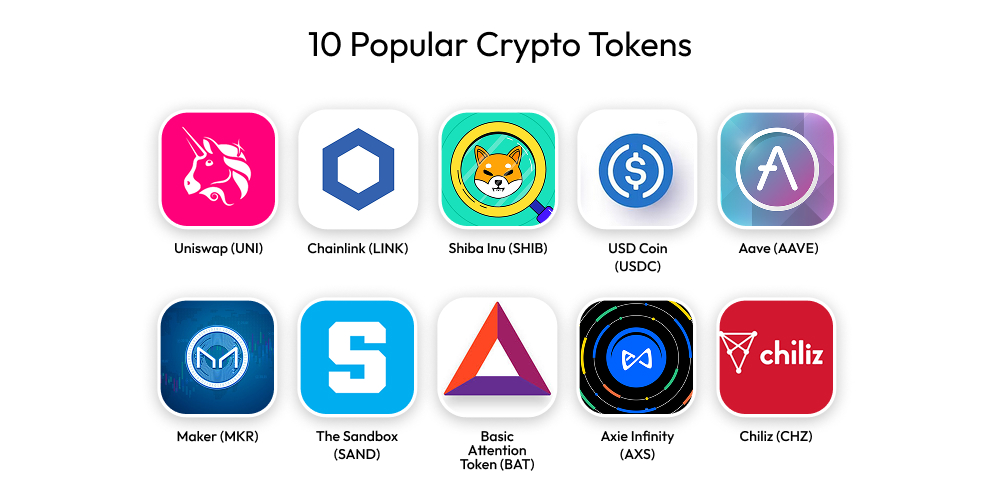
Discover the most popular cryptocurrencies to invest in that shape the blockchain ecosystem today, powering DeFi, gaming, governance, stablecoins, and more, driving innovation and new opportunities across industries worldwide.
Token |
Launch Year |
Blockchain |
Use Case |
| Uniswap (UNI) | 2020 | Ethereum (ERC-20) | Governance |
| Chainlink (LINK) | 2017 | Ethereum (ERC-20) | Decentralized Oracle |
| Shiba Inu (SHIB) | 2020 | Ethereum (ERC-20) | Meme Token / Utility |
| USD Coin (USDC) | 2018 | Ethereum + Multi-chain | Stablecoin |
| Aave (AAVE) | 2020 | Ethereum (ERC-20) | Governance / DeFi Lending |
| Maker (MKR) | 2017 | Ethereum (ERC-20) | Governance |
| The Sandbox (SAND) | 2020 | Ethereum (ERC-20) | Metaverse / Gaming |
| Basic Attention Token (BAT) | 2017 | Ethereum (ERC-20) | Digital Advertising |
| Axie Infinity (AXS) | 2020 | Ethereum + Ronin sidechain | Gaming / Governance |
| Chiliz (CHZ) | 2018 | Ethereum (ERC-20) + Chiliz Chain | Fan Engagement / Sports |
Why E-commerce Businesses Want to Launch a Crypto Token?
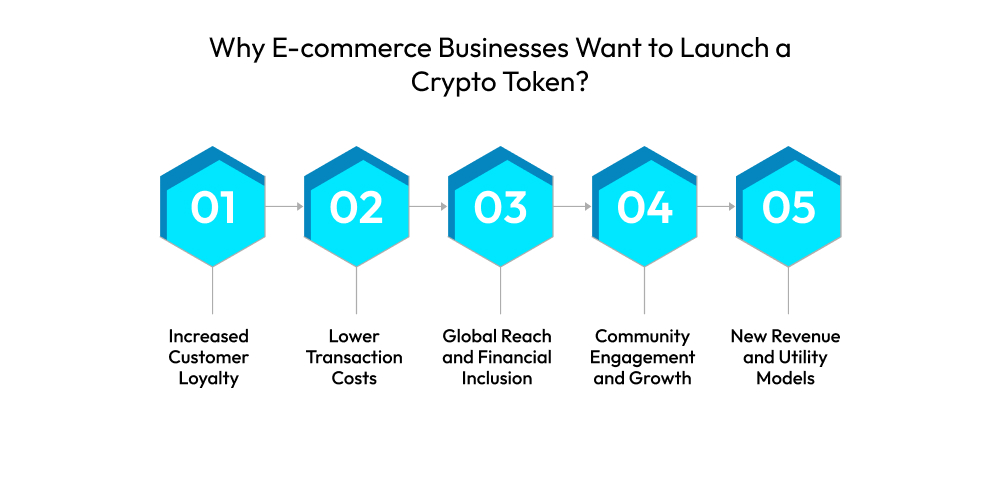
As the digital economy evolves, many e-commerce businesses are exploring the benefits of launching their own crypto tokens. Here are five key reasons to launch a social token:
- Increased Customer Loyalty
- Lower Transaction Costs
- Global Reach and Financial Inclusion
- Community Engagement and Growth
- New Revenue and Utility Models
1. Increased Customer Loyalty
Crypto tokens have the potential to change loyalty programs by providing customers with digital rewards that have real-world value. Instead of traditional points, companies may create tokens that consumers can exchange, redeem, or even bet. This not only increases repeat purchases, but also strengthens the emotional connection to the brand.
2. Lower Transaction Costs
Using digital currency for eCommerce can dramatically cut payment processing costs. Traditional payment gateways frequently charge 2-5% per transaction; however, blockchain-based payments might be significantly cheaper. This cost savings benefit both the company and the client, particularly in foreign transactions.
3. Global Reach and Financial Inclusion
Tron token development solutions enable cross-border transactions, allowing e-commerce companies to access clients in areas underserved by traditional banking systems. This provides access to emerging markets and enables smooth transactions without the use of currency exchanges or middlemen.
4. Community Engagement and Growth
Businesses may create active communities around their goods by awarding tokens to early adopters, brand evangelists, and influencers. Token holders are invested in the brand’s success, which promotes word-of-mouth marketing and organic development through incentives such as staking, governance, and exclusive access.
5. New Revenue and Utility Models
ICO token development solutions enable innovative business models such as token-gated products, early access, and gamified experiences. Furthermore, e-commerce platforms may generate cash through token sales (ICOs or IDOs), which provide liquidity and expansion capital without requiring traditional fundraising.

8 Steps to Launch a Crypto Token for eCommerce Business
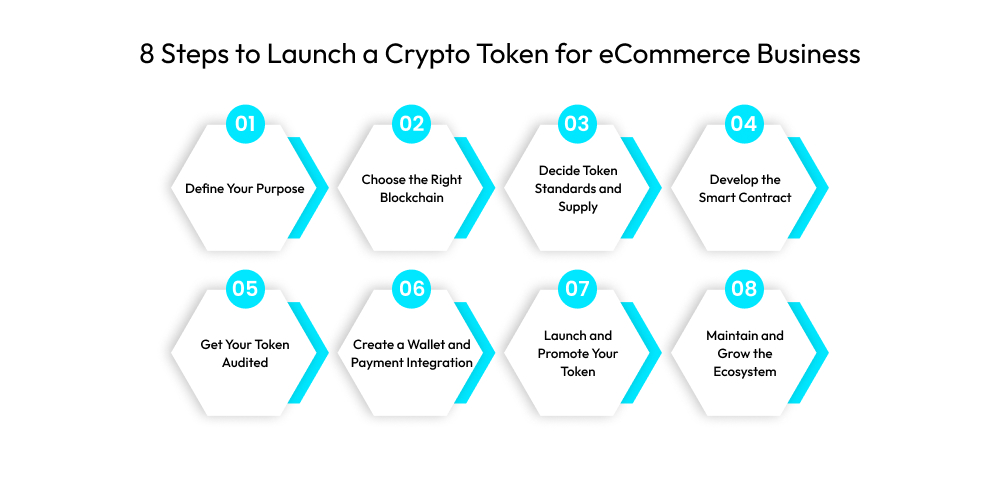
Create an ERC 721 token to boost your eCommerce business! Attract loyal customers, simplify payments, and build a modern shopping experience. Follow our easy step-by-step guide to create, promote, and grow your token in the digital economy. So, here we provide the steps of crypto token development for eCommerce business:
- Define Your Purpose
- Choose the Right Blockchain
- Decide Token Standards and Supply
- Develop the Smart Contract
- Get Your Token Audited
- Create a Wallet and Payment Integration
- Launch and Promote Your Token
- Maintain and Grow the Ecosystem
1. Define Your Purpose
Start by deciding why your eCommerce business needs a crypto token. Is it for customer rewards, faster payments, or loyalty points? Clear goals will guide your token’s design and utility. Make sure it solves a real problem in your store and adds value to both you and your customers.
2. Choose the Right Blockchain
In the second stage to create a BRC20 token, select a blockchain for online stores like Ethereum, Binance Smart Chain, or Solana. Ethereum is popular but has higher fees. Binance is faster and cheaper.
Pick the one that fits your budget, features, and technical needs. This will be the foundation where your token lives and interacts with users.
3. Decide Token Standards and Supply
In the third stage of crypto token development for eCommerce business, choose your token standard (like ERC-20 token for ecommerce). Then, set how many tokens you’ll create (fixed or unlimited).
Define details like the name, symbol, and decimals. Make sure it’s planned well so the token has long-term value and won’t lose meaning or trust among customers.
4. Develop the Smart Contract
Hire a blockchain developer from OTC crypto exchange development company or use online tools to create a smart contract for your token. This contract governs the functionality of the token, including transfers, balances, and total supply. Always test it on a testnet first to avoid errors. Make sure it’s secure and bug-free before going live.
5. Get Your Token Audited
In the fifth stage of crypto token development for eCommerce business, an e-commerce smart contracts audit by a professional team ensures your token can’t be hacked or misused. It builds trust with your users and investors. An audit may cost money, but it’s better than losing customer funds due to a bug or attack later.
6. Create a Wallet and Payment Integration
Let’s move to the sixth stage to create ERC20 token, add a crypto wallet to your website that supports your token. This lets customers store, send, and use your token easily. You can also connect payment gateways that accept crypto. The goal is to make it simple and smooth for users to shop using your token.
7. Launch and Promote Your Token
In the seventh stage of crypto token development for eCommerce business, announce your token with a strong marketing plan. Use social media, influencers, email lists, and your website to spread the word.
Offer token rewards, discounts, or early access to create excitement. A successful launch needs good buzz and customer interest from the start.
8. Maintain and Grow the Ecosystem
After launch, keep improving. Add more ways to utilize your token, such as loyalty rewards, partnerships, or staking options. Hire an experienced blockchain development company to collect user feedback and make changes as needed. A healthy token ecosystem keeps users engaged and gives your eCommerce brand a unique edge in the competitive market.
How Crypto Tokens in E-commerce Help Users?
Crypto tokens empower users with valuable rewards, lower fees, faster payments, financial control, and exclusive benefits, enhancing the shopping experience while promoting deeper engagement with e-commerce brands.
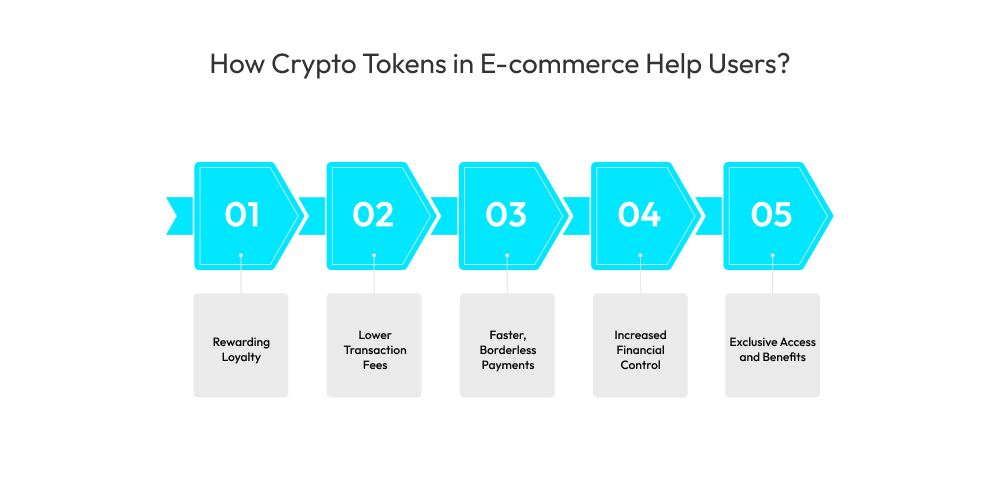
1. Rewarding Loyalty
Crypto tokens provide consumers with valuable, tradeable incentives for purchases, referrals, and brand involvement. Tokens, unlike traditional loyalty points, may increase in value, be transferred, or redeemed across platforms, providing consumers with actual advantages while promoting continuing involvement with the eCommerce brand.
2. Lower Transaction Fees
When users use cryptocurrency tokens instead of credit cards or bank transfers, they save greatly on transaction fees. This is especially useful for overseas customers, as blockchain-based payments reduce currency conversion expenses and third-party fees, saving shoppers money on each transaction.
3. Faster, Borderless Payments
Crypto tokens enable rapid cross-border transactions without the need for banks or middlemen. According to the ecommerce development company, this allows consumers to avoid delays commonly associated with international payments, particularly on weekends or holidays, and provides speedier order confirmations.
4. Increased Financial Control
Crypto tokens provide consumers complete ownership and control over their digital assets. They may spend, store, bet, or trade their tokens as they see fit, providing more flexibility than traditional reward systems, which frequently expire or have restricted redemption possibilities.
5. Exclusive Access and Benefits
Holding a brand’s token might provide customers with access to exclusive offers, early product launches, private sales, and even governance powers.
Bonus Read: Solana Blockchain in eCommerce Industry
This exclusivity provides a VIP purchasing experience, increases consumer engagement, and promotes a stronger relationship between customers and the eCommerce business.
Want a chatbot demo or pricing? Fill the form and talk to our experts today.
Pick what you need below — you can select more than one — then tap Get detail to continue.
-
Chatbot demo dashboard
-
Cost to develop an app
-
Industry report
-
Case study
10 Must-Have Features of Crypto Token in E-commerce
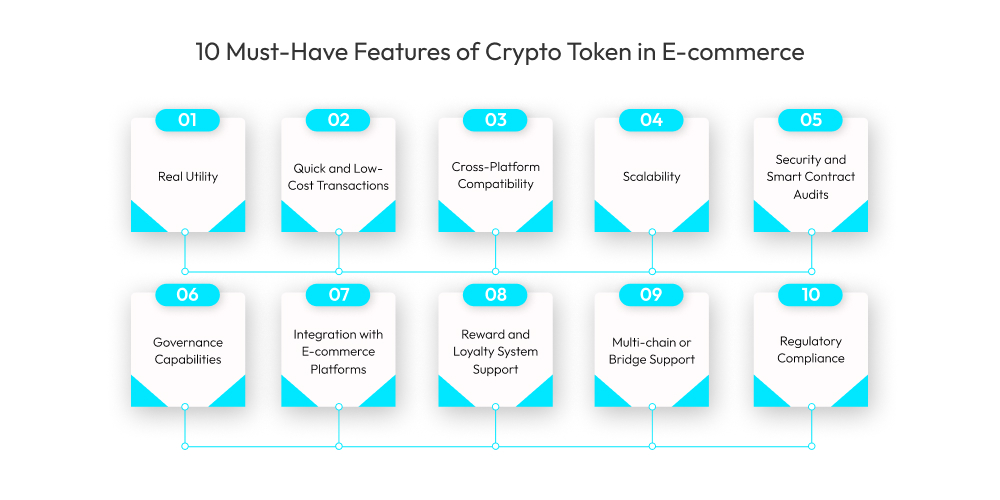
To build a crypto token for ecommerce business, it requires more than just blockchain integration. To drive user adoption and real business value, your token should include the following essential features:
-
Real Utility
To be useful and relevant to customers, the token must have obvious use cases, for example, enabling payments, discounts, awards, or exclusive access.
-
Quick and Low-Cost Transactions
To guarantee a seamless shopping experience, the token should allow for rapid transfers with low transaction (gas) fees, particularly during high-volume sales or overseas transactions.
-
Cross-Platform Compatibility
It should operate flawlessly across several wallets, browsers, and payment gateways, allowing users to conveniently store and spend their tokens.
-
Scalability
Choose a blockchain that can manage large transaction volumes without causing congestion or delays, particularly during flash sales or peak seasons.
-
Security and Smart Contract Audits
The token’s smart contract must be safe and thoroughly audited in order to protect user dollars and data.
-
Governance Capabilities
If you build polygon token, it allows users to vote on platform choices or product enhancements using the token to increase community involvement.
-
Integration with E-commerce Platforms
To ensure seamless acceptance, the token should be easily connected with systems like as Shopify, WooCommerce, and Magento.
-
Reward and Loyalty System Support
It should be designed to support loyalty programs and provide choices for earning, spending, or staking rewards.
-
Multi-chain or Bridge Support
Allowing the token to function on many blockchains broadens its versatility and reach.
-
Regulatory Compliance
To avoid future limitations or fines, ensure that the token fulfills all applicable legal requirements in your country.
The Cost to Launch a Crypto Token for eCommerce Business
The cost to launch a crypto token for an eCommerce business can range from $8,000 to over $25,000, depending on complexity and features. Basic token creation using no-code platforms may cost as little as $5,000.
However, if you hire blockchain developers, conduct smart contract audits, and ensure regulatory compliance, costs can rise significantly. Additional expenses may include platform integration, marketing, legal consultation, and exchange listings.
For a fully functional and secure token ecosystem, budgeting between $10,000 and $20,000 is realistic for most small to mid-sized e-commerce projects.
Item |
Estimated Cost |
| Token Creation | $500 – $5,000 |
| Smart Contract Audit | $2,000 – $15,000 |
| Legal & Compliance | $2,000 – $10,000 |
| Platform Integration | $1,000 – $7,000 |
| Marketing & Community | $1,000 – $10,000 |
| Exchange Listing (Optional) | $5,000 – $13,000 |
| Wallet Integration | $500 – $3,000 |
| Total Estimate | $8,000 – $25,000+ |
What Are the Key Factors Affecting the Crypto Token Development Cost?
Development cost depends on token complexity, blockchain choice, smart contract security, legal compliance, integration needs, and marketing efforts, each factor influencing the total investment required to launch a successful eCommerce crypto token.
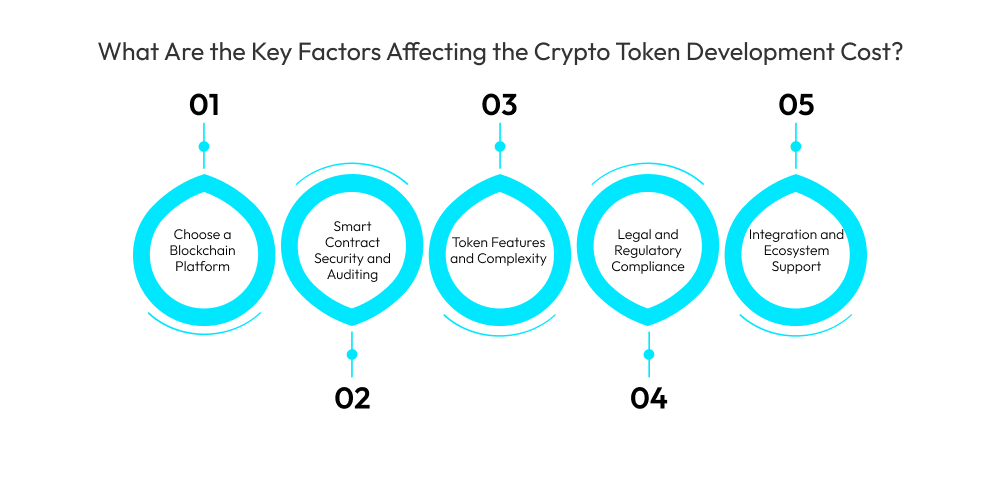
1. Choose a Blockchain Platform
The selected blockchain (e.g., Ethereum, BNB Chain, Polygon) has a considerable impact on the cost to develop a crypto token for ecommerce business.
Ethereum, while popular, charges higher gas prices, whilst alternative platforms may charge cheaper fees but provide less ecosystem support. Platform compatibility, scalability, and developer availability are all factors that impact crypto wallet development cost.
Blockchain |
Estimated Cost Impact |
| Ethereum | Higher gas fees; $3,000 – $15,000+ |
| BNB Chain | Lower fees; $2,000 – $10,000 |
| Polygon | Moderate fees; $2,500 – $12,000 |
| Solana | Moderate fees; $3,000 – $14,000 |
2. Smart Contract Security and Auditing
To avoid weaknesses and attacks, a secure token must undergo thorough smart contract audits. Hiring credible auditors or businesses to test and validate your contract code incurs considerable costs, but it is critical to maintaining confidence, preventing attacks, and meeting security requirements in the crypto world.
Audit Type |
Estimated Cost Range |
| Basic Security Review | $1,000 – $3,000 |
| Comprehensive Audit | $5,000 – $15,000 |
| Repeated Audits (post updates) | $3,000 – $7,000 |
3. Token Features and Complexity
Simple utility tokens are less expensive to build than tokens with additional functionality, such as staking, governance, or burn mechanisms. The more complicated the smart contract logic and tokenomics, the more time and skill are required, resulting in increased cost of ecommerce app development services.
Feature Complexity |
Estimated Cost Range |
| Basic Token (ERC-20) | $500 – $3,000 |
| Advanced Features (staking, governance) | $5,000 – $15,000 |
| Custom Tokenomics + Burn/Mint | $10,000 – $20,000 |

4. Legal and Regulatory Compliance
Ensuring that your token conforms with local and international regulations can increase the overall cost of cryptocurrency development services.
Legal counsel may be required to assess if your token is a utility or a security, conduct KYC/AML checks, and prepare compliance documents, especially for enterprises operating in various jurisdictions.
Service |
Estimated Cost Range |
| Initial Legal Consultation | $1,000 – $3,000 |
| Full Compliance & Documentation | $5,000 – $12,000 |
| Ongoing Legal Support | $2,000 – $5,000 annually |
5. Integration and Ecosystem Support
Integrating the coin with eCommerce platforms, wallets, and payment gateways necessitates more work. Compatibility with Shopify, WooCommerce, and mobile applications improves usability but adds complexity. The more connections required, the greater the expense of customisation, plugins, and continuous maintenance.
Integration Type |
Estimated Cost Range |
| Basic E-commerce Platform Integration | $1,000 – $4,000 |
| Wallet and Payment Gateway Integration | $2,000 – $7,000 |
| Multi-platform & Mobile App Support | $5,000 – $12,000 |
Tech Stacks Are Used to Launch a Crypto Token for eCommerce Business
| Component | Technology / Tool | Purpose |
| Blockchain Platform | Ethereum, Binance Smart Chain (BSC), Polygon, Solana | Host and run the crypto token smart contracts |
| Smart Contract Language | Solidity (Ethereum/BSC), Rust (Solana) | Write and deploy token logic and features |
| Token Standard | ERC-20, BEP-20, SPL | Define token interface and compatibility |
| Development Framework | Truffle, Hardhat, Remix | Smart contract development, testing, and deployment |
| Wallet Integration | MetaMask, Trust Wallet, Coinbase Wallet | Enable users to store and interact with tokens |
| Frontend Framework | React.js, Vue.js, Angular | Build user interfaces for token wallets and eCommerce |
| Backend | Node.js, Express.js, Python (Django/Flask) | Handle APIs, user management, and server-side logic |
| Database | MongoDB, PostgreSQL | Store user data, transaction records, and analytics |
| Payment Gateway | Crypto payment APIs (Coinbase Commerce, BitPay) | Facilitate crypto payments and token transactions |
| Security Tools | OpenZeppelin, MythX, Certik | Smart contract security libraries and auditing |
How to Make Money From Crypto Tokens in E-commerce?
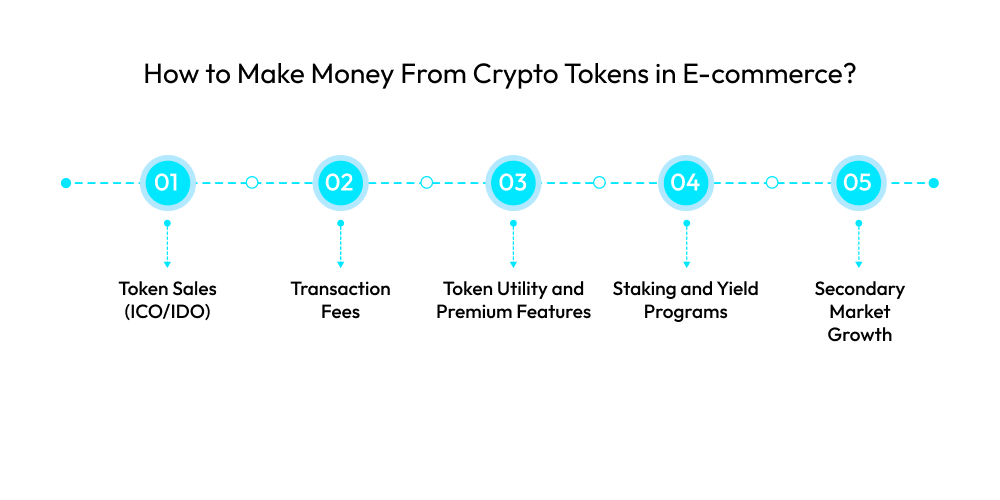
Launching a crypto token for your e-commerce business can open up multiple revenue streams beyond traditional sales. Here are five effective ways to monetize your crypto-powered eCommerce platform:
- Token Sales (ICO/IDO)
- Transaction Fees
- Token Utility and Premium Features
- Staking and Yield Programs
- Secondary Market Growth
1. Token Sales (ICO/IDO)
Initial Coin Offerings (ICO) or Initial DEX Offerings (IDO) allow businesses to raise capital by selling tokens directly to investors and customers. This upfront funding can support platform development, marketing, and expansion without relying on traditional loans or venture capital.
2. Transaction Fees
By crypto payment integration, your token as a payment method, you can earn small fees on each transaction. While crypto payments typically have lower fees than credit cards, a tiny percentage fee on token transactions can generate steady income, especially as user volume grows.
3. Token Utility and Premium Features
Tokenomics for ecommerce can be used to unlock exclusive products, early access, or premium membership perks. As we discussed earlier with a smart contract development company, charging users to access these special features or gated content with your token incentivizes purchases and increases token demand, driving revenue growth.
4. Staking and Yield Programs
Cryptocurrency token for retail offering staking rewards encourages users to lock up their tokens for a set period, supporting token price stability and liquidity. Your business can benefit by creating yield programs, earning interest on staked tokens, or partnering with DeFi platforms to generate passive income.
5. Secondary Market Growth
If your token gains popularity, its value can appreciate on secondary markets. As the token issuer, you may hold a reserve of tokens that increase in value over time. Additionally, listing fees or partnerships with exchanges can bring extra revenue.
How Dev Technosys Will Help You to Launch a Crypto Token for eCommerce Business?
As a leading cryptocurrency development company, Dev Technosys offers end-to-end solutions to launch your crypto token seamlessly. From strategic planning and blockchain selection to smart contract development, security audits, and eCommerce platform integration, our expert team ensures a smooth, compliant, and secure token launch.
We also provide ongoing support, marketing, and scalability options, helping your eCommerce business harness the full potential of blockchain technology and unlock new revenue streams with your crypto token.
Frequently Asked Questions
Q1. How Much Does It Cost To Launch a Crypto Token for eCommerce Business?
A. The cost to develop a crypto token for eCommerce business is around $8,000 and $25,000, depending on features, blockchain choice, security audits, legal compliance, integration, and marketing efforts.
Q2. How Long Does it Take to Create a Crypto Token for eCommerce Business?
A. To create a crypto token for eCommerce business usually takes 4 to 12 weeks, depending on token complexity, smart contract development, security audits, legal compliance, and integration with eCommerce platforms.
Q3. Which Technologies Are Used to Make a Crypto Token for eCommerce Business?
A. There are various technologies used to make a crypto token for ecommerce business. Here is the list:
- Ethereum Blockchain
- Solidity (Smart Contract Language)
- Truffle or Hardhat (Development Frameworks)
- MetaMask (Wallet Integration)
- React.js or Vue.js (Frontend Development)
- Node.js (Backend Development)
Q4. How Do I Choose The Right Blockchain For My Token?
A. Choose the right blockchain by evaluating transaction fees, scalability, security, developer community, compatibility with your token’s features, and ecosystem support to ensure efficient, cost-effective, and reliable token performance.
Q5. How Do I Integrate A Crypto Token With My Ecommerce Platform?
A. Integrate a crypto token with your eCommerce platform using APIs, plugins, or SDKs compatible with platforms like Shopify or WooCommerce, enabling seamless token payments, rewards, and wallet connectivity for customers.