



















Key takeaways:
-
-
- The global fleet scheduling software market will surpass $50 billion by 2029, growing rapidly at a 16‑19% CAGR.
- Core benefits of fleet scheduling software include optimizing routes, reducing idle time, improving fuel efficiency, delivery timelines, and overall operational productivity significantly.
- AI in fleet management software enables predictive maintenance, dynamic routing, driver behavior analysis, and real‑time fleet monitoring for businesses.
- Building software involves six stages and monetizes via SaaS subscriptions, per‑vehicle pricing, or freemium tiers.
-
The fleet management software industry is on the rise, and the global market size is expected to exceed $50 billion by 2029 at a compound annual growth rate (CAGR) of more than 17%. A core part of this industry is fleet scheduling software, which is essential for companies of all sizes that operate a mobile workforce.
Fleet scheduling is software that allows businesses to manage transportation-related tasks by scheduling and designing routes. Fleet scheduling software automates dispatching, tracks driver assignments, and monitors vehicle availability to reduce idle time and increase productivity.
When used correctly, fleet scheduling software reduces delivery timelines, improves fuel efficiency, optimizes resources, and saves on operating costs. Convenient for use by logistics, transportation, and service companies, fleet scheduling systems coordinate and facilitate operations to provide real-time visibility across the fleet.
In this blog, we will take you through the entire process to build fleet scheduling software. We will help you break down the major features of fleet scheduling software, provide you with development considerations when building the software, and much more.
What is Fleet Scheduling Software?
Fleet scheduling software is a software product that allows companies to plan, organize, and manage vehicles effectively. The software is designed to enhance the vehicle schedule and corresponding routes efficiently.
Fleet scheduling software automates dispatching, driver assignments, and vehicle availability, while maximizing productivity and reducing idle time. When done well, fleet scheduling programs can not only improve delivery times but also increase fuel efficiency, optimize resources, and reduce operating costs.
A fleet management app like Motive Fleet is well-suited for logistics, transportation, and service businesses, and it facilitates seamless workflow and operations management across the entire fleet with real-time visibility.
Market Stats of Fleet Scheduling Software!
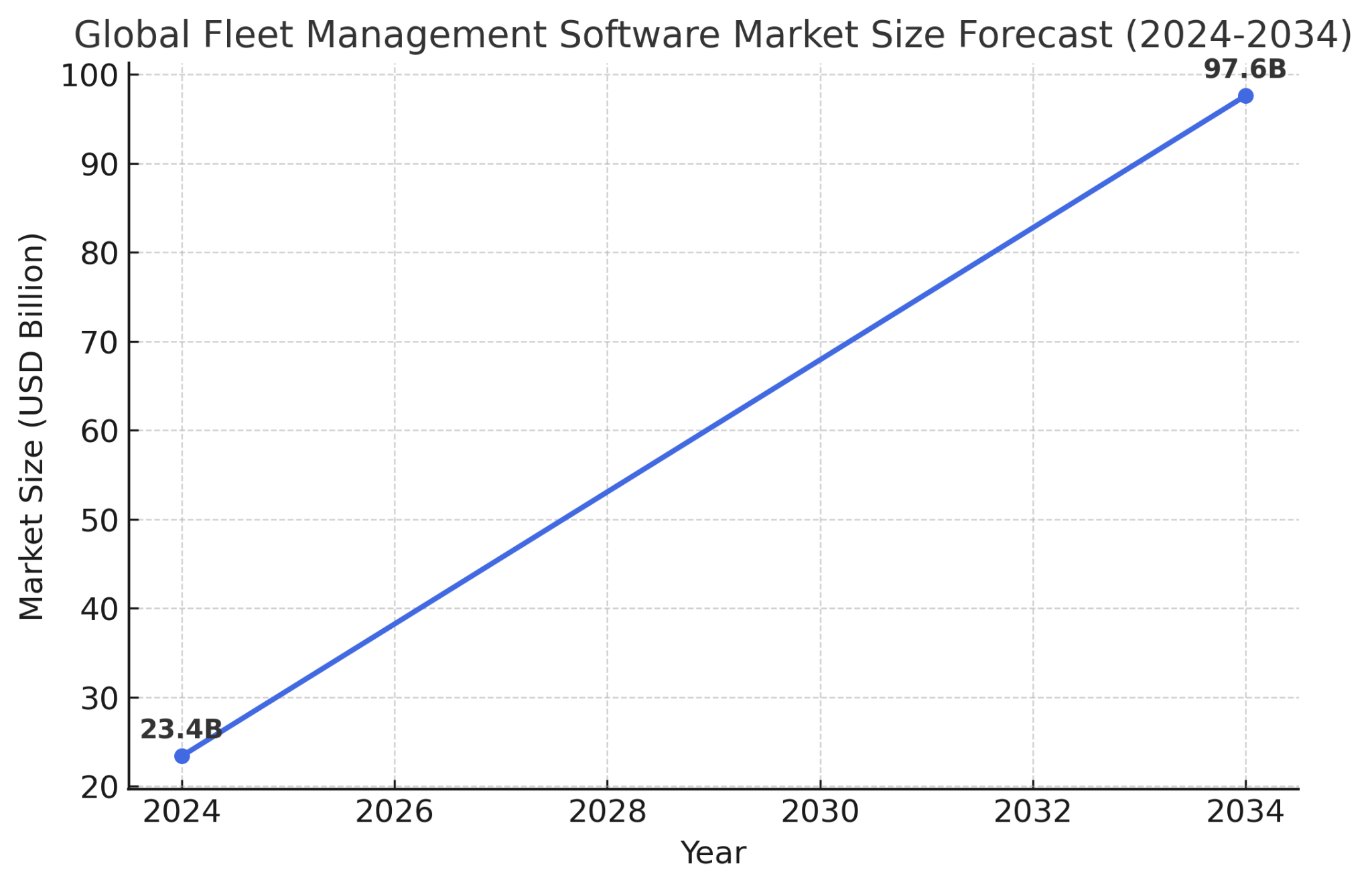
- Global market size reached approximately USD 23.4 billion in 2024, projected to rise to USD 97.6 billion by 2034 at a CAGR of 16%
- Another estimate values the global software-only market at USD 33.999 billion in 2025, growing from USD 16.5 billion in 2021 with a 8% CAGR through 2033
- Some older forecasts had projected USD 43.1 billion by 2026, with AI, telematics, and cloud segments expanding at a 15–20% CAGR
- In India, Eric W. estimates the market size at approximately USD 1.5 billion in 2024, which is projected to reach USD 5.5 billion by 2032 at 18% CAGR (another market report suggests 15.25% CAGR) and reaching $4.79B by FY 2032.
- Cloud‑based solutions had approximately7% share in 2024; EV fleet management, AI, and predictive maintenance are growing at 30%+ annually.
- Reported benefits from becoming users: fuel costs down 25%, idle time down 30%, more utilization (15%), rates of accidents went down, and compliance improved due to telematics and automation
5 Popular Fleet Scheduling Software
Before we take you towards fleet management software development, it is vital for you to look for some existing market leaders in 2025. Here you go!
1. Samsara:
An all-in-one platform featuring AI-powered dash cams, real-time GPS tracking, and route optimization; described as a fleet safety leader (providing insights from driver behaviour) and a driver tool simplifying regulatory compliance like ELD and HOS.
2. Verizon Connect:
Known for full telematics, it provides GPS Fleet Tracing, asset management, and commercial navigation for driving efficiency (tools for dispatching, route planning, and real-time vehicle diagnostics).
3. Geotab:
A big data platform, scalable and flexible, and popular due to IoT and integration capabilities with hardware partners for a nested ecosystem. Its features include advanced telematics and predictive maintenance, as well as insightful reports on fuel consumption and driver safety.
4. Fleetio:
Fleetio is a specialized fleet maintenance and fleet management solution that concentrates on simplifying the total vehicle life cycle. A fleet management app like Fleetio helps simplify fleet operations through automated preventative maintenance scheduling, digital inspection reports, fuel management, and evaluating cost actions for each asset.
5. Simply Fleet:
Simply Fleet is an intuitive and cost-effective fleet management solution for small to medium businesses. Through a simple mobile app and online web portal, Simply Fleet helps streamline Fleet operational activities like maintenance, vehicle inspections, reporting, and fuel management.
5 Important Reasons to Build Fleet Scheduling Software in 2025!
Entrepreneurs are increasingly interested in fleet management app development for an exciting reason: It is a market that reflects consistent growth potential while providing a tangible solution for fleets that operate to deliver value.
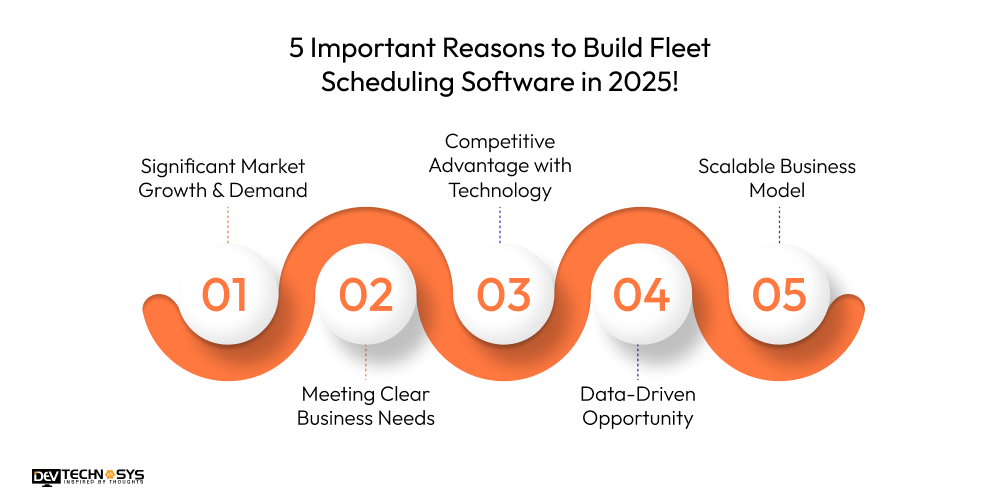
1. Significant Market Growth & Demand:
The freight logistics and transportation sectors are booming. There is now a way for companies of all sizes to manage their fleets efficiently – whether it be one delivery service business or a major logistics company – there is demand for effective fleet scheduling and software solutions.
The overall market for fleet management software and fleet scheduling software continues to show consistent growth, which further creates a conducive environment for emerging and innovative solutions.
2. Meeting Clear Business Needs:
Companies that have fleet vehicles are dealing with significant challenges such as increased fuel prices, greater need for strategic routing, maintenance upkeep, and regulatory compliance.
Software that directly addresses these needs by improving routes, automating scheduling, and monitoring the condition of the vehicles has a clear and direct ROI
3. Competitive Advantage with Technology:
An entrepreneur can build a logistics management software that is easy to use and easy to implement, and is feature-rich, and gain a competitive advantage.
Many of the existing solutions are old or overly complex. A new app that is easy to use and feature-rich can capture customers based on a better overall experience and enhanced features.
4. Data-Driven Opportunity:
The emergence of IoT and telematics means there is a ton of data from vehicles. Entrepreneurs can use AI and machine learning to create a full-fledged program that does more than schedule; it can forecast maintenance needs, evaluate driver performance, and deliver real insights that manual systems cannot provide.
5. Scalable Business Model:
Once established, Fleet scheduling software is a unique business model that can scale. Fleet scheduling is often done as a SaaS model with a fleet schedule system selling to a wide audience with lower marginal costs, collected and analyzed as a SaaS.
The tiered pricing model allows a SAAS business to grow with its users or clients, from small single users to small to large businesses.
6 Stages to Build Fleet Scheduling Software
Building Fleet scheduling software opportunity is a measured and thoughtful approach to undertake. Working with a software development business that specializes in the area is a great way to simplify the process. Here are six key stages to build fleet scheduling software:
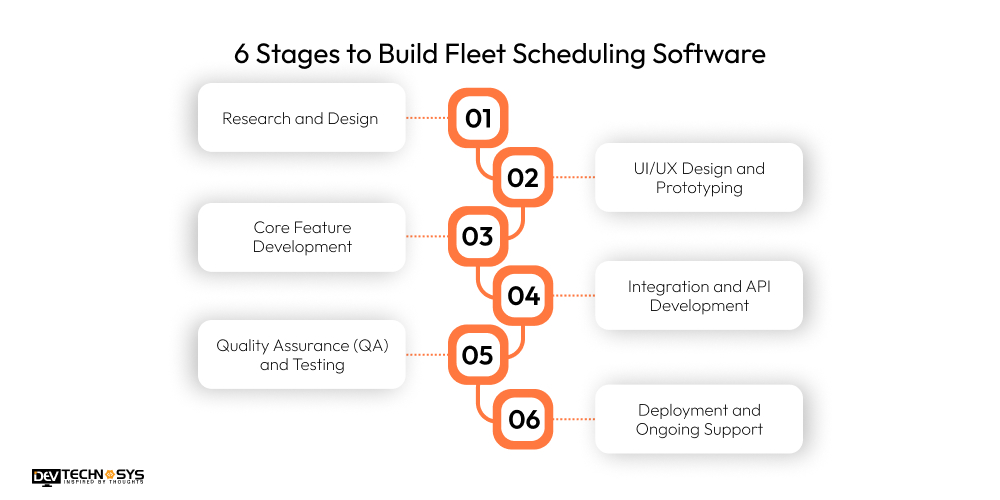
1. Research and Design:
In this first phase to create Fleet scheduling software, you will do extensive research on your business needs, the characteristics of the audience you’re trying to reach, and the unique challenges you’re facing.
The fleet management app development company will produce a feasibility study, define the project scope, and deliver an outline for the project after the analysis is complete. This phase helps to ensure that the resultant product meets your operational expectations.
2. UI/UX Design and Prototyping:
Moving to the second stage to create Fleet scheduling software, user interface design is important when it comes to adoption, as potential users want software to be easy to use!
The design team will produce wireframes and interactive prototypes to illustrate the appearance and usability of the software. The design team will build an intuitive dashboard for the dispatch team and a simple app for the driver’s mobile device.
The designs will strive for an engaging experience that is fluid across all platforms
3. Core Feature Development:
Hire mobile app developers to build the fundamental features of the software, the core functionality. These might include real-time vehicle tracking, intelligent route optimization algorithms, automated scheduling, and driver management modules.
This phase will often have an iterative nature that allows for regular updates of progress and a feedback & incorporation loop
4. Integration and API Development:
In the fourth stage to make Fleet scheduling software, fleet software must connect to other systems that will require APIs development and integration to existing CRM, ERP, and telematics systems. APIs integration might also include real-time traffic data integration and third-party map services.
5. Quality Assurance (QA) and Testing:
Before deployment, the fleet management software development will go through rigorous testing. Hire dedicated developers to identify and resolve bugs, performance issues, and security vulnerabilities.
The testing phase will encompass functional testing, usability testing, and load testing to ensure the software is strong enough to withstand all circumstances and demands required of it.
6. Deployment and Ongoing Support:
Once the logistics scheduling software has completed all planning, development, and testing, it is time to deploy (cloud, on-premise, etc.). The development house will also support the software after it has gone live (e.g., maintenance, updates, troubleshooting).
Whatever the configuration of the deployment, or even where you are hosting it, you will have a partner in the development company to ensure everything runs smoothly while your fleet operations are managed through the software.
Essential Fleet Scheduling Software Features
Are you ready to know some of the essentials and key functionalities that every fleet scheduling software must have?. Yes, you heard it right. We have covered a section that contains the must-have features of Fleet scheduling software with three different panels.
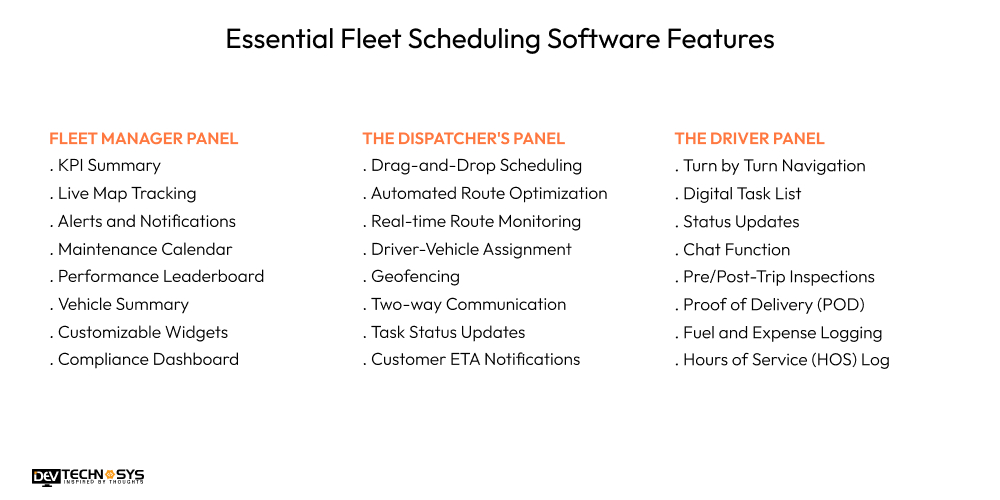
1. Fleet Manager Panel (Dashboard)
KPI Summary:
This panel visually displays a summary of fuel costs, fleet usage, and on-time delivery percentages. It will show charts and graphs representing real-time performance stats for the user to quickly assess performance and make strategic decisions.
Live Map Tracking
It shows all vehicles (with current speed, status, and location), providing instant visibility for fleet operations and areas of concern, all evident on the screen.
Alerts and Notifications:
It provides a single view of all critical alerts, whether for maintenance issues, dangerous driving behavior, or geofence violations. Clocks and reminders are included.
Maintenance Calendar:
Displays all the future preventative maintenance schedules, works orders, and maintenance records of the Fleet, preventing any unforeseen breakdowns and unnecessary fleet downtime.
Performance Leaderboard:
Ranks drivers on important safety and efficiency measures, encouraging healthy competition and improved driving habits across the team.
Vehicle Summary:
Quick summary of every vehicle in terms of status, like who the assigned driver is, how much fuel is in the vehicle, and any recent activity, to help manage the asset
Customizable Widgets:
Managers have the flexibility to customize their dashboard with widgets with respect to the most important data, based on their operational priorities.
Compliance Dashboard:
Helps managers stay on top of regulatory compliance, such as hours of service (HOS), ensuring fleet compliance to avoid hefty fines.
Want a chatbot demo or pricing? Fill the form and talk to our experts today.
Pick what you need below — you can select more than one — then tap Get detail to continue.
-
Chatbot demo dashboard
-
Cost to develop an app
-
Industry report
-
Case study
2. The Dispatcher’s Panel (Scheduling)
Drag-and-Drop Scheduling:
Makes assigning and re-assigning jobs to drivers very easy for dispatchers, drag-able and drop-able to the calendar or driver’s schedule.
Automated Route Optimization:
Smart algorithms can create the most efficient routes, factoring in traffic, delivery windows, and even vehicle capacity, and save time and fuel.
Real-time Route Monitoring:
Allows the ability to track the driver’s progress in comparison to the route they were originally planned on taking, with alerts if the route delays them, so dispatchers can modify on the run.
Driver-Vehicle Assignment:
The user-friendly interface allows drivers to be paired to a specific vehicle easily, so that the right person is paired with the right asset for the right job.
Geofencing:
Forms virtual boundaries around certain locations that automatically notify the dispatcher when a vehicle enters or leaves a particular job site.
Two-way Communication:
Feeds task updates and direct messaging for the dispatcher and driver while allowing for open, immediate communication without adding a new app for the driver on the mobile phone.
Task Status Updates:
Gives dispatchers live status feeds of all the tasks (ex, “en route,” “arrived,” “delivered”) they have completed throughout the day.
Customer ETA Notifications:
Automatically donuts the estimated time of arrival to customers as a notification based on the driver’s live location and traffic data, so customers are in the know and satisfied.

3. The Driver Panel (Mobile App)
Turn by Turn Navigation:
Optimize real-time directions on an assigned route so drivers can get to each job as efficiently and directly as possible, avoiding slower-paced routes or dead-end streets.
Digital Task List:
All scheduled jobs for the day are displayed clearly, complete with addresses, delivery instructions, and required forms.
Status Updates:
Allow Drivers access to quickly update the status of each job seamlessly (ex., arrived, departed, complete) so the dispatcher sees the operation in real-time.
Chat Function:
Built-in chat function for drivers to speak with dispatchers, which eliminates miscommunication and misunderstanding for dispatcher calls.
Pre/Post-Trip Inspections:
A digital checklist for drivers to conduct vehicle inspections, ensure safety, and log any issues to be reviewed by the manager.
Proof of Delivery (POD):
Captures digital signatures, photos, or barcodes for proof of delivery and immediately sends them to the office for recordkeeping.
Fuel and Expense Logging:
Apps like Autosist provide a simple method for drivers to log fuel purchases and any other expenses to precisely track and manage operating costs.
Hours of Service (HOS) Log:
Automatically tracks a driver’s hours and keeps them compliant with regulations, and avoids violations, which requires no manual paperwork!
Advanced Features of Fleet Scheduling Software
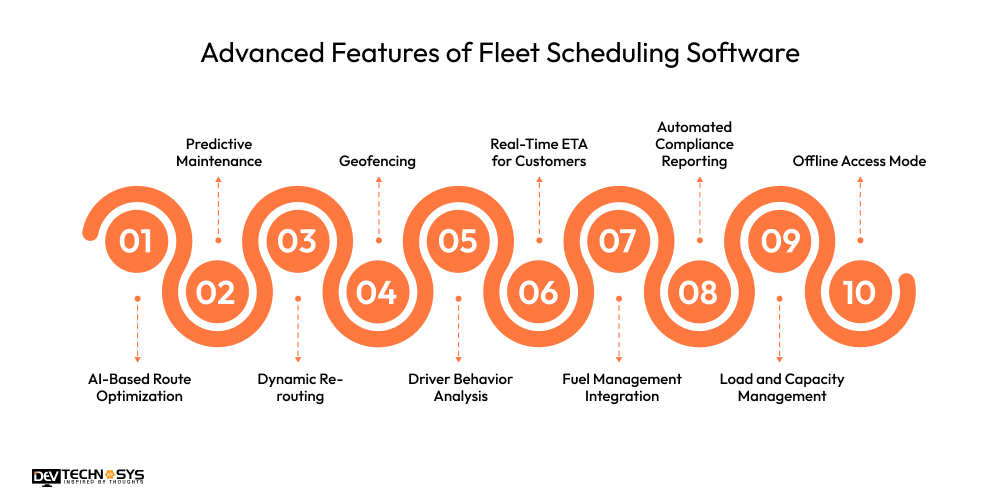
1. AI-Based Route Optimization:
Uses machine learning to examine real-time data and predict traffic, weather and road conditions to determine the most efficient routes.
2. Predictive Maintenance:
Uses telematics data to analyze when maintenance is required motivates your team, prevents a breakdown and avoids prolonged downtime.
3. Dynamic Re-routing:
Automatically updates live changes due to crazy incidents on the road like traffic jams, accidents or new customer requests.
4. Geofencing:
Allows you to create a virtual fence around certain geographical locations and receive automatic alerts when the vehicle enters or exits a defined area.
5. Driver Behavior Analysis:
Traffic Safety Analysis provides a positive and negative score regarding driver’s actions like speeding, cleaving, idling, etc. to improve safety and fuel usage.
6. Real-Time ETA for Customers:
Provides customers with live tracking links and exact estimated times of arrival, increasing transparency and satisfaction.
7. Fuel Management Integration:
Interfaces with fuel cards telematics to monitor usage, notice inefficiencies, and deter fuel pilferage.
8. Automated Compliance Reporting:
Automatically records driver hours of service, vehicle inspections, and more for effortless compliance.
9. Load and Capacity Management:
Tracks vehicle’s load space and weight limitations when scheduling, ensuring efficient use of the vehicle’s capacity and preventing overloading.
10. Integrated Proof of Delivery:
Allowing the driver to obtain electronic signatures, pictures, or barcodes on their mobile device, making the delivery process entirely digital.
How AI impacts Fleet Scheduling software?
AI greatly enhances fleet scheduling software to make its operation smarter and more efficient. Here are the ways:
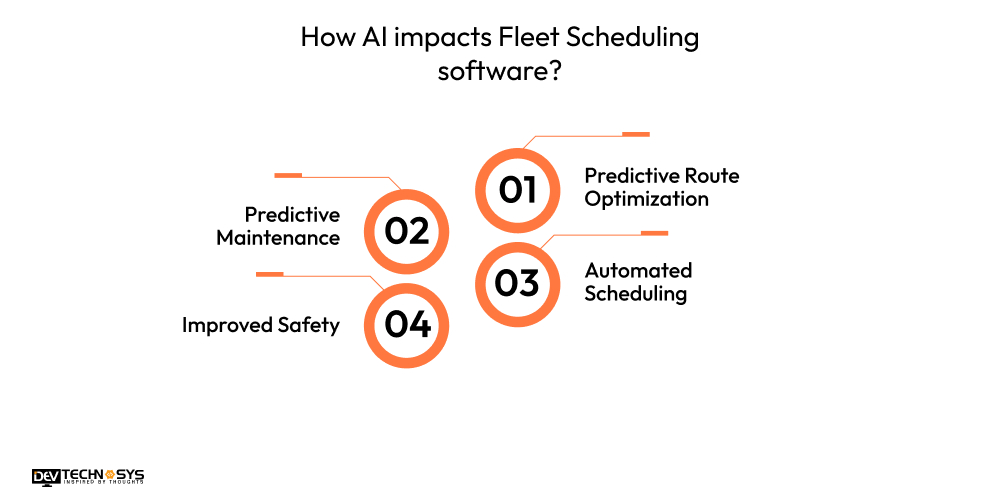
1. Predictive Route Optimization:
AI combines real-time traffic, weather, and delivery windows to plan the most efficient route that will save on fuel, which adjusts in real time to added delays or disruptions along the way.
2. Predictive Maintenance:
When using vehicle sensor data, AI will predict when a vehicle will need service to avoid costly breakdowns and maintain optimal uptime of vehicles.
3. Automated Scheduling:
AI automates the assignment of jobs to drivers based on driver availability, driver preferred location, vehicle capacity, etc., minimizing manual dispatching while mitigating human error.
4. Improved Safety:
AI monitors each driver’s driving behaviors to identify unsafe habits, giving GPS location information to training teams for targeted interventions and reducing accidents.
Success Story of Samsara
In 2015, MIT graduates Sanjit Biswas and John Bicket launched Samsara, the Connected Operations Cloud, to modernize fleet scheduling and operations using IoT and AI. Their goal was to make fleet management smarter and more efficient through technology.
Starting with $0 in revenue in 2014, Samsara experienced explosive growth, reaching $1.1 billion by 2024, achieving approximately 44% year-over-year growth. By early 2021, it had surpassed 20,000 customers, and by 2024, it was tracking 300,000 devices.
In December 2021, Samsara raised $805 million in its IPO, continuing its rapid growth trajectory. The company surpassed $1 billion in annual recurring revenue, establishing itself as a leading innovator in fleet scheduling software.
How Much Does it Cost to Build Fleet Scheduling Software?
The cost to build fleet scheduling software ranges from $8,000 – $20,000, but even a solution that is more complicated and feature-rich can easily be in the range of $28,000 or more.
The overall fleet scheduling software development cost is affected by multiple factors that are involved in the development processes, which we have covered below.
Here are six key factors that significantly impact the final fleet scheduling software development cost:
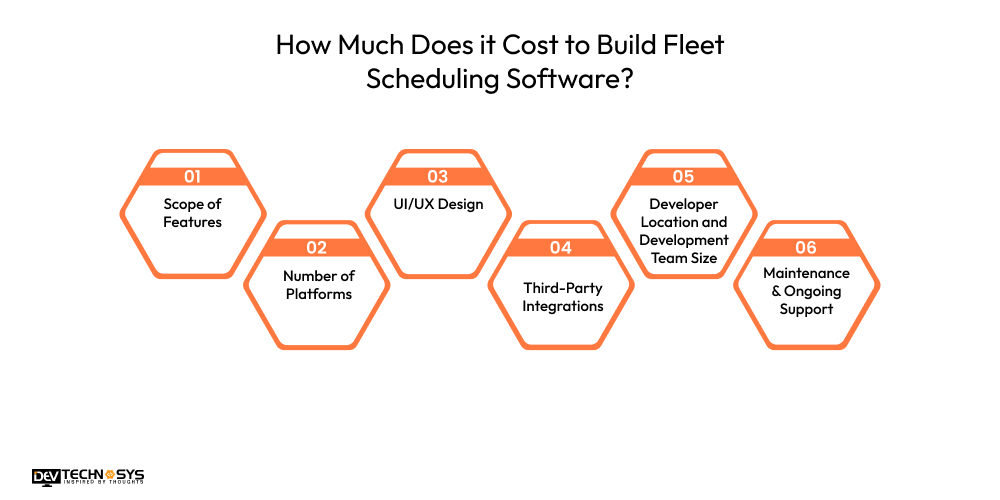
1. Scope of Features:
This is the primary factor. A basic system that includes GPS tracking and a simple dashboard will obviously cost much less than one that contains route optimization with AI, predictive maintenance analytics, and complete compliance reporting. The more panels and features you want, the higher the on-demand app development cost.
| Detail | Estimated Cost Impact | Level |
| Basic features | $8,000 – $12,000 | Simple GPS & dashboard |
| Medium complexity | $13,000 – $20,000 | Route optimization & tracking |
| Advanced feature‑rich | $21,000 – $28,000+ | AI & predictive analytics |
2. Number of Platforms:
A web application generally will cost less to develop fleet scheduling software than a native mobile application, developed for both iOS and Android platforms.
If you require a complete solution that consists of a web-based manager panel and mobile apps for drivers, the fleet scheduling software development cost will go up as you will need to develop multiple platforms.
| Platform Setup | Estimated Cost Impact | Level |
| Web only | $8,000 – $12,000 | Single platform |
| Web + One Mobile App | $13,000 – $18,000 | Dual platform |
| Web + iOS + Android Apps | $18,000 – $28,000+ | Full multi‑platform |
3. UI/UX Design:
A simple standard user interface will cost much less for design. A custom user experience that’s intuitive and visually harmonious to your workflow will require significant time from an experienced designer, so it will also increase the overall cost to develop fleet scheduling software.
| Design Level | Estimated Cost Impact | Level |
| Standard UI | $1,500 – $2,500 | Basic design |
| Custom UI/UX | $3,000 – $4,000 | Enhanced design |
| Advanced UI/UX | $4,500 – $5,000+ | Premium experience |
4. Third-Party Integrations:
Integrating with other systems, such as telematics hardware, fuel card providers, or accounting software (e.g., QuickBooks) adds complication. Each integration entails custom (code) development, testing, and maintenance, each of which adds complexity to the overall mobile app development cost.
| Integration Type | Estimated Cost Impact | Level |
| Basic API integrations | $2,000 – $3,000 | Simple |
| Multiple integrations | $4,000 – $6,000 | Moderate |
| Complex integrations | $6,000 – $8,000+ | Advanced |
5. Developer Location and Development Team Size:
Developers’ hourly rates vary significantly by geographic location. Assigning a development team in North America or Western Europe will exponentially increase the cost to build fleet scheduling software than using a team in Eastern Europe or Asia. Larger, more specialized teams can also raise the cost to develop fleet scheduling software.
| Team Location | Hourly Rate | Level |
| Asia / Eastern Europe | $15 – $25/hour | Low cost |
| South America / Mid‑Europe | $50 – $90/hour | Medium cost |
| USA / Western Europe | $100 – $150/hour | High cost |
6. Ongoing Maintenance and Support:
The cost to build an app like Onfleet is only part of the financial story. Ongoing, continuous costs must also be budgeted for – like bug fixes, software updates, server hosting and customer support. These ongoing expenses are vital for long-term solution viability, as well as security.
| Maintenance Level | Annual Cost | Level |
| Basic support | $1,000 – $1,500 | Minimal |
| Standard maintenance | $1,500 – $2,500 | Moderate |
| Full support | $2,500 – $3,000+ | Comprehensive |
5 Ways To Monetize Fleet Scheduling Software
While there are many ways to monetize fleet scheduling software, most monetization will follow a SaaS (Software as a Service) model. So to help you get the best ROI, we have curated a guide of the five common monetization models:
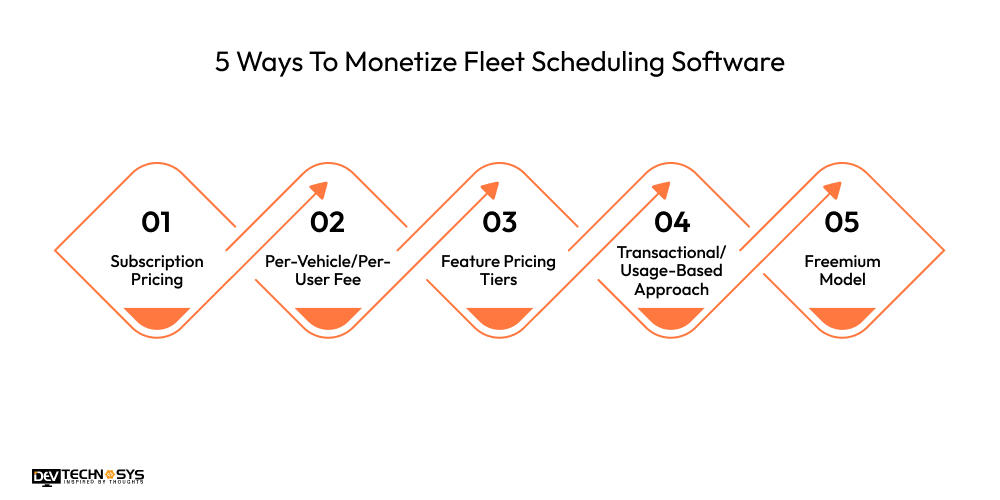
1. Subscription Pricing:
The most well-known app monetization model and, indeed, the most likely model for a fleet scheduling app will be subscription. Customers subscribe to the app by paying a periodic fee (monthly or annually) to access the software application.
Pricing can be tiered based on the number of vehicles, user seats or features. A basic plan might offer GPS tracking, while premium tiers unlock advanced features like AI-powered route optimization and detailed analytics.
2. Per-Vehicle/Per-User Fee:
This is a variation of a subscription-based model that expands with the client’s business size. The company pays a fee per vehicle tracked or user who accesses the software. This is a transparent model and works well for businesses of all sizes (small fleet to larger enterprise) because costs will scale directly with usage.
3. Feature Pricing Tiers:
This model offers different price packages native with different features. For example, a platform’s lowest tier may include planning and tracking only. The next tier could add maintenance management and driver communication, and the highest tier may include integrations, custom reports, and predictive analytics.
4. Transactional/Usage-Based Approach:
This pricing approach bills customers a fee per action or usage. For example, it could bill a fee per completed delivery, optimized route, or API call for integrations.
According to the mobile app development company, this model is well-suited for businesses with a dependent volume monthly and lowers the barrier to entry.
5. Freemium Model:
In a freemium model, you can offer a free version with limited features in order to attract a large base of users. The free tier may have basic tracking with a few vehicles.
The ultimate goal is to convert these free users to paid subscribers by providing more advanced features, scalability, or dedicated support in the premium paid version.

Technology Stack Utilized in Fleet Scheduling Software
| Category | Technologies / Tools |
| Frontend (Web Panel) | React.js, Angular, Vue.js, Tailwind CSS, Bootstrap, Material UI, Socket.io |
| Backend | Node.js + Express.js, Python (Django/Flask), Java (Spring Boot), RESTful APIs, GraphQL |
| Mobile Apps | Swift (iOS), Kotlin (Android), Flutter, React Native, Google Maps SDK, Mapbox, HERE SDK |
| Real-Time Updates | WebSockets, MQTT, Firebase Realtime Database |
| Database | PostgreSQL, MySQL, MongoDB, Firebase |
| Caching | Redis, Memcached |
| Cloud & Hosting | AWS, Google Cloud, Microsoft Azure, Docker, Kubernetes |
| Storage | AWS S3, Google Cloud Storage, Azure Blob Storage |
| Push Notifications | Firebase Cloud Messaging (FCM), OneSignal |
| Analytics & AI | TensorFlow, PyTorch, Scikit‑learn, BigQuery, Power BI |
| Telematics & GPS | Geotab API, Samsara API, OBD‑II Integrations, GPS Tracking SDKs |
| CI/CD & DevOps | GitHub Actions, Jenkins, Docker, Kubernetes, Terraform |
| Security | OAuth 2.0, SSL/TLS, JWT Authentication, AWS KMS |
How Dev Technosys Can Help You Build Fleet Scheduling Software?
Hopefully, you liked this blog and now you know how you can build fleet scheduling software in 2025. But do you know what is more important to know? To have a perfect partner who turns your idea into reality.
At Dev Technosys, we turn complex fleet scheduling dreams into road‑ready realities! Our fleet management software development company is building smart, AI‑powered software that juggles routes, drivers, and vehicles like a circus pro, minus the clowns.
From real‑time GPS tracking to automated dispatching and predictive maintenance, we craft solutions that keep fleets running smoother than fresh. Whether you’re a logistics startup or an enterprise with trucks galore, we design scalable, cloud‑based systems tailored to your workflow.
Think fewer headaches, faster deliveries, and happy drivers waving at traffic jams in the rear‑view mirror. Ready to schedule smarter and drive growth? Let’s roll!
People’s Most Searched Questions
1. How Much Does It Cost To Build Fleet Scheduling Software?
- Development cost ranges $8,000–$28,000+.
- Depends on features, platforms, and integrations.
- Advanced AI/telematics increase cost.
- Cloud hosting adds extra.
- Ongoing maintenance required.
2. What Features Are Essential In Fleet Scheduling Software?
- Real-time GPS tracking
- Route optimization
- Driver & vehicle availability management
- Maintenance scheduling
- Dispatch automation
- Analytics dashboard
- Notifications & alerts
- Cloud storage
- Mobile accessibility
3. How Long Does It Take To Make Fleet Scheduling Software?
- Basic MVP: 3–5 months
- Advanced version: 6–12 months
- Timeline varies by complexity
- Agile sprints speed delivery
- QA/testing adds 1–2 months
4. Which Technology Stack Is Best For Fleet Scheduling Software?
- Backend: js / Python / Java
- Frontend: React / Angular
- Database: PostgreSQL / MongoDB
- Mobile: Flutter / React Native
- Cloud: AWS / Azure
5. How Does Fleet Scheduling Software Improve Business Efficiency?
- Reduces idle time and delays
- Optimizes fuel consumption
- Improves driver productivity
- Enhances delivery timelines
- Tracks vehicle utilization
- Supports predictive maintenance
- Cuts operational costs
- Boosts ROI