










Key Takeaways:
-
- By 2030, around 5 billion people are anticipated to use food delivery apps, which attracts the attention of investors to invest.
- The cost to build a food delivery app ranges from $8,000 to $25,000, depending on the selected platform, features, and tech stack.
- You can earn extra income from your food delivery app through monetization strategies, such as delivery fees from customers, premium subscriptions, and brand & event partnerships.
Cravings don’t wait — why should you?
Are you tired of long waits, boring meals, and the hassle of cooking after a busy day? Or crave something mouth-watering, whether it’s a yummy burger, cheesy pizza, or spicy noodles?
Then, get excited, because with a food delivery app, you can fulfil your craving whether you are at home, at work, or on the go. Food delivery apps bring you fresh and hot meals from top restaurants straight to your door.
The online food delivery market is projected to generate approximately $1.39 trillion in revenue by 2025. Does this booming market attract you to build a food delivery app like Caviar?
If so, then you are in the right place, as this blog discusses the steps, features, and costs associated with creating a food delivery app.
Current And Future Stats of the Food Delivery App Market
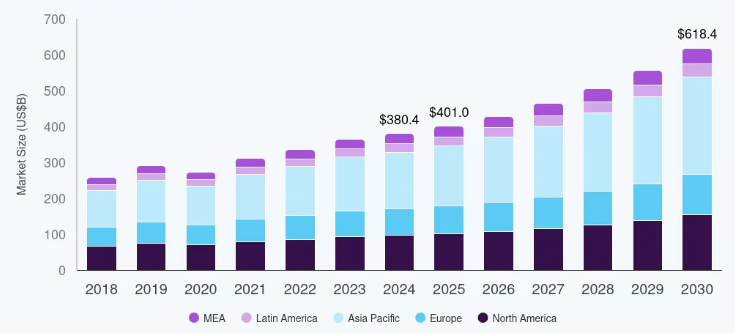
- The global online food delivery market was valued at approximately $380 billion in 2024.
- It’s expected to grow to around $618 billion by 2030, growing steadily at about 9% per year from 2025 to 2030.
- In the U.S., food delivery services are also expected to see strong growth between 2025 and 2030.
- In 2024, most people ordered food through mobile apps, making it the most popular way to use delivery services.
- Revenue from food delivery is expected to grow at a rate of around 7.6% per year, reaching $2 trillion by 2030.
- By 2030, around 2.5 billion people worldwide are expected to be using meal delivery services.
What is Caviar?
Caviar is a premium food delivery app that connects users with local and high-end restaurants. This app highly focuses on providing curated menus, high-quality, and fresh food delivery to users. Caviar was launched in 2013, with a focus on user experience and satisfaction. To create a food delivery app like Caviar, consider incorporating features such as real-time tracking, multiple payment gateways, and 24/7 customer support.
Reasons Investors Are Interested in Food Delivery App Development
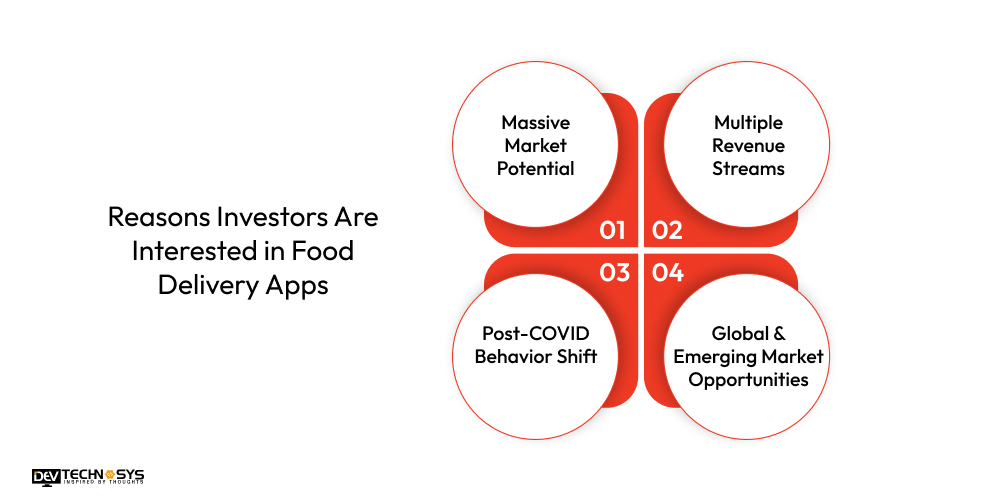
The food delivery app market is booming at a rapid rate, providing businesses with an opportunity to expand and generate income from multiple sources. Find out what the key reasons are that attract the attention of investors towards this market.
1. Massive Market Potential
The demand for food delivery apps is skyrocketing, as people with busy lifestyles are seeking convenience and quick deliveries. This market presents a significant opportunity for businesses to secure long-term investment returns and generate profitable opportunities.
2. Multiple Revenue Streams
Food delivery apps generate revenue from multiple sources, including restaurant commissions, delivery fees, in-app promotions, and ad subscriptions. It offers profitable and stable income-generating opportunities for investors.
3. Post-COVID Behavior Shift
Following the COVID-19 pandemic, there has been a significant shift in consumer behavior, with a preference for ordering in over dining out. This shift is one of the biggest trends that has attracted investors’ attention to the food delivery app industry.
4. Global & Emerging Market Opportunities
The demand for a food ordering app is not growing in large cities, but it is experiencing rapid expansion in small towns. The scalability of these apps is attracting attention from investors globally, which not only provides an opportunity to tap into new markets but also enables them to attract users worldwide.
The Role of Artificial Intelligence in Food Delivery Apps
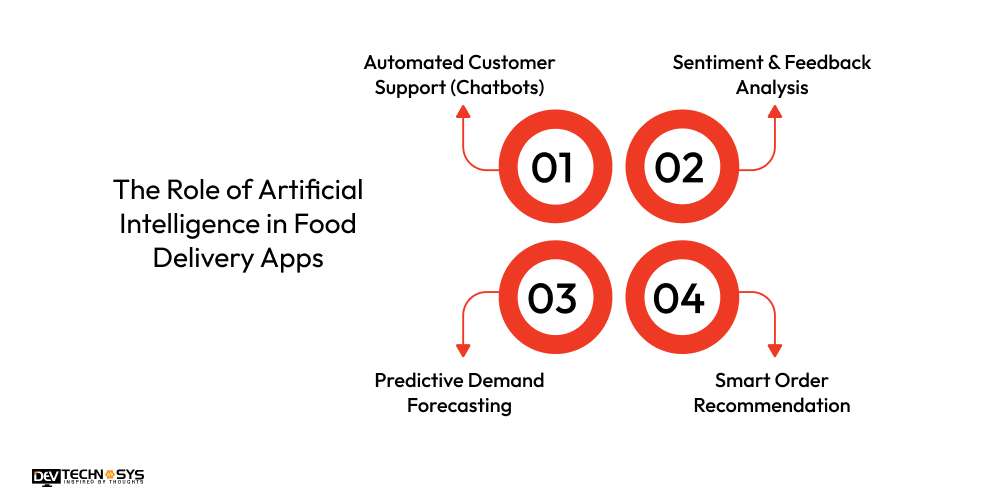
Here, we have discussed how AI is transforming the food delivery app market landscape. Find out how you can use AI to enhance the efficiency of your food delivery app like Caviar.
1. Automated Customer Support(Chatbots)
An AI-powered chatbot instantly offers assistance to consumers by providing quick support and answers. 24/7 AI-chatbot assistance reduces wait time and improves user experience, which makes a food delivery app like Caviar more efficient.
2. Sentiment & Feedback Analysis
AI with predictive analytics analyzes user feedback and reviews, enabling businesses to understand how users perceive their services and restaurants. AI also helps an app like Just Eat offer personalized recommendations, resolve issues more quickly, and enhance the overall food delivery experience for users.
3. Predictive Demand Forecasting
AI predictive analytics tools utilize machine learning and statistical algorithms to analyze historical data and forecast future outcomes. It helps businesses evaluate trends, manage resources, and streamline the food delivery process for faster and more efficient operations.
4. Smart Order Recommendation
AI helps an app like Glovo to suggest meals and restaurants based on consumers’ order history, user preferences, and current trends. Intelligent recommendations make it easy for users to find food and dishes they love. It helps in increasing the satisfaction and scalability of the app.
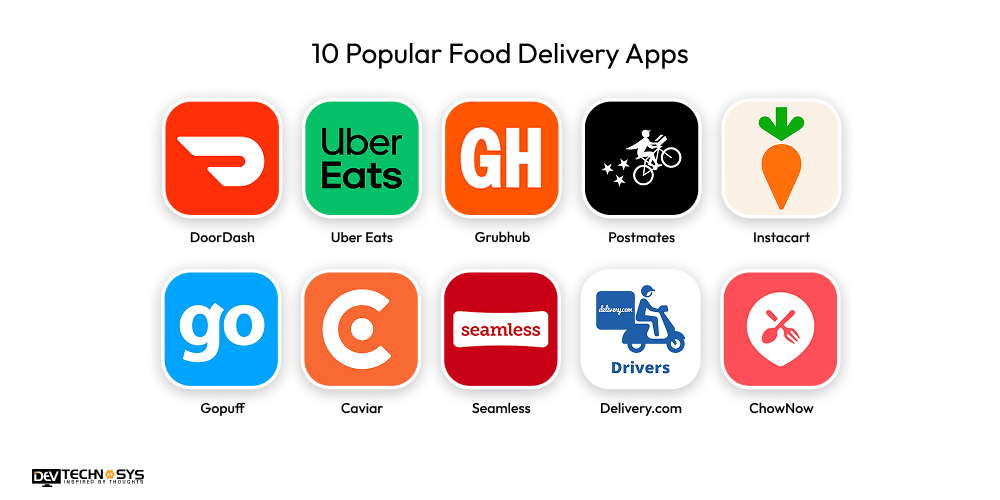
10 Popular Food Delivery Apps
Refer to the table below to explore some of the most popular food delivery apps. You will also find their ratings, download rates, and the platforms (such as Android or iOS) on which they operate.
| App | Avg. Rating (iOS / Android) | Approx. Downloads | Platforms | Key Features |
| DoorDash | ~4.8 / 4.6 | 100M+ | iOS & Android | Real-time tracking, DashPass subscription (free delivery), scheduled orders, and wide city coverage |
| Uber Eats | ~4.8 / 4.5 | 80M+ | iOS & Android | Integrated with Uber, real-time tracking, group orders, schedule later, Uber One membership |
| Grubhub | ~4.7 / 4.4 | 50M+ | iOS & Android | Extensive restaurant network, preorder, loyalty perks (Grubhub+), mix & match from multiple eateries |
| Postmates | ~4.8 / 4.1 | 10M+ | iOS & Android | Delivers food, groceries, alcohol, and essentials; 24/7 service; unlimited delivery plan |
| Instacart | ~4.8 / 4.3 | 30M+ | iOS & Android | Grocery delivery, same-day service, extensive retailer partnerships |
| Gopuff | ~4.6 / 3.9 | 10M+ | iOS & Android | 24/7 delivery of snacks, essentials from micro-fulfillment centers; Fam subscription |
| Caviar | ~4.7 / 4.2 | 0.5M+ | iOS & Android | Premium restaurants, real-time tracking, scheduling, and gourmet experience |
| Seamless | ~4.8 / 4.6 | ~2M+ | iOS & Android | Urban favorite (e.g., NYC), simple UI, integrates with Grubhub, varied payment methods |
| Delivery.com | ~4.6 / 4.0 | 1M+ | iOS & Android | Delivers food, groceries, alcohol, laundry, and more; reward points and multiple checkout options |
| ChowNow | ~4.5 / 4.0 (est.) | 1M+ | iOS & Android | Allows restaurants to run their own branded ordering systems; a commission-free model that supports small businesses. |
Why Users Love Food Delivery Apps?
- Users love food delivery apps because they bring convenience right to their fingertips, allowing them to enjoy their favorite meals.
- Whether it’s a lazy weekend or a busy workday, food delivery apps help save time and effort.
- These apps offer a vast variety of cuisines, catering to every user’s craving, depending on their mood.
- An app like Deliveroo, which focuses on providing a smooth and enjoyable user experience, prioritizes speed, easy payment, and user safety.
How to Build a Food Delivery App-Step-by-Step Guide?
Entrepreneurs must be aware of the essential steps required to build a food delivery app like Caviar. They also need to hire mobile app developers to ensure the seamless execution of each stage and successfully create an app like Zomato.
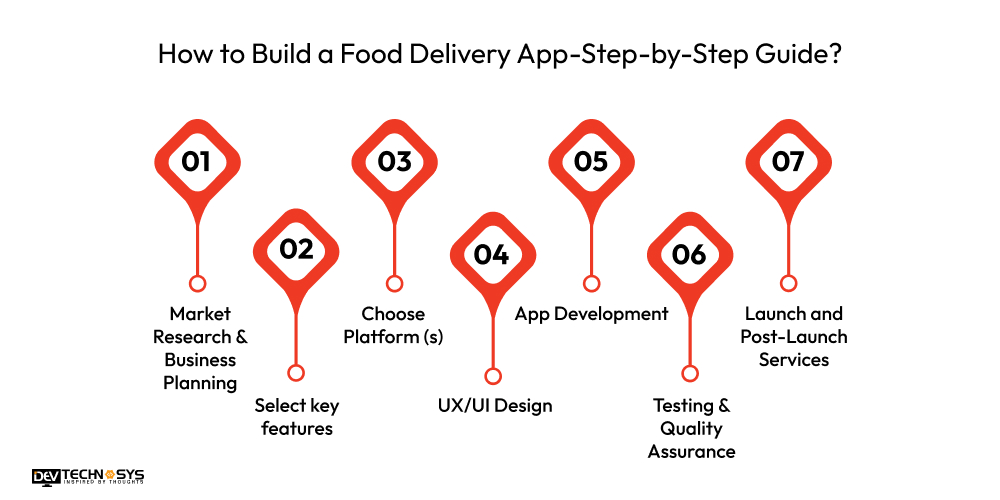
1. Market Research & Business Planning
This stage begins with gaining a thorough understanding of the target audience’s needs and expectations. Here, you also need to analyse competitors’ strategy and current trends in the food delivery app market.
This helps an app like Swiggy to have a clear business plan, solid marketing strategies, and a revenue model. A similar app to Caviar, with robust business planning and a proper layout, ensures a clear blueprint for developing a food delivery app like Favor.
2. Select key features
To effectively create a food delivery app like Hungry Panda, you need to select the features that will satisfy users’ needs and differentiate your app from competitors in the food delivery market.
Here, you need to start with basic steps, such as listing a restaurant, selecting payment options, browsing the menu, and tracking orders. To make a food delivery app stand out from others, consider adding features such as loyalty programs, ratings, and reviews.
3. Choose Platform (s)
This is the stage where you need to decide where you want to launch, which can be on Android, iOS, or both. Here, you must consider the target audience’s preferred devices and budget. If you want to save your time and money, in this case, you can select cross-platform.
Selecting the right Android app development company has a significant impact on the platform selection and development time of food delivery apps. It helps you to have reliable professional advice according to your goal.
4. UX/UI Design
A visually appealing app is the key to attracting the attention of the maximum number of users. By creating an easy-to-navigate app that focuses on features such as a smooth checkout process, simple menus, and clear buttons, you can capture users’ attention.
Entrepreneurs must use consistent and simple icons, fonts, and colors to make their app trustworthy and visually appealing. Good design helps improve overall user satisfaction, which in turn encourages repeat orders. You must invest time in prototypes and wireframes before development begins.
5. App Development
This stage starts with the coding process for the app as per your selected design and feature list. To build a food delivery app like Caviar, you must integrate payment gateways and GPS tracking.
An experienced mobile app development company helps you ensure smooth scalability and functionality of the app. Entrepreneurs need to ensure that they consider a clean process for easier updates. This helps in increasing the reach and efficiency of the food delivery app.

6. Testing & Quality Assurance
The testing phase in the food delivery app development process helps identify bugs, slowdowns, and crashes. With quality assurance, entrepreneurs can thoroughly test every feature of the app, including notifications, ordering, and tracking, to ensure it works flawlessly across multiple devices.
Testing and quality assurance help you to make an app like Caviar with a reliable and smooth experience, which in turn helps prevent negative reviews after the app’s launch.
7. Launch and Post-Launch Services
Launch your food delivery app on app stores and promote it with the help of marketing campaigns. Monitor user reviews and behavior to identify issues at an early stage. Hire dedicated developers to ensure timely updates with new features and bug fixes.
Entrepreneurs must provide support to consumers for seamless complaint management. With post-launch services, you can keep users happy.
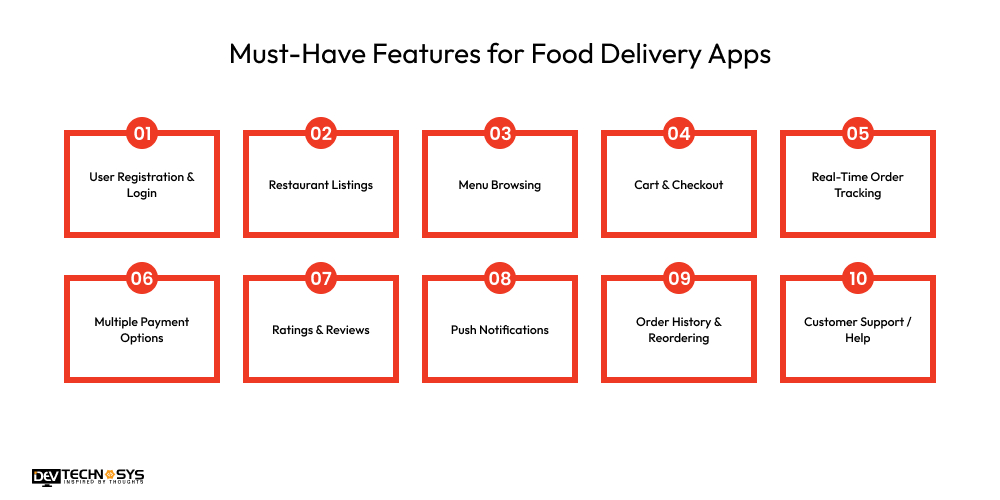
Must-Have Features for Food Delivery Apps
To create an app like Caviar, several essential features must be included in your food delivery app. This helps in increasing the efficiency, scalability, and functionality of the app.
| Must-Have Features | Purpose / Benefit |
| 1. User Registration & Login | Secure access using email, phone, or social login |
| 2. Restaurant Listings | View available restaurants with filters & categories |
| 3. Menu Browsing | Browse food items with details, images, and prices |
| 4. Cart & Checkout | Add items and place orders with payment options |
| 5. Real-Time Order Tracking | Track delivery status and ETA |
| 6. Multiple Payment Options | Pay via card, wallet, UPI, COD, etc. |
| 7. Ratings & Reviews | Rate restaurants and delivery experiences |
| 8. Push Notifications | Receive order updates, exclusive offers, and personalized alerts. |
| 9. Order History & Reordering | View past orders and repeat quickly |
| 10. Customer Support / Help | Contact support via chat, call, or FAQs |
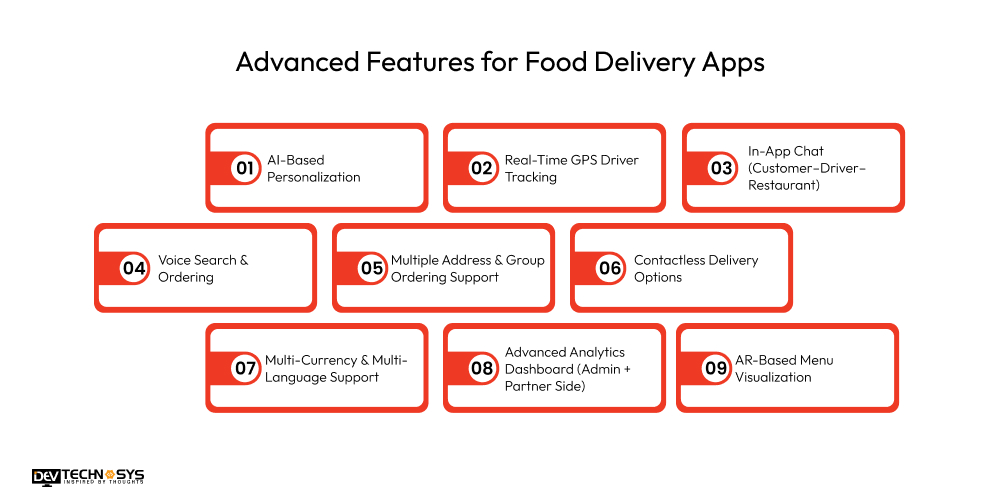
Advanced Features for Food Delivery Apps
Advanced features help entrepreneurs to create a mobile app that is unique and has the potential to perform more effectively than basic app features. Let’s explore the advanced features that enable you to create a Caviar app clone.
1. AI-Based Personalization
The top food delivery app uses machine learning to analyse the preferences and behavior of users. It helps in providing personalised meal suggestions, restaurant recommendations, and deals.
2. Real-Time GPS Driver Tracking
Apps similar to Caviar allow consumers to monitor the estimated delivery time and order location in real-time. It increases transparency and trust between users.
3. In-App Chat(Customer–Driver–Restaurant)
An app like Caviar enables seamless communication between consumers, restaurants, and delivery drivers. It helps in resolving issues more quickly with high accuracy.
4. Voice Search & Ordering
Other apps like Caviar integrate voice recognition, which helps users browse menus, locate restaurants, and place orders using voice commands. It improves the convenience and accessibility of the app.
5. Multiple Address & Group Ordering Support
To make an app for food delivery, a similar app like Caviar ensures that users can save multiple delivery addresses from different locations. This enhances app convenience and user flexibility.
6. Contactless Delivery Options
To build an app like Caviar, you must ensure that app supports delivery without physical interaction, which allows drivers to leave food at the restaurant to notify consumers. It helps you provide seamless services during health crises.
7. Multi-Currency & Multi-Language Support
The Caviar food delivery app offers multilingual support and enables users to view prices in their preferred currency. It enhances the food delivery app’s global reach and enhances inclusivity.
8. Advanced Analytics Dashboard (Admin + Partner Side)
The best food delivery app always ensures that it equips restaurant partners and admins with real-time data on revenue, orders, delivery performance, and consumer behavior. This enhances operational optimization and decision-making.
9. AR-Based Menu Visualization
To create an app like Caviar, user-generated augmented reality is utilized. The best food delivery apps allow users to visualize food dishes in 3D. It increases engagement and attracts users’ attention towards the meal.
The Cost to Develop Food Delivery Apps
The cost to create a food app like Caviar is $8,000 to $25,000. Based on platform selection, feature choice, UX/UI design, and interface, this cost will increase. Additionally, the food delivery app development cost is influenced by testing and quality assurance, which are essential elements to maintain the efficiency and reliability of the app. Let’s take a quick look at the cost table below to determine the cost of developing a food delivery app, considering key essential points.
| App Type | Estimated Cost | Development Time |
| Basic MVP App | $8,000 – $12,000 | 2 – 3 Months |
| Standard App | $13,000 – $20,000 | 3 – 5 Months |
| Feature-Rich App | $20,000 – $25,000 | 5 – 6 Months |
| Custom Enterprise-Grade App | $26,000 – $30,000 | 6 – 8 Months |
Top Factors That Affect the Cost to Develop Food Delivery Apps
Here, we have discussed several factors, including features, third-party integration, maintenance, and testing, that affect the cost of app development.
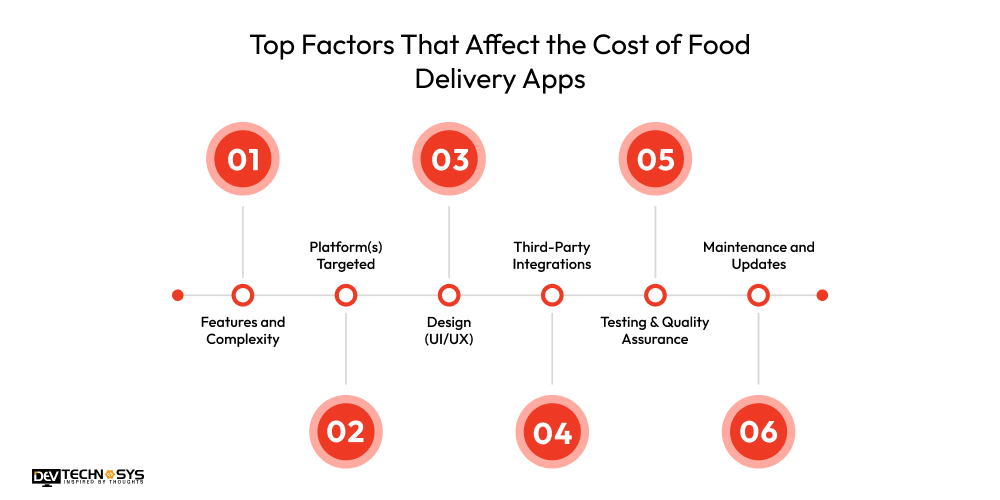
1. Features and Complexity
The more features your app has, such as multiple payment options, real-time tracking, and AI recommendations, the higher your mobile app development cost. Advanced features require more testing, time, and coding. Develop a food delivery app like Caviar by considering features that match your budget.
| Feature Complexity | Cost | Time |
| Basic Listings & Search | $2,200 – $4,200 | 1 – 2 Months |
| Intermediate (Chat, Filters, Profile) | $5,300 – $8,300 | 2 – 3 Months |
| Advanced (AI, AR, Blockchain) | $5,500 – $7,600 | 3 – 4 Months |
2. Platform(s) Targeted
If you want to build an app for both Android and iOS, then it will cost more than creating a food delivery app for a single platform. You can reduce the cost of developing a food delivery app by considering cross-platform development, as it requires a single codebase.
| Platform Complexity | Cost | Time |
| iOS, Android only, and Web | $2,400 – $4,700 | 1 – 3 Months |
| All (Native) | $5,300 – $9,300 | 2 – 3 Months |
| Cross-Platform | $5,400 – $9,300 | 3 – 4 Months |
3. Design (UI/UX)
A visually appealing and user-friendly app needs skilled UX/UI designers, which increases the overall cost of food delivery app development. High-quality design, custom animations, and intuitive navigation enhance user experience but also increase the restaurant mobile app development cost.
| UI/UX Complexity | Cost | Time |
| Basic UI | $1,500 – $2,400 | 2 – 3 Weeks |
| Custom & Responsive UI/UX | $2,500 – $4,800 | 1 – 2 Months |
| High-End Interactive Design | $5,300 – $7,300 | 2 Months |
4. Third-Party Integrations
Build a food delivery app like Caviar by integrating tools such as SMS services, payment gateways, and apps, which, however, can increase development costs. You need to ensure that every integration is securely connected, which increases usages feeds and ongoing expenses.
| Third-party integration Complexity | Cost | Time |
| Basic Backend (CRUD APIs) | $2,300 – $3,300 | 2 – 3 Weeks |
| Scalable Backend + DB | $4,800 – $7,300 | 1 – 3 Months |
| Third-party Integrations | $3,600 – $6,300 | 1 – 2 Months |
5. Testing & Quality Assurance
An App like SkipTheDishes conducts testing to ensure that the food delivery app works smoothly. It includes steps such as checking for bugs, performance issues, and crashes. Strong quality assurance improves app performance, but it also increases the cost of app development.
| Testing Complexity | Cost | Time |
| Manual Testing Only | $9,300 – $1,900 | 2 Weeks |
| Manual + Automated Testing | $1,600 – $3,800 | 3 – 4 Weeks |
| Advanced Testing + Security Audits | $3,900 – $5,800 | 1 Month |
6. Maintenance and Updates
After launch, your food delivery app needs regular bug fixes, updates, and feature improvements. These maintenance increases the overall cost of app development. An app like DoorDash conducts regular maintenance, which helps ensure the app’s compatibility and security.
| Maintenance Complexity | Cost | Time |
| Basic (Bug Fixes, Minor Updates) | $1,800 – $2,700 | Ongoing Monthly |
| Standard (Feature Updates, Monitoring) | $3,300 – $5,700 | Ongoing Monthly |
| Premium (24/7 Support) | $6,800 – $8,300 | Ongoing Monthly |
Best Tech Stack for a Food Delivery App
Food delivery app development process also includes the most critical stage, which is selecting the right tech stack. This helps ensure the efficiency, scalability, and maintainability of the food delivery app. Let’s determine the essential tech stack that you need to include in your app to build a food delivery app like Caviar with high efficiency.
| Category | Technology | Notes |
| Frontend (Customer App) | React Native / Flutter | Cross-platform for iOS and Android |
| Frontend (Admin Panel / Web) | React.js / Angular / Vue.js | Responsive web dashboard for admin & restaurants |
| Backend | Node.js / Django / Ruby on Rails | Scalable server-side logic and APIs |
| Database | PostgreSQL / MongoDB | PostgreSQL for structured data, MongoDB for flexibility |
| Authentication | Firebase Auth / Auth0 / OAuth 2.0 | Secure login, social media logins, etc. |
| Real-time Features | Socket.io / Firebase Realtime DB / Pusher | Real-time order tracking and updates |
| Cloud & Hosting | AWS / Google Cloud / Azure | Scalable infrastructure and services |
| Push Notifications | Firebase Cloud Messaging (FCM) / OneSignal | Customer updates, promotions, order status |
| Maps & Navigation | Google Maps API / Mapbox | Route tracking, restaurant/customer location |
| Payment Gateway | Stripe / PayPal / Razorpay | Secure in-app payments and refunds |
| Containerization | Docker | Simplifies deployment and scaling |
| CI/CD | GitHub Actions / Jenkins / GitLab CI | Automated testing and deployment |
| Monitoring & Analytics | Firebase Analytics / Google Analytics / Sentry | Track user behavior and app performance |

How To Make Money From a Food Delivery App Like Caviar?
To develop an app like Caviar, you must find out the efficient monetisation strategies through which you can earn extra money. So let’s have a look and find out how you can earn additional income from your food delivery app.
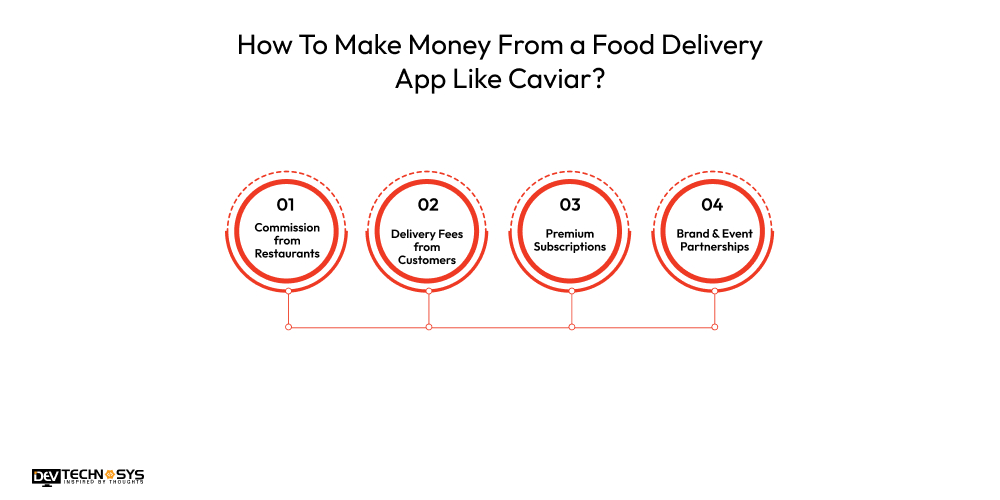
1. Commission from Restaurants
You can charge a certain percentage of commission from the restaurant for each order placed through the food delivery app. This is a stable source of income, a common strategy for earning money from the app.
2. Delivery Fees from Customers
An app like Menulog collects delivery fees from consumers for each order. These fees help cover driver costs, which in turn generate revenue, particularly during periods of high demand that increase opportunities for profit generation.
3. Premium Subscriptions
To develop an app like Caviar, entrepreneurs must offer subscription plans that include benefits such as exclusive deals and offers, free delivery, and priority support. This is an excellent strategy for generating recurring revenue from the app.
4. Brand & Event Partnerships
To earn extra income from food delivery apps entrepreneurs need to collaborate with brands to promote exclusive offers and special menus. It offers you the opportunity to have an additional income source.
Conclusion
Based on the above blog, we have now come to the conclusion that food delivery apps have significantly changed how people enjoy meals. These apps bring speed, convenience, and variety to doorsteps. Businesses looking to make a food delivery app like Caviar are considering features such as secure payment gateways, personalised recommendations, and real-time tracking. With the right food delivery app development company, you can integrate third-party integration, which helps you earn extra money from partnerships with restaurants.
Frequently Asked Questions
Find answers to the most common questions related to this article.
The cost to build a food delivery app like Caviar is $8,000 to $25,000. This cost fluctuates based on platform selection, feature choice, and third-party integrations.
The time to create a food delivery app is between 3-4 months. Due to testing, bug fixes and quality checks, this will increase.
Features that you must consider to build a food delivery app like Caviar include:
User Registration & Login
Restaurant Listings
AI-Based Personalization
Real-Time GPS Driver Tracking
In-App Chat (Customer–Driver–Restaurant)
Voice Search & Ordering
Food delivery app like Caviar generates extra income from monetisation strategies like:
Commission from Restaurants
Delivery Fees from Customers
Premium Subscriptions
Brand & Event Partnerships
The best tech stack to create a food delivery app includes:
React Native
React.js
Node.js
Postgre
SQL
Socket.io
Docker