




















Creating a fitness app such as Jefit provides a unique opportunity for entrepreneurs to enter the growing fitness tech market. The global fitness app market was valued at around USD 16.1 billion in 2023 and is expected to increase at a 17.9% CAGR between 2024 and 2032. The higher growth stems from increasing health consciousness, the skyrocketing number of chronic illnesses, and a larger emphasis on newer technologies including AI and wearables.
The base cost for building a fitness app with personalized workouts, progress tracking, and social sharing ranges between $8,000 and $30,000, depending on complexity and platforms. Entrepreneurs will find the opportunity for a positive return appealing, considering this industry is quite expanding and there is a greater demand for digital fitness solutions. But if you are confused about the Jefit application you must know we are here for you with perfect quotations. So are you ready to know how much it’s going to cost to build a workout app like Jetfit? Lets get that!
What is a Jefit Workout?
Jefit is a fitness planning and tracking app for strength training (and for gym-goers). Users can easily create a personalized workout based on a database of 1,400+ exercises linked to videos. The workout apps for fitness have one simple function: to record all sets, reps, and weights to track progress, One Rep Max (1RM), and overall strength improvement over time. It also includes a large community for encouragement and sharing workouts.
Global Fitness App Market Overview
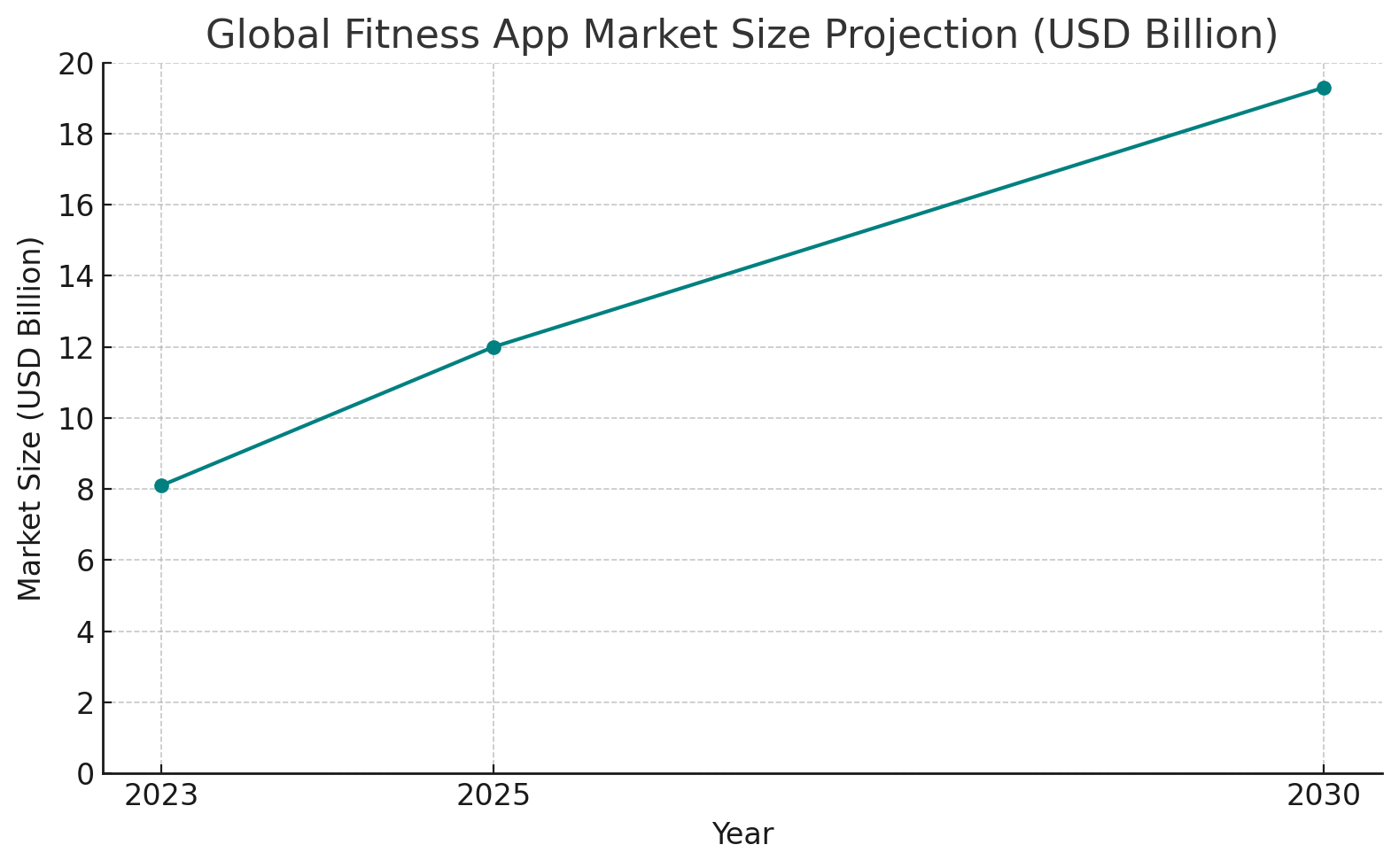
- The global on-demand workout marketplace was estimated at roughly USD 8.1 billion in 2023 and is projected to be worth around USD 19.3 billion by 2030, advancing at a CAGR of 17.6%.
- Exercise and weight loss applications dominate the market, accounting for over 54.8 percent of the market share in 2023, with lifestyle monitoring apps accounting for approximately 50.0% of market share at a CAGR of 16.3% in 2024.
- Emerging segments, such as move-to-earn fitness applications, were valued at USD 636.5 million in 2023 and are expected to reach USD 3.29 billion by 2033, growing at a CAGR of 17.85%.
- North America had the greatest revenue share at 46.61% in 2024. The Asia Pacific region is expected to grow the fastest due to the rapid increase in health awareness and smartphone penetration.
You can reach out anytime; we are available 24/7. Our team provides a quick response.

Why Do Entrepreneurs Want to Build A Workout App Like Jefit?
The surge of fitness and health tech has made it a compelling investment for entrepreneurial minds to get involved in a workout app like Jefit. Here are 5 reasons to develop the best fitness or workout app:
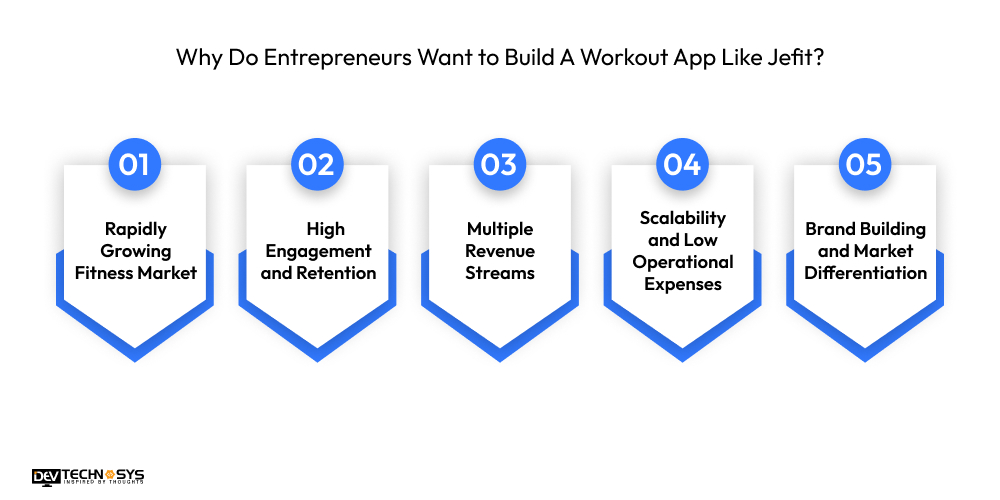
1. Rapidly Growing Fitness Market:
The global fitness app market is anticipated to reach billions in revenue by 2027, fueled by a growing awareness of health, a growing demand for home workouts, and a surge of digital fitness products.
Entrepreneurs are aware of an expanding and constantly evolving group of consumers, increasingly selecting convenient app-based fitness products over traditional gym memberships.
2. High Engagement and Retention:
Apps like Google Fit and Jefit are built to enhance high levels of engagement for its users. They can end up being almost addicting by offering valuable progress tracking features, developing personalized workout plans, and offering social options like community challenges.
This high engagement results in significant long-term retention of users, as many workout app solutions use subscription-based or freemium monetization models, which are financially lucrative from an investment perspective.
3. Multiple Revenue Streams:
Fitness apps typically provide various forms of monetization, including in-app purchases, premium subscriptions, partnerships with fitness brands, and advertisements.
Entrepreneurs see an opportunity to build a company that generates income each and every month while also promoting cross-marketing opportunities with health and wellness products.
4. Scalability and Low Operational Expenses:
Unlike brick and mortar gyms or fitness studios, an app for workout business can be scaled immediately and across the globe with minimal operational costs.
Once the app is developed, it can successfully serve thousands of users at any given time virtually and at the same time. This makes the fitness app model very attractive for an investor because it can generate profits with high margins and for a low model cost.
5. Brand Building and Market Differentiation:
By creating a fitness app like Hevy, entrepreneurs can not only create good digital branding for themselves in the wellness industry but also become known for their brand through the channel of unique features, personalized experience, or specialized niche-focused solutions.
This way they can separate themselves from competitors and get more loyal customers which will not only increase the valuation of the app but also its market presence.
What is the Average Cost to Build a Workout App like Jefit?
An average cost to develop a workout app like Jefit is estimated around $8,000 to $30,000 which can vary depending on the number of features, the complexity of the app, and the development approach. A basic version with the essential functions of workout tracking, exercise libraries, and user profiles will be closer to the minimum side of the range.
On the other hand, an app with artificial intelligence-based coaching, personalized plan, real-time analytics, wearable integration, and community features will have many features and thus a higher cost to develop a fitness app will be required. Other things, such as cross-platform development, advanced UI/UX design, and backend infrastructure, can also affect the Jefit app development cost.
The essential things that come with working with a well-qualified app development company are quality, scalability, and cost efficiency.
| Factor | Short Description | Estimated Cost Impact |
| App Design & UI/UX | Custom, user-friendly design with smooth navigation and engaging visuals. | $1,000 – $4,000 |
| App Complexity | Level of features like personalized plans, AI coaching, video tutorials, and gamification. | $2,000 – $6,000 |
| Platform Choice | Developing for Android, iOS, or both; or using cross-platform frameworks. | $1,500 – $5,000 |
| Feature Set | Workout logs, progress tracking, community forums, wearable integration, AI recommendations. | $2,000 – $7,000 |
| Third-Party Integrations | APIs for payment, calendars, fitness trackers, social logins, and wearables. | $800 – $3,000 |
| Backend Infrastructure | Server, cloud storage, database, and real-time updates for scalability and security. | $1,500 – $5,000 |
| Developer Location & Hourly Rate | Rates vary by region; North America/Europe higher, Asia lower. | $1,000 – $4,000 |
| App Maintenance & Updates | Ongoing updates, bug fixes, and feature enhancements post-launch. | $800 – $3,000/year |
| Testing & QA | Ensures the app works smoothly, securely, and is compatible across devices. | $800 – $2,500 |
| Marketing & Launch | App store optimization, ads, influencer campaigns, and launch promotions. | $500 – $2,000 |

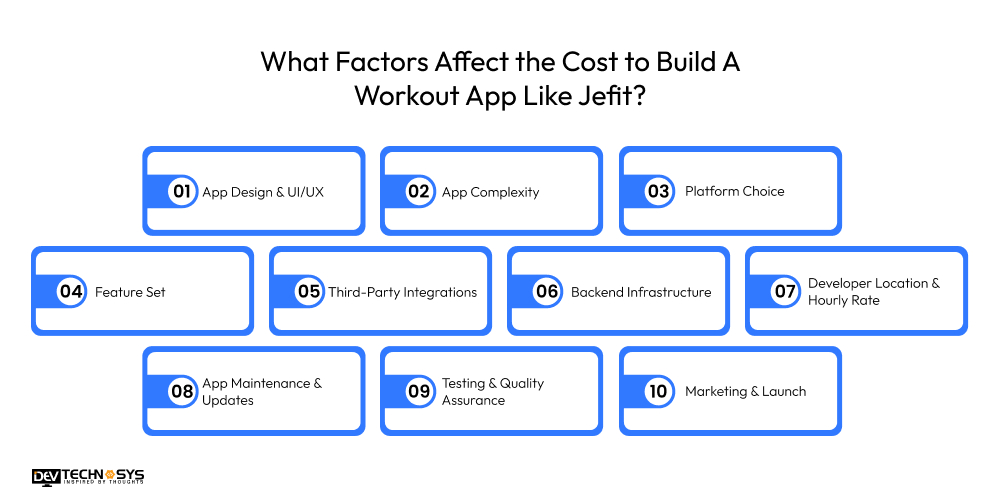
What Factors Affect the Cost to Build A Workout App Like Jefit?
Here is the list of factors affecting the overall cost to build a workout app like Jefit. If you’re wondering about building a leading workout app then learning about cost with its uncertain factors is important. So let’s get it right.
1. App Design & UI/UX
An eye-catching, user-friendly design will increase interaction with the app which, however, will require more design skill and time. Custom animations, easy navigation, and sleek interfaces are more expensive than just using basic templates. The use of a perfect UI/UX for both beginners and professionals will elevate the cost to make a workout app like Jefit, but will also increase the rate of retention and satisfaction.
2. App Complexity
One of the main factors that influences how much time and money it will take to edit app development cost is its complexity, including the functionality of the app, such as personalized workout plans, progress tracking, video tutorials, and AI recommendations.
An app that is simple and only does basic tracking will be cheaper to make, while the development of advanced functionality with analytics and gamification will result in a significant increase in the fitness website development cost.
3. Platform Choice
Creating a single-platform app, for example, Android or iOS, is less expensive than developing a cross-platform app. Nevertheless, the choice of both platforms will lead to extended development time, more thorough testing, and higher workout app development costs. Choosing hybrid development frameworks such as Flutter or React Native will not only save you money but also allow you to target a wider audience.
4. Feature Set
Fitness applications are usually packed with features that include workout logs, progress charts, AI coaching, community forums, and wearable integration.
These features directly reflect the fitness app development cost. Every feature must be developed, tested, and integrated, so the creation of more complicated features will require more cost to create a workout app like Jefit.
5. Third-Party Integrations
Third-party services in an app, for example, API connections for payment, fitness trackers, calendars, or social logins, add comfort to the user but also their price. The process of making wearables such as the FitBit or Apple Watch available for customers is going to take more development hours and testing, which will raise the cost to create a workout app like Jefit.
6. Backend Infrastructure
The backend side of the app, which is strong, guarantees data security, allows the app to grow, and also gives real-time updates. The storage of data in the cloud, the management of a server, and the designing of a database are all sources of expenses. More users and more data will lead to the need for a strong and secure system which will increase the total mobile app development cost.
7. Developer Location & Hourly Rate
The cost to build a workout app like Jefit differs due to the location. Developers in North America or Europe ask for $80–$150/hour, whereas those in Asia may ask for $10–$25/hour. The most considerable effect on the final price is selecting the right team based on the workout app development cost.
8. App Maintenance & Updates
Mobile app maintenance service after the release of the app, which includes bug fixing, updates, and feature enhancement, is an ongoing cost. Regular updates are the main reason for users to keep using the application and for the developers to stand against the competition. It is very important for the maintenance budget to be 15-20% of the initial workout app development cost annually.
9. Testing & Quality Assurance
Complete QA is the basis of a flawless software which will be compatible with all the different devices and operating systems. The more complicated the application, the more expensive the testing will be.
To achieve the smooth functioning of the app by its security, performance, functionality and usability testing, it is inevitable to increase the cost to build a workout app like Jefit.
10. Marketing & Launch
Making the app known by implementing app store optimization, ads, influencer marketing, and running campaigns, is an effective way to let more people know about the product, but it also increases the overall women fitness app development cost.
A well-planned release with discounts can have more downloads and a better return on investment; however, it still requires money beyond the development phase.
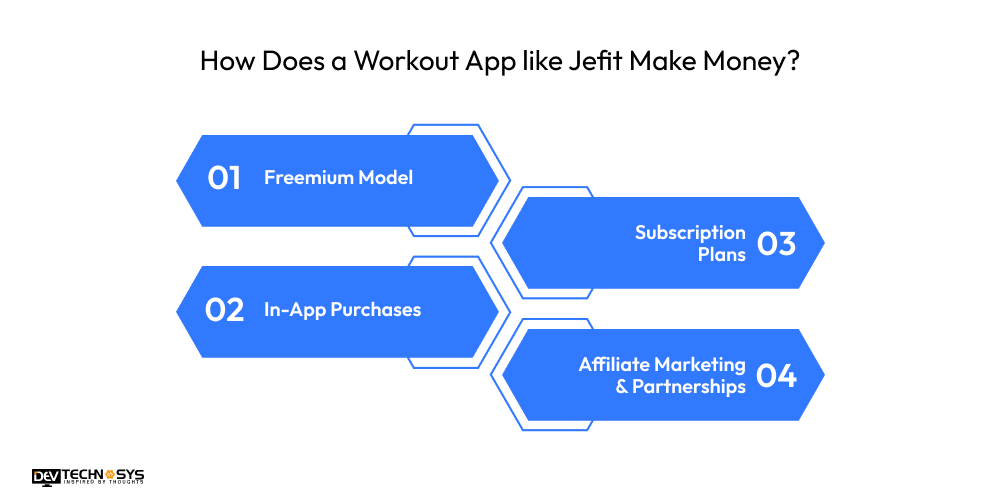
How Does a Workout App like Jefit Make Money?
Users utilize best workout apps such as Jefit which are designed to motivate workout plans, track progress, and engage the community. Jefit, as well as others, benefit from the users but also employ smart money-making strategies typical of the app industry to generate proceeds. Here are five common ways workout apps make money:
1. Freemium Model
Many fitness apps like Fitbit use a freemium model where basic features are free, but a subscription is needed for advanced features. The user can do his workout, track his progress, and use the program’s basic features at no cost. What makes the users convert to paid subscribers are the features that include AI-based coaching, detailed analytics, and tailored plans.
2. Subscription Plans
Monthly or yearly subscription plans provide a steady revenue stream. Jefit, for instance, limits users to basic exercises if they are not paying the subscription. Program customization, ad-free experience, and progress tracking analytics are included in the premium content, which is kept behind the paywall. Subscriptions are the form that secures regular income while at the same time giving continuous value to loyal users.
3. In-App Purchases
Typically, in-app purchases offer users the possibility to buy content that can be the like of the following: a specialized workout plan, a nutrition guide, or an exclusive…
4. Affiliate Marketing & Partnerships
A fitness app like 7 Minute Workout would be best off teaming up with a supplement brand, a fitness equipment company, or an online coaching service. By means of affiliate links, promotions, or partnerships, the app gets a commission for every purchase made by the users through the app.
In A Nutshell!
To sum up, the creation of a workout app like Jefit is a process that requires not only careful planning but also the right technology stack and expert execution. As a result of features, design, and platform choice, the overall cost will vary.
However, you will get a feature-rich, high-performing app at a fraction of the cost by partnering with a mobile app development company. Fitness app development has been our team’s specialty for more than 15 years. With Dev Technosys, you get custom-made, scalable, user-centric solutions that are compatible not only with your budget but also with your business goals.
Whether you require a straightforward MVP or an extensive fitness platform, we assure you of the cost-effective development of your project without the sacrifice of quality or performance.
FAQ
Q1: How To Build A Workout App Like Jefit?
To make a workout app like Jefit, it requires figuring out what features it will have, selecting the platform, designing UI/UX, coding or using app builders for development, integrating APIs, testing, and finally, making it available for iOS and Android users.
Q2: What Features Should A Top Workout App Like Jefit Have?
Some of the key features that can be implemented are personalized workout plans, exercise tracking, progress charts, social sharing, reminders, community challenges, nutrition tips, video tutorials, subscription or premium options which have proven to be a way of keeping user engagement.
Q3: How Long Does It Take To Make A Workout App Like Jetfit?
For a simple app, the development process usually takes 4-6 months; however, if we are talking about a feature-rich app with advanced analytics, social integration, and AI-driven plans, then the development may take 8-12 months or more.
Q4: How Much Does It Cost To Develop A Workout App Like Jefit?
The cost to build a workout app like Jefit depends on how complicated your app is and the platform you choose. A simple app could fall between $8,000 and $16,000, while a comprehensive app could go as high as $16,000 to $30,000 or more, which also includes design, development, and testing.
Q5: What Are The Alternatives Of Jefit In Workout App?
Jefit alternatives can be MyFitnessPal, Fitbod, Nike Training Club, StrongLifts, and Freeletics. These apps generally provide different levels of workout tracking, nutrition guidance, and community features that cater to fitness enthusiasts.