

















Technology has transformed everything so well that it is hard to live a life without it. In this transitional phase, the automotive industry is no exception.
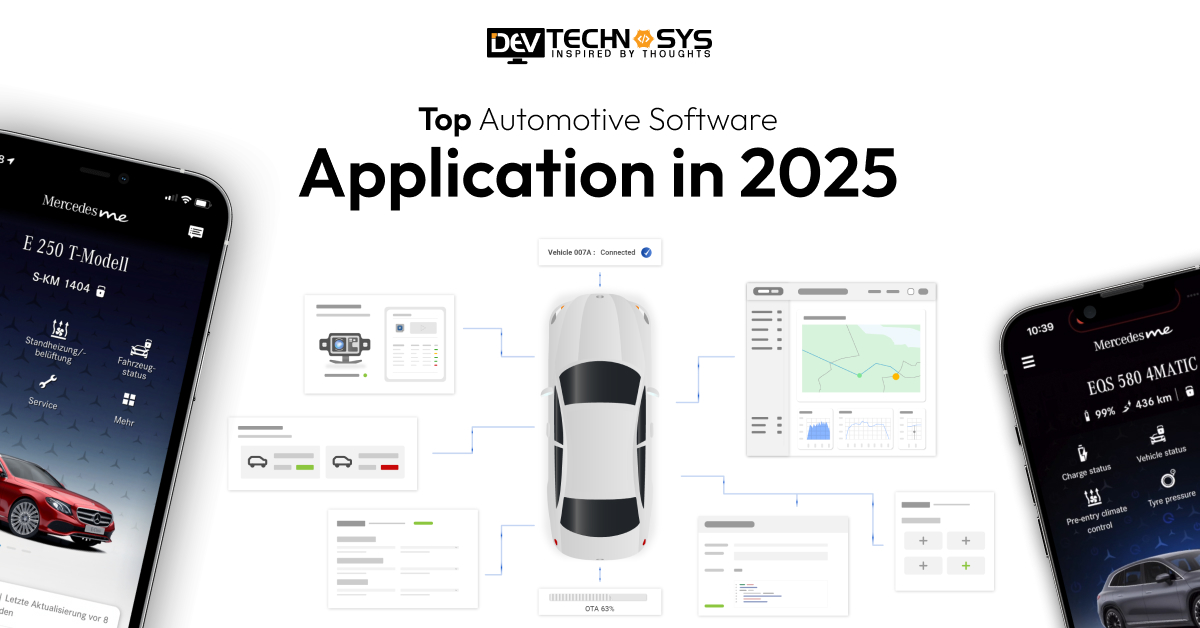
Today, the shift from the technical domain to digital solutions is highly influencing the creation of automotive software applications in 2025. From autonomous driving to connected car technologies, these applications have empowered everything.
The automotive software trends are perfectly redefining mobility in 2025, an era of digital transformations. Some of the paramount applications now incorporate several features, including IoT, real-time data analytics, AI, and cloud computing. It strengthens the safety and performance while enhancing the user experience.
The connected car software helps manufacturers, fleet managers, and drivers in making smart decisions. While the demand for smart vehicles and sustainable mobility is increasing, the demand for automotive embedded software applications is also rising. So, here is a guide where we will learn about the top automotive applications of 2025 that are revolutionizing the future of transportation.
What is an Automotive Software Application?
The automotive software application is a virtual platform that fuels the functionality of modern transportation. It has a controlling system that regulates systems, such as infotainment, connected car platforms, autonomous driving, and vehicle diagnostics. As these applications have modern tools, including AI, IoT, etc.
They upgrade performance with safety and driving experience. It also helps in making careful and intelligent action while focusing on the efficiency of operations. These connected car software solutions bring variation and innovation to electric vehicles with smart mobility and viable alternatives.
Top Automotive Software Applications in 2025
As we can see, softwares has become the core of the latest vehicles. These software applications have changed how we drive and gain experience with new updates.
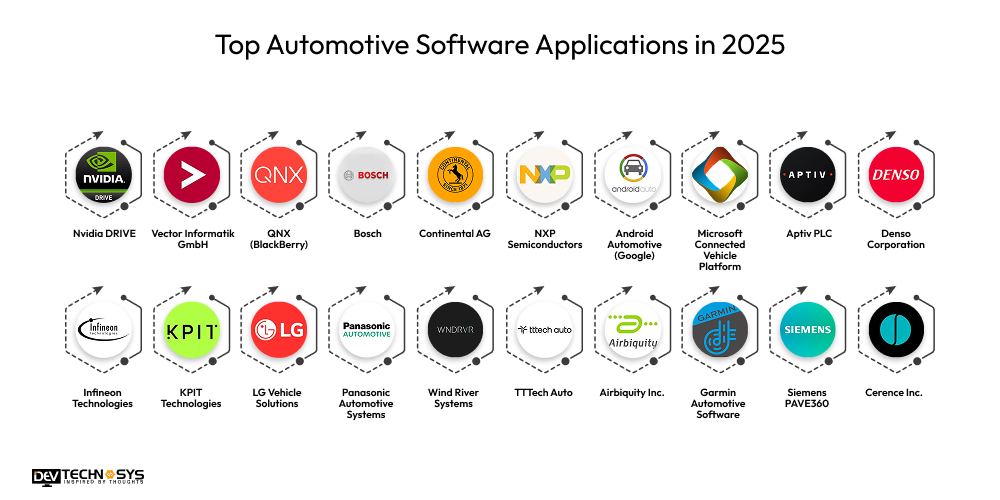
In 2025, the best automotive software applications will give a safer, smarter, and more connected vehicle experience to drivers worldwide. Let us introduce you to the top automotive software, or we can say, globally leading applications of 2025.
1. Nvidia DRIVE
One of the leading names in the list of autonomous vehicle software 2025 is Nvidia DRIVE. It is an advanced, all-encompassing AI solution that offers safe, intelligent, and scalable mobility alternatives.
With this app, you will get real-time analytics, deep learning, and advanced sensor fusion. It continues to merge its research, AI systems, and partnerships with automakers, and brings out strong, secure, and intelligent autonomous driving systems.
Key Features:
- Powerful NVIDIA DRIVE AGX systems
- NVIDIA Halos Safety System
- NVIDIA DRIVE Constellation
- NVIDIA Omniverse and Cosmos
- End-to-end development with over-the-air updates.
2. Vector Informatik GmbH
Another popular name in the automotive industry is Vector Informatik. It delivers development tools and vehicle software solutions. The best part is that they simplify the complex vehicle electronics development.
This platform also supports efficient automotive app maintenance services. It strongly concentrates on the Software-Defined Vehicle (SDV), primarily with reliable development solutions.
Key Features:
- MICROSAR AUTOSAR stack for vehicle software
- Diagnostic tools
- HIL/SIL testing solutions
- Software Factory for automated software.
3. QNX (BlackBerry)
QNX (Blackberry) is also the best automotive software that delivers safe and secure operating systems. It is a trusted name in real-time automotive operating systems.
It is widely known for reliability, infotainment, telematics, and safety-critical applications. It also empowers dashboards, cluster displays, and vehicle telematics software. It provides automakers with future-ready programs.
Key Features:
- QNX Neutrino RTOS
- QNX Hypervisor
- QNX SDP
- Cybersecurity
- BlackBerry IVY
- Support for Software-Defined Vehicles (SDVs)
- Cloud-First approach.
4. Bosch
At Bosch, you will find a broad spectrum of automotive software for fleet management. It strengthens control, ADAS, and connectivity. Their software has embedded software and cloud services and upgrades vehicle performance, safety, and compliance. It keeps on modifying intelligent mobility with cloud-powered services. Also, it involves ADAS in its automotive software portfolio.
Key Features:
- Software-Defined Vehicles (SDV)
- Scalable Software & Services
- Connected Map Services
- AI-powered Multifunction Cameras
- Driver Assistance Systems (ADAS)
5. Continental AG
You will get advanced vehicle software solutions at Continental AG as it focuses on autonomous mobility, connectivity, and safety. It also develops softwares for vehicle telematics, EV charging management, and integrated systems that improve vehicle intelligence and efficiency. It also merges automation into next-gen vehicle software ecosystems, making it one of the most preferred ones.
Key Features:
- Software-Defined Vehicle (SDV) Ecosystem
- Advanced Driver-Assistance Systems (ADAS)
- Autonomous Driving
- Connectivity & V2X Communication
- Digital Cockpits & Displays
Want a chatbot demo or pricing? Fill the form and talk to our experts today.
Pick what you need below — you can select more than one — then tap Get detail to continue.
-
Chatbot demo dashboard
-
Cost to develop an app
-
Industry report
-
Case study
6. NXP Semiconductors
NXP Semiconductors is the dominant provider of automotive infotainment software, along with hardware solutions. They are popular for delivering secure connected mobility. Their vehicle software includes AI that supports next-gen car driving systems. They centralize all the processing and create more intelligent, connected vehicles. It delivers scalable and safer software with its cutting-edge processor.
Key Features:
- S32 Automotive Processing Platform
- Radar Processors
- Integrated Solutions
- Sensors
- Autonomous Driving & ADAS
- S32 CoreRide Platform
7. Android Automotive (Google)
Android Automotive is a mobile app development system specifically designed for in-vehicle infotainment (IVI) systems. It is an open-source operating system that enables native applications and smartphone integration. It improves in-car experiences through navigation, seamless apps, intuitive interfaces, media, voice control, and connected services.
Key Features:
- Native Integration with Vehicle Hardware
- Google Services
- Play Store Access
- Voice Control
- Google Assistant
- Over-the-Air Updates
- Multimedia Capabilities
- Multi-User Support.
8. Microsoft Connected Vehicle Platform
Microsoft Connected Vehicle Platform is a cloud-based vehicle software solution developed specifically for connected vehicles. They mainly concentrate on safer driving and optimized fleet management. It supports predictive maintenance platforms, automotive AI software applications, and vehicle telematics software. It is renowned for offering secure driving solutions for modern fleets.
Key Features:
- Connectivity
- Over-the-Air (OTA) Software Updates
- Scalability and Reliability
- Command-and-Control
- Telematics
9. Aptiv PLC
Aptiv offers software solutions for autonomous driving, connected services, and advanced driver assistance systems. They focus on automotive AI software applications and software for EV charging management, improving safety, reliability, and electric vehicle performance. This software application redefines smart vehicle architecture with integrated systems. They are designed to support autonomy and electrification.
Key Features:
- Android Automotive OS Integration
- ADAS and Perception Software
- Smart Vehicle Architecture (SVA)
- Cloud-Native Software with OTA Updates
- Integrated Cockpit Solutions
10. Denso Corporation
DENSO creates automotive software for implanted control systems, electrification management, and vehicle telematics solutions. These get aligned with electric vehicle software applications and provide efficiency, connectivity, and advanced functionality of the vehicle. Denso Corporation also provides immense support for both traditional and electric platforms.
Key Features:
- Automated Driving Systems
- Human-Machine Interface (HMI)
- Edge/Cloud Integrated Platform
- Software-Centric Product Development

11. Infineon Technologies
Infeneon builds automotive softwares for embedded control, EV charging systems, and power management. They offer a secure solution that supports electric vehicle software applications and reduces overall automotive software development cost. It makes sure the EVs are safe by delivering secure, efficient, and scalable software for managing energy and computing.
Key Features:
- Software-Defined Vehicle Enablement
- AI & Edge Computing
- Next-Generation Architectures
- Robust Cybersecurity
- Intelligent Motor Control
- Advanced Connectivit
12. KPIT Technologies
KPIT Technologies works on autonomous software for vehicles, along with automotive AI software applications and vehicle telematics software. They provide solutions with predictive maintenance platforms and connected mobility solutions for smarter, safer vehicles. KPIT Technologies is a smart choice for embedded automotive AI and predictive solutions for the connected mobility era.
Key Features:
- Specialized Software IP and AI
- Embedded Systems Expertise
- Software-Defined Vehicles
- Electric & Conventional Powertrains
- Software Integration & Validation
13. LG Vehicle Solutions
LG Vehicle Solution builds cutting-edge software for automotive infotainment, EV charging management, and connected services. Their vehicle softwares corresponds with fleet management as well as electric vehicles. LG even reinforces digital in-car experiences with infotainment, AI, and energy that is smartly managed.
Key Features:
- AI-Powered Mobility Experience
- In-Cabin Sensing Solutions
- LG Automotive Content Platform (LGACP)
- Cross-Domain Controller (xDC)
- Software-Defined Vehicle (SDV) Solutions
14. Panasonic Automotive Systems
For infotainment, autonomous driving, and connected mobility, Panasonic is the best option. It delivers vehicle software solutions that integrate advanced AI applications and predictive maintenance platforms for smarter transportation. It empowers automakers with scalable, cloud-native software that not only enhances safety but also infotainment.
Key Features:
- A flexible software framework
- High-performance computing
- Inter-domain communication
- Integrated cybersecurity solutions
- Cloud-native development capabilities
15. Wind River Systems
One more name renowned when it comes to car software development trends is Wind River Systems. It provides real-time operating systems and development platforms.
They create automotive AI software applications, autonomous vehicle software, and critical safety systems. They also deliver real-time platforms that are of high priority to address the evolving needs of autonomous vehicles.
Key Features:
- Cloud-Based Development
- Over-the-Air (OTA) Deployment
- DevSecOps Integration
- Visibility and Anomaly Detection
- Shift-Left Testing
16. TTTech Auto
TTTech Auto develops software for safe autonomous driving and vehicle telematics software. Their platforms integrate automotive AI software applications, predictive maintenance platforms, and safety-critical control systems. They are well-known for delivering reliability in autonomous driving, along with time-triggered, safety-focused vehicle software platforms.
Key Features:
- Time-Triggered Execution
- Safety and Security by Design
- Standardized and Open Platforms
- Series Proven Technology
- Integrated Communication
17. Airbiquity Inc.
Airbiquity, an automotive software development company, offers connected vehicle software solutions that include vehicle telematics software and OTA (over-the-air) updates.
Their platforms enhance fleet management, predictive maintenance, and automotive infotainment software. They stand out with connected services that make modern vehicles forward-looking.
Key Features:
- Over-the-Air (OTA) Software
- Data Management
- Device Integration
- End-to-End Connected Car Services
- Automotive Cyber Security
- Enhanced Vehicle Services
18. Garmin Automotive Software
Garmin Automotive Software serves with advanced automotive infotainment software and navigation solutions. This provides real-time mapping, vehicle telematics software, and connected mobility tools. These softwares enhance driving experiences with a focus on creating mobile apps.
Key Features:
- Garmin Unified Cabin
- GPS Navigation Systems
- Driver Assistance & Safety
- Integration and Partnerships
- Hands-Free Assistance
- Qualcomm Snapdragon
19. Siemens PAVE360
Siemens PAVE360 is a digital twin platform that simulates, tests, and validates complete automotive systems before production. It speeds up development cycles by building real-world scenarios in a virtual environment. It is primarily used for autonomous vehicle design, and it integrates hardware, software, and AI seamlessly.
Key Features:
- Digital Twin Platform
- Accelerated Pre-Silicon Development
- Hardware-Software Co-Design
- Cloud-Hosted Solution
- PAVE360 Backplane
- Systems-Aware Verification
- Supports SDV Transition
- Enhanced Collaboration
20. Cerence Inc.
Cerence develops AI-powered automotive software with facilities, including voice assistants, natural language processing, and in-car infotainment systems.
Due to this, drivers can interact with vehicles through speech, gestures, and customized features. Cerence is shaping the human-vehicle relationship for a technological future with advanced AI integration and making cars more adaptive.
Key Features:
- Generative AI and LLMs
- AI Agents for Work
- In-Vehicle Communication (ICC)
- Emergency Vehicle Detection (EVD)
- Connected Car Services

Conclusion
At last, we would like to conclude that automotive software is not just an option but a necessity to modern mobility. Whether it is about cutting-edge autonomous vehicle software in 2025 or advanced electric vehicle software applications, these applications are the perfect solutions.
They are also transforming driving skills and techniques, how we connect, and maintenance of the vehicle. This guide is the great answer to your search for the best automotive software solutions that shape the future of transportation.
FAQs
1. What is automotive software development?
An automotive software development is a system in which softwares that powers vehicle functions is designed and developed.
2. What are the most important trends in automotive software for 2025?
Software-defined vehicles (SDVs), AI-powered autonomous driving, over-the-air (OTA) updates, enhanced cybersecurity, digital twins, and real-time vehicle connectivity are the most recent trends in automotive software for 2025.
3. What are the benefits of automotive software?
With automotive software, you will get benefits, including
- Safety of the vehicle
- Regular feature updates
- Improves driving experience
- Reduced maintenance costs
4. Why is over-the-air (OTA) updating important for vehicles?
The over-the-air (OTA) updates are necessary for the vehicle due to several reasons:
- Bug fixing
- Adding new features
- Advanced security
- Keeping vehicles up-to-date
5. How does automotive software support electric vehicles (EVs)?
Automotive softwares in electric vehicles ensures better health, battery-preserving charging, energy use gets monitored, and predictive maintenance.