




















Key Takeaways:
Smart contract audit costs generally range from $8,000 to $30,000+, depending on the contract complexity, blockchain network, security requirements, and auditor expertise. Basic audits for simple ERC-20 or BEP-20 smart contracts may cost around $8,000 – $15,000+, while advanced DeFi, NFT, DAO, or cross-chain protocols can exceed $30,000+ due to deeper vulnerability testing and multiple audit rounds.
Cost Breakdown by Audit Complexity:
- Basic Smart Contract Audit ($8,000 to $15,000+): Covers simple token contracts, standard functions, automated testing, and basic vulnerability analysis for startups or MVP blockchain projects.
- Mid-Level Smart Contract Audit ($15,000 to $22,000+): Includes detailed manual code review, API integrations, staking systems, governance mechanisms, and advanced penetration testing.
- Advanced/Enterprise Smart Contract Audit ($22,000 to $30,000+): Designed for DeFi platforms, DAOs, GameFi, and cross-chain ecosystems with complex tokenomics, liquidity pools, bridges, and multi-layer security analysis.
Key Cost Drivers:
- Contract Complexity: Simple token contracts are significantly cheaper than multi-chain DeFi or AI-powered blockchain ecosystems with advanced logic.
- Blockchain Network: Audits on Ethereum-based DeFi protocol cost is more due to higher security expectations and contract complexity compared to smaller blockchain ecosystems.
- Security Scope: Additional services such as penetration testing, formal verification, bug bounty assessments, and repeated audit rounds increase the total audit budget.
- Audit Firm Reputation: Well-known blockchain security audit cost is higher because of their expertise, industry trust, and detailed reporting standards.
Development Timeline:
- Basic Audit: 1 to 2+ weeks
- Mid-Level Audit: 2 to 4+ weeks
- Advanced Audit: 4 to 6+ weeks
Without a doubt, smart contracts facilitate the functioning of today’s decentralized world. They power crypto exchanges, NFTs, DeFi platforms, and ICOs. But with such innovation comes immense responsibility
According to Chainalysis, crypto scams, hacks, and smart contract exploits have caused billions in losses worldwide, making smart contract audits essential for every blockchain project. For businesses, a smart contract audit is more of a business investment rather than a simple security measure. It helps identify vulnerabilities, improve user trust, and prevent costly cyberattacks before launch.
In this ultimate guide, we break down the different components that determine the cost of audits, including project scope and complexity, the experience of the auditor, turnaround time, and the various components that determine the price of audits.
If you are an established protocol with upgrades on the horizon, or a start-up gearing up for a launch, this information on the components that determine the cost of audits for smart contracts will help you to budget properly.
What is Smart Contract Audit?
A smart contract audit is mainly an analysis system that reviews the contract’s code to find glitches, bugs, and errors before deploying to the blockchain.
Auditors examine how the contract behaves, test for exploits, and ensure it follows best practices. This helps prevent hacks, protects user funds, and ensures reliable blockchain operation. It increases trust and safety overall for all users.
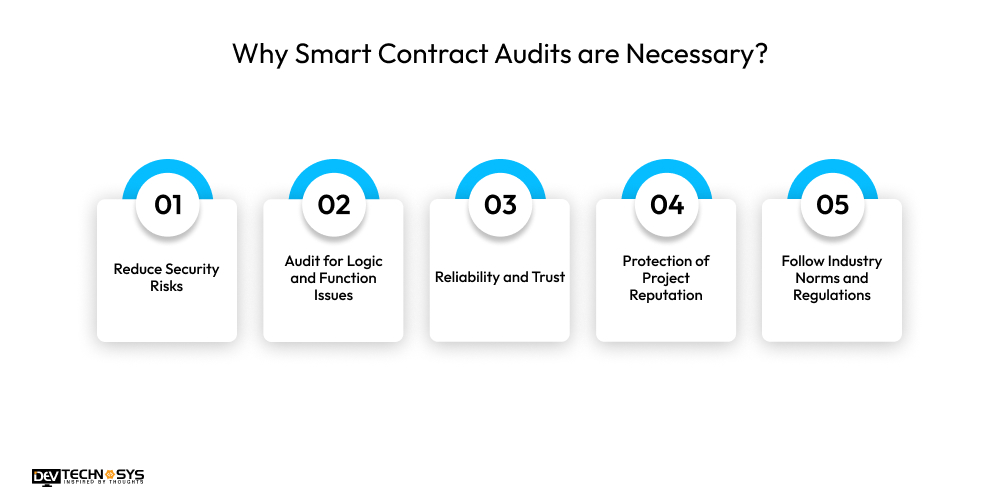
Why Smart Contract Audits are Necessary?
As you know, nowadays, security is one of the most important concerns in every sector. When deploying the smart contracts on blockchain, there are different types of bugs and errors that occur, that why smart contract audits help to observe every step.
1. Reduce Security Risks
Since smart contract development solutions manage assets, any defect can result in significant losses. Pre-deployment audits can find issues in the code like reentrancy, integer overflows, and access-control issues.
Even though audits won’t find all issues, identifying defects in the code will reduce the level of risk and the probability of hacks, theft, or unwanted occurrences.
2. Audit for Logic and Function Issues
Well-written contracts can still have logic issues that result in the malfunctioning of key features of the contract. By auditing, such contracts that do audit the contract across all deterministic states, rather than in just the “happy path,” will achieve the goal of safety and usefulness for that contract.
3. Reliability and Trust
Projects with audited smart contracts build confidence for their investors and users. Trusting contracts and the systems they are built on will encourage adoption and long-term credibility for the project in the blockchain community.
4. Protection of Project Reputation
One error has the potential to tarnish a project’s brand for eternity. Reputation audits identify potential security concerns, and catastrophic failures avoid public outcry and monetary loss. By eliminating such issues, the project can continue to be stable and gain the trust of users and investors.
5. Follow Industry Norms and Regulations
The expansion of blockchain development services brings with it a need for various industries and regulators to have high benchmarks for security. Create a Smart contracts audits help projects achieve such goals by implementing best practice guidelines.
This is a dual security and compliance gain, which allows the project to operate with regulatory oversight and legally binding agreements with other players in the market.
How Much Does a Smart Contract Audit Cost?
The cost to audit a Smart Contract ranges from $8,000 to $30,000, based on the smart contract project types. It includes various factors that totally affect the cost for smart contract and dapp development services, such as project complexity, audit depth, turnaround time, team size, auditor reputation, and many more.
There are many additional factors that can also impact the blockchain smart contract audit cost, such as code size, required security certifications, smart contract audit pricing model, and multi-contract systems. Here’s the table highlighting the cost of smart contract audits based on audit type.
Audit Type / Project Size |
Estimated Cost |
Description |
| Basic Token Contract Audit | $8,000 | Covers simple ERC-20 or BEP-20 tokens with limited functionality and minimal risk. |
| Simple Smart Contract Audit Services | $10,500 | Reviews small contracts with straightforward logic and few external dependencies. |
| Medium-Complexity dApp Audit | $12,000 | Suitable for dApps and web development, with moderate logic, user interactions, and multiple functions. |
| NFT / Marketplace Audit | $15,500 | Includes ERC-721/1155 contracts, minting logic, and marketplace transaction flows. |
| Multi-Contract System Audit | $18,000 | Evaluates interconnected contracts requiring advanced logic and interaction checks. |
| DeFi Protocol (Moderate) Audit | $22,000 | Reviews lending, staking, AMMs, or yield contracts with higher security needs. |
| Large / High-Complexity Protocol | $30,000+ | Intended for complex DeFi ecosystems or protocols requiring deep smart contract security testing. |
What Factors Affect the Smart Contract Audit Cost?
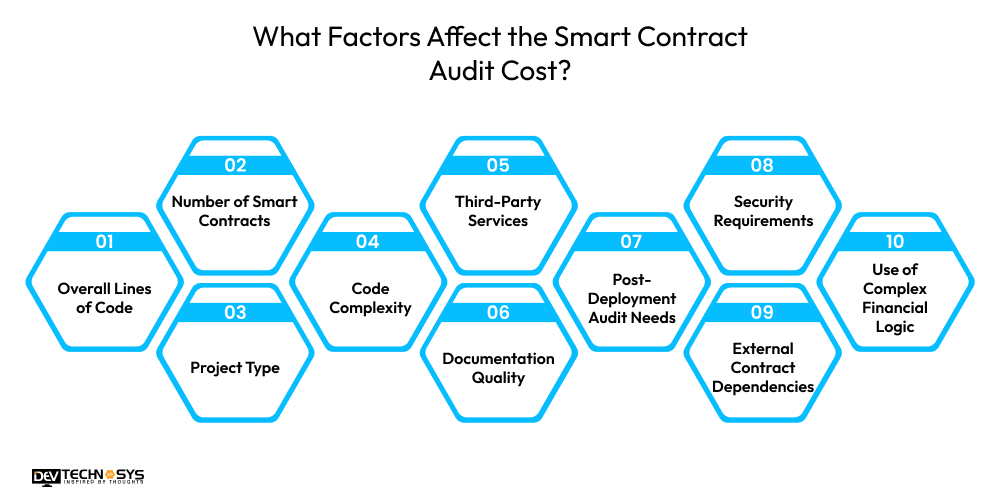
Before choosing the auditing, you must know about the crucial factors that can highly impact the overall cost to deploy a smart contract. So, let’s explore the various types of key factors affecting smart contract audit pricing:
1. Overall Lines of Code
The larger base code demand requires more audit time to successfully review manually and automated testing. Checking each line of code leads to an increase in smart contract audit timeline and cost, and this can also require additional verification. The extensive Lines of Code (LOC) mainly required higher auditing fees and more effort.
LOC Range |
Impact on Cost |
Estimated Additional Cost |
| < 500 LOC | Low | $500 – $1,000 |
| 500–2,000 LOC | Medium | $1,500 – $3,000 |
| > 2,000 LOC | High | $3,500 – $6,000 |
2. Number of Smart Contracts
Projects containing multiple interconnected contracts require additional time to review interactions, dependencies, and potential cross-contract vulnerabilities. Each contract adds its own security surface area. More solidity smart contract audit means more functions, states, and transaction flows to analyze. As the quantity increases, auditors must devote extra hours, driving the total smart contract auditor cost higher.
Contract Count |
Impact on Cost |
Estimated Additional Cost |
| 1–2 Contracts | Low | $500 – $1,500 |
| 3–5 Contracts | Medium | $2,000 – $4,000 |
| 6+ Contracts | High | $4,500 – $7,000 |
3. Project Type
Different project categories carry varying risk levels. Smart contract audit for DeFi projects often involves complex financial mechanics that need in-depth analysis, while NFT projects may be simpler, even the NFT smart contract audit cost will be lower than that of DeFi smart contract audit cost. dApps with advanced logic fall in between. Higher-risk categories demand thorough testing, simulation, and manual review, influencing the auditor’s workload and the overall audit and blockchain app development cost.
Type |
Impact on Cost |
Estimated Additional Cost |
| Basic Token / NFT | Low | $800 – $1,500 |
| dApp with Moderate Logic | Medium | $2,000 – $4,000 |
| DeFi Protocol | High | $5,000 – $10,000 |
4. Code Complexity
The more complex a smart contract’s logic, the longer auditors must spend reviewing edge cases, interactions, and potential vulnerabilities. Complex mathematical functions, more automated smart contract audit tools, custom logic, and advanced features require deeper manual analysis. Higher complexity increases the probability of hidden bugs, making DeFi security audits more time-consuming and ultimately raising the overall cost of a smart contract audit.
Complexity Level |
Impact on Cost |
Estimated Additional Cost |
| Simple Logic | Low | $600 – $1,200 |
| Moderate Complexity | Medium | $1,800 – $3,500 |
| Advanced / Custom Logic | High | $4,000 – $8,000 |

5. Third-Party Services
Smart contracts that rely on price feeds, randomness oracles, or external data providers require auditors to analyze how data is fetched, validated, and protected. Incorrect integration can open attack vectors like oracle manipulation. Reviewing these connections adds substantial effort, making audits more complex and increasing the overall cost to create a smart contract.
Integration Level |
Impact on Cost |
Estimated Additional Cost |
| Minimal External Calls | Low | $300 – $800 |
| Some Oracle/API Use | Medium | $1,200 – $2,500 |
| Heavy Third-Party Reliance | High | $3,000 – $6,000 |
6. Documentation Quality
Well-written documentation helps auditors understand contract logic, expected behaviors, and system architecture quickly. Poor or missing documentation slows the process, as auditors must deduce functionality manually. The added time required to interpret unclear workflows, assumptions, or architectural choices increases the smart contract security audit cost.
Documentation Level |
Impact on Cost |
Estimated Additional Cost |
| Well Documented | Low | $0 – $500 |
| Basic Documentation | Medium | $1,000 – $2,000 |
| Poor / Missing Documentation | High | $2,500 – $5,000 |
7. Post-Deployment Audit Needs
Some projects require audits after deployment to verify upgrades, patches, or live system behaviors. Post-deployment audits include monitoring, event analysis, and verifying upgrade safety. This extra scope expands time commitments and raises the total Binance Smart Chain development cost compared to a single pre-deployment review.
Requirement |
Impact on Cost |
Estimated Additional Cost |
| Minor Post-Deployment Review | Low | $700 – $1,200 |
| Upgrade Review Needed | Medium | $1,500 – $3,000 |
| Continuous Monitoring | High | $4,000 – $8,000 |
8. Security Requirements
Some projects require advanced security frameworks, including custom threat modeling, formal verification, economic attack simulations, or adversarial testing. These specialized assessments are resource-intensive and require expert auditors. Environments managing user funds, significantly increase the Web3 security audit cost.
Security Level |
Impact on Cost |
Estimated Additional Cost |
| Basic Security Checks | Low | $500 – $1,000 |
| Enhanced Threat Modeling | Medium | $2,000 – $4,000 |
| Advanced Security / Formal Verification | High | $5,000 – $12,000 |
9. External Contract Dependencies
When a project depends on third-party contracts or libraries, auditors must evaluate those interactions for reliability and security. Dependencies can introduce vulnerabilities outside the project’s direct code. Ensuring compatibility, checking permissions, and analyzing potential attack vectors increases workload, adding extra steps that raise the total cost of smart contract development services.
Dependency Level |
Impact on Cost |
Estimated Additional Cost |
| Minimal Dependencies | Low | $300 – $700 |
| Moderate External Integrations | Medium | $1,500 – $3,000 |
| Heavy Reliance on External Contracts | High | $3,500 – $7,000 |
10. Use of Complex Financial Logic
Contracts that manage lending, borrowing, staking, swapping, or complex liquidity mechanisms require specialized security expertise. These financial operations increase the likelihood of logic errors and economic exploits. Auditors must simulate and test various financial scenarios, significantly increasing time and cost to audit a smart contract compared to simple, straightforward smart contract structures.
Logic Complexity |
Impact on Cost |
Estimated Additional Cost |
| Basic Economic Logic | Low | $1,000 – $2,000 |
| Moderate Financial Mechanisms | Medium | $3,000 – $6,000 |
| Advanced DeFi Logic | High | $6,000 – $12,000 |
Types of Smart Contract Audits and Their Costs
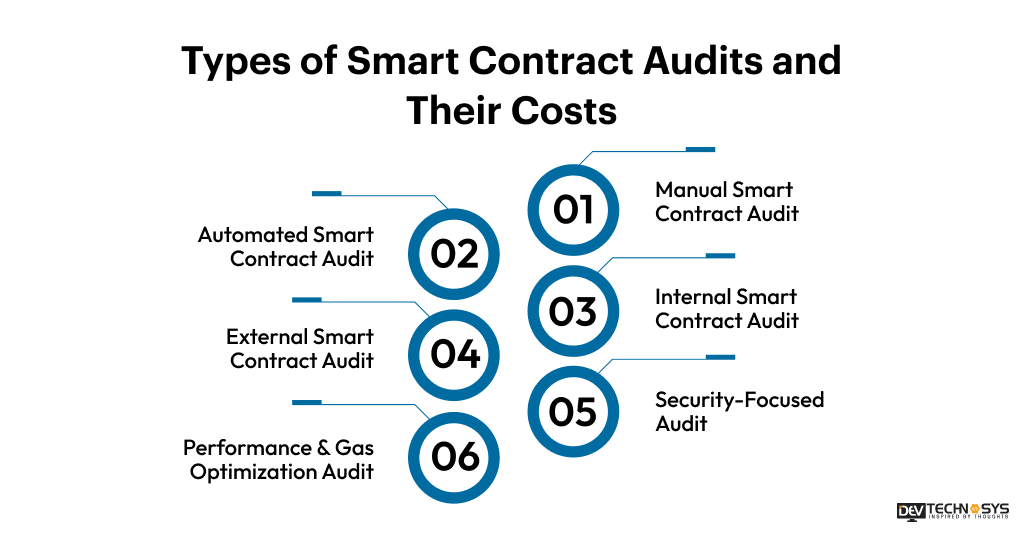
According to a top Dex development company, different types of audits come with varying levels of depth and smart contract audit cost per hour. Majorly, it depends on project complexity and security requirements. Let’s check them out:
1. Manual Smart Contract Audit
In a manual audit, blockchain security experts carefully review the smart contract code line by line to identify vulnerabilities, logic errors, and security flaws. This method provides deep analysis and is highly effective for complex blockchain applications. It is considered the most reliable approach for detecting critical and hidden security issues.
Cost Factor |
Estimated Cost |
Description |
| Basic Projects | $5,000 – $12,000 | Simple contract review and testing |
| Mid-Level Projects | $12,000 – $18,000 | DeFi/NFT logic review with deeper analysis |
| Complex Projects | $18,000 – $22,000+ | Large-scale DeFi, ICO, or enterprise systems |
2. Automated Smart Contract Audit
Automated audits use specialized security tools and scanners to quickly detect common vulnerabilities, coding issues, and security loopholes. They are faster and more cost-effective but may not identify advanced logical or architectural flaws. These tools are often used as a first layer of security checking before manual review.
Cost Factor |
Estimated Cost |
Description |
| Basic Scan Tools | $500 – $2,000 | Automated vulnerability detection tools |
| Advanced Tools | $2,000 – $5,000 | Multi-layer scanning with reporting |
| Enterprise Tools | $5,000 – $10,000+ | Continuous monitoring systems |
3. Internal Smart Contract Audit
An internal audit is conducted by the in-house development or security team before public deployment. It helps identify basic coding issues early and improves the overall quality of the smart contract before external auditing begins. This step ensures faster development cycles and reduces early-stage errors.
Cost Factor |
Estimated Cost |
Description |
| Small Team | $1,000 – $3,000 | Basic in-house review |
| Mid-Level Team | $3,000 – $7,000 | Structured internal QA process |
| Expert Team | $7,000 – $12,000 | Advanced internal security checks |
4. External Smart Contract Audit
External audits are performed by third-party blockchain security firms. These audits provide unbiased security assessments, detailed vulnerability reports, and stronger credibility for investors and blockchain users. They are widely trusted for validating smart contract safety before launch.
Cost Factor |
Estimated Cost |
Description |
| Startup Projects | $5,000 to $10,000 | Basic third-party audit report |
| Growing Projects | $10,000 to $15,000 | Deep vulnerability assessment |
| Enterprise Projects | $15,000 to $21,000+ | Full-scale security audit with certification |
5. Security-Focused Audit
This type of audit primarily focuses on identifying vulnerabilities such as reentrancy attacks, overflow issues, access control flaws, and potential hacking risks that could compromise blockchain security. It also helps businesses strengthen smart contract reliability and reduce the chances of financial losses caused by cyberattacks or malicious exploits.
Cost Factor |
Estimated Cost |
Description |
| Standard Security Audit | $6,000 to $9,000 | Vulnerability detection (basic threats) |
| Advanced Security Audit | $9,000 to $13,000 | Includes penetration testing & threat modeling |
| High-Security Systems | $13,000 to $20,000+ | Deep security + attack simulation |
6. Performance & Gas Optimization Audit
Performance audits analyze smart contract efficiency, scalability, and gas consumption. The goal is to reduce transaction costs, improve execution speed, and optimize blockchain resource utilization. These audits also help businesses enhance user experience by making blockchain transactions faster, smoother, and more cost-efficient across the platform.
Cost Factor |
Estimated Cost |
Description |
| Basic Optimization | $2,000 to $5,000 | Code efficiency improvements |
| Mid-Level Optimization | $5,000 to $8,000 | Gas reduction & execution tuning |
| Advanced Optimization | $10,000 to $18,000+ | High-scale performance engineering |
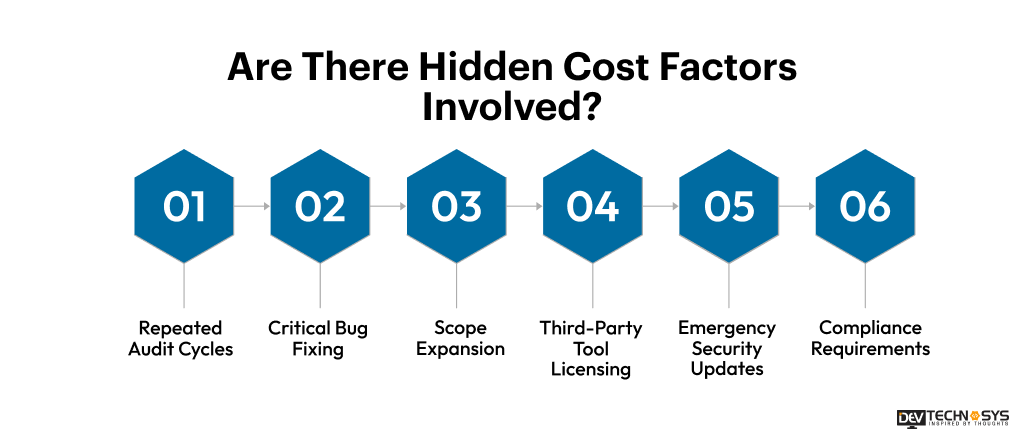
Are There Hidden Cost Factors Involved?
Yes, smart contract audit projects often include several hidden cost factors that businesses underestimate during planning. Let’s learn about these factors in depth.
1. Repeated Audit Cycles
Repeated audit cycles occur when vulnerabilities are fixed and the smart contract needs to be re-audited. Each cycle increases testing time, developer effort, and security validation costs, making the overall audit process more expensive than initially planned for blockchain projects.
2. Critical Bug Fixing
Critical bug fixing involves resolving high-severity vulnerabilities identified during audits. These issues often require advanced blockchain developers to rewrite or modify core logic, increasing coding time, re-testing efforts, and overall smart contract audit costs significantly.
3. Scope Expansion
According to top providers of ICO development services, scope expansion happens when new features or functionalities are added during the audit process. This increases testing complexity, extends review timelines, and requires additional security validation, ultimately raising the total cost of the smart contract audit project.
4. Third-Party Tool Licensing
Third-party tool licensing includes the cost of using advanced security scanners, auditing platforms, and monitoring tools. These tools often come with subscription fees, which increase overall audit expenses but improve vulnerability detection accuracy and blockchain security coverage.
5. Emergency Security Updates
Emergency security updates are required when critical vulnerabilities are discovered after deployment. Fixing these issues quickly demands urgent developer involvement, rapid testing, and redeployment, which significantly increases overall smart contract maintenance and audit-related expenses.
6. Compliance Requirements
Compliance requirements involve ensuring the smart contract meets legal and regulatory standards such as KYC, AML, and token regulations. These additional checks require expert consultation and documentation, increasing both time and cost of the audit process.
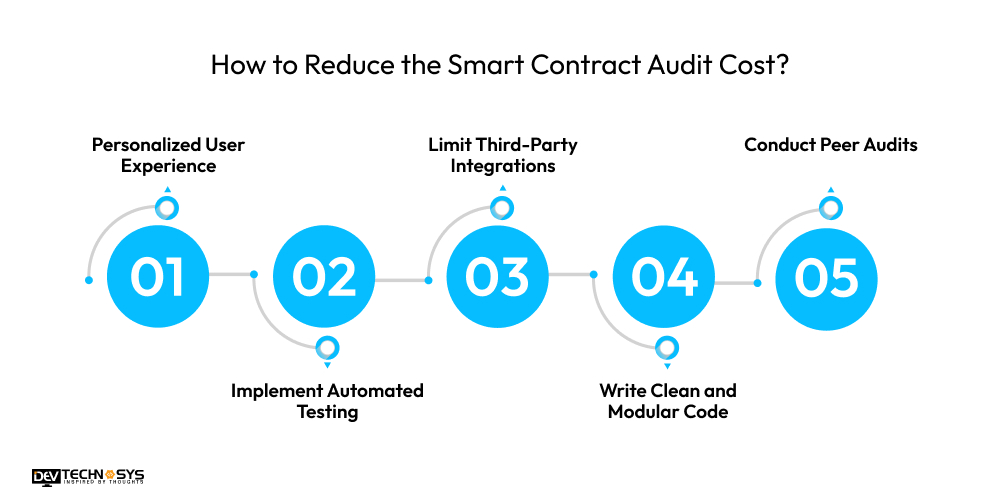
How to Reduce the Smart Contract Audit Cost?
To reduce the smart contract and blockchain audit cost, there are many different ways available that help businesses to audit their smart contract before deploying them to the blockchain. So, here we provide the detailed description of cost-reducing approaches:
1. Use Established Libraries
Move to the first cost-reducing method: use well-crafted libraries such as OpenZeppelin for basic functions and ERC standards. Use this battle-tested code to reduce the large number of code lines, and this can also reduce the cost to audit a smart contract. It can reduce or avoid reinventing the core functionalities; otherwise, custom features increase the smart contract audit costs and processes.
2. Implement Automated Testing
Businesses need to conduct unit and integration testing before deploying smart contracts. This is a long process, implement the automated testing that can easily find the bugs or errors, and cover the core logic, and spend less time on verification. At last, this can reduce the manual or human efforts and also less auditing fees.
3. Limit Third-Party Integrations
There are various types of third-party integrations that exist. Have you really used them? If not, then integrate limited third-party services to reduce the auditing time because a higher number of integrations leads to an auditing scope and risk. Some businesses really want to use them, but then they rely on reputable sources.
4. Write Clean and Modular Code
Clean, well-structured, and modular code is easier to audit. Breaking contracts into smaller, reusable modules reduces complexity, making it faster for auditors to review. Avoid unnecessary logic and optimize functions. Clear variable naming, proper commenting, and following best practices help auditors understand your code quickly, directly reducing time-based audit costs.
5. Conduct Peer Audits
Have experienced team members or external peers of the Solidity development company review the contract before a formal audit. Internal reviews catch basic mistakes and security flaws early, minimizing the auditor’s effort on trivial issues. A clean, pre-audited codebase can lower quotes and shorten timelines, leading to significant cost savings.
Smart Contract Audit Timeline Explained
A smart contract audit typically follows a structured process to ensure security, accuracy, and performance before deployment. The timeline depends on project complexity, code size, and audit type. On average, a basic audit may take 1 to 2 weeks, while complex DeFi or enterprise projects can extend beyond a month due to deep testing and multiple review cycles.
Phase |
Duration |
Description |
| Initial Review | 1–3 Days | Understanding project scope and codebase |
| Code Analysis | 3–7 Days | Manual and automated vulnerability detection |
| Security Testing | 3–10 Days | Identifying bugs, exploits, and logic issues |
| Fixes & Re-audit | 3–7 Days | Developers fix issues, and auditors recheck |
| Final Report | 1–3 Days | Detailed security report and recommendations |
Why Businesses Should Invest in Smart Contract Audits?
Smart contract audits have become essential for businesses looking for a cryptocurrency exchange development company to launch their blockchain-based applications, DeFi platforms, NFTs, and crypto exchanges. A proper audit helps identify security vulnerabilities, protect user funds, improve investor trust, and prevent costly hacks or smart contract failures before deployment.
ICOs offer businesses a faster and more decentralized way to raise capital compared to traditional fundraising methods.
They provide access to global investors without geographical limitations or banking dependencies.
Investment in solidity development services can deliver high growth potential as blockchain ecosystems expand.
ICOs help startups build active communities and increase brand visibility in the crypto market.
Blockchain technology offers transparency, security, and faster transaction processing for digital fundraising.
Investors can benefit from token utility, staking rewards, governance rights, and ecosystem participation.
The growing adoption of Web3 smart contract audit, DeFi, and AI-powered blockchain projects continues to increase long-term ICO investment opportunities globally.
You can reach out anytime; we are available 24/7. Our team provides a quick response.

Why Proper Budgeting Matters in Smart Contract Auditing?
Every top DeFi development company knows how important proper budgeting is for smart contract auditing. It enables firms to efficiently manage security expenses and prevent unforeseen financial risks, while securing affordable smart contract audits.
Code review, vulnerability testing, penetration analysis, and compliance checks are just a few of the procedures involved in a smart contract audit, all of which require knowledgeable blockchain security specialists. However, hiring experienced and skilled providers increases the smart contract auditing cost. Businesses may sacrifice audit quality in the absence of a clear budget, raising the possibility of hackers, smart contract vulnerabilities, and post-deployment financial losses.
Key Benefits of Budgeting:
Helps prevent unexpected security expenses.
Ensures high-quality smart contract testing.
Reduces the risk of hacks and vulnerabilities.
Supports post-audit fixes and re-testing.
Improves investor and user trust.
Helps allocate resources efficiently.
Strengthens long-term blockchain security.
Prevents costly deployment failures.
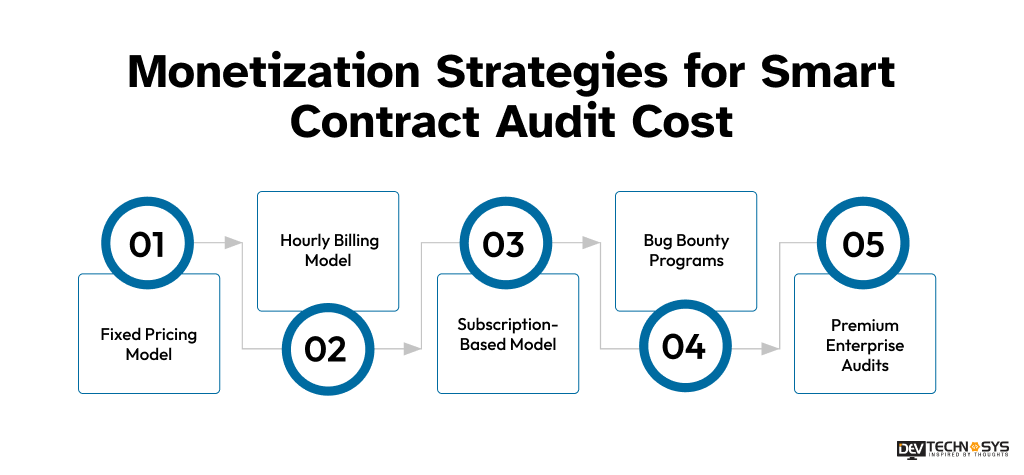
Monetization Strategies for Smart Contract Audit Cost
Smart contract audit services generate revenue through multiple pricing and engagement models based on project complexity and security needs.
1. Fixed Pricing Model
In this model, audit firms charge a fixed fee based on project size and complexity. It provides predictable pricing for clients while ensuring stable revenue for auditors, making it suitable for startups and standard blockchain projects.
2. Hourly Billing Model
Auditors charge clients based on the number of hours spent reviewing and testing smart contracts. This model is flexible and ideal for complex projects where the scope is unclear or requires continuous debugging and detailed analysis.
3. Subscription-Based Model
Companies offer ongoing audit and security monitoring services through monthly or yearly subscriptions. This ensures continuous protection, real-time vulnerability tracking, and recurring revenue for audit providers working with long-term blockchain projects.
4. Bug Bounty Programs
Organizations reward external ethical hackers for discovering vulnerabilities in smart contracts. Payments are made based on the severity of bugs found, making it a cost-effective model while improving overall platform security through community participation.
5. Premium Enterprise Audits
High-value blockchain projects pay premium fees for deep security audits, compliance checks, and advanced penetration testing. These services generate higher profit margins due to specialized expertise and increased demand from large-scale DeFi and enterprise platforms.
Smart Contract Vs Ethereum Vs Solana Audit Costs
Are you looking for the best auditing for your project? But cost can confuse your selection. Let’s explore the comparison table with descriptions for various types of audits, such as smart contracts, Ethereum, and Solana.
Category |
Smart Contract (Generic) |
Ethereum (Solidity) |
Solana (Rust) |
| Typical Cost Range | $5,000 – $150,000+ depending on complexity | $8,000 – $50,000 for standard contracts; $50,000+ for complex DeFi | $5,000 – $20,000 for standard contracts; higher for complex programs |
| Audit Duration | 2–16 weeks, depending on project size | 2–12 weeks, depending on complexity | 3–14 weeks; may be longer due to Rust/CPI checks |
| Auditor Availability | Moderate; depends on language | High; many Solidity auditors | Niche: fewer Rust auditors available |
| Tooling Support | Varies by language | Mature tools (Slither, MythX, Echidna) | Growing tools; less mature than Ethereum |
| Complexity Sensitivity | High – more features = higher cost | Complex DeFi bridges increase cost | Complex CPI and cross-program calls increase cost |
| Remediation / Re-Audit | Extra 20–30% typically | Same; fixes require re-verification | Same; fewer auditors can make re-audit slower and costlier |
| Risk Premium | High-value contracts increase cost | DeFi and large-cap projects increase audit fees | High-value Solana programs can increase cost due to niche expertise |
| Value Justification | Insurance against hacks builds trust | Boosts investor confidence, credibility | Adds trust for Solana-specific threats and cross-program interactions |
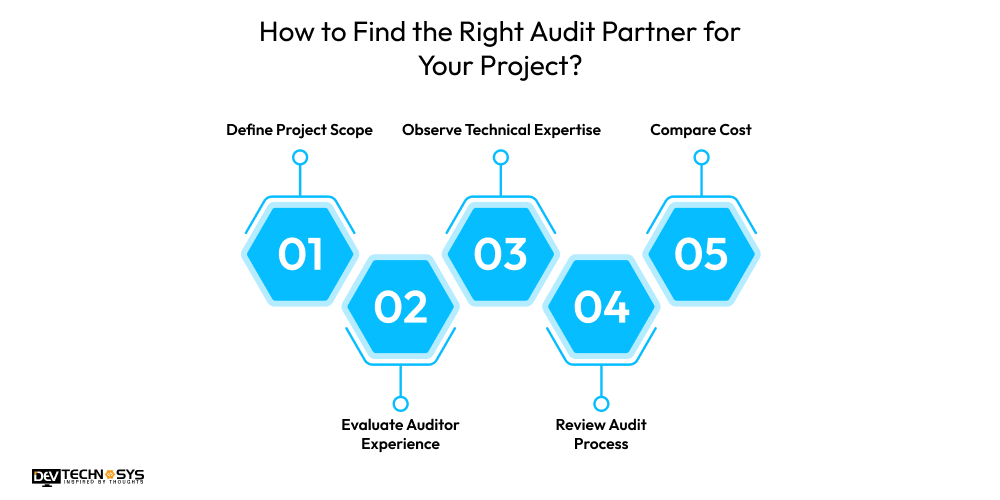
How to Find the Right Audit Partner for Your Project?
You have waited for this section after knowing the cost to audit a smart contract. Now the wait comes to an end. We provide the step-by-step process to find the best audit partner for your project, and you can easily understand which partner can fulfill your security requirements.
1. Define Project Scope
First of all, you need to outline your project complexity and select the features as per the personalized preferences and core requirements. This project scope identifies the right smart contract auditor and makes sure that technical expertise is matched to your demands.
2. Evaluate Auditor Experience
Check the auditor’s portfolio, past clients, and industry reputation. Look for experience with similar projects, audit reports, and known security incidents. Reliable auditors have verified credentials, case studies, and positive community feedback.
3. Observe Technical Expertise
Move to the third step, make sure that your auditor is proficient in your platform’s languages, such as Solidity and Rust. They must have knowledge in formal verification, fuzzing, static analysis, and cross-program checks. This can reduce the risk of vulnerabilities and cover all technical expertise.
4. Review Audit Process
Understand their methodology, timelines, reporting style, and remediation support. Effective auditors provide clear reports, actionable recommendations, and good communication. Transparent Ethereum development services reduce misunderstandings, prevent delays, and improve overall audit quality.
5. Compare Cost
At the last stage, compare the costs between various auditors, and the cheaper cost is not always better. Go with experienced and balanced cost auditors that offer powerful smart contract audit services, such as turnaround time, audit depth, and robust security measures. Prioritize auditors who deliver strong value and a comprehensive security review for your project.
Conclusion
In summary, the smart contract code audit cost depends on multiple factors, including code complexity, number of contracts, project type, and security requirements. For projects seeking safe deployment, engaging a professional smart contract development company such as Dev Technosys ensures comprehensive auditing, vulnerability detection, and reliable reporting.
With 15+ years of expertise, our developers deliver secure and scalable blockchain solutions tailored to your business needs.While audits can be expensive, they are a crucial investment to protect user funds, prevent exploits, and enhance credibility, ultimately saving projects from costly failures and establishing trust in the blockchain ecosystem.
Frequently Asked Questions
Find answers to the most common questions related to this article.
Smart contract audits are crucial because they identify vulnerabilities, prevent exploits, protect investor funds, and ensure system reliability. They enhance project credibility, reduce security risks, and build trust with users in blockchain ecosystems.
A smart contract audit typically takes 1 to 6 weeks, depending on code complexity, number of contracts, project type, and auditor workload, ensuring thorough review, testing, and vulnerability detection.
Here, we provide a few steps to audit a smart contract:
Understand the project & requirements
Manual code review
Automated testing & analysis
Functional & security testing
Reporting & recommendations
The average price for smart contract audit and complexity depends on code size, number of contracts, project type, logic complexity, third-party integrations, security requirements, documentation quality, testing coverage, urgency, auditor expertise, and post-deployment audit needs.
Smart contract audits are expensive due to their complexity, need for expert manual review, thorough testing, security analysis, vulnerability detection, multiple contracts, integration with third-party services, high-risk DeFi logic, and detailed reporting requirements.