










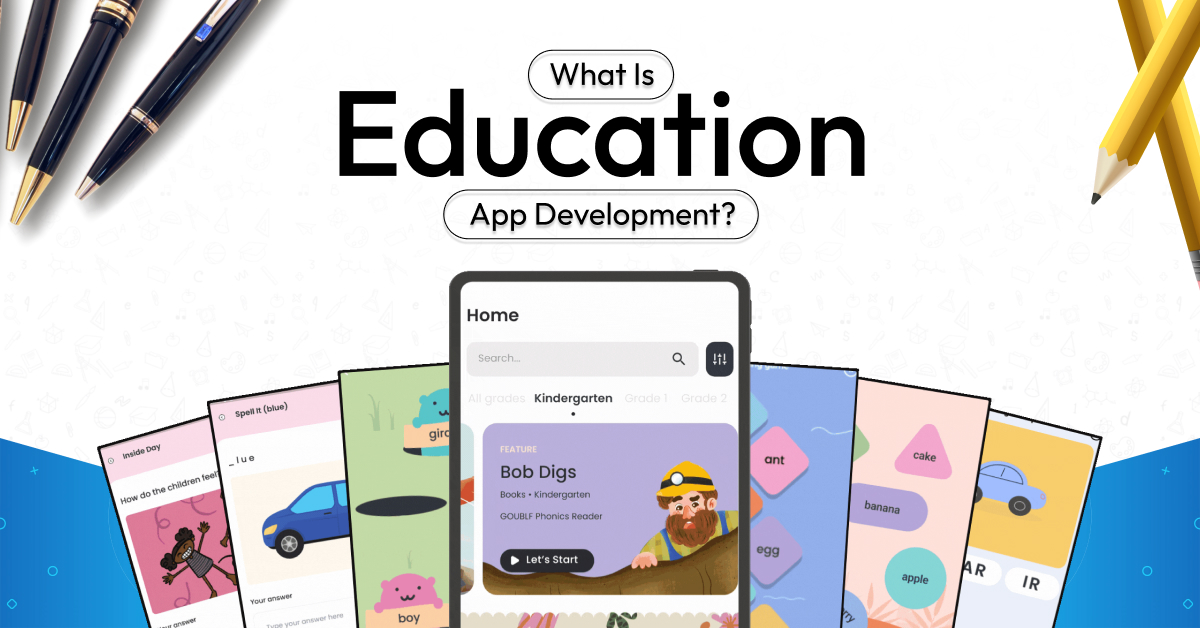
In 2026, there will hardly be anyone who is unfamiliar with education apps, especially students and people in the education field. Education apps brought a revolution to the teaching industry, enhancing how knowledge is delivered and acquired.
AI-powered eLearning apps offer advanced solutions to make learning more accessible, engaging, and personalized. But what exactly does it take to develop a scalable education app? Let’s find out together through this blog.
This blog explores the essentials of education app development. This blog has answers to all your questions, whether you’re a company developing a cutting-edge Edtech app or a curious individual exploring how learning software development facilitates skill development. So, let’s start learning without further ado!
Education Apps Market Overview
- The education apps market size is forecast to increase by USD 08 billion, at a CAGR of 14.5% between 2024 and 2029.
- The higher education market is experiencing significant growth, with adoption increasing by 25% over the past year.
- According to recent studies, the number of K-12 students using educational apps has increased by 35% in the last three years.
- North America is estimated to contribute 33% to global market growth during the forecast period.

What is the Purpose of Education App Development?
Education app development is the process of designing and developing a digital software for mobile or web. The purpose of education software development is to provide interactive learning content, tools, and experiences for various users.
From elementary kids to university students to corporate employees, these apps cater to everyone. AI-powered personalized learning apps focus on engagement, accessibility, performance and often include progress tracking and a user-friendly interface to engage users.
Successful Real World Examples of Education Apps
Education apps demonstrate how the right mix of technology, user experience, and learning design can drive massive adoption and long-term engagement. Here are the successful real world examples of education apps that showcase how innovative features and accessibility can successfully transform modern learning across global audiences.
1. Duolingo
Duolingo, Inc., founded in 2009 by Luis von Ahn and Severin Hacker, is an American educational technology company that produces language learning apps and offers language certification.
Duolingo is one of the most popular language-learning apps worldwide, known for its gamified learning experience. Duolingo ranked as the top revenue-generating educational app in 2023, earning $315 M and accumulating about 148 M downloads.
2. Google Classroom
Google Classroom supports over 150 million students and educators worldwide as part of Google for Education. It is widely adopted by schools and educational institutions for managing digital classrooms. It simplifies assignment distribution, grading, communication, and collaboration between teachers and students while integrating seamlessly with other Google tools like Docs, Drive, and Meet.
What are the Different Types of Education Apps to Build in 2026?
Whether you are a startup or an enterprise, if you have decided to build an education app from scratch, then you can’t miss these eight simple and profitable types of education app development ideas.
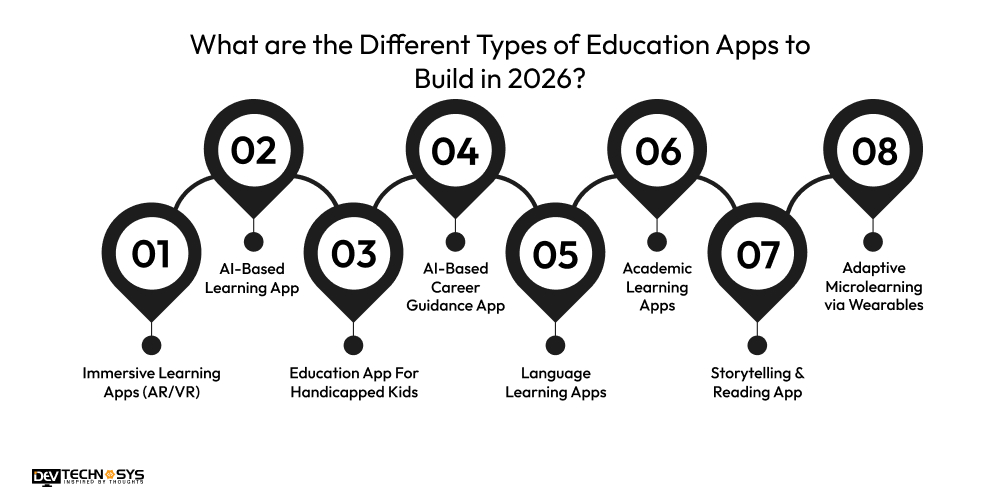
1. Immersive Learning Apps (AR/VR)
Immersive mobile education app development incorporates Augmented Reality (AR) and Virtual Reality (VR) elements to create interactive education software.
Virtual classroom app development benefits students greatly, as VR classroom apps transport them into a complete immersive learning environment, whether that’s a Roman marketplace, a biotech lab, or a physics simulation. What sets the VR-powered classroom app apart is its ability to replace passive learning with hands-on discovery.
Top Examples of Immersive Learning Apps:
- Merge EDU: AR/VR STEM experiences for visualizing 3D science concepts right in students’ hands.
- McGraw-Hill AR: An AR learning tool that layers curriculum content like science and math onto the real world.
- Quiver: Turns coloring pages into AR animations to make creativity and learning come alive.
2. AI-Based Learning App
AI-powered eLearning apps are far better than traditional e-learning methods. AI-based Education app development cost ensures faster learning, more engagement, and effectiveness.
AI in education app development helps businesses understand users’ learning speed, weaknesses, preferred formats, and concentration patterns, and utilize this information to curate personalized lessons that adapt in real time. As today’s students prefer AI-based personalized learning apps, demand for dynamic, AI-powered e-learning app development will only grow.
Top Examples of AI-based Learning Apps:
- QANDA: Uses AI and OCR to solve problems and give step-by-step explanations.
- Duolingo Max: AI in language learning (roleplay, instant feedback).
- Khan Academy (AI): Features an AI tutor, “Khanmigo,” for adaptive help.
3. Education App For Handicapped Kids
A mobile for handicapped kids allows them to learn and study from the comfort of their home. These edtech startup solutions are specially created for handicapped students, who can’t attend daily classes and lectures.
The app will bridge the gap between teachers and handicapped children, giving them a platform to learn on a regular basis. So a mobile app for handicapped kids can be a unique and profitable idea for a business wanting eLearning startup app development.
Top Examples of Education App For Handicapped Kids:
- Be My Eyes: Connects visually impaired users with helpers (plus AI assistance).
- Lingvano Sign Language ASL: Teaches sign language, useful for deaf learners.
- Tiimo: Helps neurodivergent users (e.g., ADHD, autism) with planning and learning support.
Want a chatbot demo or pricing? Fill the form and talk to our experts today.
Pick what you need below — you can select more than one — then tap Get detail to continue.
-
Chatbot demo dashboard
-
Cost to develop an app
-
Industry report
-
Case study
4. AI-Based Career Guidance App
AI-based career guidance apps use AI to provide personalized career advice, skills-gap analysis, job matching, and resume assistance. AI-based kids learning app development involves tools like Careerflow for job applications and HyperWrite’s assistant for tailored roadmaps.
Cloud-based education apps for career guidance help users explore roles and navigate job markets by analyzing personal data to suggest tailored paths and resources.
Top Examples of AI-Based Career Guidance App:
- Coursera AI Mentor: Personalized career guidance and course recommendations.
- LinkedIn Learning (AI features): Suggests skills and career paths using AI.
- AI Guru / LearnAI Now / DataMinds AI: AI-powered apps for career skill building (emerging category).
5. Language Learning Apps
eLearning app development helps users learn new languages through interactive lessons, gamification, speech recognition, and personalized learning paths. SaaS-based eLearning solutions focus on improving vocabulary, grammar, pronunciation, and listening skills, making language education accessible anytime, anywhere. Online learning app development is an excellent idea if you are considering building an education app.
Top Examples of Language Learning Apps:
- Duolingo: Popular gamified language learning app.
- Mondly: AR/VR and speech recognition for immersive language learning.
- Beelinguapp: Bilingual reading with audio for language learners.
6. Academic Learning Apps
Academic learning and tutor app development are beneficial for students looking for academic help and career guidance. Unlike the traditional career advice tools, the academic learning app uses machine learning and enterprise LMS solutions to understand user inputs and to draw on vast datasets on job market trends, providing actionable, data-driven guidance. Guide learners toward the right career paths by incorporating psychometrics, behavioral analytics, and real-world job trends.
Top Examples of Academic Learning Apps:
- BYJU’S: Concept clarity with animated lessons (top kids learning app).
- Creta Class: AI-driven early learning (math & language) for kids.
- Prodigy Math: Game-based math learning for elementary through middle grades
7. Storytelling & Reading App
Storytelling and reading apps have become quite popular due to people’s shifting interests from physical books to e-books. According to a top mobile app development company, storytelling and reading apps focus on improving literacy, comprehension, and creativity through interactive stories, audiobooks, and personalized reading experiences. They often include narration, animations, quizzes, and progress tracking to engage learners of all ages.
Top Examples of Storytelling & Reading App:
- Wonderscope: AR storytelling where kids interact with stories.
- Headway: Bite-sized non-fiction summaries and knowledge lessons.
- Epic: Large digital library of children’s books
8. Adaptive Microlearning via Wearables
Adaptive microlearning via wearables delivers short, personalized learning content through smartwatches, fitness bands, and AR glasses. These apps use real-time data and AI to provide timely lessons, reminders, and skill reinforcement in everyday contexts.
If you want to create a mobile app that leverages wearable technology for learning, AI-driven personalization and seamless device integration can help you deliver highly engaging and future-ready educational experiences.
Top Examples of Adaptive Microlearning via Wearables:
- Headway: Offers bite-sized learning summaries with wearable alerts for quick daily learning.
- Axonify: Uses microlearning and performance nudges, adaptable for wearable-based prompts.
- OttoLearn: Provides adaptive microlearning modules with smart reminders suitable for wearable integration.
What are the Essential Functionalities for Modern Education Apps?
If you are a business looking for hybrid app development for academic purposes, then do not forget to incorporate these features. Here are some of the essential features that an education app must include.
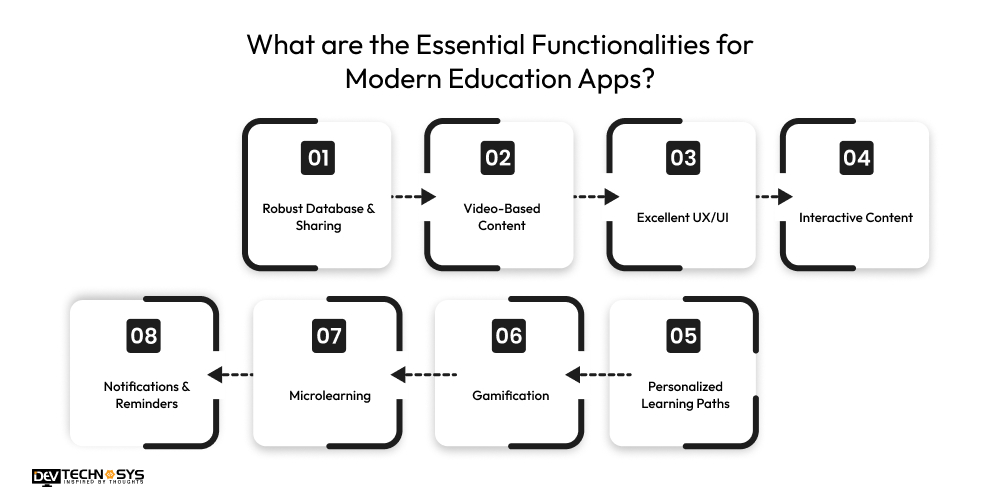
1. Robust Database & Sharing
A strong, secure, and scalable database is the backbone of any education app. It allows users to store large volumes of content, track progress, and share materials seamlessly across devices. It facilitates collaboration among students, teachers, and peers, enabling real-time group projects, document exchange, and resource access.
2. Video-Based Content
Education app features like video lessons and tutorials are a critical component of modern education apps. They help learners understand complex concepts visually and allow for replay and self-paced learning. White-label education app features like offline downloads and streaming optimize the learning experience and make it more engaging.
3. Excellent UX/UI
A clean, intuitive interface with easy navigation ensures learners can quickly access lessons and features. School management software development with well-designed UX/UI enhances user satisfaction, encourages frequent use, and minimizes dropout rates. Visual appeal and responsive layouts are essential to cater to all devices and age groups.
4. Interactive Content
Interactive learning tools such as quizzes, polls, simulations, and hands-on exercises transform passive learning into active engagement. By encouraging learners to participate, solve problems, and apply concepts, interactive content improves retention, understanding, and critical thinking skills.
5. Personalized Learning Paths
According to experts who provide education app development services, modern apps must use adaptive learning algorithms to track individual progress, performance, and preferences. This data-driven approach allows the app to recommend personalized lessons or courses tailored to each learner’s strengths and weaknesses, ensuring effective learning outcomes.
6. Gamification
Gamification elements like badges, points, leaderboards, challenges, and rewards make learning more engaging and enjoyable. These features tap into motivation psychology, encouraging regular participation, healthy competition, and sustained interest over time, particularly for younger audiences or casual learners.
7. Microlearning
Microlearning delivers content in small, focused modules that can be completed quickly. This approach is ideal for mobile users and busy learners, allowing them to fit learning into short breaks, reinforce skills continuously, and improve knowledge retention through bite-sized lessons.
8. Notifications & Reminders
Push notifications, alerts, and reminders help learners stay on track with their study schedules. Timely prompts encourage lesson completion, reinforce learning habits, and increase overall engagement, ensuring users remain active and consistent in their learning journey.
What Are the Advanced Features to Include in an Education App?
Now that we have discussed the must-have features of education app development, let’s move on to the advanced features to include in an education app. Here are some advanced education app development features for 2026.
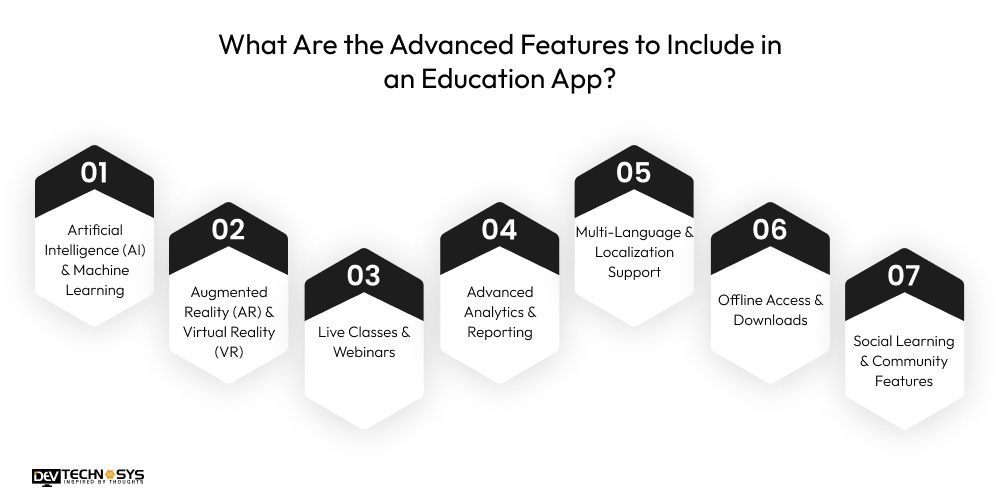
1. Artificial Intelligence (AI) & Machine Learning
AI-powered education app features drive adaptive learning by analyzing student performance and identifying knowledge gaps. AI tutor app features personalized lessons, exercises, or study paths for students. Machine learning and AI in education app development enhance content delivery and provide educators with actionable insights.
2. Augmented Reality (AR) & Virtual Reality (VR)
AR and VR enable immersive, hands-on learning experiences. Students can explore 3D models, virtual labs, and realistic simulations to make abstract concepts tangible. These technologies are particularly valuable for STEM subjects, medical training, and technical skills where practice and visualization are essential.
3. Live Classes & Webinars
Real-time video streaming allows educators to host interactive classes, webinars, and Q&A sessions. Features like chat, polls, whiteboards, and screen sharing in a custom LMS software development replicate a physical classroom experience, fostering collaboration and keeping learners engaged throughout the session.

4. Advanced Analytics & Reporting
Cloud-based education app features with advanced analytics provide in-depth insights into learner behavior, engagement levels, course completion rates, and performance metrics. Administrators and educators can identify struggling students, track progress, and refine content or strategies based on data-driven decisions.
5. Multi-Language & Localization Support
Personalized learning AI features, such as support for multiple languages and regional content, ensure accessibility for a global audience. Enterprise education app features like localization enhance comprehension, respect cultural nuances, and allow learners from different countries to engage effectively with the educational material.
6. Offline Access & Downloads
Smart education app features offline access and download options. This feature allows learners to download lessons, videos, and resources for use offline. This feature ensures uninterrupted learning, particularly for students in areas with poor connectivity, making the app more versatile and user-friendly.
7. Social Learning & Community Features
Social learning tools like discussion forums, study groups, and peer interactions promote collaborative learning. Gamification elements, leaderboards, badges, and group projects increase engagement, motivation, and knowledge sharing, turning the learning experience into a more interactive and enjoyable journey.
Conclusion
We hope the above-provided details and information helped you learn more about education app development. Education app development is transforming how knowledge is delivered and experienced in the digital era.
From schools to corporate training, education apps empower organizations to modernize learning systems, which drives growth and engagement. If you are a business interested in building an edge-cutting education app, then contact a leading education app development company like Dev Technosys. And stay tuned for more information.
Frequently Asked Questions
Find answers to the most common questions related to this article.
Students, teachers, schools, universities, coaching institutes, corporate trainers, and eLearning businesses benefit from education apps. Education apps improve accessibility, engagement, learning efficiency, and performance tracking.
Common types include eLearning apps, language-learning apps, exam-preparation apps, virtual classroom apps, skill-development platforms, corporate training apps, and child-learning or gamified education apps.
Key features include user registration, course management, video lessons, quizzes, progress tracking, notifications, offline access, live classes, discussion forums, and secure payment integration.
A good education app provides a seamless, captivating user experience, solves a real learning problem, and gives a special value that other apps don't. Clear outcomes, strong customisation, and steady learner motivation are essential. In the competitive EdTech market, apps that combine innovation with quantifiable impact stand out.
Yes, if they are developed properly. Modern-day education apps implement data encryption, secure authentication, role-based access, and compliance with data protection regulations to ensure user privacy and safety.
Yes, absolutely. Education apps are built using scalable architectures that support future growth. This allows seamless addition of new courses, increased user capacity, advanced features, third-party integrations, and performance enhancements without affecting existing functionality.