


















Key takeaways:
-
- 62% of global leaders are concerned about AI compliance. Which makes AI governance platforms a critical tool for enterprises.
- With a comprehensive AI governance framework and training programs, organizations can successfully implement an AI governance platform.
- Bias detection, automated monitoring, compliance management, and explainability are some types of AI governance solutions.
- IBM watsonx.governance, Microsoft Responsible AI, Google Cloud Model Governance, AWS AI Governance, and Fiddler AI are trusted AI platforms.
The AI adoption rate is accelerating at full speed. As per Statista, 73 million new AI users are expected in 2026. But this scalability of AI beyond its control leaves us worried.
The need for accountability and compliant use of AI has never been more crucial. And not enough people know about AI management platforms. Many enterprises still feel overwhelmed by AI regulations and are struggling with them.
According to Grand View Research, the enterprise AI governance market is estimated to reach USD 3,590.2 million by 2033. This is a clear and urgent sign that establishing an AI governance framework is a high priority.
In this blog, we’ll share the best AI governance platforms for enterprises. Also, delve into the features, implementation challenges, how to choose the right platform, and more.
What is AI Governance?
Simply put, AI governance is a structured framework comprising policies, tools, principles, and processes. These guidelines and procedures ensure the ethical, safe, and responsible use of Artificial intelligence.
AI data governance ensures that AI is leveraged safely and transparently in AI development. Before the use of AI become liability, it defines how one must build, deploy, and coexist with AI.
AI management platforms help businesses build trust and ensure compliance. Organizations using AI governance solutions are experiencing fewer AI-related incidents.
Functioning as an operational manual, it helps deploy AI responsibly, transparently, and in accordance with all ethical standards. It aims to identify and reduce risks like cybersecurity threats, data privacy issues, inaccurate outputs, and regulatory noncompliance.
Why AI Governance Matters In 2026?
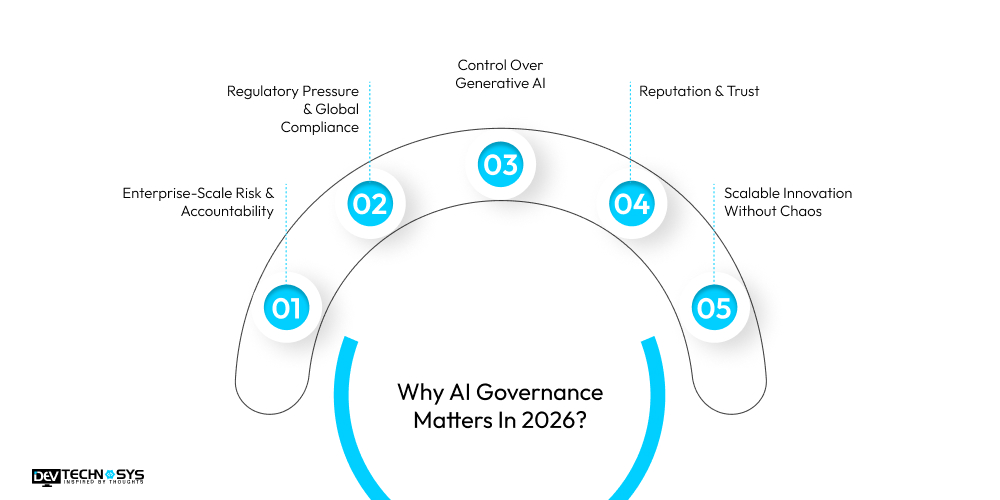
AI is advancing much faster than its regulation. Gartner stated that 62% of leaders are very concerned about AI compliance. Trust in AI companies has declined from 61% to 53% in 2025, according to McKinsey’s Technology Trends Outlook 2025. These figures highlight the risks of undermining AI adoption. Which makes imposing compliance requirements on the usage of artificial intelligence.
1. Enterprise-Scale Risk & Accountability
All the hiring, healthcare, and security decisions are influenced by AI. Without proper frameworks, these errors become enterprise-wide failures. AI governance clearly defines responsibility and ownership across the AI lifecycle. It documents decisions, manages risks, and enforces policies. This ensures that humans remain accountable for AI-driven outcomes.
2. Regulatory Pressure & Global Compliance
In 2026, it has become important for enterprises to meet global compliance standards, such as the EU AI Act and ISO/IEC 42001. The governance laws have become an integral part of the AI landscape.
AI governance tools helps organization centralize compliance and reduce legal exposure. Without meeting global compliance, scaling AI becomes slower, costlier, and riskier.
3. Control Over Generative AI
With the rise in Generative and autonomous artificial intelligence. AI ethics and governance are becoming increasingly important. To control data leakage and misuse at scale, it maintains visibility into how AI systems operate. AI risk management software provides human oversight, monitoring, and audit trails. It ensures AI usage remains safe and ethical.
4. Reputation & Trust
From customers to employees, everyone is more likely to trust AI when it is monitored and governed. In the time of backlash and viral scrutiny, AI management platforms protect the reputation of an AI software development company. It builds public trust and internal confidence in deploying AI. Conducting regular audits avoids bias or unfair treatment of individuals or groups.
5. Scalable Innovation Without Chaos
Clear policies and standardized processes help in scaling innovation sustainably. Enterprises with mature AI governance policies often deploy AI faster, more safely, and with greater confidence.
AI governance responsibilities help businesses innovate responsibly while avoiding costly rework, delays, and setbacks. It allows sustained, uniform dispersion of AI.
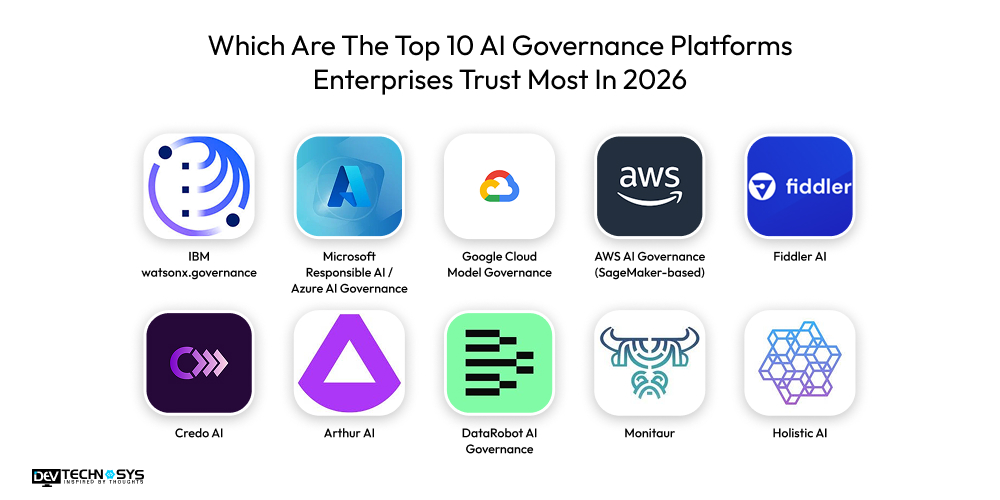
Which Are The Top 10 AI Governance Platforms Enterprises Trust Most In 2026?
Trusted AI compliance software help business leaders to monitor, manage, and keep their AI systems trustworthy and compliant. There are hundreds of options, making the decision to choose an AI governance system tougher. This section has compiled a list of the top 10 AI governance tools, comparing their benefits and capabilities.
Rank |
AI Governance Platform |
Core Strength |
Best Suited For |
Key Governance Capabilities |
| 1 | IBM watsonx.governance | Enterprise-grade governance & compliance | Large regulated enterprises | Model lifecycle governance, bias detection, explainability, and audit trails |
| 2 | Microsoft Responsible AI / Azure AI Governance | Deep cloud & enterprise integration | Enterprises using the Microsoft AI stack | Policy enforcement, transparency, risk assessment, and documentation |
| 3 | Google Cloud Model Governance | Scalable governance for ML & GenAI | Data-driven enterprises | Model monitoring, explainability, lineage, and compliance reporting |
| 4 | AWS AI Governance (SageMaker-based) | End-to-end AI lifecycle control | Cloud-native enterprises | Model tracking, risk controls, access governance, and auditability |
| 5 | Fiddler AI | Explainability-first governance | High-risk decision environments | Model explainability, performance monitoring, and fairness analysis |
| 6 | Credo AI | Policy-driven AI governance | Compliance-focused organizations | AI risk management, policy mapping, and regulatory alignment |
| 7 | Arthur AI | Real-time AI monitoring & trust | Enterprises deploying production AI | Drift detection, bias monitoring, model performance oversight |
| 8 | DataRobot AI Governance | Embedded governance with AutoML | Rapid AI deployment teams | Model registry, compliance workflows, lifecycle management |
| 9 | Monitaur | Audit-ready AI governance | Financial services & insurance | Model documentation, validation, and regulatory reporting |
| 10 | Holistic AI | Broad AI risk & compliance coverage | Global enterprises | Bias detection, risk scoring, governance dashboards |
Out of the 10 best AI management platforms for enterprises, we have highlighted 5 top-tier platforms. These AI governance strategy platforms manage AI risks, ensure compliance, and govern complex AI lifecycles. Let’s know more about these AI governance tools.
1. IBM watsonx.governance
The first and foremost on the list of best AI deployment governance platforms and tools is IBM watsonx.governance. It is a comprehensive platform that supports multiple LLMs.
Designed for large enterprises, IBM watsonx.governance. offers tools for transparency and explainability. Deep governance automation and strong alignment with global AI regulations make it the most trusted AI Governance platform.
Core Governance Capabilities:
- Bias and fairness assessment
- Model lifecycle management
- Audit-ready documentation
- Explainable AI reporting
2. Microsoft Responsible AI / Azure AI Governance
Microsoft Responsible AI is among the best AI compliance management for enterprise data management. Their AI governance solutions are heavenly integrated in the Azure ecosystem.
From ML to generative AI governance, this platform provides policy enforcement, transparency, and risk management. With built-in compliance tooling, it is the ideal platform for companies invested in Microsoft technologies.
Core Governance Capabilities:
- Enterprise security integration
- Policy and access controls
- Risk and impact assessments
- Model documentation automation
Quick Fact: Microsoft was named a Leader in the 2025-2026 IDC MarketScape for Unified AI Governance Platforms.
3. Google Cloud Model Governance
Google Cloud Model Governance is one of the platforms that offer governance tools for AI model lifecycle management. The robust monitoring, lineage tracking, and explainability are key reasons why enterprises trust this platform.
It is a perfect choice for AI in enterprise product developmentGenerative AI Development Services. Given the large volumes of models and datasets. Google Cloud Model Governance enables responsible AI experimentation in 2026.
Core Governance Capabilities:
- Scalable governance workflows
- Model monitoring and validation
- Compliance reporting
- Explainability and insights
4. AWS AI Governance (SageMaker-based)
Built around Amazon SageMaker, AWS is another notable Artificial Intelligence Governance platform in Florida. It enables governance of ML/AI workflows on AWS for developing, deploying, and monitoring AI models.
By offering flexibility, security, and deep integration with cloud infrastructure, it has become one of the trusted names. This platform is an amazing choice for dynamic workloads, bursts, or variable use.
Core Governance Capabilities:
- Model registry and tracking
- Access and security controls
- Lifecycle tracking within AWS ecosystems
- Audit logs and traceability
5. Fiddler AI
This AI data governance platform is designed to help organizations explain, improve, and monitor their ML and LLMs. Fiddler AI has a user-friendly interface that enables cross-team collaboration by sharing insights and tools.
Through robust compliance features, it adheres to data protection laws and industry regulations. This AI governance platform might be a little expensive for startups and businesses with limited funding.
Core Governance Capabilities:
- Model explainability
- Identifies and mitigates biases in AI models
- Drift detection
- Decision transparency
Want a chatbot demo or pricing? Fill the form and talk to our experts today.
Pick what you need below — you can select more than one — then tap Get detail to continue.
-
Chatbot demo dashboard
-
Cost to develop an app
-
Industry report
-
Case study
Types Of AI Governance Platforms Explained
The landscape of responsible AI platforms spans across multiple categories. Each AI enterprise governance type addresses specific governance challenges.
Understanding the types of AI model governance platforms helps enterprises to choose the best solution. From detecting bias to managing compliance workflows, we explain in detail the types of platforms below.
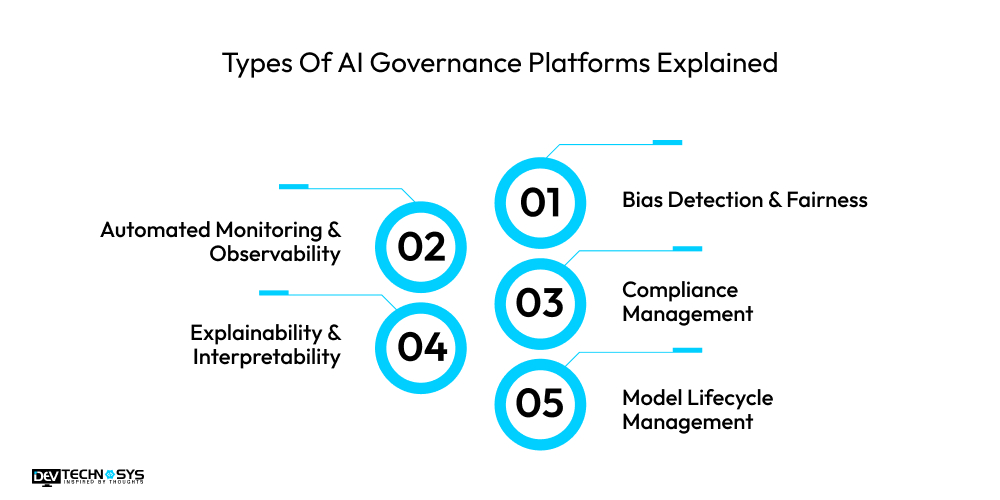
1. Bias Detection & Fairness
The truth is, humans tend to have biases. And this is evident in AI automation in software development. That’s where bias detection and fairness governance come in.
AI governance tools under this category identify human biases in AI, such as gender, racial, or age bias. This types of platforms are better suited for organizations deploying AI for decision-making.
Example: IBM AI Fairness 360, Microsoft Fairlearn, Aequitas
2. Automated Monitoring & Observability
These types of responsible AI in Enterprise Product DevelopmentAI platforms monitor AI models for performance, violations, and defects. These tools measure the effectiveness of AI governance guidelines.
Automated monitoring tools are ideal for AI deployments that require continuous oversight. Along with detecting drift and anomalies, these provide compliance reporting and audit trails.
Example: Fiddler AI, Arize, WhyLabs
3. Compliance Management
To track an organization’s compliance with regulatory requirements, compliance management tools are used. These tools are used by enterprises that are subject to the EU AI Act and industry regulations. AI compliance software help institutions avoid legal penalties and reputational damage. By keeping them up-to-date on changes.
Example: Credo AI, Holistic AI, OneTrust
4. Explainability & Interpretability
To make humans understand the AI decision-making process, these tools are used. Explainability and interpretability platform types are used in high-risk AI application scenarios.
The AI decisions are made more transparent to strengthen an enterprise’s trust in the AI outcome. It improves internal confidence by highlighting decision logic and outcome drivers.
Example: SHAP, LIME, Seldon
5. Model Lifecycle Management
Model lifecycle management tools govern AI systems from deployment through retirement. These platforms operate 3 primary tasks: development and deployment, monitoring and maintenance, and retirement and archiving of AI models. Model lifecycle management platforms are used by data science teams working with mature MLOps.
Example: MLflow, Weights & Biases, DataRobot
What Are The Core Features To Look For In AI Enterprise Governance Platforms?
AI governance for large enterprises should deliver consolidated and sophisticated solutions. The capabilities of AI governance monitoring tools will determine how well an organization can scale AI use in 2026.
Best AI governance platforms for enterprises help institutions address the potential risks and challenges associated with AI. In this section, we discuss the core capabilities and features you should watch for in the AI agent governance platform.
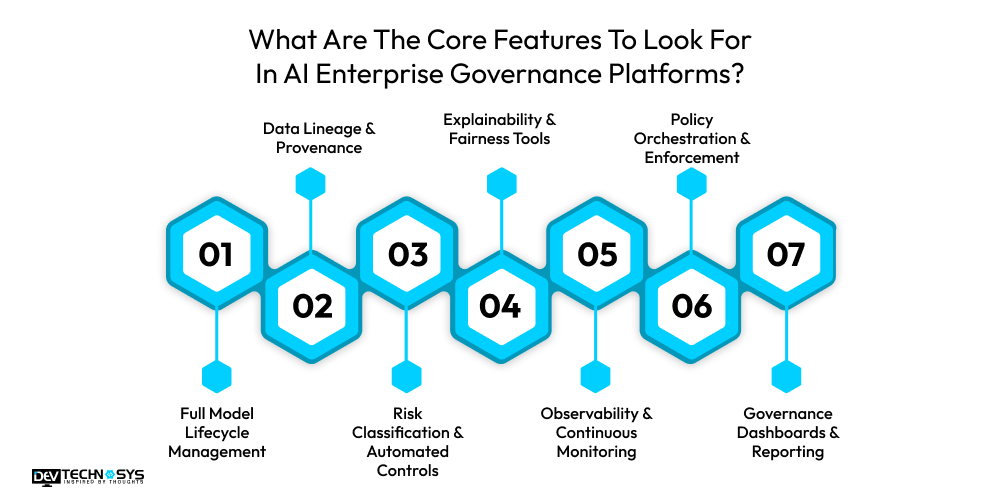
1. Full Model Lifecycle Management
The most basic and necessary feature is governance across the AI model’s complete lifecycle. This feature oversees each phase of AI development, including testing, deployment, updates, and retirement. It ensures that all models are validated and approved for deployment.
2. Data Lineage & Provenance
This feature is important for compliance, replicability, and root cause analysis. The AI policy management tool with data lineage support, dataset versioning and complete end-to-end lineage mapping. It addresses enterprise privacy obligations and strengthens accountability.
3. Risk Classification & Automated Controls
Another key feature in AI governance strategy platforms is risk classifications. It enables platforms to sort and allocate AI models into appropriate risk categories. Each risk category should initiate responses in accordance with the latest policies.
4. Explainability & Fairness Tools
One of the core enterprise AI governance platform features is the integration of fairness and explainability tools. They are essential for global and local explainability, fairness monitoring, and threshold monitoring. It mitigates the risk of harmful, non-transparent outcomes.
5. Observability & Continuous Monitoring
Continuous monitoring helps track AI model performance in real time. Which in return ensures the safety, stability, and performance of AI systems. Platforms with this feature can monitor model drift, performance degradation, adversarial anomalies, and operational measurements.
6. Policy Orchestration & Enforcement
Policy orchestration and enforcement is another feature to look for. Gen AI governance platform couples datasets, features, models, and endpoints with an AI governance framework. Active, operationalized compliance ensures that compliance becomes more than rules on paper.
7. Governance Dashboards & Reporting
An AI risk management platform with a governance dashboard converts complex governance data into simple, actionable information. All the metrics, risks, and compliance statuses are consolidated into a single executive view. It reinforces transparency.

How Do You Choose The Right AI Governance Platform For Your Enterprise?
The decision of AI governance software should not be underestimated. Most enterprises spend thousands of dollars on platforms that do not fit their needs. And if the right platform is not chosen, then your institute might land in trouble. Here we’ll help you to choose the best AI governance platform.
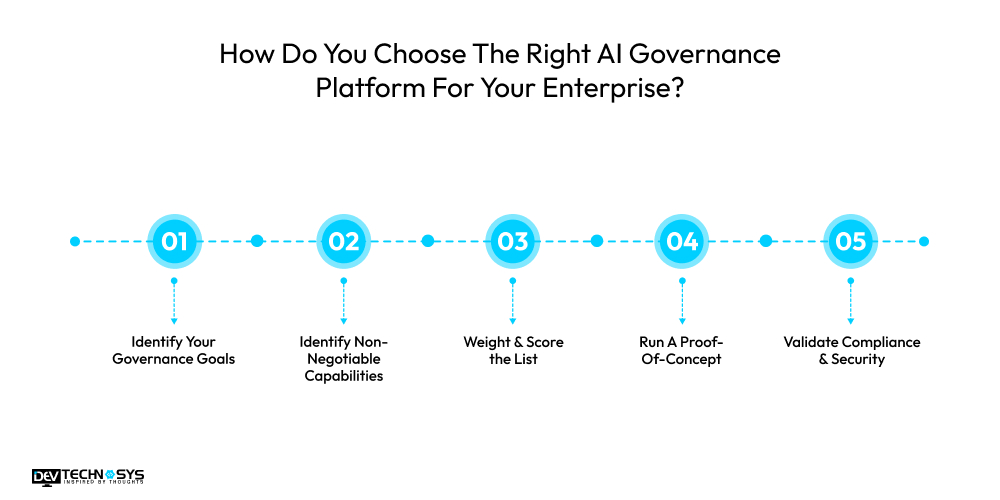
1. Identify Your Governance Goals
Having clarity about your governance goals ensures that the chosen platform meets operational needs. You can map out the organization’s AI use cases. According to the latest AI Risk Management Framework by NIST, governance goals must align with the intended purpose and context of the AI model.
2. Identify Non-Negotiable Capabilities
Next, identify the capabilities that are non-negotiable for your enterprise. According to the EU Artificial Intelligence Act, record keeping, human oversight, continuous monitoring, and risk classification are core requirements. Without core capabilities, the platform will not meet standard governance rules.
3. Weight & Score the List
After shortlisting the top AI policy management tool, use a scoring system to evaluate further. Gartner’s 2025 AI governance tooling guide states: Integration, compliance, scalability, and cost are the categories to evaluate. With a consistent scoring process, you can avoid bias in selecting leading responsible AI platforms.
4. Run A Proof-Of-Concept
Before finalizing the AI governance tool, run a pilot test in production-like conditions. Forrester says most governance gaps are identified in realistic workload and data flow. So monitor how the platform enforces policies, and observe its performance. To validate functionality and operational resilience, do not skip this step.
5. Validate Compliance & Security
In the final step, verify and cross-check that the platform meets your security and compliance requirements. The Cloud Security Alliance recommends checking vendor SOC 2 reports, penetration test results, and evidence of regulatory audits. Evaluate internal audits, governance, and reporting outputs before closing the deal.
What Are The Biggest AI Governance Challenges Enterprises Face Today?
Responsible AI platforms are critical in adopting AI at scale. But many enterprises are struggling to implement effective AI governance. We have gathered some of the most pressing AI governance challenges enterprises are facing in 2026.
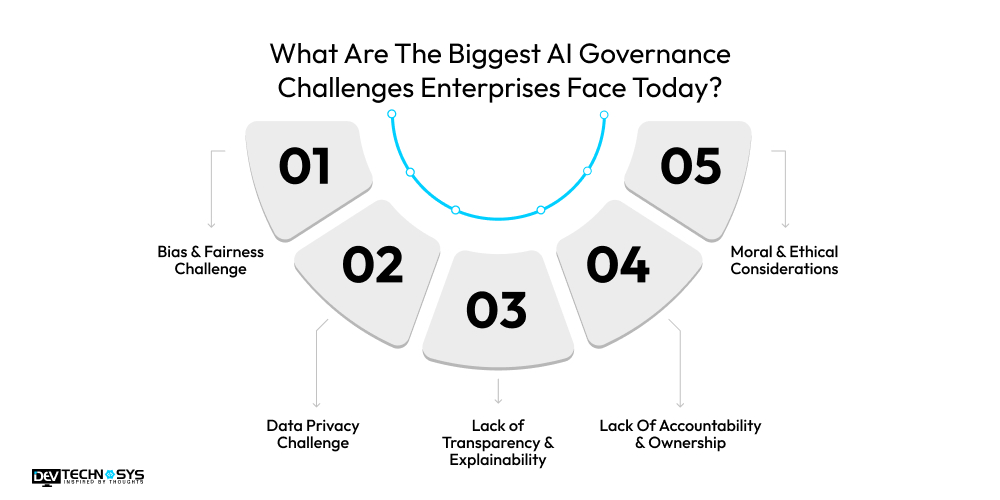
1. Bias & Fairness Challenge
AI models are as good as the data they are trained on. The historical biases embedded in systems lead to discrimination. Amazon’s AI hiring tool is one of high profile examples that struggled with this challenge. With a proactive approach, conduct regular bias audits and introduce bias-detection tools. The Four D’s framework mitigates bias risks.
2. Data Privacy Challenge
Large LLMs consume an abundance of sensitive data. This makes AI systems prime targets for breaches, data poisoning, and model theft. In 2023, OpenAI’s ChatGPT allegedly faced a data breach. You can employ privacy-enhancing technologies and tools for robust security in AI systems. Also, develop AI-specific incident response plans.
3. Lack of Transparency & Explainability
The difficulty in explaining how AI decisions are made leads to compliance risks and eroded trust. Apple’s credit card algorithm, which was investigated by a US financial regulator, is a fine example of it. In 2026, transparency is a business imperative. You can conduct AIAs and use visual tools to better understand AI decision-making.
4. Lack Of Accountability & Ownership
The most-asked question is: who takes responsibility when AI fails? An organization’s regulatory and reputational risks determine the answers. Which is why clear accountability guidelines are essential.
You can establish an AI Risk Committee and develop and document processes for human intervention when AI fails. Tesla is under investigation for its full self-driving technology.
5. Moral & Ethical Considerations
Navigating ethical and moral implications is another big hurdle in AI governance. A prime example is Clearview AI’s facial recognition technology. Which faced backlash for privacy violations.
You can align the AI models with organizational values. Through regular ethical reviews, evaluate long-term social impacts. For ethical AI solutions, go through a global framework.
How Can Enterprises Successfully Implement AI Governance?
A strategic approach that balances innovation and responsibility is required to implement AI governance. By following best practices, enterprises can deploy robust, responsible AI solutions. These practices provide a structured approach to managing the complexities and risks associated with AI.
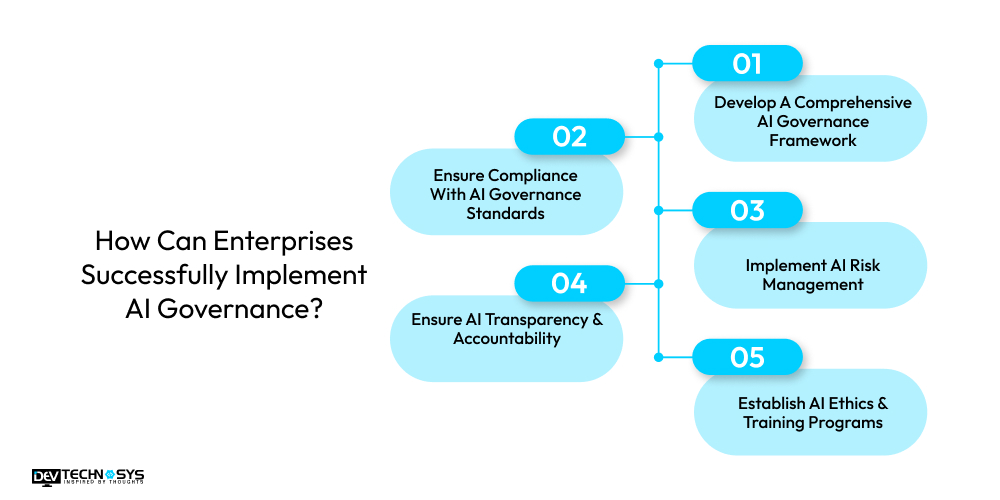
1. Develop A Comprehensive AI Governance Framework
Build a robust AI governance framework that aligns with your organization’s principles. Pay close attention to protect sensitive information by following strong data security measures. 82.6% phishing emails now use AI tech. Make your AI operations transparent and assign clear responsibilities. It will shield your organization from potential risks.
Quick Fact: 52% of AI deployment projects exceed time and budget when governance is inadequate.
2. Ensure Compliance With AI Governance Standards
Meticulous attention to regulatory adherence is required to ensure compliance with AI governance standards. Establish a permissions-aware framework. Implement role-based access and conduct regular evaluations.
This will safeguard your organization against unauthorized access and maintain data integrity. With proactive monitoring and dynamic policy reviews, enterprises can adapt to regulatory changes.
3. Implement AI Risk Management
To address potential ethical and security challenges, effective AI risk management is important. Conduct a thorough evaluation by mapping out risks and assessing the severity and frequency of identified risks.
With structured, regular audits, verify that generative AI development services comply with guidelines. A well-defined AI risk management helps institutions uphold ethical standards.
4. Ensure AI Transparency & Accountability
Fostering responsibility and openness in AI models helps build trust and integrity. Develop a cohesive documentation strategy and create detailed logs.
By keeping all relevant records, the enterprise gains clarity into how outcomes are achieved. Encourage open forums and involve diverse stakeholder groups to improve transparency.
5. Establish AI Ethics & Training Programs
To use AI technology responsibly, strong AI ethics and governance frameworks are crucial. Make a comprehensive ethics curriculum with emphasis on core AI values.
Use real-world examples to identify ethical challenges. Implement continuous learning and certification programs to keep employees informed about the future of AI policy management tools.
You can reach out anytime; we are available 24/7. Our team provides a quick response.

Why Should Enterprises Address Shadow AI Risks Now?
In the context of AI oversight platforms, Shadow AI is one of the most underaddressed governance challenges. In a nutshell, Shadow AI refers to the AI tools and models used within the organization without the security team’s approval. This phenomenon is growing through services like ChatGPT, Gemini, and Claude. Let’s take a look at the latest data on Shadow AI risks:
- 65% of AI tools operate without IT approval, according to Knostic.
- IBM’s Cost of a Data Breach Report 2025 found that standard AI breaches cost enterprises $ 670,000 or more.
- In February 2025, the OmniGPT AI chatbot was alleged to have been breached, leaking 34M messages and API keys.
- According to Cisco’s 2025 study, 46% of organizations reported internal data leaks through Gen AI.
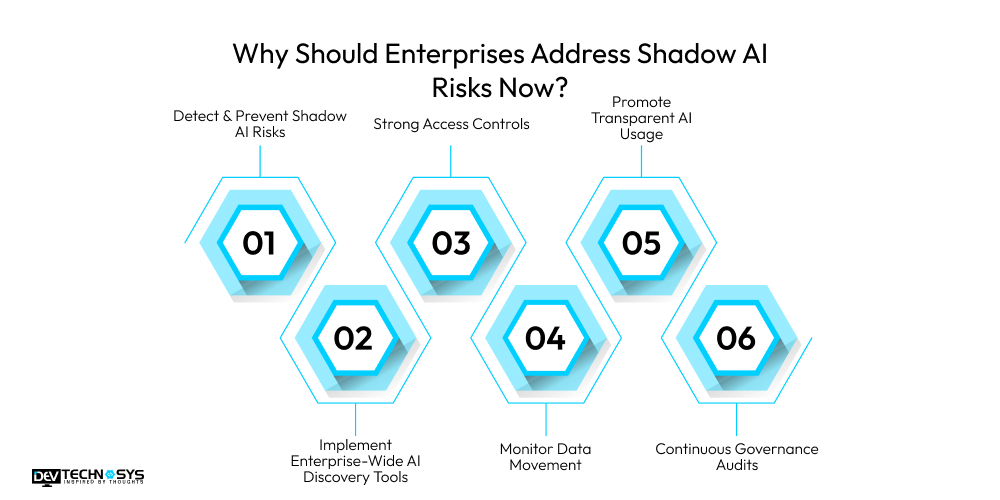
1. Detect & Prevent Shadow AI Risks
Policy development, employee education, and continuous oversight are some of the ways to effectively control Shadow AI. The best AI governance platforms include shadow AI detection capabilities. Reliance AI, one of the leading cloud AI oversight platforms, has launched a dedicated shadow AI detection feature.
2. Implement Enterprise-Wide AI Discovery Tools
Deploy automated AI governance tools in United States to identify unauthorized AI applications. These include platform scans, networks, APIs, and SaaS usage. Rather than periodic audits, enterprises are relying on continuous visibility. It strengthens the AI governance framework by reducing blind spots.
3. Strong Access Controls
Make it a strict rule to obtain security and IT reviews before using any AI systems in the workflow. Limiting unsanctioned purchases prevents introducing new Shadow AI risks. Further, role-based access controls restrict who can access external AI mobile app development services.
4. Monitor Data Movement
The best way to detect Shadow AI is to look for unusual data transfers or abnormal usage patterns. By deploying AI governance monitoring solutions, enterprises can uncover hidden AI workflows. Tracking the usage pattern protects intellectual property and information.
5. Promote Transparent AI Usage
Provide regular employee training to clarify acceptable AI practices, data-handling rules, and security risks. Encouraging transparency helps enterprises surface shadow AI more quickly and build responsible innovation habits through AI governance.
6. Continuous Governance Audits
Across workflow conducts regular AI audit platforms. This helps in adapting to evolving technologies and employee behaviors. The ongoing oversight improves detection accuracy and ensures shadow AI cannot persist unnoticed. Enterprises can enforce policies more consistently.
Use Case Studies Of Enterprises Using AI Governance Platforms
Real-world examples of AI governance tools show how enterprises scale AI responsibly. AI compliance platforms play a vital role in strengthening accountability and maintaining transparency. Below are some use cases that highlight practical scenarios for enterprises leveraging AI ethics platforms
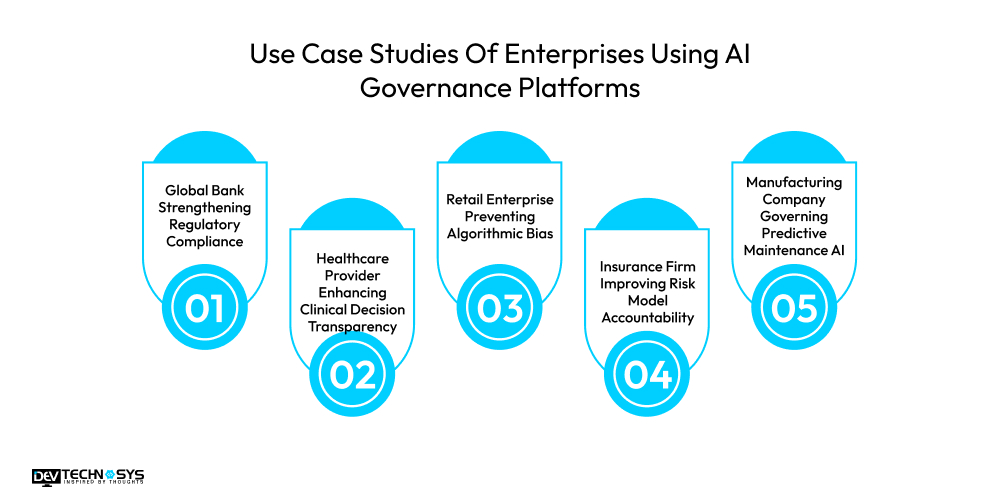
1. Global Bank Strengthening Regulatory Compliance
A multinational bank implemented AI agent governance platform. The goal was to verify credit-scoring and fraud-detection models. It automated audit trails, centralized documentation, and categorised models by regulatory risk. It helped the bank in reducing legal exposure.
2. Healthcare Provider Enhancing Clinical Decision Transparency
A leading healthcare company adopted cloud AI ethics platforms to monitor diagnostic models. It validated model accuracy and generated explainability reports for clinical teams. Healthcare AI governance platforms in USA ensured patient safety and improved trust among medical staff.
3. Retail Enterprise Preventing Algorithmic Bias
To review pricing, a retail organization deployed an AI governance tool. It helped teams correct unintended disparities by analyzing demographic impacts. Retail AI governance solutions protected brand reputation, promoted equitable experiences, and maintained customer trust.
4. Insurance Firm Improving Risk Model Accountability
A large insurance company uses automated AI oversight platforms to supervise underwriting and claims models. It helped the firm in establishing clear ownership, version control, and risk checkpoints. AI governance for insurance maintains strict compliance standards.
5. Manufacturing Company Governing Predictive Maintenance AI
A global manufacturing company integrated Artificial Intelligence governance into its operations. AI risk management software identified performance deviations and validated maintenance models. The company obtained higher equipment reliability and minimized downtime.
To Wrap Up!
Strong AI policy management tools are essential, as AI has become central to every business operation. An AI governance framework ensures ethical, compliant, and transparent use of Artificial Intelligence.
Without proper guidelines, an AI development company can face security, compliance, and operational risks. Top AI governance tools for enterprises in 2026 provide automated safeguards against evolving regulations. And the best platform and tool aligns with your organization’s AI priorities.
Frequently Asked Questions
Find answers to the most common questions related to this article.
Responsible AI platforms manage risk, ensure compliance, promote transparency, and uphold accountability. They provide continuous monitoring and structured oversight. These platforms help enterprises scale AI confidently, avoid costly violations, protect brand trust, and align innovation with ethical and legal guidelines.
Selecting the best AI governance platform for enterprises requires a structured approach. Here are the key steps to make an informed decision.
Identify Your Governance Goals
Identify Non-Negotiable Capabilities
Weight & Score the List
Run A Proof-Of-Concept
Validate Compliance & Security
AI governance tools are specifically designed tools to support secure, ethical, and legal deployment of AI. These tools cover all the parties involved in the AI adoption. AI oversight platforms are used to implement policies, track AI behavior, and assess risk.
The top AI model governance platforms are trusted by enterprises to ensure compliance, improve transparency, and maintain accountability. The top-rated platforms are:
IBM watsonx.governance
Microsoft Responsible AI
Google Cloud Model Governance
AWS AI Governance
Fiddler AI
Credo AI
Popular AI ethics platforms are integrated with advanced features to reduce regulatory risk and strengthen accountability. The core features are:
Full Model Lifecycle Management
Data Lineage
Risk Classification
Automated Controls
Explainability & Fairness Tools
Continuous Monitoring