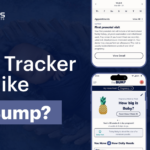















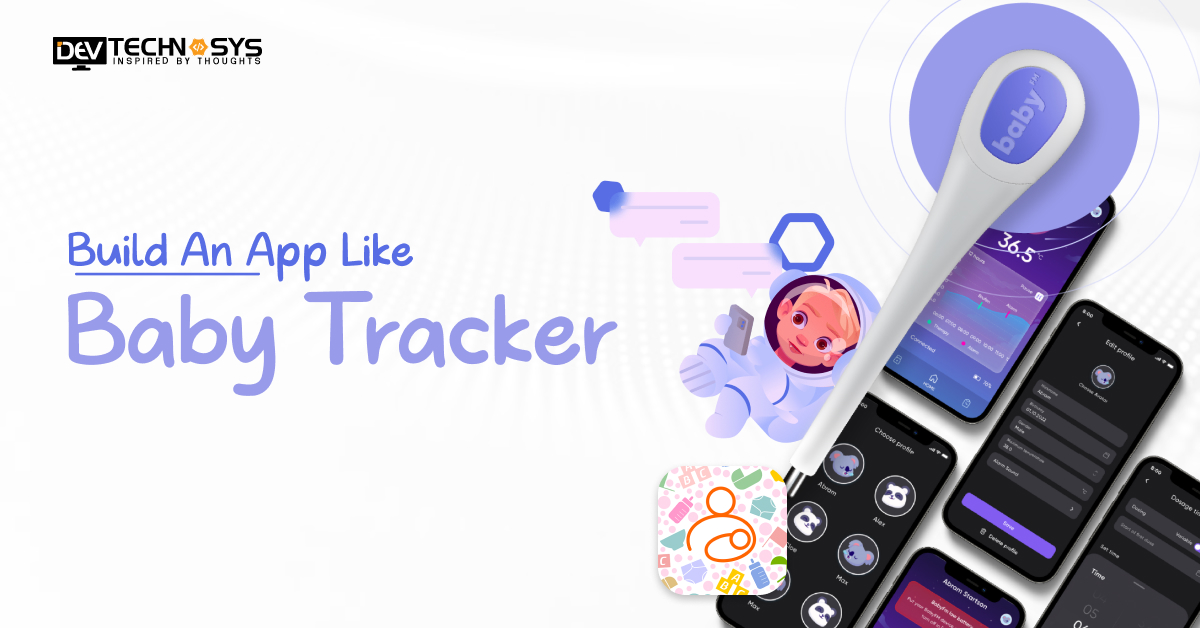
“Capture Every Giggle”
Are you included in one of the busiest parents?
Then you think so much about your baby and how it can be taken care of?
Now, explore the real-time baby tracking app like Baby Tracker in Europe, which provides the baby updates such as sleeping, feeding, growth tracking, and a photo gallery.
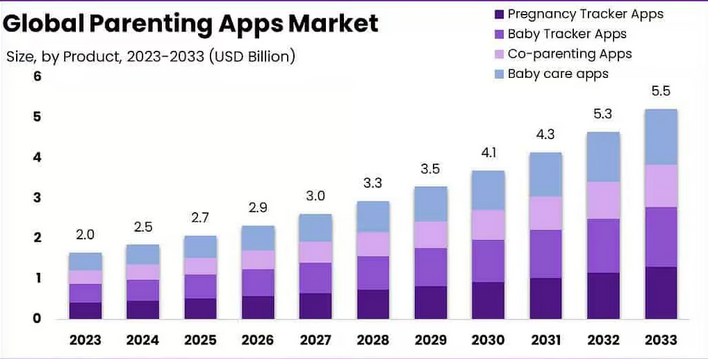
Recently, we found that the global baby tracking apps are valued at around $2.0 billion in 2023, projected to increase to around $5.5 billion by the end of 2033.
The above data reveal that build an app like Baby Tracker is one of the most lucrative opportunities for businesses.
In this dynamic blog, we will discuss in detail how to build an app like Baby Tracker, market analysis, benefits, features, cost, and money-making techniques.
Keep Reading!
Global Market Statistics of Parenting Applications
- The parenting applications market size is expected to increase with a CAGR of 2% during the forecast period from 2024 to 2030.
- As per the segment-wise, the baby tracker apps hold the largest share of the parenting apps market, around 6% in 2023.
- According to a recent study, the parenting apps market size is projected to reach approximately $5.5 billion by 2033, up from $2.0 billion in 2023.
- As per the region-wise, North America is the leading region that holds the largest market revenue share, around 7% and generates revenue of around $0.7 billion in 2024.
- The Android apps market segment dominates the parenting apps market and holds a share of around 4% in 2023.
What is Baby Tracker?
The Baby Tracker is a parenting platform that enables parents to monitor their baby’s daily activities, physical development, health, sleep tracking, diaper changes, and feeding. These type of baby tracking applications helps busy parents to get informed about their baby with detailed information.
It offers many premium features like reminders and alarms, timeline and reports, data sharing, multimedia, and activity logging.
10 Popular Apps Like Baby Tracker
Before going to the development steps, look at the Baby Tracker alternatives to get an idea of which type of application you want to develop. So, here is the list with user ratings, launched year, and platform availability:
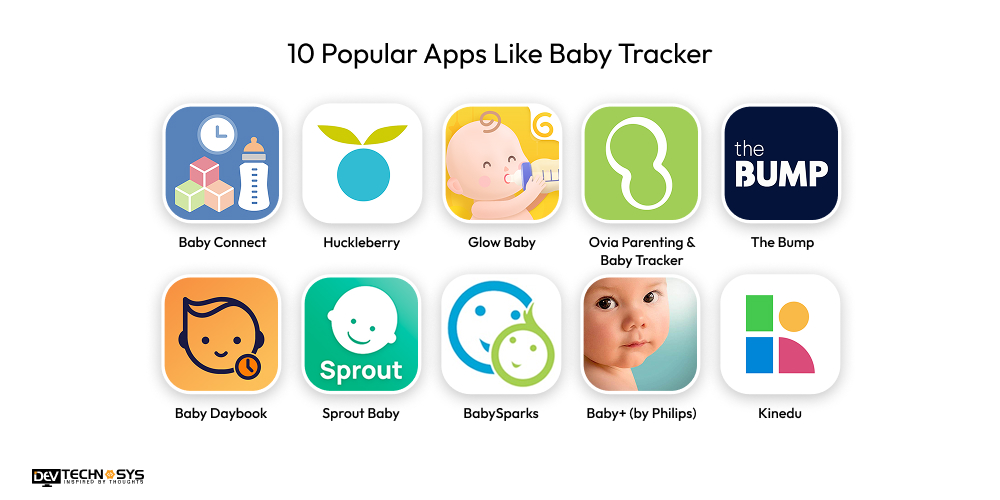
| App Name | Launch Year | Downloads (approx.) | Avg. Rating | Platforms |
| Baby Connect | 2009 | 100K+ | 4.7 | Android, iOS, Web |
| Huckleberry | 2017 | 1M+ | 4.8 | Android, iOS |
| Glow Baby | 2016 | 1M+ | 4.6 | Android, iOS |
| Ovia Parenting & Baby Tracker | 2013 | 1M+ | 4.7 | Android, iOS |
| The Bump | 2008 | 1M+ | 4.6 | Android, iOS |
| Baby Daybook | 2015 | 5M+ | 4.8 | Android, iOS |
| Sprout Baby | 2014 | 500K+ | 4.5 | Android, iOS |
| BabySparks | 2015 | 1M+ | 4.6 | Android, iOS |
| Baby+ (by Philips) | 2017 | 5M+ | 4.7 | Android, iOS |
| Kinedu: Baby Development Plan | 2013 | 5M+ | 4.6 | Android, iOS |
Why Businesses Invest in Baby Tracking App Development?
Investing in the baby tracking app development is a profit-generating opportunity for entrepreneurs because of higher demand, competitive advantage, and data-driven insights. SO, here we provide the various types of benefits:
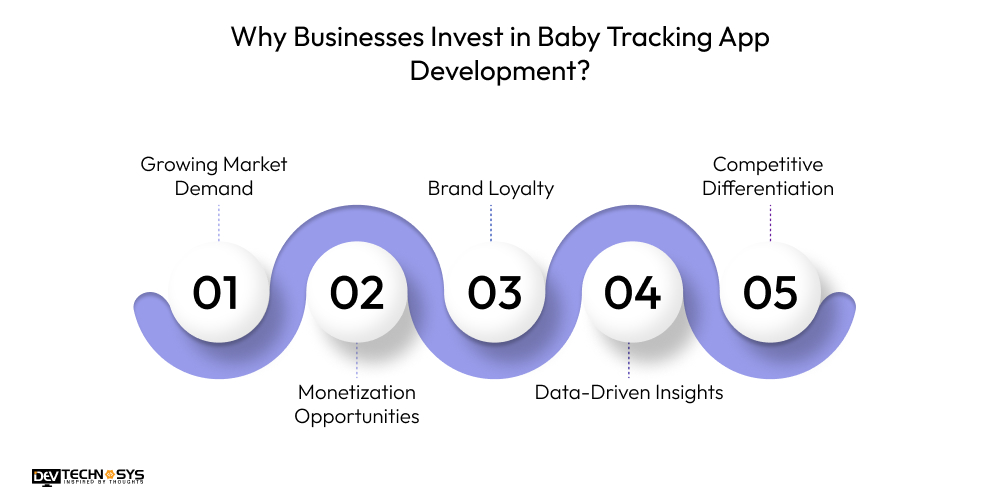
1. Growing Market Demand
Modern parents seek convenient, tech-driven parenting solutions. Baby tracking apps meet this demand by helping monitor sleep, feeding, and growth patterns. With increasing smartphone usage among parents, businesses invest in such apps to capture a rapidly expanding, loyal customer base in the childcare technology sector.
2. Monetization Opportunities
The best baby tracking app development solutions enable recurring revenue streams through premium features, in-app purchases, and personalized content. Businesses can monetize via data-driven insights, affiliate marketing with baby product brands, and subscription models, making these apps financially attractive while delivering real value to parents seeking customized childcare support.
3. Brand Loyalty
These baby tracking on demand app development solutions make long-term relationships with parents from pregnancy through early childhood. Frequent app interactions increase brand trust and retention. By providing continuous value and emotional support during parenting, businesses establish lasting engagement and open doors for cross-selling related products and services.
4. Data-Driven Insights
Baby tracking apps gather valuable health and behavioral data. Businesses use these insights to improve app functionality, personalize user experiences, and collaborate with healthcare providers. This data also fuels predictive analytics, enabling companies to develop smarter features that align with modern parenting needs and medical guidance.
5. Competitive Differentiation
In the booming health and wellness app market, baby tracking solutions offer a niche for innovation. According to the pregnancy app development company, businesses leverage AI, IoT, and wearable integration to stand out. Investing in such apps enhances brand image, showcases technological expertise, and positions companies as leaders in digital parenting solutions.
What are the Steps to Build an App Like Baby Tracker?
To create an app like Baby Tracker, you will need to observe development steps to understand each process in depth. From gathering requirements and market analysis to publishing and post-launch maintenance services. So, here we provide the step-by-step baby tracking mobile app development process:
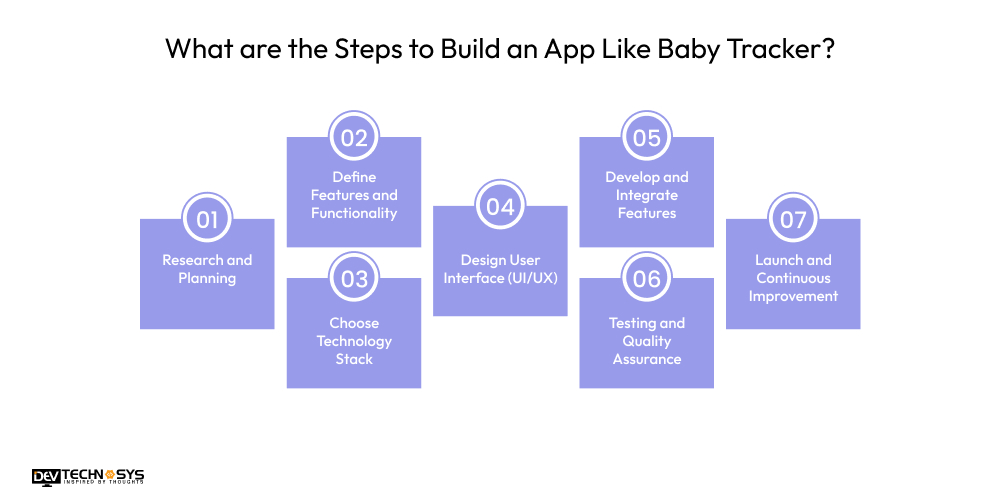
1. Research and Planning
Begin by studying existing baby tracker apps to understand user needs, key features, and pain points. Define your target audience, unique value proposition, and monetization model. Create a detailed project roadmap, including timeline, budget, and essential app goals to ensure the product aligns with parents’ real-life caregiving challenges.
2. Define Features and Functionality
List all core features such as feeding logs, diaper tracking, sleep monitoring, and growth charts. Include optional add-ons like reminders, reports, and multi-device syncing. Hire dedicated developers to prioritize features based on user value and technical feasibility. This step helps balance usability, innovation, and development complexity while keeping the app simple and intuitive.
3. Choose Technology Stack
Select suitable technologies for your app’s frontend, backend, and database. For example, use Flutter or React Native for cross-platform development, and Firebase or AWS for backend management. Consider scalability, data security, and offline functionality. Choosing the right stack ensures a stable, fast, and easily maintainable app experience for users.
4. Design User Interface (UI/UX)
Create a visually appealing, parent-friendly design with intuitive navigation and soft colors. Hire mobile app developers to use wireframes and prototypes to test layouts and improve usability. Focus on accessibility and readability, ensuring parents can log data quickly, even when multitasking. A seamless, comforting interface enhances user satisfaction and long-term app engagement.
5. Develop and Integrate Features
Start coding based on your chosen tech stack, integrating front-end and back-end functions. Implement features like timers, logs, analytics, and notifications. Test each module for accuracy and smooth performance. Ensure data synchronization and privacy standards. Proper development and integration form the foundation of a reliable, functional baby tracking app.
6. Testing and Quality Assurance
In this stage, to make an app like Baby Tracker, hire a professional mobile app development company to conduct extensive testing to identify and fix bugs. Use unit, integration, and user acceptance testing to ensure every feature performs correctly.
Simulate real-world scenarios like low connectivity or simultaneous users. Prioritize security, speed, and accuracy, as parents rely on precise, real-time data for tracking their baby’s well-being.
7. Launch and Continuous Improvement
Deploy the app on major app stores and gather user feedback through reviews and surveys. Monitor performance metrics, crash reports, and engagement trends. Regularly update features, fix issues, and adapt to user needs. Continuous improvement ensures your baby tracker remains trusted, relevant, and competitive in the parenting app market.
10 Best Features That Must Be Integrated in Baby Tracking Apps
Let’s explore the various types of features that can be integrated into baby tracking apps like Baby Tracker and increase user engagement. So, here is the list of features:
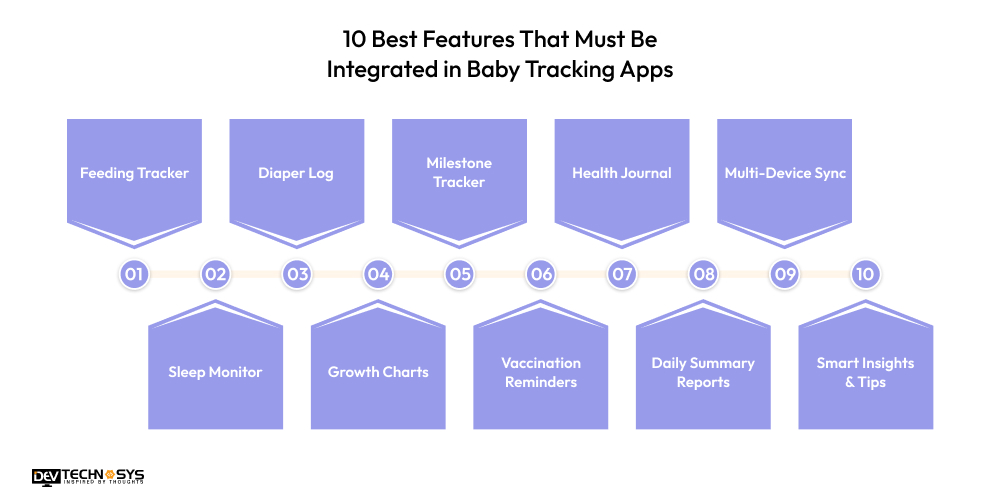
1. Feeding Tracker
Log breastfeeding, bottle feeding, and solids with time, quantity, and duration to monitor the baby’s nutrition effectively.
2. Sleep Monitor
A similar app like Baby Tracker records sleep patterns, nap durations, and bedtime routines to identify trends and improve the baby’s sleep schedule.
You can reach out anytime; we are available 24/7. Our team provides a quick response.

3. Diaper Log
Baby Tracker alternatives track wet and dirty diapers to monitor hydration, digestion, and detect potential health or dietary issues early.
4. Growth Charts
Automatically plot height, weight, and head circumference against WHO standards for easy growth comparison and tracking.
5. Milestone Tracker
Record and celebrate developmental milestones like crawling or first words, ensuring timely progress and pediatric reference.
6. Smart Insights & Tips
Hire healthcare app developers to use AI to analyze baby data and offer personalized parenting tips, routines, and health suggestions.
7. Vaccination Reminders
A similar app like Baby Tracker, sets alerts for upcoming immunizations with detailed schedules and record-keeping for completed vaccines.
8. Health Journal
Log doctor visits, medications, allergies, and symptoms for comprehensive baby health management.
9. Daily Summary Reports
Baby Tracker clone apps provide parents with easy-to-read daily summaries of feeding, sleep, and diaper activities.
10. Multi-Device Sync
Allow both parents and caregivers to update and access baby data in real time from multiple devices.
Choose the Best Baby Tracking App Between Baby Tracker vs Huckleberry vs The Bump
Let’s choose your perfect baby tracking app that can fulfill your requirements. Here we provide a comparison of various applications with their special features:
| Feature | Baby Tracker | Huckleberry | The Bump |
| Focus | Feeding, sleep, diaper logs | Sleep tracking & insights | Pregnancy + baby development |
| Ease of Use | Very simple & quick | User-friendly, modern | More content-heavy |
| Sleep Tools | Basic logs | Advanced AI sleep tips | Minimal |
| Sharing | Multi-caregiver sync | Multi-child profiles | Limited sharing |
| Content | Minimal | Moderate | Rich articles, guides |
| Cost | Mostly free | Free + premium plans | Free |
| Best For | Simple daily tracking | Sleep-focused parents | Pregnancy-to-baby journey |
What is the Cost to Build an App Like Baby Tracker?
The cost to develop an app like Baby Tracker is around $8,000 to $25,000. The overall development cost is mainly based on the crucial factors such as premium features, backend infrastructure, deployment platforms, third-party integrations, security measures, and development team.
It includes many additional factors such as maintenance, functions, project complexity, and size, among others. So, to clear the confusion, we provide the cost table with a detailed description:
| Category | Estimated Cost Range (USD) |
| UI/UX Design | $800 – $2,000 |
| App Development (Frontend) | $5,000 – $7,000 |
| Backend Development | $5,500 – $10,000 |
| Features & Integrations | $700 – $2,000 |
| Testing & QA | $600 – $1,500 |
| Deployment & Launch | $400 – $1,000 |
| Maintenance (Post-Launch) | $1,000 – $4,000 |
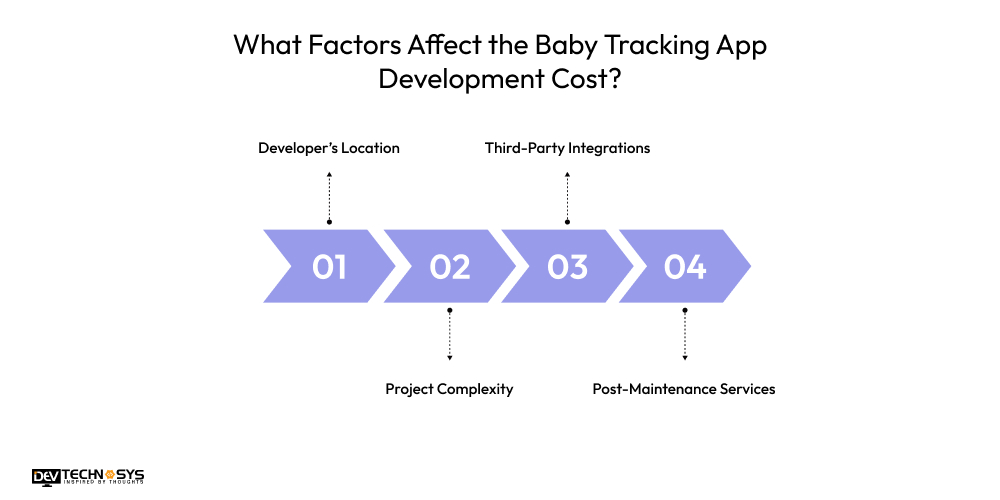
What Factors Affect the Baby Tracking App Development Cost?
To make an app like Baby Tracker within a fixed budget, you need to first figure out the crucial factors that can affect the overall cost. It includes backend infrastructure, development team, platform choice, and design UI/UX. So, let’s take a look at the factors below:
1. Developer’s Location
The development team location is one of the most common cost-affecting factors that can highly impact overall cost. If businesses hire developers from the USA and the UK, it can be highly expensive due to higher living costs. This can directly fluctuate the final baby tracker app development cost.
| Location | Cost Range | Affecting Cost Explanation |
| North America | $18,000 – $25,000 | High hourly rates due to living costs and market demand |
| Eastern Europe | $12,000 – $18,000 | Skilled developers at moderate rates reduce cost |
| Asia (India, Vietnam) | $8,000 – $14,000 | Lower rates, can save significantly on overall cost |
2. Project Complexity
There are various types of baby tracking applications with different functionalities; some of the advanced features of apps are highly expensive. It includes basic, mid-premium, and highly complex applications. So, businesses need to choose an application as per their project requirements; otherwise, it can raise the cost to build an app like Baby Tracker.
| Complexity Level | Cost Range | Affecting Cost Explanation |
| Basic | $8,500 – $11,000 | Simple baby tracker with limited features |
| Medium | $11,500 – $17,000 | Adds reminders, health logs, and basic analytics |
| Advanced | $17,500 – $25,000 | AI suggestions, detailed analytics, multi-platform support |

3. Third-Party Integrations
Integrating third-party tools and applications is required to increase the app’s flexibility and accessibility. It includes various integrations such as payment gateways, analytics, communication tools, social media logins, and more. But some of them have higher licensing fees and take more time to integrate. So, this can significantly affect the final baby tracking mobile app development cost.
| Integration Type | Cost Range | Affecting Cost Explanation |
| Basic APIs | $8,000 – $10,500 | Minimal integrations like weather or simple notifications |
| Medium | $10,500 – $16,000 | Payment gateways, fitness tracker integration, or calendars |
| Advanced | $16,500 – $22,000 | IoT devices, cloud sync, EHR/medical integrations |
4. Post-Maintenance Services
Post-maintenance and support services are conducted to maintain every process and keep the app up-to-date. It involves regular backups, design enhancements, upgrading OS versions, fixing bugs or glitches, and solving security issues. These maintenance services can influence the initial baby tracker app development cost.
| Service Type | Cost Range | Affecting Cost Explanation |
| Minimal | $8,000 – $10,000 | Bug fixes only, no major updates |
| Standard | $10,500 – $16,000 | Regular updates, minor feature improvements, and server monitoring |
| Premium | $17,000 – $24,000 | Continuous upgrades, performance optimization, and full support |
Key Tools, Frameworks, and Industries Involved in Building a Best Baby Tracker App
Here, we provide a detailed explanation of how baby tracking apps are helpful for which industry and what tools and frameworks are used when developing:
| Category | Entities / Examples | Description |
| AI Tools | TensorFlow, Core ML, ChatGPT API | Smart insights, reminders, predictions |
| Frameworks | Flutter, React Native, Swift, Kotlin | App development platforms |
| Backend & Database | Firebase, AWS, MongoDB | Data storage and user management |
| Analytics | Google Analytics, Mixpanel | User tracking and performance |
| Design Tools | Figma, Adobe XD | UI/UX design and prototyping |
| Cloud Services | AWS, Google Cloud | Hosting and scalability |
| Industries | HealthTech, Parenting, Wellness | Core sectors for baby tracking apps |
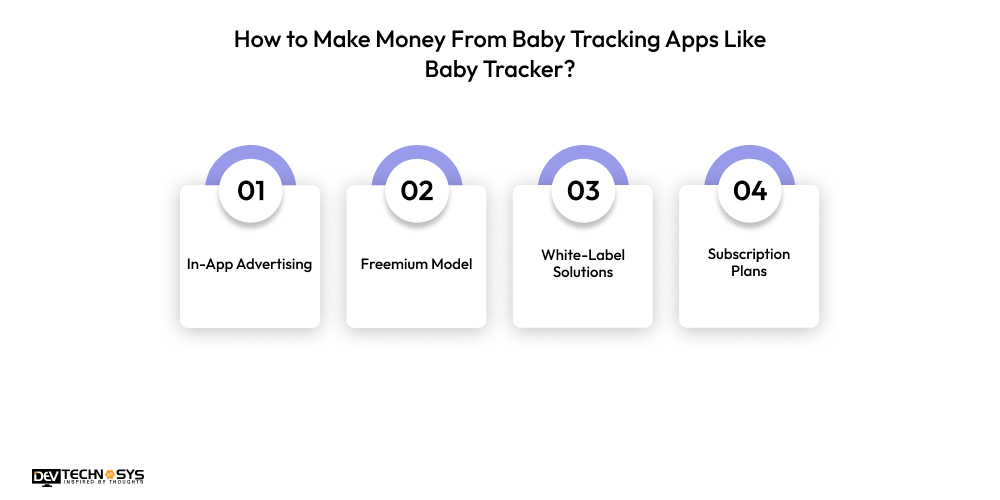
How to Make Money From Baby Tracking Apps Like Baby Tracker?
When businesses create a pregnancy tracking app with advanced features, they have expectations to gain higher success rates and generate revenue streams. For that, here we provide the excellent monetization techniques that help businesses make money from baby tracking apps:
1. In-App Advertising
In the first money-making technique, a pregnancy monitoring app like Ovia allows third-party organizations to show their services and products in the app as an advertisement. Include various types of ad formats such as banner ads, pop-up window ads, display ads, and native ads. Charge an advertising fee of around 5% to 8% on each user click.
2. Freemium Model
Offer a free version of the app with limited or basic functionality, and on the other side, offer a premium version of the app with premium features, but it’s paid. So, users pay for premium services and features, this can easily generate higher revenue streams and increase the overall business valuation.
3. White-Label Solutions
Businesses can license their baby tracker clone app and sell to daycare centers, hospitals, and more. Charge an annual licensing fee or revenue shares. It can be a steady income source and generate higher revenue as compared to other monetization techniques.
4. Subscription Plans
The mental health app development solutions offer various subscription plans like basic, premium, and enterprise. Users need to purchase them on a yearly and a monthly basis to access the full potential of the app. These subscription plans can increase the overall valuation and are one of the simplest monetization models.
Conclusion
To build a baby tracking app like Baby Tracker, start by defining key features such as feeding logs, sleep tracking, and growth monitoring. Choose reliable frameworks, a strong backend, and simple UI/UX design. Work with a trusted baby-tracking app development company to ensure smooth performance, data security, and scalability.
With the right tools, design, and development team, you can successfully create an app like Baby Tracker that helps parents easily monitor and manage their baby’s daily activities.
Frequently Asked Questions
1. How AI Can Personalize Insights in a Baby Tracking App For Parents?
AI can personalize insights in a baby tracking app by analyzing activity patterns, predicting needs, suggesting routines, and offering tailored tips to help parents understand and support their baby’s growth better.
2. How to Integrate Health APIs and Sensors in a Baby Monitoring App?
Integrate health APIs and sensors by connecting wearable devices, using platform SDKs, syncing real-time data, and processing metrics like heart rate, sleep, and activity to provide accurate baby monitoring insights.
3. What is the Difference Between The Baby Tracker App Features With Other Parenting Apps, And Suggest Improvements?
Baby milestone tracker apps focus on detailed logging of feeding, sleep, and growth, while other parenting apps offer broader advice or community features. Improvements could include AI-driven insights, smart reminders, and seamless wearable integration.
4. How Much Does it Cost to Build an App Like Baby Tracker?
The cost to develop an app like Baby Tracker lies between $8,000 and $25,000. It can fluctuate due to several factors such as project complexity, functions, backend infrastructure, platforms, third-party integrations, tech stacks, and more.
5. How Long Does it Take to Create an App Like Baby Tracker?
To create an app like Baby Tracker, it mainly takes around 3 to 6 months. The development time normally depends on several factors like developers’ working hours, number of features, app complexity, and more.