














Key takeaways:
-
- Creator economy platform development should follow a clear sequence: niche and user journeys first, then architecture, MVP, and monetization, to avoid costly rebuilds later.
- The creator economy market is projected to grow from $310.4 billion in 2026 to $1,345.5 billion by 2033, making now the right time to build a creator economy platform.
- Building a creator economy platform costs between $30,000 for an MVP and $120,000+ for a full-featured custom platform.
- Choosing between custom development, white-label, or an MVP-first approach shapes your cost, timeline, and long-term scalability.
The creator economy is no longer a side-hustle industry. It is fast becoming a core investment category. According to Grand View Research, there are currently over 207 million active content creators globally who are already creating and monetizing content. For investors and founders, it is that combination of scale and momentum that makes the field worth backing. The key dilemma is how to build a creative economy platform that harnesses this growth instead of letting it go to established companies.
This transition is happening due to creators leaving the platforms that are taking large cuts, burying content under unpredictable algorithms, or skipping direct payouts. A well-built digital creator platform handles all three at once, giving creators one place to publish, grow a paying audience, and manage subscriptions or digital product income.
For startup owners, this is a real opportunity. This guide covers exactly what it takes to develop a creator economy platform, from niche idea selection to tech stack, monetization, security, and budget.
What is a Creator Economy Platform?
A creator economy platform is a digital ecosystem that allows creators to post content, grow an audience, and get compensated directly for their work without relying only on third-party social apps. It replaces five disparate tools with one integrated system that puts the fundamental things producers need in one place.
- Content hosting and distribution: So that creators can publish videos, posts, courses, or audio in one place instead of scattering them across platforms.
- Audience management: To give creators direct access to subscriber and fan data instead of relying on an algorithm to reach them.
- Monetization tools: This includes subscriptions, tips, digital products, and paid memberships, which are built directly into the platform.
- Payment infrastructure: Handle payouts, currency conversion, and compliance so creators get paid reliably.
- Analytics and engagement features: Help creators understand what is working and grow their business with data, not guesswork.
This is the foundation every founder needs to understand before they start to build a creator economy platform, since each of these pieces becomes a real technical and product decision later in the build process.
Industry Insight
According to Visa’s 2025 Creator Report, 68% of creators consider themselves small business owners, highlighting the shift from content creation to entrepreneurship.
Creator Economy Market Size and Growth in 2026 and Beyond
According to Grand View Research, the data points below explain exactly why now is the right time to develop a creator economy platform and where the biggest opportunities sit within the market.
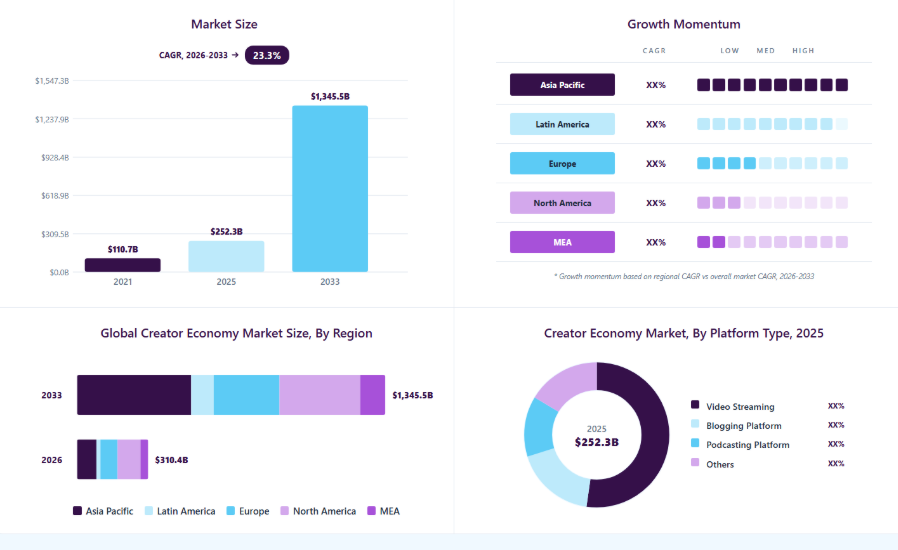
- The content creator market is expected to grow from $310.4 billion in 2026 to $1,345.5 billion by 2033, at a CAGR of 23.3%.
- Video streaming led the market with the largest revenue share of 52.2% in 2025, showing where user attention and monetization intent already concentrate.
- Advertising held the largest revenue share at 36% in 2025, while subscriptions are expected to grow at the fastest CAGR going forward, signaling a shift toward owned, recurring creator revenue.
- Individual content creators accounted for 57.2% of the market in 2025, making solo creators the largest and fastest-moving segment to design a creator economy platform around.
Types of Creator Economy Platforms You Can Build in 2026
Not every content creator economy platform is built in the same way, and getting the model right early means avoiding costly pivots down the road. These are the models that will help you understand and, ultimately, build a functional creator management platform. To gain a better perspective on how individual tools stack up, our best content creation platforms list details the best of the best that creators are using now.
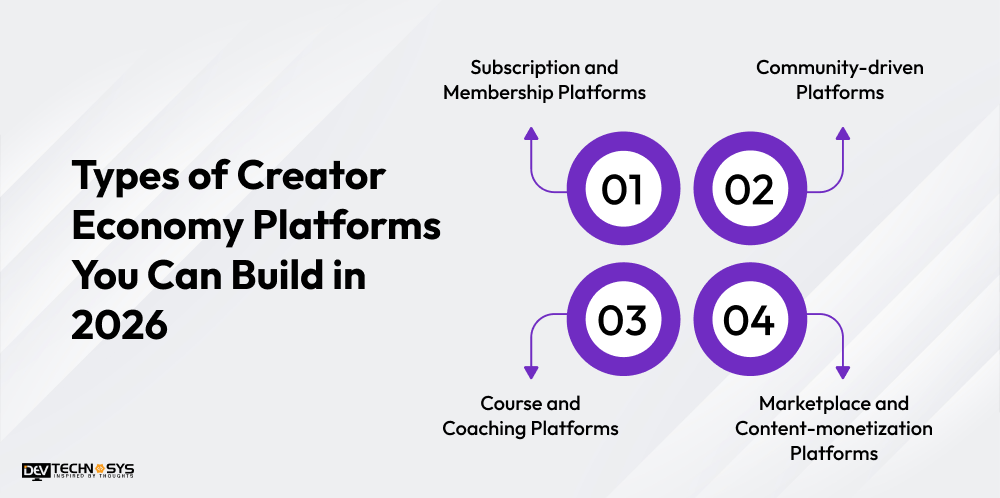
1. Subscription and Membership Platforms
These platforms let creators charge recurring fees for exclusive content, private communities, or early access, giving them predictable, owned revenue instead of relying on ad payouts alone.
2. Community-driven Platforms
Focused on paid access to groups, forums, or chat spaces where engagement itself is the product. The community app development solution covers how these platforms are typically architected and how they work.
3. Course and Coaching Platforms
Built for educators and coaches who want to package expertise into paid courses, cohorts, or one-on-one coaching sessions, with structured content delivery and progress tracking.
4. Marketplace and Content-monetization Platforms
Connect creators directly with buyers for digital products, templates, presets, or licensed assets, often supported by ownership and royalty mechanics. Our NFT marketplace development page covers this model in more depth.
How to Build a Creator Economy Platform: Step-by-Step Process
Deciding to develop a creator economy platform is not one big leap; it is a sequence of decisions that compound. Skipping steps or building features in the wrong order is usually why creator economy platform development stalls after launch. Here is the process that works, from idea to a live, monetizing platform.
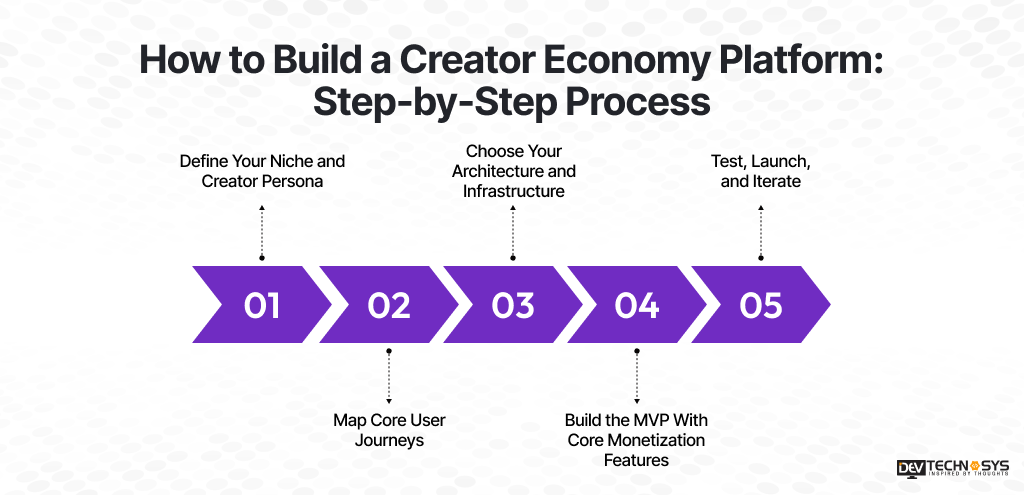
1. Define Your Niche and Creator Persona
Generic “creators welcome” platforms can’t compete with YouTube or Patreon on scale. Narrower platforms succeed by tackling one group’s specific need, whether that’s fitness coaches, streamers, musicians, or online educators. Figure out who your platform is for before you write a single feature list; every subsequent decision, from payment processes to content formats, hangs on this.
2. Map Core User Journeys (Creator Side and Fan Side)
Every platform in the creator business platform has two users, not one. Here’s how a creator signs up, sets up monetization, and distributes content, and how a fan discovers, subscribes, and pays. Founders who build just for creators have awkward fan experiences that harm retention and income.
3. Choose Your Architecture and Infrastructure
Determine early if the platform is mobile-first, web-first, or both, and if content is mainly video, text, audio, or a combination. This decision is what drives your whole architecture, especially if video is a key part of the experience. Platforms largely dependent on video streaming require dedicated infrastructure for encoding, adaptive bitrate distribution, and storage at scale, which a video streaming app development company covers in more detail if that is your primary content format.
4. Build the MVP With Core Monetization Features
Don’t try to construct everything at once. To get a working MVP, you require content publication, one monetization strategy (subscriptions or tips are generally quickest to install), a basic creator dashboard, and secure payments. This is where most creator economy app development decisions either put a platform up for scale or lock in technological debt early on. Everything else, from analytics, numerous payment options, to sophisticated content gating, may be put in after launch. An MVP app development company breaks down everything, including how to scope this stage without overbuilding.
5. Test, Launch, and Iterate
Launch to a limited group of true makers, and only open up broadly afterward, such as a beta program. Their input on payout speed, friction in uploading content, and dashboard usability will uncover flaws that no internal testing ever finds. Treat the first months after launch as an extension of the build process and not a finished product,t and keep iterating based on what artists and fans are actually using.
Founders who regularly follow this process end up with a more solid content creator management platform than those who attempt to implement every feature before ever launching. This is what makes a true creative monetization platform vs a feature list that no one uses.
Must-have Features of a Creator Economy Platform in 2026-2027
There is a core set of features that every successful platform has, and the reason founders find themselves rebuilding months after launch is that they skipped one or more of them. If you want to make a creative economy platform that really keeps creators, these are non-negotiable.
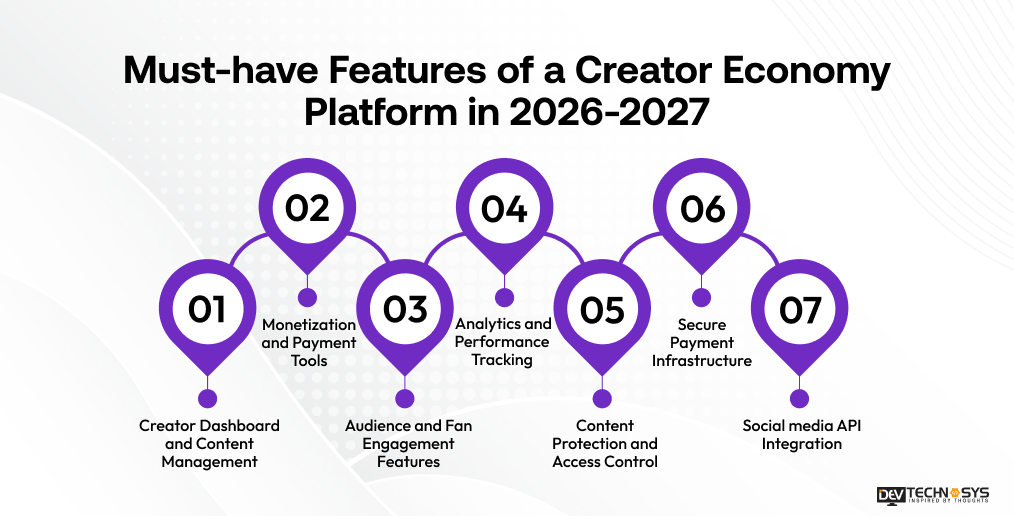
1. Creator Dashboard and Content Management
Recommendation engines pair fans with creators they’re likely to support, rather than waiting for creators to establish an audience from nothing. AI creator economics matching algorithms look at viewing and spending behaviors to fuel AI in social media and surface intelligent creator matching in real time. A powerful recommendation engine for creators significantly reduces the time it takes new creators to get their first paying audience.
2. Monetization and Payment Tools
Support for subscriptions, tips, pay-per-view, and digital product sales, backed by reliable payout infrastructure. These creator economy platform features are what separate a real business tool from a glorified content feed.
3. Audience and Fan Engagement Features
Comments, direct messaging, community spaces, and notification systems that help creators build relationships with fans, not just broadcast to them. Platforms that skip this often see fans churn faster than creators can replace them.
4. Analytics and Performance Tracking
Creators need visibility into what content performs, where revenue comes from, and how their audience is growing. Without this, they cannot make informed decisions, and neither can the platform’s growth team.

5. Content Protection and Access Control
Paywalls, DRM, and download restrictions that keep paid content from being redistributed for free. This becomes especially critical if you create a creator economy platform centered on premium video or exclusive downloads, where leaked content directly cuts into creator revenue.
6. Secure Payment Infrastructure
Reliable payouts, multi-currency compatibility, and fraud protection are must-haves, as creators won’t stick around on a platform where payments are delayed or ambiguous. As the creator base expands, strong payment gateway integration is critical for large-scale platforms that process recurring and one-off payments to make sure payments are accurate and on schedule.
7. Social media API Integration
Not many creators remain on a single platform, and allowing them to cross-post, import audiences, or sync material from existing social accounts minimizes friction at enrollment. Creators can bring their existing followers along instead of beginning from scratch with a well-prepared social media app for business startup.
Industry Insight
According to IAB’s 2025 Creator Economy Ad Spend & Strategy Report, U.S. creator ad spending is projected to reach $37 billion in 2025, up 26% year over year.
Recommended Tech Stack to Build a Creator Economy Platform
Choosing the right tech stack early prevents costly rewrites later, especially once you’re handling video, payments, and real-time data at scale. For platforms exploring token-based rewards or ownership models, this is also where blockchain app development decisions need to be made upfront rather than retrofitted after launch. Here’s a breakdown of the stack layers that matter most.
Layer |
Recommended technologies |
Why it matters |
| Frontend (web) | React.js, Next.js, Vue.js | Fast rendering, SEO-friendly SSR, and component reusability for creator dashboards and storefronts |
| Mobile | React Native, Flutter | Single codebase for iOS and Android, faster time-to-market for creator and fan apps |
| Backend | Node.js, Python (Django/FastAPI) | Handles high-concurrency requests, real-time features, and scales well with microservices |
| Database | PostgreSQL, MongoDB, Redis | Relational data for transactions, flexible schemas for content, caching for fast reads |
| API layer | REST, GraphQL | GraphQL reduces over-fetching for complex creator dashboards with nested data |
| Payments | Stripe Connect, PayPal, MassPay | Multi-party payouts, multi-currency support, and built-in compliance tooling |
| Cloud & infrastructure | AWS, Google Cloud, Cloudflare CDN | Scalable storage and delivery for video-heavy platforms, especially during traffic spikes |
| Web3 / blockchain (optional) | Ethereum, Polygon, smart contracts | Enables tokenized rewards, verifiable content ownership, and creator royalty mechanisms |
Many platforms do not require Web3 creator economy functionalities and SaaS creator platform immediately; nevertheless, if tokenized ownership, NFT-centric content, or on-chain royalty distributions are included in the future plans, designing the architecture accordingly from the outset prevents an expensive transition later.
The right combination depends on your platform’s core content format and expected scale, but this stack covers what’s needed for a production-ready, secure, and scalable build.
Monetization Models for a Creator Economy Platform
A creator ecosystem is only as valuable as the ways it lets creators earn, so supporting multiple revenue streams from launch gives creators reasons to stay instead of testing competitors.
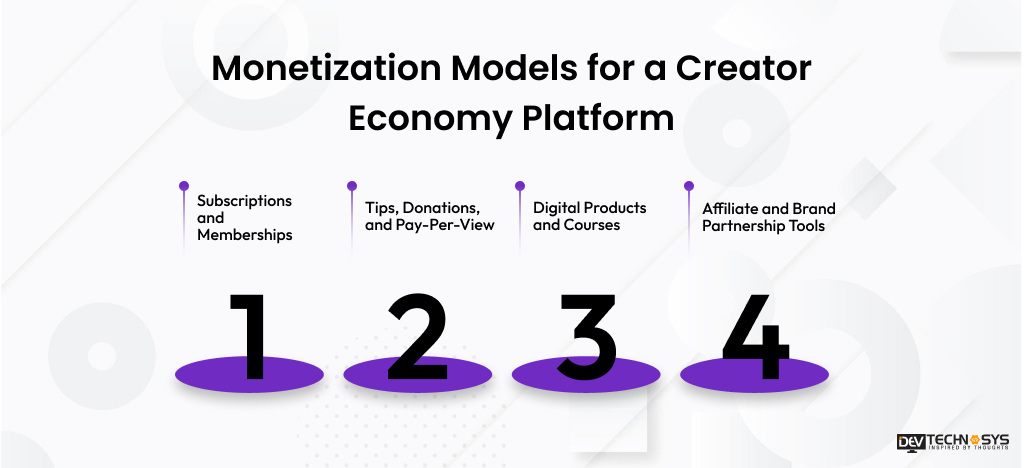
1. Subscriptions and Memberships
Recurring access to premium content or community areas provides creators with reliable, proprietary revenue rather than sporadic payments. This often represents the primary monetization tier that any reputable creative monetization platform must effectively facilitate.
2. Tips, Donations, and Pay-Per-View
Methods with minimal resistance for fans to assist creators directly, including one-off gratuities, live-stream contributions, or payments to access exclusive content. These are most effective when used in conjunction with subscriptions, rather than serving as a substitute.
3. Digital Products and Courses
Templates, presets, booklets, and organized courses enable artists to transform their expertise into a sustainable cash stream without the necessity for continuous fresh content. This is frequently where the advancement of content creator platforms yields the greatest returns, as digital things possess substantial profit margins with minimal continuous effort.
4. Affiliate and Brand Partnership Tools
Built-in tracking for affiliate links and sponsored content helps creators monetize brand relationships directly on the platform, instead of managing deals through spreadsheets and DMs.
What is the Cost to Build a Creator Economy Platform?
The cost to build a creator economy platform typically ranges from $30,000 for a basic MVP to $120,000 or more for a full-featured, scalable platform with custom development.
Creator economy platform development cost depends on several factors:
- Number of monetization models supported.
- Whether you’re building native mobile apps alongside web.
- Video infrastructure requirements.
- Third-party integrations like payment gateways and social APIs.
- Complexity of admin and analytics dashboards.
Platform scope |
Estimated cost |
Key features included |
| MVP (core features only) | $30,000 – $50,000 | Content publishing, one payment method, basic creator dashboard, user authentication |
| Mid-scale platform | $50,000 – $85,000 | Multiple monetization models, analytics dashboard, mobile app, membership tiers |
| Full-featured, custom platform | $85,000 – $120,000 | AI-powered recommendations, multi-currency payments, advanced content protection, social API integrations |
Security and Compliance for Content Creator Platforms
Trust is the cornerstone of every creator monetization platform, and vulnerabilities are among the quickest means to erode it. Both creators and fans require assurance that their data, content, and financial transactions are secure prior to engaging with a new platform.
- Data protection: Follow GDPR and CCPA standards from day one, covering how creator and fan data is collected, stored, and shared, not added as an afterthought post-launch.
- Payment compliance: PCI DSS adherence across every transaction flow, whether it’s a subscription charge, a tip, or a payout, since even one mishandled payment can trigger regulatory exposure.
- Content moderation: Automated filtering combined with human review keeps the platform safe for both creators and brands considering partnerships and reduces the risk of harmful or non-compliant content spreading unchecked.
- DRM and watermarking: Ensure the protection of paid material against redistribution, especially on platforms focused on premium video or exclusive downloads. These techniques are in close proximity to the topics we address in OTT App Security Solutions, specifically with content protection for video-oriented platforms.
Custom Development vs White-label vs MVP: Which One Should You Choose?
After determining which content creation platform to build, the subsequent choice pertains to the method of construction. Every method entails genuine compromises regarding expense, velocity, and enduring adaptability, and the optimal selection hinges on the urgency of idea validation versus the degree of control required over the platform in the long run.
Factor |
Custom development |
White-label solutions |
MVP-first development |
| Cost range | $50,000 – $120,000+ | $8,000 – $40,000 | $30,000 – $50,000 |
| Timeline | 3–10 months | 4–8 weeks | 3–4 months |
| Monetization flexibility | Any model, including custom revenue splits and niche payment flows | Limited to the models the provider already supports | Focused on one or two core monetization methods to start |
| Creator branding | Fully white-labeled to your brand, no third-party trace | Often carries provider branding or shared infrastructure | Your brand from day one, minimal but distinct |
| AI and advanced features | Custom recommendation engines, DRM, and analytics built to spec | Pre-set feature bundles, little room for custom AI matching | Core features only, AI and advanced tooling added post-validation |
| Data ownership | Full ownership of creator and fan data | Data often sits partly with the provider’s shared systems | Full ownership from the start, even at a smaller scale |
| Best for | Platforms with a validated niche and specific monetization needs | Founders testing demand fast with a limited budget | Founders validating the model before a full custom build |
Industry Insight
According to Adobe’s 2026 Creators’ Toolkit Report, 75% of creators describe creative AI as “integrated or essential” to their workflow.
Common Mistakes to Avoid When Building a Creator Economy Platform
Even well-funded platforms fail when they overlook the basics. These are the mistakes that show up most often.
- Niche neglect: Trying to serve every type of creator instead of solving one group’s specific problem leads to a platform that feels generic and struggles to stand out.
- Weak payment infrastructure: Delayed payouts, limited currency support, or unreliable payment processing are among the fastest ways to lose creator trust early on.
- No compliance planning: Treating data protection and payment compliance as an afterthought instead of building them into the architecture from day one creates legal and operational risk later.
- Algorithm-dependent design: Building a platform that still relies on unpredictable discovery algorithms defeats the purpose of giving creators ownership over their audience.
- Skipping analytics: Launching without performance dashboards leaves creators guessing what’s working, which pushes them back toward platforms that already give them that visibility.
Conclusion
The creative economy continues to thrive, as does the need for platforms that provide creators genuine control over their earnings. Reaching that point necessitates the appropriate niche, a concentrated MVP, robust payment and compliance frameworks, and a development strategy that aligns with your financial constraints and schedule, whether it be bespoke, white-label, or a hybrid of both.
If you’re ready to move from planning to execution, working with a team experienced across streaming, payments, and creator-focused platforms, similar to what goes into a social media app development company build, can shorten that path considerably and help you avoid the costly mistakes covered above.
Frequently Asked Questions
Find answers to the most common questions related to this article.
Costs typically range from $30,000 for a basic MVP to $120,000 or more for a full-featured, custom-built platform. The final creator economy platform development cost depends on features, mobile app requirements, payment integrations, and whether you choose custom development or a white-label solution.
Timelines vary by approach. An MVP can launch in 3–4 months, a mid-scale platform in 5–7 months, and a full-featured custom build in 7–10 months. The timeline depends on what type of content creator platform you want to build, the range of features, and many more.
Most platforms use React or Next.js for web, React Native or Flutter for mobile, and Node.js or Python for the backend. Video-heavy platforms also need cloud storage and CDN infrastructure, while platforms exploring tokenized ownership may add blockchain components.
Strong platforms support multiple models: subscriptions and memberships, tips and pay-per-view, digital product sales, and affiliate or brand partnership tools. Supporting at least three of these gives creators flexible, layered income instead of relying on a single revenue source.
Yes, the market is projected to grow significantly through 2033, and most creators still lack platforms built specifically for their monetization needs. Platforms solving a focused niche problem, rather than competing broadly with YouTube or Patreon, have the strongest profitability potential.