










Key takeaways:
-
- OTT platforms lose billions annually to piracy, credential attacks, and payment fraud, making security a revenue issue, not just a technical one.
- Multi-DRM protection, encryption, and API security form the core defense layer against most content and data risks.
- Real breaches at Disney+, Netflix, and HBO Max prove these risks are active threats, not hypothetical scenarios.
- GDPR and COPPA compliance isn’t optional; it’s now a baseline requirement tied directly to platform security.
- Building security into the architecture from day one is far cheaper than fixing it after a breach.
OTT streaming industry is projected to generate over $210 billion globally by the end of 2026. And this scale has made it one of the most heavily targeted sectors in digital entertainment. According to VdoCipherPR, streaming piracy standalones will cost $113 billion in losses by 2027 to U.S. video providers.
Newswire predicted that individual platforms can lose up to 25% of annual revenue to illegal redistribution and unauthorized access. Beyond these, OTT platforms also suffer from credential stuffing, API abuse, payment fraud, and failures to meet compliance standards that threaten user confidence and business continuity.
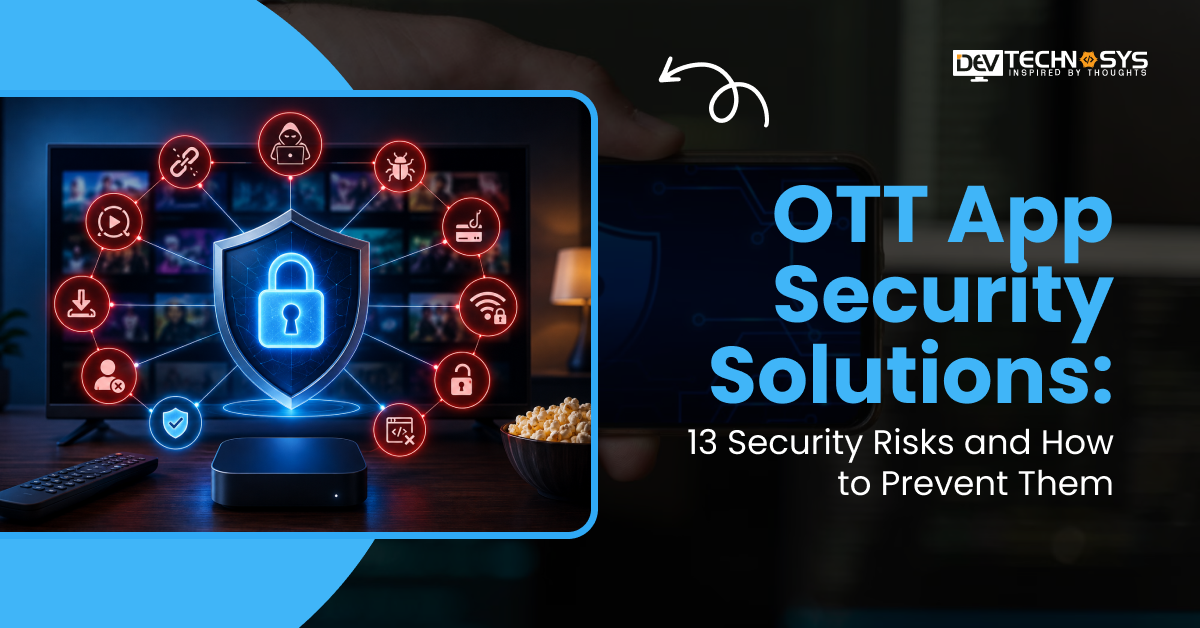
For OTT platform owners and developers, the risks are no longer a choice. In this guide, we will discuss the 13 most important OTT app security risks facing streaming platforms today and provide practical, actionable OTT app security solutions to prevent them all. This way, you can protect your platform, your users, and your revenue before an attack puts you on the back foot instead of the front foot.
What is OTT App Security?
OTT app security refers to the practices, technologies, and protocols used to safeguard over-the-top streaming applications, their content, and their users from unauthorized access, data theft, piracy, and cyber assaults.
It covers everything from how video content is encrypted and delivered to users to how payment information and personal data are stored and transmitted.
OTT security has two primary goals, unlike typical app security: protection of the platform’s infrastructure (APIs, servers, user accounts) and protection of the content itself (DRM, watermarking, encrypted video streaming protocols such as HLS and DASH). A robust OTT app security strategy should cover both tiers.
A vulnerability in either can lead to piracy, data breaches, or regulatory penalties.
Below are the 13 OTT app security risks and solutions after deep analysis and research:
1. Content Piracy and Illegal Redistribution
Content piracy is the illegal downloading, re-streaming, or redistribution of copyrighted OTT material via illegal platforms, mirror sites, or IPTV providers. According to World Metrics, pirated video content continues to be the biggest danger to streaming services, with more than 230 billion views a year, and more than 80% of that traffic is coming from unlawful streaming services rather than downloads.
World Indicators Piracy doesn’t just lead to lost revenue; it also ruins licensing relationships with content owners and exclusive partnerships that platforms spend a lot of money on. The fix begins with treating content protection as infrastructure, not an afterthought:
- Implement multi-DRM encryption across all devices and platforms.
- Embed forensic watermarking so leaked content can be traced to its source.
- Use automated piracy-monitoring tools to detect and issue takedowns for unauthorized redistribution in near real time.
2. DRM Circumvention And Bypass
Digital Rights Management (DRM) circumvention is when attackers remove, circumvent, or exploit holes in content protection systems to get access to and redistribute premium video without authorization.
DRM is relied upon by most OTT platforms to control how video streaming apps work and playback, and bypassing the DRM layer effectively disables the primary content protection of the platform.
This typically involves enforcing a multi-DRM license policy, so playback only proceeds when a valid, device-specific license is issued:
“
license_policy:
drm_systems: [widevine, fairplay, playready]
security_level: L1 # hardware-backed decryption only
license_duration: 24h
offline_playback: false
hdcp_required: true # blocks output to unauthorized displays
“
Best OTT app security solutions for DRM circumvention:
- Deploy multi-DRM protection (Widevine for Android/Chrome, FairPlay for iOS/Safari, PlayReady for Windows/Xbox) rather than relying on a single system.
- Enforce hardware-backed decryption (L1/L3 security levels) so content never fully decrypts in unprotected software.
- Requires HDCP (High-bandwidth Digital Content Protection) to block output to unauthorized recording devices.
Industry Insight
According to Vodlix’s 2026 OTT security playbook, DRM should be treated as one lock on a much larger building, since it controls playback authorization but doesn’t address every security layer a platform needs.
3. Credential Stuffing and Account Takeover
Credential stuffing happens when attackers try to log in to OTT accounts using lists of usernames and passwords acquired from other data breaches in the hope that users have reused the same credentials elsewhere.
A 2024 Kaspersky report for Gulf News found that more than 7 million streaming accounts on major platforms were compromised, mostly through phishing and credential theft, underscoring how much of this risk is a result of user behavior and not only backend vulnerabilities.
Once inside, attackers can hijack user accounts, resell access on dark web marketplaces, or utilize stored payment details for fraud. Mitigation for credential stuffing starts with enforcing multi-factor authentication (MFA) on all accounts. Adding rate limiting and CAPTCHA on login attempts to slow automated attacks.
Monitoring for unusual login patterns like impossible-travel logins or rapid failed-attempt spikes.
4. Insecure APIs, Backend and Infrastructure Vulnerabilities
There are dozens of APIs for OTT platforms that deal with authentication, billing, delivering content, and recommendations. Each API is a possible entry point if it is not secured properly. Misconfigured APIs can leak user data, enable unauthorized access to back-end systems, or be exploited to overload infrastructure with DDoS attacks.
The risk is compounded by cloud misconfiguration, particularly as platforms span numerous regions and CDNs.
A basic rate-limiting and authentication check at the API gateway level looks like this:
“
api_gateway_rule:
auth_required: true
token_type: oauth2_bearer
rate_limit: 100_requests/min/user
token_expiry: 15min
on_limit_exceeded: block_and_log
“
Best OTT app security risks mitigation on APIs:
- Enforce OAuth 2.0 API security with short-lived, auto-expiring tokens rather than static API keys.
- Apply rate limiting at the API gateway to prevent abuse and slow DDoS attempts.
- Run regular cloud misconfiguration audits, since exposed storage buckets and open ports are among the most common infrastructure gaps.
- Use AI-based threat detection to flag abnormal API traffic patterns in real time.
5. Password and Subscription Sharing
Password and subscription sharing between unauthorized users lets numerous people outside a home share a single paid account and quietly eats away at subscription revenues without ever launching a typical “attack.” It’s not as dramatic as a breach, but the financial toll piles up fast at scale, which is why big OTT platforms like Netflix have been cracking down more and more in recent years.
The answer isn’t about preventing sharing entirely, because some of it is genuine multi-device household use, but about finding patterns that are clearly outside of that.
- Platforms can place restrictions on how many streams can be viewed on one account at a time.
- They can detect logins from an unusually large number of different IP addresses or locations in a short period of time.
- They can require household verification measures such as periodic re-authentication of devices or one-time codes that are sent to a primary device.
6. Payment and Billing Fraud
Payment and billing fraud is an attack on the transaction layer of OTT platforms, from stolen card details used for fraudulent sign-ups to chargeback abuse and phony subscription renewals. In addition to the streaming app development cost, platforms already spend on payment infrastructure. As the platforms are handling recurring billing at scale, even a minor fraud rate equates to considerable losses. A robust OTT app security solution at the payment layer protects both income and compliance standing.
Best OTT security practices:
- Maintain PCI DSS-compliant streaming payment processing rather than storing card data directly on platform servers.
- Use tokenization so raw payment details never touch the application backend
- Flag and auto-review transactions with mismatched billing geography, rapid retry attempts, or unusual card velocity.
- Require step-up verification (biometric authentication or 2FA) for high-risk transactions like plan upgrades or payment method changes.
7. Weak Encryption in Transit and Storage
Attackers can intercept or extract that data with relatively little effort when video streams, user data, or payment information travel or sit unencrypted, or use outdated encryption standards. This impacts both content protection and user privacy, as inadequate encryption completely negates DRM, no matter how strong the license policy is on paper.
A minimal transport-layer config should enforce modern protocols only:
“
tls_config:
min_version: TLS1.3
cipher_suites: [AES_256_GCM, CHACHA20_POLY1305]
certificate_pinning: true
weak_protocols_blocked: [SSLv3, TLS1.0, TLS1.1]
“
Best OTT application security practices:
- Enforce end-to-end encryption streaming using AES-128/256 for content at rest and TLS 1.3 for data in transit
- Enable certificate pinning to prevent man-in-the-middle interception even on compromised networks
- Rotate encryption keys periodically rather than using static, long-lived keys
- Audit stored data (user profiles, payment tokens, viewing history) to confirm nothing sensitive sits in plaintext
8. Man-in-the-Middle Attacks
A man-in-the-middle (MITM) attack streaming scenario occurs when an attacker secretly intercepts communication between a user’s device and the OTT platform’s servers, typically on unsecured public Wi-Fi, to eavesdrop on or manipulate data in transit.
This can provide login credentials, session tokens, or payment details without the user being aware that the connection has been hacked.
MITM attacks are especially effective against apps that ignore certificate validation or accept self-signed certificates without notice.
Prevention involves the same encryption practices discussed earlier but applied everywhere:
- Require TLS 1.3 for every connection.
- Use certificate pinning so the app refuses unexpected or spoofed certificates.
- Use secure, encrypted API endpoints for all authentication and session management, never falling back to unencrypted connections even temporarily.
Industry Insight
According to consulting firm Kearney, online video piracy causes approximately $75 billion in annual revenue leakage industry-wide, with losses projected to reach $125 billion by 2028 if current trends hold.
9. Malware-Injected and Repackaged Apps
Attackers typically clone a legal OTT software, implant malicious code, and re-release it through third-party app stores or phishing sites that look like the real deal. Users who download these repackaged versions unintentionally provide credentials, financial details, or access to their device, while the platform’s brand bears the reputational damage for an app it never even launched.
App cloning protection starts with strong code signing so the platform and users’ devices can verify an app hasn’t been altered since release. Platforms should also scan periodically for unofficial app store listings that mimic their branding, perform runtime checks to detect if the app is operating in a modified or repackaged state, and encourage users to install only from legitimate app stores.

10. Jailbroken and Rooted Device Exploits
OTT apps depend on the inherent security constraints that jailbroken or rooted devices remove, which allow attackers, and sometimes even the device owner, low-level access to bypass DRM, extract decryption keys, or modify the app’s runtime behavior. Content played on a compromised device is much more readily captured, decrypted, or illegally redistributed.
Jailbroken rooted device detection is a standard requirement from DRM providers like Widevine, which restricts playback to lower security levels on compromised devices rather than blocking access outright.
- Platforms should implement root/jailbreak detection at app launch.
- Downgrade video quality or block premium content playback on flagged devices.
- Pair this with VPN detection and geo-blocking to prevent location-based restriction bypass alongside device-level tampering.
11. Reverse Engineering, Code Tampering and App Shielding
Reverse engineering happens when attackers decompile the code of an OTT app to understand its logic, obtain DRM keys, uncover API endpoints, or locate weaknesses to exploit. Protecting against code tampering is important because once the internal logic of an app is exposed, attackers can change it to evade license checks, wipe out security safeguards, or repackage the software as a cloned version.
A basic app integrity check enforced at launch looks like this:
“
integrity_check:
verify_signature: true
detect_debugger: true
detect_emulator: true
detect_root_jailbreak: true
on_tamper_detected: block_launch_and_report
“
OTT aap security solutions against reverse engineering:
- Apply code obfuscation to make decompiled code difficult to read or reverse engineer meaningfully.
- Use runtime application self-protection (RASP) to detect and respond to tampering attempts while the app is actively running.
- Implement anti-tampering technology that checks the app’s integrity at launch and blocks execution if modifications are detected.
- Strip debug symbols and disable verbose logging in production builds, since both make reverse engineering significantly easier.
12. Insecure Local Data Storage and Third-Party SDK Leaks
For performance reasons, OTT apps save viewing history, session tokens, or user preferences locally on the device. If this data is stored unencrypted, anyone with access to the device can retrieve it. Another layer of danger comes from third-party SDKs, analytics, ad networks, and crash reporting, each of which is a potential point for data leakage if it collects more data than necessary or has its own bugs.
Best OTT app security risk mitigation:
- Encrypt all locally cached data, including session tokens and cached user preferences; never store them in plaintext.
- Audit every third-party SDK for the data it actually collects and transmits, removing any that overreach.
- Apply the principle of least privilege to SDK permissions, restricting access to only what each integration genuinely needs.
- Follow OWASP MASVS guidelines for secure local storage practices on both iOS and Android.
13. GDPR, COPPA and Data Privacy Compliance Failures
For performance reasons, OTT apps save viewing history, session tokens, or user preferences locally on the device, which puts them squarely under regulations like GDPR (for EU users) and COPPA (for any US platform with content accessible to children under 13). If this data is stored unencrypted, anyone with access to the device can retrieve it. Another layer of danger comes from third-party SDKs, analytics, ad networks, and crash reporting, each of which is a potential point for data leakage if it collects more data than necessary or has its own bugs.
Secure OTT app development from compliance:
- Implement clear, granular consent management for data collection, not a single blanket “accept all” prompt.
- Apply age-verification and parental consent flows for any content or account accessible to users under 13, per COPPA.
- Limit data retention to what’s operationally necessary, and establish clear deletion timelines for inactive accounts.
- Maintain audit logs of who accesses user data internally, and encrypt personal data both in transit and at rest to satisfy both regulatory and security requirements simultaneously.
Planning a Video Streaming Project?
Get a tailored development cost estimate in a few simple steps.
- 3 quick steps
- 100% free
- Reply in 1 business day
2 Minutes Read
Past Security Breaches Occurred on Different OTT Platforms
These real incidents show these risks aren’t hypothetical; they’ve already cost major platforms money, trust, and content security. Thinking about building your own platform one day? See what it takes to build an app like Netflix.
Platform |
Year |
What happened |
Root cause |
Impact |
Lesson learned |
| Disney+ | 2019 | Thousands of accounts hacked hours after launch | Credential stuffing from reused passwords | Public trust hit during high-profile launch | Enforce MFA from day one |
| Netflix | 2020 | [INTERNAL LINK: build an app like Netflix] — hacker group stole unreleased episodes, demanded ransom | Compromised production/distribution partner | Threat of premature content leaks | Secure the full content supply chain, not just the app |
| HBO Max | 2024 | Season finale leaked on TikTok before release | Unintentional release by shared third-party vendor | Exposed shared-vendor risk across studios | Vet and audit every third-party integration |
| Netflix, Disney+, Prime, HBO Max, Apple TV+ | 2024 | 7M+ accounts compromised (Kaspersky) | Phishing, spyware, fake browser extensions | Netflix: 5.6M+ accounts exposed | Security must include user education |
| Netflix, HBO, Hulu +39 others | Ongoing | 854 stolen credential listings found on the dark web | Aggregated credentials from prior breaches | Industry-wide account takeover risk | Continuous dark web monitoring catches leaks early |
OTT App Security Best Practices Checklist
Bringing every risk covered above into one quick-reference set of OTT app security solutions, use this checklist to audit your own platform’s coverage.
Security Area |
Recommended Controls |
| Content Protection | Multi-DRM (Widevine, FairPlay, PlayReady), forensic watermarking |
| Authentication | Multi-factor authentication (MFA), OAuth 2.0, rate-limited login attempts |
| API & Infrastructure | Secure token expiry, API rate limiting, cloud configuration audits |
| Payments | PCI DSS compliance, payment tokenization, step-up authentication/verification |
| Encryption | TLS 1.3 for data in transit, AES-256 for data at rest, certificate pinning |
| Device Security | Root/jailbreak detection, VPN detection, geo-blocking enforcement |
| Application Integrity | Code obfuscation, Runtime Application Self-Protection (RASP), anti-tampering mechanisms |
| Data Storage | Encrypted local caching, secure data storage, SDK permission audits |
| Compliance & Privacy | GDPR/COPPA consent management, data retention policies, audit logging |
Whether you’re building a new platform or auditing an existing one, partnering with experienced video streaming app development services ensures these protections are built into the architecture from day one, not patched on after a breach.
Industry Insight
According to AI Digital’s 2026 industry analysis, the global DRM market is valued at approximately $5.53 billion and is projected to nearly double by 2030, as platforms prioritize secure monetization alongside compliance with tightening data regulations.
How Does Dev Technosys Help in Securing OTT Apps?
Building a secure OTT platform takes more than bolting on security features after launch; it needs to be part of the architecture from the start. As a video streaming app development company, Dev Technosys builds OTT platforms with security woven into every layer, not retrofitted after the fact.
Our OTT app security solutions cover:
- Multi-DRM integration (Widevine, FairPlay, PlayReady) with forensic watermarking
- Encrypted streaming protocols and secure, rate-limited API architecture
- PCI DSS compliant payment processing and tokenized transactions
- GDPR/COPPA-ready data handling and consent management
- App shielding, code obfuscation, and anti-tampering protection
Whether you’re building a new streaming platform or auditing an existing one for vulnerabilities, our developers and security specialists help close the gaps before attackers find them.
Planning a Short Video App Project?
Get a tailored development cost estimate in a few simple steps.
- 3 quick steps
- 100% free
- Reply in 1 business day
2 Minutes Read
Conclusion
OTT platforms are a juicy target for cybercriminals. That’s because they sit at the nexus of high-value content, sensitive user data, and frequent money flows. The 13 OTT app security risks discussed here, from content theft and DRM bypass to compliance failures, are not hypothetical. They’ve already cost large platforms revenue, trust, and legal standing, as seen by the breach cases above.
The good news is that for every risk, there is a feasible fix. The difference between platforms that scale safely and those that end up in the next breach news is picking the correct OTT app security solutions early, rather than waiting until after something happens.
Frequently Asked Questions
Find answers to the most common questions related to this article.
OTT platforms manage valuable material, payment data, and personal data at scale and are therefore common targets for piracy, fraud, and data breaches. Weak security means lost revenue, broken licensing contracts, regulatory penalties, and diminished user trust. All of these are significantly more costly to address after the fact than they are to avoid in the first place.
Content piracy remains the most severe danger, with pirated streaming representing the largest share of worldwide content theft and costing platforms billions in lost revenue each year. Next up is credential stuffing and account takeover, as compromised user accounts fuel piracy and fraud on the platform.
DRM (Digital Rights Management) is a method of encrypting video content and then restricting playback through device-specific licenses. This way, only authorized users on approved devices may decrypt and watch it. Technologies like Widevine, FairPlay, and PlayReady also use hardware-backed decryption to prevent protected content from being recorded or redistributed without permission.
Deploy multi-DRM protection across all platforms, add forensic watermarking to trace leaks back to the source, and use automated pirate monitoring tools to swiftly spot and shut down illicit distribution. Together, these OTT app security solutions dramatically limit the financial impact of piracy.
At minimum, platforms must include multi-DRM protection, end-to-end encryption, OAuth 2.0 API security, PCI DSS compliant payment processing, and multi-factor authentication. A complete protection approach includes regular security audits, third-party SDK inspections, and app shielding against reverse engineering.
An OTT platform that processes EU user data must follow GDPR. If the platform is available to minors under 13 in the US, it falls under COPPA. Compliance includes clear consent management, limited data retention, parental verification channels, and encrypted storage of personal and payment data.