



















Ethereum smart contract development with Solidity has changed the world of decentralized apps and finance. However, there is much more that goes into ensuring secure contracts than simply writing code on the EVM (Ethereum Virtual Machine).
For one mistake, such as re-entrancy, overflow, an error in access rights, or wrong implementation of an oracle, a hacker can steal millions of dollars worth of crypto. Gas optimization, proper storage, and the use of secure upgradability patterns alone can make a difference in the reliability of contracts, and each of the developer’s decisions affects the end outcome.
Another important point in Ethereum smart contract development is to conduct comprehensive security checks, static analysis, fuzzing, and formal verification after the delivery is done.
This guidebook provides information about the most costly mistakes made by developers and describes how not to commit such errors.
Why Does Ethereum Still Dominate Smart Contract Development?
Ethereum remains at the forefront of smart contract technology development due to its well-established developer ecosystem, highly secure platform, excellent Solidity tools, strong layer 2 rollups, and extensive acceptance in the business milieu. Companies trust Ethereum as their preferred blockchain for building secure, scalable, and future-proof Web3.js solutions.
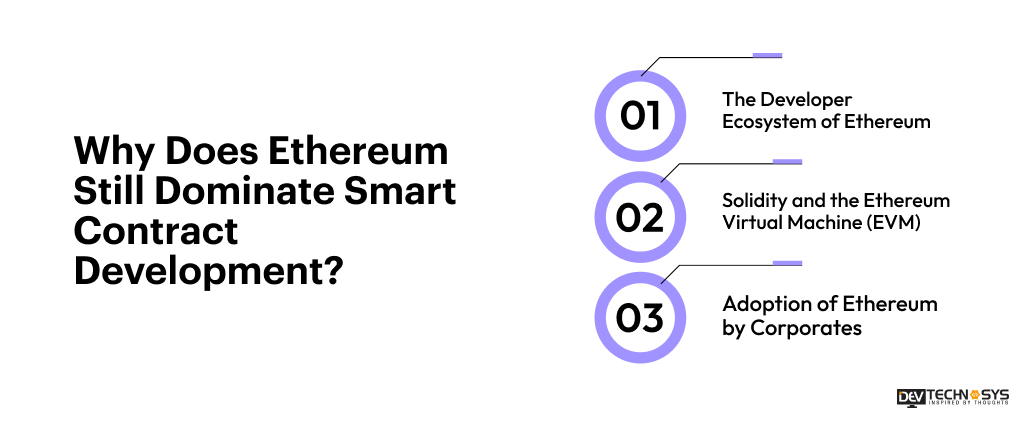
1. The Developer Ecosystem of Ethereum
Ethereum has continued its dominance in the development of smart contracts due to its considerable and engaged community of developers. Thousands of developers contribute to the open-source tools, frameworks, libraries, and educational material available in the ecosystem.
The effectiveness of this ecosystem is that it enables the easy process of developing decentralized applications while continuously improving them and providing security updates.
2. Solidity and the Ethereum Virtual Machine (EVM)
Solidity is the main programming language of Ethereum used for developing smart contracts, while the Ethereum Virtual Machine (EVM) is responsible for making their execution in all compatible blockchains identical.
With EVM providing a uniform environment for all the technologies, developers can create distributed apps that are highly secure, reusable, and interoperable.
3. Adoption of Ethereum by Corporates
Today, many companies turn to Ethereum for blockchain development services due to its high reliability, developed infrastructure, and huge ecosystem.
The Ethereum platform is used in many sectors, including finance, healthcare, supply chain, and digital identity, to streamline their processes and deal with the complications of conducting transactions online.
Why Is Security More Important Than Speed?
When it comes to the development of smart contracts, security is king over speed of transaction since vulnerabilities put digital assets as well as critical commercial information at risk indefinitely.
To protect from costly breaches, it is necessary to conduct thorough audits, ensure secure coding practices are implemented, perform formal testing, set access controls, and monitor operations constantly.
Planning a Smart Contract Project?
Get a tailored development cost estimate in a few simple steps.
- 3 quick steps
- 100% free
- Reply in 1 business day
2 Minutes Read
Understanding the Ethereum Smart Contract Lifecycle
The Ethereum smart contract lifecycle includes all the phases from planning and architecture to Solidity development, testing, auditing for security, deployment, and monitoring afterward.
Following this well-structured lifecycle helps remove possible weak points, achieve optimal gas limit, guarantee the proper functioning of the EVM (Ethereum Virtual Machine), and implement safe and scalable decentralized apps.
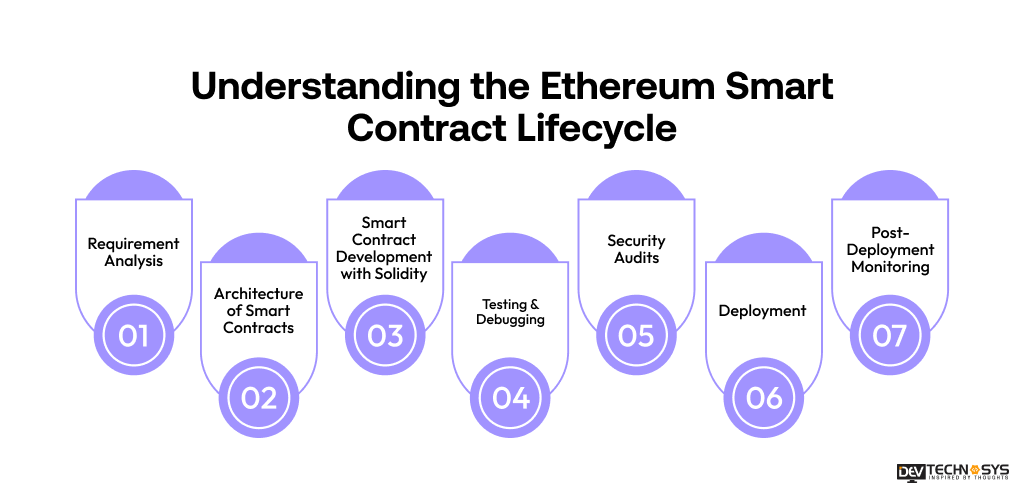
1. Requirement Analysis
A smart contract’s journey starts with gathering business needs, understanding the necessary on-chain processes, and specifying the functional and security goals of the contract.
With all needed information, developers determine the tokenomics, governance policies, transaction process, access rights, compliance level, gas optimization, and the blockchain to use for smart contract release.
2. Architecture of Smart Contracts
When creating smart contracts, their architecture is modular, meaning that contract interactions, system memory layout, programming patterns, and upgradeability principles are clarified, as well as information about oracles, events, protocols, and connections with other contracts. This function will guarantee the decentralized and stable operation of smart contracts.
3. Smart Contract Development with Solidity
The Ethereum smart contract development involves programming in Solidity and complies with safe coding practices. Developers create the required logic, storage variables, and functions, and reduce gas consumption by using reusable code and complying with the main characteristics of the Ethereum Virtual Machine (EVM).
4. Testing & Debugging
The smart contracts are validated through unit tests, integration tests, and automated regression tests using Hardhat and Foundry development frameworks.
During the debugging phase, the smart contract’s various edge cases, transaction failures, reentrancy cases, overflow issues, and gas efficiency are all tested to ensure that everything works when deployed to Ethereum.
5. Security Audits
The security audit carefully checks for vulnerabilities, which may include denial-of-service vulnerabilities, reentrancy attack solidity, vulnerabilities related to control access, integer overflow problems, and oracle manipulation problems.
Static methods, formal verification, manual code review, and penetration testing are a few of the methods utilized to increase the strength of the contract.
6. Deployment
Once all the steps above are completed, the smart contract can be deployed on the Ethereum network by utilizing the respective deployment scripts to ensure that everything is safe. The developers set up the constructor parameters and the ownership of the contract before verifying the smart contract on the Ethereum blockchain.
7. Post-Deployment Monitoring
Post-deployment monitoring keeps track of the events relating to the contract, transaction activities, the usage of gas, and any abnormal behaviors. The developers make use of technology for blockchain analysis, alerting systems, node monitoring, etc. to find anomalies, check the health of the contract, look out for upgrades, and ensure security and efficiency.
The Costliest Solidity Mistakes Developers Make
The occurrence of even small Solidity coding errors can lead to major security threats, monetary loss, as well as irreversible transactions on the blockchain.
Some of the common issues include reentrancy attacks, inadequate smart contract access control, insecure external calls, reliance on timestamps, and faulty arithmetic logic.
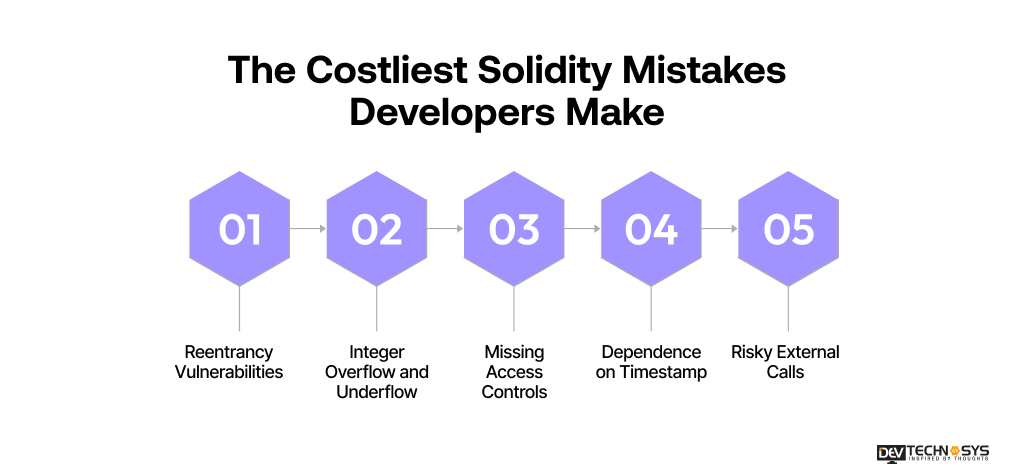
1. Reentrancy Vulnerabilities
The term reentrancy refers to the process wherein an external contract calls a vulnerable function over and over again before the execution of the earlier contract is completed.
As a result, the funds get depleted, or the contract state is changed. By using the Checks-Effects-Interactions pattern, reentrancy guards, and performing state variable updates before external calls.
2. Integer Overflow and Underflow
It may result in wrong calculations of token amounts and loss of funds. Both above-mentioned issues were excluded in the smart contract programming language version 0.8 and above.
However, developers should always remember to double-check arithmetic operations, use proper data types, and perform thorough testing of their mathematical operations.
3. Missing Access Controls
Improper access control enables unauthorized individuals to carry out privileged functions, change important settings, or transfer funds. To restrain administrative actions, developers are recommended to apply role-based access control, ownership verification, use of multi-signature authentication, as well as secure authorization measures.
4. Dependence on Timestamp
Using block.timestamp in business-critical implementations may allow miners to manipulate the dealings. Developers should not use timestamps for randomization or making important operational decisions. Instead, they can resort to trusted oracles, confirmations of blocks, and deterministic methods to implement their contracts safely and effectively.
5. Risky External Calls
Calling untrusted external contracts without appropriate checks poses a significant risk of being the victim of reentrancy, execution issues, and other malicious activities.
Developers should verify the target addresses, check the return values, limit gas forwarding when possible, use secure methods, as well as isolate the external calls.
Storage & Gas Optimization Mistakes That Increase Costs
The performance of smart contracts depends on effective management of storage and optimization of gas. Bad coding practices can lead to increased deployment and smart contract audit costs, as well as limited scalability.
Thus, it is important for developers to be aware of common storage and gas optimization errors in order to create a smart contract that provides a higher level of security, efficiency, and performance.
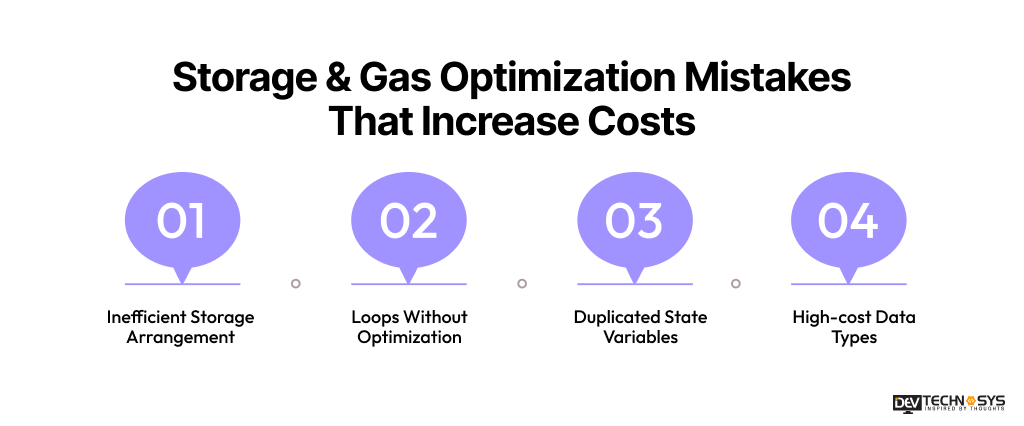
1. Inefficient Storage Arrangement
An inefficient storage arrangement leads to higher gas costs due to extra storage transactions. Improved management of state variables, storage optimization, and limited usage of SSTORE can enhance contract workability and save on the costs of installing the contract.
2. Loops Without Optimization
Unoptimized loops access storage many times, conduct unnecessary computations, or run over large arrays. Using saved values in memory, limiting the number of runs of a loop, and reducing on-chain operations allows saving on gas and improving execution efficiency.
3. Duplicated State Variables
Keeping duplicated variables increases the amount of storage consumed and the number of costly SSTORE. The elimination of redundancy, reuse of the available variables, and calculation of the necessary values when needed leads to a decrease in the contracted size and smart contract audit cost.
4. High-cost Data Types
Choosing unsuitable data types increases gas consumption and storage amount. Using integers of required size, fixed-size arrays, bytes32, and the technique of storage packing makes it possible to create more efficient memory distribution.
Upgradeable Smart Contracts: Common Mistakes
With the help of upgradeable smart contracts, features can be added to the contracts and bugs fixed easily. However, smart contract development mistakes in implementing the contracts can harm the security and integrity of the contract itself.
Another commonly encountered issue is misconfigured proxies, storage collision proxy units, mistakes in initialization, and weak authorization for upgrades.
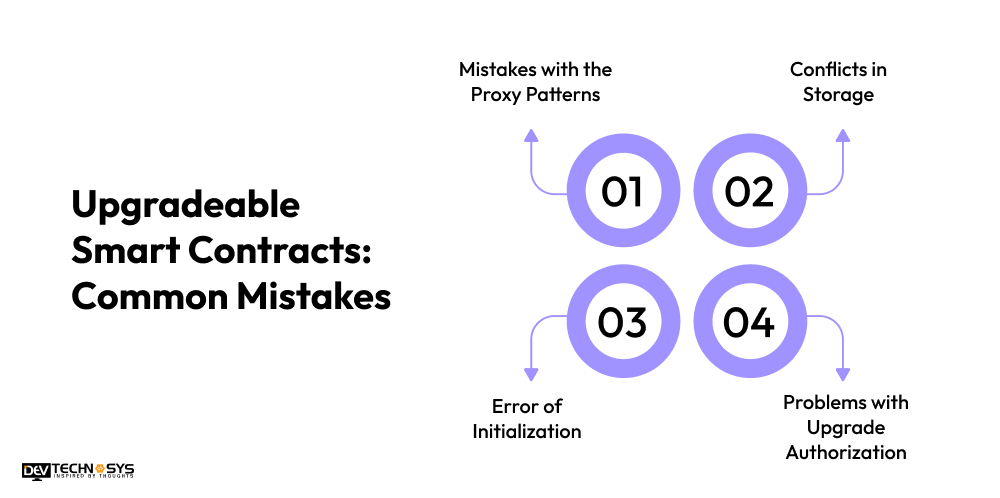
1. Mistakes with the Proxy Patterns
The wrong usage of proxy pattern solidity can ruin upgradeability, leak administrative capabilities, or damage contract logic. Developers have to set up Transparent or UUPS proxy patterns correctly, distinguish implementation contracts from storage, and perform testing of upgrade processes in detail.
2. Conflicts in Storage
Collisions happen in cases when upgraded contracts overwrite storage slots, thus corrupting state variables and leading to unexpected behavior. Use of the same storage structure, avoidance of gaps in storage slots, and ordering of variables can solve the compatibility issues in the future.
3. Error of Initialization
Contracts that can be upgraded contain functions of initialization instead of constructors. If initializations are absent, duplicated, or badly protected, contracts can stay uninitialized or fall into the hands of unauthorized owners. It is advisable to use modifiers of OpenZeppelin in this case.
4. Problems with Upgrade Authorization
A weak upgrade authorization can give attackers or unauthorized administrators a chance to alter contract logic. A good way to avoid this situation is to use role-based access controls, use multisig contract wallets, implement governance mechanisms, and constantly observe access to upgrades.

Oracle Integration Risks Developers Often Ignore
Connecting Ethereum smart contracts to real-world data is what chainlink oracles do, and the security of such a connection is extremely important. When the architecture of an oracle is weak, is centrally controlled, uses inconsistent data feeds, or has poor validation has to do with contract performance, the outcome is less reliable.
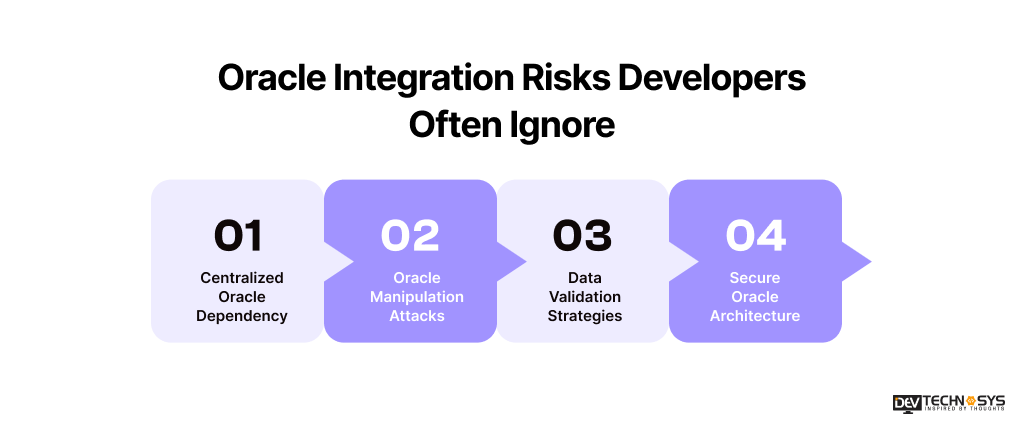
1. Centralized Oracle Dependency
Centralization of the oracle provider creates a risk of failure that affects the operations of decentralized applications. By utilizing decentralized oracle networks with multiple data sources and failover mechanisms, the reliability and availability of data is ensured.
2. Oracle Manipulation Attacks
An attacker can make use of wrong, uninformative, or altered oracle data, which interferes with contract execution. To prevent this, a developer should employ decentralized oracle solutions, price volatility checking, time-weighted average price, and validating information from different sources.
3. Data Validation Strategies
Before affecting the operation of smart contracts, external data must be verified beforehand. This includes multiple cross-checks, checks for reasonable value fluctuations, eliminating out-of-date data, and consistency checking.
4. Secure Oracle Architecture
Proper oracle architecture integrates decentralized oracle networks, cryptographic verification, multiple data providers, a failover solution, and continuous monitoring. This approach minimizes the chances of manipulation and creates reliable off-chain data for the operation of Ethereum smart contracts.
Solidity Security Best Practices Every Developer Should Follow
Security-wise, writing secure Solidity smart contracts obliges developers to possess more skills than simply writing functional code. Developers need to be aware of the key security practices that include secure design patterns, audited libraries, role-based access control methods, emergency protocols, and governance systems to follow.
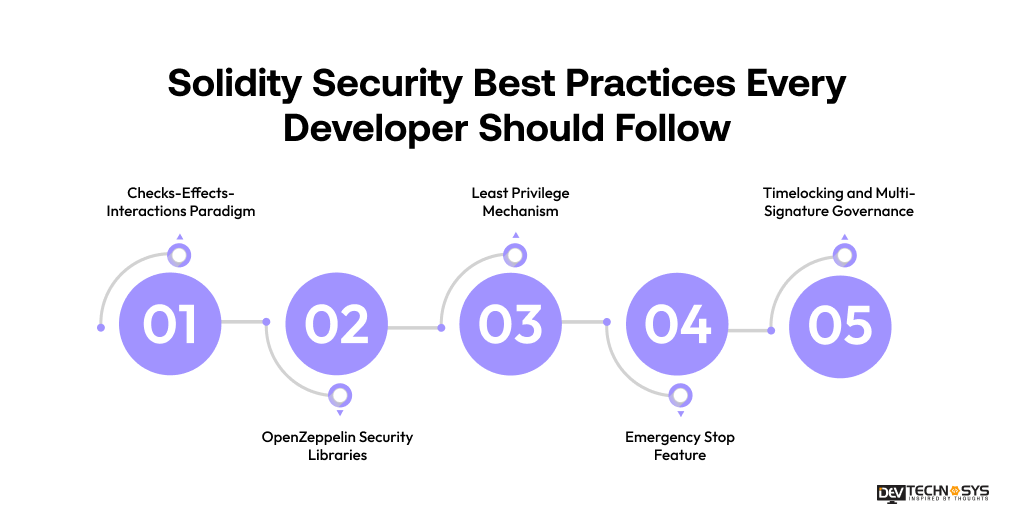
1. Checks-Effects-Interactions Paradigm
The Checks-Effects-Interactions paradigm lessens re-entrancy threats by validating conditions initially, modifying contract status afterward, and interacting with outside contracts last.
This order of execution hinders malicious callbacks from taking advantage of unfinished changes in status, hence enhancing transaction integrity and improving the general safety of Ethereum smart contracts.
2. OpenZeppelin Security Libraries
OpenZeppelin offers verified libraries for smart contracts to ease the process of building secure applications in Solidity. Developers can use reusable modules for access limitations, token parameters, the capability to upgrade programs, cryptography, and prevention of re-entrancy. Thus, the application of these standardized components accelerates Web3 development and increases the security of blockchain applications.
3. Least Privilege Mechanism
The application of the least privilege mechanism guarantees that every entity has only the access level needed for the fulfillment of its objective. The application of the role-based access control (RBAC) system, verification of rights, multi-signature approvals, and limited control functions lowers the number of illegal actions and reduces the risk of possible attacks.
4. Emergency Stop Feature
An emergency stop feature makes it possible for the administrators to mute specific functions of the smart contract if there is an incident or any unexpected failure.
Through the implementation of the pause and resume functions through the approved methods, it determines the minimum possible losses and eliminates the risk.
5. Timelocking and Multi-Signature Governance
Timelocking contracts enable postponing any urgent management action until the time it is carried out. With the help of timelocking in combination with the multi-signature technology, the risk of insider fraud can be minimized, and the operational transparency of the governance can be improved.
Testing Strategies Before Mainnet Deployment
Before going to the deployment phase, it is a must to conduct testing strategies to deliver secure and reliable Ethereum smart contracts. There are various testing techniques, such as unit testing, integration testing, formal verification smart contracts, invariant testing, fuzz testing, and more. It helps to identify errors, vulnerabilities, bugs, validate business logic, and maintain overall performance.
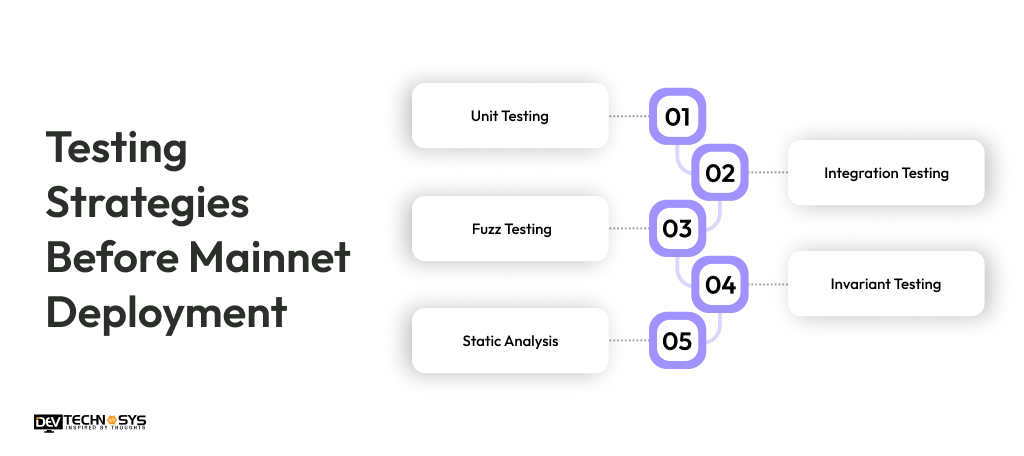
1. Unit Testing
Unit testing assesses each function of a smart contract separately, checking that it behaves as expected in normal plus extreme situations. Using tools like Hardhat, Foundry Solidity, or the Truffle framework, developers confirm how accurately the contracts execute the business logic, transfer state values, emit events, and authorize access.
2. Integration Testing
Integration testing checks whether different smart contracts perform together properly, external protocols comply with different standards, and oracle services give the correct information.
It allows for confirming whether all data transfer is done properly, cross-contract communication is working, and functionality is ensured before launching the contract on Ethereum.
3. Fuzz Testing
Fuzz testing consists of checking a product under a variety of unanticipated and random conditions so as to detect any hidden issues, exceptions that occur during performance, and costly smart contract errors resulting from the executed program. That is done by running different tests and verifying each outcome.
4. Invariant Testing
Invariant testing basically verifies the predefined security and business rules that always remain true throughout transaction sequences. After that, developers share the critical conditions, such as token supply consistency, contract integrity, and balance preservation, during the complex paths and unwanted conditions.
5. Static Analysis
Static analysis is best for scanning the Solidity source code without executing it to find errors, bugs, and vulnerabilities. Uses powerful tools like Mythril, Slither, and Solhint for identifying gas optimization issues, dead code, access control flaws, and inefficient patterns. It mainly helps coders to detect any error and provide seamless backend services.
Tools Every Solidity Developer Should Know
The use of appropriate Solidity development tools enhances programming productivity, the accuracy of testing, and the security of smart contracts. Ethereum smart contract development platforms such as Hardhat, Foundry, Remix IDE, OpenZeppelin, Slither, and Mythril facilitate development work, discover weaknesses in smart contracts, and automate tests.
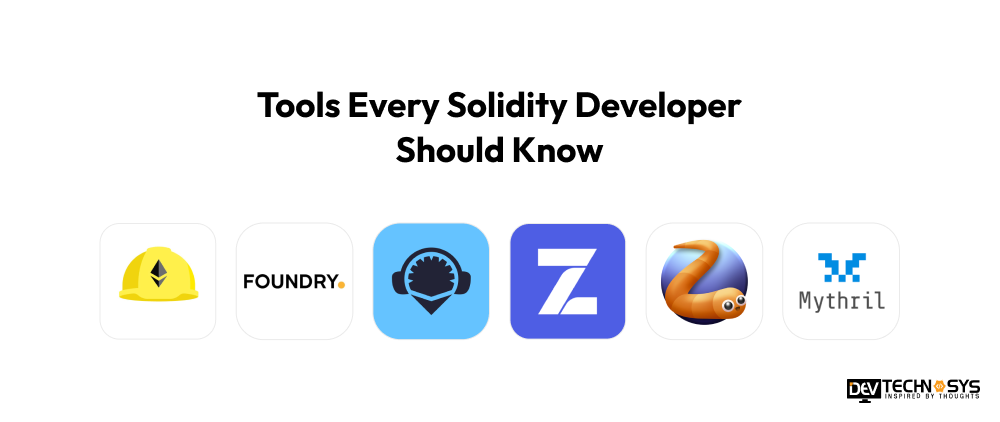
1. Hardhat
Hardhat is one of the most famous tools that most of the developers use for Ethereum smart contract development. It is the best framework for building and testing smart contracts.
With the help of Hardhat, developers can compile Solidity code, debug transactions, deploy contracts, run automated tests, and more. This plugin system improves deployment and efficiency for every project.
2. Foundry
Foundry is a new and swift toolkit designed for Solidity development services. Developers can utilize it for smart contracts, unit testing, fuzz testing, and application deployment right from a command-line interface. Its remarkable capabilities and testing options gained popularity among well-versed blockchain programmers.
3. Remix IDE
Remix IDE is an online development environment that allows writers to write, compile, create, and deploy Solidity smart contracts without installation.
Remix IDE also has its own debugger, compiler, and deployment utilities, which make it a great platform for novice learners who have just started their journey with Solidity.
4. OpenZeppelin
OpenZeppelin is a reliable and verified Solidity library provider for the development of secure smart contract exploits. Programmers can easily use ERC-20, ERC-4337, and ERC-721 implementations, access, upgradeable, and security modules without starting from the very beginning, thus minimizing code mistakes and keeping up with common Ethereum security principles.
5. Slither
Slither is a type of static analysis tool; therefore, it is used to find out whether Solidity-based programs have any security issues or programming mistakes found in the code. It provides fast detection of issues like reentrancy and issues with any other aspect of Solidity programming.
6. Mythril
Mythril is a kind of security analysis tool that gets help from analyzing the patterns found in bytecode. It helps in catching some common types of attacks, misses in integer operations, and unmonitored exit point calls of the contracts. It is used to improve the overall security of the contracts prior to their launch.
Want a chatbot demo or pricing? Fill the form and talk to our experts today.
Pick what you need below — you can select more than one — then tap Get detail to continue.
-
Chatbot demo dashboard
-
Cost to develop an app
-
Industry report
-
Case study
Real-World Ethereum Smart Contract Failures and Lessons Learned
Numerous Ethereum smart contract failures have shed light on the risks of poor coding and testing. Events like The DAO, Parity Wallet, Wormhole, and Euler Finance show the need for security-first development, thorough auditing, continuous oversight, and established best practices.
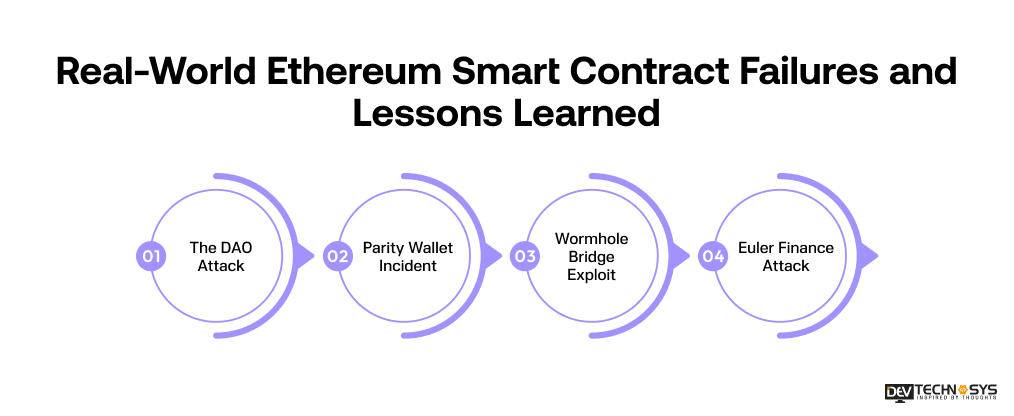
1. The DAO Attack
The 2016 DAO hack attack took advantage of a reentrancy issue that enabled the perpetrators to withdraw Ether multiple times before the updates to balances occurred.
Consequently, many millions of dollars were lost, which served as an important lesson regarding the significance of secure coding and state management practices and smart contract security audits.
2. Parity Wallet Incident
The Parity wallet hack incident was caused by a contract library that was disabled mistakenly, which resulted in millions of dollars in Ether being frozen forever.
This incident showed how dangerous an upgradeable contract architecture could be, thus proving the necessity of proper permission control and code tests.
3. Wormhole Bridge Exploit
The Wormhole Bridge exploit occurred when the hackers managed to avoid signature verification and generate tokens without authorization. The exploit inflicted losses of hundreds of millions of dollars, thus making it clear that it is important to ensure cryptography validation, secure communication over different chains, and conduct audits regularly.
4. Euler Finance Attack
Euler Finance’s breach relied on a vulnerability in the lending mechanism of the protocol, incurring significant monetary losses. It made it evident that audited smart contracts may have hidden threats. Regular testing, formal review, bug bounty initiatives, and online surveillance are vital for enhancing protocol security.
What Developers Can Learn?
Each Ethereum smart contract failure proves the necessity of secure programming, rigorous testing, independent security audits, and continuous monitoring.
Programmers should use standardized design solutions, trusted libraries, validate external communication, and develop emergency plans for minimizing risk and developing successful decentralized applications.
AI Is Changing Smart Contract Security
The rise of artificial intelligence has brought about a new way of doing things that makes contracts more secure from vulnerabilities through automated detection of vulnerabilities, monitoring of threats, and checking of code.
The high-powered technology is capable of detecting Solidity errors, making suggestions for improving the security of coding practices, optimizing gas usage, and identifying malicious activities happening online much quicker than a traditional review process would allow.
AI is in collaboration with security audits carried out by professionals in cybersecurity to assist developers in producing better Ethereum smart contracts.
How Does Dev Technosys Build Secure Ethereum Smart Contracts?
In order to build safe Ethereum smart contracts, the knowledge of the right skills, established security practices, and extensive testing is necessary. As a reliable Ethereum development company, Dev Technosys uses secure Solidity coding guidelines, full audits, gas optimization solidity methods, automated testing, and constant oversight throughout the full process of solidity smart contract development process. Our blockchain specialists use top industry practices to produce scalable and reliable smart contracts that provide safety to digital assets.