















Quick Summary:
Payment app development costs in 2026 typically range between $4,999 and $98,999. The final cost depends on the app’s complexity, security requirements, integrations, and regulatory compliance.
Cost Breakdown by Complexity
-
- Basic/MVP App: $4,999–$15,000 – Core payment features, user registration, transaction processing, and basic security.
- Mid-Level App: $15,000–$50,000 – Includes digital wallets, payment gateway integrations, KYC, transaction history, and enhanced security.
- Advanced App: $50,000–$98,999 – Supports AI-powered fraud detection, multi-currency payments, advanced analytics, real-time monitoring, and complex integrations.
Key Cost Factors
-
- App features, payment gateway integration, UI/UX design, security architecture, KYC/AML requirements, regulatory compliance, and platform selection significantly influence development costs.
Development Timeline
-
- Building a secure and scalable payment app typically takes approximately 4 to 7+ months, depending on complexity and compliance requirements.
Platform & Integration Costs
-
- Developing for iOS, Android, and web, along with integrating banking APIs, payment gateways, wallets, and third-party services, can increase the overall budget.
Additional Costs
-
- Businesses should also plan for ongoing expenses such as maintenance, security updates, cloud infrastructure, compliance audits, fraud monitoring, and payment processing fees.
Payment applications in 2026 are no longer a digital wallet; they are the backbone of the modern fintech ecosystem. This industry is evolving with advanced fintech innovations such as instant fund transfers, a fraud detection engine, and cross-border payments.
This rapid evolution has attracted businesses, entrepreneurs, and startups to shift towards online payment app development. But the question appears: what would be the cost to develop a payment app in 2026-2027?
The overall mobile payment app development cost is commonly estimated from $10,000 to $28,000+. The final fintech software development cost is driven by features, complexity, security requirements, and integrations.
Whether interested in a simple MVP or a fully-functional, AI-powered payment app development, understanding the cost structure is necessary. In this blog, we have covered everything related to the Paytm clone app development cost.
Everything Businesses Need to Know About Payment Apps
A payment app is a digital platform that lets users send, receive, and manage money online via smartphone. With these applications, there is no need to maintain and have cash everywhere. It makes online money transfers faster, safer, and more convenient.
The common features of an NFC payment app development in 2026 include:
- User Registration
- Digital Wallet Integration
- Bank Account Linking
- Instant Money Transfers
- QR Code Payments
- Transaction History
- Real-Time Notifications
Modern apps in 2026 are coming with additional services, including bill payments and expense tracking. Basically, these payment apps act as a bridge between users and the financial ecosystem.
Service Options
Who Needs a Custom Payment App?
If you are a business that needs safe payment processes, fast transactions, and ready-to-use functionality, we have what you need.
Having trouble with manual payments?
By using our system, you can ensure smooth collection, transactions, and payment tracking from one secure platform.
For startups and small businessesDo you want to extend payment options?
Enable the use of multiple payment methods, set up recurring billing, and create seamless transactions.
For retailers and growing companiesAre you struggling with payment integration?
Connect gateways, banking systems, and software for effective transactions.
For fintech experts and digital businesses
How Much Does It Cost to Build a Payment App in 2026-2027?
The cost to develop a loan lending app in Houston, USA is around $4,999 to $98,999; the cost can be influenced by several major factors. It involves a wide variety of factors, such as project size, backend infrastructure, development team, platform choice, number of integrations, emerging technologies, design UI/UX, and more.
Additional factors also exist, such as security measures, maintenance & support services, testing, features, functions, and project complexity.
| Payment App Type | Development Cost ($) | Key Capabilities | Best For |
| Basic Payment App (MVP) | $4,999 – $15,000 | Secure payments, login, wallet, transactions, gateway integration | Startups testing payment products |
| Mid-Level Payment App | $15,000 – $50,000 | KYC/AML, multiple payments, refunds, APIs, admin dashboard | Growing fintech and payment businesses |
| Advanced Payment App | $50,000 – $98,999+ | Multi-currency, fraud detection, analytics, real-time monitoring | Enterprises building scalable payment ecosystems |
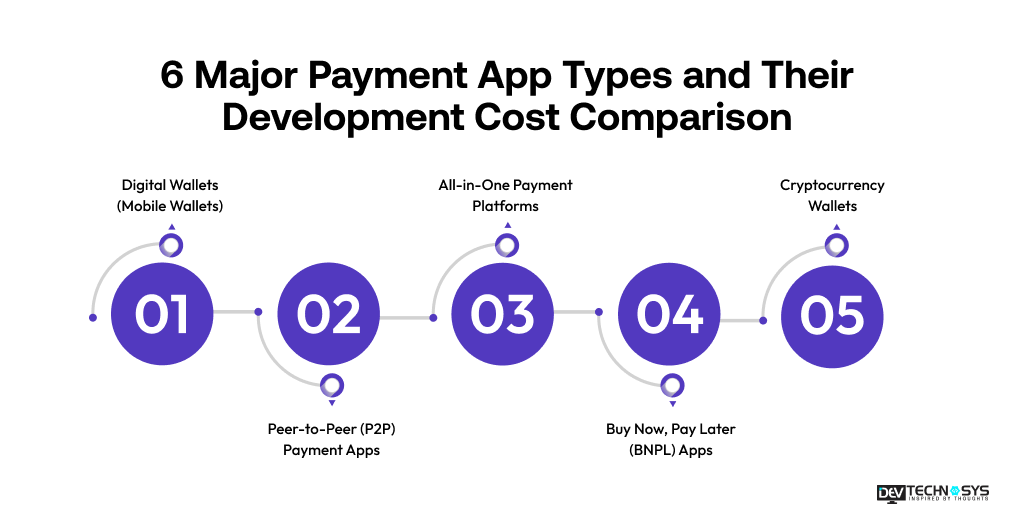
6 Major Payment App Types and Their Development Cost Comparison
Mobile wallets, P2P, BNPL, Mobile POS, etc., are the primary types of payment apps. Multiple businesses and entrepreneurs are investing in one of these types of financial apps. Therefore, we are here to explain the services each app offers, along with their development cost breakdown.
1. Digital Wallets (Mobile Wallets)
Digital or mobile wallet apps are used to digitally store money, link bank accounts/cards, and make instant payments. It is preferred among users because they are fast, secure, and eliminates the need to maintain cash. Secure digital wallet development is perfect for entrepreneurs due to high user adoption and strong monetization potential.
Real-world Examples of Digital Wallet Apps: Paytm, PhonePe, Google Pay, Apple Pay
The digital wallet app development cost breakdown:
| Complexity | Development cost ($) | Key features |
| Basic | 4,999–12,000 | User registration, wallet balance, basic transactions, payment history |
| Mid-Level | 12,001–30,000 | Bank account linking, QR payments, transaction notifications, KYC verification |
| Advanced | 30,001–65,000 | Multi-currency support, biometric authentication, fraud detection, real-time analytics |
2. Peer-to-Peer (P2P) Payment Apps
Peer-to-peer payment apps help users send and receive money immediately through mobile numbers, UPI IDs, or email addresses. People are using these apps for their speed and convenience in transferring money without delays. Businesses can invest in P2P payment apps because of high transaction volumes, strong engagement, and scalable monetization.
Real-world Examples of P2P Apps: Venmo, Cash App, Wise, Revolut
Explaining Peer-to-Peer payment app development cost 2026:
| Complexity | Development cost ($) | Key features |
| Basic | 4,999–10,000 | User profiles, contact-based transfers, payment requests, transaction history |
| Mid-Level | 10,001–28,000 | Bank integration, instant transfers, split bills, push notifications, identity verification |
| Advanced | 28,001–55,000 | Real-time payment processing, automated fraud detection, recurring transfers, advanced security |
3. All-in-One Payment Platforms
An app that combines wallets, bill payments, transfers, shopping, and financial services altogether is an all-in-one payment app. It has become famous among users because they don’t need different apps for different purposes. Startups can benefit by building this app through user retention, engagement, and multiple revenue streams.
Real-world Examples of All-in-One Payment Apps: Paytm, Alipay, KakaoPay, GrabPay
Cost breakdown to build an all-in-one payment app:
| Complexity | Development cost ($) | Key features |
| Basic | 9,999–20,000 | User accounts, basic payments, transaction records, simple dashboard |
| Mid-Level | 20,001–50,000 | Digital wallets, bill payments, QR scanning, multiple payment gateways, loyalty rewards |
| Advanced | 50,001–98,999 | Unified financial services, multi-platform support, AI fraud detection, advanced analytics, real-time monitoring |
4. Buy Now, Pay Later (BNPL) Apps
BNPL (Buy Now Pay Later) apps let users make purchases instantly and pay flexible installments. It is a completely different system from traditional credit cards. People choose these apps because of affordability, easy approvals, and improved checkout experience. Businesses benefit from higher conversion rates, increased merchant sales, and revenue through interest and service fees.
Real-world Examples of BNPL apps: Klarna, Afterpay, Sezzle, Zip
A BNPL app development cost breakdown:
| Complexity | Development cost ($) | Key features |
| Basic | 8,999–18,000 | User registration, installment calculator, repayment schedules, basic payment tracking |
| Mid-Level | 18,001–40,000 | Merchant integration, credit assessment, KYC verification, automated reminders, repayment management |
| Advanced | 40,001–85,000 | AI-based risk scoring, automated underwriting, dynamic credit limits, fraud prevention, real-time credit monitoring |
5. Cryptocurrency Wallets
Users can easily and securely store, send, and receive digital assets using blockchain technology through cryptocurrency wallets. For decentralization, transparency, and global investment opportunities, it is a perfect choice. If an entrepreneur invests in crypto payment app development, they benefit from early adoption in Web3 ecosystems.
Real-world Examples of Cryptocurrency Wallets: MetaMask, Trust Wallet, Phantom, Exodus
Cryptocurrency Wallet App Development Cost Breakdown:
| Complexity | Development cost ($) | Key features |
| Basic | 4,999–15,000 | Wallet creation, crypto balance display, send and receive transactions, basic transaction history |
| Mid-Level | 15,001–35,000 | Multi-cryptocurrency support, blockchain integration, QR transfers, portfolio tracking |
| Advanced | 35,001–75,000 | Multi-chain support, hardware wallet integration, advanced key management, DeFi integration, enhanced security monitoring |
Core Features vs. Advanced Features: What Drives the Price Up
The overall fintech payment app development cost in 2026 highly depended on the features integrated. Core features are basic but really important for the platform. These features essentially focus on essential payment functionality and user management.
Whereas advanced features focus on the app’s long-term market value. They strengthen platform security, enhance user experience, and make the app scalable and competitive. Therefore, an increase in feature complexity can give rise to development time, security requirements, and integration costs.
1. Payment App Development Cost by Features
| Core Feature | What It Adds | Estimated Cost |
| User Registration & Login | Secure account access and authentication | $4,000–$5,000 |
| User Profile Management | Personal and payment detail management | $4,000–$5,000 |
| Digital Wallet | Balance storage and payment management | $5,000–$6,000 |
| Bank Account Linking | Secure connection with banking accounts | $6,000–$7,000 |
| P2P Money Transfers | Instant user-to-user payments | $6,000–$7,000 |
| Transaction History | Payment records and activity tracking | $4,000–$5,000 |
| Payment Gateway Integration | Online payment acceptance and processing | $6,000–$8,000 |
| QR Code Payments | Scan-and-pay transaction functionality | $6,000–$8,000 |
| Push Notifications | Real-time payment and security alerts | $4,000–$5,000 |
| Admin Dashboard | User, payment, and transaction management | $6,000–$8,000 |
2. Advanced Features That Increase Development Costs
| Advanced Feature | Why It Increases Development Cost | Estimated Cost |
| AI Fraud Detection | Requires AI models and real-time risk analysis | $11,000–$14,000 |
| Multi-Currency Support | Adds currency conversion and global payment logic | $9,000–$12,000 |
| Cross-Border Payments | Requires international APIs and compliance workflows | $10,000–$13,000 |
| Cryptocurrency Integration | Adds blockchain connectivity and asset handling | $11,000–$14,000 |
| Biometric Authentication | Requires additional identity verification layers | $9,000–$11,000 |
| Open Banking APIs | Requires secure third-party banking integrations | $10,000–$13,000 |
| BNPL Functionality | Adds credit, eligibility, and repayment workflows | $11,000–$14,000 |
| NFC Contactless Payments | Requires tap-to-pay and device-level integration | $10,000–$13,000 |
| Loyalty & Rewards Engine | Adds cashback, points, and reward management | $9,000–$11,000 |
| White-Label Infrastructure | Requires multi-tenant architecture and customization | $11,000–$14,000 |
What Exactly Drives the Payment Application Development Cost?
Advanced features generally increase the cost to make a payment app. That’s because advanced features integrate AI, advanced security, compliance systems, and real-time processing infrastructure. Also, these features upgrade scalability, customer retention, and monetization opportunities. A payment app with advanced features becomes more profitable and competitive than an app with basic features.
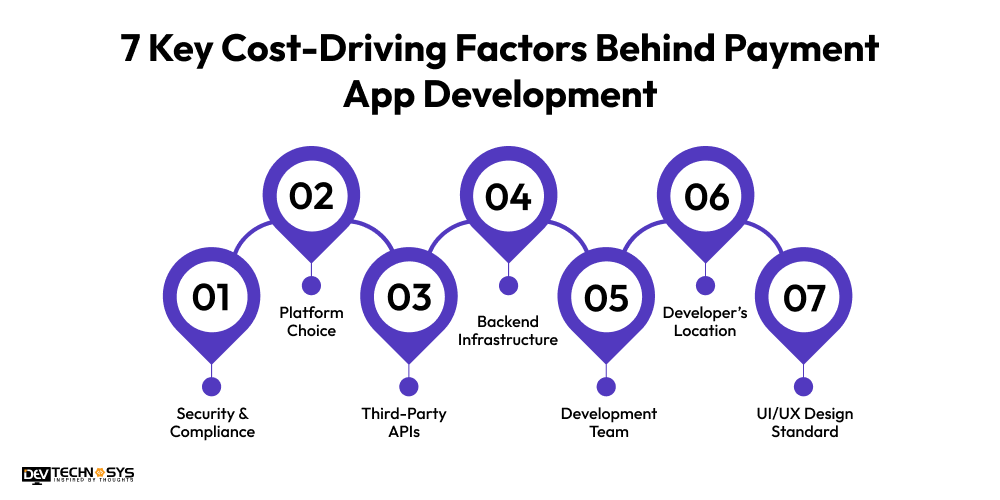
7 Key Cost-Driving Factors Behind Payment App Development
Third-party integrations, security, UI/UX, development team, and their locations are some major factors affecting payment app development cost. Understanding these factors will help businesses make secure and informed financial decisions.
1. Security & Compliance
Security and compliance primarily affect the cross-platform payment app development cost. It’s because payment apps process sensitive financial data and digital transactions. Such apps require:
- PCI DSS Compliance
- Anti-Money Laundering (AML)
- Know Your Customer (KYC)
- Tokenization
- End-to-End Encryption (E2EE)
- Two-Factor Authentication (2FA)
These security measures increase complexity, testing efforts, and the cost of UPI payment app development services.
| Security & Compliance Area | What Drives the Cost | Estimated Cost |
| Data Encryption | Protecting payment and user data | $5,000–$8,000 |
| PCI DSS Compliance | Securing card payment processing | $8,000–$12,000 |
| KYC & AML | Identity and transaction verification | $7,000–$12,000 |
| Fraud Prevention | Detecting suspicious payment activity | $8,000–$15,000 |
| Security Audits | Vulnerability testing and compliance reviews | $5,000–$10,000 |
| Typical Cost Range | Depends on security depth and regulations | $5,000–$20,000 |
2. Platform Choice
The selection of a platform such as Android, iOS, or cross-platform affects the eWallet app development cost. Developing native payment apps for either Android or iOS demands more time and resources, and offers personalization. Web, UPI, and wearable payment platforms also influence architecture, integrations, and scalability requirements for secure digital wallet development.
| Platform Strategy | Development Scope | Estimated Cost |
| iOS App | Native iPhone/iPad payment experience | $10,000–$16,000 |
| Android App | Native Android payment experience | $10,000–$16,000 |
| Cross-Platform | Shared codebase for iOS and Android | $12,000–$20,000 |
| Web Payment Platform | Browser-based payment experience | $10,000–$18,000 |
| Multi-Platform | iOS, Android, and web ecosystem | $20,000–$30,000 |
3. Third-Party APIs
Third-party APIs play a vital role in NFC payment app development, offering:
- Payment Gateway Integration
- UPI Integration
- Open Banking APIs
- Fraud Detection
- Notifications
- Banking-as-a-Service (BaaS)
All these APIs can significantly increase the payment gateway app development cost. The budget is exceeded due to licensing fees, complexity, security validation, and continuous synchronization requirements.
| Integration Type | Purpose in Payment App | Estimated Cost |
| Payment Gateway APIs | Process online payments securely | $4,000–$7,000 |
| Banking APIs | Connect accounts and banking services | $5,000–$9,000 |
| KYC/AML APIs | Automate identity and compliance checks | $4,000–$7,000 |
| Fraud Detection APIs | Monitor transactions for suspicious activity | $5,000–$9,000 |
| Currency Exchange APIs | Enable real-time currency conversion | $4,000–$7,000 |
| Typical Integration Range | Varies by API count and complexity | $4,000–$12,000 |
4. Backend Infrastructure
A payment software development company powers the backend of the application by strengthening:
- Payment Processing Engine
- Transaction Routing
- Settlement and Reconciliation
- Real-Time Payment Rails
A scalable and secure backend needs cloud hosting, secure databases, load balancing, and API management. Fintech apps in 2026 come with instant fund transfers and recurring billing infrastructure, increasing the payment app backend development cost.
| Backend Component | What It Handles | Estimated Cost |
| Payment Processing Engine | Transaction authorization and processing | $10,000–$15,000 |
| Database Architecture | Secure storage of payment records | $8,000–$13,000 |
| API Infrastructure | Communication between systems and services | $7,000–$12,000 |
| Cloud Infrastructure | Scalable hosting and computing resources | $8,000–$15,000 |
| Real-Time Monitoring | Transaction and system performance tracking | $7,000–$12,000 |
| Typical Infrastructure Range | Based on scalability and transaction volume | $10,000–$25,000 |
5. Development Team
The type of development team (freelancers/ in-house teams/ development companies) influences mobile payment app pricing.
- Freelancers are ideal for single tasks or MVP development. However, they lack fintech expertise.
- An in-house team offers full control over development but demands elevated operational costs.
- While a fintech software development company offers specialized skills, structured workflows, and enterprise-grade development capabilities.
| Hiring Model | Cost Advantage | Estimated Cost |
| Freelancers | Lower upfront cost for smaller projects | $12,000–$17,000 |
| In-House Team | Greater control but higher recurring expenses | $18,000–$25,000 |
| Development Company | Full team, expertise, and project management | $20,000–$25,000 |
| Dedicated Development Team | Flexible long-term development capacity | $18,000–$25,000 |
6. Developer’s Location
The geographical location from where you hire payment app developers impacts the payment software development cost. It is due to varying hourly rates and operational expenses of different regions. A mobile app development company from regions like Western Europe, North America, and Australia offers expensive custom payment app development services.
| Development Location | Typical Cost Position | Estimated Cost |
| India | Cost-effective development with skilled talent | $10,000–$14,000 |
| Eastern Europe | Moderate development rates and expertise | $14,000–$18,000 |
| Western Europe | Higher rates for specialized fintech teams | $18,000–$23,000 |
| North America | Premium rates for experienced developers | $20,000–$23,000 |
7. UI/UX Design Standard
UI/UX design plays a critical role in affecting the digital wallet development budget. It improves user engagement and transaction experience in payment applications. Advanced interfaces with personalized dashboards, animations, and intuitive navigation increase the fintech app UI UX design cost. High-quality UI/UX also strengthens customer trust and improves retention in competitive fintech markets.
| Design Level | Design Scope | Estimated Cost |
| Basic UI/UX | Essential screens and straightforward navigation | $6,000–$9,000 |
| Custom UI/UX | Branded interfaces and tailored user journeys | $9,000–$13,000 |
| Advanced UI/UX | Interactive flows, animations, and personalization | $12,000–$16,000 |
| Premium Fintech UX | Research-driven, conversion-focused experience | $15,000–$18,000 |
Planning a Payment App Project?
Get a tailored development cost estimate in a few simple steps.
- 3 quick steps
- 100% free
- Reply in 1 business day
2 Minutes Read
Hidden Payment App Development Costs Businesses Often Ignore
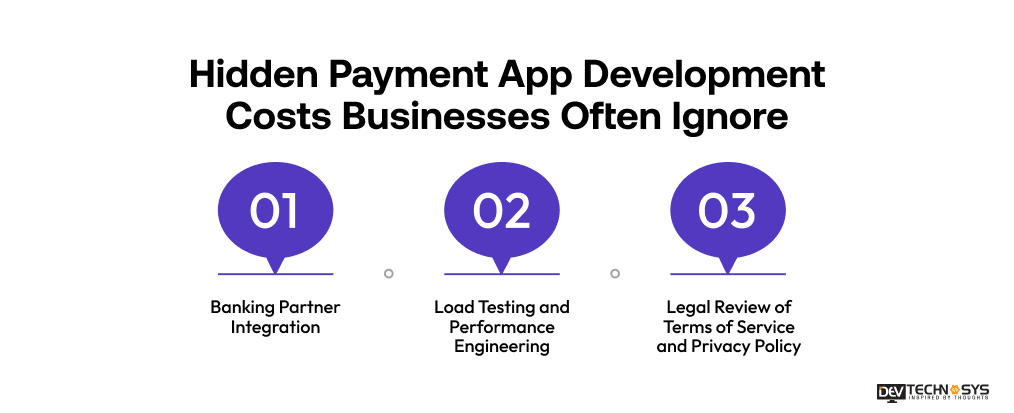
While developing a payment app, some hidden costs might appear that build up the overall payment app development cost estimate. These include partner integration, review delay, load testing, and legal review. These hidden costs are often ignored, and then appear as a surprise. We will now understand these expenses to avoid future budget failures.
1. Banking Partner Integration
Payment apps usually get connected to the banking systems or Banking-as-a-Service (BaaS). It is important for account linking, transaction processing, and ledger management. This process involves technical integrations, vendor approvals, and legal documentation. All these can increase the complexity, timeline, and cost to develop a fintech app in 2026.
2. Load Testing and Performance Engineering
Payment apps mainly handle high transaction volumes during peak usage periods. They hold the pressure to offer seamless services without crashes and delays. For this, load testing and performance optimization are done to ensure stable payment processing and response times. This adds to the final custom eWallet app development cost.
3. Legal Review of Terms of Service and Privacy Policy
Fintech applications require legally compliant Terms of Service, Privacy Policies, and user agreements. It is mandatory to protect both the business and customers. Legal review ensures the app follows financial regulations, data privacy laws, and user protection standards before launch. However, it might appear as a sudden expense in payment app development services.
Security & Compliance: What Does It Add to Payment App Development Cost?
The top payment software development companies suggest that security and regulatory compliance are major cost drivers. Based on the platform requirements, adding security and compliance can range between $5,000 and $20,000. In a payment app, security and compliance protect cardholder data, control access, monitor transactions, and meet applicable privacy requirements.
| Security & Compliance Area | What It Covers | Relevant Standards / Regulations | Estimated Cost |
| Information Security | Security policies, access controls, and risk management | ISO 27001, SOC 1, SOC 2 | $5,000–$8,000 |
| Payment Data Security | Card data protection, encryption, and tokenization | PCI DSS | $7,000–$12,000 |
| Identity & Financial Crime Controls | User verification and suspicious transaction monitoring | KYC, AML | $6,000–$11,000 |
| Fraud Detection & Monitoring | Fraud prevention and real-time transaction monitoring | PCI DSS, SOC 2 | $8,000–$14,000 |
| Privacy & Data Protection | Personal data handling, consent, and user privacy | GDPR, CCPA | $5,000–$9,000 |
| Payment Security Testing | Vulnerability testing, penetration testing, and audits | ISO 27001, SOC 2, PCI DSS | $5,000–$10,000 |
| Payment Regulations | Secure payment services and customer authentication | PSD2, applicable local regulations | $6,000–$12,000 |
| Overall Security & Compliance | Depends on features, markets, integrations, and regulatory scope | ISO 27001, ISO, SOC 1, SOC 2, GDPR, CCPA, PCI DSS | $5,000–$20,000+ |
Note: The feature, tech stack, and security & compliance costs are included in the overall development expenses at Dev Technosys.
Payment App Development Timeline vs. Cost Comparison
| Build Approach | Development Timeline | Estimated Cost Range ($) | Scalability |
| No-Code / Low-Code Payment App | 1–2 months | 4,999–9,999 | Limited |
| API-Based MVP Development | 2–3 months | 9,999–29,999 | Moderate |
| Custom Payment App | 3–4 months | 29,999–59,999 | High |
| AI-Powered Payment App | 4+ months | 59,999–79,999 | Very High |
| Advanced Custom Fintech Platform | 4+ months | 79,999–98,999 | Enterprise-Grade |
- As per the best digital payment development companies, No-Code/Low-Code payment applications are the fastest and most affordable option. It usually takes 3-4 months to develop and costs $30,000 to $45,000. However, it involves high risk and has scalability and customization limitations.
- API-based MVP Payment apps take 4-5 months to develop and cost between $45,000 and $70,000. It offers faster deployment with better payment integrations and flexibility.
- A custom payment app usually requires a development budget of $70,000-$1,00,000 and takes 5-6 months to develop. Such apps offer upgraded security, branding, and scalability.
- An AI-powered payment platform can be developed within 6-7 months at a cost ranging between $1,00,000–$1,25,000. Such apps provide AI fraud detection, smart analytics, automation, and personalized payment experiences.
- An advanced or enterprise-level payment application takes 7+ months to develop and usually costs between $1,25,000 and $1,50,000. It includes high-level, modern features, compliance requirements, AI systems, and robust infrastructure.
Expert Advice: This comparison is by one of the best payment app development companies, Dev Technosys. As per our delivery head, Narayan Das, it is evident that a short timeline might reduce development costs initially but limit scalability. Whereas an extended development cycle can increase development expenses but deliver long-term business growth.
How to Reduce Payment App Development Costs Without Sacrificing Quality?
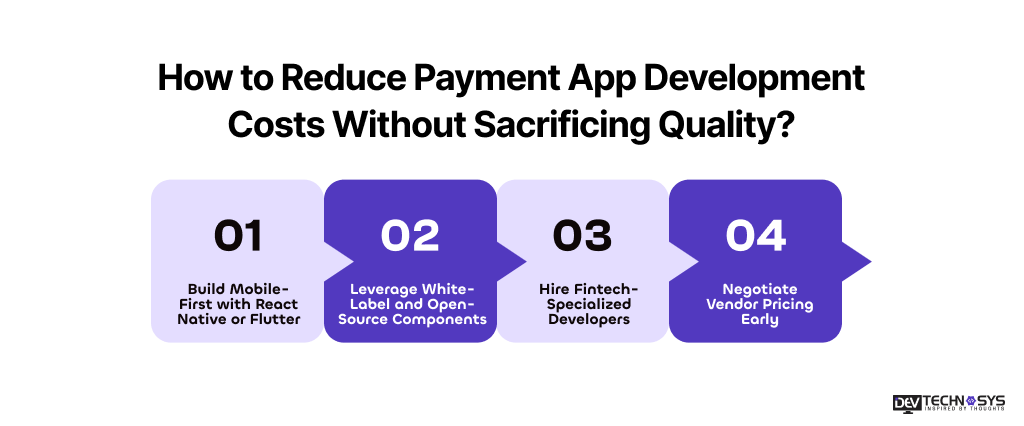
Despite knowing everything, it is necessary to know the measures that reduce the cost to build a payment app like ZainCash. Some of these measures include cross-platform development, white-label elements, hiring experienced developers, and price negotiations. We will discuss these strategies to lower the payment app development timeline and pricing.
1. Build Mobile-First with React Native or Flutter
Cross-platform frameworks like React Native or Flutter let enterprises build an app for different platforms with a single codebase. This strategy helps in reducing development complexity while maintaining a smooth and consistent user experience.
2. Leverage White-Label and Open-Source Components
Integrating white-label and open-source components like dashboards, onboarding systems, and support tools reduces development time and costs. It also allows businesses to customize the platform experience.
3. Hire Fintech-Specialized Developers
Less experienced developers unfamiliar with PCI DSS, payment API patterns, or reconciliation logic will learn on your payment app development cost breakdown. Whereas fintech specialists’ hourly cost is higher, but saves two times their cost premium in avoided mistakes and rework.
4. Negotiate Vendor Pricing Early
Stripe, KYC vendors, and BaaS providers all have startup programs with discounted rates. Plaid’s startup program, Stripe Atlas pricing, and Jumio’s pilot tiers can reduce vendor costs in the first year.
Service Options
What Can We Create or Enhance for Your Payment App?
Communicate your requirements in terms of payments and the kinds of features for your application.
Custom-built Payment App
Create a reliable payment app for web or mobile platforms with integration of digital wallets, transaction processing facilities, payment history, and control over user access.
Your payment solutionPayments Integration and Automation
Use banking APIs, gateways of payment processing and systems of merchants to connect with the required payment processing structure. Use automated transactions, billing, and payment notification processes.
Making your payment operations smoothUpgrade of payment app and AI
Update the existing payment services, improve their security, and use AI technology for detection of fraud.
Enhancing your payment app
Post-Launch Payment App Maintenance Costs Businesses Should Know
After launching the payment app, around 15-20% of the total secure digital payment app development cost is required annually. It is for continuous maintenance to ensure smooth performance, security, and scalability of the platform. The payment app maintenance cost commonly includes:
- Bug Fixes
- Security Updates
- Server Monitoring
- API Upgrades
- Performance Optimization
Regular maintenance of a payment app is mandatory because it manages the sensitive financial data of the users.
Payment App Maintenance Cost Breakdown (Post-Launch)
| Maintenance Component | What It Includes | Annual Cost Impact |
| Bug Fixes & Updates | Fixing issues, UI improvements, and minor enhancements | 3% – 5% |
| Server & Cloud Hosting | AWS, Google Cloud, database hosting | 4% – 6% |
| Security Updates | Encryption, fraud protection, and patch updates | 3% – 5% |
| API & Integration Updates | Payment gateways, banking APIs, third-party tools | 2% – 4% |
| Performance Optimization | Speed improvements, load balancing | 2% – 3% |
| Compliance & Monitoring | PCI-DSS, KYC/AML updates, audits | 1% – 3% |
Spending on payment app development services, even after launch, seems like additional expenses. But this is an investment that protects the payment app. It guarantees uninterrupted security, transactions, a regulatory compliance framework, and user retention.
Cashuuu
Built a Secure Digital Wallet & Payment Platform for Seamless Global Transactions in 22 Weeks
How Dev Technosys partnered with Cashuuu to create a secure fintech platform for real-time money transfers, multi-currency payments, expense management, and smarter financial experiences.
Fadi, UAE
Digital Wallet & Fintech Payment Platform
22 Weeks
$15,000
Challenge
Cashuuu needed a secure and scalable payment platform capable of handling instant transfers, multi-currency transactions, KYC/AML requirements, multiple payment integrations, and high volumes of financial data.
Solution
Dev Technosys developed a mobile-first fintech platform with P2P transfers, QR payments, multi-currency wallets, cross-border payments, biometric authentication, KYC/AML monitoring, and intelligent spending insights.
Results
- Real-time money transfers and wallet management
- Multi-currency payment capabilities
- Secure biometric and encrypted transactions
- KYC/AML monitoring for safer financial operations
- Cross-border payment support
Conclusion
Developing a payment app in 2026-2027 is a great chance for entrepreneurs wanted to enter the evolving fintech industry. Whether building digital wallets or AI-powered fintech platforms, the development expense depends on complexity, security, integrations, and scalability.
Understanding the complete pricing structure helps businesses plan smarter budgets and avoid unexpected expenses. It is important for businesses to invest in secure, scalable, and user-friendly payment app development.
With the right strategy and ewallet app development company, businesses can deliver strong long-term growth and competitive advantages.
Awards & Recognitions
Dev Technosys is acknowledged as a Top App Development Company by Barchart. This recognition has showcased our capabilities in delivering scalable, secure, innovative, high-performing, and user-focused digital solutions. It also highlights our dedication to serving our clients with the best online solutions across industries, including payment, eWallet, and fintech solutions. Each web and mobile platform at Dev Technosys is designed around performance, usability, and business growth.
Frequently Asked Questions
Find answers to the most common questions related to this article.
The overall cost to make a payment app can range from $4,999 to $98,999+. The cost is affected by the complexity, APIs, UI/UX, security, development team, backend, and other factors. A simple app with minimal core integrations is less expensive than a full-fledged payment application.
Yes, PCI DSS compliance is mandatory for the payment app development. It stores, processes, and transmits the data of payment app users. This even protects sensitive financial information through security standards. It includes standards like encryption, authentication, and secure payment processing that help businesses meet financial and regulatory requirements.
Developing a payment app generally takes 1 to 4+ months, driven by integrations, security & compliance, and complexity. A simple app with fewer integrations and complexity can be developed within 1 to 2 months. Whereas a high-level app with elevated complexity can take 4+ months to get developed.
The most cost-effective way to build a payment app is to start with an MVP. It includes cross-platform frameworks like Flutter or React Native. Also, it integrates ready-made payment APIs that help reduce development time and avoid unnecessary custom features. This way, businesses can validate the market before scaling further.
Payment app maintenance generally costs around 15–20% of the total development cost annually. These expenses include security updates, bug fixes, server hosting, API maintenance, compliance upgrades, and performance optimization. It ensures smooth transactions, user security, and long-term scalability in competitive fintech environments.