















Key takeaways:
-
- In 2026, hospitality POS software for trending businesses is important as it streamlines and automates operations, while improving customer experiences.
- Usually, the cost to build a hospitality POS software can range somewhere between $10,000 and $28,000+.
- The market size of hospitality POS software was valued at $467.15 million in 2025. These numbers are expected to reach $1,063.66 million by 2034.
- Businesses invest in custom hospitality POS software because it offers competitive advantages and digital transformation to modernize hospitality businesses.
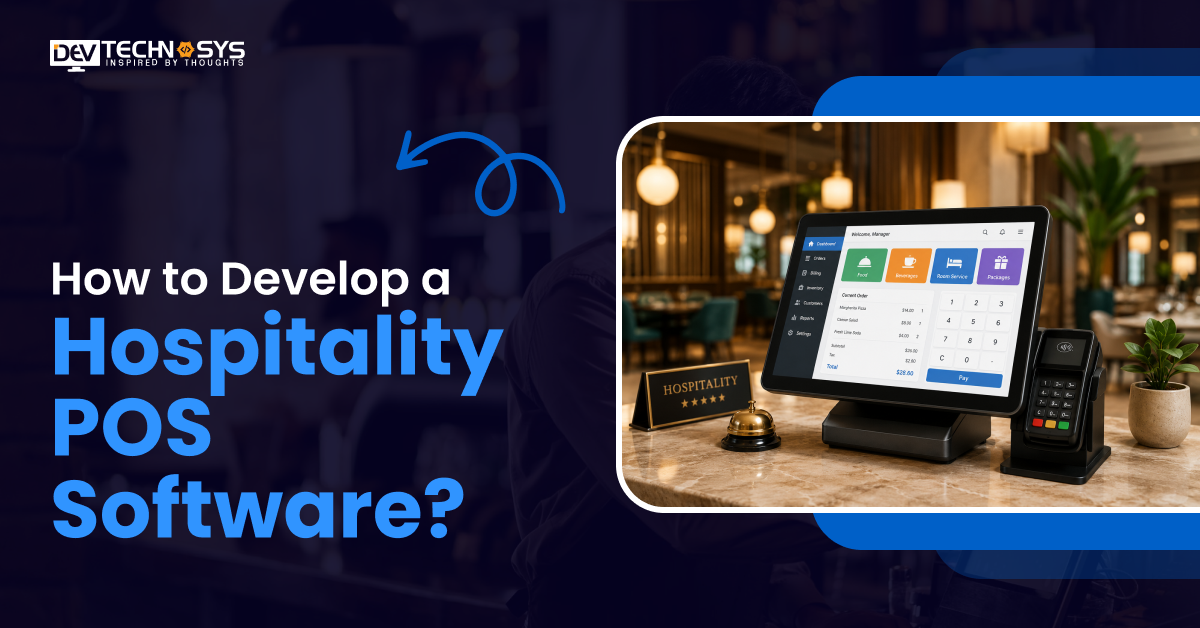
Hospitality businesses in 2026 no longer rely on simple systems to manage different operations. Be it restaurants, cafes, hotels, or resorts, all need a smarter choice, a hospitality POS software. This program can manage orders, payments, inventory, customers, and analytics all in one platform.
The increased customer demand for convenience has forced enterprises to develop a hospitality POS software. It helps to increase service speed, automate procedures, and enhance guest experiences. These modern POS systems help businesses work efficiently and scale more quickly.
Do you also want to transform your business with innovative hospitality Point of Sale software? It is the ideal time to invest in hospitality POS software development, offering everything from AI-powered analytics to cloud-based access.
To build a fully-featured hospitality POS system, a correct strategy, technology, integrations, and an enterprise-focused approach are needed. In this blog, we will learn everything related to hospitality POS application development.
What Is Hospitality POS Software and How Does It Work?
Hospitality POS software is a digital system that lets businesses manage orders, payments, and inventory from one platform. It is intended specifically for restaurants, hotels, cafes, and resorts.
This software combines front-end service staff with kitchen, billing, and management systems to streamline everyday operations. The top POS software development companies develop hospitality POS software to boost the speed, accuracy, and guest experience. These systems also cut down on human mistakes and delays in operations.
Working of a Hospitality POS Software
- Order Placement: Orders are placed by staff or customers through POS terminals, mobile apps, or QR-based digital menus in less time.
- Order Processing: Then the order request is sent to the kitchen display directly for a quick and accurate preparation.
- Billing & Payment: The POS system automatically applies taxes and calculates the bill, and allows customers to pay with multiple secure payment methods.
- Inventory Update: With each order completion, the stock levels get updated in real time. It avoids shortages and over-ordering issues.
- Reporting & Analytics: The system generates real-time sales reports and insights for better business decision-making strategies.
How Custom Hospitality POS Software Is Better Than Traditional Systems?
Relying on traditional hospitality POS systems is not sufficient in 2026. Restaurants, hotels, cafes, and resorts are getting modernized with time and demand custom mobile hospitality POS solutions. In this section, we will differentiate how custom hospitality POS software development is better from traditional ones.
Feature |
Traditional POS Systems |
Custom Hospitality POS Software |
| Customization | Limited features and rigid workflows | Fully customized based on business needs |
| Scalability | Difficult to scale for multiple locations | Easily scalable for franchises and chains |
| AI Capabilities | Minimal or unavailable | AI-powered analytics, forecasting, and automation |
| Third-Party Integrations | Limited integrations | Seamless integration with CRM, ERP, delivery apps, and payment gateways |
| Cloud Accessibility | Mostly on-premise systems | Cloud-based access from anywhere |
| Customer Experience | Basic billing and checkout | Personalized offers, loyalty programs, and faster service |
| Inventory Management | Manual or semi-automated | Real-time inventory tracking and smart stock alerts |
| Reporting & Analytics | Basic reports | Advanced real-time business insights and predictive analytics |
| Payment Options | Limited payment methods | Contactless, QR-based, mobile wallet, and multi-currency payments |
| Security | Standard security features | Advanced encryption, PCI-DSS compliance, and fraud detection |
| Performance Speed | Slower during peak hours | Optimized for high-volume hospitality operations |
| Long-Term Cost Efficiency | Higher maintenance and upgrade costs | Better ROI with automation and operational efficiency |
Hospitality POS Software Development Process Explained in Simple Steps
To develop a hospitality POS software, it is recommended to understand how restaurants, hotels, etc., actually work. This is because we are aiming to build a system that connects multiple operations in one smooth workflow.
A successful hospitality POS custom software development is far beyond just coding. It’s about business needs, ideal tech stack, design, and more to build something that improves speed and accuracy.
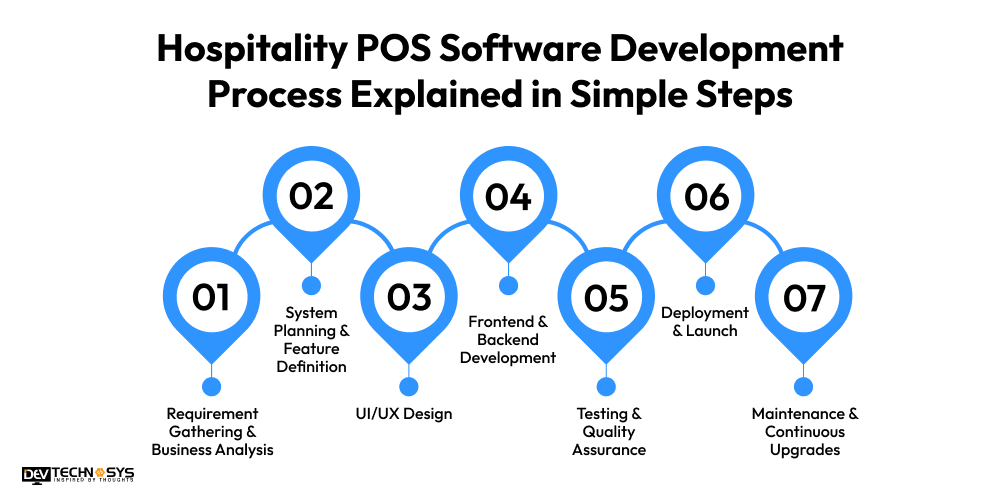
1. Requirement Gathering & Business Analysis
The hospitality POS system development process begins with understanding business goals, operational flow, and target users. In this stage, the system scope, core modules, integrations, and scalability needs are defined.
Developers also examine the apin points to make the developemnt smooth from the beginning. It is important to ensure the POS solution aligns with restaurant, hotel, or cafe requirements effectively.
2. System Planning & Feature Definition
In this phase, the core structure of POS software development services is planned. It also includes deciding and finalizing features like order management, billing, inventory tracking, and customer management.
Also, this step includes defining system architecture and module interactions. This guarantees seamless communication between all the components and supports scalability in the future.
3. UI/UX Design
The next step is to focus on UI/UX design of the application. It includes developing a simple, fast, and easy-to-use interface for the overall staff and managers. The main goal is to create an intuitive UI/UX that speeds up business operations.
Designers make prototypes and wireframes that help management navigate through the app smoothly. It also supports quick order handling and seamless user experiences.
4. Frontend & Backend Development
Developing the frontend and backend is the core hospitality POS software product development services stage. The frontend handles user interaction, and the backend manages databases, APIs, billing systems, and business logic.
When they are both combined, a fully functional system is built. So basically, here the hospitality POS software is all set to support real-time order processing, inventory updates, and payment handling.
5. Testing & Quality Assurance
To develop a hospitality POS software, thorough testing is necessary. It ensures the SaaS hospitality POS platform works smoothly under real-world conditions. For this, the platform’s speed, performance, security, and accuracy are checked on multiple devices during peak hours.
Also, the QA team finds out the bugs, fixes issues, and optimizes the system. This can ensure reliable operation, preventing downtime and a seamless customer and staff experience.
6. Deployment & Launch
As the testing is completed, the hotel POS software development is all set to be deployed. Such a platform is launched on cloud or on-premises servers. The system goes live for real-time use and helps restaurants or hotels in managing operations digitally.
When the platform is deployed properly, it helps businesses minimize operational disruptions. Also, it delivers faster, more accurate customer service experiences.
7. Maintenance & Continuous Upgrades
After launch, ongoing maintenance ensures the system remains updated and efficient in this ever-evolving market. Here, developers regularly fix bugs, improve performance, and add new features according to user feedback.
Continuous updates help the hospitality POS software adapt to changing business needs. It also helps the software keep up with technological advancements and evolving hospitality industry trends.
Must-Have Features to Develop a Hospitality POS Software
The forward-thinking hospitality enterprises in 2026 wanted something more than just a billing system. A feature-studded hospitality POS system improves restaurant operations, customer experience, and manages daily workflow. The core hospitality POS software features directly impact business performance, service speed, and long-term scalability.
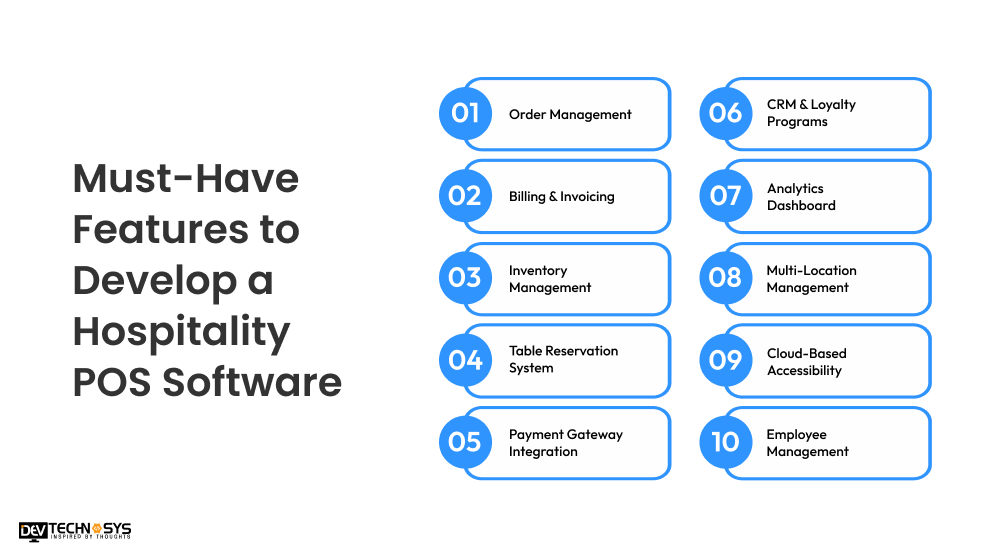
Hospitality POS Feature |
Key Benefit |
| Order Management | Faster and error-free order processing |
| Billing & Invoicing | Quick and accurate payment handling |
| Inventory Management | Real-time stock monitoring and control |
| Table Reservation System | Better seating and booking management |
| Payment Gateway Integration | Secure and flexible digital transactions |
| CRM & Loyalty Programs | Improved customer engagement and retention |
| Analytics Dashboard | Real-time business performance insights |
| Multi-Location Management | Centralized branch operation control |
| Cloud-Based Accessibility | Remote access to POS operations anytime |
| Employee Management | Efficient staff tracking and scheduling |
i. Order Management
Hospitality order management software can manage dine-in, takeaway, online, and QR-based orders. It reduces manual errors and improves coordination between staff and kitchen teams.
ii. Billing & Invoicing
Hospitality billing and invoicing software helps systematize payment, taxes, and discount calculations to generate a receipt. It enhances transaction accuracy and supports multiple payment methods.
iii. Inventory Management
Inventory management in hospitality POS lets the enterprises track ingredient consumption, supplier records, and stock availability. It minimizes wastage, prevents shortages, and improves purchasing decisions.

iv. Table Reservation System
With the QR code ordering system, guests can access menus, place orders, and even make reservations. It helps enterprises reduce waiting times and optimize seating arrangements.
v. Payment Gateway Integration
The hospitality payment processing software supports secure payments through cards, UPI, mobile wallets, and digital payment methods. It strengthens contactless payment integration and NFC payment technology.
vi. CRM & Loyalty Programs
With hospitality CRM integration, hotels and restaurants can store customer preferences, order history, and loyalty rewards. It offers personalized marketing campaigns to improve customer engagement and repeat visits.
vii. Analytics Dashboard
The AI-powered dashboard of modern businesses provides analytics that deliver instant insights into sales, guest behavior, and operations. It helps hospitality businesses make smart decisions by optimizing workflow.
viii. Multi-Location Management
A multi-location hospitality POS system helps restaurants and hotels manage sales, inventory, and staff operations across multiple branches. It improves operational consistency, centralizes business control, and simplifies performance monitoring.
ix. Cloud-Based Accessibility
Cloud-based POS architecture enables hospitality businesses to access operational data remotely from any device. It improves scalability, real-time monitoring, system flexibility, and secure data management.
x. Employee Management
A hospitality staff management system helps businesses track employee attendance, schedules, productivity, and shift management. It improves workforce coordination and increases accountability.
AI Features Revolutionizing Hospitality POS Software in 2026
AI is revolutionizing the restaurants, hotels, cafes, and resorts in a modern and manageable way. Rather than only relying on manual processes, today’s hospitality businesses are adding smart, AI-integrated POS systems.
The AI features help automate workflows, predict customer behavior, optimize inventory, and improve service experiences. Some of the top AI features transforming hospitality POS software include:
AI-Powered Hospitality Feature |
What It Actually Does |
Business-Level Impact |
| Predictive Sales Intelligence | Forecasts future sales using customer and seasonal data | Improves operational planning and revenue optimization |
| Smart Inventory Forecasting | Predicts stock requirements automatically | Reduces food wastage and inventory shortages |
| Personalized Guest Recommendations | Suggests menu items based on customer behavior | Increases upselling and customer engagement |
| AI-Based Dynamic Pricing | Adjusts pricing based on demand and peak hours | Maximizes profitability and competitive pricing |
| Voice-Enabled POS Ordering | Accepts voice-based order placement and commands | Speeds up service and reduces manual workload |
| AI Chatbots & Virtual Assistants | Handles reservations, inquiries, and support requests | Enhances customer support availability |
| Fraud Detection Monitoring | Identifies suspicious transactions in real time | Improves payment security and risk management |
| Automated Workforce Optimization | Predicts staffing needs using operational data | Reduces labor inefficiencies and scheduling issues |
| Customer Sentiment Analysis | Analyzes reviews and feedback automatically | Helps improve guest satisfaction strategies |
| AI-Driven Business Analytics | Generates actionable operational insights instantly | Supports smarter decision-making and business growth |
How Much Does It Cost to Build Hospitality POS Software in 2026?
The average hospitality POS software development cost can be estimated at $10,000 to $28,000+. The final development cost is determined by the complexity of the POS software. We will explain it like this:
- A simple hospitality software with a basic MVP structure has very little development complexity. Therefore, the cost to develop a hospitality POS can range between $10,000 and $16,000.
- A mid-range hospitality POS solution is a combination of core and advanced integrations, increasing development complexity. It can cost somewhere from $16,000 to $22,000.
- A hospitality POS software solution with advanced integrations and modern technologies has a very high level of development complexity. Such software can cost between $22,000 and $28,000+.
Despite the complexity, several other factors are available that can influence the hospitality POS software cost. These include regulatory compliance, UI/UX design, development team, developer’s location, API integration, and several other factors. Have a look at some of these factors affecting the cost to develop a hospitality POS software.
1. Third-Party Integration
Hospitality POS integration services like payment gateways, CRM platforms, ERP systems, delivery apps, and accounting software influence the development cost.
These integrations require additional API development, testing, synchronization, and ongoing maintenance. For seamless operations, businesses need more integrations, which raises the cost of custom software development.
Integration Type |
Estimated Cost |
| Payment Gateway Integration | $800 – $1,500 |
| CRM & Loyalty Program Integration | $1,000 – $2,000 |
| Food Delivery App Integration | $1,200 – $2,500 |
| ERP & Accounting Software Integration | $1,500 – $3,500 |
2. Choice of Platform
The selection between developing Android, iOS, or cross-platform POS solutions usually affects the development expenses. A platform with multi-platform compatibility needs additional design, development, testing, and maintenance efforts. It can increase project complexity, development time, and hospitality management POS software development prices.
Platform Type |
Estimated Cost |
| Android POS App Development | $10,000 – $18,000 |
| iOS POS App Development | $12,000 – $20,000 |
| Web-Based POS Solution | $10,000 – $22,000 |
| Cross-Platform POS Development | $15,000 – $25,000+ |
3. Security & Compliance
Security measures like data encryption & PCI-DSS compliance can impact the budget to build POS software for small businesses and large enterprises. Such security standards demand secure payment processing, protected customer data storage, and compliance management. It minimizes cyber risks but elevates the hospitality POS software development cost.
Security Feature |
Estimated Cost |
| Data Encryption Implementation | $1,000 – $2,500 |
| PCI-DSS Compliance Setup | $2,000 – $6,000 |
| Multi-Factor Authentication | $1,200 – $3,000 |
| Security Testing & Monitoring | $1,500 – $4,000 |
4. Hardware Ecosystem & Compatibility
Modern hospitality POS softwares generally supports barcode scanners, receipt printers, NFC devices, kiosks, and cash drawers. These hardware systems ensure the POS system’s compatibility for restaurants, hotels, cafes, and multi-location environment businesses. However, this can increase complexity, efforts, and cost to develop hospitality POS software.
Hardware Integration |
Estimated Cost |
| Barcode Scanner Integration | $1,500 – $2,500 |
| Receipt Printer Compatibility | $1,500 – $3,000 |
| NFC & Contactless Payment Support | $2,000 – $4,500 |
| Multi-Device POS Hardware Integration | $3,000 – $6,000 |
5. Deployment Architecture (Cloud vs. On-Premises)
A cloud-based hospitality POS software requires cloud hosting, storage, scalability, and cybersecurity infrastructure. In contrast, on-premises deployment involves hardware installation and maintenance.
The selected deployment architecture affects the software flexibility, performance management, scalability, and hospitality POS software development cost.
Deployment Type |
Estimated Cost |
| Cloud Infrastructure Setup | $2,000 – $5,000 |
| On-Premises POS Deployment | $3,000 – $7,000 |
| Cloud Security & Backup Systems | $2,500 – $6,000 |
| Server Maintenance & Monitoring | $2,000 – $5,500 |
Want a chatbot demo or pricing? Fill the form and talk to our experts today.
Pick what you need below — you can select more than one — then tap Get detail to continue.
-
Chatbot demo dashboard
-
Cost to develop an app
-
Industry report
-
Case study
Hospitality POS Software Development Timeline Explained
The average time for hospitality POS software development services ranges from 3 to 7+ months. The development timeline is affected by the platform complexity, AI integrations, custom features, third-party APIs, and other requirements. Here is a structured development timeline roadmap explained below.
Development Stage |
Estimated Timeline |
Key Activities |
| Requirement Analysis & Planning | 1–2 Weeks | Business analysis, feature planning, competitor research, and workflow mapping |
| UI/UX Design | 2–3 Weeks | Creating wireframes, POS dashboards, mobile-friendly layouts, and user journeys |
| Frontend & Backend Development | 6–10 Weeks | Developing core modules, admin panels, APIs, payment systems, and cloud infrastructure |
| POS Hardware & Third-Party Integrations | 2–4 Weeks | Integrating payment gateways, CRM, ERP, barcode scanners, and inventory systems |
| AI Features & Automation Integration | 2–3 Weeks | Implementing AI analytics, smart recommendations, forecasting, and automation tools |
| Testing & Quality Assurance | 2–3 Weeks | Bug fixing, performance testing, security checks, and usability optimization |
| Deployment & Launch | 1 Week | Cloud deployment, app store release, POS hardware setup, and production launch |
| Post-Launch Support & Upgrades | Ongoing | Performance monitoring, feature enhancements, and security updates |
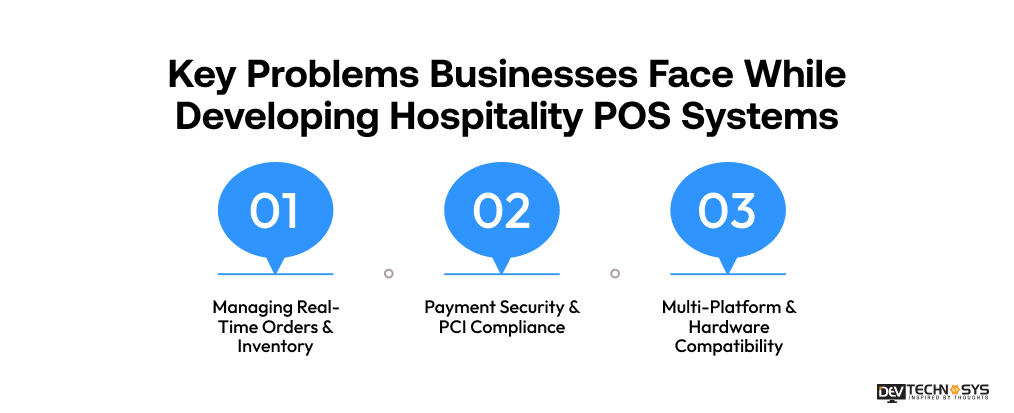
Key Problems Businesses Face While Developing Hospitality POS Systems
Even when everything goes well, the POS development company faces challenges when they develop a hospitality POS software. In this section, we are addressing the problems faced while building a hospitality POS system and their solutions.
1. Managing Real-Time Orders & Inventory
Hospitality businesses, such as restaurants, hotels, or cafes, go through difficulty while managing live order updates and inventory coordination. It is because the inventory has to be managed across multiple departments or locations. Even a single delay can lead to stock mismatches, order errors, and operational mismanagement.
Solution: Implement cloud-based real-time synchronization to maintain accurate operational and inventory data.
2. Payment Security & PCI Compliance
Maintaining security while making digital payments is a major problem in hospitality POS development. Businesses must safeguard the payment information of customers while complying with PCI-DSS regulations, encryption standards, and cybersecurity practices. Otherwise, it can lead to fraud, financial losses, and operational risks.
Solution: Use encrypted payment gateways and PCI-DSS-compliant security infrastructure for secure transactions.
3. Multi-Platform & Hardware Compatibility
When businesses make a hospitality POS software, they must operate smoothly across multiple devices and operating systems. They also have to operate with hardware components like printers, scanners, kiosks, and tablets. Ensuring compatibility across different environments increases development complexity and requires extensive integration.
Solution: Build a scalable POS architecture with flexible device and hardware integration capabilities.
Technologies Required for Hospitality POS Software Development
Selecting the right, modern hospitality POS technology guarantees quick transactions, inventory management, secure payment, and a seamless user experience.
The ideal technologies depend on the software’s features, integrations, AI capabilities, and expected business scale. We will now understand the technologies needed to develop a hospitality POS software.
Technology Layer |
Recommended Technologies |
Purpose in Hospitality POS Software |
| Frontend Development | React.js, Angular, Vue.js | Build responsive and interactive user interfaces |
| Mobile App Development | Flutter, React Native, Swift, Kotlin | Develop cross-platform and native mobile POS apps |
| Backend Development | Node.js, Python, Laravel, Java | Manage business logic, APIs, and server-side operations |
| Database Management | PostgreSQL, MySQL, MongoDB | Store customer, billing, and inventory data securely |
| Cloud Infrastructure | AWS, Microsoft Azure, Google Cloud | Enable cloud hosting, scalability, and remote access |
| Payment Gateway Integration | Stripe, PayPal, Razorpay, Square | Process secure online and offline payments |
| AI & Analytics | TensorFlow, OpenAI APIs, Power BI | Enable predictive analytics and AI-powered automation |
| Real-Time Communication | WebSockets, Firebase | Support live order tracking and instant updates |
| Security Technologies | SSL Encryption, OAuth 2.0, PCI-DSS Compliance | Protect transactions and sensitive customer data |
| POS Hardware Integration | RFID, Barcode Scanners, NFC, IoT APIs | Connect the POS software with hardware devices |
| DevOps & Deployment | Docker, Kubernetes, Jenkins | Automate deployment and system management |
| Reporting & Dashboards | Tableau, Power BI, Google Data Studio | Generate real-time operational insights and reports |
Emerging Technologies in Hospitality POS Systems for 2026
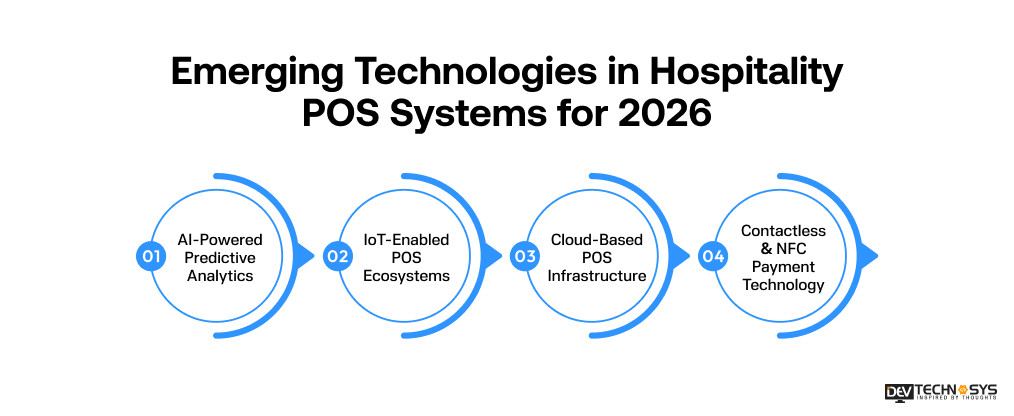
A reliable hospitality POS software development company integrates the latest technologies into new hospitality systems. AI, IoT, cloud computing, and contactless ecosystems are the highly innovative emerging technologies of 2026. Here, we will understand how these innovations transform restaurants, hotels, resorts, and cafes’ operations.
1. AI-Powered Predictive Analytics
Future hospitality POS software trends include AI-powered predictive analytics. It helps businesses in forecasting sales trends, customer behavior, and inventory requirements.
Predictive analytics works on the basis of historical and real-time data. This technology improves decision-making, reduces operational inefficiencies, and enables smarter business planning.
2. IoT-Enabled POS Ecosystems
IoT-enabled devices in hospitality POS softwares connect it with smart kitchen equipment, inventory sensors, kiosks, and payment terminals. It even upgrades operational automation, real-time monitoring, and device communication. This way, it helps hospitality businesses streamline workflows and reduce manual operational inefficiencies.
3. Cloud-Based POS Infrastructure
A cloud-based POS system lets businesses have access to their operational data remotely. For this, they utilize secure internet-based platforms. This technology enhances scalability, real-time synchronization, data security, and a multi-location management system. Cloud-based POS infrastructure limitations are associated with traditional on-premises POS environments.
4. Contactless & NFC Payment Technology
Contactless payment systems using NFC technology enable customers to complete transactions quickly through smartphones, cards, or wearable devices. This technology improves payment convenience, reduces physical interaction, speeds up checkout processes, and enhances customer experiences across modern hospitality businesses
¬
Final Words
Present-day hospitality businesses are switching and adopting smarter, more connected POS solutions. Their motive is to improve customer experiences, streamline operations, and increase long-term profitability.
Integrating AI, cloud computing, and other advanced technologies, these hospitality POS software are transforming the way restaurants, hotels, and cafes operate. Therefore, do develop a hospitality POS software, businesses require the right development strategy.
Along with strategy, the right developemnt partner, tech stack, integrations, and security measures are needed to build your own POS system.
Frequently Asked Questions
Find answers to the most common questions related to this article.
The overall cost to build a hospitality POS software can generally range between $10,000 and $28,000+. The final development expenses are determined by complexity, the developer’s location, UI/UX, security, and several other factors. A simple app with basic but essential integrations is less costly than the fully-featured ones.
A hospitality POS software must integrate some essential features like order management, billing and invoicing, and inventory tracking. Some other features include payment gateway integration, table management, CRM, loyalty programs, analytics dashboards, employee management, and cloud access. In 2026, the upcoming latest systems offer QR ordering, contactless payments, AI-driven reporting, and real-time synchronization.
Yes, integrating AI to make a hospitality POS software helps in automating operations and improving customer experiences. The common AI features include predictive analytics, personalized recommendations, automated customer support, fraud detection, and dynamic pricing. When AI is combined with the hospitality POS software, businesses can increase efficiency, reduce operational costs, and improve decision-making.
React.js, Angular, Flutter, Node.js, Python, Laravel, PostgreSQL, MongoDB, AWS, and Google Cloud are the core technologies used to create a hospitality POS software. Other important technologies include AI APIs, payment gateways, WebSockets, and IoT integrations. These can support real-time communication, secure transactions, scalability, and advanced business analytics features.
As hospitality POS systems are becoming popular, businesses should invest in them due to improved:
Operational efficiency
Customer experiences
Scalability
Automates workflows
Personalization
Seamless integrations
Real-time analytics
AI-powered automation
Better flexibility
After investing to create a hospitality POS softwares, businesses can meet the evolving needs of hospitality businesses.