














Hotel POS Development at a Glance:
-
- Custom hotel POS platforms are highly demanded in 2026 because they offer greater flexibility, scalability, and integration capabilities.
- The hotel Point of Sale software market is USD 9.112 billion in 2025. It is expected to reach USD 15.44 billion by 2035.
- Generally, the overall cost to develop a hotel POS software can be estimated from $10,000 to $28,000+.
- Modern hotel POS systems require advanced integrations with PMS, CRM, payment gateways, and accounting platforms for seamless hotel management.
Gone were the days when hotels operated for only room bookings and front-desk management. Today’s hotel businesses manage multiple guest transactions every minute, from restaurants, spas, bars, cafes, to room services.
Managing these tasks manually, through disconnected systems, can lead to errors, delays, inventory issues, and poor guest experience. That’s where a hotel POS system for hotels becomes essential and makes a grand entry.
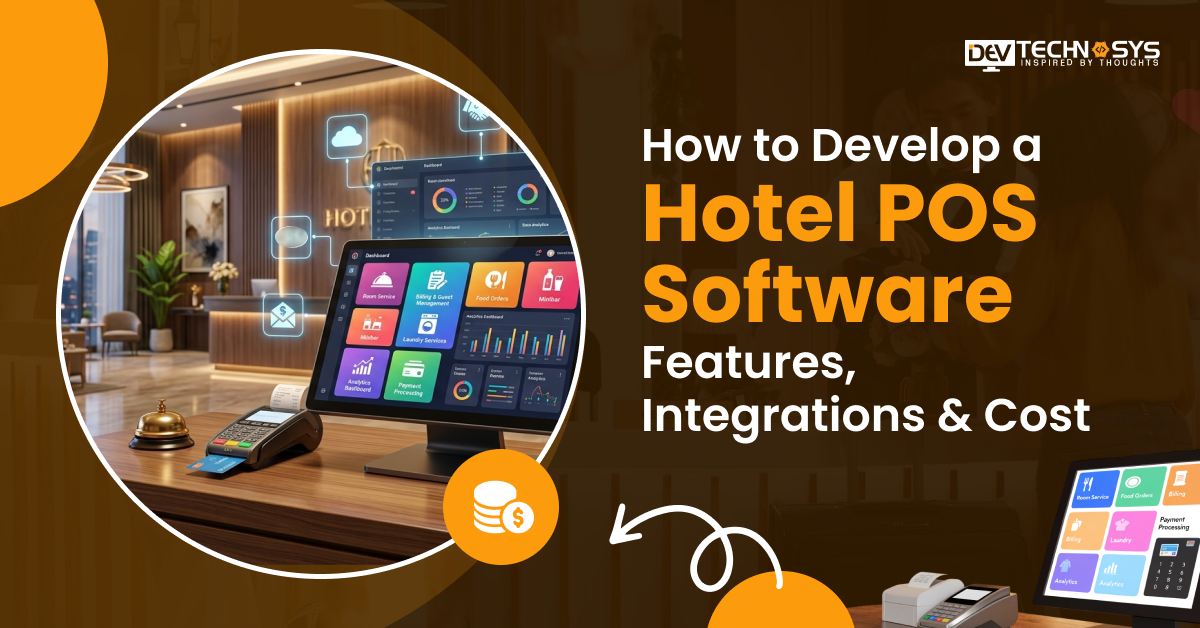
A hotel POS system helps businesses consolidate payments, automate operations, and track real-time sales. It even connects PMS, CRM, booking engines, and payment gateways seamlessly. Are you someone who wants to develop a hotel POS software?
This guide is definitely for you. It covers how to make a hotel POS software, its key features, integrations, architecture, and development cost.
A Complete Overview of Hotel POS Systems
A hotel POS (Point of Sale) system is a hardware and software solution that processes transactions and tracks sales. It manages the operations of various revenue centers of the hotels, including restaurants, bars, spas, and cafes. Hotel POS software development services act as a centralized operational hub for sales, inventory, and staff.
Key Features and Benefits of POS Software for Hotels:
- Room-Charging Capabilities
- Centralized Billing
- Cross-Departmental Tracking
- Hotel Inventory Management
- Enhanced Guest Experience
Hotel POS vs PMS: Features, Functions & Use Cases
POS and PMS systems play important but different roles in hotel and hospitality operations. A POS is used to handle billing, payments, restaurants, bars, and other guest transactions. Whereas a PMS is integrated to manage reservations, guest check-ins, and room operations.
Feature |
Hotel POS System |
Hotel PMS |
| Main Users | Restaurant staff, cashiers, bar managers | Front desk staff and hotel managers |
| Core Functions | Billing, payments, and inventory tracking | Room booking, check-in/check-out |
| Revenue Source | Restaurant, spa, bar, and retail revenue | Room booking and accommodation revenue |
| Guest Data Handling | Tracks guest purchases and transactions | Stores guest profiles and reservation details |
| Operational Areas | Restaurants, spas, bars, cafes | Front desk, housekeeping, and reservations |
| Real-Time Updates | Syncs outlet transactions instantly | Updates room availability and guest status |
| Integration Role | Sends billing data to PMS | Shares guest stay data with POS |
| Example Use Case | Charging restaurant bills to guest rooms | Managing reservations and room allocation |
Why Modern Hotel Businesses Need to Develop Smart POS Solutions?
Hotel businesses in 2026 are inclined to use hotel POS software to manage guests, multiple operations, and real-time services. Integration of POS software helps businesses to automate workflows, improve guest experiences, increase operational efficiency, and support scalable hospitality management digitally.
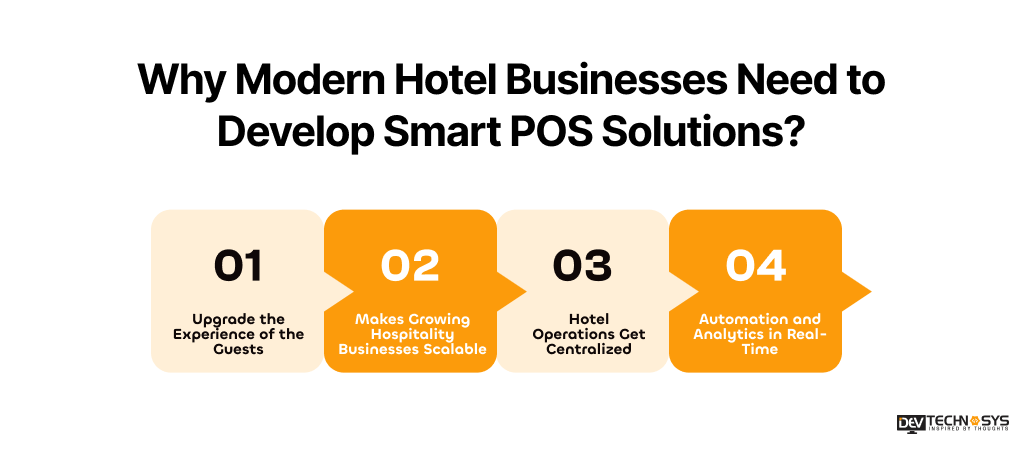
1. Upgrade the Experience of the Guests
Faster billing, contactless payments, personalized services, and seamless room charging are the services offered by cloud-based POS architecture. It helps enhance guest experience by delivering convenience across restaurants, spas, cafes, and hotel services.
2. Makes Growing Hospitality Businesses Scalable
Cloud-based hotel POS systems built by top POS software development companies support businesses in several ways. It offers multi-property management, remote accessibility, third-party integrations, and operational scalability, essential for long-term business growth.
3. Hotel Operations Get Centralized
The latest hotel POS app development solutions connect restaurants, front desks, housekeeping, inventory, and payment systems. All these systems are connected to a centralized platform. It helps hospitality businesses in streamlining their operations with reduced manual management.
4. Automation and Analytics in Real-Time
Advanced hotel restaurant POS software enables real-time sales tracking, AI-driven insights, automated reporting, and inventory monitoring. It allows enterprises to enhance their decision-making by optimizing operational performance with increased efficiency.
What are the Types of Hotel POS Systems Based on Business Models?
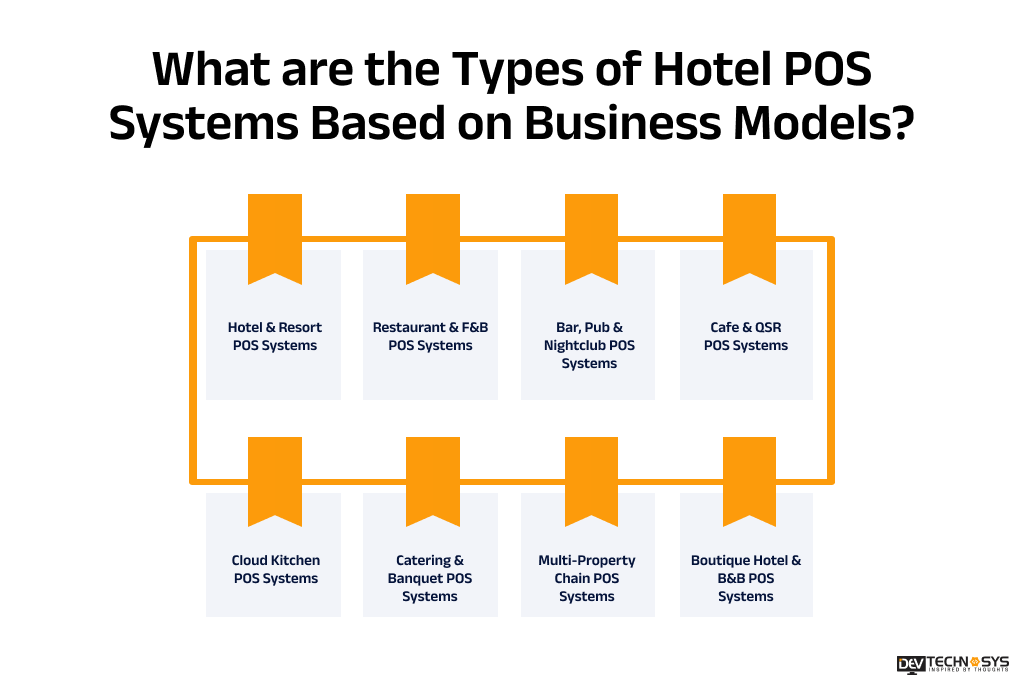
Hotel & resort, restaurant and F&B, cloud kitchen, catering, and banquet are the essential types of hotel POS systems. These businesses demand to build a custom hotel POS software according to their operational workflow. This development type is also affected by the guest services and property size. Here, we will learn about some of these hotel POS system types.
1. Hotel & Resort POS Systems
Hotel and resort POS systems are built to handle guest billing, room charges, restaurants, spas, and multiple hotel departments. All these functions are managed through a unified and streamlined hospitality platform.
2. Restaurant & F&B POS Systems
Restaurant and food-service POS solutions help in supervising overall hotel dining-related operations and services. It includes table management, order processing, kitchen coordination, and payment handling.
3. Bar, Pub & Nightclub POS Systems
A bar, pub, and nightclub SaaS-based hotel POS solution strengthens the functionalities for a nightlife and entertainment business. It manages operations like fast billing, beverage inventory tracking, tab management, and high-volume transactions.
4. Cafe & QSR POS Systems
A cafe and quick-service restaurant POS systems are ideal for cafes, food courts, and quick-service restaurants. They focus on rapid ordering, self-service payments, QR ordering, and faster customer checkout experiences.
5. Cloud Kitchen POS Systems
Cloud kitchen POS systems help delivery-based food businesses automate online order handling. It handles services like online food orders, delivery integrations, inventory tracking, and centralized kitchen operations.
6. Catering & Banquet POS Systems
Catering and banquet POS systems simplify large-scale event management operations smoothly. It streamlines services by centralizing bookings, catering services, billing, food services, and guest coordination.
7. Multi-Property Chain POS Systems
Multi-property chain POS systems manage the workings of multiple hotel branches at different locations. It centralizes billing, reporting, inventory, and guest management in an efficient and streamlined way.
8. Boutique Hotel & B&B POS Systems
Boutique hotel POS systems support personalized hospitality experiences. It provides guest management, simplified billing, and operational flexibility for small hospitality businesses and bed-and-breakfast properties.
Behind the Scenes: How Hotel POS Software Works?
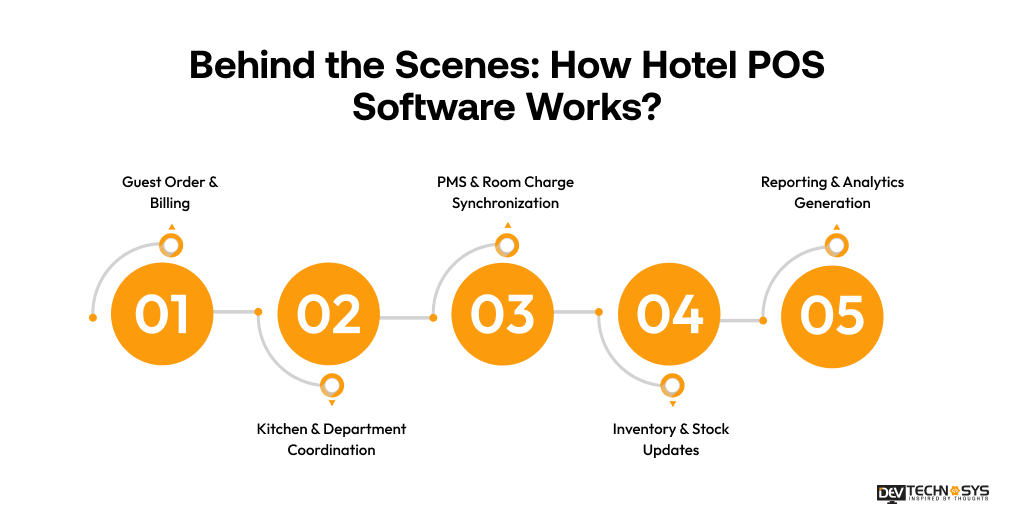
A multi-property hotel POS software operates as a centralized system. It connects billing, payments, inventory, guest services, and hotel departments in real time. Businesses develop a hotel POS software because it automates operations, reduces manual errors, and delivers faster guest experiences. In this section, we will understand its workflow.
1. Guest Order & Billing Processing
When guests place orders at restaurants, cafes, or room service, the POS system instantly records transactions. Then, it generates bills and updates payment details automatically.
2. Kitchen & Department Coordination
The system sends orders directly to kitchens, bars, or service departments in real time. This can help staff reduce delays and improve operational communication efficiently.
3. PMS & Room Charge Synchronization
Hotel POS software is nowadays connected with PMS platforms. It posts restaurant, spa, or minibar charges directly to guest rooms for centralized billing management.
4. Inventory & Stock Updates
With a hotel POS system, every transaction updates inventory levels automatically. It allows hotels to monitor stock availability, reduce wastage, and manage procurement processes efficiently
5. Reporting & Analytics Generation
The POS system collects operational and sales data continuously and generates real-time reports. It also offers revenue insights, staff analytics, and business performance dashboards for management teams.
Want a chatbot demo or pricing? Fill the form and talk to our experts today.
Pick what you need below — you can select more than one — then tap Get detail to continue.
-
Chatbot demo dashboard
-
Cost to develop an app
-
Industry report
-
Case study
How to Develop a Hotel POS Software? Step-by-Step Development Guide
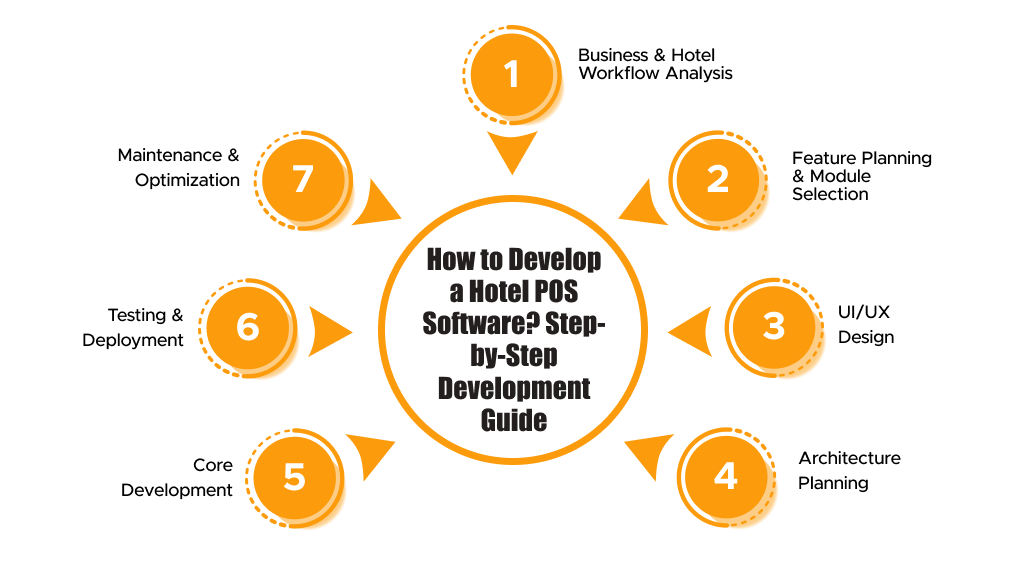
To develop a hotel POS software, businesses must focus on strategic planning, scalable architecture, seamless integrations, and hospitality-focused workflows. Following each development step, let enterprises build secure, efficient, and user-friendly hotel POS systems. We have explained the entire development process step-wise.
Step 1: Business & Hotel Workflow Analysis
The first and crucial step of hotel POS development is understanding hotel operations, billing requirements, and restaurant management. A development company offering Saas development services helps businesses analyze operational challenges. With this, enterprises can define project goals and create customized hotel POS software.
Step 2: Feature Planning & Module Selection
In this stage, businesses finalize essential hotel POS features. It includes features like billing, inventory tracking, room service, PMS integration, reporting, loyalty programs, and payment systems. Proper module planning helps reduce unnecessary development costs. It also guarantees the software supports operational efficiency and future scalability requirements.
Step 3: UI/UX Design
Now, a mobile app development agency works on an intuitive and user-friendly interface. A simplified interface brings ease in billing, order management, and hotel operations. It even improves staff productivity, reduces operational errors, and enhances user experiences. A well-designed UI/UX enables faster adoption of hotel POS software across departments.
Step 4: Architecture Planning
Architecture planning means selecting the right backend infrastructure, databases, APIs, cloud systems, and security frameworks for hotel POS. If the architecture is scalable and seamless, it helps businesses support real-time operations and third-party integrations. It even supports multi-property management and long-term software performance without operational disruptions.
Step 5: Core Development
It’s the time for final, core development, where a fintech software development company builds essential functionalities. It includes developing frontend interfaces, backend logic, inventory systems, payment modules, billing workflows, and operational management functions. This phase transforms the software concept into a fully functional hotel POS platform capable of managing hospitality services.
Step 6: Testing & Deployment
Before launch, the hotel POS software undergoes functionality testing, performance testing, security testing, and integration validation. It is really mandatory to identify operational, technical, and security-related issues. After successful testing, the software is deployed across hotel departments, ensuring stable, smooth, and seamless hospitality service management.
Step 7: Maintenance & Optimization
Post-launch maintenance helps businesses monitor software performance regularly. It fixes technical issues, releases feature updates, and optimizes operational workflows. Ongoing maintenance ensures the hotel POS system remains secure, scalable, integration-ready, and aligned with evolving hospitality industry requirements and guest expectations.
What are the Core & Advanced Features of Modern Hotel POS Systems?
Modern but core features of hotel POS software let enterprises manage billing, reservations, guest services, inventory, and payments. While advanced features integrated by a software development company support the hospitality workflow automation, cloud management, contactless services, and more. Have a look at the core and advanced features a cross-platform POS development for hotels should have.
-
Core Features of Hotel POS Systems
Core hotel POS features help businesses manage daily operations and services efficiently. It includes hospitality operations, guest transactions, restaurant workflows, billing, and other hotel services.
Core Feature |
Functionality |
Business Benefit |
| Order & Billing Management | Processes guest orders, invoices, and payments | Faster and error-free billing operations |
| Table Management | Tracks table reservations and dining availability | Improves restaurant service efficiency |
| Room Service / IRD | Handles in-room dining requests and billing | Enhances guest convenience and experience |
| KOT Printing | Sends kitchen orders directly to the kitchen staff | Reduces manual errors and service delays |
| Reservation & Waitlist Management | Manages restaurant and hotel reservations | Improves customer flow and occupancy management |
| Loyalty & Membership Programs | Tracks rewards, memberships, and guest benefits | Increases customer retention and repeat bookings |
| Discounts & Coupons | Applies promotional offers and discount codes | Boosts guest engagement and sales conversions |
| Tax / GST / VAT Management | Automates tax calculations and compliance reporting | Simplifies financial management and taxation |
-
Advanced Features of Modern Hotel POS Systems
Advanced hotel POS features help hospitality businesses automate operations. These features can improve guest personalization and manage multi-property ecosystems more intelligently.
Advanced Feature |
Functionality |
Business Benefit |
| Room Booking (PMS Integration) | Connects POS with hotel room management systems | Centralizes guest and reservation management |
| Check-In / Check-Out Automation | Streamlines guest arrival and departure processes | Reduces front-desk workload and waiting time |
| Housekeeping Management | Tracks room cleaning and maintenance status | Improves room availability and operational efficiency |
| Restaurant Linking | Connects hotel restaurants with guest room billing | Enables seamless room charge posting |
| Banquet & Event Management | Manages event bookings, catering, and billing | Simplifies large-scale hospitality operations |
| Guest Mobile Application | Supports mobile ordering, payments, and bookings | Enhances digital guest experiences |
| Cloud-Based POS Management | Enables centralized remote access and monitoring | Improves scalability and operational flexibility |
| AI-Powered Analytics & Automation | Provides predictive insights and smart recommendations | Improves revenue generation and decision-making |
Best Hotel POS Software Examples for Business Inspiration
Oracle Simphony, Toast POS, Lightspeed POS, Revel Systems, and EPOS Now are among the top hotel POS software examples. They are utilized to upgrade guest services and streamline hospitality operations. After learning about these popular hotel POS systems, businesses can understand essential features, integrations, scalability, and modern hospitality.
Hotel POS Software |
Best For |
Key Strength |
Popular Among |
| Oracle Simphony | Enterprise hotels & resorts | Advanced multi-property management | Luxury hotel chains |
| Toast POS | Hotel restaurants & cafes | Restaurant-focused POS operations | Hospitality restaurants |
| Lightspeed POS | Boutique hotels & resorts | Cloud-based analytics & flexibility | Boutique hospitality businesses |
| Square POS | Small hotels & cafes | Easy deployment & payment processing | Small hospitality businesses |
| Clover POS | Mid-sized hotel outlets | Flexible hardware ecosystem | Hotels & restaurants |
| Revel Systems | Multi-location hotel POS | Centralized reporting & operations | Hotel franchises |
| TouchBistro | Hotel bars & restaurants | Tableside ordering capabilities | Food & beverage operations |
| SkyTab POS | Integrated hospitality payments | Fast transaction processing | Hotel dining services |
| EPOS Now | Small & growing hotel businesses | Inventory & employee management | Independent hotels |
| NCR Aloha POS | High-volume hospitality operations | Enterprise-grade restaurant management | Large hotel restaurants |
Hotel POS Development Timeline & Key Integrations
Hotel accounting software, CRM, payment gateway, PMS, and ERP are among the primary hotel booking POS integrations. These integrations can even affect the development timeline, which is typically between 3 and 7+ months. In this section, we will understand how different integrations influence hotel POS software development time.
Integration / Module |
Average Timeline |
Purpose |
| PMS Integration | 2–3 Weeks | Syncs room bookings, guest profiles, and billing |
| Hotel CRM Integration | 1–2 Weeks | Manages customer data and loyalty programs |
| Secure Payment Gateway Integration | 1 Week | Enables secure digital and card payments |
| Accounting Software Integration | 1–2 Weeks | Automates financial reporting and tax management |
| Booking Engine Integration | 1–2 Weeks | Connects online reservations with hotel operations |
| Housekeeping System Integration | 1 Week | Tracks room cleaning and maintenance status |
| ERP Integration | 2–4 Weeks | Centralizes inventory, procurement, and operations |
| Loyalty System Integration | 1 Week | Supports rewards, memberships, and guest retention |
| Delivery Platform Integration | 3–7 Days | Connects food delivery and online order systems |
| Complete Hotel POS Development | 3–7+ Months | Builds a fully integrated hospitality management ecosystem |

Hotel POS Software Architecture & Tech Stack Explained
Businesses that want to build a hotel POS software require the right software architecture and modern technology stack. When a scalable architecture is combined with the right tech stack makes the foundation stronger. A custom hotel POS software development helps hotels improve scalability, security, integrations, and operational performance.
Architecture Area |
PurPOSe of Hotel POS Software |
Recommended Technologies |
| Frontend Architecture | Manages billing screens, dashboards, and user interactions | React.js, Angular, Vue.js, Flutter |
| Backend Architecture | Handles business logic, APIs, and transaction processing | Node.js, .NET, Python, Java |
| Database Management | Stores guest data, billing records, and inventory details | PostgreSQL, MySQL, MongoDB |
| Cloud Infrastructure | Enables scalability, centralized access, and remote operations | AWS, Microsoft Azure, Google Cloud |
| API Integration Layer | Connects PMS, CRM, booking engines, and payment gateways | REST APIs, GraphQL APIs |
| Real-Time Communication | Supports live transaction updates and synchronization | WebSockets, Firebase |
| Security Architecture | Protects guest information and payment data | OAuth 2.0, SSL Encryption, JWT |
| Analytics & Reporting | Generates operational and revenue insights | Power BI, Tableau, Google Analytics |
| Offline Synchronization | Maintains POS operations during connectivity issues | Local caching, sync engines |
| DevOps & Deployment | Supports software deployment and infrastructure automation | Docker, Kubernetes, Jenkins |
What are the Major Challenges in Hotel POS Software Development?
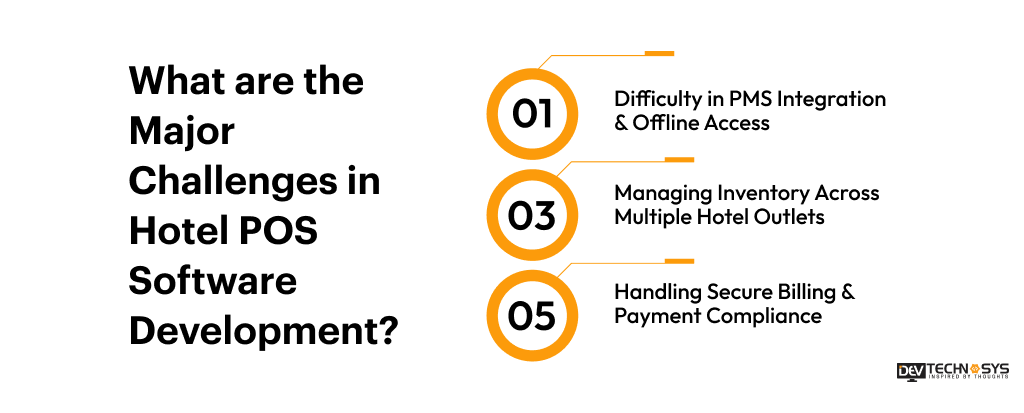
It’s difficult to develop a hotel POS software because it demands a balance between fast-paced transactions and deep operational integrations. It gives rise to the issues related to offline usage, PMS integration, data security, and inventory management. Now we will know these challenges and ways to reduce or eliminate them.
1. Difficulty in PMS Integration & Offline Access
Maintaining smooth connectivity between the POS system and PMS is the biggest challenge for a POS software development company. If the internet connection or coordination is poor, it disturbs billing, reservations, and guest services. It can even lead to operational delays and bad customer experiences.
Solution: Businesses can use cloud-based APIs, offline sync functionality, and real-time backups. It ensures uninterrupted hotel operations and seamless PMS connectivity.
2. Managing Inventory Across Multiple Hotel Outlets
Hotels that combine restaurants, bars, cafes, and room services find it difficult to manage the inventory of different departments. If the stock visibility is unclear, it can cause inventory mismatches, wastage, delayed procurement, and operational inefficiencies. This can cost the businesses’ reputation, especially during busy hospitality hours.
Solution: Implement centralized inventory systems with real-time stock tracking and automated purchase management for better operational control.
3. Handling Secure Billing & Payment Compliance
The complex billing process is done with the hotel’s POS system. It includes billing operations involving room charges, restaurant payments, taxes, discounts, and multiple payment methods. Securing the payment-related information of guests while ensuring PCI DSS compliance standards is a major challenge when you make a hotel POS software.
Solution: Businesses can use encrypted payment gateways, secure authentication systems, and PCI DSS-compliant infrastructure. It protects guest payment data and prevents security breaches.
How Much Does Hotel POS Software Development Cost?
The average hotel POS software development cost is estimated somewhere between $10,000 and $28,000+. The final cost is determined by the complexity of the platform. We will explain it in this way:
Basic App: A simple app built with the MPS strategy has fewer integrations and lower complexity. It will cost approximately from $10,000 to $16,000.
- Mid-Level App: The mid-range app is a combination of basic and advanced integrations, which keeps the complexity moderate. Such an app will cost between $16,000 and $22,000.
- Advanced App: An advanced app has modern features and the latest technologies, making it complex to build. This app will price from $22,000 to $28,000+.
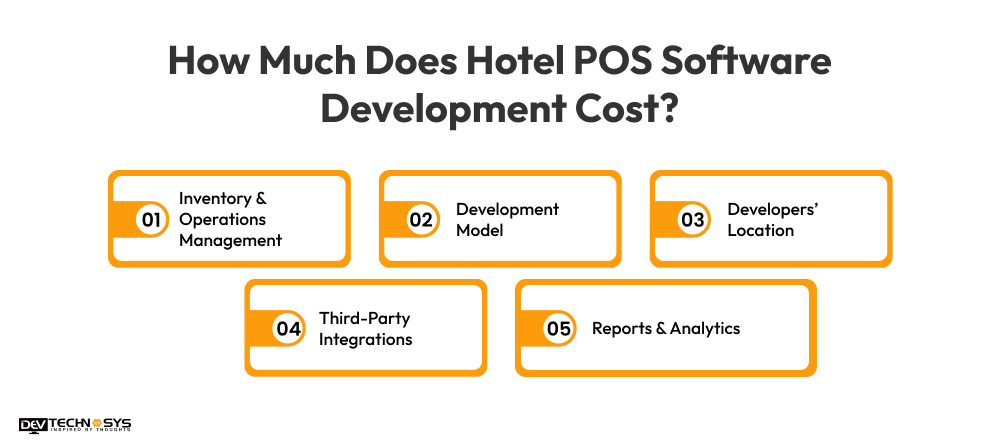
Apart from complexity, multiple factors that can influence the cost of custom software development for a hotel POS. It includes third-party integrations, inventory & operations, reports & analytics, development model, developers’ location, and more. We will clearly explain how these factors affect the cost to build hotel management POS software.
3. Third-Party Integrations
API & third-party integrations can significantly impact the budget to create a hotel POS software. It includes integrations such as payment gateways, CRM, OTAs, accounting software, food delivery apps, and channel managers. All these increase the complexity, maintenance requirements, and the cost to develop a multi-property management system.
Integration Type |
Estimated Cost |
Purpose |
| Hotel Payment Gateway Integration | $800–$1,500 | Enables secure online and card payments |
| CRM Integration | $1,000–$2,000 | Manages guest relationships and customer data |
| OTA & Channel Manager Integration | $1,500–$3,500 | Synchronizes bookings and room availability |
| Accounting Software Integration | $800–$1,800 | Automates financial records and tax management |
| Food Delivery App Integration | $1,000–$2,500 | Connects hotel restaurants with delivery platforms |
| Email & SMS Integration | $800–$1,200 | Sends automated guest notifications and updates |
4. Inventory & Operations Management
Inventory and operational modules influence the cost to build a hotel POS software because it requires:
- Real-time stock tracking
- Recipe management
- Vendor coordination
- Wastage monitoring
- Purchase order automation
- Multi-store synchronization
These features increase the cost to develop hotel POS software as they require advanced backend logic, centralized databases, and seamless communication.
Feature |
Estimated Cost |
Purpose |
| Real-Time Stock Tracking | $2,000–$3,500 | Monitors inventory availability instantly |
| Recipe Management | $1,500–$2,500 | Tracks ingredients and food consumption |
| Vendor Management | $1,500–$3,000 | Manages suppliers and procurement workflows |
| Wastage Tracking | $1,000–$2,000 | Reduces inventory loss and operational waste |
| Purchase Order Automation | $2,000–$4,000 | Automates purchasing and stock replenishment |
| Multi-Store Synchronization | $3,000–$7,000 | Centralizes operations across multiple locations |
5. Reports & Analytics
Modern reporting and analytics are responsible for the higher hotel and restaurant POS software development costs. It includes real-time data processing, dashboard creation, custom report generation, and performance tracking capabilities. Modules like sales reports, tax reports, and employee analytics want a scalable data architecture that increases the development cost.
Reporting Module |
Estimated Cost |
Purpose |
| Sales Reports | $1,000–$2,000 | Tracks revenue and transaction performance |
| Inventory Reports | $1,500–$2,500 | Monitors stock usage and inventory trends |
| Tax Reports | $1,000–$2,000 | Simplifies tax calculations and compliance |
| Employee Analytics | $1,500–$3,000 | Measures staff productivity and performance |
| Customer Reports | $1,500–$3,000 | Analyzes guest behavior and purchase patterns |
| Live Dashboard | $2,500–$5,000 | Provides real-time operational insights |
6. Development Model
The development model selected, as per the team structure, project flexibility, and engagement duration, affects cost to develop a hotel POS software. A dedicated development team brings scalability and offers continuous support, and a fixed-price model reduces flexibility. Whereas time-and-material and hybrid models impact overall budgeting, timelines, and resource allocation differently.
Development Model |
Estimated Cost |
Purpose |
| Dedicated Development Team | $6,000–$10,000 | Supports long-term development and scalability |
| Fixed-Price Model | $3,000–$6,000 | Best for projects with fixed requirements |
| Time & Material Model | $4,000–$8,000 | Offers flexibility for evolving project needs |
| Hybrid Development Model | $5,000–$9,000 | Balances flexibility, cost, and resource allocation |
7. Developers’ Location
Developers’ location significantly influences the cost of hotel POS software product development. It is due to differences in hourly rates, technical expertise, market demand, and operational expenses. Development teams in North America, Australia, and Western Europe typically charge higher rates for hotel POS development.
Developer Region |
Average Hourly Rate |
Cost Advantage |
| North America | $80–$150/hour | Premium expertise and enterprise development |
| Western Europe | $60–$120/hour | Strong technical standards and innovation |
| Australia | $70–$130/hour | Advanced hospitality software expertise |
| Eastern Europe | $40–$80/hour | Cost-effective development with skilled talent |
| Asia (India, Vietnam) | $20–$50/hour | Affordable and scalable development services |
Custom vs Ready-Made Hotel POS: Which is Better?
Hotel businesses in 2026 demand scalable, integration-ready, and guest-focused POS systems. These systems help them manage modern hospitality operations for modern people efficiently. A ready-made POS software offers faster deployment and lower upfront costs. If you build a hotel POS software that is customized, it provides greater flexibility, advanced integrations, and long-term business scalability.
Factor |
Custom Hotel POS Software |
Ready-Made Hotel POS Software |
| Customization | Fully tailored to hotel workflows and branding | Limited customization options |
| Integration Flexibility | Easily integrates with PMS, CRM, ERP, and APIs | Integration capabilities may be restricted |
| Scalability | Scales with business growth and multi-property operations | May face limitations as operations expand |
| Upfront Cost | Higher initial development investment | Lower setup and subscription cost |
| Deployment Time | Longer development and implementation timeline | Faster deployment and setup |
| Ownership & Control | Full ownership of features, data, and updates | Vendor controls platform updates and policies |
| Advanced Features | Supports AI, automation, and custom modules | Limited to pre-built functionalities |
| Long-Term ROI | Better flexibility and operational efficiency over time | Recurring subscription and upgrade costs |
Next-Generation Technologies in Hotel POS Software
The latest hotel POS software development is evolving with technologies like AI, IoT, contactless payment, and cloud connectivity. These next-gen technologies help hospitality businesses enhance their operations, efficiency, personalize guest experience, and strengthen security. We will understand how these technologies help the hotel Point of Sale system.
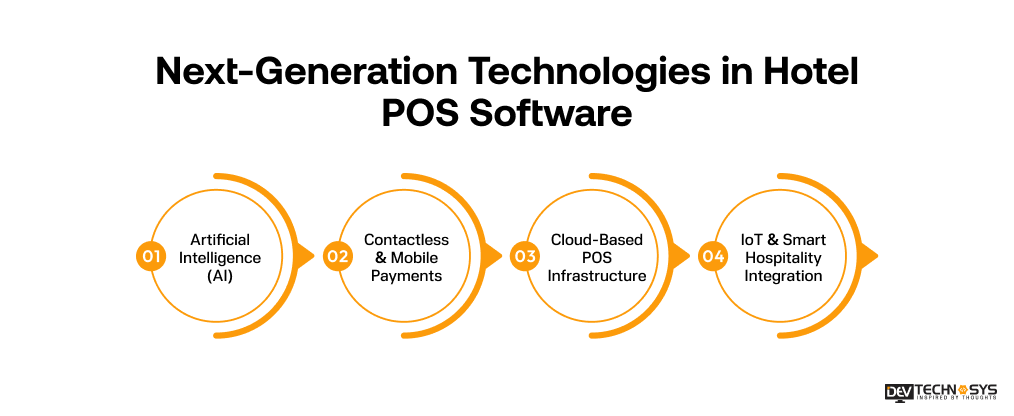
1. Artificial Intelligence (AI)
AI-powered hotel POS software supports smart upselling, guest behavior analysis, and predictive inventory management. AI in hotel POS software development also helps manage automated recommendations and personalized hospitality experiences through real-time data synchronization.
2. Contactless & Mobile Payments
Advanced POS platforms are integrating QR payments, NFC transactions, mobile wallets, and self-service ordering for contactless payment processing. It helps in delivering faster, safer, and frictionless payment experiences to the guests and decreases wait times.
3. Cloud-Based POS Infrastructure
A cloud-based hotel POS system offers businesses centralized management, remote accessibility, real-time synchronization, and automatic updates. It provides improved scalability for enterprises with multi-property hotel operations. A hotel business’s cloud database infrastructure hardware dependency improves operational flexibility.
4. IoT & Smart Hospitality Integration
IoT-enabled hospitality POS software development connects businesses with smart rooms, digital menus, self-service kiosks, and automated room services. It easily streamlines the hospitality operations and improves guest convenience while enabling real-time communication.
Conclusion
The evolving hospitality businesses explain that hotels in 2026 and beyond do not rely on traditional systems and operations. As guests are becoming modern, so hotel businesses also have to be contemporary.
Businesses create a hotel POS software that delivers faster services, contactless experiences, personalized interactions, and seamless transactions. Be it PMS, AI integration, cloud infrastructure, or real-time analytics, a well-developed hotel POS solution manages operations.
Whether you choose a custom-built platform or a ready-made solution, selecting the right hotel POS software development company is necessary. It helps improve efficiency, increase revenue, and build a smarter, future-ready hospitality business.
Frequently Asked Questions
Find answers to the most common questions related to this article.
The overall hotel POS software development cost can be somewhere between $10,000 and $28,000+. The final development cost is determined by the software’s complexity and multiple factors. The factors include UI/UX standard, developer’s location, maintenance & updates, security compliance, platform selection, development team, and so on.
Web and mobile POS technology for big or small hotels requires important integrations with:
PMS
CRM
Payment gateways
Booking engines
Accounting software
Housekeeping systems
ERP platforms, and so on.
These integrations help hotels streamline operations, automate billing, synchronize guest data, improve payment processing, and deliver seamless hospitality experiences.
Usually, it takes 3 to 6+ months to develop a hotel POS software for modern businesses. However, the development timeline is influenced by the platforms’ complexity, integrations, and security compliance. A simple, MVP hotel POS takes less development time than a highly advanced one.
Yes, AI can be integrated into hotel POS software, and modern hotel businesses are demanding it. It allows personalized guest recommendations, predictive inventory management, automated upselling, fraud detection, and real-time analytics. AI-powered automation helps hotels improve operational efficiency, enhance guest experiences, and increase revenue.
A POS system manages guest transactions, billing, restaurant operations, and payment processing. Whereas a PMS handles reservations, room allocation, guest check-ins, and housekeeping management. Both systems work together to streamline hotel operations, improve guest experiences, and centralize hospitality management processes efficiently.