





















Key takeaways:
-
- The cost to develop a private blockchain is around $8,000 to $30,000, depending on project complexity, platform choice, development team expertise, and location, and more.
- The global blockchain market is projected to grow from USD 32.99 billion in 2025 to USD 393.45 billion by 2030.
- Private blockchain platforms offer multiple revenue-generating opportunities for businesses through secure, scalable, and enterprise-focused solutions.
- The process to develop a private blockchain involves different key steps, such as conceptualizing the purpose of blockchain implementation and testing its functionality.
What if you could change the way businesses secure data? Well, you can do this by investing in private blockchain development. It offers a customized and permissioned network, ensuring enhanced privacy and security for the business operation. Unlike the public blockchain, the private blockchain is accessible only to authorized participants, making it ideal for businesses looking to protect sensitive information or data from cyber threats.
In a study, I found that the size of the worldwide blockchain market in 2026 is experiencing rapid expansion, with projected valuations ranging from approximately $39.8 billion to $67.4 billion. Hence, this shows room for business growth and gives businesses a competitive edge in today’s digital world.
So, if you are also considering to develop a private blockchain platform, this blog is for you. Read the blog until the end.
What is the Private Blockchain?
A private blockchain is a distributed ledger technology that can only be accessed by authorized participants. Unlike the public blockchain, which is open to all, the private blockchain offers control over who can be a participant or validate transactions. Hence, this allows for faster transaction processing, greater scalability, and enhanced privacy.
Private blockchains are often utilized in industries like supply chain management, healthcare, and finance, where data confidentiality and security are critical. They provide businesses with the benefits of blockchain technology, such as transparency and immutability, within a controlled environment.
Moreover, as AI has changed all the industry, integration of the Artificial Intelligence development services with private blockchain can further enhance data analysis, automation, and decision making processes that provide greater value to business.
How Are Private and Public Blockchain Networks Different From Each Other?
The private blockchain is quite different from the public blockchain, as mentioned in table below:
Features |
Private Blockchain |
Public Blockchain |
| Accessibility | Can not be accessed by unauthorized participants | Anyone can access the platforms with an internet connection. |
| Consensus Mechanism | A group of individuals or organizations control the system | Distributed among network participants |
| Scalability | More scalable because of limited participants | Face scalability issues as the network grows |
| Use Cases | Suitable for private transactions, supply chain management, and internal business apps. | Ideal for decentralized finance, cryptocurrencies, and public record-keeping. |
| Data Privacy | High level of data privacy and confidentiality | Limited data privacy; transactions are publicly visible |
Market Analysis of Blockchain Technology
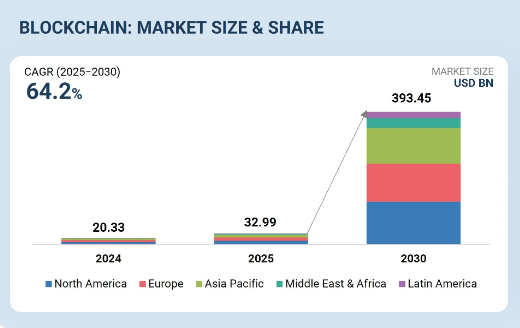
- The global blockchain market is projected to grow from USD 32.99 billion in 2025 to USD 393.45 billion by 2030 at a CAGR of 64.2% during the forecast period.
- The North America blockchain market accounted for a 34.8% revenue share.
- By offering, the services segment is expected to register the highest CAGR of 67.5%.
- By organization size, the SMEs segment is expected to grow at the fastest rate during the forecast period.
How Do Private Blockchain Work?
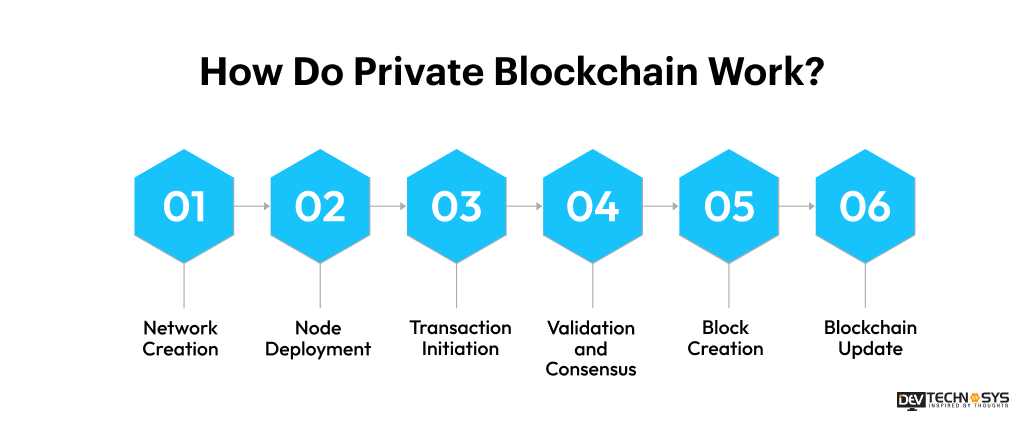
Do you know how private blockchain works? Well, with the following step-by-step, let’s learning how product blockchain works:
- Network Creation
- Node Deployment
- Transaction Initiation
- Validation and Consensus
- Block Creation
- Blockchain Update
1. Network Creation
A group of individuals or organizations creates a private blockchain network after agreeing on the protocols and rules that will determine the nodes (participants) and choosing the consensus mechanism.
2. Node Deployment
Nodes are devices or computers that join the network and participate in the validation and consensus process. Depending on the business’s requirements, these nodes can be deployed on-premises or in the cloud.
3. Transaction Initiation
Authorized users within the network initiate transactions on a private blockchain. Hence, these transactions can represent different activities, such as recording data, executing smart contracts, and transferring assets.
4. Validation and Consensus
After initiating transactions, it’s broadcast to all nodes in the network. These nodes validate the transaction’s authenticity and ensure that it is complex with the network’s rules. The consensus mechanisms, such as proof-of-authority, are used to agree on the transaction’s validity.
5. Block Creation
A block is a collection of validated transactions. After a consensus is reached, a new block is created and added to the blockchain. The block includes a hash for the previous block that makes a blockchain, which is challenging to tamper with.
6. Blockchain Update
The newly developed block is distributed to all nodes in the network. That updates their blockchain’s copies. Hence, this ensures all participants have an accurate and consistent ledger view.
Benefits of Private Blockchain Development
Nowadays, businesses are investing in a private blockchain, which offers significant benefits that make it the first choice for entrepreneurs looking for innovative private blockchain solutions. If you are also committed to innovation, learn how investment in blockchain application development services can benefit your business:
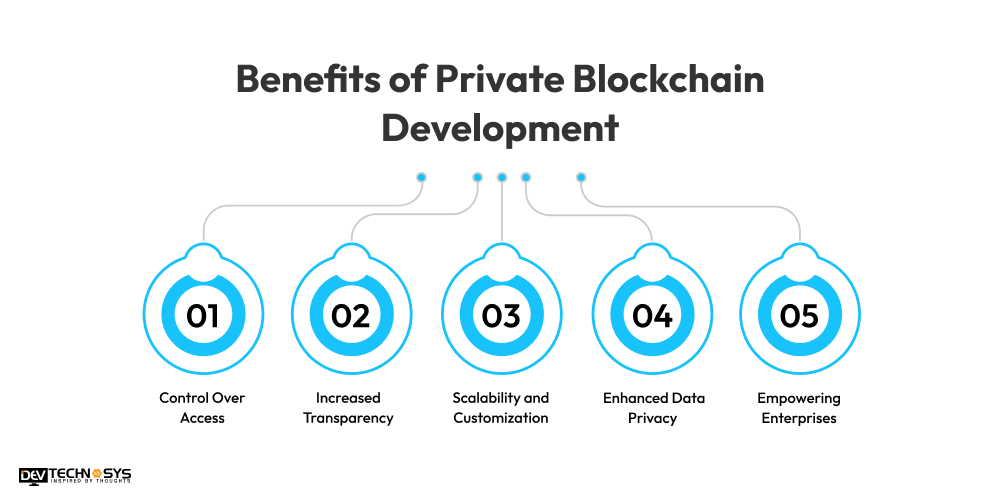
- Control Over Access
- Increased Transparency
- Scalability and Customization
- Enhanced Data Privacy
- Empowering Enterprises
1. Control Over Access
Private blockchain enables businesses to control access, which is one of the biggest blockchain benefits for business. Unlike public blockchains, which anyone can access, private blockchains are restricted. Hence, if you invest in private blockchain development, you will have great control over how you can view and change data so that sensitive information can remain secure.
2. Increased Transparency
Another one of the benefits of private blockchain for businesses is increased transparency. Maintaining privacy and transparency is critical for creating trust and accountability. With a private blockchain, you can ensure transparency within the network. As a result, authorized participants can easily view the entire transaction history and data authenticity. Hence, this transparency will help you improve compliance and prevent fraud.
3. Scalability and Customization
With blockchain development platform, you can enjoy significant stability and customization for your business with changing needs. You can scale your blockchain solution up or down based on demand, ensuring that technology remains aligned with their planned growth. Moreover, the system is optimized to handle high transactions, ensuring business performance is not compromised.
4. Enhanced Data Privacy
Compared to traditional databases, privacy blockchain offers enhanced data privacy. Cryptographic techniques must be used to ensure that data can be stored so that unauthorized parties cannot access it. This is significant for industries dealing with sensitive information, such as finance and healthcare.
5. Empowering Enterprises
Private blockchains streamline work processes and reduce costs at the workplace. For instance, the system can be used in supply chain management to track the movement of goods and ensure they meet quality standards. Moreover, the dapp development company uses blockchain technology to build a decentralized app that automates tasks and improves efficiency.
How to Develop a Private Blockchain: Step-by-Step Guide
Do you know how to build a blockchain network? Well, building a private blockchain is a quiet, complex, yet rewarding process. This involves different key steps, such as conceptualizing the purpose of blockchain implementation and testing its functionality.
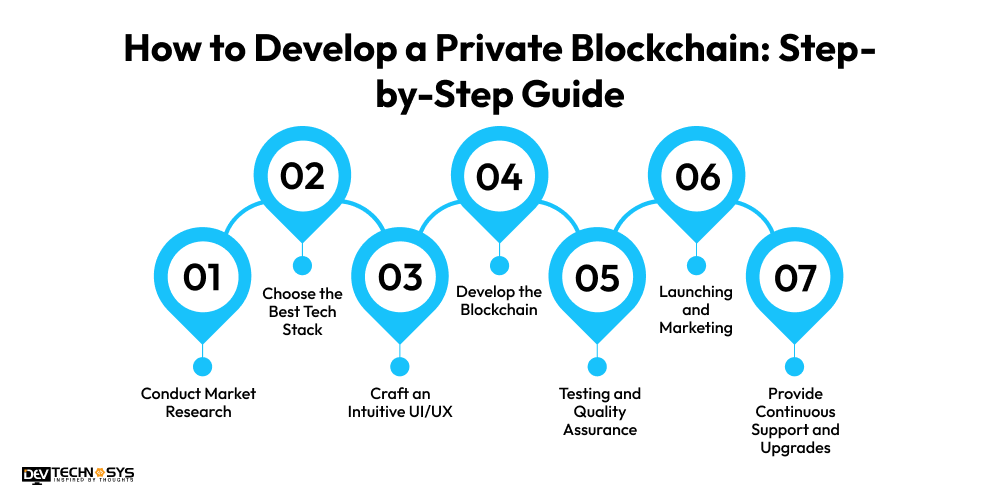
If you want to know more about the custom blockchain development process, let’s understand it with the following steps:
- Conduct Market Research
- Choose the Best Tech Stack
- Craft an Intuitive UI/UX
- Develop the Blockchain
- Testing and Quality Assurance
- Launching and Marketing
- Provide Continuous Support and Upgrades
1. Conduct Market Research
Let’s start with market research, a foundational step in private blockchain app development. It’s important for you to have an in-depth understanding of your target audience, market situation, and the industry you will enter. Moreover, you must also identify potential competitors and know what they offer so that you can change something new to fill the market gap, if any.
2. Choose the Best Tech Stack
Now, shift your focus to the tech stack used in developing private blockchains. While choosing the stack, consider your blockchain’s security, performance, and scalability. Some popular options include Hyperledger Fabric, Corda, and Ethereum.
As it’s quite difficult to choose the best tech stack among so many, you are advised to hire an Ethereum development company that is knowledgeable about different Tech Stacks and how to work with them.
3. Craft an Intuitive UI/UX
Now it’s time to design a good interface that can make your private blockchain accessible to a larger audience. Remember that crafting an intuitive user interface and user experience is important for user adoption.
You are responsible for ensuring potential users can easily interact with the platform. You must understand the value proposition and meet their expectations.
4. Develop the Blockchain
At this phase, your blockchain solution will take shape. Your private blockchain development company will create the core infrastructure, implement smart contracts, and integrate with external systems.
A dApps development company with experience in blockchain technology is critical for a successful project. Professionals will analyze all the requirements for your project and then move further accordingly, ensuring success.
5. Testing and Quality Assurance
This is one of the most significant stages of private blockchain development process, ensuring the security and reliability of the system. Conduct different testing, including unit testing, security audit, and integration testing.
This helps identify and resolve potential vulnerabilities before deployment. Hire one of the best blockchain development companies that can guarantee proper functionality and compliance with your blockchain.
6. Launching and Marketing
Finally, you can bring your blockchain solution to market. However, you are advised to develop a market strategy to reach your target audience and create awareness for your system.
With effective marketing, you can easily gain the consumer’s attention and build a strong community. Your private blockchain companies must also consider user feedback so that significant changes can be adjusted or new blockchain trends can be introduced.
7. Provide Continuous Support and Upgrades
Now that you have developed and launched your blockchain, your DeFi development company needs to provide continued support and maintenance for long-term success. You must offer reliable customer support to address your inquiries and issues immediately.
By staying updated with new blockchain development and making necessary adjustments, you can maintain the competitiveness of your solution in today’s competitive market.
Industry Insights: According to Reuters, institutional adoption of blockchain infrastructure is rapidly increasing. Major financial organizations such as J.P. Morgan, Coinbase, and Franklin Templeton are actively using blockchain for financial settlements and digital asset infrastructure.
10 Must-have Features of a Private Blockchain
Undoubtedly, private blockchains help businesses secure significant information and data. However, you must be aware of what makes it advanced and successful.
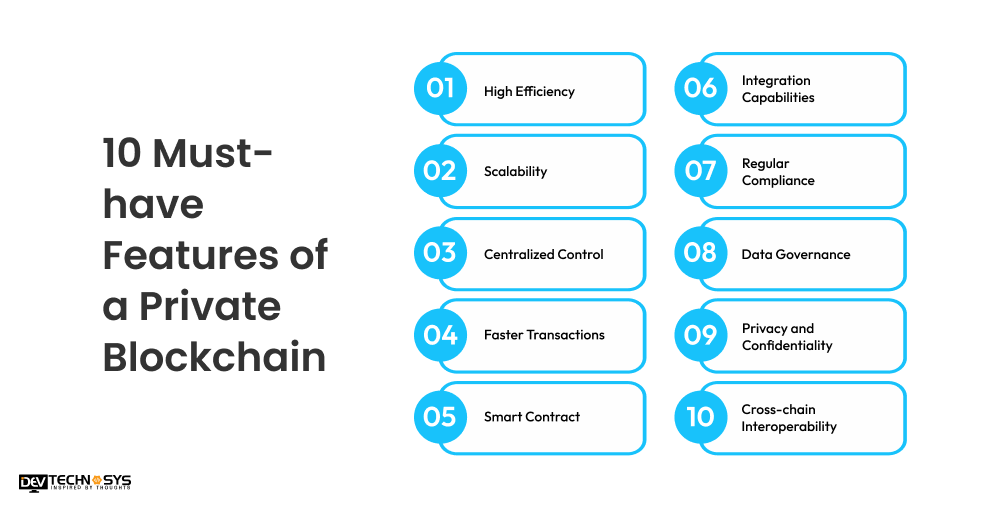
The features! Hence, you must consider the following unique and significant features to attain your business goals with this system:
- High Efficiency
- Scalability
- Centralized Control
- Faster Transactions
- Smart Contract
- Integration Capabilities
- Regular Compliance
- Data Governance
- Privacy and Confidentiality
- Cross-chain Interoperability
1. High Efficiency
Blockchain optimizes resource use and minimizes operational cost. This includes efficient consensus mechanisms, energy-efficient hardware, and storage optimization, which leads to cost savings and sustainability.
2. Scalability
Private blockchain handles increased workload and maintains performance with a growing network. Hence, this ensures that the system can grow as per the business’s needs.
3. Centralized Control
Centralized control is among the crucial features of private blockchain. Private blockchains are managed by a central authority that allows for greater control over network operations and governance. This makes them ideal for business use cases.
4. Faster Transactions
The system ensures faster transaction speed than public blockchains because of reduced network connections and the ability to customize consensus mechanisms.
5. Smart Contract
The self-executing contracts automate processes that reduce the requirement for intermediaries and streamline workflows. Hence, smart contract development increases the efficiency of operations while reducing costs.
6. Integration Capabilities
Ensure your blockchain integrates with existing systems and apps. This guarantees data flow and interoperability, enabling smoother transitions and adoption at the workplace.
7. Regular Compliance
Private blockchains adhere to relevant industry regulations and standards to maintain integrity and trust. As one of the key features of a private blockchain network, it ensures they also meet industry’s best practices and legal requirements.
8. Data Governance
With effective data governance, you can ensure security, compliance, and data quality. This includes access controls, audit trails, and data extension policies, thereby maintaining data privacy and trust.
9. Privacy and Confidentiality
With private blockchain, businesses can protect data privacy, sensitive data, and information from unauthorized access, making them suitable for managing sensitive data.
10. Cross-chain Interoperability
Interacting with another blockchain, both private and public, expands the network’s capabilities and enables collaboration with external entities that increase the network’s reach.
Industry Insights: According to the industry analysis by Blockchain Council, the enterprise blockchain market has already surpassed USD 600 billion globally.
Public vs. Private Blockchain: Knowing the Difference
Blockchain technology is mainly divided into public and private networks, each serving different business and operational purposes. Public blockchains focus on decentralization and transparency, while private blockchains prioritize security, control, and enterprise-level privacy. Here’s the table highlighting the difference in public vs. private blockchain , based on various factors.
Feature |
Public Blockchain |
Private Blockchain |
| Accessibility | Open to everyone | Restricted access to authorized users |
| Decentralization | Fully decentralized | Partially decentralized or centralized |
| Transparency | High transparency | Limited visibility and controlled access |
| Transaction Speed | Slower due to network validation | Faster with fewer participants |
| Security | Secured by consensus mechanisms | Secured through permissions and enterprise protocols |
| Scalability | Limited scalability | Highly scalable for enterprise usage |
| Governance | Community-driven | Controlled by a single organization or consortium |
| Energy Consumption | Higher energy usage | Lower energy consumption |
| Common Use Cases | Cryptocurrencies, NFTs, DeFi | Supply chain, healthcare, banking, enterprise solutions |
| Popular Platforms | Bitcoin, Ethereum | Hyperledger Fabric, Corda |
How Much Does Private Blockchain Development Cost?
The cost to develop a private blockchain can lie between $8,000 and $30,000. The cost generally depends on the platform, the complexity of features, and the location and skill of the development team. However, the basic blockchain app development cost might range from $8,000 to $15,000. But the cost to build a private blockchain app with advanced features and functionality is more than $30,000.
If your project has specific, unique criteria or varied levels of complexity, the costs will vary. Now let’s check out some key cost-influencing factors:
1. Feature Complexity & Scope
The complexity of the project can impact the development budget of your private blockchain platform. Simple blockchain solutions that need only basic asset tracking features cost less. However, complex hyperledger blockchain development with advanced features like smart contracts, multi-signature wallets, automation, and third-party integrations exceeds the cost significantly.
Project Complexity |
Estimated Cost |
Timeline |
| Basic Blockchain Solution | $4,000 to $6,000 | 1 to 2 Months |
| Mid-Level Blockchain Platform | $6,000 to $8,000 | 2 to 5 Months |
| Advanced Enterprise Blockchain | $8,000 to $10,000+ | 5 to 8 Months |
2. Development Team Location
The geographical location of blockchain developers might affects hourly development rates and overall project expenses. Hiring experienced mobile app development firm or private blockchain developers from North America or Western Europe is generally more expensive, whereas developers from Eastern Europe or Asia often provide more cost-effective blockchain development services.
Development Region |
Hourly Rate |
Project Timeline |
| Asia | $15 – $25/hour | 2 to 5 Months |
| Eastern Europe | $40 – $70/hour | 3 to 6 Months |
| North America/Western Europe | $70 – $100+/hour | 4 to 8 Months |
3. Platform Selection (Framework)
The choice of blockchain framework directly influences development complexity, implementation requirements, and licensing expenses. Popular platforms like Hyperledger Fabric, Corda, and Quorum offer different scalability, privacy, and customization capabilities, which can affect both development timelines and project budgets.
Blockchain Framework |
Estimated Cost |
Timeline |
| Hyperledger Fabric | $8,000 – $13,000 | 2 – 4 Months |
| Corda | $13,000 – $18,000 | 3 – 6 Months |
| Quorum | $18,000 – $22,000+ | 4 – 7 Months |
4. Security Requirements & Compliance
The polgon blockchain development services also involve enterprise-grade security, regulatory compliance, and advanced encryption standards, which demand additional development effort and testing. Industries such as finance, healthcare, and supply chain often require strict compliance measures, security audits, and secure identity management systems, increasing total development costs.
Security Level |
Estimated Cost |
Timeline |
| Standard Security | $5,000 – $7,000 | 1 – 3 Months |
| Advanced Security | $7,000 – $9,000 | 3 – 5 Months |
| Enterprise Compliance Security | $9,000 – $12,000+ | 5 – 8 Months |
5. Infrastructure & Node Maintenance
Private blockchain networks require dedicated infrastructure and continuous node maintenance for smooth operations. Costs include cloud hosting, server configuration, node monitoring, performance optimization, software updates, and ongoing technical support to maintain network stability and security.
Infrastructure Type |
Estimated Cost |
Timeline |
| Small Private Network | $8,000 – $11,000 | 1 – 2 Months |
| Medium Blockchain Infrastructure | $11,000 – $15,000 | 2 – 5 Months |
| Enterprise Node Infrastructure | $15,000 – $18,000+ | 5 – 7 Months |
6. UI/UX Design
An intuitive and user-friendly interface improves user engagement and operational efficiency within blockchain applications. Custom dashboard designs, responsive interfaces, mobile compatibility, and interactive user experiences require additional design and frontend development resources, increasing the overall project cost.
Design Complexity |
Estimated Cost |
Timeline |
| Basic UI/UX Design | $3,000 – $6,000 | 2 – 4 Weeks |
| Custom UI/UX Design | $6,000 – $9,000 | 1 – 2 Months |
| Advanced Enterprise UI/UX | $9,000 – $13,000+ | 2 – 4 Months |
How Long Does it Take to Build a Private Blockchain?
Building a private blockchain typically takes between 2 and 8 months, depending on project complexity, security requirements, integrations, and customization needs. Simple blockchain networks with limited functionality take less time to develop. Whereas the enterprise-grade platforms requiring smart contracts, compliance systems, multi-signature authentication, and advanced infrastructure demand longer development cycles.
Factors such as team size, chosen blockchain framework, UI/UX design, testing, and node deployment also significantly influence the overall project timeline and delivery schedule.
Development Stage |
Estimated Timeline |
| Planning & Requirement Analysis | 1 – 2 Weeks |
| UI/UX Design | 2 – 4 Weeks |
| Blockchain Development | 1 – 3 Months |
| Security & Compliance Implementation | 2 – 6 Weeks |
| Testing & Quality Assurance | 2 – 4 Weeks |
| Deployment & Maintenance | 1 – 2 Weeks |
Industry Insights: Statista reports that secure information exchange remains one of the top enterprise blockchain use cases globally, especially among finance, healthcare, and supply chain companies.
What are the Best Monitization Strategies for Private Blockchain?
Private blockchain platforms offer multiple revenue-generating opportunities for businesses through secure, scalable, and enterprise-focused solutions. Let’s check out some of the most effective monetization methods.
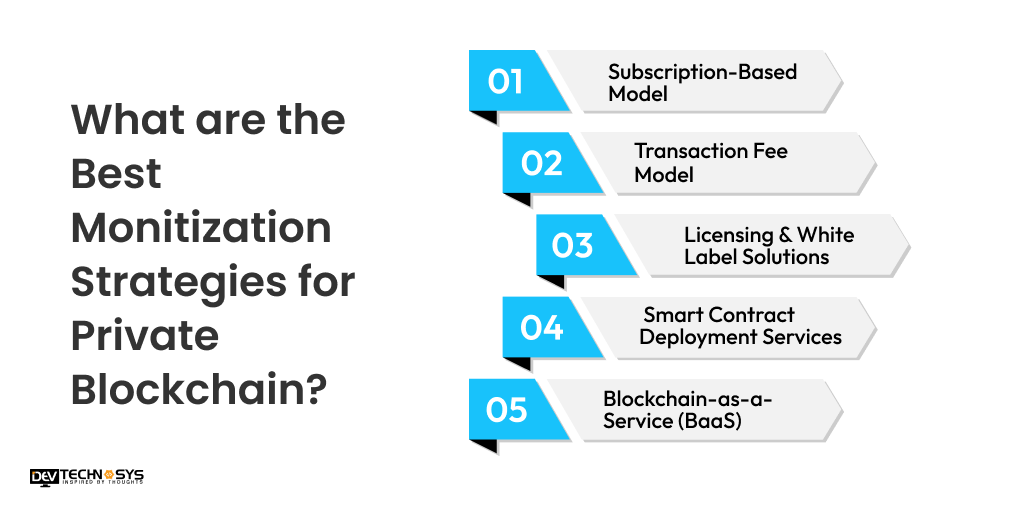
1. Subscription-Based Model
Users can pay subscription fees to access private blockchain platforms, dashboards, analytics tools, and premium business features. These fees can be paid monthly or yearly. This way of making money guarantees a steady income while providing flexible blockchain services that can be used by businesses, healthcare systems, supply chain networks, or financial institutions.
2. Transaction Fee Model
Private blockchain platforms can make money by charging transaction or processing fees for every task on the network that has been checked. This model is often used in fintech, cross-border payments, supply chain management, and platforms for transferring digital assets that need to make deals safe and clear.
3. Licensing & White Label Solutions
Businesses can make money from private blockchain technology by selling “white-label” blockchain solutions or letting businesses use their own platforms. Businesses can change the solution’s look and feel to fit their needs while cutting down on development time, infrastructure costs, and the difficulty of putting it in place.
4. Smart Contract Deployment Services
Blockchain service providers can make money by creating, deploying, and managing smart contracts for businesses and new businesses. These services help businesses run more smoothly while cutting down on costs and work that needs to be done by hand. They do this by automating things like agreements, payments, decentralized processes, and compliance management.
5. Blockchain-as-a-Service (BaaS)
Businesses can rent blockchain infrastructure, hosting, node management, and security services through Blockchain-as-a-Service instead of building their own systems from scratch. This cloud-based way to make money helps businesses use blockchain technology more effectively while giving service providers a steady stream of income.
Crucial Elements of The Blockchain Framework
A blockchain is a distributed digital ledger that records transactions in a way that makes them difficult to hack or alter. Here are the key elements of the blockchain framework that you know most about:
- Network
- Wallet
- Hashing
- Consensus
- Transaction
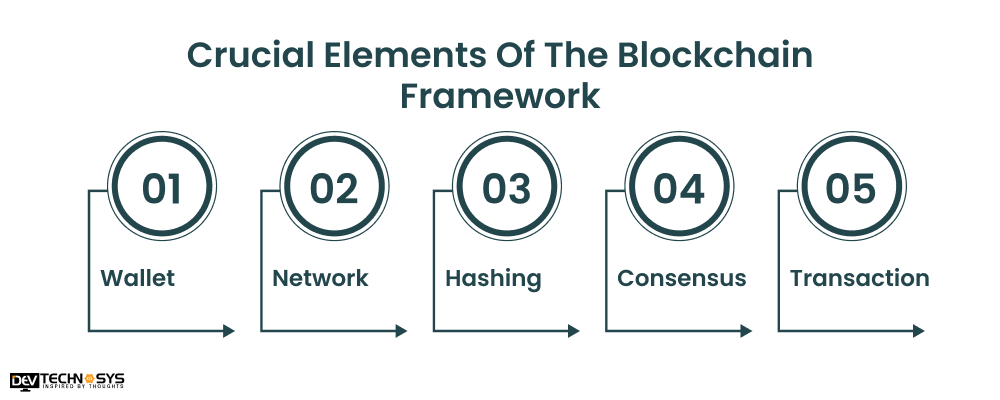
1. Network
In this peer-to-peer system, computers (nodes) connect and communicate. All the nodes maintain a copy of the blockchain to ensure security. The network operates on consensus mechanisms to validate and add new blocks to the chain. Typically, Network is very critical for Ethereum blockchain development services.
2. Wallet
This element stores private and public keys significant to access and central cryptocurrency. The public key is used to receive transactions, while the private key is used to sign and authorize transactions. Wallet can be either hardware-based (stored on physical devices) or software-based (stored on a mobile or computer device)
3. Hashing
It’s a cryptographic function that converts data into a different, fixed-length string of characters. In a blockchain, all blocks contain a hash of the previous block. Hence, this creates a blockchain where modifying one block can impact all subsequent blocks, making it challenging to tamper with the data.
4. Consensus
Consensus is a significant aspect of Solana blockchain development. It’s a process by which participants (nodes) in the network agree on the new block’s validity and add it to the blockchain. Several consensus mechanisms exist, such as Proof of Stake (PoS), Proof of Work (PoW), and Delegated Proof of Stake (DPoS).
5. Transaction
It’s a record of value transfer between two parties. In the blockchain, transactions are grouped into blocks and added to the chain. The transactions include information such as the address of the sender and recipient, the amount transferred, and a digital signature to verify the sender’s identity.
Pick what you need below — you can select more than one — then tap Get detail to continue.Want a chatbot demo or pricing? Fill the form and talk to our experts today.
Chatbot demo dashboard
Cost to develop an app
Industry report
Case study
Examples of Private Blockchain
Private blockchains, unlike public ones like Ethereum and Bitcoin, are designed for controlled and specific networks. They offer enhanced security, privacy, and stability for businesses. Here are some key examples to help you understand the private blockchain.
- Corda
- Quorum
- Hyperledger Fabric
1. Corda
It’s a distributed leader platform designed for the financial businesses. Its unique selling point is its confidentiality and focus. Transactions on this platform are only visible to the parties involved that ensure regulatory compliance. Hence, this makes it ideal for apps like securities settlement, trade finance, and asset management.
2. Quorum
It’s another business-grade blockchain platform based on the Ethereum blockchain. However, Quorum offers additional features for private networks, such as enhanced privacy and permission access. This platform is often used for financial apps, healthcare, and supply chain management development.
3. Hyperledger Fabric
Hyperledger Fabric is a modular, open-source blockchain platform designed for various use cases, from supply chain management to IoT apps. It offers customization and flexibility that allow businesses to create tailored blockchain solutions.
5 Use Cases of Private Blockchain
In today’s technological world, private blockchain has become one of the powerful solutions for businesses looking for efficient and secure daily management. If you are curious to know about the implementation of privacy and blockchain in different industries, here are some of the examples:
- Healthcare
- Real Estate
- Financial Services
- Intellectual Property
- Supply Chain Management
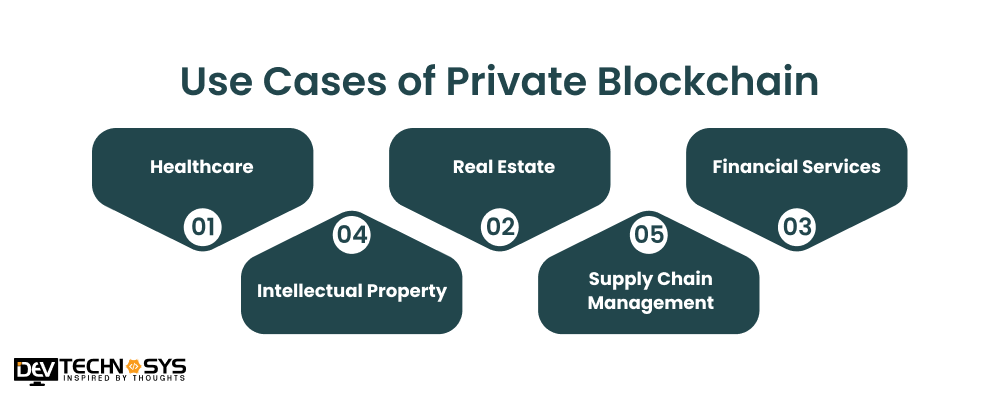
1. Healthcare
If Private blockchain integrates with healthcare app development services, it can potentially change the healthcare industry by ensuring secure medical data. Healthcare businesses can store patient data on a decentralized network that prevents data breaches and unauthorized access.
2. Real Estate
Blockchain in real estate app development makes streamlined real estate transactions possible by efficient and transparent property ownership record. Smart contact can also automate processes like property transfers and rental agreements, minimizing fraud while reducing paperwork.
3. Financial Services
For financial businesses, private blockchain facilitates key benefits. It can improve transaction speed, reduce fraud, and enhance security. Blockchain in finance app development can also be used for cross-border payment, eliminating the need for intermediaries to reduce costs.
4. Intellectual Property
A private blockchain can help prevent rights infringement and facilitate dispute resolutions by creating a digital ledger of ownership and creation dates. Moreover, it can enable a new startup model based on tokenizing intellectual property assets.
5. Supply Chain Management
Blockchain can improve the efficiency and transparency of the supply chain by providing a real-time view of product movement. With supply chain management software development, you can also ensure product quality, enhance sustainability efforts, and reduce the risk of counterfeit products.

Tech Stack For Private Blockchain Development
As you want to create a private blockchain, you must select the right and most suitable tech stack, ensuring success. As per the private blockchain development company, ideal stack depends on performance, security, development expertise, and scalability.
If you are not familiar with the tech stack required for developing private blockchain platforms, here is a table to help you understand technologies of different components:
Component |
Description |
Popular Choices |
|
| Consensus Algorithm | Determines how nodes agree on the blockchain’s state. | Proof-of-Authority (PoA), Proof-of-Stake (PoS), Federated Byzantine Agreement (FBA) | |
| Programming Language | Used to create smart contracts and blockchain applications. | Solidity, Go, Java, C++ | |
| Database | Stores data related to the blockchain, such as blocks and transactions . |
LevelDB, RocksDB |
|
| Blockchain Platform | Provides a foundation for creating blockchain apps. | Provides a foundation for building blockchain applications. | |
| Cryptography | Ensures the integrity and security of the blockchain. | Cryptographic hashing algorithms (SHA-256, SHA-3), Elliptic Curve Cryptography (ECC) | |
| Networking |
Facilitates communication between nodes in the blockchain network. |
TCP/IP, HTTP | |
| Development Tools | Helps in building and testing blockchain applications. | Remix, Truffle, Ganache, Geth | |
| Cloud Platform | Provides infrastructure for launching and managing blockchain applications. |
Export to Sheets |
Wrapping Up!
This blog has figured out that building a private blockchain is a strategic move that ensures enhanced business security. The platform offers an efficient, secure, and transparent way of managing data and operations that protects businesses from any type of cyber threat. If you invest in private blockchain development services, this will ensure your business’s security for the future.
So, if you are looking for the same and want to build your own blockchain, consult with a blockchain app development company like Dev Technosys. We have a team of dedicated developers who help clients attain their business goals associated with the private blockchain.
We leverage cutting-edge technologies and help businesses customize and implement blockchain solutions tailored to unique requirements.
Frequently Asked Questions
Find answers to the most common questions related to this article.
The cost to develop a private blockchain varies greatly on the platform’s features, complexity, and scale. Typically, the cost can range from $8000 to $25000 based on your project’s requirements and its complexity level.
The time required for developing private blockchain can be 3 to 7 months. However, if you have unique requirements for your blockchain, the time can be between 10 months to 1 year, depending on your projects’ requirements and difficulties.
Here, are some of the future trends of a private blockchain you must consider:
Interoperability
Artificial intelligence integration
Hybrid modules
Ensure privacy and security for your private blockchain in the following ways:
Access controls
Cryptography
Regular audits
Data masking
Incident response plans
You can make money with private blockchain in the following ways:
Data monetization
Infrastructure provision
Consulting service
On average the cost to hire blockchain developer is around $15 to $25, depending on their experience, skills and locations.