
















Have you ever wondered how amazing apps or websites like Rakuten work?
Rakuten is a huge online platform where people can shop, earn rewards, and find cool deals, all in one place!
Building something like Rakuten might sound super hard, but with the right steps and some smart ideas, anyone can learn how it’s done, even a curious mind like mine!
In this guide, I’ll show you how to build a platform like Rakuten in a fun and easy way.
We’ll explore how to create a user-friendly website or app, set up shopping features, and even add rewards to keep users coming back.
Let’s get ready to think like tech pros and bring our own Rakuten-style platform to life.
Ready to learn something exciting?
Let’s build it together!
What is Rakuten App?
Rakuten is a well-known Japanese app and website that lets you purchase, get cash back, and use digital services. People may buy things, plan trips, and get incentives for their purchases. It links users to thousands of merchants and provides them points or cash back.
An online marketplace platform like Rakuten also offers services including e-books, streaming, and money management. It is like a giant online mall where you may shop and get extra rewards.
- Cashback Rewards
- Rakuten Points
- Online Marketplace
Present and Future Statistics of Rakuten
- Rakuten Card has issued over 30 million cards and is seeing an increasing Gross Transaction Value (GTV) in purchasing.
- The company wanted to make a virtual shopping mall where its more than 140 million users could get a lot of services that are needed in the digital market, all in one place.
- As a different business, Rakuten Mobile made 2 billion yen in sales, which is a 40.7% rise year-over-year. It also cut its running losses by 17.5 billion yen.
- The company runs more than 70 different businesses in areas like travel, e-commerce, digital content, banking, messaging, and more.
- More than 28,000 people work for Rakuten around the world. The business works in 30 different countries and areas.
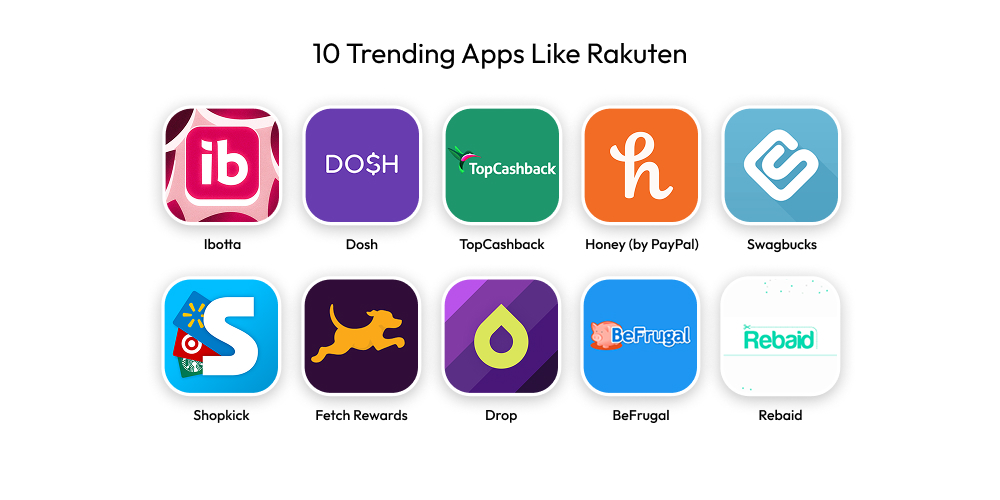
10 Trending Apps Like Rakuten
Discover 10 best apps like Rakuten that help you earn while you shop, from cashback rewards to smart savings; these must-have apps make every purchase more profitable!
App Name |
Downloads |
Rating (Avg.) |
Launched |
Platform |
| Ibotta | 10M+ (Android) | 4.5 ★ | 2012 | Android, iOS |
| Dosh | 5M+ (Android) | 4.4 ★ | 2016 | Android, iOS |
| TopCashback | 1M+ (Android) | 4.3 ★ | 2005 (UK), App in 2012 | Android, iOS |
| Honey (by PayPal) | 1M+ (Android) | 4.0 ★ | 2012 | Android, iOS |
| Swagbucks | 5M+ (Android) | 4.2 ★ | 2008 | Android, iOS |
| Shopkick | 10M+ (Android) | 4.3 ★ | 2010 | Android, iOS |
| Fetch Rewards | 10M+ (Android) | 4.6 ★ | 2013 | Android, iOS |
| Drop | 1M+ (Android) | 3.9 ★ | 2015 | Android, iOS |
| BeFrugal | 500K+ (Android) | 4.4 ★ | 2009 | Android, iOS |
| Rebaid | 100K+ (Android) | 4.0 ★ | 2019 | Android, iOS |
Why Do Businesses Invest in Rakuten Clone App Development?
With the rapid growth of e-commerce and digital savings trends, cashback and rewards platforms like Rakuten have gained massive popularity. Many businesses are now investing in marketplace app development to capitalize on this booming market. Here are five compelling reasons why:
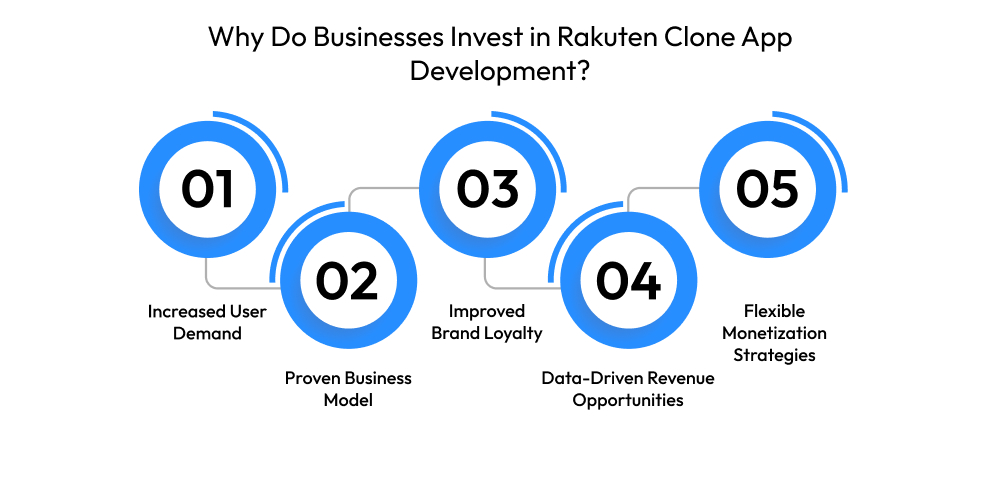
- Increased User Demand
- Proven Business Model
- Improved Brand Loyalty
- Data-Driven Revenue Opportunities
- Flexible Monetization Strategies
1. Increased User Demand
Today’s shoppers are more frugal than ever. With inflation and economic uncertainty, people actively seek out sites that provide cashback, bargains, and discounts. A Rakuten clone app addresses this requirement by providing value with each transaction, resulting in increased user engagement and retention.
2. Proven Business Model
Rakuten’s success demonstrates the power of affiliate marketing mixed with cashback benefits. It’s a low-inventory approach that generates income through partner commissions and affiliate connections. A clone-on-demand app development solution enables organizations to use a tried-and-true framework with excellent scalability.
3. Improved Brand Loyalty
Cashback and incentive programs inherently stimulate repeat purchases. Businesses that adopt Rakuten-like concepts can increase customer loyalty by promoting repeat visits. The Rakuten clone app becomes a go-to platform for not just buying but also making money while purchasing.
4. Data-Driven Revenue Opportunities
An e-commerce app development solution captures vital information about user preferences, purchasing habits, and popular items. This information may be used to create individualized marketing campaigns, negotiate better affiliate relationships, and offer targeted incentives, ultimately increasing ROI.
5. Flexible Monetization Strategies
Aside from affiliate commissions, Rakuten-style applications generate additional money through sponsored listings, premium memberships, in-app advertising, and special partner promotions. This flexibility appeals to both startups and established enterprises.
How Can AI Benefit Rakuten and Other Marketplace Apps?
- AI analyzes user behavior to suggest relevant products, increasing engagement, improving user experience, and boosting overall conversion rates.
- AI adjusts product prices in real-time based on demand, competition, and user trends, maximizing revenue and competitiveness for vendors.
- AI monitors transactions to detect suspicious activity or fraud patterns, ensuring safer shopping environments for users and vendors.
- AI predicts inventory needs based on historical data and demand trends, reducing stockouts or overstock issues for sellers.
- AI automates product classification, improving listing accuracy and search relevance, saving time for sellers and admins.
7 Steps to Build a Platform Like Rakuten
Unlock the secrets to building a profitable cashback app: follow these 7 strategic steps to develop a Rakuten-like platform that drives user engagement, boosts brand partnerships, and generates multiple revenue streams with ease.
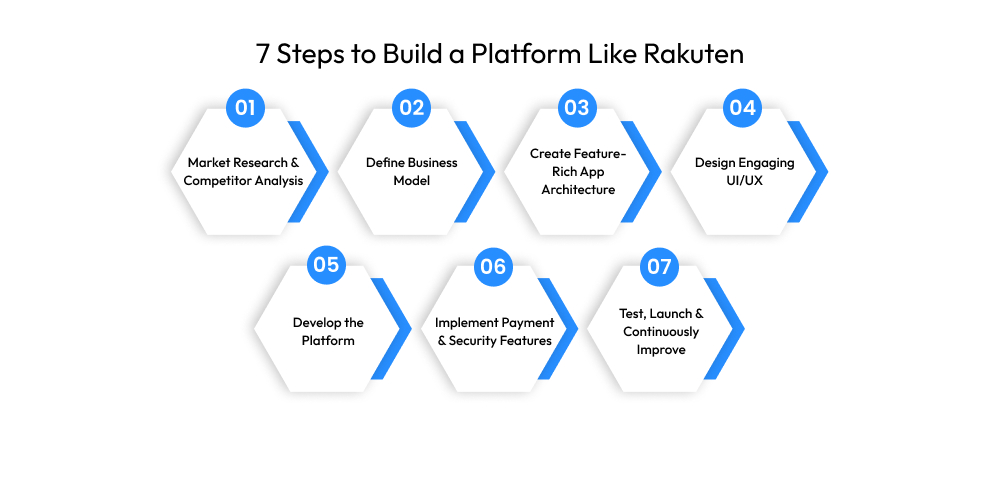
- Market Research & Competitor Analysis
- Define Business Model
- Create Feature-Rich App Architecture
- Design Engaging UI/UX
- Develop the Platform
- Implement Payment & Security Features
- Test, Launch & Continuously Improve
1. Market Research & Competitor Analysis
Let’s start the first stage of super app development. Begin by studying the cashback and affiliate marketing landscape. Identify target audiences, competitor strengths, user pain points, and emerging trends. This insight helps define your unique value proposition, refine app features, and position your Rakuten-like platform effectively in a saturated yet growing market.
| Who are the top competitors in the cashback app market? |
| Which platforms (Android, iOS, Web) are competitors using? |
| How do competitors attract and retain users? |
2. Define Business Model
Let’s move to the second stage to build an app like Rakuten, choose a sustainable model: affiliate commissions, in-app ads, premium subscriptions, or brand partnerships. Determine how users earn rewards and how you’ll monetize. Clear financial planning ensures the app remains profitable while delivering genuine value to users and encouraging merchants to join the platform.
| Will the platform be B2C, B2B, or a hybrid? |
| How will users earn cashback or rewards? |
| What percentage of the commission will be shared with users? |
3. Create Feature-Rich App Architecture
Moving to the third stage of video streaming app development, outline essential features such as user profiles, cashback tracking, merchant dashboards, product listings, referral systems, and real-time notifications. Incorporate admin controls, analytics dashboards, and secure payment gateways. A scalable, modular architecture ensures smooth performance and future upgrades as user demand grows.
| What core features should the user panel include? |
| What functionalities are needed in the admin dashboard? |
| What technologies will ensure scalability and speed? |
4. Design Engaging UI/UX
In the fourth stage to develop an app like Rakuten, focus on clean, intuitive interfaces that make shopping, earning cashback, and navigation effortless. Integrate reward progress visuals, simple search options, and instant deal alerts. A delightful user experience builds trust, encourages longer usage, and increases conversion and retention rates significantly.
| Are key actions like shopping and cashback easy to access? |
| Are colors and typography consistent with the brand? |
| How many steps does it take to complete a cashback transaction? |
5. Develop the Platform
Let’s move forward to the fifth stage to create an app like Rakuten, use reliable technologies to build a secure, fast-performing app. Hire experienced coders from a messaging app development company to ensure seamless integration with affiliate networks and eCommerce APIs.
Backend systems should handle real-time cashback tracking, transaction logs, and data analytics. Ensure compatibility with Android, iOS, and web platforms for broader reach.
| Which tech stack suits the app’s scalability needs? |
| Is the backend optimized for high-user traffic? |
| What database system ensures fast, secure data handling? |
6. Implement Payment & Security Features
Coming to the sixth stage to build an app like Rakuten, integrate secure payment gateways for withdrawals and purchases. Ensure data encryption, two-factor authentication, and fraud detection mechanisms are in place. Protect user data and comply with privacy laws like GDPR to build credibility and meet legal standards.
| Which payment gateways will the app support? |
| Is the app compliant with PCI-DSS and GDPR standards? |
| Will two-factor authentication be enabled for users? |
7. Test, Launch & Continuously Improve
Hire an experienced mobile app development agency to conduct thorough testing to resolve bugs, UX flaws, and performance issues. Launch a beta version, gather feedback, and refine the platform. Post-launch, continue analyzing user behavior, adding features, and optimizing performance to stay competitive in the dynamic cashback market.
| Has the app undergone complete functional and usability testing? |
| Were performance and stress tests conducted under peak loads? |
| How often will app updates and improvements be released? |
Pick what you need below — you can select more than one — then tap Get detail to continue.Want a chatbot demo or pricing? Fill the form and talk to our experts today.
Chatbot demo dashboard
Cost to develop an app
Industry report
Case study
10 Normal and Advanced Features of an App Like Rakuten
These features collectively create a seamless, trustworthy, and engaging shopping experience, driving user satisfaction and business growth for a platform like Rakuten.
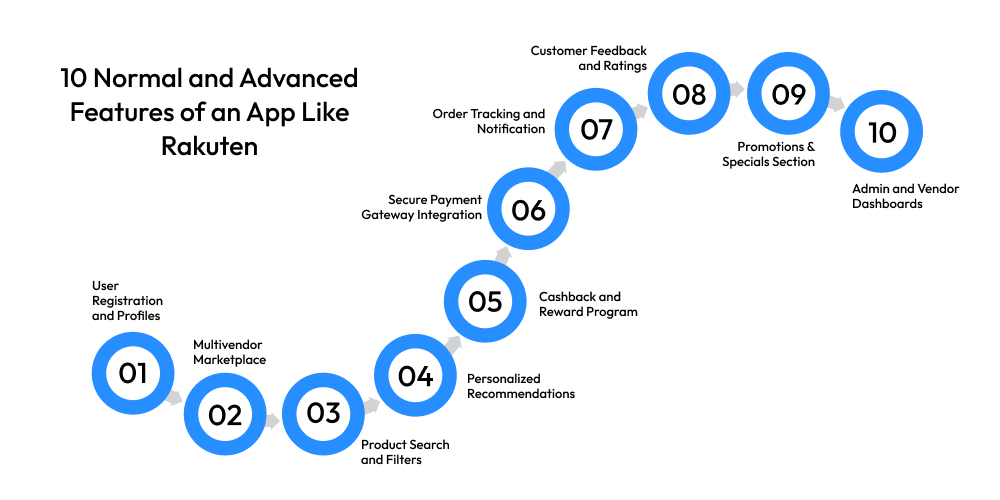
1. User Registration and Profiles
Rakuten alternatives enable users to quickly register and set up profiles to manage their account information, preferences, and order history.
2. Multivendor Marketplace
Apps similar to Rakuten enable various vendors, allowing customers to explore and buy from a wide range of merchants in one spot.
3. Product Search and Filters
Users may rapidly identify desired goods thanks to advanced search capability that includes filters for category, price, ratings, and other criteria.
4. Personalized Recommendations
The Rakuten alternative uses artificial intelligence and machine learning to deliver personalized product recommendations based on user activity and interests.
5. Cashback and Reward Program
The cash back apps like Rakuten allow users to gain cashback or loyalty points for their purchases, which encourages repeat buying and increases engagement.
6. Secure Payment Gateway Integration
The Rakuten rewards app offers multiple payment choices, such as credit cards, digital wallets, and local payment methods, guaranteeing that transactions go smoothly and securely.
7. Order Tracking and Notification
If businesses create a mobile app like Rakuten, it offers real-time order status updates and push alerts to keep customers informed about shipment and delivery.
8. Customer Feedback and Ratings
Apps similar to Rakuten allow users to read and offer reviews on items and sellers, promoting trust and making educated purchase decisions.
9. Promotions & Specials Section
The Rakuten cashback app offers daily specials, discounts, and unique promotions to engage and keep users.
10. Admin and Vendor Dashboards
Platform administrators and suppliers may use powerful dashboards to manage inventory, track sales, handle orders, and assess performance.
The Cost to Build a Platform Like Rakuten
The cost to develop a platform like Rakuten can range from $8,000 to $25,000, depending on factors such as complexity, features, scale, and region. Key expenses include UI/UX design, mobile and web development, backend infrastructure, payment systems, recommendation engines, loyalty programs, and cloud services.
Additional costs cover security, compliance, third-party integrations, and ongoing maintenance. Hiring a skilled in-house team or a reputable development agency adds to the budget. Ultimately, the cost to build an app like Rakuten depends on your specific vision, timeline, and whether you’re building from scratch or leveraging existing solutions.
Component |
Estimated Cost (USD) |
| UI/UX Design | $5,000 – $12,000 |
| Frontend Development | $7,000 – $13,000 |
| Backend Development | $10,000 – $18,000 |
| Payment Integration | $4,000 – $8,000 |
| Loyalty/Reward System | $5,000 – $7,000 |
| Recommendation Engine | $10,000 – $15,000 |
| Security & Compliance | $6,000 – $10,000 |
| QA & Testing | $4,000 – $9,000 |
| DevOps & Hosting | $10,000 – $16,000 (annual) |
| Maintenance (1st year) | $5,000 – $10,000 |
Total Estimated Range: $8,000 – $25,000+
What Factors Can Affect the Cost to Build a Platform Like Rakuten?
Project complexity and required features directly impact the total cost to build an online marketplace website. Team location, technology choices, and ongoing maintenance also play key roles in determining the final budget.
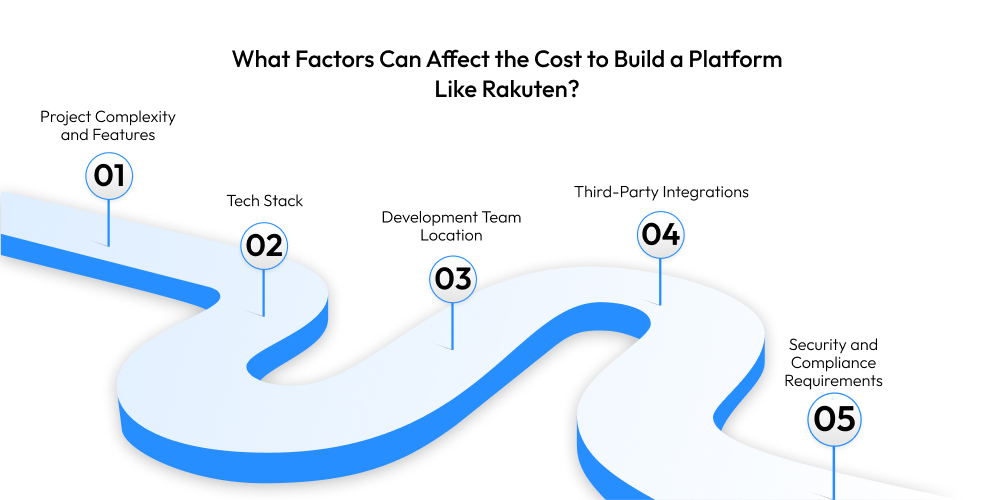
1. Project Complexity and Features
The cost to build an app like Rakuten rises with the complexity of the platform and the number of features. Advanced features such as multi-vendor support, tailored suggestions, loyalty programs, and payment systems need more development time and resources, which raises the overall Rakuten app development cost.
Feature/Complexity Aspect |
Estimated Cost Impact (USD) |
| Multi-vendor marketplace setup | $5,000 – $8,000 |
| User profiles & dashboards | $7,000 – $12,000 |
| Loyalty & reward systems | $4,000 – $9,000 |
| Personalized recommendations | $7,000 – $11,000 |
| Multi-language & multi-currency | $6,000 – $10,000 |
| Advanced search & filtering | $8,000 – $13,000 |
2. Tech Stack
Selecting the appropriate technology stack affects both initial development and long-term maintenance expenses. Modern frameworks and cloud infrastructure may be more expensive upfront, but they provide more scalability and efficiency. Conversely, old or inefficient technology may raise the cost to develop a mobile app like Rakuten.
Technology Aspect |
Estimated Cost Impact (USD) |
| Frontend framework (React, Flutter) | $10,000 – $20,000 |
| Backend framework (Node.js, Django) | $12,000 – $18,000 |
| Cloud infrastructure setup | $5,000 – $10,000 |
| Database selection & optimization | $8,000 – $12,000 |
| API development | $7,000 – $10,000 |

3. Development Team Location
Your development team’s geographic location has a significant impact on the Rakuten app development cost. Hiring developers in North America or Europe is often more expensive than outsourcing to nations with lower labor costs, such as India or Eastern Europe. However, variances in communication, quality, and time zones can all have an impact on the cost to develop an app like Rakuten.
Region |
Average Hourly Rate (USD) |
Estimated Cost for Full Project (USD) |
| North America / Europe | $72 – $100/hr | $50,000 – $80,000+ |
| Eastern Europe | $40 – $70/hr | $30,000 – $50,000 |
| India / Southeast Asia | $15 – $40/hr | $8,000 – $25,000 |
4. Third-Party Integrations
Integration with third-party services such as payment gateways, shipping suppliers, marketing tools, and analytics platforms increases development complexity and costs. Some connectors are simple, while others need proprietary APIs or licensing, which can raise the cost of reward app development services.
Integration Type |
Estimated Cost Impact (USD) |
| Payment gateways (Stripe, PayPal) | $5,000 – $8,000 |
| Shipping & logistics APIs | $5,000 – $7,000 |
| Marketing & analytics tools | $3,000 – $5,000 |
| CRM and customer support tools | $4,000 – $6,000 |
| Social media login & Sharing | $2,000 – $5,000 |
5. Security and Compliance Requirements
Ensuring that your platform complies with data protection standards (such as GDPR) and has strong security measures raises development expenses. Implementing encryption, fraud detection, secure payment processing, and regular security audits necessitates specialist knowledge and continual commitment.
Security/Compliance Aspect |
Estimated Cost Impact (USD) |
| GDPR and data privacy compliance | $10,000 – $12,000 |
| Payment Security (PCI DSS) | $5,000 – $8,000 |
| Data encryption and backups | $5,000 – $7,000 |
| Fraud detection and prevention | $10,000 – $12,000 |
| Security audits and penetration testing | $5,000 – $9,000 |
How To Make Money From Apps Like Rakuten?
These monetization strategies can be combined to diversify income streams, ensuring the app’s long-term profitability and growth. So, let’s take a look at the best monetization techniques to generate new revenue streams:
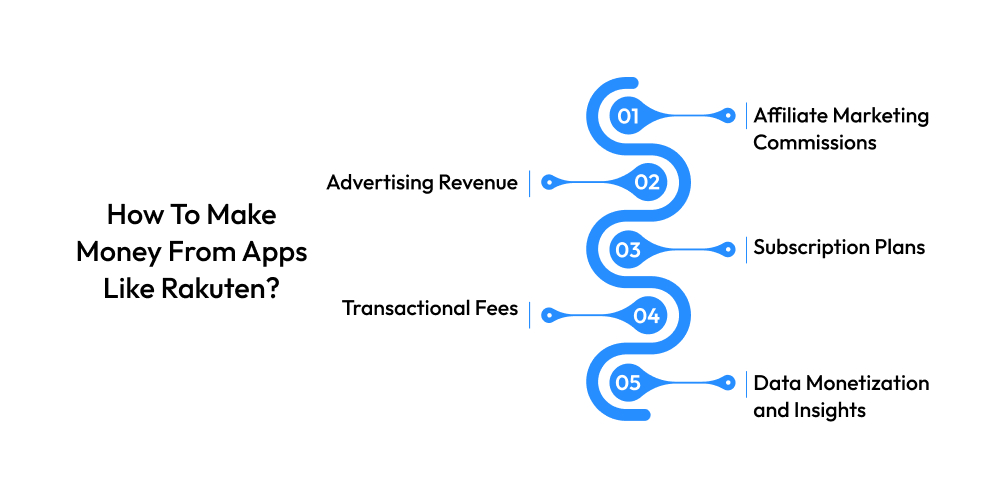
- Affiliate Marketing Commissions
- Advertising Revenue
- Subscription Plans
- Transactional Fees
- Data Monetization and Insights
1. Affiliate Marketing Commissions
Rakuten earning app primarily generates money by collaborating with retailers and receiving commissions on each sale completed through its platform. When users purchase things through the app’s referral links, Rakuten earns a share of the sale as an affiliate commission. This concept benefits both the platform and the shops by increasing traffic and revenue without incurring upfront fees.
2. Advertising Revenue
The travel app development solutions can make revenue by displaying advertisements from third-party companies or sponsored listings. Retailers and companies pay to promote their items within the app via banners, highlighted spots, and push notifications. Targeted advertising based on user behavior improves click-through rates and ad effectiveness, resulting in larger ad revenues.
3. Subscription Plans
The Rakuten shopping app, offering premium membership options to users, can generate a consistent revenue stream. Subscribers may receive perks such as better cashback rates, early access to discounts, and ad-free surfing. Sellers can also subscribe for premium vendor accounts, which include expanded tools, analytics, and promotional possibilities to increase their exposure and sales.
4. Transactional Fees
The Rakuten instant messaging app may charge vendors a fee for each transaction or order completed. This cost is for payment processing, customer assistance, and platform maintenance. According to the mobile app development company in Japan, while it must be competitive to attract sellers, transaction fees generate constant revenue that is directly proportional to the number of transactions.
5. Data Monetization and Insights
For a price, the Rakuten streaming app may provide brands and merchants with important market insights by studying user activity and purchasing trends. This data-driven strategy enables partners to optimize marketing campaigns, inventories, and product introductions. However, strong privacy compliance is required to keep user confidence while monetizing data.

Final Words!
Building a platform like Rakuten requires careful planning, the right technology, and a skilled marketplace app development company to bring your vision to life. From robust multi-vendor features to secure payment integration and personalized user experiences, every detail matters.
Partnering with experts ensures scalability, security, and seamless functionality, helping you create a competitive and engaging marketplace. Ready to transform your idea into a successful platform? Collaborate with a top marketplace app development company and turn your dream into reality today!
Frequently Asked Questions
Q1. How Much Does it Cost to Build a Platform Like Rakuten?
The cost to develop a platform like Rakuten ranges from $8,000 and $25,000, depending on features, complexity, team location, and technology choices. Customization and scalability can further influence the overall budget.
Q2. How Long Does it Take to Create a Platform Like Rakuten?
To create a platform like Rakuten, it usually takes between 3 to 6 months, depending on feature complexity, team size, technology stack, and development approach, including design, testing, and deployment phases.
Q3. What Technology Stack is Best to Make a Platform Like Rakuten?
The best technology stack to make a platform like Rakuten includes React or Flutter for the frontend, Node.js or Django for the backend, PostgreSQL or MongoDB for databases, and AWS or Google Cloud for scalable cloud infrastructure.
Q4. What Are The Biggest Challenges When Building A Marketplace App Like Rakuten?
The biggest challenges include managing multiple vendors, ensuring platform security, handling large-scale transactions, providing seamless user experiences, integrating diverse payment methods, maintaining scalability, and effectively supporting customer service and dispute resolution.
Q5. What Marketing Strategies Work Best For Launching?
Effective marketing strategies for launching include SEO optimization, influencer partnerships, referral programs, targeted social media ads, content marketing, email campaigns, and engaging promotions to build brand awareness and attract both users and vendors quickly.