



















Do you own a hospital? Have you provided healthcare services online? If not.
Then your staff is too busy with many healthcare operations such as filling patient forms, scheduling appointments, the billing process, and many more.
To streamline your healthcare operations, just need an all-in-one solution, called custom healthcare software.
In a recent study, we found that 91% of US non-federal acute care hospitals have their own healthcare software and certified EHR(Electronic Health Records) System.
Do you also want to build a custom healthcare software for your hospital? But you do not have any idea about their development process and total cost.
Be familiar with this blog, we will provide each and every detail about how to build a custom healthcare software and other useful information.
Move Forward!
Global Market Statistics of Healthcare Software
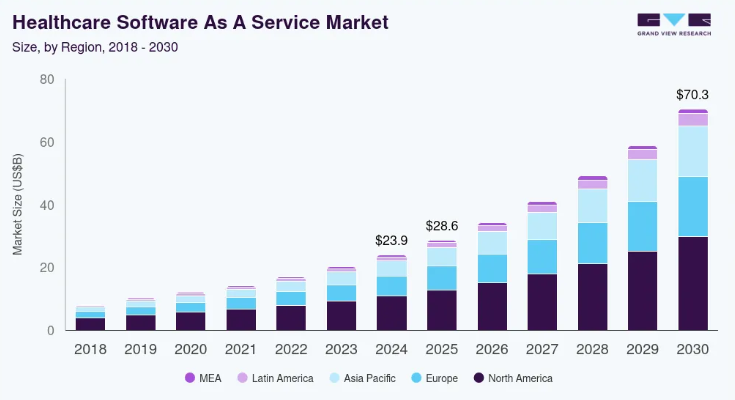
- The global healthcare software market valuation is around $25.13 billion in 2024; this is expected to increase to around $74.74 billion by the end of 2030.
- Looking at application-wise, the telemedicine application segment records the largest market revenue share, around 39% in 2024.
- As per the region-wise, the North America region accounted for the highest revenue share of the healthcare software market, around 39% in 2024.
- By the deployment type, the hybrid model held the largest share in 2025, which can be increased.
- According to the worldwide market, the healthcare software market is projected to increase with a CAGR of 0% from 2025 to 2030.
What is Custom Healthcare Software?
The custom healthcare software is mainly designed for a specific organization or hospital that suits their requirements and demands. This software enables them to integrate features and services as per their personal preferences and unique needs. The customized healthcare software is heavily modified to handle a higher number of operations and match specific workflows.
Examples: Hospital management systems, custom electronic health records, and patient portals.
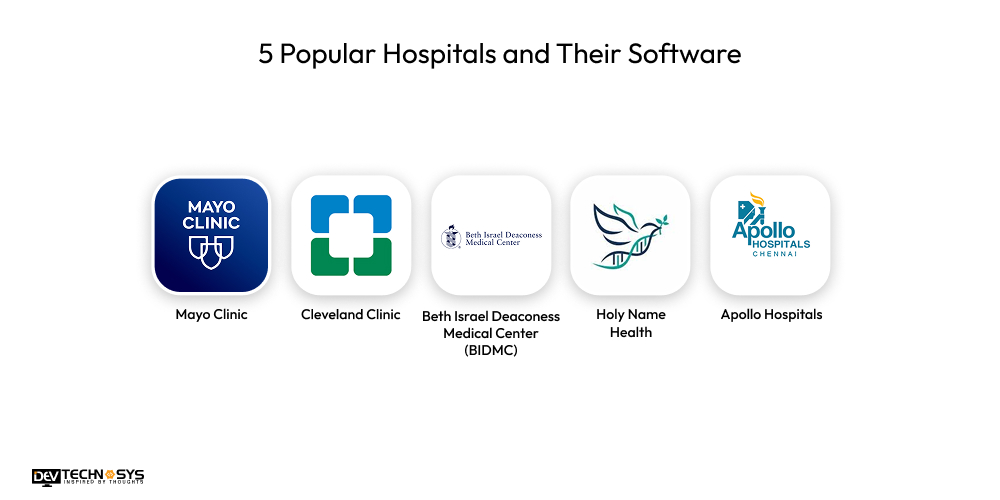
5 Popular Hospitals and Their Software
Before starting to build your own custom healthcare software, you can observe the existing software to understand its functionalities and working criteria.
| Hospital / Health System | Country | Software Name / Type | Details |
| Mayo Clinic | USA | Epic Systems (EpicCare) | Mayo uses Epic for its unified EHR across all campuses, improving patient record access and care coordination. |
| Cleveland Clinic | USA | Epic Systems (MyChart, EpicCare) | Uses Epic’s suite for patient records, scheduling, and telehealth, customized for its clinical workflows. |
| Beth Israel Deaconess Medical Center (BIDMC) | USA | WebOMR (Online Medical Record) | A home-grown EHR system developed internally; later licensed by Athenahealth. |
| Holy Name Health | USA | Harmony EHR | A fully custom-built EHR created in-house to improve usability and clinician workflow integration. |
| Apollo Hospitals | India | Apollo Prism / MedMantra | Apollo developed its own hospital management and patient portal systems, integrated across its network. |
Why Hospital Owners Want to Build a Custom Healthcare Software?
Hospital owners invest in custom healthcare software to enhance operational efficiency, improve patient care, and ensure data security. Tailored solutions streamline workflows, integrate seamlessly with existing systems, and support compliance with healthcare regulations, offering scalability and long-term savings. So, here we provide the benefits of mobile app development in healthcare industry:
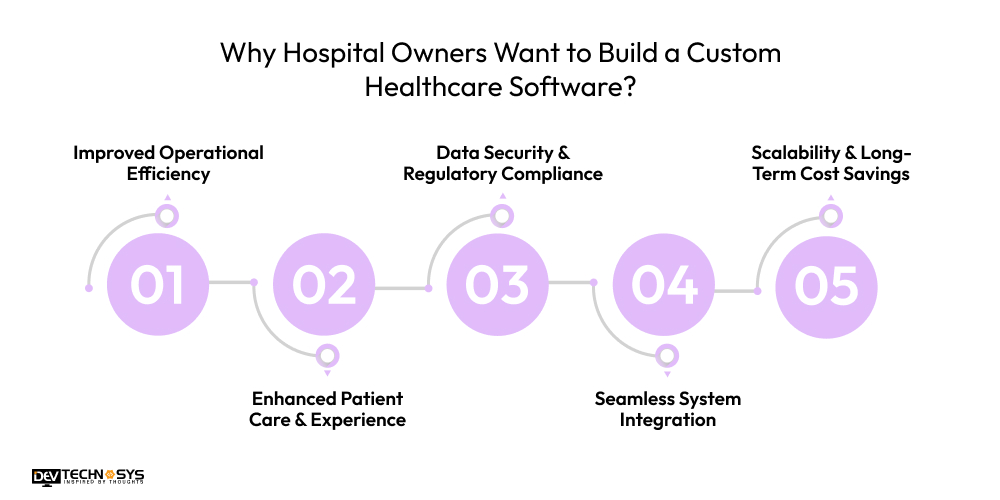
1. Improved Operational Efficiency
Custom healthcare software automates repetitive administrative tasks like scheduling, billing, and reporting. It streamlines workflows, minimizes human error, and boosts staff productivity, enabling hospitals to manage operations more efficiently while focusing more on patient care and service quality.
2. Enhanced Patient Care & Experience
Personalized software allows hospitals to provide better patient engagement through features like telemedicine, portals, and reminders. Medical app like K Health ensures accurate health records, faster communication, and smoother care coordination, significantly improving overall patient satisfaction and treatment outcomes.
3. Data Security & Regulatory Compliance
Hospitals handle sensitive patient information that must comply with HIPAA, HL7, and GDPR standards. Custom solutions ensure robust data encryption, controlled access, and compliance adherence, protecting patient privacy and preventing costly penalties or reputational damage.
4. Seamless System Integration
Custom-built software startup solutions integrate easily with existing hospital systems, including EHRs, labs, billing, and insurance platforms. It ensures smooth data flow across departments, eliminates duplication, and improves real-time collaboration between healthcare professionals for faster, more accurate decision-making.
5. Scalability & Long-Term Cost Savings
Unlike off-the-shelf tools, custom software grows with hospital needs. It supports future expansions, new departments, and technologies. Though initially more expensive, it reduces long-term costs by eliminating subscription fees, integration issues, and unnecessary third-party dependencies.
7 Key Steps to Build a Custom Healthcare Software
To create a custom healthcare software, analyze each development process with detailed information. From the market analysis to post-launch maintenance services. So, let’s explore the step-by-step healthcare software development guide:
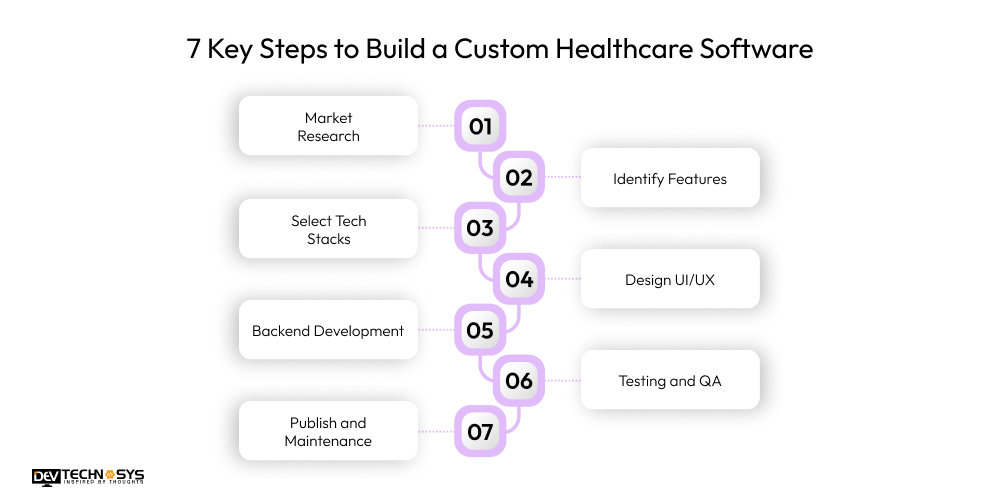
1. Market Research
In the first stage to make a custom healthcare software, identify the project requirements and demands. Hire software developers to make a proper list of requirements; this can reduce the confusion and data redundancy. Research in the market, what are the latest trends, and which healthcare software is gaining higher success rates and popularity?
2. Identify Features
Move to the second step of the healthcare software development process, you need to find the basic and advanced features for your project. It includes various features such as appointment scheduling, patient portals, billing, electronic health records, telehealth integration, security, and mobile accessibility.
3. Select Tech Stacks
Hire dedicated developers to select the best tech stacks that can easily build a more reliable and scalable system. There is a wide range of technologies, including:
For Backend: Node.js, C#, Ruby on Rails
For Frontend: Angular, Flutter Web, React.js
For Database: Cassandra, MariaDB, Redis
For Security: O Auth 2.0, JWT, TLS/SSL
For Cloud Storage: AWS, Azure, Oracle Cloud
4. Design UI/UX
In the fourth step to create a custom healthcare software, employ talented designers that has expertise in various designing tools such as Figma, Farmer, Zeplin, and Marvel.
The user interface design must be simple and user-friendly to quickly access the navigation bars. Involves various UI elements like fonts, style, colors, templates, layouts, texture, and wireframes.
5. Backend Development
To start the real coding, you need to hire backend developers from a software development company to create functions, APIs, manage servers, databases, and handle overall architecture.
There is a wide range of third-party tools and applications for integration, such as payment gateways, communication tools, social media logins, CRM, ERP, analytics, and many more.
6. Testing and QA
Test the software under various techniques such as unit, security, integration, functional, black-box, white-box, and user acceptance testing. Make sure that all bugs or errors are solved; this can increase the overall performance. So, ensure that the services and features of the app are working correctly and smoothly.
7. Publish and Maintenance
Move to the last stage to make a custom healthcare software, and publish the software on the live phase. After that, hire healthcare app developers to conduct maintenance services to keep the software up-to-date, such as fixing security issues, performance optimization, regular updates, adding new enhancements, and more.
Best Features That Must Be Integrated in Custom Healthcare Software
Integrating features is one of the most difficult tasks, because businesses are confused about which type of functionalities are best. So, here we provide the must-have key features of hospital management software:
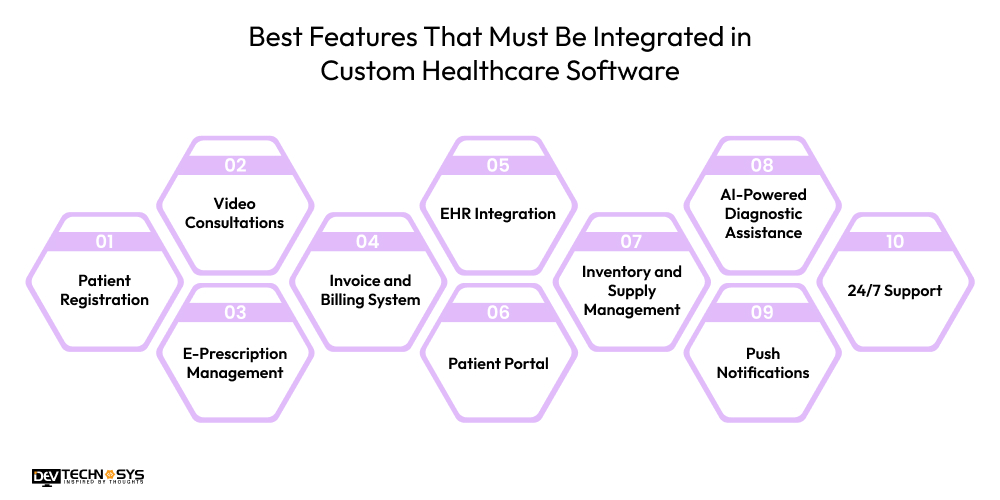
1. Patient Registration
The medical data management software enables users to register their profile via input personal information, medical history, demographics, and more.
2. Video Consultations
The patient engagement software solutions offer real-time remote consultations through video conferencing, and doctors can prescribe, diagnose, and monitor patients without in-person visits.
3. E-Prescription Management
The healthcare automation systems enable physicians to generate prescriptions electronically and send them to pharmacies, this provides a paperless workflow from both sides.
4. Invoice and Billing System
The cloud healthcare management systems offer an automated billing system, generate invoices, and manage payments, this can enhance the users’ experience.
5. EHR Integration
The electronic health records maintain the patient data, including diagnosis, test results, prescriptions, and more. It can ensure data consistency and care coordination.
You can reach out anytime; we are available 24/7. Our team provides a quick response.

6. Patient Portal
The healthcare software solutions enable patients to manage their personal data, appointment scheduling, cancellations, billing, and many other activities.
7. Inventory and Supply Management
The cloud-based healthcare software can track the medications, medical supplies, and equipment, automate reordering, prevent shortages, and manage expiry dates.
8. AI-Powered Diagnostic Assistance
AI in healthcare software analyzes patient health records, test results, and medical images to provide accurate suggestions for diagnosis and aid clinicians, this can reduce human or manual error.
9. Push Notifications
Sends timely alerts to patients and staff for appointments, test results, medication reminders, or emergencies, enhancing communication and improving adherence to treatments.
10. 24/7 Support
Provides round-the-clock technical and medical assistance through chat, phone calls, or in-app support, addressing urgent issues promptly to ensure uninterrupted service.

What is the Cost to Build a Custom Healthcare Software?
The Healthcare CRM Software Development Cost to develop a custom healthcare software is around $8,000 to $25,000 or more. This can go up and down due to various factors such as project complexity, advanced features, size, third-party integrations, tech stacks, security methods, testing, and designing.
In customized software, there are various services and features that can be integrated as per the business’s personal preferences, so the software product development cost can depend on them.
| Stage | Description | Estimated Cost (USD) |
| Requirement Analysis & Planning | Gathering requirements, defining scope, and compliance needs | $1,000 – $2,000 |
| UI/UX Design | Wireframes, prototypes, and user interface design | $1,000 – $3,000 |
| Frontend Development | Building user-facing components (web or mobile) | $5,500 – $8,000 |
| Backend Development | Server, database, APIs, and integrations (EHR, HL7, etc.) | $6,000 – $12,000 |
| Security & Compliance Setup | HIPAA compliance, encryption, and user authentication | $800 – $2,500 |
| Testing & Quality Assurance | Functional, security, and performance testing | $700 – $2,000 |
| Deployment & Maintenance | App launch, hosting setup, minor post-launch support | $1,000 – $2,500 |
5 Major Factors Affecting the Custom Healthcare Software Development Cost
Before starting to build a custom healthcare software, you need to observe what factors can affect the overall hospital software development cost. So, let’s figure out the crucial factors:
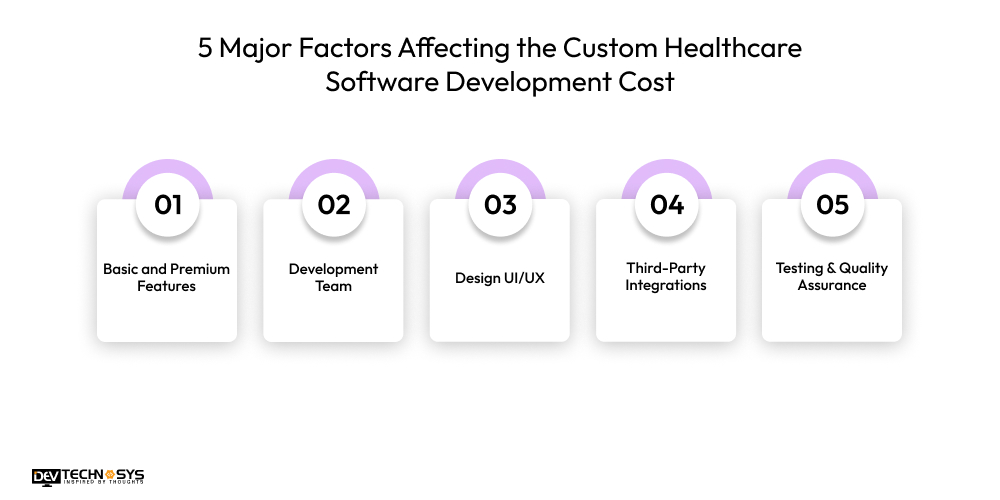
1. Basic and Premium Features
In the first cost-affecting factor, features are of different types, like basic and advanced. It includes appointment scheduling, telemedicine, billing, EHR integration, and many more. These premium features are high-priced, this can directly impact the healthcare app development cost.
| Feature Level | Description | Estimated Cost (USD) |
| Basic Features | Appointment booking, patient registration, and basic records | $1,000 – $3,000 |
| Moderate Features | E-prescriptions, notifications, and user dashboards | $2,500 – $5,000 |
| Premium Features | Telemedicine, AI analytics, wearable integration | $4,000 – $7,000 |
2. Development Team
The development team living location and expertise are one of the most common factors that can raise the cost to build a custom healthcare software.
Hiring developers from high-tech countries or regions like the USA and UK is higher cost as compared to the Asia-Pacific region. Developers with more experience in technical knowledge can also demand higher salary packages.
| Team Type | Description | Estimated Cost (USD) |
| Small Local Team | 2–3 developers, limited scope | $2,000 – $5,000 |
| Mid-Level Outsourced Team | Balanced cost-quality ratio, skilled professionals | $3,000 – $7,000 |
| Expert In-House Team | Experienced developers with healthcare specialization | $5,000 – $9,000 |
3. Design UI/UX
Move to another factor, design a user interface of software that includes various types of high-quality UI elements and the use of paid design tools. UI elements involve layouts, fonts, buttons, navigation bars, styles, color, templates, themes, and more. So, these elements can increase the final custom healthcare software development cost.
| Design Level | Description | Estimated Cost (USD) |
| Basic Design | Simple layout, limited customization | $800 – $2,000 |
| Moderate Design | Custom color scheme, intuitive navigation | $1,500 – $3,500 |
| Advanced Design | Premium visuals, accessibility, and responsive design | $3,000 – $5,000 |
4. Third-Party Integrations
Integrating the third-party tools and applications is a must because it can increase the software accessibility and flexibility. It involves various third-party integrations such as payment gateways, communication tools, CRM, analytics and reporting, social media logins, and push notifications. But some of them have higher licensing fees on an annual basis, this can increase the overall cost to develop a custom healthcare software.
| Integration Type | Description | Estimated Cost (USD) |
| Basic APIs | Payment gateways, email notifications | $800 – $1,500 |
| Healthcare APIs | EHR/EMR, HL7, or FHIR integrations | $1,500 – $3,000 |
| Complex Systems | Wearables, AI, or insurance claim systems | $3,000 – $5,000 |
5. Testing & Quality Assurance
In the last cost-affecting factor, the custom healthcare software needs extensive testing and quality assurance. There are various software testing services, such as performance, usability, functional, integration, security, user-acceptance, unit, and black-box testing. So, these testing techniques can cost more than normal testing, this can also fluctuate the total cost to build a custom healthcare software.
| Testing Level | Description | Estimated Cost (USD) |
| Basic Testing | Functional testing, bug fixes | $700 – $1,500 |
| Comprehensive QA | Security, performance, and compliance testing | $1,500 – $3,000 |
| Advanced QA & Automation | Automated tests, penetration testing, HIPAA audits | $2,500 – $4,000 |
Conclusion
In conclusion, building custom healthcare software for your hospital requires careful planning, compliance with regulations, and a deep understanding of patient and staff needs. By choosing the right technology stack, ensuring data security, and integrating with existing systems, hospitals can enhance efficiency and improve patient care.
Partnering with experienced medical device software development professionals ensures the solution meets safety and quality standards. A well-designed custom system empowers healthcare providers to deliver faster, smarter, and more reliable services for better overall outcomes.