








Key takeaways:
-
- Entertainment app development focuses on building digital applications that deliver fun, engagement, and interactive experiences for diverse user audiences globally.
- These applications include video streaming, music platforms, gaming apps, social media, and live content services for entertainment worldwide user enjoyment.
- Basic and advanced features include personalized recommendations, offline access, multi-device compatibility, adaptive streaming technology, and more.
The most used apps in today’s time are entertainment apps. Because whenever you use these apps, you don’t even realize the time. These entrainment applications include music streaming apps, video streaming apps, gaming apps, social media apps, and more.
Talking about the entertainment application development, it is a process to develop mobile or web apps for entertainment, and these apps help people entertain.
The developer’s team designs the app with advanced graphics and animations, making with easy to use with navigation to be used by all age groups.
As per the global market analysis, the entertainment apps were valued at around $111.20 billion in 2025; it is projected to grow to around $261.23 billion by the end of 2032.
In this blog, we will explore the entertainment app development, various types of entertainment apps, basic and advanced functionalities, and more.
Let’s dig more!
What is Entertainment App Development?
The entertainment app development is a process that builds mobile and web applications for the entertainment industry. There are various types of entertainment apps available, such as social media apps, music streaming apps, video streaming apps, gaming apps, live event apps, and many more.
The entertainment app development process includes various robust steps such as gathering project requirements, market research, features & functions, tech stacks, design UI/UX, development, testing & QA, publishing, and post-launch maintenance. It also includes advanced technologies such as AR/VR, AI, cloud services, and more to enhance user experience.
What are the Different Types of Entertainment Applications?
There are various types of entertainment applications available to build; it helps businesses to choose the entertainment app type as per their preferences and requirements. So, let’s take a look at the different types of entertainment applications:
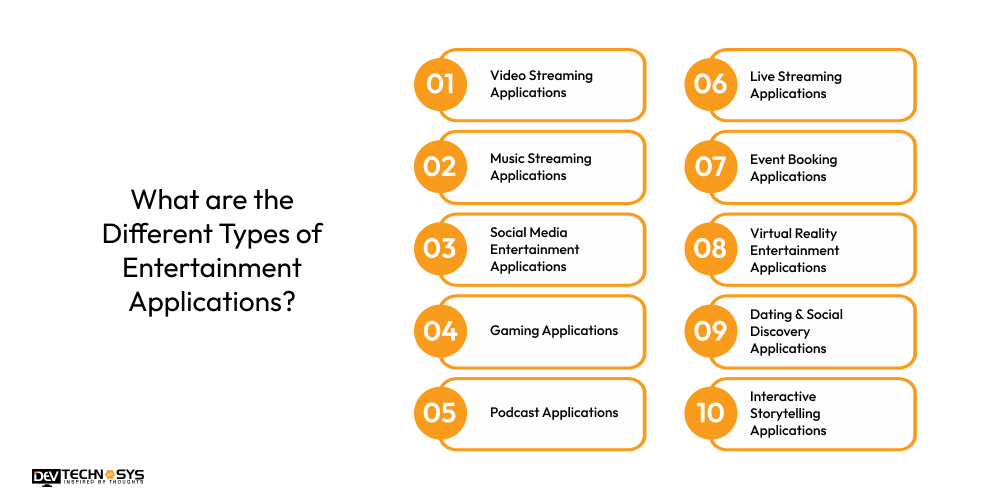
1. Video Streaming Applications
The video streaming applications enable users to watch movies, web series, TV shows, documentaries, and other video content. These video streaming app development solutions use cloud services to provide smooth playback across various devices. It includes various advanced features such as offline watching, HD video quality, subscription plans, and personalized recommendations.
Real-World Examples: Netflix, Amazon Prime Video, etc.
Key Features:
- Multi-Device Support
- On-Demand Content Library
- Personalized Recommendations
- High-Quality Video Contents
- Offline Downloads
2. Music Streaming Applications
Music streaming applications allow users to listen to billions of songs, podcasts, and albums without downloading or owning files. These music streaming app development solutions enable users to search for their favorite artists, create custom playlists, and enjoy a personalized recommendations experience. Users can listen to songs from anywhere or anytime with a stable internet connection.
Real-World Examples: Spotify, Apple Music, etc.
Key Features:
- Cross-Device Syncing
- Offline listening
- Personalized Playlists
- Lyrics Display
- Podcast Integration
3. Social Media Entertainment Applications
The social media app development solutions enable users to connect with worldwide users and share their content, activity, and more. Users can share posts, short videos, and engage through likes, comments, and share with others.
Social entertainment app development solutions involve various types of modern features such as real-time communication, watching short videos, and more.
Real-World Examples: TikTok, Instagram, Facebook, etc.
Key Features:
- Algorithm-Based Feeds
- Content-Creation Tools
- Live Streaming
- Short-Form Content
- Social Engaged Features
4. Gaming Applications
The gaming app development solutions provide an immersive gameplay to engage users and also provide a competitive and casual gaming experience. These gaming applications provide entertainment through foster communities, track achievements and badges, and centralize discovery and progress. It can enhance the user experience and engage users with social interactions.
Real-World Examples: PUBG Mobile, Candy Crush, etc.
Key Features:
- High-Quality Graphics
- Leaderboards
- Regular Updates
- Multi-Player Modes
- In-Game Rewards
5. Podcast Applications
The podcast app development solutions allow users to access audio shows that cover various content such as news, storytelling, entertainment, and education.
The podcast applications enable users to listen to podcasts while multitasking, and it is one of the most popular entertainment formats. Users can subscribe to their favorite episodes to get regular updates.
Real-World Examples: Pocket Casts, Google Podcasts, etc.
Key Features:
- Topic-Based Discovery
- Playback Speed Control
- Download for Offline Use
- Automatic Updates
- Episode Subscriptions
6. Live Streaming Applications
Live streaming apps allow users to watch and share videos online in real time. These apps are popular for concerts, gaming, webinars, and influencers. Live streaming app development solutions provide entertainment through audience engagement with live chats, reactions, and virtual gifts.
Real-World Examples: Twitch, YouTube Live, etc.
Key Features:
- Real-time broadcasting
- Live chat interaction
- Monetization options
- Viewer analytics
- Multi-platform access
7. Event Booking Applications
Event booking apps help users find, plan, and pay for entertainment events like shows, sports, or concerts. They improve planning by including digital tickets, payment security, and seat selection. Event booking apps enhance online and offline entertainment experiences.
Real-World Examples: BookMyShow, Eventbrite, etc.
Key Features:
- Event discovery
- Online ticket booking
- Seat selection
- Payment integration
- Event reminders
Want a chatbot demo or pricing? Fill the form and talk to our experts today.
Pick what you need below — you can select more than one — then tap Get detail to continue.
-
Chatbot demo dashboard
-
Cost to develop an app
-
Industry report
-
Case study
8. Virtual Reality Entertainment Applications
Virtual reality entertainment apps give users immersive digital entertainment experiences using gaming, storytelling, and VR headsets. These apps engage users with interactive environments using realistic visuals and sound.
Real-World Examples: Meta Quest VR, VRChat, etc.
Key Features:
- Immersive 3D environments
- Motion tracking
- Interactive gameplay
- High-quality visuals
- Multiplayer experiences
9. Dating & Social Discovery Applications
Social discovery and dating apps provide entertainment through social matchmaking and interaction. These dating app development solutions incorporate browsing of profiles, chatting, and connecting with new people. Social discovery and dating apps also include communication and interaction for a more entertaining and social networking experience.
Real-World Examples: Tinder, Bumble, etc.
Key Features:
- Profile matching
- Chat functionality
- Location-based discovery
- Multimedia profiles
- Privacy controls
10. Interactive Storytelling Applications
Interactive storytelling applications allow users to actively participate in narratives by making choices that influence story outcomes. These apps combine elements of reading and gaming, offering branching storylines, character development, and multiple endings, creating personalized and immersive entertainment experiences for users.
Real-World Examples: Episode, Choices, etc.
Key Features:
- Choice-based narratives
- Multiple endings
- Character customization
- Episodic content
- Engaging storylines
What are the Core Features of Entertainment Applications?
Before starting the development process, you must look at the core or basic features that must be integrated. So, here we provide a detailed description of the core features of entertainment apps:
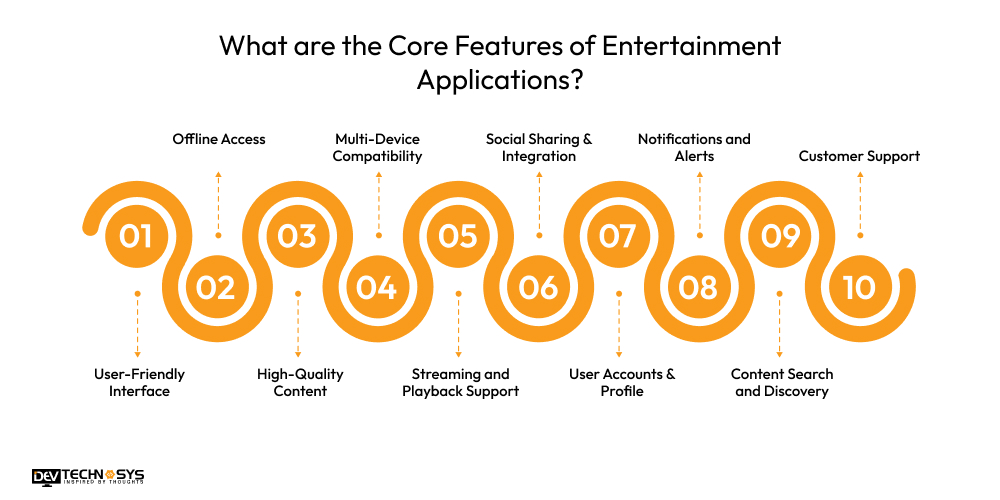
1. User-Friendly Interface
The entertainment apps mainly focused on a clean and user-friendly interface that enables users to easily access all the navigation bars and functionalities of the app. It includes responsive controls, clear menus, smooth transitions, and more to enhance the user’s experience.
2. Offline Access
The offline access enables users to download the video content to access without internet connectivity. It helps users during travel and in low-internet connectivity areas, where users can easily watch, which can increase the convenience and flexibility. Users can download the video content in a higher quality.
3. High-Quality Content
The success of entertainment applications depends on delivering high-quality audio, video, or interactive content. High-resolution visuals, clear sound, engaging storytelling, and regularly updated material ensure users remain interested and perceive the app as valuable and premium.
4. Multi-Device Compatibility
Entertainment applications should function smoothly across various devices such as smartphones, tablets, Smart TV app development solutions, and desktops. Consistent performance and synchronized user data across platforms ensure flexibility and allow users to enjoy content anytime, anywhere.
5. Streaming and Playback Support
Entertainment apps must provide seamless streaming and playback functionality. This includes fast loading times, adaptive streaming for different network speeds, minimal buffering, and support for pause, rewind, and resume features to enhance uninterrupted enjoyment.
6. Social Sharing & Integration
The social sharing features allow users to share their achievements, badges, leaderboards, and recommendations with their friends or family members via social media platforms. These integrations encourage community engagement and promote the application organically.
7. User Accounts & Profile
The user accounts and multiple profiles help users to maintain their multiple accounts within a single entertainment app. It enables users to perform various actions such as personalized recommendations, history, preferences, and more. Allowing different users to maintain individualized experiences within a single entertainment application.
8. Notifications and Alerts
The entertainment MVP application development solutions send alert messages and notifications to users about updates, live events, download start and completion, new content, and software updates. These push notifications remind users about their past and future activities and maintain the users’ engagement.
9. Content Search and Discovery
The advanced content search and discovery enable users to find their favorite content instantly. The entertainment apps provide various tools such as filters, voice search, categories, and personalized suggestions to reduce the searching time and efforts of users. This feature can enhance the user’s satisfaction and make it easy to explore content.
10. Customer Support
The entertainment applications have a customer support team to handle or manage the concerns raised and provide a quick response. The team is available 24/7 to solve the users’ queries as soon as possible, which can increase the overall performance of the application and enhance the users’ experience.

What are the Advanced Features of Entertainment Applications?
After observing the basic features, you have to analyze the advanced features of entertainment applications that can make your app unique and gain a competitive advantage. So, let’s take a look at the premium or modern features of entertainment applications:
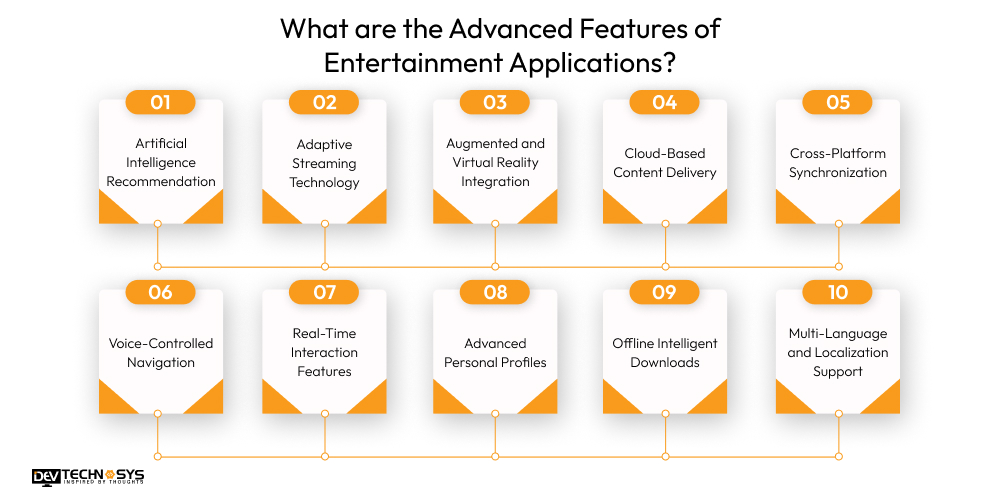
1. Artificial Intelligence Recommendation
The modern entertainment apps use AI to analyze or observe the user’s behaviour, preferences, habits, and viewing history, and more. These advanced entertainment apps suggest relevant movies, TV shows, music, games, and more. It can improve the user’s experience and content discovery.
2. Adaptive Streaming Technology
It is one of the best features of entertainment apps; adaptive streaming technology adjusts the video or audio quality based on the internet speed and device capability. This feature minimizes buffering, smooths video playback, and delivers optimal quality even under fluctuating network or internet speed.
3. Augmented and Virtual Reality Integration
AR and VR technologies provide immersive entertainment experiences. Users can interact with virtual environments, attend virtual concerts, or play immersive games. These features elevate engagement by offering realistic and interactive experiences beyond traditional screen-based entertainment.
4. Cloud-Based Content Delivery
The cloud technology enables entertainment apps to store and deliver content efficiently and smoothly. These cloud-based entertainment applications support faster load times, scalability, and global accessibility. Cloud-based systems enable seamless content synchronization across all types of devices, from anywhere and at any time.
5. Cross-Platform Synchronization
The advanced entertainment hybrid app development solutions support cross-platform synchronization means the app syncs the user’s progress and preferences on multiple devices.
A users start to watch movies or TV shows on one device, and they can continue to watch seamlessly on another device. It can enhance the user’s flexibility and convenience.
6. Voice-Controlled Navigation
Voice assistants and voice commands enable hands-free interaction with entertainment applications. Users can search for content, control playback, or adjust settings using voice, making the app more accessible, efficient, and suitable for smart devices and home systems.
7. Real-Time Interaction Features
Real-time chats, live polls, reactions, and audience participation enhance live events and streaming experiences. These features foster community engagement, allow instant feedback, and create a shared entertainment environment among users worldwide.
Hiring a professional mobile app development company to integrate these real-time interaction features can easily increase user engagement and enhance the users’ entertainment experience.
8. Advanced Personal Profiles
The advanced personal profiles store various information such as user preferences, parental settings, watch history, personalized recommendations, and more.
These modern entertainment apps support multiple users within one account while maintaining privacy and content separation. It can enhance the users’ and their family members’ experience to watch content separately.
9. Offline Intelligent Downloads
The offline intelligent downloads automatically select the optimal content quality based on the storage, usage patterns, and network availability. This advanced feature ensures efficient storage use while providing high-quality offline entertainment without manual intervention. Users can also download video content as per their preferred quality to reduce internet data.
10. Multi-Language and Localization Support
Advanced entertainment apps support multiple languages, subtitles, and region-specific content. Localization enhances global reach, cultural relevance, and accessibility, allowing users from different regions to enjoy content comfortably in their preferred language. Users can change language as per their understanding and preferences, this can enhance the overall experience of users.
Conclusion
To summarize, how users interact with content, socialize, and experience digital fun is influenced significantly by the development of entertainment applications. With the integration of creativity and tech, entertainment applications enhance digital experiences, ranging from streaming and gaming to live events and interactive storytelling.
A professional entertainment app development company guarantees adaptable design, smooth functionality, and a user-centered approach to meet the shifting requirements of the market. As digital entertainment evolves, app development will become increasingly valuable for businesses looking to attract and keep the contemporary audience.
Frequently Asked Questions
Find answers to the most common questions related to this article.
The entertainment application development is the process of developing mobile or web applications for entertainment industry. It includes various stages to complete the development process, such as market research, collecting project requirements, identifying features, tech stacks, designing UI/UX, development, testing, publishing, and maintenance services. It includes various entertainment app types such as gaming, social media, video, and music streaming.
The entertainment application development includes various types of apps such as video streaming apps, music streaming apps, gaming apps, social media apps, podcast apps, event-based apps, and live-streaming apps. These applications focus on providing fun, relaxation, interaction, and engaging digital content for users across different devices and platforms.
There are various types of technologies that are used for entertainment application development. Here, we provide the list of tech stacks:
Java
Python
C++
JavaScript
Node.js
HTML
AWS
The cost to develop an entertainment app is around $8,000 to $25,000 or higher. There are many factors that can affect the cost, such as features, functions, project complexity, backend infrastructure, deployment platforms, development team, tech stacks, third-party integrations, design UI/UX, and more.
There are various challenges are occur during the entertainment application development. Let’s take a look at the key challenges:
Higher development cost
Privacy and security measures
Cross-platform compatibility issues
Content licensing restrictions
Scalability during peak traffic