











Key takeaways:
-
- AI agent platforms provide infrastructure for building, deploying, and managing autonomous agents. They support the full lifecycle of running agents reliably.
- We have compared these platforms based on real-world usability, flexibility, and alignment with modern business needs.
- Engineering, analytics, and operations teams rely on the best AI agent platforms such as CrewAI, AutoGen, and LangChain Hub.
Are you looking for the best AI agent platforms and builders in 2026? Well, you’re in luck today! AI agent platforms are becoming powerful, and every enterprise is paying close attention to them. A few of them are actually promising.
AI agents for business are designed to power complex workflows and drive meaningful results. They help companies plan and execute multi-step workflows. An IBM report states that 92% of leaders expect that agentic AI will deliver measurable ROI within two years.
In this blog, we’re going to show the top 10 AI agent platforms comparison. By the end, you will be able to evaluate solutions, compare capabilities, and choose the right one for your business. Alright, let’s dive straight into the comparison.
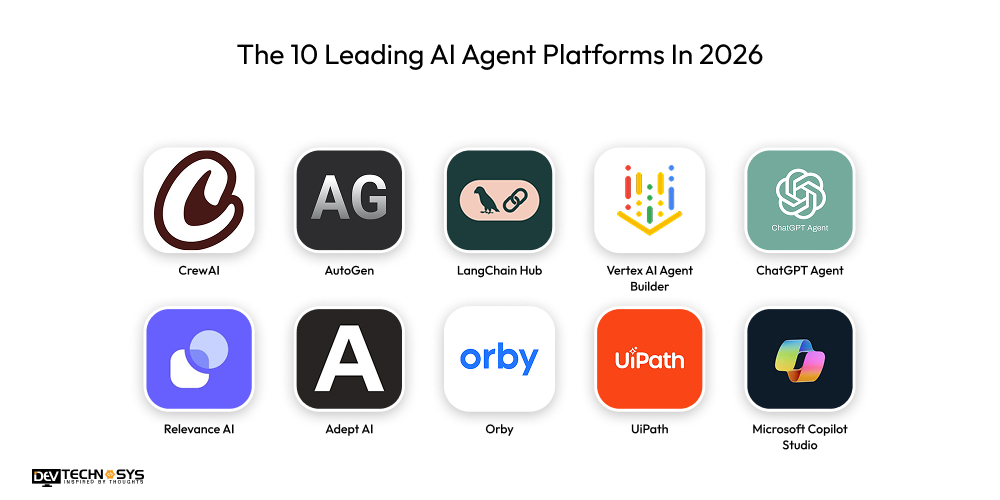
The 10 Leading AI Agent Platforms In 2026
Best AI agent builders offers scalable path forward for startups. These intelligent AI agents help increase efficiency and redefine how work is done. Each tool in this list supports different levels of reasoning, planning, and AI development services.
1. CrewAI
In the AI agent platform comparison guide, CrewAI is at the top. This AI agent software is designed to build intelligent and multi-agent systems. It is an open-source framework for collaborating on solving complex problems.
CrewAI vs AutoGen: The CrewAI framework is a valuable tool for analytical processes, research, data analysis, and content creation.
Standout Features:
- Real-Time Adaptation: It adapts to changing environments in real time
- Data-Driven Decisions: Enable high-level automation without human intervention.
- Scalable Architecture: Supports business scaling from small projects to enterprise-level
- Collaborative Systems: Multiple agents can work together simultaneously
| Pros | Cons |
| Flexible role-based multi-agent workflows | Moderate learning curve for beginners |
| Strong for content and research automation | Requires coding expertise |
2. AutoGen
AutoGen is one of the top AI agent platforms that works for agent-to-agent communication. Its predictive analytics and machine learning capabilities make it stand out in AI agent development.
In AutoGen vs CrewAI comparison, AutoGen is positioned as a flexible communication and interaction pattern. It is a go-to solution for research and production use.
Standout Features:
- Custom Algorithms: It offers flexibility in system design
- Extensibility & Integration: The platform is easy to integrate
- Continuous Learning: It adapts to new data and improves over time
- Automated Workflows: Reduce the need for human involvement
| Pros | Cons |
| Excellent for highly autonomous agents | Advanced technical skills needed |
| Great for multi-step agent orchestration | Less beginner-friendly documentation |
3. LangChain Hub
Among the best AI productivity tools, LangChain specializes in building natural language processing (NLP) agents. Developers can experiment with chains, prompts, and agents in a reproducible way.
The LangChain framework powers chatbots to handle customer queries and solve problems. In the LangChain vs CrewAI comparison: this one interacts intelligently with humans.
Standout Features:
- Contextual Awareness: It remembers context and past interactions
- Cross-Platform: Operates seamlessly across different platforms
- Advanced NLP Capabilities: Perfect for conversational AI systems
- Real-Time Learning: AI agents learn from ongoing conversations
| Pros | Cons |
| Rich repository of reusable components | Dependency on the LangChain ecosystem |
| Easy sharing of prompts and chains | Not a full standalone agent platform |
4. Vertex AI Agent Builder
When popular AI agent platforms compared, Vertex AI Agent Builder makes the list. Developed by Google, it is a cloud-native service for building AI agents for business.
From the perspective of an artificial intelligence development company, it is a powerful tool for complex AI models. It is positioned with scalability and governance in mind.
Standout Features:
- Pre-Built Models: Provide access to pre-trained AI models
- Complete Agent Lifecycle: Manages every step of the process
- Cloud Integrations: Integrate with Google Cloud
- Enterprise Security Controls: It supports compliance requirements
| Pros | Cons |
| Built on robust Google Cloud infrastructure | Requires Google Cloud expertise |
| Scales easily for enterprise use | Higher cost for heavy usage |

5. ChatGPT Agent
OpenAI’s ChatGPT is one of the best conversational AI platforms that we have seen in recent times. GPT-4 enables businesses to build highly sophisticated autonomous systems.
It is known for generating human-like text, but its core ability lies in powering generative AI agents. In LangChain vs OpenAI, ChatGPT-4 handles complex, context-rich conversation tasks.
Standout Features:
- Extensive Knowledge: Has access to vast amounts of data
- Integration with Other AI Tools: Provides seamless integrations
- Contextual Understanding: Better understanding of contexts
- Multitasking: Manage multiple tasks simultaneously
| Pros | Cons |
| Highly capable conversational AI | Can be expensive at scale |
| Simple setup with powerful language understanding | Custom workflows need careful design |
Industry Insights: KPMG AI Quarterly Pulse Survey reports that over 51% of organizations are exploring the use of AI agents, and another 37% are piloting them.
6. Relevance AI
Relevance AI ranks among the top AI agent platforms that deploy custom AI decision-making engines. Being a no-code AI agent builder, it has adaptive workflows.
The main focus of this platform is agentic automation that empowers non-technical business users. It is ideal for teams that seek fast deployment of AI models.
Standout Features:
- API Integration: Connects to external systems and services
- LLM-Agnostic Platform: Supports models from OpenAI, etc.
- Operational Dashboard: Shows visibility in agent activity
- Event-Triggered Agents: Agents can respond to business signals
| Pros | Cons |
| Strong semantic search and retrieval | May need additional tooling for full workflows |
| Good for vector database-driven agents | Less mature automation ecosystem |
7. Adept AI
As one of the best AI agent platforms, Adept AI deploys LLM-powered agents. With an action-oriented approach, it builds AI for enterprise software systems.
Adept’s AI chatbot development services are suitable for firms seeking automation when APIs are limited. Instead of static chatbots, its agents can navigate applications.
Standout Features:
- Multimodal AI Agents: Interpret software environments accurately
- Interface Navigation: Interacts with application UIs directly
- Human-in-the-Loop Control: It combines autonomy with oversight
- Enterprise Workflow Automation: Handles repetitive digital tasks
| Pros | Cons |
| Advanced task execution abilities | Limited user-facing customization tools |
| Built for autonomous action planning | Smaller community than larger platforms |
8. Orby
Orby is among the best platforms for building AI agents. It emphasizes improving efficiency through generative process automation. Its smart AI assistants can monitor systems, make proactive decisions, and execute workflows with minimal human intervention.
Companies that need flexible automation across systems may prefer Orby vs Adept AI.
Standout Features:
- Proactive Autonomy: Take pre-emptive actions to resolve issues
- Transparent Decision-Making: It offers explainability and logging
- Neuro-Symbolic Reasoning: Neural models blend with structured logic
- Quick Deployment: Reduces the effort to implement automation workflows
| Pros | Cons |
| Focused on streamlined agent experience | Fewer enterprise-grade integrations |
| Simple onboarding and usage | May lack depth for complex tasks |
9. UiPath
In the AI agent platforms comparison, UiPath remains one of the top AI agent tools. It stands out by combining traditional robotic process automation (RPA) with emerging agentic AI capabilities.
It can understand unstructured data and make decisions. Enterprises seeking to combine RPA with adaptive automations can partner with an AI agent development company.
Standout Features:
- AI + RPA Fusion: Integrates rule-based automation with Generative AI
- Expanded Models: Native support for LLM providers
- Enterprise Integrations: Can integrate with ERP, CRM, etc.
- Maestro Orchestration: Manages AI agents, robots, and humans
| Pros | Cons |
| Excellent automation and RPA integration | Less focus on conversational AI |
| Strong enterprise support | Steep licensing costs |
10. Microsoft Copilot Studio
Microsoft Copilot Studio is a low-code AI automation platform. It is used for building conversational and workflow-based AI agents. Businesses can create conversational AI assistants that can automate workflows and answer questions.
It is a business-friendly platform that is suited for developing internal agents and copilots. This platform combines conversational AI and workflow automation.
Standout Features:
- Prebuilt Conversational Templates: Speeding up Copilot use cases
- Low-Code Interface: Allows non-developers to create an AI agent
- Microsoft Ecosystem: Operates with Microsoft tools and data
- Enterprise-Grade Security: Has built-in governance controls
| Pros | Cons |
| Low-code agent building for productivity | Best use tied to the Microsoft ecosystem |
| Deep integration with Office and Teams | Complex customization may need developers |
Industry Insights: According to the Xtended View AI Agents Statistics 2026 report, 66% of adopters say AI agents deliver measurable productivity gains.
Pick what you need below — you can select more than one — then tap Get detail to continue.Want a chatbot demo or pricing? Fill the form and talk to our experts today.
Chatbot demo dashboard
Cost to develop an app
Industry report
Case study
Top 3 AI Agent Platforms Compared At A Glance
In the AI agent platforms comparison section above, each platform targets a different type of user. To help you quickly choose between these platforms, we have compared the top-rated 3 platforms side by side.
| Feature | CrewAI | AutoGen | LangChain Hub |
| Type | Multi-agent framework | Multi-agent orchestration | LangChain component hub |
| Best For | Role-based agent teams | Complex autonomous workflows | Modular pipeline building |
| Ease of Use | Moderate | Advanced | Moderate |
| Autonomy Level | High | Very High | Depends on setup |
| Scalability | Good | High | Scales with LangChain apps |
| Customization | Flexible roles | Deep logic control | Flexible within LangChain |
| Ideal Users | Developers | Experienced AI engineers | LangChain developers |
Which AI Agent Platform Works Best For You?
Finding which AI agent software fits your goals means cutting through the list of top AI apps. The right choice isn’t the flashiest, but the one that aligns with your enterprise’s needs. Here’s what you should consider before selecting the right and scalable AI agent platform.
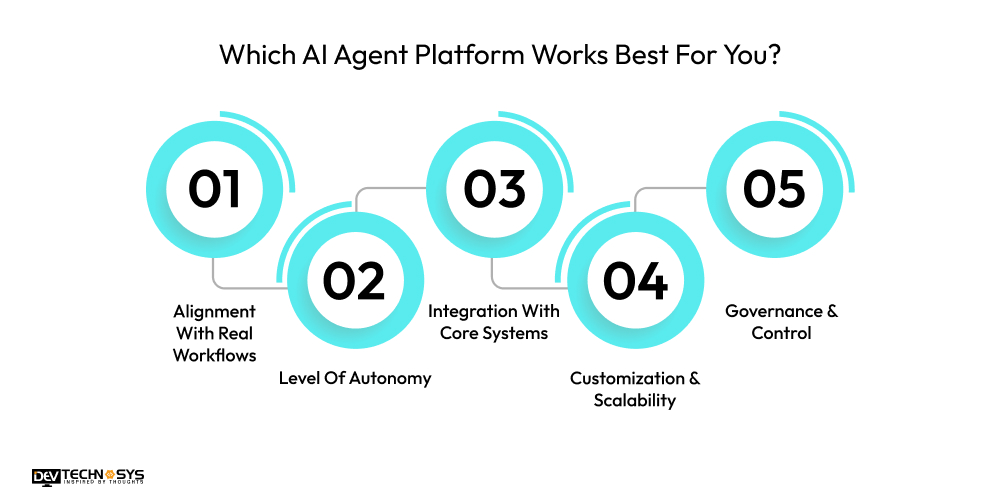
1. Alignment With Real Workflows
The first thing to do is start with use cases that match your business goals. Ensure that the platform isn’t built for demo purposes. Check whether it supports onboarding and supply-chain reconciliation.
2. Level Of Autonomy
Next, evaluate the level of independence the platform offers. Top AI agent platforms can plan, act, and adapt with minimal supervision. They give you full control to dial autonomy up or down.
3. Integration With Core Systems
You must know that AI Agents vs. AI Assistants are only as powerful as the systems they integrate with. So ensure that the platform offers native or API integrations with your CRM, ERP, ticketing, and data platforms.
4. Customization & Scalability
In the list of best AI agent builders, check whether they provide low-code/no-code design and SDK options. As your workflow expands, so must your chosen platform, rather than locking you into limitations.
5. Governance & Control
You must not compromise in governance and security. Look for role-based access, policy enforcement, audit logs, and compliance certifications. After that, you can choose the platform that best fits your workflows.
Final Words!
Agentic tools and platforms are empowering businesses to find information, complete tasks, and drive outcomes in a single conversation. From IT and HR to finance and operations, top AI agent platforms orchestrate complex workflows securely and efficiently.
With their unique capabilities, you can build an AI agent and turn potential into performance. Operational workflows, decision-making, and customer interactions are being transformed. Investment in the right one will unlock new, exciting opportunities. We hope you got the right platform from this blog.
Frequently Asked Questions
Find answers to the most common questions related to this article.
For beginners, low-code or no-code AI agent platforms are a great choice. These types of platforms offer templates, drag-and-drop workflows, and guided setup to reduce technical complexity. Startups or non-developers can create and deploy AI agents without having deep programming skills.
For enterprise businesses, platforms that offer scalability, security, and compliance controls are best suited. The best AI agent platform for enterprises provides role-based access and deep integrations with existing systems. They ensure reliable performance, regulatory compliance, and seamless deployment.
AI agent platform costs depend primarily on usage, scale, and features. Some features of the AI agent platform are only available with premium subscriptions. Enterprise AI agents operate on a usage-based pricing model. API usage, model calls, storage, integrations, and advanced features further determine the cost.
When selecting the best AI agent builder, compare features like autonomy level, integration options, scalability, pricing, and ease of use. Also evaluates multi-agent workflows, customization flexibility, analytics, security controls, memory management, and access to external tools.
From a distance, both seem similar, but at the core, they are different. A chatbot only responds to user queries in a conversational style. But AI agents go beyond that; they plan actions, retrieve data, and perform multi-step, complex tasks. They automate enterprise-level workflow seamlessly.