




















Key Takeaways:
The insurance software development cost is between $10,000 to $28,000, depending on the requirements and complexity of the software. The cost of the development is affected by the range of features, third-party APIs, the development team, and regulatory compliance.
- Factors Based on Development Complexity:
- Basic Insurance Software ($10,000 – $14,000): User registration, policy viewing, basic claims filing, document upload, and simple reporting with limited third-party integrations.
- Mid-Level Insurance Platform ($14,000 – $20,000): Premium calculation engine, KYC verification, payment gateway integration, CRM integration, customer portal, and automated notifications with moderate backend complexity.
- Advanced Enterprise Insurance Suite ($20,000 – $28,000): AI-powered claims automation, fraud detection, predictive analytics, digital underwriting, legacy system integration, multi-portal support, and highly secure, scalable architecture.
- Cost Based on Types of Insurance Softwares
- Insurance Agency Management Software: $10,000 – $14,000 (client management, policy tracking, and commission automation features)
- Policy Administration Software: $12,000 – $18,000 (policy issuance, endorsements, renewals, and compliance management)
- Claims Management Software: $14,000 – $20,000 (FNOL, claims tracking, fraud detection, and settlement processing)
- Underwriting Software:$16,000 – $22,000 (risk assessment, digital underwriting workflows, and predictive analytics)
- Enterprise Insurance Management Suite:$20,000 – $28,000 (full suite with AI, multi-portal, and legacy integrations)
- Cost of Popular Insurance Softwares
- Guidewire-like Platform:$18,000 – $25,000 (policy administration, claims management, and AI-powered analytics)
- Duck Creek-like Platform: $16,000 – $23,000 (product configuration, claims automation, and customer self-service portal)
- Majesco-like Platform: $15,000 – $22,000 (core policy management, digital underwriting, and API ecosystem integration)
- Applied Epic-like Platform:$10,000 – $14,000 (agency management, policy tracking, and commission reporting)
The insurance industry is no longer about paper and spreadsheets; it’s going digital, and fast. According to a report by Mordor Intelligence, the worldwide insurance software market size is $15.03 billion in 2026 and forecast to reach $20.41 billion by 2031 with a CAGR of 6.31%. That’s not a fad. It’s a clear signal that insurers globally are investing big in technology to remain competitive.
But here’s the thing that every insurance business is asking before they make the move: how much does it really cost?
The cost of creating a policy administration system from the start, updating a legacy platform, or deploying a full-blown corporate insurance suite depends on a variety of moving parts. Tech stack, team location, compliance constraints, third-party integration, and many more.
This guide breaks down the insurance software development cost in 2026 in a clear, no-fluff way, so you can plan your budget with confidence and make the right build decisions from day one.
What is Insurance Software?
Insurance software is a digital platform that assists insurance businesses in handling their essential operations, issuance, claims processing, underwriting, billing, and customer management. Consider it the backbone of a contemporary insurance firm.
Unlike generic business software, insurance platforms are created for industry-specific activities such as premium calculation, risk assessment, regulatory compliance, and fraud detection. They are available as cloud-based SaaS solutions or can be custom-created to meet a company’s specific requirements.
It doesn’t matter whether you are a new InsurTech or an experienced veteran; having the right insurance software helps to eliminate errors, improve claim processing times, and offer improved experiences to both the agents and insureds.
What is the Average Cost to Develop Insurance Software in 2026?
The cost to develop insurance software ranges from $10,000 to $28,000. It is affected by the complexity, range of features, tech stack, and the location of your development team. At the low end of the cost, you have a simple MVP insurance portal, and at the high end, you have a fully loaded corporate platform with AI, claims automation, and third-party interfaces.
| Software Type | Complexity | Cost Range |
Key Features |
| Basic Insurance Portal | Low | $10,000 – $14,000 | Policy viewing, user login, basic claims filing, document upload |
| Mid-Level Insurance Platform | Medium | $14,000 – $20,000 | Premium calculator, KYC verification, payment gateway, CRM integration |
| Full-Scale Insurance Suite | High | $20,000 – $28,000 | AI claims automation, fraud detection, analytics dashboard, and legacy system integration. |
Industry Insight
According to Boston Consulting Group (BCG), AI and GenAI could create a USD 4 billion annual profit expansion opportunity for India’s insurance industry through automation, underwriting efficiency, and claims optimization.
What are the Factors That Affect the Cost to Develop Insurance Software?
Building insurance software is not a one-size-fits-all solution. Several major aspects directly affect the insurance software development cost, from the modules you require to the team you choose. Here is what affects the insurance app development cost:
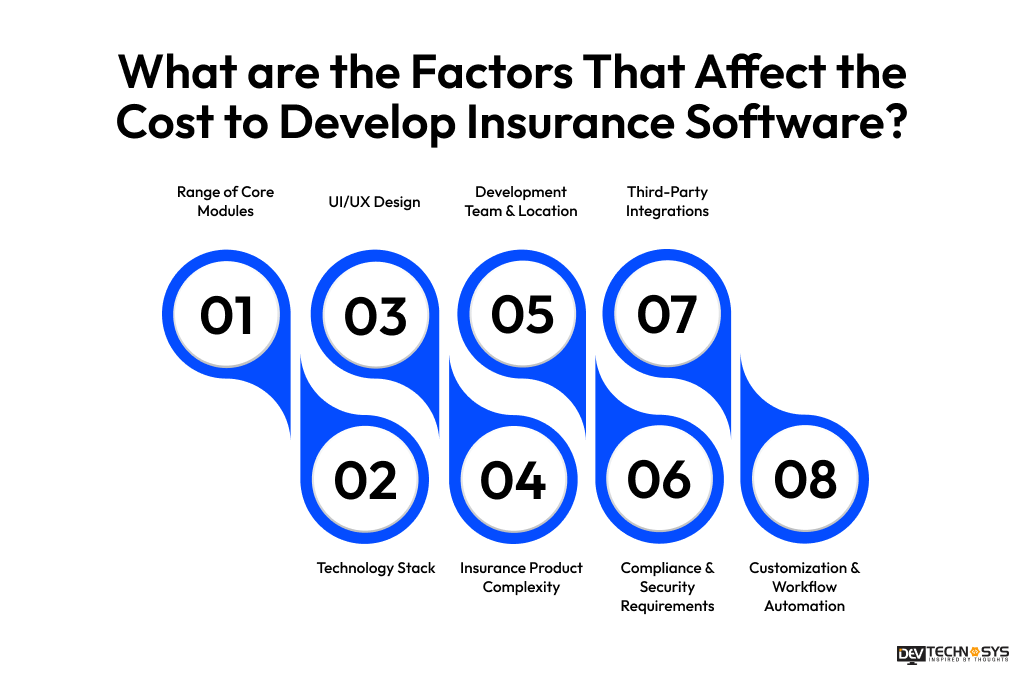
1. Range of Core Modules
The more modules your insurance software has, the more it will cost to design. Each module involves individual design, development, and testing work. A basic portal will cost a fraction of a fully integrated multi-module insurance platform.
|
Module Range |
Description |
Cost Contribution |
| 1–2 Core Modules | Basic policy viewing & claims filing | +$500 – $1,500 |
| 3–5 Modules | Adds billing, CRM, &customer portal | +$1,500 – $3,000 |
| 6+ Modules | Full suite with automation & analytics | +$3,000 – $5,000 |
2. Technology Stack
The technology stack you pick has a big impact on how long it takes and how much it costs to build. Modern architectures and AI technologies are more expensive to adopt, but offer better scalability, security, and long-term performance for your insurance platform. This deterines the cost to build insurance software in the long run, even after the development.
|
Stack Type |
Description | Cost Contribution |
| Basic (PHP, MySQL) | Simple web-based insurance portal | +$500 – $1,000 |
| Mid (Node.js, React) | Scalable with API integrations | +$1,000 – $2,500 |
| Advanced (AI, Microservices) | Real-time processing, ML-based decisions | +$2,500 – $4,500 |
3. UI/UX Design
A strong insurance platform can boost agent productivity and policyholder satisfaction. Complex multi-role interfaces for admin, agent, and customer demand additional design hours, which adds significantly to the final cost compared to a basic single-role UI.
|
Design Complexity |
Description |
Cost Contribution |
| Basic UI | Single-role, template-based design | +$300 – $800 |
| Standard UX | Multi-role with custom workflows | +$800 – $2,000 |
| Premium UI/UX | Custom design system, animations, portals | +$2,000 – $3,500 |
4. Insurance Product Complexity
The intricacy of the health, life, auto, or business insurance package that you are designing is directly. Creating products with dynamic pricing, multi-tier coverage, and regulatory-specific restrictions is substantially more difficult and expensive.
|
Product Type |
Description |
Cost Contribution |
| Single Line (e.g., auto) | Fixed rules, standard workflows | +$500 – $1,500 |
| Multi-Line (e.g. health + life) | Multiple rule engines & workflows | +$1,500 – $3,000 |
| Specialty/Commercial | Complex underwriting & compliance logic | +$3,000 – $5,000 |
5. Development Team & Location
One of the main cost drivers is the location of your development staff. The most competitive pricing can be found in offshore teams in South Asia, while US or UK-based teams have a much higher hourly fee for the same deliverable due to their high living costs.
|
Team Location |
Description |
Cost Contribution |
| South Asia (India, Pakistan) | Cost-effective, strong talent pool | +$500 – $1,500 |
| Eastern Europe | Mid-range rates, high quality | +$1,500 – $3,000 |
| USA / UK / Australia | Premium rates, local compliance expertise | +$3,000 – $6,000 |
6. Compliance & Security Requirements
The insurance applications are bound by strict laws, like HIPAA, GDPR, and SOC. The need for compliance, data security, logging, user authentication, and a lot more takes up considerable resources, thereby influencing your budget substantially in the long run.
|
Compliance Level |
Description |
Cost Contribution |
| Basic Security | SSL, login authentication, data encryption | +$300 – $800 |
| Standard Compliance | GDPR-ready, audit logs, role-based access | +$800 – $2,000 |
| Full Regulatory Compliance | HIPAA, SOC 2, real-time monitoring | +$2,000 – $4,000 |
7. Third-Party Integrations
Adding integration with the payment gateway, KYC verification system, CRM software, and telematics solution will increase the cost and duration of your insurance platform development. More connections result in increased cost to build insurance software in overall.
|
Integration Type |
Description |
Cost Contribution |
| Basic (1–2 APIs) | Payment gateway or SMS integration | +$300 – $1,000 |
| Standard (3–5 APIs) | CRM, KYC, document verification | +$1,000 – $2,500 |
| Advanced (6+ APIs) | Telematics, analytics, legacy systems | +$2,500 – $4,000 |
8. Customization & Workflow Automation
Custom operations like automated routing of claims, AI-based underwriting judgments, or rules-based premium calculations require lots of backend infrastructure. The more automated and personalized your workflows get, the more development hours and cost they entail.
|
Automation Level |
Description |
Cost Contribution |
| Basic | Manual workflows, standard forms | +$300 – $800 |
| Moderate | Rule-based automation, notifications | +$800 – $2,000 |
| Advanced | AI-driven workflows, claims automation | +$2,000 – $4,000 |
Why Businesses Choose Software Over Apps in the Insurance Sector?
When it comes to managing complex insurance operations, a dedicated software platform simply does more than a mobile app ever could. Apps are great for customer-facing interactions, but the real backbone of an insurance business runs on software.
Insurance software offers multi-role access for admins, agents, underwriters, and customers in one system. It manages deep connections with payment gateways, CRMs, and legacy systems, automating activities like claims routing and premium calculations.
Most professional insurance software development services also build platforms with built-in HIPAA, GDPR, and SOC 2 compliance frameworks, something a standard mobile app simply can’t accommodate at scale.
Why Budgeting for Your Insurance Software Project is Crucial?
One of the most common reasons why projects fail in the middle of the way is designing insurance software without a budget. There are many things that can blow up the project beyond the original estimate, including mid-project changes, regulatory compliance, and third-party integrations.
If you properly curate your budget initially, then you can have ample time to focus on features, development team, and tech stack, and avoid any mishaps during the development of the project. This saves both money and time in the long run.
Whether you’re building an MVP or a full-scale platform, upfront budgeting helps ensure your insurance software project is on track from day one.
How Much Does It Cost to Build Different Types of Insurance Softwares?
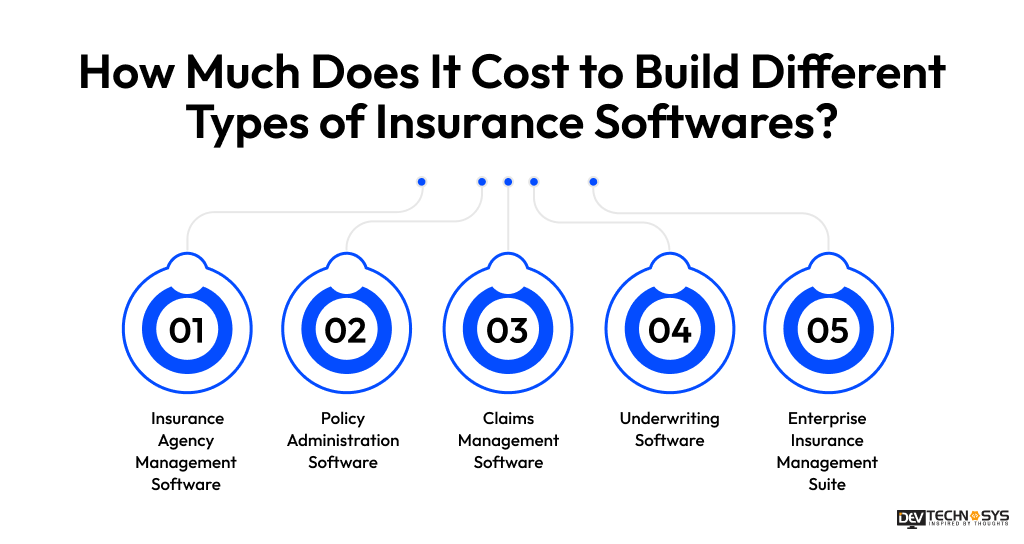
Different types of insurance softwares cost differently. The cost of development is determined by the type of platform you build, whether it’s an agency management tool or a full enterprise suite. Here’s a detailed breakdown pf different types of insurance softwares:
1. Insurance Agency Management Software
Insurance agency management software allows agents to handle clients, policies, commissions, and renewals through one platform. It’s perfect for small to mid-sized agencies that want to take their core business online without creating a full enterprise system.
|
Feature/Module |
Description |
Cost |
| Client & Policy Management | Store, manage, and renew client policies | $1,500 – $3,000 |
| Commission Tracking | Automated agent commission calculations | $800 – $1,500 |
| Document Management | Upload, store, retrieve policy documents | $500 – $1,000 |
| Reporting & Analytics | Agency performance dashboards | $700 – $1,200 |
| Total Estimated Cost | $10,000 – $14,000 |
2. Policy Administration Software
Policy administration software manages the entire policy life cycle from issuance, endorsements, renewals, and cancellations. This is the heart of every insurance operation and needs strong rule-based workflows and compliance-ready infrastructure.
|
Feature/Module |
Description |
Cost |
| Policy Issuance & Renewal | Automated policy generation & renewals | $2,000 – $3,500 |
| Endorsement Management | Mid-term policy changes & adjustments | $1,000 – $2,000 |
| Premium Calculation Engine | Rule-based dynamic pricing system | $1,500 – $2,500 |
| Compliance & Audit Trails | Regulatory reporting & activity logs | $800 – $1,500 |
| Total Estimated Cost | $12,000 – $18,000 |
3. Claims Management Software
Claims management software automates the claims process from first notice of loss (FNOL) to final settlement. The automation of this procedure decreases processing time, minimizes fraud, and greatly enhances policyholder satisfaction.
|
Feature/Module |
Description |
Cost |
| FNOL & Claims Intake | Digital first notice of loss submission | $1,500 – $2,500 |
| Claims Tracking & Workflow | Automated routing & status updates | $1,500 – $2,500 |
| Fraud Detection System | AI-based suspicious claims flagging | $2,000 – $3,500 |
| Settlement & Payment Module | Automated claims payout processing | $1,000 – $2,000 |
| Total Estimated Cost | $14,000 – $20,000 |
4. Underwriting Software
Underwriting software streamlines the processes of risk assessment, price decisions, and workflows for policy approval. It cuts down on manual underwriting time, enhances accuracy, and enables insurers to make faster, data-driven choices through predictive analytics and real-time data.
|
Feature/Module |
Description |
Cost |
| Risk Assessment Engine | Automated risk scoring & profiling | $2,000 – $3,500 |
| Digital Underwriting Workflow | Rule-based approval & rejection logic | $1,500 – $2,500 |
| Predictive Analytics | ML-based risk prediction models | $2,500 – $4,000 |
| Third-Party Data Integration | Credit, telematics & external data APIs | $1,000 – $2,000 |
| Total Estimated Cost | $16,000 – $22,000 |

5. Enterprise Insurance Management Suite
An enterprise insurance management suite combines all modules, policy, claims, underwriting, billing, and CRM into one unified platform. It’s built for large carriers managing high volumes across multiple insurance product lines.
|
Feature/Module |
Description |
Cost |
| Full Policy & Claims Suite | End-to-end policy and claims management | $4,000 – $6,000 |
| AI & Automation Layer | Claims automation, fraud detection, analytics | $3,500 – $5,500 |
| Multi-Portal Development | Agent, customer & admin portals | $2,500 – $4,000 |
| Legacy System Integration | Migration & API connectivity | $2,000 – $3,500 |
| Total Estimated Cost | $20,000 – $28,000 |
Industry Insight
According to ScienceSoft, one in three insurers had at least one AI agent running in production by Q4 2025, signaling rapid adoption of agentic AI systems in claims and underwriting workflows.
5 Popular Insurance Software in 2026 & Their Estimated Costs
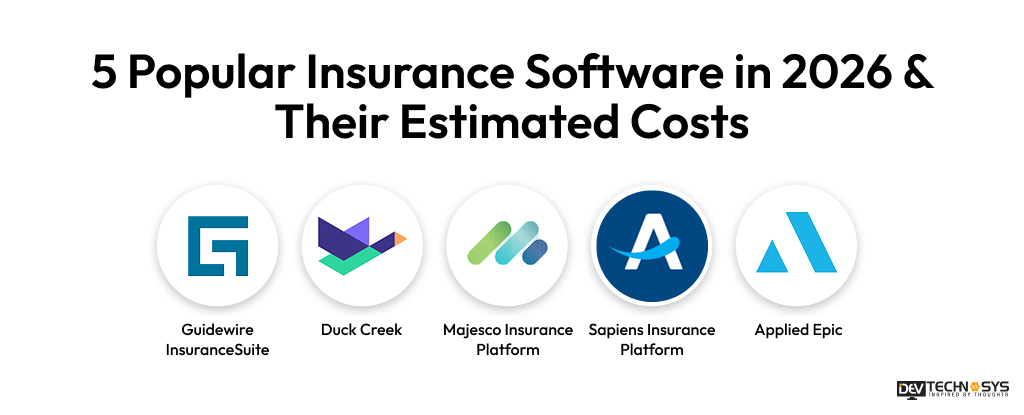
Several enterprise insurance software systems lead the market in 2026. Licensing such systems comes at a price tag of tens of thousands per year. Here’s a brief look at the main solutions and the price tag on building them in-house:
1. Guidewire InsuranceSuite
One of the most successful enterprise systems in use within the insurance sector, where all processes of policies, billing, and claim management are consolidated, is Guidewire. This system was built for large insurers, but the licensing costs are extremely high.
|
Feature |
Estimated Build Cost (From Scratch) |
| Policy Administration | $3,000 – $5,000 |
| Claims Management | $2,500 – $4,000 |
| Billing & Payments | $1,500 – $2,500 |
| AI-Powered Analytics | $2,500 – $4,000 |
| Total Estimated Cost | $18,000 – $25,000 |
2. Duck Creek
Duck Creek is a cloud-native insurance platform for P&C carriers. It provides customizable product configuration, claims automation, and distribution administration. It is a popular solution for mid to large-sized insurance firms.
|
Feature |
Estimated Build Cost (From Scratch) |
| Product Configuration Engine | $2,500 – $4,000 |
| Claims Automation | $2,000 – $3,500 |
| Distribution Management | $1,500 – $2,500 |
| Customer Self-Service Portal | $1,000 – $2,000 |
| Total Estimated Cost | $16,000 – $23,000 |
3. Majesco Insurance Platform
Majesco is a cloud-native insurance software provider for life and annuity, and property & casualty insurers. The company’s primary emphasis is on digital transformation, offering cutting-edge core systems, analytics, and connectivity within the ecosystem.
|
Feature |
Estimated Build Cost (From Scratch) |
| Core Policy Management | $2,500 – $4,000 |
| Digital Underwriting | $2,000 – $3,500 |
| Analytics & Reporting | $1,500 – $2,500 |
| API Ecosystem Integration | $1,500 – $2,500 |
| Total Estimated Cost | $15,000 – $22,000 |
4. Sapiens Insurance Platform
Sapiens offers a complete range of solutions for the life, P&C, and reinsurance markets. It is ideal for insurers looking for speed to market with low-code configuration capabilities that allow fast operational changes without extensive development.
| Feature |
Estimated Build Cost (From Scratch) |
| Low-Code Policy Configuration | $2,000 – $3,500 |
| Reinsurance Management | $2,500 – $4,000 |
| Claims & Billing Suite | $2,000 – $3,500 |
| Compliance & Audit Module | $1,000 – $2,000 |
| Total Estimated Cost | $14,000 – $20,000 |
5. Applied Epic
Applied Epic is the top agency management system for independent insurance agents and brokers. This platform combines customer data, policy administration, and accounting, making it the platform of choice for agencies wanting to simplify their day-to-day operations. The cost to create insurance software like Applied Epic is variable and dependent upon the requirements.
|
Feature |
Estimated Build Cost (From Scratch) |
| Agency & Client Management | $1,500 – $2,500 |
| Policy Tracking & Renewals | $1,500 – $2,500 |
| Accounting & Commission Tracking | $1,000 – $2,000 |
| Reporting & Dashboards | $800 – $1,500 |
| Total Estimated Cost | $10,000 – $14,000 |
What is the Timeline of Building Insurance Software?
The time it takes to develop insurance software depends on the complexity of features, the number of integrations, and the size of your development team. The timeline also affects the cost to create insurance software variable in the development phase. Here’s a practical step-by-step breakdown to help you plan your project effectively:
|
Development Stage |
Description |
Timeline |
| Discovery & Planning | Requirement gathering, scope definition, and architecture planning | 1 – 2 Weeks |
| UI/UX Design | Wireframes, prototypes, design system | 1 – 2 Weeks |
| Frontend Development | User interfaces for all roles & portals | 2 – 3 Weeks |
| Backend Development | APIs, database, business logic, integrations | 3 – 5 Weeks |
| QA & Testing | Functional, security, and performance testing | 1 – 2 Weeks |
| Deployment & Launch | Cloud setup, go-live, final configurations | 3 – 5 Days |
What Are the Hidden Costs of Insurance Software Development?
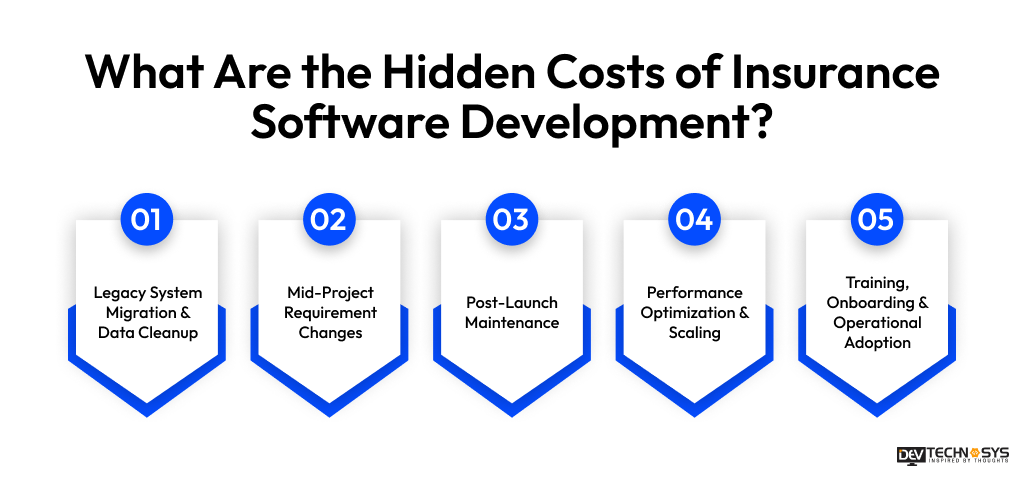
Most of the insurance software development funds go into the construction costs. The true costs are often in the post-launch phase. Being aware of these hidden expenditures beforehand can help you avoid major budget overruns later on.
1. Legacy System Migration & Data Cleanup
Migrating data from outdated systems is one of the most underestimated costs in insurance software development. Old data needs cleaning, mapping, and validating before it can work in a modern platform, similar to challenges faced in mobile banking app development services when modernizing legacy financial infrastructure.
2. Mid-Project Requirement Changes
Scope creep is a silent budget killer in the cost to create insurance software projects. Every new feature request mid-development adds hours, delays timelines, and inflates the final insurance software development cost beyond the original estimate.
3. Post-Launch Maintenance
No software launches perfectly. Post-launch bug fixing, security patches, and performance updates are ongoing costs that most businesses overlook. Much like working with a reliable payment app development company, long-term maintenance is what keeps your platform stable and secure.
4. Performance Optimization & Scaling
As your user base grows, your insurance software maintenance costs increase, too. Scaling servers, optimizing databases, and improving load handling are expenses that hit hardest when your platform wasn’t built cloud-native from day one.
5. Training, Onboarding & Operational Adoption
Even the best insurance platform fails if your team doesn’t know how to use it. Staff training, onboarding documentation, and change management are real costs, especially for platforms handling complex workflows, much like those built by a professional money transfer app development services team managing high-volume financial operations.
Industry Insight
According to Risk & Insurance, insurers redesigning claims operations around AI achieved a 35% productivity boost and cut homeowners’ claims processing times in half.
How to Reduce Insurance Software Development Cost in 2026?
Software insurance doesn’t need to bleed your budget dry. With the appropriate strategy and development technique, you may drastically lower costs without sacrificing quality or compliance. Here’s how:
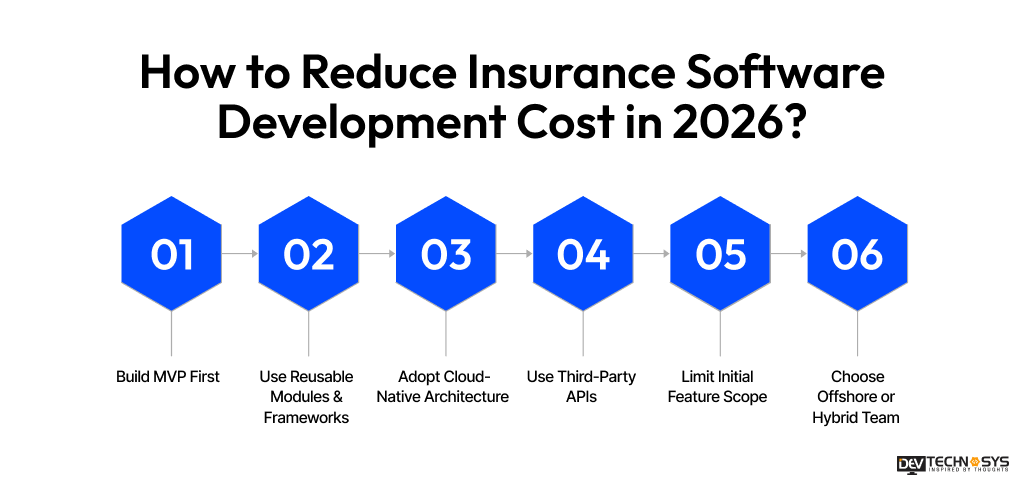
1. Build MVP First
Start with the basics, test with real users, and grow slowly by building an MVP first. When you develop a health insurance software and want to keep your initial investment minimal and check market fit, this model is really useful for you.
2. Use Reusable Modules & Frameworks
Off-the-shelf modules for insurance management, claims processing, and billing can reduce development time substantially. Reusable frameworks can save time and custom insurance software expenses, while providing the same functionality and scalability without having to build everything from scratch.
3. Adopt Cloud-Native Architecture
The cloud-based development platform runs on either AWS, Azure, or Google Cloud, and the scaling happens automatically, which means that you will only be charged for what you consume, thereby saving money on insurance software development.
4. Use Third-Party APIs
It takes a lot of time and money to develop any feature from the start. APIs from third parties, such as KYC verification, payment gateways, and even generative AI in insurance industry solutions, may dramatically reduce development time and maintain your platform modern and feature-rich.
5. Limit Initial Feature Scope
Feature overload at launch is one of the primary causes of insurance software development expense. Focus on the must-have features initially, such as authentication, policy administration, and claims filing, then roll out more sophisticated features such as fraud detection and analytics in subsequent phases.
6. Choose Offshore or Hybrid Team
Hiring an offshore or hybrid development team is one of the best strategies to cut your insurance software development costs. With intricate telematics, real-time integrations, and building an app for vehicle insurance, you may get the same quality output from experienced teams in South Asia for a fraction of the cost of US or UK-based developers.
What are the Monetization Models for Insurance Software?
Building insurance software is an investment, but the right monetization model turns it into a revenue engine. Here’s how leading InsurTech businesses are generating returns from their platforms:
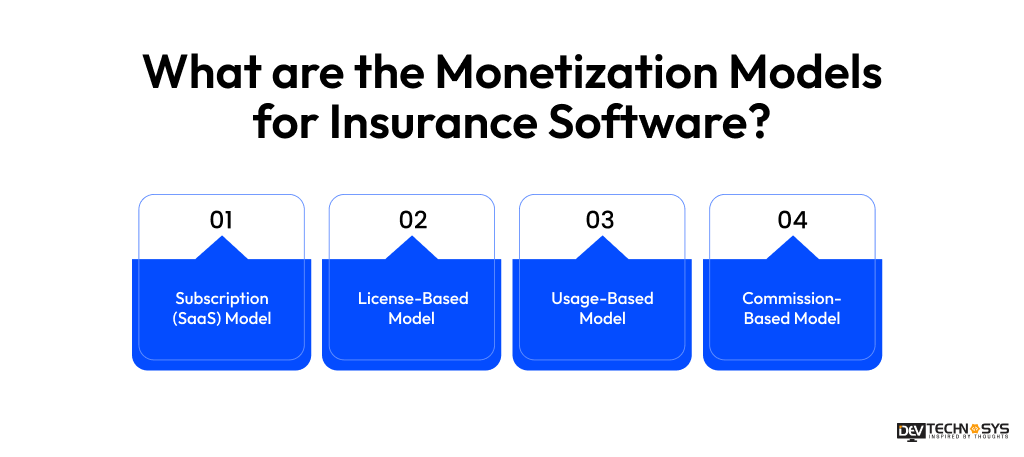
1. Subscription (SaaS) Model
The SaaS model is the most prevalent monetization technique that modern insurance systems prefer. Users pay a predictable recurring revenue via a fixed monthly or annual price for access. When you partner with the right custom software development company, your SaaS platform will be created with this model’s multi-tenancy architecture and scalability in mind.
2. License-Based Model
The license-based model charges a one-time fee for permanent software access. It works well for enterprise carriers who prefer owning the platform outright rather than paying ongoing subscriptions. While upfront revenue is higher, it requires strong post-sale support and regular update cycles to retain clients long-term.
3. Usage-Based Model
The usage-based model charges clients based on actual platform consumption, per policy issued, per claim processed, or per API call made. This model is ideal for startups and mid-sized insurers who want low entry costs with the flexibility to scale their insurance software development cost proportionally.
4. Commission-Based Model
The commission-based model earns revenue by taking a percentage of every policy sold or renewed through the platform. It’s a performance-driven approach that aligns your success directly with your clients’. Investing in custom insurance software development with built-in commission tracking and automated payout systems makes this model seamless to operate at scale.
Conlusion
In 2026, the cost to develop insurance software is between $10,000 and $28,000, depending on the complexity, features, tech stack, and the location of your development team. Building a basic agency portal or a full-fledged business platform requires understanding the cost drivers, hidden costs, and the correct monetization model to make the difference between a successful and an over-budget project.
Budget is important, but so is choosing the proper technology partner. Dev Technosys, a trusted mobile app development firm with 15+ years of experience, has helped 500+ insurance organizations construct safe, scalable, and compliance-ready software solutions that generate genuine ROI. We have the experience your project needs, from MVP to enterprise.
Frequently Asked Questions
Find answers to the most common questions related to this article.
The insurance software development cost in 2026 normally runs from $10,000 to $28,000, depending on the complexity, features, and technology stack. A basic insurance portal starts at $10,000, while a full-scale business platform with AI, claims automation, and third-party interfaces can cost $28,000 or more.
Insurance businesses can cut down their cost to build insurance software by: Starting with an MVP, using reusable modules, going for a cloud-native architecture, limiting the scope of features initially, and opting for an offshore or hybrid development team.
Complexity defines the timelines for insurance software development. A basic platform takes 1-2 months, 3-4 months for a mid-level platform with standard integrations, and 4-6 months or more for a full-scale corporate insurance management software with AI and legacy connectors.
The insurance software maintenance cost typically runs between 15% to 20% annually of the total development cost of the project. These include security updates, bug fixes, performance optimization, and server monitoring to keep the insurance app up and running.
Yes, you can make economical insurance software with the appropriate strategy. Develop a completely functional insurance SaaS platform development cost within a budget of $10,000 to $14,000 by following tips like starting with an MVP, restricting the first feature scope, using third-party APIs, and working with an experienced offshore team.