
















Quick Overview
- The cost to build an insurance app in 2026 typically ranges between $10,000 to $28,000+, depending on app complexity, features, integrations, and compliance requirements.
- Cost Breakdown by Complexity:
- Basic/MVP Insurance App : $10,000 – $15,000
Core features like user registration, policy listing, premium calculator, and basic claims submission. - Mid-Level Insurance App : $15,000 – $22,000
Includes policy comparison, in-app payments, notifications, document upload, and improved UI/UX. - Advanced Insurance App : $22,000 – $28,000+
AI-powered risk assessment, chatbot support, real-time claim tracking, analytics dashboard, and API integrations.
- Basic/MVP Insurance App : $10,000 – $15,000
- Key Cost Factors:
App complexity, feature set, UI/UX design, regulatory compliance, security standards (KYC/AML), backend infrastructure, third-party integrations, and platform choice (iOS, Android, and Web). - Development Timeline:
On average, it takes 3 to 8 months to develop a fully functional insurance app, depending on features and customization requirements. - Regional Cost Rates:
Development in regions like India can be 40–60% more cost-effective compared to the US, UK, or Western Europe while maintaining high-quality output. - Additional Costs:
Ongoing expenses include maintenance (15–20% annually), cloud hosting, security updates, compliance upgrades, third-party API charges, and marketing costs.
Securing insurance is no longer an exhausting process of hectic paperwork and long approval wait times. In 2026, the insurance industry is powered digitally with the latest technologies and functionalities. It makes comparing, buying, maintaining, and claiming insurance a matter of a few taps on smartphones.
The digital shift in the insurance industry makes entrepreneurs and insurers ask: How much does insurance app development cost? The insurance app development budget is $10,000-$28,000+, driven by features, complexity, and compliance needs.
Whether developing MVPs or an AI-driven platform, understanding the structure of the cost to develop an insurance app is necessary. In this blog, we have broken down everything related to insurance mobile app development cost.
After reading this guide, businesses can easily plan, budget, and build a successful insurance app in 2026.
What is an Insurance App?
An insurance app is a mobile or web application that allows users to:
- Compare multiple policies
- Manage policies
- File claims
- Contact insurance providers
- Track claim.
All these can be simply done directly through smartphones, laptops, or computers. Since everything is saved in the app, there is no need to collect or maintain paperwork. In insurance apps, customers can access documents, bills, and customer support. This app develops a bridge between policyholders and broker/agents.
How Much Does it Cost to Develop an Insurance App?
The average insurance software development cost can be somewhere between $10,000 and $28,000+. The overall development expenses are usually determined by the complexity of the application. Let’s understand:
- A simple app that follows basic MVP development structure is less complex to build. A basic insurance mobile app development cost can range from $10,000 to $16,000.
- A mid-level app combines basic and advanced integration, which is neither too difficult nor too easy to develop. A moderate app can be built between $16,000 and $22,000.
- An advanced app is created with high-level integrations and modern functionalities, making it complicated to develop. An advanced insurance app development cost can be from $22,000 to $28,000+.
We will clearly explain this insurance app development price breakdown through a table:
App Type |
Best For |
Key Features Included |
Estimated Cost (USD) |
| Basic Insurance App (MVP) | Startups & small agencies | User registration, policy listing, premium calculator, and basic claims request | $10,000 – $15,000 |
| Standard Insurance App | Growing insurance businesses | Policy comparison, secure payments, push notifications, document upload, and user dashboard | $15,000 – $22,000 |
| Advanced Insurance App | Enterprises & large insurers | AI chatbot, real-time claim tracking, analytics dashboard, API integrations, automation | $22,000 – $28,000+ |
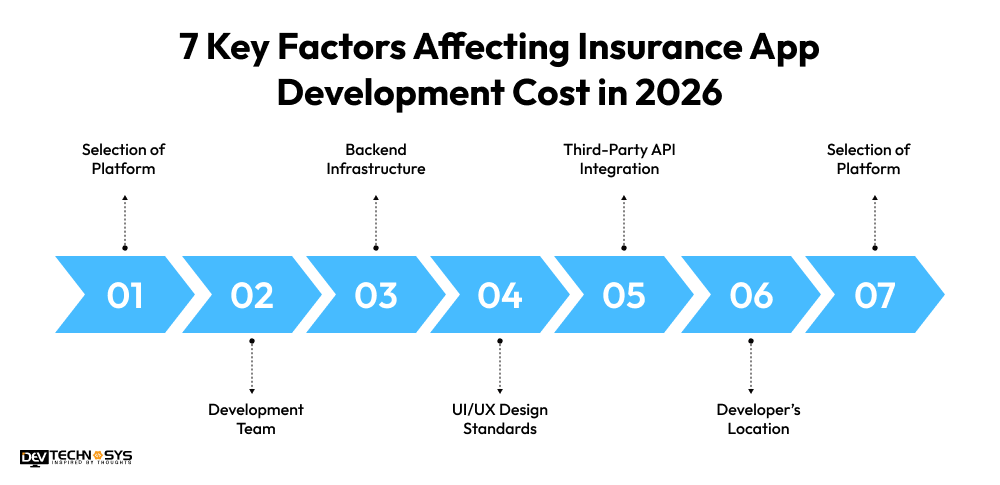
7 Key Factors Affecting the Cost to Make an Insurance App in 2026
Apart from complexity, multiple other factors impact the cost of insurance iOS and Android app development services. It includes security, APIs, features, development team & their location, UI/UX, backend infrastructure, and more. We will learn about a few of these influences, along with their cost structures.
1. Security and Regulatory Compliance
To handle sensitive and crucial data of users, strong security and compliance are mandatory in insurance apps. For this, entrepreneurs implement KYC, AML, and data encryption security measures and adhere to GDPR or HIPAA regulations. All these implementations ensure user trust but increase the insurance software development cost.
Component |
What It Covers |
Estimated Cost (USD) |
| Data Encryption & Protection | Secure user data, prevent breaches | $1,500 – $3,000 |
| KYC & AML Integration | Identity verification and fraud prevention | $2,000 – $4,500 |
| Regulatory Compliance Setup | GDPR, HIPAA, or region-specific compliance | $2,500 – $6,000 |
2. Development Team
The selection between freelancers, in-house teams, and development agencies impacts the development expenses. Freelancers are cost-effective but lack reliability for high-end applications. In-house teams take full control over the project but work on a monthly salary basis. While development firms offer expert, structured, and fast development at higher costs.
Team Type |
Best For |
Estimated Cost (USD) |
| Freelancers | Small projects, MVPs | $3,000 – $6,000 |
| In-House Team | Long-term projects, full control | $8,000 – $15,000 |
| Development Company | End-to-end, scalable solutions | $10,000 – $15,000 |
3. Backend Infrastructure
Insurance apps require a strong backend infrastructure and a robust backend needs scalable servers, cloud integration, and databases. These are important to manage policies, claims, and policyholders’ data efficiently. A secure backend ensures performance and reliability, but also elevates the cost to develop a car insurance app.
Component |
What It Covers |
Estimated Cost (USD) |
| Server Setup | Hosting and server configuration | $2,000 – $6,000 |
| Database Management | Data storage and optimization | $3,000 – $8,000 |
| Cloud Integration | Scalability and performance (AWS, Azure, etc.) | $5,000 – $9,000 |
4. UI/UX Design Standards
An intuitive, seamless, and easy-to-use design of an insurance app improves user engagement and retention. Therefore, investing in top-class UI/UX with effortless navigation and modern interfaces is required. It needs more time and resources to enhance the user experience, but increases the cost to develop insurance app.
Design Element |
What It Covers |
Estimated Cost (USD) |
| Wireframing & Prototyping | App structure and layout planning | $2,000 – $4,000 |
| Visual Design | UI elements, branding, and aesthetics | $3,000 – $7,000 |
| User Experience (UX) | Navigation, usability, and engagement | $4,000 – $10,000 |
5. Third-Party API Integration
If entrepreneurs are integrating third-party services, it adds, increases, and streamlines the functionalities. It includes APIs for payment gateways, identity verification, chatbots, and analytics. Every integration demands proper development time, testing, and ongoing fees. This leads to an expanded budget to build a health insurance app.
API Type |
What It Covers |
Estimated Cost (USD) |
| Payment Gateway | Secure in-app transactions | $500 – $1,500 |
| Identity Verification | KYC APIs and authentication | $1,000 – $2,500 |
| Analytics & Chatbots | User insights and automated support | $1,500 – $3,500 |
6. Developer’s Location
The cost to develop a medical insurance app also varies according to the region you are hiring developers from. Hiring developers from Western Europe, North America, and Australia can increase the cost to create an insurance app. The cost to make an insurance app per hour in these companies is high.
Region |
Cost Impact Level |
Estimated Cost (USD) |
| Asia (India, etc.) | Highly cost-effective | $1,000 – $3,000 |
| Eastern Europe | Moderate cost with high quality | $2,000 – $5,000 |
| North America/Europe | High cost with premium expertise | $4,000 – $6,000 |
7. Selection of Platform
The choice between iOS, Android, or cross-platform development impacts insurance app development services pricing. Creating an app on separate platforms can increase the development resources, timeline, and expenses. The selection between platforms also influences performance, user experience consistency, and the level of customization.
Platform Type |
What It Covers |
Estimated Cost (USD) |
| Single Platform (iOS/Android) | One operating system | $10,000 – $18,000 |
| Cross-Platform | One codebase for multiple platforms | $15,000 – $22,000 |
| Multi-Platform (Native) | Separate apps for iOS and Android | $22,000 – $28,000+ |
Is Insurance App Development Worth It in 2026?
Yes, developing an insurance app in 2026 can be a great and worthy decision in 2026. We will understand this clearly through the points explained below.
- As insurance industries are transitioning into digital platforms, a mobile app is a necessary option.
- Customers are looking for convenience in accessing policies, claims, and support anytime, anywhere.
- Insurance apps are automated and reduce manual work by saving time and cost.
- With the expanding InsurTech market, entrepreneurs get strong opportunities for great ROI.
- Investing in an insurance app today helps businesses stay competitive and future-ready always.
Why Proper Budgeting is Critical for Insurance App Development Success?
Budgeting plays an essential role in the success of an insurance app development. It leads to smooth development without unexpected financial issues. Be it designing, development, or testing, streamlined expense management helps allocate resources efficiently.
If an insurance or fintech app development company plans finances, it prevents overspending while maintaining product quality. It even allows the firm to prioritize the essential features as per the business goals.
An appropriate budget plan supports the app’s scalability and future upgrades. It even manages ongoing expenses like regular updates and maintenance. Planning the budget smartly can even reduce the delays in app launch.
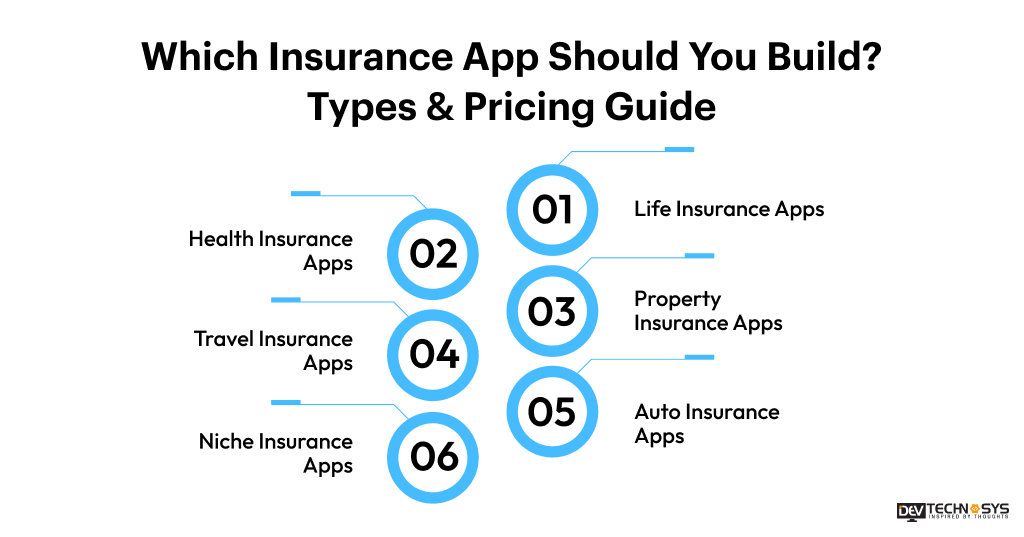
Which Insurance App Should You Build? Types & Pricing Guide
Health, life, property, auto, and travel are some of the common types of insurance apps. These insurances have different user needs, features, and busines goals. Each influences the development complexity, functionality, and overall cost of building insurance app from scratch. Have a look at the insurance app development cost breakdown according to different types.
1. Life Insurance Apps
A life insurance application is a highly demanding digital product that offers long-term customer relationships. This app allows customers to explore and compare policies, calculate premiums, and manage long-term coverage plans. If entrepreneurs develop a life insurance app, they get continuous customer engagement, user trust, and recurring revenue.
2. Health Insurance Apps
A health insurance app helps users compare healthcare plans, access their health records, and track coverage. Building such an app can be beneficial due to increasing healthcare awareness among users. A health insurance app lets insurance holders receive a great experience, seamless services, and faster service.
3. Property Insurance Apps
By having property insurance, customers can insure homes, offices, or assets against damage or loss. Such apps have simplified policy management and claim processing. Entrepreneurs making a property insurance app can give great ROI and scalability, as people are concerned about protecting their property.
4. Travel Insurance Apps
Travel Insurance apps provide users with coverage for travel-related problems. It includes trip cancellations, medical emergencies, and lost belongings. Making travel insurance apps can be a great option because of the increasing global travel demand. This type of insurance ensures convenience and real-time assistance for travelers.
5. Auto Insurance Apps
In the auto insurance app, users are offered vehicle policies, renew insurance, track claims, and access roadside assistance. As people continue to own vehicles, building an auto insurance app can be really profitable. This increases the demand for mobile-based services for policy management and emergency support.
6. Niche Insurance Apps
Businesses can opt for insurance apps for different niches such as cyber insurance, pet insurance, and identity theft protection. Such apps have a specific targeted audience base that demands tailored services. Creating a niche insurance app allows businesses to stand out and tap into the digitalized market.
Have a look at the insurance app development pricing model for multiple insurance types.
App Type |
Core Use |
Cost (USD) |
| Life Insurance Apps | Long-term financial coverage | $12,000 – $25,000+ |
| Health Insurance Apps | Medical & claim management | $15,000 – $28,000+ |
| Property Insurance Apps | Home & asset protection | $12,000 – $24,000+ |
| Travel Insurance Apps | Trip & emergency coverage | $10,000 – $20,000+ |
| Auto Insurance Apps | Vehicle policy management | $13,000 – $26,000+ |
| Niche Insurance Apps | Specialized insurance needs | $10,000 – $22,000+ |

Case Studies: Insurance Apps and Their Estimated Development Costs
GEICO, State Farm, USAA, and Progressive are among the top insurance applications. These apps are offering great support and help to customers for multiple issues. In this section, we will learn why to build insurance apps like these and how much the development costs.
1. App Like GEICO
The GEICO app is well-known for offering policy quotes quickly, digital ID cards, claims filing, and chatbot support. Businesses want to build an app like GEICO to automate the cost savings for users. With a GEICO-like app, entrepreneurs can deliver convenience while improving customer retention and upgrading digital insurance services.
Development Component |
What It Includes |
Estimated Cost (USD) |
| UI/UX Design | Simple dashboard, policy access | $2,000 – $3,500 |
| Core Features | Claims, ID cards, policy management | $4,000 – $7,000 |
| API Integrations | Payments, chatbot, notifications | $1,500 – $3,500 |
| Backend & Database | Secure storage and processing | $2,500 – $5,000 |
| Testing & Deployment | QA and launch | $1,000 – $2,000 |
| Total Cost | $11,000 – $21,000 |
2. App Like State Farm
State Farm insurance app offers services like policy management, claims tracking, agent contact, and personalized coverage suggestions. Many entrepreneurs prefer building such a hybrid digital-agent model. An app like State Farm generates stronger customer relationships, seamless communication, and higher trust.
Development Component |
What It Includes |
Estimated Cost (USD) |
| UI/UX Design | Multi-service interface | $2,500 – $4,500 |
| Core Features | Multi-policy, claims, payments | $5,000 – $8,500 |
| API Integrations | CRM, payment systems | $2,000 – $3,500 |
| Backend Infrastructure | Scalable system | $3,500 – $6,500 |
| Testing & Deployment | Performance testing | $1,000 – $2,500 |
| Total Cost | $14,000 – $25,000 |
3. App Like USAA
USAA is another popular app that delivers banking and financial planning services along with insurance plans. Businesses get attracted to its niche-focused, loyalty-driven model. Making an app like USAA allows businesses to reach a specific targeted audience. It also helps in increasing engagement and creating long-term customer value.
Development Component |
What It Includes |
Estimated Cost (USD) |
| UI/UX Design | Personalized and secure UI | $2,500 – $4,000 |
| Core Features | Member tools, claims, and financial features | $4,500 – $8,000 |
| API Integrations | Secure login, analytics | $2,000 – $3,500 |
| Backend & Security | High-level data protection | $3,500 – $6,000 |
| Testing & Deployment | Security testing | $1,000 – $2,000 |
| Total Cost | $13,000 – $23,000 |
4. App Like Progressive
Progressive Corporation is a widley used insurance platform that offers price comparison tools, usage-based insurance, and easy claims processing. Entrepreneurs are enticed by its innovation and transparency. Creating such apps helps attract users who are looking for budget options and even boosts conversions.
Development Component |
What It Includes |
Estimated Cost (USD) |
| UI/UX Design | Data-driven interface | $2,500 – $4,500 |
| Core Features | Usage-based pricing, claims | $5,500 – $9,500 |
| API Integrations | Telematics, payments | $2,500 – $4,500 |
| Backend Infrastructure | Real-time analytics | $4,000 – $7,000 |
| Testing & Deployment | QA and optimization | $1,000 – $2,500 |
| Total Cost | $16,000 – $26,000 |
5. App Like Allstate
Allstate insurance application provides its users with safe driving rewards, policy tracking, claims filing, and protection services. Entrepreneurs like its value-added features, which are something beyond just insurance. Building an app like Allstate enhances customer engagement, promotes loyalty programs, and differentiates brands in a competitive insurance market.
Development Component |
What It Includes |
Estimated Cost (USD) |
| UI/UX Design | Feature-rich UI | $3,000 – $5,000 |
| Core Features | Claims, roadside assistance | $5,000 – $9,000 |
| API Integrations | Payments, support systems | $2,000 – $4,000 |
| Backend Infrastructure | Scalable backend | $3,500 – $6,500 |
| Testing & Deployment | Testing and launch | $1,000 – $2,000 |
| Total Cost | $15,000 – $24,000 |
Planning a Mobile App?
Get a tailored development cost estimate in 3 simple steps — app basics, features, timeline, and your contact details.
- 3 quick steps
- 100% free
- Reply in 1 business day
2 Minutes Read
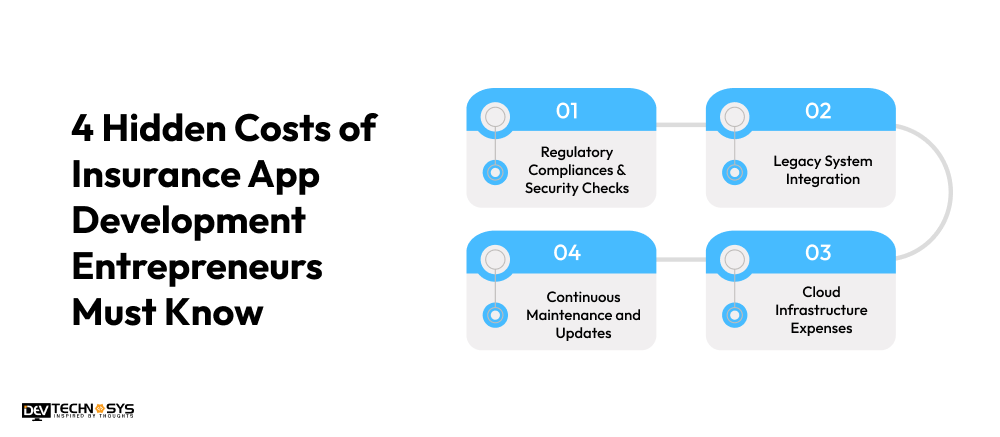
4 Hidden Costs of Insurance App Development Entrepreneurs Must Know
Even when everything is planned well, there are some expenses that might affect your development budget. Compliance, after-launch maintenance, and API licensing are some of the reasons affecting the cost to develop an insurance app. We have explained some hidden costs that help entrepreneurs in smart budget planning.
1. Regulatory Compliances & Security Checks
Apart from basic development, insurance applications have to follow regulations and security standards to avoid penalties. For this, they have to implement KYC, data encryption, and several legal compliances. They require extra tools, audits, and expert involvement, which can increase the overall insurance app development cost estimation.
2. Legacy System Integration
An insurance software development company finds it difficult to connect older insurance systems with modern apps. Integrating legacy systems demands custom APIs and additional development efforts. This can smooth data flow but increase development time and cost to develop a health insurance app.
3. Continuous Maintenance and Updates
Launching the app is just the beginning, but maintaining it requires extra efforts, time, and cost. To maintain the app, regular updates, bug fixes, feature improvements, and OS compatibility upgrades are done. These are ongoing expenses that affect the custom insurance app development cost over time.
4. Cloud Infrastructure Expenses
For data storage, apps’ scalability, and performance, insurance apps rely on cloud services. It is an important investment for a long-term app’s success. Cloud hosting, server usage, and bandwidth costs increase with increasing user traffic. This can also affect the overall claim management app development cost.
From Idea to Launch: Insurance App Development Time Breakdown
Generally, it takes 3 to 8+ months to develop an insurance application. The final development timeline is decided by the complexity, features, and integrations within the platform. We will explain the insurance and the mobile banking app development timeline through a detailed table.
| Development Stage | What Happens in This Phase | Estimated Duration |
| Validate Idea & Market Research | Analyze competitors, define target audience, validate demand, and identify unique value | 2 – 3 weeks |
| Finalize Key Features | Decide on core and advanced features, create a product roadmap, and prioritize functionalities | 1 – 2 weeks |
| Pick the Suitable Tech Stack | Choose technologies (frontend, backend, APIs), define architecture, and scalability approach | 1 – 2 weeks |
| Create an Intuitive App Design | Design UI/UX, wireframes, prototypes, and ensure user-friendly navigation | 3 – 5 weeks |
| Insurance App Development | Frontend & backend development, API integrations, payment setup, and feature implementation | 8 – 14 weeks |
| Test the App for Quality | Perform QA testing, bug fixing, security checks, and performance optimization | 2 – 4 weeks |
| Launch and Promote the App | Deploy on app stores, marketing campaigns, and initial user acquisition | 1 – 2 weeks |
| Maintain and Update Regularly | Continuous updates, feature enhancements, compliance updates, and performance monitoring | Ongoing |
How to Cut Down Insurance App Development Expenses Smartly?
After knowing everything about policy management app development cost, entrepreneurs demand affordable insurance management and payment app development services. They implement several measures, like MVP, cross-platform, and agile development, to reduce the development expenses. In this section, we will learn the ways to reduce insurance mobile app development costs.
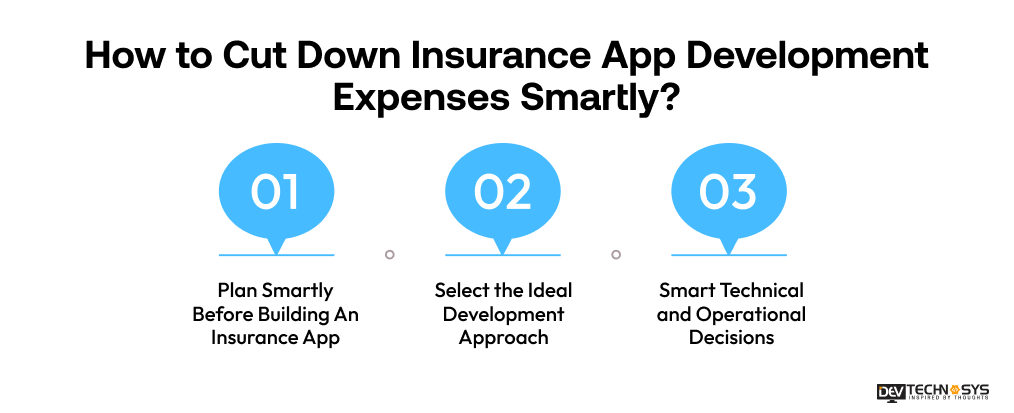
1. Plan Smartly Before Building An Insurance App
Insurance businesses can develop an app with an MVP strategy to test the market demand. They include essential features first and then make changes as per user feedback over time. Also, creating detailed documentation, wireframes, and technical specifications early helps reduce the health insurance app development cost.
2. Select the Ideal Development Approach
Opt for cross-platform frameworks to create an app that works on iOS and Android with a single codebase. To develop a health insurance software at lower costs, integrate open-source modules and low-code tools. This reduces manual coding and significantly lowers frontend and development expenses.
3. Smart Technical and Operational Decisions
To lower the development prices, entrepreneurs can use cloud platforms for scalable, pay-as-you-go hosting. Businesses should also implement automated testing to catch bugs early and integrate third-party APIs. These measures not only reduce the development timeline but also lower the life insurance app development cost.
Profitable Monetization Models for Insurance Apps in 2026
Commission, in-app advertisement, subscription, parametric & embedded insurances, and lead generation model are common money-making models. Here we are explaining highly profitable models for insurance apps in 2026.
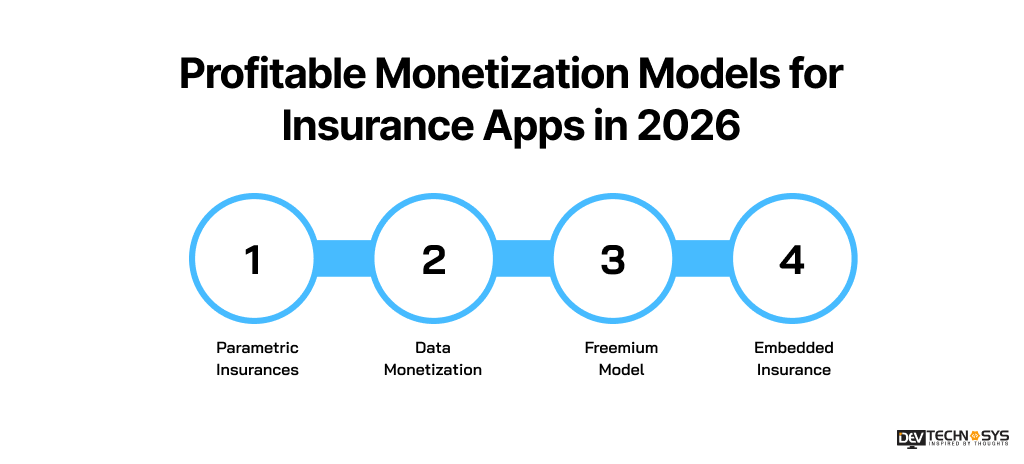
1. Parametric Insurances
Build an insurance software management system with parametric insurance that works on predefined triggers like weather or flight delays. Through this, apps can generate revenue by automating policy sales, faster claims, and reducing operational costs.
2. Data Monetization
Insurance apps always collect valuable user behavior and risk data. By analyzing and sharing these insights with partners, businesses can generate recurring revenue. They also offer personalized policies and better user experiences.
3. Freemium Model
With this model, insurance apps can offer basic services for free but charge fees for premium services. Premium services include advanced coverage, faster claims, or personalized recommendations. It helps generate recurring income by providing customer engagement.
4. Embedded Insurance
Provide users with insurance with services like travel bookings or e-commerce platforms. While making transactions for such services, users can buy coverage. This helps the app earn continuous commissions while increasing conversions.
You can reach out anytime; we are available 24/7. Our team provides a quick response.

Why is Dev Technosys a Smart Choice For Insurance App Development?
Dev Technosys is the most reliable and highly demanding mobile app development agency. We have been serving clients worldwide in multiple industries for more than 15 years. Our aim is to deliver to clients digital products that drive business growth, enhance user engagement, and ensure long-term scalability.
Conclusion
In this digital world, entrepreneurs are coming up with something to offer users with accessible digital insurance services. Be it travel insurance or any specific niche insurance app, understanding the cost factors really matters.
This blog helps businesses make well-planned decisions about the cost to build an insurance app in 2026. It even protects them from overspending that might become a burden. As the InsurTech market is witnessing immense growth, it is the right time to turn your idea into reality.
Partnering with an experienced insurance app development company can help you reduce risks. It also speeds up development and delivers a high-quality product that scales well.
Frequently Asked Questions
Find answers to the most common questions related to this article.
The average cost to make an insurance app can be estimated from $10,000 to $28,000+. This cost is basically determined by the app’s complexity. A simple app with basic integrations is less expensive compared to a fully-featured, functional, AI-powered application.
Generally, the app development timeline can range between 3 and 8+ months, as per the complexity level. A basic app with limited integrations can be developed within 3 to 5 months. In contrast, an advanced app with modern integrations takes 8+ months to get developed.
The main security requirements an insurance app requires are:
Strong data encryption
Secure user authentication (MFA)
Regulatory compliance (KYC, GDPR)
Secure APIs
Regular security audits.
These measures protect sensitive user data, prevent fraud, and ensure legal compliance. It also builds trust while maintaining app performance and reliability.
Some of the essential factors that heavily impact the cost to build an insurance app include:
Security and Regulatory Compliance
Development Team
Backend Infrastructure
UI/UX Design Standards
Third-Party API Integration
Developer’s Location
Selection of Platform
Understanding such factors helps entrepreneurs make smart and informed decisions.
Compliance plays a crucial role in insurance app development strategy. It is necessary to ensure legal operations, protect sensitive user data, and build users’ trust in the app. Compliance also helps businesses meet regulations like KYC and data protection laws to reduce the risk of penalties.