




















Key takeaways:
-
- Native is good for apps with intense hardware and high performance, while React Native includes a single codebase for both platforms.
- According to Sophylabs, React Native becomes suitable for most commercial uses, as it can deliver near-native performance for 90% of business apps.
- You should choose Native for AR/VR, gaming, and advanced graphics, and choose React Native for quicker and affordable app development.
- With React Native, you can reduce the costs by 40-60% compared to the maintenance and development costs of separate Native apps
In the world of mobile app development, it is necessary to choose the correct framework between React Native or Native as it impacts your project’s success and scalability. Both approaches have their own advantages and disadvantages. There are many factors that come into play when deciding between Android and iOS. The right choice depends on the goal, timeline, budget, and user experience of the project.
This comprehensive guide compares both React Native and Native based on various factors. You can choose according to your project requirements. Whether you are a startup going for rapid scalability or an established enterprise demanding peak performance, knowing the difference between React Native vs Native is crucial.
What is React Native?
React Native is an open-source framework created by Meta (Facebook). Developers can make cross-platform mobile apps using JavaScript or TypeScript with React. With React Native, you can share the codebase across iOS and Android, which makes the development process faster and cost-effective.
Some of the apps built with React Native are: Instagram, Facebook, Uber Eats, Pinterest, and more. They have shown their scalability and reliability across various industries and user bases.
What is Native?
Native development refers to building apps only for one platform using the tools and language provided by the platform owner. Native apps are famous for their smooth user experience and high performance. For apps requiring high performance and deep hardware integration, Native Apps are mostly preferred.
For Android, Kotlin or Java languages are used; for iOS, Swift or Objective-C languages are used. Apps built with native Development are: Google Maps, WhatsApp, YouTube, Spotify, and Snapchat.
React Native vs Native: Pros and Cons
You can decide the best framework for your project by learning about the pros and cons of each approach.
Pros of React Native and Native
React Native Benefits |
Native Benefits |
| Single codebase for Android & iOS | Superior performance and responsiveness |
| Faster development and lower costs | Full access to device hardware and latest APIs |
| Reusable components with Hot Reloading | Better platform-specific UI/UX and customization |
| Large community and third-party library support | Enhanced security and stability |
Cons of React Native and Native
React Native Cons |
Native Cons |
| May require native modules for advanced features | Separate codebases for Android and iOS |
| Slight performance limitations for graphics-intensive apps | Longer development and testing cycles |
| Limited deep platform-specific customization | Higher development and maintenance costs |
Planning a Mobile App?
Get a tailored development cost estimate in 3 simple steps — app basics, features, timeline, and your contact details.
- 3 quick steps
- 100% free
- Reply in 1 business day
2 Minutes Read
React Native vs Native: A Detailed Comparison
In this section, you will get to know about the detailed comparison between React Native vs Native App Development based on various factors:
1. Development Time and Team Skills
- Native: For Native app development, two teams are required, for Android and iOS. This can slow development and increase time to market.
- React Native: For React Native app development, one team can build the app for both platforms simultaneously. This can reduce time by almost 40%.
Decision: For this one, React Native gets the point for speed and team efficiency.
2. Code Reuse and Maintenance
- Native: Each platform works with its own code, so you need to manage the updates twice.
- React Native: You can apply one update to both platforms, making maintenance easier.
Decision: For long-term maintenance, React Native is best to save time and resources.

3. Mobile App Development Cost
- Native: It costs more because you need to work on both platforms separately.
- React Native: It can reduce the cost by 40% because of the shared codebase.
Decision: If budget is your main concern, then you should choose React Native. It is ideal for startups or MVPs.
4. User Experience and Performance
- Native: It provides the best performance and pixel-perfect animations as the apps work directly on the device’s operating system.
- React Native: Its performance is native-like, which makes it ideal for most business apps. However, for intense apps, like 3D games or AR apps, Native performs better.
Decision: In short, for React native vs Native performance, Native wins. You should use Native for high-performance apps, and for most business apps, React Native suits perfectly well.
5. Scalability
- Native: It also offers great architectural flexibility when it comes to highly specialized workflows and advanced multimedia processing.
- React Native: It is highly scalable, especially for SMEs, start-ups, and enterprise applications. It helps the products evolve over time.
Decision: When it comes to providing a large set of opportunities and processing a lot of work, React Native Scalability wins clearly.
6. Access to Device Features
- Native: It provides complete, immediate access to all the device features and APIs when released.
- React Native: It covers most of the features, but for advanced integrations, it may require writing native modules.
Decision: For complex hardware integrations, Native rules, while React Native is also enough for standard features.
7. Adapting to Future Trends
- Native: Its system is made to easily adapt to future trends because it supports new OS versions and hardware innovations.
- React Native: As major updates come, it evolves continuously to improve flexibility and performance.
Decision: In this case, Native wins for innovation; however, React Native tries to close the gap every year.
8. Security and Compliance
- Native: It uses OOP (Object Oriented Programming) based languages, such as Java and Kotlin for Android and Swift and Objective-C for iOS, which are more secure.
- React Native: It is based on JavaScript, which is not strongly typed, and it also involves third-party integrations, which makes it hard to identify errors and loopholes in the development process.
Decision: The final verdict is that Native apps are more secure than React Native Apps.
A Quick Comparison Table
Features |
React Native |
Native |
| Codebase | Single codebase for iOS and Android | Separate codebases for each platform |
| Cost of Development | Lower | Higher |
| Speed of Development | Faster | Slower |
| User Experience | Near-native | Fully native experience |
| Performance | High for most business apps | Best possible performance |
| Scalability | Best for most applications | Best for highly complex applications |
| Maintenance | Easier because of shared code | Separate maintenance for each platform |
| Device Hardware Access | Supports most APIs through native modules | Complete access to all device features |
| Best For | eCommerce, MVPs, SaaS, Social apps | Fintech, Gaming, AR/VR, High-performance apps |
Decision Framework: Choose Based on What Your App Actually Does
You should consider what type of app you are developing, and based on that, you should choose the best framework. You can choose either React Native or Native as per your requirements.
App Requirements |
Recommended Choice |
Reason |
| Build both Android and iOS apps on a limited budget | React Native | Lower development and maintenance costs |
| Deliver console-like gaming or 3D graphics | Native | Maximum GPU and CPU performance |
| Support advanced AR/VR experiences | Native | Direct access to platform APIs and graphics frameworks |
| Launch an MVP within a few months | React Native | Faster development with a shared codebase |
| Handle millions of users with advanced performance requirements | Native | Better optimization and resource management |
| Develop a food delivery or booking app | React Native | Shared features work well across platforms |
| Integrate AI-powered chat or customer support | React Native | Sufficient performance and quicker development |
| Create a social networking app | React Native | Rapid iteration and efficient updates |
| Build an eCommerce platform | React Native | Excellent performance with faster delivery |
| Use advanced Bluetooth, NFC, or IoT features extensively | Native | Better hardware integration and platform control |
| Build a healthcare or fintech app | Depends on compliance and feature complexity | Native may be preferable for highly regulated or hardware-intensive requirements |
In short, you should:
- Choose Native App Framework if your mobile app needs a high level of performance, security, or heavy integration with device hardware.
- Choose React Native Framework if you prioritize speed, scalability, and cost efficiency on both Android and iOS with a single codebase.
More features don’t mean better technology; choose the one that best fits your product’s goals, long-term roadmap, and user expectations.
React Native vs Native Development Cost
The React Native vs Native cost depends on various factors, including the complexity of the app, UI/UX design, developer’s location, project time, and third-party integrations.
Here is the cost for developing an app using React Native or Native based on the complexity:
App Complexity |
React Native Development Cost |
Native Development Cost |
| Basic App | $30,000 – $50,000 | $40,000 – $60,000 |
| Medium Complexity | $50,000 – $90,000 | $70,000 – $110,000 |
| Complex App | $90,000 – $130,000 | $120,000 – $150,000+ |
React Native is an affordable option because it uses a single codebase for both Android and iOS, and requires fewer development hours.
Planning a Blockchain Project?
Get a tailored development cost estimate in a few simple steps.
- 3 quick steps
- 100% free
- Reply in 1 business day
2 Minutes Read
Common Mistakes Businesses Make While Choosing a Mobile Framework
It is important to choose the right Mobile Framework between React Native or Native for developing an app because the wrong approach can increase costs, delay launches, and cause unnecessary technical challenges. Many businesses also prefer to hire a Native or react native development company to avoid these mistakes for their mobile app development.
Here are some of the mistakes that you can avoid while choosing between React Native vs Native:
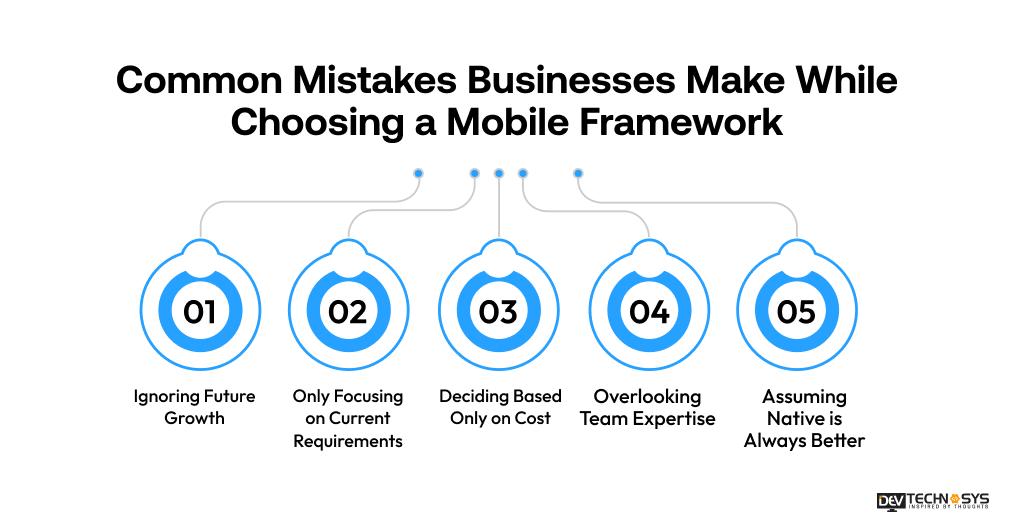
1. Ignoring Future Growth
Most businesses build their MVP without thinking about their future features. If you have integrated advanced hardware or performance-intensive functions, then evaluate whether your chosen framework supports your plans.
2. Only Focusing on Current Requirements
You need to build your app while keeping the future of your business in mind; it cannot be solely based on the present. You should consider user growth, future demands, evolving expectations of customers, and future integrations when choosing a technical framework.
3. Deciding Based Only on Cost
If you have chosen your mobile framework only on the basis of cost, then it could be the wrong approach. You need to consider the future roadmap, maintenance requirements, and how big you are going to scale it. These factors will help in choosing the correct framework.
4. Overlooking Team Expertise
Whichever framework you choose, it will only work if the right team with the right experience is building it. It is necessary to hire dedicated react native app developers with proven experience in the selected field and technology.
5. Assuming Native is Always Better
It is a well-known fact that Native provides excellent performance, but it is not necessary that every application needs it. For many business applications and start-ups, React Native works well enough while minimizing the development cost and time.
Conclusion
The process of developing a mobile app is evolving constantly. If you want to build an app quickly and cost-efficiently, then React Native would be a great choice, while for performance and UX, Native is the way to go. When you decide between React Native or Native for mobile app development, the decision depends on your budget, business goals, and technical requirements.
At Dev Technosys, we help businesses make the best decisions with expert consultation and development services. We provide react native maintenance and support services at affordable prices with a team of expert developers.
Frequently Asked Questions
Find answers to the most common questions related to this article.
Yes, React Native is used widely for enterprise-level applications, such as customer-facing apps, CRM systems, and internal business tools. However, for complex enterprise solutions that demand high performance, native development can also provide benefits
If implemented accurately, both approaches are highly secure. Although Native app development offers better control over platform-specific features, it is best suited for industries like healthcare, banking, and government
For Start-ups, React Native is better compared with Native because it is faster, cost-efficient, and best for launching apps across both platforms simultaneously.
Yes, React Native is always cheaper than Native because of a single shared codebase and smaller teams. It can reduce costs by up to 40%; however, in the case of complex apps with heavy native modules, the savings can be reduced
Yes, this can be done. Many businesses start developing the app with React Native for MVPs, then rebuild parts using Native development to add advanced features or improve scalability.