




















Key Takeways:
The cost to build inventory management software will typically fall between $30,000 for a simple version and $50,000 for a medium one. If you need a complete set of features for your enterprise software solution, expect to spend between $90,000 and $150,000 or more, depending on additional features, integrations, security, and scale.
Cost Impacted by Project or Development Complexity:
-
- Basic Inventory Software ($30,000 to $50,000): Contains product management, inventory stock management system, purchase tracking, basic reporting, user login, and a simple admin panel.
- Medium Complexity Inventory Software ($50,000 to $90,000): May incorporate usage of barcodes, warehouse management, supplier routing, alerts on stock, stock movement, role-based access, and outsourced systems.
- Complex/Enterprise Inventory Software ($150,000 and above): Enables use of several warehouses, AI stock demand prediction, RFID support, and integration with ERP systems.
Cost Based on Inventory Software Types:
-
- Warehouse Inventory Management System: $40,000 to $80,000
- Retail Inventory Management Software: $35,000 to $70,000
- Manufacturing Inventory Platform: $50,000 to $100,000
- Multi-Warehouse Inventory System: $60,000 to $120,000
- Enterprise Inventory Management Solution: $90,000 to $150,000+
Costs of Development in Different Areas/Countries:
-
- The cost to develop inventory management software in the United States varies between $60,000 and $150,000 due to the complexity of the system and the features available.
- Australia has inventory management software development costs between $50,000 and $120,000 depending on the level of expertise, software features, and workflow processes.
- For Canada, the cost to create inventory management software can start from $45,000 and reach up to $120,000 for a number of reasons such as complexity, integrations, security, and scalability needs.
Other Expenses:
-
- Maintenance and Support: Maintenance costs are usually estimated around 10%-20% of the cost of the software.
- Cloud and Infrastructure: Technical aspects of the implementation project include expenses for hosting, databases, storage, and monitoring.
According to McKinsey, one consumer-goods company reduced inventory 30% while increasing on-time delivery performance to 95% using advanced analytics.
The cost for the development of inventory management software will depend on much more than just the feature set. The size of the business, the complexity of inventory, the warehouse needs, the integration options, the platforms used, the level of automation and security, and the development options can all contribute to the final sum to be spent.
Thus, the cost to create a simple inventory monitoring solution can be small while the expenses for the development of a multi-warehouse business platform with AI forecasting, ERP integration, barcode or RFID options, and analytics can be quite high.
In this blog, we will present various aspects that affect the Python inventory management software development cost, and therefore you will be able to plan the budget much more easily.
Industry Insights: As per Fortune Business Insights, the market is projected to grow at a 9.13% CAGR from 2026 to 2034, indicating expansion across inventory technology solutions.
What is Inventory Management Software?
Inventory management software refers to a technology that assists in product storage, organization, and inventory oversight. It keeps track of stock items available, their storage locations, and the ordering of more units.
It can be used for supply chain management, purchasing, sales, warehousing, and inventory. Additionally, it reduces the use of human effort, prevents stock shortages, and increases the accuracy of forecasting and reporting inventory trends.
Planning a Inventory Management Software Project?
Get a tailored development cost estimate in a few simple steps.
- 3 quick steps
- 100% free
- Reply in 1 business day
2 Minutes Read
How Much Does Inventory Management Software Development Cost?
The inventory management software development cost generally ranges between $30,000 and $150,000, contingent on the level of sophistication of the solution and the business needs.
For instance, a simple solution with inventory tracking and reporting capability costs less. Nevertheless, more sophisticated inventory management systems incorporating multiple warehouse functions, Artificial Intelligence forecasting, barcode/RFID systems, ERP systems, automation, and real-time analytics often are associated with higher prices.
Software Type |
Estimated Cost |
Short Description |
| Basic Inventory Software | $30,000 – $50,000 | Stock tracking, product management, and basic reports. |
| Mid-Level Inventory Software | $50,000 – $90,000 | Warehouse tools, barcode scanning, alerts, and integrations. |
| Advanced Inventory Software | $90,000 – $150,000 | Multi-warehouse, AI forecasting, ERP integration, and automation. |
Cost of Developing Different Types of Inventory Management Software
The inventory management software price depends on the requirements of the company, complexity of operations, and the functionality needed. Different types of systems such as retail, warehouse, manufacturing, e-commerce, multi-warehouse, and ERP systems require different approaches to custom software development.
Being aware of different characteristics enables business owners to determine correctly their budget and functionality needed for their operations.
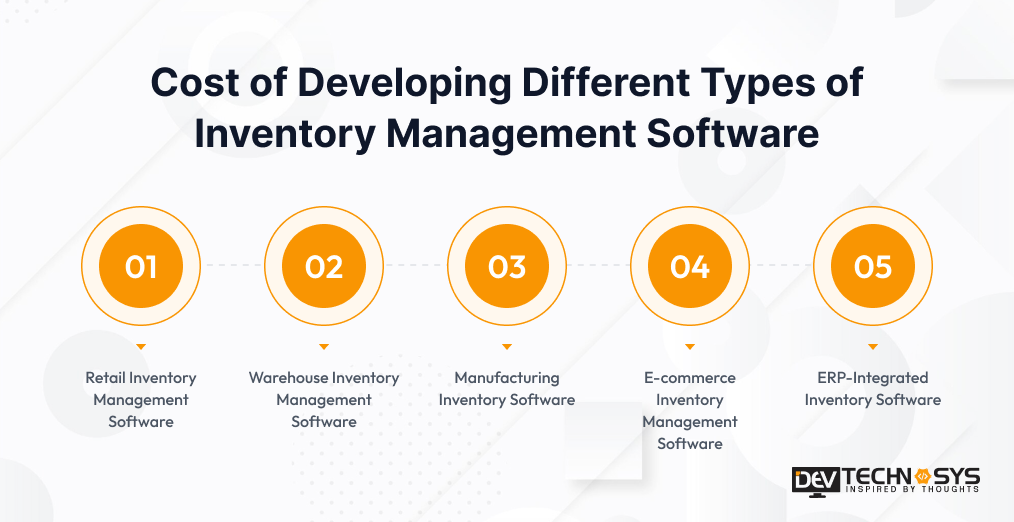
1. Retail Inventory Management Software
Inventory tracking software for retail refers to software that stores and manages information regarding the products sold by the retail business, stock, sales, suppliers, and purchase orders.
The inventory management app development cost depends on the functionality of various components of retail software such as barcoding, integration with POS systems, stock alarms, and real-time inventory updates.
2. Warehouse Inventory Management Software
Inventory management software for warehouses refers to warehouse software that manages receiving, storing, picking, packing, and shipping products effectively.
Warehouse management software development complexity depends on the workflows in warehouses, usage of barcode and RFID scanning, stock movement, user roles and responsibilities, order management, and real-time visibility.
3. Manufacturing Inventory Software
The software for manufacturing inventory is one that will hold all that involves raw materials, components, finished goods, production orders, as well as stock transfers.
The expenses of producing software will differ from each other, with the costs varying due to the features it has. It is possible to add ERP systems to existing manufacturing workflow systems.
4. E-commerce Inventory Management Software
The e-commerce inventory software is the software that is used to help with inventory management across different online shops, warehouses, and marketplaces.
The unique requirements involved in the development of inventory software include real-time inventory updates, order synchronization, product management, and payment integration, amongst others.
5. ERP-Integrated Inventory Software
The advantages of using multi-warehouse inventory software are that it allows you to have an inventory control system that is in different places from only one location.
The complexity of the development of such an application depends on the activities carried out in the warehouses, the inventory movements, the tracking system of the inventory levels, and the master dashboard processes.
Inventory Software Type |
Estimated Development Cost |
Complexity |
| Retail Inventory Management Software | $35,000 – $70,000 | Medium |
| Warehouse Inventory Management Software | $40,000 – $80,000 | Medium–High |
| Manufacturing Inventory Software | $50,000 – $100,000 | High |
| E-commerce Inventory Management Software | $60,000 – $120,000 | Medium |
| ERP-Integrated Inventory Software | $80,000 – $130,000+ | High–Enterprise |
Inventory Management Software Development Cost by Features
The cloud-based inventory management software cost mainly depends on the functionality of the solution. Some basic tracking tools are relatively easy to develop, while advanced features, such as utilizing AI in forecasting, barcode scanning, real-time analytics, automation, and ERP integration services, increase total inventory management system costs significantly.
Inventory Feature |
Key Functionality |
Complexity |
Cost Impact |
| Product Management | SKUs, categories, variants, product catalog | Low | Low |
| Stock Tracking | Stock levels, movements, adjustments, alerts | Medium | Medium |
| Barcode & RFID | Scanning, tagging, label generation | Medium | Medium–High |
| Purchase Orders | PO creation, approvals, supplier ordering | Medium | Medium |
| Supplier Management | Supplier profiles, pricing, order tracking | Medium | Medium |
| Warehouse Management | Locations, bins, picking, packing, transfers | High | High |
| Multi-Warehouse Management | Centralized stock across locations | High | High |
| Demand Forecasting | Demand prediction and replenishment planning | High | High |
| AI-Based Analytics | AI insights, recommendations, anomaly detection | High | High |
| ERP Integration | SAP, Oracle, Microsoft Dynamics integration | High | High |
| Real-Time Reporting | Dashboards, KPIs, inventory reports | Medium–High | Medium–High |
| Inventory Automation | Auto-reordering, alerts, workflow automation | High | High |
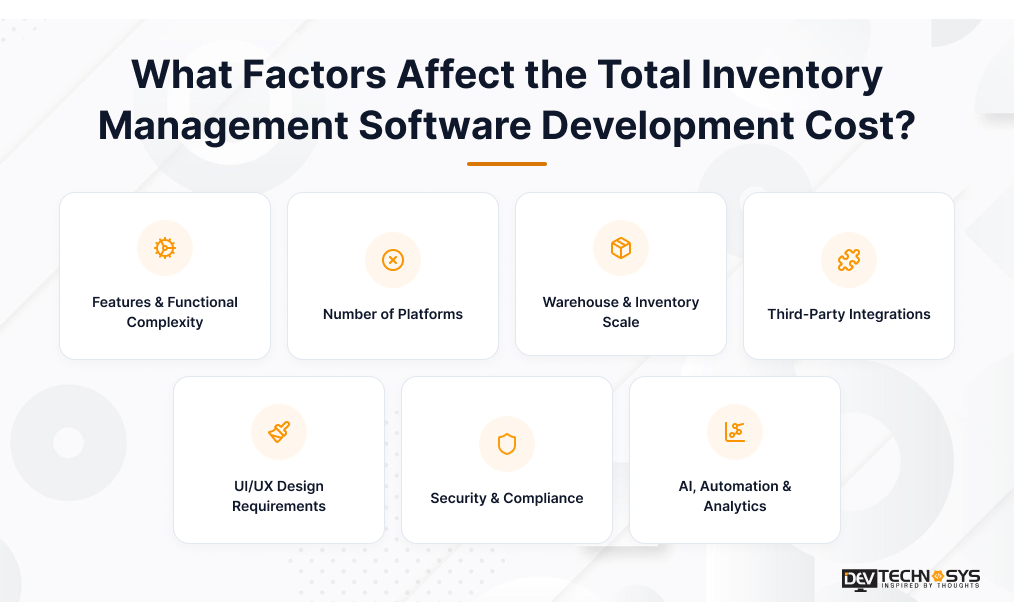
What Factors Affect the Total Inventory Management Software Development Cost?
The total raw material inventory management software development cost depends on several interrelated aspects. The total amount can depend on factors like features, platform options, type of warehouses, integration of third-party software, and others. Understanding these factors will help the company estimate their budget, set realistic expectations, and plan for the necessary functions.
1. Features & Functional Complexity
The number and intricacy of characteristics is one of the factors affecting the effort necessary to perform development. For instance, stock management is less expensive, while features such as demand planning and forecasting, automated stock replenishment methods, and advanced analytics necessitate additional design, development, testing, and integration efforts, thus increasing the overall custom inventory software development cost.
Feature Level |
Cost Impact |
What It Includes |
| Basic | 10–15% | Stock tracking, product catalog, and basic reports |
| Moderate | 20–25% | Purchase orders, alerts, barcode, and supplier workflows |
| Advanced | 25–30% | Forecasting, automation, batch tracking, and advanced analytics |
2. Number of Platforms
Creating the software for web, Android, iOS, desktop, and warehouse hardware increases the scope of the development process. An application that works well on several platforms demands additional interfaces, testing, and optimization. Usually, the development of a solution for one platform is less expensive than that of a cross-platform system.
Platform Scope |
Cost Impact |
What It Includes |
| Web Only | 5–10% | Browser-based inventory management system |
| Web + Mobile | 15–25% | Responsive web platform with Android/iOS apps |
| Multi-Platform | 25–35% | Web, mobile, tablets, and specialized devices |
3. Warehouse & Inventory Scale
It is easier to manage a single warehouse than several locations. In the case of a multi-warehouse inventory, stock transfers are complicated, and there exist multiple location-based permissions necessary for the functioning of the system.
Moreover, the larger the scale of operations, the more intricate its architecture and testing requirements are, which increases the custom inventory management software cost.
Operational Scale |
Cost Impact |
What It Includes |
| Single Warehouse | 5–10% | Centralized stock and warehouse management |
| Multiple Warehouses | 10–15% | Transfers, location tracking, and centralized visibility |
| Enterprise Network | 15–20% | Multiple regions, warehouses, currencies, and complex stock flows |
4. Third-Party Integrations
Utilization of third-party programs, including SAP, Zoho, Oracle NetSuite, Shopify, QuickBooks, Stripe, shipping programs, or CRM systems, lengthens the order management system development cycle.
To deploy each third-party program, API configuration, data mapping, authentication, testing, and maintenance have to be performed properly, which makes more integrations associated with additional inventory software integration cost and time for development.
Integration Scope |
Cost Impact |
What It Includes |
| Few Integrations | 5–10% | Basic accounting or eCommerce connections |
| Multiple Integrations | 15–20% | ERP, CRM, payment, shipping, and marketplace APIs |
| Complex Ecosystem | 20–25% | Multiple enterprise systems, custom APIs, and real-time synchronization |
5. UI/UX Design Requirements
The simpler the interface is, the less design work should be done for it than for an elaborate application for warehouse workers, managers, suppliers, and admin.
For instance, custom dashboards, mobile-friendly workflows, barcode interfaces, and specialized portals require more E2E testing, research, and prototyping, and therefore increase the inventory management system development cost.
Design Level |
Cost Impact |
What It Includes |
| Standard UI | 5–10% | Ready-to-use layouts and basic dashboards |
| Customized UI | 10–20% | Branded screens and role-specific workflows |
| Advanced UX | 20–30% | Custom dashboards, warehouse interfaces, and optimized user journeys |
6. Security & Compliance
Inventory platforms that process business, supplier, employer, and transaction data should have enough security controls. Therefore, features like encryption, role-based access, audit trail logs, multi-factor authentication, secure APIs, and compliance requirements add development and testing effort and hence can increase the overall AI inventory management software development cost.
Security Requirement |
Cost Impact |
What It Includes |
| Standard Security | 5–12% | Authentication, authorization, and secure data handling |
| Enhanced Protection | 14–18% | Encryption, MFA, audit logs, and advanced access controls |
| Enterprise Compliance | 20–24% | Compliance frameworks, security testing, monitoring, and detailed audit controls |
7. AI, Automation & Analytics
The use of complex technologies such as prediction of demand by means of AI, smart replenishment of stock, monitoring of anomalies in shipment, automation of purchases, and analysis of data. And online dashboards require a separate team of engineers along with data parks and services.
Intelligence Level |
Cost Impact |
What It Includes |
| Basic Automation | 5–10% | Alerts, reorder triggers, and automated stock updates |
| Advanced Analytics | 15–25% | Dashboards, demand analysis, and inventory performance insights |
| AI-Powered System | 25–40% | Demand forecasting, anomaly detection, predictive replenishment, and intelligent recommendations |
Look What Gartner Says:
Gartner predicts 70% of large organizations will adopt AI-based supply-chain forecasting for future demand by 2030.
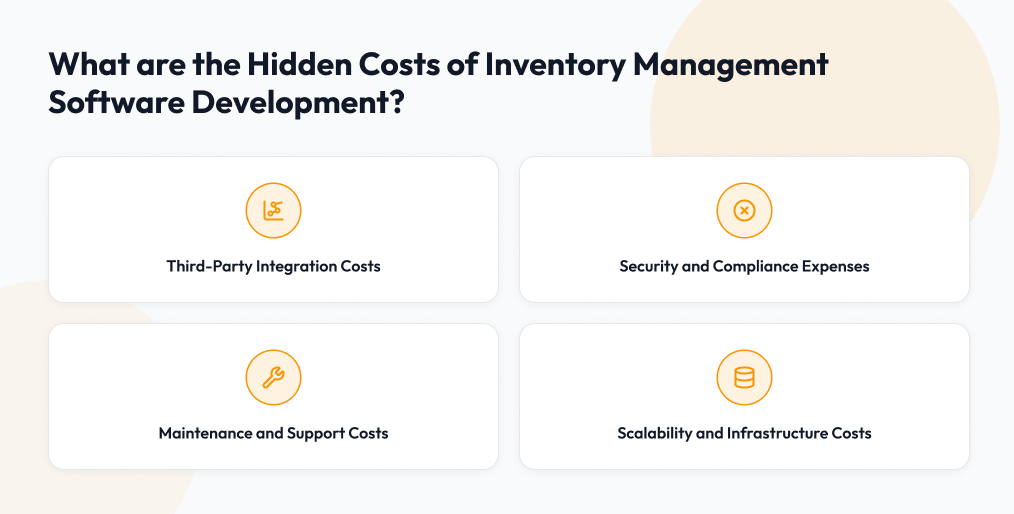
What are the Hidden Costs of Inventory Management Software Development?
The initial cost of custom inventory software hardly ever includes all costs arising from implementing inventory software. Hidden costs of inventory management software come up from third-party integrations, protection, cloud infrastructure services, upkeep, software testing, migrating data, and scalability. By anticipating such costs, businesses can prepare a reasonable budget and expect no unaccounted costs.
1. Third-Party Integration Costs
Integration of inventory systems with ERP, accounting, payment, shipping, barcode, or marketplace systems may incur some additional costs connected with development and subscription.
Changes in API may create ongoing maintenance costs as well. These expenses are usually not taken into consideration during the planning stage, but they may increase the total ERP software development budget quite a lot as integration requirements grow.
2. Security and Compliance Expenses
Inventory systems are responsible for keeping sensitive business or supplier, product, and transaction data. This means that inventory systems need strong security systems. Encryption, access control, security testing, compliance upgrades, etc., require additional spending above that estimated during the planning phase.
3. Maintenance and Support Costs
Asset tracking software development does not stop after the launch of the product. Bug fixing, optimization, application of updates to the operating system, maintaining databases, and developing additional features require serious investments at a later point in time as well. If maintenance costs are not taken into consideration during planning, the company may face some unexpected expenses.
4. Scalability and Infrastructure Costs
As the number of inventory records, users, warehouses, transactions, and integrations rises, sufficient cloud resources, database tuning, storage, monitoring, or performance enhancement may be needed.
If systems are designed only for current needs, they may incur high scalability costs. One way to avoid the financial burden of future network upgrades is to plan infrastructure according to anticipated expansion.

How to Reduce the Inventory Management Software Development Cost?
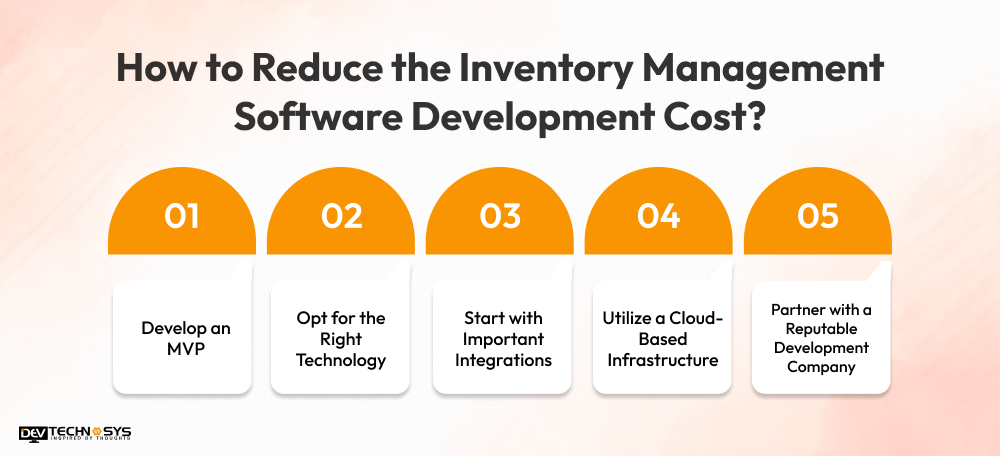
The first step towards decreasing the costs associated with the production of best inventory management software is through wise planning and establishment of priorities.
Concentrate on the features that are most important, ensure the use of a scalable tech stack, limit the number of unnecessary integrations, and launch a minimum viable product first.
1. Develop an MVP
Begin with vital inventory functions, such as stock tracking, inventory management, orders, and simple reporting. Avoid adding complex automation and sophisticated integrations. Launching an MVP can help confirm your idea, get input from your users, and keep costs low before enhancing the system.
2. Opt for the Right Technology
Choose technologies that fit your project’s criteria, scalability, and budget. Trying out proven systems, cloud technologies, and reusable resources may speed up the supply chain software development services process and cut the costs of maintenance. Don’t choose too complex technologies when there are simpler ones that can do the same job.
3. Start with Important Integrations
Integrations can significantly raise the cost of developing the system. Hence, it’s important to choose only those systems that are really needed. For instance, integrate accounting, ERP, payment, barcode, or shipping systems first. Integrate the rest of the systems later according to your business needs to make the development process easier.
4. Utilize a Cloud-Based Infrastructure
Using cloud platforms saves the initial cost of the hardware installation because there is no need for expensive physical servers and costly support. Select elastic cloud resources for the cloud needs based on actual consumption instead of overprovisioning.
Thus, the companies control the expenditures related to expenditures while ensuring the potential for their development and a higher level of stock available.
5. Partner with a Reputable Development Company
If you cooperate with a reliable POS software development company, you will avoid the risk of costly mistakes, revisions, and delays. A skilled team will be able to recommend appropriate technologies, reusable components, and development practices, and will draw up a project plan with the proper budget.
Quick Insights:
PwC reports 92% of operations and supply-chain leaders say technology investments have not fully delivered expected results.
Inventory Management Software Development Timeline
The development schedule for inventory management applications depends on several factors, including scope of the project, the complexity of the features, integration tasks, platform requirements, and the need for testing.
A basic minimum viable product is easier and faster to create than more sophisticated systems that use automation, analytics, and ERP systems and support several different locations.
Development Stage |
Estimated Timeline |
Key Activities |
| Requirement Analysis | 1–2 Weeks | Business requirements, workflows, feature planning |
| UI/UX Design | 2–3 Weeks | Wireframes, prototypes, interface design |
| Backend Development | 4–6 Weeks | APIs, database, inventory logic, user management |
| Frontend Development | 3–5 Weeks | Dashboards, inventory screens, reports, responsive UI |
| Integrations | 2–4 Weeks | ERP, payment, barcode, accounting, third-party APIs |
| Testing & Security | 2–3 Weeks | Functional testing, performance, API and security testing |
| Deployment | 1–2 Weeks | Server setup, data migration, deployment, monitoring |
| Total Timeline | 15–25 Weeks | End-to-end development and deployment |
Inventory Management Software Security and Compliance
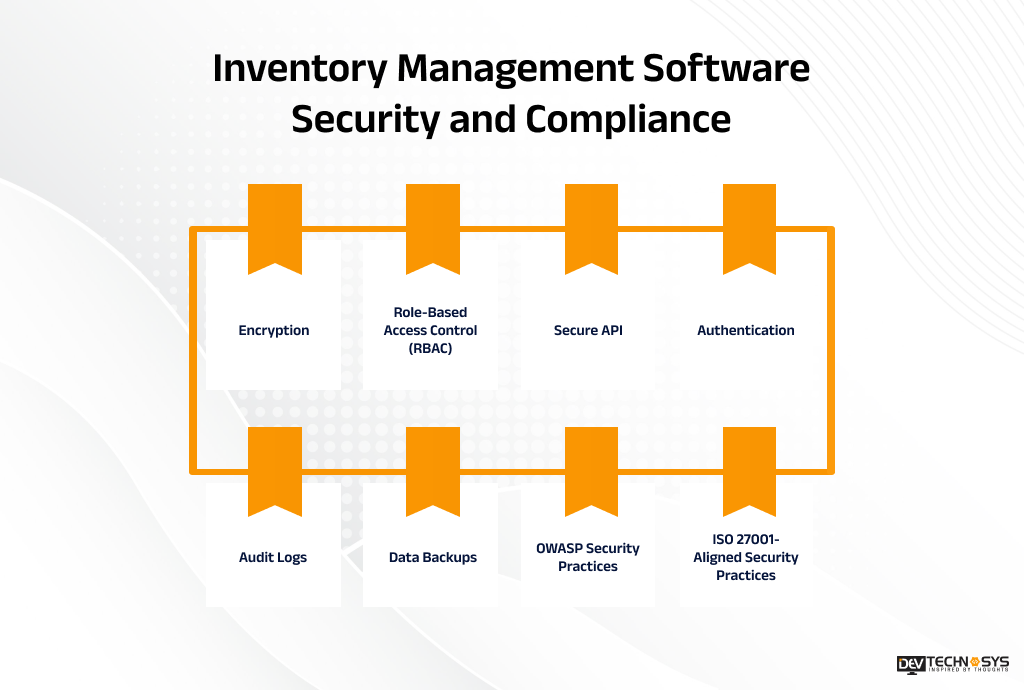
Inventory management software deals with critical business data like inventory levels, supplier details, purchase order information, customer information, and employee access. Secure systems can help to keep unauthorized people away from accessing data and avoid any possible harm, as well as not break rules described in laws.
1. Encryption:
Protect your sensitive inventory or business data by encrypting it during transmission through the internet using TLS, and during storage by applying encryption technologies such as AES-256. Businesses must follow PCI-DSS to fulfill security requirements.
2. Role-Based Access Control (RBAC):
Give rights based on the employee’s position at the company. For instance, warehouse employees can update the inventory information while managers can approve purchases and see reports.
3. Secure API:
Protect your inventory software API by using the following methods: authentication, authorization, checking the information you get, limiting the number of actions performed by the person, using tokens, and understanding errors.
4. Authentication:
Apply the proper methods of access management, like using strong passwords, applying 2-step verification, session management, and hashing.
5. Audit Logs:
Keep track of significant actions, such as logins, stock modifications, order alterations, user privilege changes, and data downloads. Audit Logs like SOC 1 and SOC 2 play an important role in supervision, investigations, and establishing responsibility.
6. Data Backups:
Set up encrypted and verified backup procedures to safeguard inventory records from being lost due to accidental destruction, service outages, ransomware, or any other obstacles. Implement the necessary recovery operations, GDPR, and data retention regulations.
7. OWASP Security Practices:
Adhere to appropriate OWASP recommendations for web and API security. This will help protect against broken access control, code injection attacks, authentication failures, security misconfiguration, and many others.
8. ISO 27001-Aligned Security Practices:
Ensure that information security processes comply with ISO 27001, including risk assessment, access control management, incident response organization, and security policies.
Planning a Supply Chain Project?
Get a tailored development cost estimate in a few simple steps.
- 3 quick steps
- 100% free
- Reply in 1 business day
2 Minutes Read
The Hidden Cost of Not Building Inventory Management Software
The investment in the inventory management software will pay off, but the absence of it incurs hidden costs. Manual reconciliation, overstocking, stock deficiency, shrinkage, and obsolescence may silently create losses, and the comparison may lead to grasping the ROI and the payback timeframe.
Cost Area |
Calculation |
Financial Impact |
| Manual Reconciliation | Hours × labor cost | Higher operational costs |
| Overstock | Excess inventory × carrying rate | Capital tied up |
| Stockouts | Lost orders × order value | Lost revenue & customers |
| Shrinkage & Expiry | Lost units × unit cost | Direct inventory loss |
| Software ROI | (Savings − software cost) ÷ software cost | Measures profitability |
| Payback Period | Software cost ÷ monthly savings | Time to recover investment |
Simple ROI Formula:
Annual Inventory Savings = Labor Savings + Reduced Overstock Cost + Recovered Lost Sales + Reduced Shrinkage
ROI (%) = (Annual Savings − Software Investment) ÷ Software Investment × 100
Payback Period = Software Investment ÷ Monthly Savings
Custom vs Off-the-Shelf Inventory Management Software: Quick Comparison
Whether to go for personalized or ready-to-use inventory management software depends on the requirements of your business, the budget, and the expansion.
Custom solutions are more scalable with more REST API inventory integration opportunities, but off-the-shelf ones can be installed faster with predictable features. By checking this overview, you can see the major distinctions and make the appropriate choice.
Factor |
Custom Inventory Software |
Off-the-Shelf Software |
| Initial Cost | Higher upfront investment | Lower initial investment |
| Customization | Fully tailored to business needs | Limited to built-in options |
| Scalability | Easily scales with business growth | Depends on vendor plans |
| Features | Features built around requirements | Predefined feature set |
| Integrations | Custom integrations supported | Limited to available integrations |
| Security | Security controls can be customized | Vendor-defined security measures |
| Ownership | Greater ownership and control | Vendor owns the platform |
| Maintenance | Managed according to business needs | Mostly handled by the vendor |
| Deployment Time | Requires longer development time | Faster to implement |
| Long-Term Flexibility | Highly flexible for future changes | Depends on vendor roadmap |
How to Generate Money From Inventory Management Software?
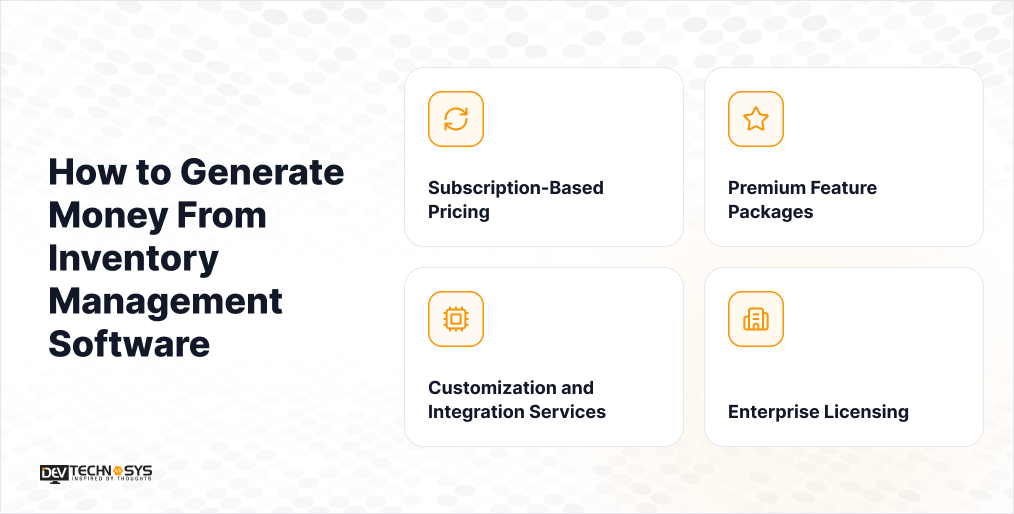
With the help of inventory management software, it is possible to create subscriptions, premium features, enterprise licenses, customizations, and GraphQL inventory integration services that generate recurring and scalable revenue.
The choice of monetization model relies on the specifics of your target market, the features available, the level of operations, and the value provided. A flexible pricing plan helps achieve sustainable business growth.
1. Subscription-Based Pricing
Create plans to make subscribers pay monthly or yearly to avail of the product based on users, storage units, storage capacity, or additional features. The tiered pricing model suggests that small businesses can afford to start, while bigger companies will pay more for enhanced analytics, automation, and enterprise-level inventory management.
2. Premium Feature Packages
Make extra revenue by putting the advanced features under the premium plan. Features like AI forecasting demand, predictive analytics, automated order placement, barcode management, robust reporting, and synchronization can push customers to upgrade and increase their operational efficiency.
3. Customization and Integration Services
Charge customers for custom development, ERP systems integration, API connections, data transfer, and automation of working processes. This model works well in the cases of companies that need special inventory software developed to meet their particular operational needs, existing IT environment, or industry selling requirements.
4. Enterprise Licensing
Enterprise licensing solutions should be offered to businesses that run a number of warehouses, offices, or other locations. Businesses will be billed depending on their usage, number of places, users, and size of operations. The solution should include comprehensive support, enhanced security features, tailored dashboards, and prioritized maintenance, thus offering various additional revenue streams.
Conclusion
The cost of developing inventory management software depends on certain aspects such as the presence of functions, difficulty level, integration level, safety rules, type of platform being used, and the location of the development company.
The right inventory management software development company allows achieving accurate inventory, automating repeated processes, decreasing mistakes related to stock, and supporting business development.
An important stage in software development is defining a customer’s needs and future possibilities, which allows avoiding further expenditures for software development.
Frequently Asked Questions
Find answers to the most common questions related to this article.
The cost to build inventory management software will generally be between $30,000 and $150,000 and above, depending on the functionality, complications, integrations, practical applications, as well as customized options and security. This means that basic applications will be cheaper than those advanced ones, including those with AI forecasting capabilities.
Definitely yes, but the integration will mostly depend on the type of ERP and inventory system being used. Integration will also take into account such factors as types of data shared, the use of special connectors, as well as the availability of special APIs.
Based on the size of the software being developed, the process of building Node.js inventory management software can take about 3-6 months. The MVP or minimum viable product will also require less time for this process. To put it differently, the more complex the software system is, the longer its development will take.
Long-term, custom inventory software may end up being a more affordable option when your company requires a higher level of customization, integration, and scalability. While development may have a higher initial cost, companies can save on ongoing fees and dependence on a SaaS vendor once their requirements increase.
Annual costs for React inventory management software maintenance can represent somewhere around 15-20% of the total development costs. Costs of maintenance often include fixing bugs, new security updates, performance optimizations, monitoring of the infrastructure, integrations and backups done by external parties, technical support, and improvements.