






Key takeaways:
-
- Enterprise blockchain pilots fail not because of blockchain technology itself, but due to technical, operational, or complexity issues arising from integration with legacy systems.
- Successful blockchain adoption within an enterprise requires seamless integration with ERP, CRM, databases, APIs, identity systems, and the organization’s existing business workflows.
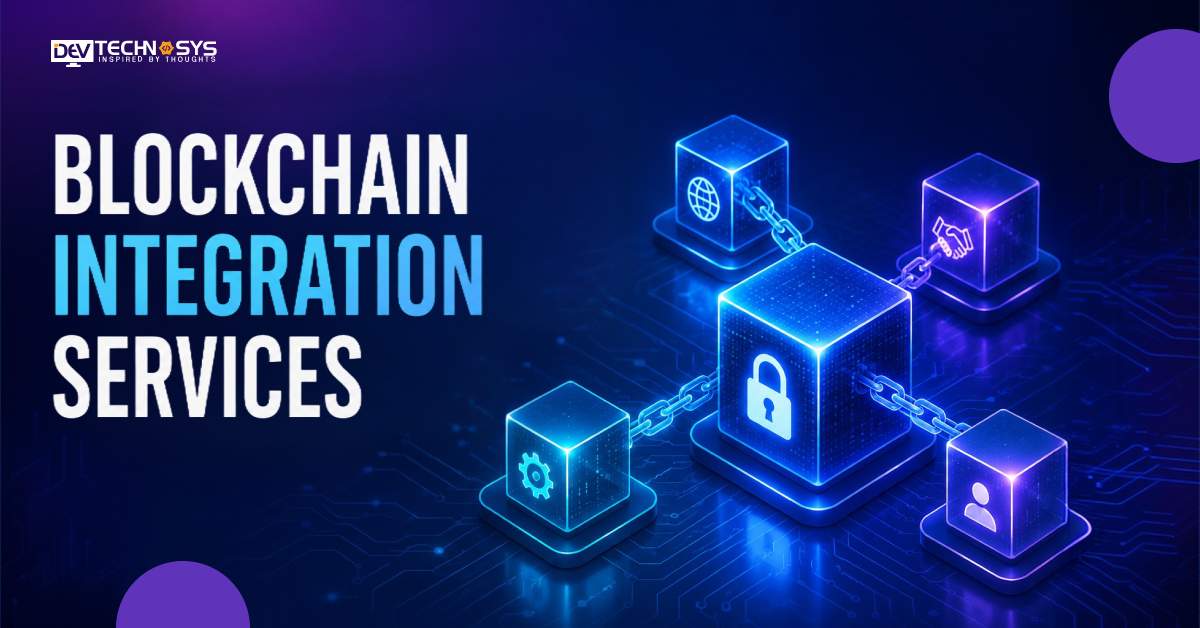
- There are various types of blockchain integration services patterns available, such as APIs, Middleware, event-driven architecture, and other integration layers. This helps businesses to integrate as per their requirements and demands.
- Blockchain should enhance existing enterprise systems rather than replace them. The responsibilities of blockchain networks, databases, applications, and systems of record must be clearly defined.
We saw on Grand View Research that the valuation of blockchain technology is projected to reach $108.3 billion by 2026, and according to their estimates, it could rise to $9,055.5 billion by the end of 2033.
Observing this growth, many companies and organizations are beginning to work on blockchain projects, seeking faster and more secure transactions, improved tracking, and stronger trust with business partners.
However, are you aware that many enterprise blockchain pilots fail to reach the final stage? Why is this the case?
It is not the fault of the blockchain technology itself; rather, many large companies still rely on legacy software, and those systems are unable to support modern blockchain technology.
It fails to provide support because data formats differ, APIs are limited, and changing these business processes is extremely difficult.
So, through this blog, we will explain that simply selecting the right blockchain network does not guarantee successful blockchain integration services. The old and new systems must be made to work together and do so smoothly.
What is Enterprise Blockchain Integration?
Enterprise blockchain integration simply means connecting blockchain technology with a company’s existing systems so that it can securely process transactions and store information.
Organizations can perform a wide range of operations and functions using this, such as securely maintaining records, exchanging information, tracking products, and conducting payment transactions with greater security. When businesses connect blockchain technology with their overall business, it can be easily familiar with tools like databases, websites, and software.
What is the Legacy System Boundary in Blockchain Integration?
To put it simply, the legacy system boundary is a connection point that integrates the blockchain with existing systems. If the legacy system is poorly designed, blockchain will fail to effectively execute the very processes for which it was integrated, such as enabling faster and secure transactions, data storage, and various other functions. It acts as a bridge that connects the old business world to the new world of blockchain.
Everyone knows that blockchain works very effectively, but companies have long relied on established platforms such as ERP, CRM, core banking, payment systems, databases, and data warehouses.
Therefore, the primary challenge lies in enabling seamless communication between these platforms and blockchain technology while ensuring everything remains secure.
What Can Be Inside the Legacy Boundary?
- ERP – manages finance, inventory, purchasing, and operations.
- CRM – manages customers, sales, and relationships.
- Core banking – handles banking accounts and transactions.
- Payment systems – process payments and transfers.
- Supply-chain platforms – track products and shipments.
- Databases – store important business information.
- Data warehouses – collect and organize large amounts of company data.
- IAM – controls who can access systems and information.
- HSM/key management – protects important blockchain keys.
- Compliance systems – help companies follow laws and regulations.
- Reporting systems – turn business data into reports.
- Partner APIs – allow outside companies to exchange information.
Industry Insights:
According to IBM, Enterprise blockchain infrastructure is expanding around digital-asset custody, token issuance, permissioned blockchain networks, and secure platforms designed to satisfy regulatory and resilience requirements.
Free App Idea Reality Check: Let's Stress-Test Your Concept
Share your app idea with us. Within 3 business days, we'll uncover UX gaps, feature opportunities, and potential development challenges, so you can build with confidence. No strings attached.
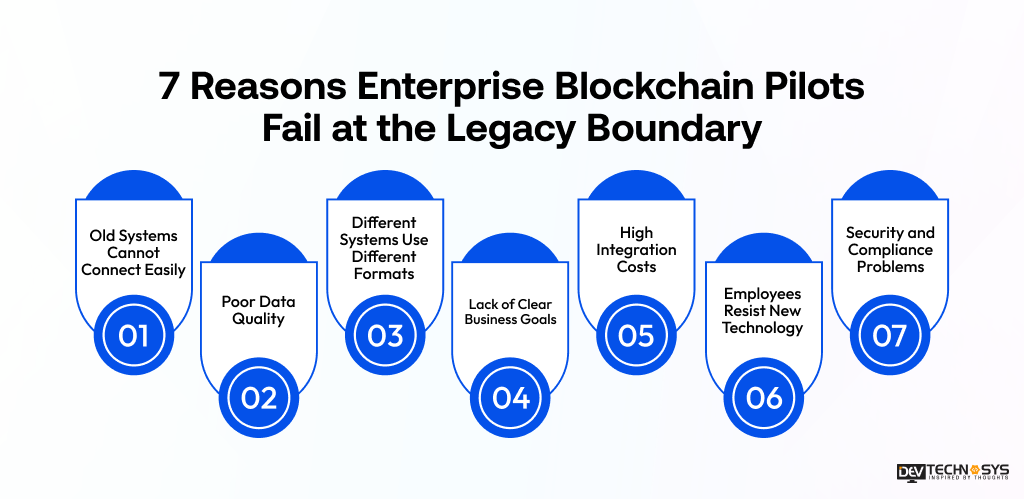
7 Reasons Enterprise Blockchain Pilots Fail at the Legacy Boundary
This is the main section of the blog where you will learn why blockchain integrations fail in large companies. Essentially, the primary reason is that organizations still rely on legacy systems and suffer from poor data quality, which cannot support blockchain integration. Furthermore, their data formats differ significantly and are extremely difficult to modify.
1. Old Systems Cannot Connect Easily
This is a very common reason for the failure of blockchain pilots. Even today, many companies rely on outdated computer systems whose configurations do not support blockchain technology.
Upgrading these systems to provide the necessary support would be extremely costly and time-consuming. Even then, the process would likely face delays and errors, requiring significant additional effort. Consequently, blockchain pilots often fail at the launch stage.
2. Poor Data Quality
To utilize blockchain effectively, companies must provide accurate data so the system can function correctly. Legacy software modernization often contains missing, outdated, or erroneous data.
If this is fed into the blockchain, it will yield incorrect results, as the blockchain itself cannot rectify such data. Consequently, companies would need to perform manual data cleaning, a process that wastes significant time, slows down pilot projects, and reduces the likelihood of success.
3. Different Systems Use Different Formats
Legacy systems and modern blockchain platforms use different formats for data storage; their methods differ completely. Consequently, the data must be converted from one format to the other, a process that is both difficult and risky.
During this conversion, data can be lost, become mismatched, or undergo complete alteration. Doing this requires proper tools, which are very expensive, and it is a long process with a very low chance of success.
4. Lack of Clear Business Goals
New technologies are entering the market at a rapid pace these days. Some companies are very excited about adopting these technologies into their businesses, yet they often lack a clear goal regarding where and how this blockchain ERP integration will be utilized.
This confusion extends to employees, who may question the necessity of such implementations. After all, without a clear objective, it is impossible to achieve tangible results.
5. High Integration Costs
Integrating blockchain technology with legacy systems requires various new elements, such as new software, tools, skilled personnel, and enhanced security and blockchain compliance measures, all of which can drive up integration costs.
Even small-scale pilot projects may require a larger budget than anticipated. Consequently, if a company realizes that integration costs are far exceeding expectations, it might decide to abandon the project midway.
6. Employees Resist New Technology
It is a very simple reason: when you assign new tasks to employees, they often perceive them as difficult. If an employee has been working with the same processes or technology for years and is suddenly told to switch to blockchain.
They will face challenges and worry that the work is becoming too difficult. They might undergo training for these new tools, but if they do not grasp the concepts well, they might even quit.
7. Security and Compliance Problems
It is crucial for companies to adhere to security and compliance rules and regulations. Integrating legacy systems with blockchain can introduce security risks, and many industries enforce strict protocols regarding data storage and sharing.
If the blockchain setup is not implemented correctly, the project may encounter issues, potentially forcing the company to shut it down to ensure regulatory compliance blockchain.
The Hidden Architecture Behind a Successful Enterprise Blockchain Integration
Blockchain rarely stands alone in a successful enterprise blockchain integration. A reliable implementation is always built upon a robust design and architecture that connects with existing systems, such as databases, ERPs, CRMs, APIs, blockchain networks, and many others. The interconnected layers show how a seamless integration works:
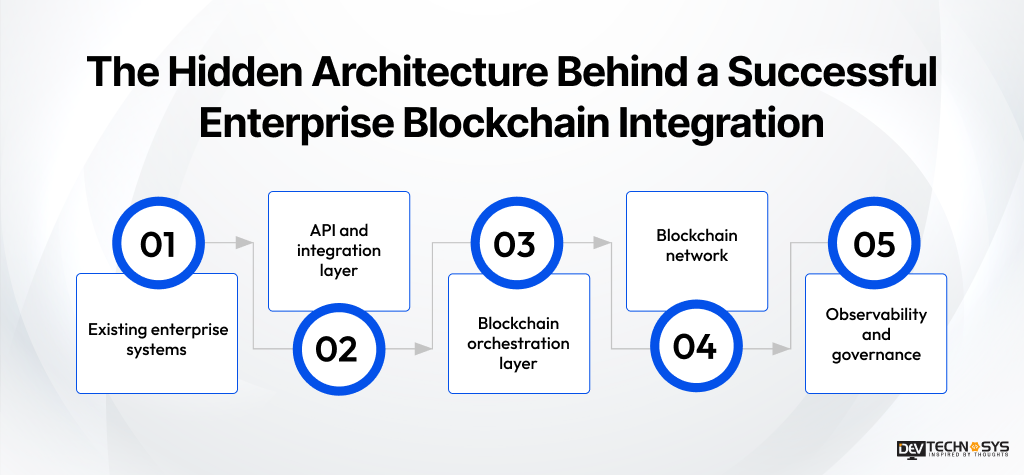
Layer 1: Existing enterprise systems
This layer contains existing systems that handle daily operations, such as ERP, CRM, legacy applications, databases, and many others. Instead of replacing these systems, blockchain works alongside them to further enhance their capabilities. The advantage here is that the data remains in its original format and can also be shared via blockchain infrastructure.
Layer 2: API and integration layer
It basically works as enterprise applications connect with blockchain services via APIs, blockchain middleware, batch synchronization, event-driven integration, and more.
Through these integration services, it performs various processes, such as secure transactions, authentication, routing, protocol compatibility, and validation. These types of integrations help businesses to protect from blockchain complexity and maintain communication between systems.
Layer 3: Blockchain orchestration layer
This orchestration layer coordinates with the blockchain as well as with services such as transactions, wallets, identities, and workflows. This layer helps manage various processes, such as transaction states, workflow logic, retries, and many others. It mainly helps enterprise product development solutions to process contracts and networks and how to process them easily.
Layer 4: Blockchain network
Blockchain networks provide a shared and tamper-resistant infrastructure that records smart contract operations and validates transactions. It mainly depends on the requirements of businesses because enterprise applications may be public, private, hybrid, or consortium networks.
Before designing the network, several factors are considered, such as scalability, transaction costs, interoperability, regulatory requirements, and blockchain data privacy, to ensure optimal blockchain performance.
Layer 5: Observability and governance
This is the final layer that provides security, visibility, operational control, and compliance to the entire integration. It monitors various operations like smart contracts, transactions, system performance, APIs, and failures.
In governance, it shares information about regulatory controls, identity management, access policies, smart contract audit requirements, and many more. With these advancements, it makes sure that blockchain is secure, safe, and reliable.
Market Insights:
As per the Deloitte, blockchain applications are expanding across financial services, healthcare, manufacturing, transportation, government, telecommunications, and real estate, increasing demand for industry-specific integration capabilities.
Planning a Blockchain Project?
Get a tailored development cost estimate in a few simple steps.
- 3 quick steps
- 100% free
- Reply in 1 business day
2 Minutes Read
Blockchain Integration Patterns for Legacy Enterprise Systems
Blockchain integration patterns help businesses integrate blockchain technology with their existing systems. There are various approaches available, such as blockchain API integration, middleware, batch synchronization, and event-driven integration.
Selecting the right method is crucial to ensure it meets your business needs while remaining within your budget. Let’s take a view at the various types of blockchain integration patterns.
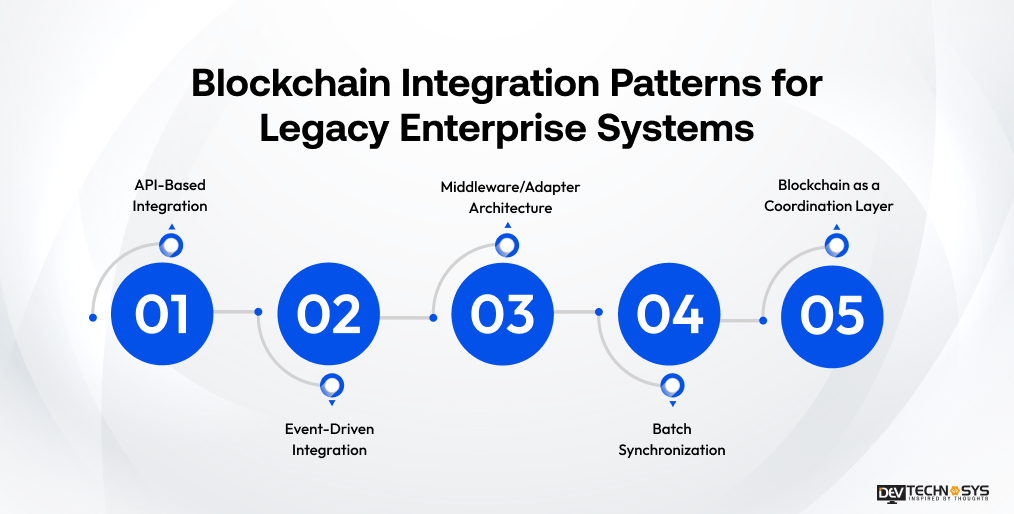
Pattern 1: API-Based Integration
API-based integrations connect enterprise applications with blockchain technology using APIs. Through this, businesses can perform various operations, such as executing transactions, managing blockchain records, and storing specific information. This approach works effectively for partner platforms, customer applications, and internal software, as they are all connected via APIs.
Pattern 2: Event-Driven Integration
Event-driven integration is a highly advanced form of blockchain integration that responds automatically whenever an event occurs on the blockchain. For instance, if a shipment is updated, it sends real-time notifications to businesses, keeping them informed.
This type of integration is beneficial for various use cases, such as supply chain digital transformation, real-time updates, settlement alerts, and much more.
Pattern 3: Middleware/Adapter Architecture
As the name suggests, middleware acts as a bridge. It integrates blockchain technology with various existing legacy systems. Adapters within it have the capability to translate complex data formats into different business rules or formats. This type of integration is particularly useful for businesses that operate multiple applications and handle complex data requiring translation.
Pattern 4: Batch Synchronization
Broadly speaking, batch synchronization is used to keep everything, such as information, up to date. Essentially, it schedules blockchain operations for enterprise applications on an hourly or daily basis to ensure data remains up-to-date.
It handles various types of data, such as accounting records, reports, and large datasets. It acts like a bottleneck; whenever the company needs real-time updated data, it requests it from this source.
Pattern 5: Blockchain as a Coordination Layer
Blockchain does not aim to replace existing systems like ERP or CRM; instead, it seeks to work alongside them to provide better and more accurate data. Thereby simplifying business operations and boosts productivity.
Existing systems can continue to handle day-to-day operations, while blockchain facilitates information sharing, verification, and coordination among business partners.

Blockchain Integration Services: What Should an Enterprise Actually Buy?
Enterprises should focus on blockchain integration services that can solve real-world business problems. Therefore, selecting the right services is crucial.
There are various services available, such as consulting, integrating legacy systems, smart contract development, and maintenance. Read the explanation below to understand which of these services would benefit your business.
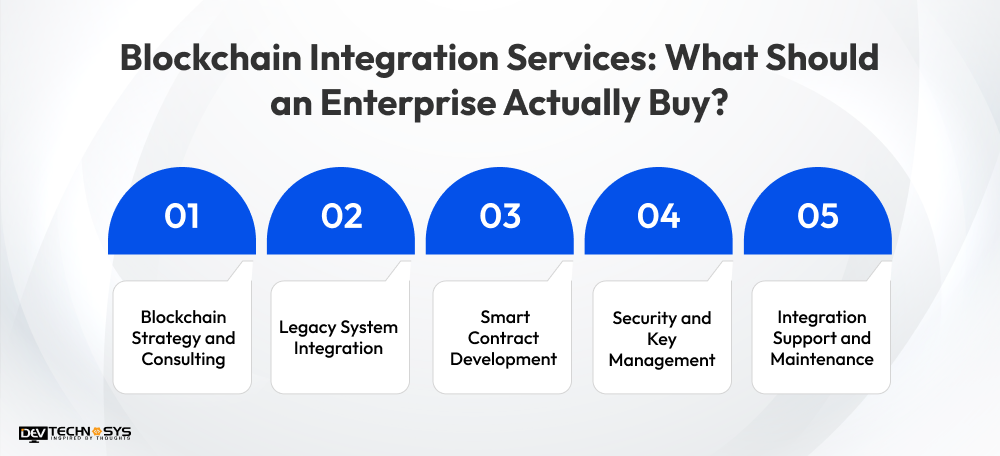
1. Blockchain Strategy and Consulting
Businesses should first opt for blockchain consulting services to clearly understand their actual requirements, such as security needs, operational processes, and future business goals.
Experts thoroughly evaluate these aspects to determine whether blockchain technology is truly necessary. This approach effectively saves money for businesses, given that blockchain is a new and expensive technology.
2. Legacy System Integration
Legacy integration helps businesses integrate blockchain with existing systems, such as ERP, CRM, and various other platforms, ensuring secure and efficient communication. It is one of the best integrations because blockchain technology has to work smoothly with existing systems, as companies still depend on existing systems.
3. Smart Contract Development
Smart contract development is a key aspect of blockchain technology. Smart contracts enable businesses to automate tasks whenever specific conditions are met.
Enterprises require experts to effectively design, develop, test, and audit these smart contracts. Smart contracts must be secure and reliable to meet business requirements, and professional development can eliminate the risk of errors.
4. Security and Key Management
Blockchain systems require robust security measures because digital keys control blockchain access and transactions. Enterprise applications must incorporate various services, such as secure hardware, identity control, and key management, to ensure security.
These services help businesses prevent unauthorized users from accessing or controlling data. Robust security is essential for many industries, including healthcare, government, and finance.
5. Integration Support and Maintenance
Even after blockchain integration services, it is not as if you have no further need to make purchases. Technologies and systems evolve over time, so you will need to acquire maintenance and support services to keep them running smoothly. This encompasses a range of activities, such as upgrading features, fixing ongoing bugs or errors, upgrading versions, and much more.
Enterprise Blockchain Integration vs. Blockchain Development
Enterprise blockchain integration essentially involves the capability to connect blockchain technology with existing platforms, such as ERP systems, databases, APIs, and business workflows.
Blockchain development, on the other hand, focuses on building components like networks, smart contracts, blockchain-powered features, and decentralized applications.
While development creates the blockchain solution itself, integration directly connects that solution to the enterprise technology ecosystem. So, let’s explore in greater detail the difference between enterprise blockchain integration and blockchain development.
Aspect |
Enterprise Blockchain Integration |
Blockchain Development |
| Primary Focus | Connects blockchain with existing enterprise systems | Builds blockchain-based applications and solutions |
| Main Objective | Enables interoperability and seamless data exchange | Creates new blockchain functionality |
| Core Technologies | APIs, middleware, connectors, ERP, CRM | Smart contracts, dApps, wallets, blockchain networks |
| System Integration | Integrates with legacy and enterprise platforms | May operate independently of legacy systems |
| Data Management | Maps and synchronizes data across systems | Manages blockchain-native data and transactions |
| Business Workflows | Integrates blockchain into existing workflows | Creates blockchain-powered workflows |
| Security Focus | Enterprise security, IAM, API security, key management | Smart-contract and blockchain-level security |
| Typical Deliverables | Integration architecture, APIs, middleware, data pipelines | Smart contracts, dApps, wallets, blockchain platforms |
| Common Use Case | Connecting blockchain with ERP, banking, or supply-chain systems | Building DeFi, tokenization, or decentralized applications |
| End Goal | Seamless enterprise adoption and operational continuity | Delivering a functional blockchain product or application |
Final Words!
It is time to say goodbye now. However, we hope that reading this blog has given you a clear understanding of the subject. We have explained everything that causes blockchain integration services to fail at the final stage, as well as the reasons behind these failures. You must have gained an idea of how to successfully integrate blockchain without encountering such failures.
Do you want to integrate blockchain into your existing system to streamline your business operations? Consult with a CMMI Level blockchain development company that integrates blockchain at a lower cost while taking care of security and compliance measures.
Frequently Asked Questions
Find answers to the most common questions related to this article.
Yes, blockchain can be integrated with SAP or ERP systems using middleware, APIs, adapters, or event-driven tools. The ERP system continues to handle its standard operations, such as managing orders, inventory, and finance. While the blockchain facilitates the sharing of trusted transactions and records. This approach enables enterprises to integrate blockchain technology without having to replace their existing systems.
The enterprise blockchain integration cost lies between $15,000 and $30,000, based on various factors. For a small pilot, it costs around $15,000 to $20,000; for a mid-complexity pilot, it is around $20,000 to $30,000; and for a larger enterprise, it can cost around $30,000 or more. The cost can fluctuate due to various factors, such as complexity, blockchain security audits, smart contracts, and more.
Blockchain integration services mainly take around 4 to 10 weeks for a small pilot, and larger enterprises take around 3 to 6 months. The total integration timeline depends on several factors, such as blockchain data migration, security, compliance requirements, smart contracts, a higher number of integrations, and more. Basically, if organizations have clear goals, then integration moves faster.
No, blockchain cannot replace legacy systems; however, it can work alongside them, integrating with components like data warehouses and ERP databases. While blockchain handles shared records, transactions, and trust, legacy systems continue to perform their standard tasks, such as managing vast amounts of business data. This approach demonstrates to businesses how they can leverage the benefits of blockchain.
To implement a blockchain PoC into the production process, organizations need to evaluate its performance, security, scalability, and compatibility with their systems for integration purposes. The next step after that is to resolve technical problems, determine the rules of governance, and make sure that it is compliant. Gradual implementation supplemented by constant monitoring and training of users can nip risks in the bud and make the blockchain solution generate business value.