


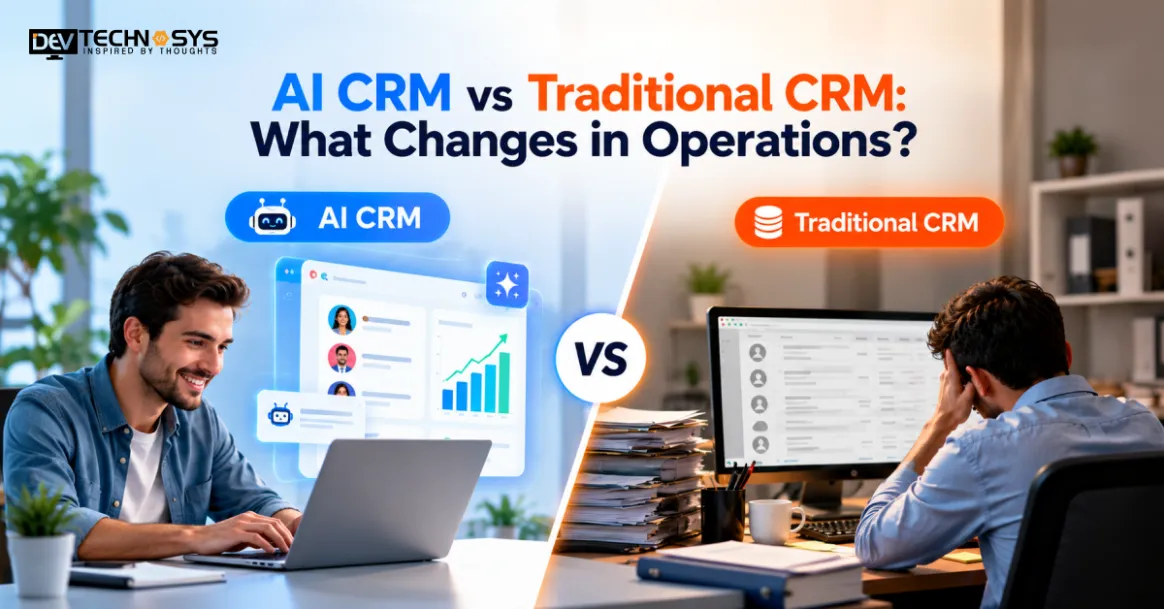
Key Takeaways:
-
- Is AI CRM better than traditional CRM? Between AI CRM vs Traditional CRM, when companies want quicker decision support, predictive insights, and intelligent automation, AI CRM Implementation may be more successful.
- Does AI CRM handle operations better? It may help teams with customer insights, support lead qualification, automate tedious CRM chores, and personalize interactions
- Why choose AI CRM? One of the main AI CRM benefits is that it helps companies find relevant customer and sales insights, decrease manual labor, and enhance data visibility
- What changes with AI CRM? CRM has evolved from mainly storing and organizing customer data. Intelligent CRM systems now automate workflows, evaluate data, and recommend actions
To remain competitive and meet customer needs, businesses are adopting innovative CRM tools and systems from suppliers that offer feature-rich, often industry-specific products and services and leverage advanced technologies like AI CRM.
At this point, you’re probably asking yourself whether AI CRM is actually better than traditional CRM. It is capable of executing day-to-day operations more effectively. Why should businesses consider making the switch? What changes in operations?
In this blog, I’ll answer your questions about AI CRM: what it is, how it changes operations, its practical benefits, whether it’s better than traditional CRM, and much more. We hope this blog will help businesses understand AI CRM vs traditional CRM software and make an informed decision.
What Is an AI CRM?
Artificial intelligence in customer relationship management (CRM) can help build more personalized experiences and address customer needs faster. When companies apply AI software to CRM, the system can provide a range of services, such as AI CRM data analysis, streamlined call-based transactions, and a natural language interface to support core B2B operations. AI CRM, the first major platform shift in CRM in 25 years, and it will have major implications for businesses moving forward.
What Is a Traditional CRM?
Traditional CRM software manages customer interactions, centralizes data, and supports sales, retention, and relationship management. It collects information from forms, calls, emails, chats, and campaigns, then helps teams track contacts, opportunities, and deal stages. However, manual data entry and updates can create incomplete records, outdated information, and unreliable pipeline visibility.
AI CRM vs Traditional CRM: What’s the Difference?
The key difference between AI CRM vs Traditional CRM is how each system handles customer data and business workflows. Traditional CRM primarily stores and organizes customer information, while AI CRM for business operations uses that data to generate insights, automate tasks, and support decisions. The real differences, side by side:

- Lead capture: Traditional: a person types it in. AI CRM: captured automatically from the website, chatbot, WhatsApp, and ads.
- Lead scoring: Conventional: either a manual tag or none at all. An agentic AI development company uses AI CRM to score each lead automatically as hot, warm, or cold.
- First Reaction Time: Conventional: every time someone checks, it takes minutes to hours. AI CRM: seconds, through an instant WhatsApp alert and AI chatbot.
- Traditional Follow-up: a prompt to take action. AI CRM: self-contained automated sequences.
- Setup: Conventional: admin training, data migration, frequently takes weeks. AI CRM: usually takes two hours to complete.
- Its True Purpose: Conventional: overseeing an existing pipeline. AI CRM: ensuring that nothing enters the pipeline at all or too late.
Area | Traditional CRM | AI CRM |
| Data Management | Stores customer data | Captures, enriches, and analyzes data |
| Data Entry | Mostly manual | Through AI Automation or AI-assisted |
| Customer Insights | Reports and historical data | Real-time insights and recommendations |
| Customer Service | Agent-led | AI-assisted and automated |
| Sales Forecasting | Historical data-based | AI sales copilot, AI-driven predictions |
| Personalization | Predefined segments | Context- and behavior-based |
| Workflow Automation | Rules and triggers | AI CRM Workflow Automation |
| CRM Updates | Manually updated | AI-assisted updates |
| Lead Management | Rule-based and manual | AI CRM Predictive Analytics Services |
| Decision-Making | Human-led | AI CRM Automation with human oversight |
| Scalability | More manual effort | Greater workflow automation |
Industry Insights:
HubSpot reports that 80% of sales leaders using a CRM say it is already fully AI-integrated, highlighting how AI is increasingly becoming part of the CRM layer rather than a separate sales tool.
How AI Changes Day-to-Day CRM Operations?
AI changes CRM operations by moving teams from manually managing customer information to using AI-assisted insights, automation, and recommendations. Instead of simply recording what happened, an AI CRM can help teams identify what needs attention and what action to take next.
1. Automates the Repetitive Entering of Data
When comparing the AI CRM vs Traditional CRM, remember that AI can pull data from emails, phone calls, meetings, forms, and other engagements to update customer records. Companies are leaning towards artificial Intelligence development services to cut down on time-consuming manual entry and keep CRM data up to date.
2. Enhances Lead Qualification
AI does not merely follow predefined rules; it processes customer behavior, interactions, and other signals to help distinguish leads that show great interest.
3. Aids Sales Forecasting
Salesforce development company uses AI CRM to leverage data on sales activity in the pipeline to determine possible problems and make recommendations.
4. Customizes Customer Engagement
AI uses data about the previous purchasing behavior, preferences, and profile info of customers to send them the most relevant information.
5. Improves Customer Service Efficiency
AI technology can perform tasks such as case summarization, gathering important information, providing recommendations for responses, analyzing customers’ intent, and automating manual processes as well. Difficult or delicate situations will still be sent to human representatives.
6. Offers the Best Next Steps
AI consulting services providers create CRM systems that use AI algorithms to analyze customer- and opportunity-related data to suggest follow-ups, such as contacting a client who hasn’t purchased in a while, updating opportunity details, or increasing urgency on a customer service issue.
7. Decreases CRM Administration Process
AI technologies can help with meeting summaries, writing emails, creating tasks, updating records, and carrying out all other routine operations. This means sales/service teams need less effort for CRM administration and can focus on sales.
8. Gives Possibility for Proactive Work
Standard CRM only assists in understanding what happened in the past, but with AI CRM integration, it is possible to analyze current signals and draw conclusions about opportunities emerging, threats appearing, or clients who need help.
AI CRM vs Traditional CRM: What Changes for Each Team?
AI CRM changes how teams collect information, prioritize work, make decisions, and interact with customers. If we compare AI CRM vs Traditional CRM, the biggest operational shift is from manual execution to AI-assisted workflows.
Team | Traditional CRM Operations | AI CRM Operations |
| Sales | Manually update leads, track deals, and schedule follow-ups | Prioritize leads, generate follow-ups, and identify next-best actions |
| Marketing | Build segments, manage campaigns, and analyze reports | Identify customer patterns, AI CRM Personalization in campaigns, and optimize targeting |
| Customer Service | Manually review cases and respond to customers | Summarize cases, suggest responses, and automate routine requests |
| Sales Management | Review pipeline reports and historical performance | Build custom CRM software to identify pipeline risks, forecast outcomes, and receive actionable insights |
| Operations | Maintain records and coordinate workflows manually | Automate data updates, trigger workflows, and monitor operational patterns |
| Management | Rely on dashboards and periodic reports | Access AI-generated insights for faster operational decisions |
Which CRM Tasks Can AI Automate?
AI in Customer Relationship Management (CRM) automates a wide range of repetitive data, sales, marketing, and support tasks. Instead of following strict, rigid rules like traditional automation, AI uses context, machine learning, and natural language processing to handle complex workflows.
CRM Task | How AI Automates It |
Data Entry | Captures and updates customer information |
| Lead Qualification | Scores leads and identifies high-intent prospects |
| Meeting Notes | Transcribes calls and summarizes key points |
| Follow-Ups | Drafts messages and recommends follow-up timing |
| Email Management | Summarizes emails and suggests responses |
| Customer Support | Answers routine queries and routes complex cases |
| Task Creation | Converts conversations into tasks and reminders |
| Sales Forecasting | Analyzes pipeline data to identify trends and risks |
| Customer Segmentation | Groups customers based on behavior and attributes |
| CRM Reporting | Generates summaries and surfaces actionable insights |
Industry Insights:
Salesforce’s 2026 State of Sales found that 87% of sales organizations currently use AI, including for prospecting, forecasting, lead scoring, and email drafting. This shows how AI is already becoming part of everyday sales and CRM operations.
What AI CRM Still Cannot Replace?
AI fails to substitute the core record-keeping system (CRM database), human judgment, trust, and relationship-building essential for closing deals with potentially high stakes. While artificial intelligence can automate many administrative tasks, as it has all the processing capabilities required for that purpose, it depends exclusively on the CRM as its historical memory.
What AI Still Cannot Replace:
- The System of Record: A single system of record like Salesforce or HubSpot is required to store tidy and correctly structured information, including information about customers and the history of contact, as well as permissions. Without the correct database, various AI-Powered CRM models can make wrong evaluations or hallucinate information.
- Human Trust and Empathy: Relationships in business involving a lot of money and stakes depend mostly on how well people connect and apply emotional intelligence.
- Complex Negotiation Process and Exceptions: In cases where something unexpected happens and a deal encounters legal or financial challenges, humans have to deal with the issue of exceptions, escalation, or customized trade-offs.
- Historical Context and Intent: An AI tool can offer summaries of meetings or phone calls, but the ultimate understanding of the nuances involved in a relationship with a client has been made possible through months and years of communication offline and online.
Benefits of Moving From Traditional CRM to AI CRM
Moving from a traditional CRM to an AI CRM transforms customer relationship management from a static database into an active, intelligent system that automates work and predicts outcomes. Here are some of the main AI CRM benefits:
- Automated Data Entry: AI-powered CRM helps process email texts automatically, record phone calls, and record meetings, in addition to automatically updating customer files.
- Predictive Lead Scoring: Machine Learning development helps assess historical purchasing data to determine the likelihood of the lead’s conversion and to help salespeople concentrate on the most lucrative customers.
- Real-Time Insights & Forecasting: With the help of AI, special systems analyze patterns of engagement to generate accurate forecasts and warning notifications about possible cancellations before they occur.
- Instant 24/7 Support: AI-powered chatbots respond to typical customer questions in real time and give intelligent advice to customer service representatives.
- Natural Language Control. One of the benefits of CRM is that it helps users access and search databases, create follow-up emails, and modify the status of their customers using ordinary conversational phrases.
What Are the Challenges of AI CRM Adoption?
The primary challenge of AI CRM adoption is poor or fragmented data quality, which directly undermines the accuracy, trust, and predictive reliability of autonomous AI CRM features. Let’s see other major challenges:
1. Poor Data Quality
- Siloed data across legacy systems
- Duplicate or incomplete customer records
- AI performance suffers without consistent data
2. Integration & Legacy Bottlenecks
- Difficulty connecting AI with existing systems
- Complex data mapping and synchronization
- Workflow disruptions without proper integration planning
3. Change Resistance & Skills Gaps
- Employee resistance to new workflows
- Limited AI and data literacy
- Insufficient training and adoption support
4. Governance & Privacy Risks
- Sensitive customer data security concerns
- Privacy and regulatory compliance requirements
- Risk of inaccurate or biased AI outputs
5. Cost & ROI Uncertainty
- Initial implementation and subscription costs
- Unclear AI adoption strategy
- Difficulty measuring operational and financial impact
Expert Insight:
According to Mohit Nag, AI Expert at Dev Technoys, AI CRM adoption is not only a technology upgrade. Businesses must first address data quality, integration complexity, governance, and employee adoption
AI CRM vs. Traditional CRM: Which One Should You Choose?
AI CRM vs Conventional CRM: The right choice depends on several factors like the amount of data to be handled, complexity of the workflow, requirements for automation, and capability of the users. In some cases, an AI CRM may not be the right solution for every business.
Choose Traditional CRM If:
- Your workflows are relatively simple: It is quite possible that the process of managing contacts, the sales Pipeline, and working through established workflows does not require being a part of a sophisticated AI system.
- You mainly need centralized customer records: Traditional CRM is good enough for keeping in order all contacts, interactions with them, sales opportunities, and histories.
- Your team prefers greater manual control: Teams can review, update, and manage CRM activities without relying heavily on AI-generated recommendations.
- Advanced automation is not a priority: If your processes are predictable and manageable with rules and triggers, traditional CRM may be sufficient.
Choose AI CRM If:
- Your teams manage large customer datasets: AI can analyze huge amounts of customer data and provide valuable insights and patterns.
- Lead volumes are increasing: AI can score, qualify, and prioritize leads so that sales teams can work more productively.
- Sales forecasting needs improvement: AI can analyze pipeline activity and past trends and predict the risks.
- Customer interactions are high-volume: AI can help in answering simple questions, summarizing cases, reminding, and doing other routine tasks.
- You need predictive insights or intelligent automation: AI CRM can go beyond established rules and norms by identifying patterns and suggesting necessary actions.
How to Transition From Traditional CRM to AI CRM?
Moving from a traditional CRM to an AI CRM should be gradual. Businesses should first improve their data foundation, then introduce AI into specific workflows before scaling adoption.
Step 1: Audit Existing CRM Data
Review data quality, duplicates, missing fields, and current workflows.
Step 2: Identify High-Value AI Use Cases
Prioritize tasks such as lead scoring, data entry, forecasting, and customer support.
Step 3: Clean and Unify Customer Data
Standardize records, remove duplicates, and connect relevant data sources.
Step 4: Integrate AI With Existing Workflows
Connect AI with CRM and business systems while defining human oversight.
Step 5: Establish Permissions and Governance
Set access controls, privacy rules, data policies, and approval requirements.
Step 6: Pilot AI-Assisted Workflows
Test selected use cases, measure performance, and gather team feedback.
Step 7: Measure Results and Expand Gradually
Track efficiency, accuracy, adoption, and business outcomes before scaling.
Conclusion
AI CRM changes operations by moving CRM beyond data storage toward automation, predictive insights, and AI-assisted decision-making. Instead of AI CRM customer management, traditional CRM remains effective for structured customer management. However, AI CRM can reduce manual work, improve responsiveness, and support more proactive workflows. The right choice depends on your data, processes, goals, and automation needs.
If you are a business looking for a top CRM development company, contact Dev Technosys. With 10+ years of proven expertise in CRM and emerging technologies, we build scalable CRM solutions tailored to your business workflows, customer needs, and growth goals.
Frequently Asked Questions
Find answers to the most common questions related to this article.
AI CRM can be more effective for businesses that need automation, predictive insights, intelligent recommendations, and AI-assisted workflows. Traditional CRM remains suitable for businesses primarily focused on customer records, pipeline management, and structured workflows
The four common categories/types of AI CRM are analytical CRM, operational CRM, collaborative CRM, and conversational CRM. They focus on customer-data analysis, workflow automation, cross-team coordination, and AI-powered customer interactions.
AI CRM software is used to automate customer-data management, qualify leads, forecast sales, personalize interactions, assist customer service, recommend next actions, and generate insights from customer and business data.
The seven core components of an AI CRM are:
- Customer Data Management
- AI & Machine Learning Models
- Data Analytics & Predictive Insights
- Workflow & Task Automation
- Conversational AI
- CRM Integrations & APIs
- Security, Governance & Access Controls
Traditional CRM mainly stores and organizes customer information, while AI CRM can analyze that information, identify patterns, automate tasks, recommend actions, and support teams with AI-generated insights.
Businesses should consider AI CRM when manual CRM work is increasing, customer data is growing, teams need better insights, or repetitive sales and service workflows require greater automation.


