


















Every cold lead is a potential property deal slipping through your fingers. When buyers inquire about multiple properties, the agent who understands their intent and follows up at the right moment is more likely to win the sale.
By scoring prospects based on buying intent, engaging buyers through AI chatbots, and predicting the best time to follow up, AI-powered CRM helps agents prioritize opportunities that are more likely to convert. According to the National Association of REALTORS® (NAR) 2026 Technology Report, 55% of surveyed agents said AI had a positive effect on their business.
The business impact? Less time wasted on cold leads, shorter sales cycles, higher agent productivity, and better returns on marketing spend. Here’s how AI-powered real estate CRM capabilities can turn your property sales pipeline into a revenue-generating engine.
What Is an AI-Powered Real Estate CRM?
It’s an AI-powered customer relationship management software that actively works your leads instead of just storing them. It automatically captures, sorts, replies to, and follows up with property leads so nothing depends on someone remembering to check the system.
Industry Insight:
NAR / Realtors Property Resource, February 2026 found in a survey that 92% of surveyed real estate agents were using AI or planning to use it. This supports the growing relevance of AI-assisted CRM workflows.
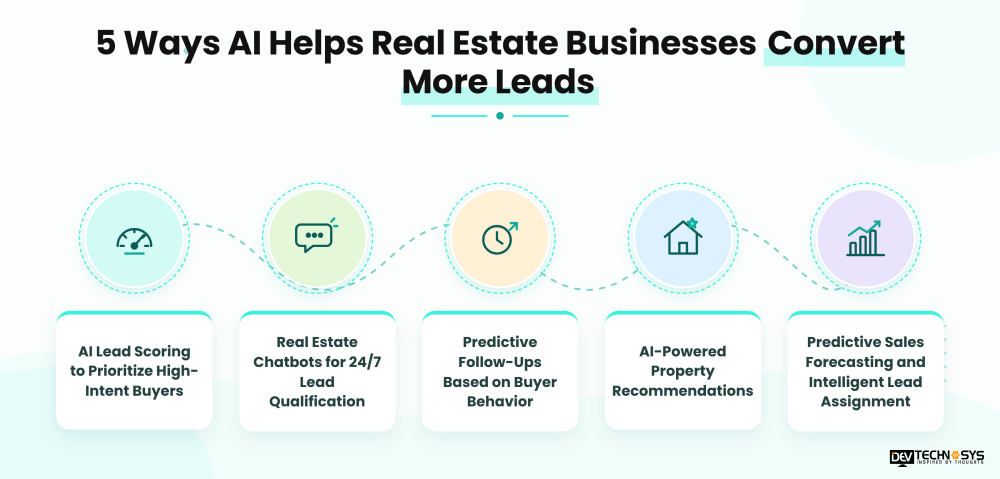
5 Ways AI Helps Real Estate Businesses Convert More Leads
AI helps real estate businesses convert more leads by identifying serious buyers, automating engagement, and optimizing sales follow-ups. From intelligent real estate lead scoring to predictive forecasting, these capabilities help brokerages and property developers improve sales productivity, reduce missed opportunities, and generate more revenue from existing marketing investments.
1. AI Lead Scoring to Prioritize High-Intent Buyers
In real estate CRM software development, AI-powered lead scoring analyzes prospect behavior and engagement to identify buyers most likely to convert.
- Behavioral Analysis: AI-powered real estate CRM tracks repeat property views, pricing inquiries, saved listings, and responses to follow-ups.
- Automated Segmentation: AI in real estate crm categorizes prospects as hot, warm, or cold based on engagement and conversion signals.
- Smarter Prioritization: The best AI crm for real estate helps agents focus on promising leads instead of treating every inquiry equally.
Business Outcome: Better lead prioritization, more efficient follow-ups, and fewer missed sales opportunities.
2. Real Estate Chatbots for 24/7 Lead Qualification
AI chatbots help real estate businesses engage prospects instantly and qualify leads beyond business hours. Real estate chatbot development solutions enable businesses to automate these interactions across websites and supported messaging channels.
- Instant Responses: Answers questions about pricing, amenities, availability, and property locations across supported channels.
- Automated AI Chatbot Qualification: Collects buyer preferences, budget, property type, and purchase timeline.
- Appointment Booking: Helps qualified prospects schedule site visits and syncs conversation details with the CRM.
Business Outcome: 27/7 real estate AI lead qualification, Faster responses, fewer missed inquiries, and more qualified prospects entering the sales pipeline.
3. Predictive Follow-Ups Based on Buyer Behavior
Predictive AI helps agents determine when and how to reconnect with prospects based on their engagement history and buying signals.
- Behavior-Based Triggers: Initiates follow-ups when buyers revisit listings, request brochures, or engage with offers.
- Lead Reactivation: Identifies inactive prospects who may respond to relevant property updates or new listings.
- Next-Best-Action Suggestions: Recommends whether to call, share property details, or arrange a site visit.
Business Outcome: More relevant conversations, fewer forgotten leads, and better use of sales representatives’ time.
4. AI-Driven Property Recommendations
AI property recommendations and AI-powered property matching help match prospects with suitable properties based on their budgets, preferences, search history, and interactions.
- Intelligent Matching: AI-powered real estate CRM suggests properties based on location, price, configuration, and amenities.
- Personalized Suggestions: Shares relevant listings and inventory updates through CRM-connected channels.
- Alternative Discovery: Recommends comparable properties when a preferred unit is unavailable or exceeds the buyer’s budget.
Business Outcome: More relevant inquiries, stronger buyer engagement, and a better chance of progressing from property discovery to a site visit.
5. Predictive Sales Forecasting and Intelligent Lead Assignment
AI in the real estate industry helps sales managers distribute leads effectively, identify stalled deals, and forecast potential revenue using CRM data.
- Intelligent Lead Routing: Assigns prospects based on agent availability, location, specialization, and workload.
- Sales Forecasting: Estimates deal progression using engagement history, lead scores, and previous sales patterns.
- Performance Insights: Highlights follow-up gaps and opportunities that need immediate attention.
Business Outcome: Better lead distribution, improved pipeline visibility, and more informed decisions about sales capacity and revenue targets.
How AI Lead Scoring, Chatbots, and Follow-Ups Work Together
AI lead scoring, real estate chatbots, and predictive follow ups real estate deliver better results when they operate as one connected workflow rather than separate CRM features. Chatbots capture and qualify property inquiries, AI scoring ranks prospects by buying intent, and automated follow-ups keep promising buyers engaged until they are ready for the next step.
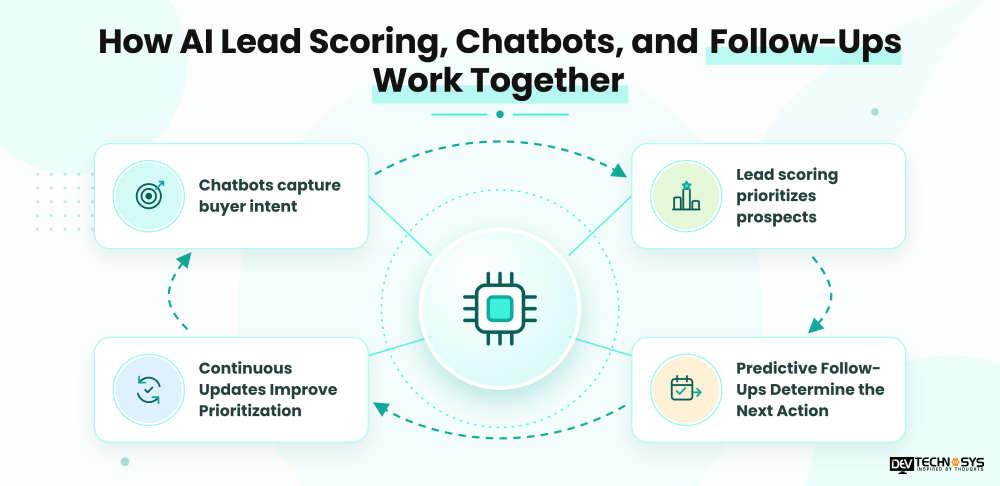
Here’s How the Process Works:
- Chatbots capture buyer intent: AI chatbots collect details about a prospect’s budget, preferred property type, location, and purchase timeline. Contact a top AI chatbot development company to build a chatbot tailored for your business.
- Lead scoring prioritizes prospects: The real estate lead management CRM combines these details with engagement signals, such as repeat property views and responses, to estimate buying intent.
- Predictive Follow-Ups Determine the Next Action: Based on the prospect’s activity, the CRM may recommend a phone call, send matching property options, or prompt an agent to arrange a site visit.
- Continuous Updates Improve Prioritization: If the buyer revisits the listing or responds to a message, the CRM updates their engagement profile and can adjust the recommended action.
The Business Advantage: Instead of treating chatbots, lead scoring, and follow-ups as separate tools, real estate teams can connect them into a coordinated sales process. This helps agents identify promising buyers, deliver more relevant communication, and move qualified opportunities toward site visits and sales.

From Property Inquiry to Site Visit: A Real-World Workflow
An AI-powered real estate CRM helps turn a property inquiry into a scheduled site visit by automating lead capture, qualification, agent assignment, and appointment coordination. Here’s an example of how the AI workflow works for a buyer interested in a 3-BHK apartment:
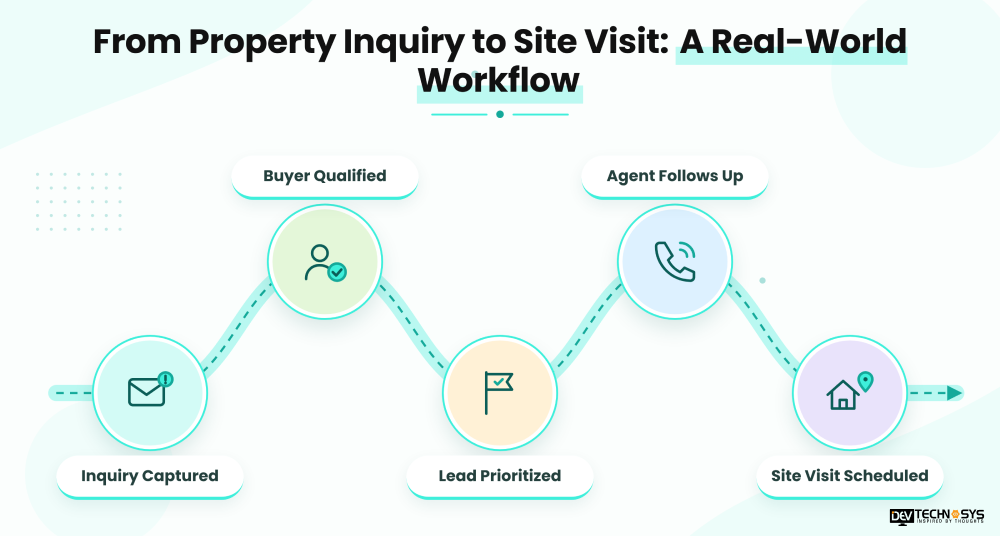
- Inquiry Captured: The buyer enquires through a property portal, website, or WhatsApp. The CRM records their contact details and property interest.
- Buyer Qualified: An AI chatbot asks about budget, location, configuration, and purchase timeline to establish whether the property matches the buyer’s needs.
- Lead Prioritized: AI evaluates the buyer’s responses and engagement signals to help the sales team prioritize the inquiry.
- Agent Follows Up: The AI agents for real estate assign the lead to a suitable agent and prompt a personalized follow-up with pricing, floor plans, or available units.
- Site Visit Scheduled: The site visit and booking management feature allows buyers to choose an available appointment slot, receives confirmation and reminders, and the CRM updates the lead status.
This workflow reduces human handoff fallback, helps Salesforce Agentforce real estate agents respond faster to qualified buyers, and makes it easier to track how property inquiries progress toward site visits. Results depend on lead quality, system integration, and timely sales-team action.
How Accurate Is AI Lead Scoring in Real Estate?
AI lead scoring in real estate can help identify high-intent buyers, but its accuracy depends on CRM data quality, the signals it analyzes, and the model’s performance. It evaluates factors such as property views, budget, inquiry history, chatbot responses, and engagement with follow-up messages to estimate the likelihood of a purchase.
However, AI in CRM cannot reliably predict whether a buyer will book a site visit or close a deal based on engagement through AI follow-up automation alone. Browsing activity may not indicate serious intent, and some ready-to-buy prospects may leave few digital signals. Regularly reviewing these results helps teams refine scoring models and prioritize leads more effectively.
Factor |
What AI Predicts |
Limitation |
| Property views | Property interest | Browsing doesn’t confirm buying intent. |
| Budget and preferences | Property suitability | Buyer requirements may change. |
| Inquiry history | Lead engagement | Frequent inquiries don’t guarantee a sale. |
| Chatbot responses | Needs and purchase timeline | Responses may not reflect readiness. |
| Follow-up engagement | Continued interest | Engagement doesn’t guarantee conversion. |
| Past conversions | Potential bookings and sales | Outcomes depend on several factors. |
Essential Features of AI Real Estate CRM Software
An AI real estate CRM combines intelligent automation, buyer insights, and sales analytics to help property businesses manage leads more effectively. The right features help agents prioritize serious buyers, personalize follow-ups, and convert more inquiries into site visits and bookings.
1. AI Lead Scoring
AI evaluates buyer behavior, budget, preferences, and inquiry history to rank leads by potential purchase intent. This helps agents prioritize promising prospects and use their time more effectively.
2. AI Chatbots for Lead Qualification
AI chatbots for real estate apps answer property queries and collect buyer details, such as budget, location, and purchase timeline. They enable 24/7 engagement while reducing manual lead qualification.
3. Predictive Follow-Ups
Real estate automation with AI analyzes buyer interactions to recommend when and how agents should follow up. This helps maintain engagement and reduces the risk of missing potential sales opportunities.
4. Automated Lead Assignment
The custom AI real estate crm assigns inquiries based on agent expertise, location, and workload. This speeds up responses, balances workloads, and reduces the chances of leads being overlooked.
5. Personalized Property Recommendations
AI matches buyers with listings based on budget, location, and property preferences. Relevant suggestions improve buyer engagement and increase opportunities for site visits.
6. Predictive Sales Forecasting
AI analyzes historical sales and current pipeline data to estimate future bookings and revenue. Managers can identify sales gaps and plan resources more effectively.
7. AI-Powered Performance Analytics
Analytics track lead response times, site visits, bookings, and conversion rates. These insights help teams identify sales bottlenecks and improve their lead conversion strategies.
Types of AI Powering Real Estate Solutions
Five AI technologies power modern real estate solutions, each addressing different business needs, from lead forecasting to property marketing and document processing.
1. Predictive Analytics
Predictive analytics uses historical data and machine learning to estimate property values, forecast market trends, and score buyer intent. Predictive analytics services help businesses make data-driven decisions and prioritize promising leads.
2. Generative AI
Generative AI in real estate creates property descriptions, marketing content, listing images, and market summaries. It helps real estate teams produce content faster and personalize property marketing. McKinsey estimated that generative AI could deliver productivity value equivalent to 1.0–1.7% of real estate industry revenue, or roughly $110–180 billion.
3. Agentic AI and AI Agents
Agentic AI development helps businesses execute multi-step tasks, such as qualifying leads, updating CRM records, scheduling site visits, and sending follow-ups. This reduces repetitive work and speeds up sales workflows.
4. Computer Vision
Computer vision analyzes property images and videos for virtual staging, image enhancement, floor plan recognition, and building inspections. It improves property presentation and supports visual assessments.
5. Natural Language Processing (NLP)
NLP helps systems understand and process human language in contracts, leases, emails, and chatbot conversations. It makes document search, data grounding, and buyer communication more efficient.
How to Implement AI in Your Real Estate CRM
Implementing AI in a real estate CRM requires a structured approach that connects business goals, reliable data, and intelligent automation. These five phases help businesses deploy AI effectively, measure results, and scale successful workflows.
Phase 1: Assess Business Needs and Prepare Data
- Choose a Use Case: Real estate crm automation helps identify a priority, such as slow lead response, poor qualification, or missed follow-ups.
- Clean and Centralize Data: Consolidate CRM records, property listings, and customer interactions. Fix data gaps and inconsistencies before implementing AI.
Phase 2: Integrate and Configure AI
- Implement Lead Scoring: Analyze buyer preferences, inquiry history, and engagement signals to prioritize leads.
- Connect AI Tools: Integrate chatbots, predictive lead scoring, and automated follow-ups into your CRM using APIs or AI integration services tailored to real estate workflows.
Phase 3: Test an AI MVP
- Start Small: Pilot one use case, such as AI-powered lead qualification, with a small sales team.
- Measure Results: Compare response times, qualified leads, site visits, and conversion rates against existing performance.
Phase 4: Automate Sales Workflows
- Personalize Follow-Ups: Automate initial inquiries, appointment scheduling, and relevant property suggestions.
- Support Agent Decisions: Combine lead scores and conversation history to help agents prioritize prospects and choose the next action.
Phase 5: Monitor and Scale
- Track Performance: Review prediction accuracy, data quality, AI crm data entry time management, agent adoption, and sales outcomes.
- Ensure Responsible AI Use: Apply privacy controls, access restrictions, and checks for bias and compliance with applicable housing regulations before expanding AI across workflows.
AI Lead Scoring vs. Rule-Based Scoring: Which Works Better for Real Estate?
Real estate businesses can prioritize leads using rule-based scoring or AI-powered lead scoring. The main difference is how each method evaluates buyer intent and adapts to changing behavior.
Feature |
Rule-Based Scoring |
AI Lead Scoring |
| Logic | Uses fixed rules, such as points for viewing multiple listings. | Uses historical data to predict lead conversion likelihood. |
| Adaptability | Requires manual rule updates. | Can adapt as new data becomes available. |
| Signals | Tracks predefined actions, such as form submissions and property views. | Can analyze broader behavioral and engagement patterns. |
| Data Needs | Works with minimal historical data. | Needs sufficient, reliable data for effective predictions. |
| Best For | Small brokerages and low-volume pipelines. | High-volume teams with complex sales pipelines and adequate data. |
Which should you choose? Rule-based scoring is a practical starting point for smaller teams. AI lead scoring can offer deeper insights when you have enough reliable data, but you should validate its predictions against actual site visits, bookings, and sales.
Security, Privacy, and Compliance Best Practices for AI-Powered Real Estate CRM
An AI-powered real estate CRM handles sensitive buyer information, financial preferences, property inquiries, and communication history. Implementing AI agent security controls and regulatory compliance checks helps protect this data privacy, reduce legal risks, and prevent unfair AI-driven decisions.
Requirement |
What to Implement |
Why It Matters |
| Data Encryption and Access Control | Encryption, role based access, and MFA. | Prevents unauthorized data access. |
| Data Privacy and Consent | Consent management and data retention policies. | Protects personal data and supports privacy compliance. |
| Secure API Integrations | API authentication and webhook validation. | Reduces data leaks and unauthorized access. |
| Fair Housing and Bias Prevention | AI bias testing and human review. | Helps prevent unfair housing decisions. |
| AI Transparency and Human Oversight | AI disclosures and approval workflows. | Improves accountability and reduces errors. |
| Audit Logs and Monitoring | Access logs and security alerts. | Helps detect and investigate security incidents. |
| Incident Response and Backups | Encrypted backups and response plans. | Supports recovery and reduces disruption. |
| Regulatory Compliance | Compliance policies and regular reviews. | Reduces AI hallucination risk and legal and compliance risks. |
Regulations and Frameworks to Consider:
- Fair Housing Act AI: Test AI recommendations and screening workflows for discriminatory outcomes.
- Privacy Laws: Apply relevant consent, data access, and retention requirements.
- FCRA: Assess requirements when using consumer reports for tenant screening or other covered decisions.
- FTC Safeguards Rule: Confirm whether the business falls within its scope.
- NIST AI Risk Management Framework: Guide AI risk assessment, testing, and ongoing monitoring.
Key Takeaway: Integrate security, privacy, and fairness controls during development. Validate them before launch and monitor them as the CRM evolves.
How Much Does AI-Powered Real Estate CRM Development Cost?
The real estate CRM software development cost typically ranges from $4,999 to $89,999, depending on how complex the AI features available in the solution are, as well as data integration, workflow automation, and customization aspects. Thus, a simple system may include lead scoring and automated follow-up, while an advanced platform may offer predictive analytics, AI chatbot integration, property suggestions, and other real estate system integrations.
Development Level |
Estimated Cost |
Timeline |
| Basic CRM | 4,999–15,000 | 4–8 weeks |
| Mid-Level CRM | 15,000–40,000 | 8–16 weeks |
| Advanced CRM | 40,000–89,999 | 16–28+ weeks |
Budget Tip: Start with an MVP of a simple AI-powered CRM that would include lead management, AI lead scoring, and automated follow-up functionalities. Test it to prove its value in qualifying leads and improving site visits before adding advanced AI capabilities.
How to Measure AI Real Estate CRM Performance?
Measuring an AI-based real estate CRM’s performance helps manage lead quality, boost conversion rates, reduce sales expenses, and track the return on AI investments.
KPI |
What to Measure |
Business Impact |
| Lead-to-Sale Conversion Rate | Percentage of leads converted into property buyers. | Increases sales opportunities and revenue potential. |
| Lead Response Time | Time taken to respond to new inquiries. | Reduces lead drop-offs and engages buyers faster. |
| Lead Scoring Accuracy | How accurately AI identifies high-intent prospects. | Helps agents prioritize promising leads and reduce wasted effort. |
| Site Visit Booking Rate | Percentage of leads who schedule property visits. | Creates more opportunities to convert prospects into buyers. |
| Follow-Up Engagement Rate | Responses to automated emails, messages, and reminders. | Keeps prospects engaged and reduces missed follow-ups. |
| Cost per Qualified Lead | Lead-generation costs divided by the number of qualified leads. | Improves marketing efficiency and controls acquisition costs. |
| Sales Cycle Length | Average time from initial inquiry to property purchase. | Accelerates deal closures and improves sales efficiency. |
| AI Automation Rate | Percentage of eligible tasks completed automatically. | Reduces repetitive work and frees agents to focus on selling. |
How to Use These Metrics:
- Establish a Baseline: Record performance before implementing AI.
- Compare Results: Measure changes across similar periods and lead sources.
- Validate Predictions: Compare AI lead scores with actual site visits, bookings, and sales.
- Optimize Regularly: Refine scoring rules, chatbot responses, and follow-up timing based on results.
Evaluate an AI-powered real estate CRM based on its effectiveness in producing qualified leads, conducting property viewings, conversions, sales efficiency, and costs, as opposed to the amount of work it automates. The effectiveness of an AI-enabled real estate CRM can be established by measuring the improved quality of leads and the increased conversion rate. Metrics establish the link between AI performance and clear business results.
Conclusion
With an AI-enabled real estate CRM, property developers and agents can turn inquiries into qualified leads using features like lead scoring, chatbots, personalized recommendations, and predictive follow-ups. Consequently, they will combine automation provided by AI with the experience of humans in order to increase site visits and chances of making a conversion. Moreover, investing in a real estate CRM tailored to each company’s specific needs will help you gain the benefits of AI.
Frequently Asked Questions
Find answers to the most common questions related to this article.
AI chatbots can answer questions at any time of the day or night, gather information about customer wants and needs, answer typical questions about properties, qualify prospective buyers, and set appointments for property visits. They can also handle advanced client queries and pass them to sales agents.
Yes. AI models can estimate conversion likelihood using historical sales data and current buyer engagement. This capability is accurate and reliable as long as the model is strong and you account for how behaviors and information can shift over time; predictions are also more accurate when data quality is high.
Yes, it can, as long as it has the API and permission from the platforms. Thus, customers can use their AI CRM with property databases, MLS platforms, websites, other marketing tools, WhatsApp, their email, and all possible calling systems in one place.
Predictive follow-up offers recommendations on when to contact a prospect and what to do with it based on buyer activity, previous engagement with the customer, and its patterns of involvement.
Definitely. AI assigns leads automatically according to their availability for the location where a property type is located in and other factors such as load and performance history. Companies should create assignment procedures and escalation policies so that leads are not lost.
AI can match property listings with a prospect's budget, preferred location, configuration, amenities, and browsing behavior. Recommendations should use current listing data and respect buyer preferences and applicable fair housing requirements.