














Key Takeaways:
-
- Create a multi-discipline fintech software development team structure with delineated objectives across programming, security, testing, and compliance.
- Emphasize the understanding of the finance industry, transaction integrity, API integration, and cybersecurity right away.
- Introduce idempotency, ledger control, automated testing, and recovery processes to ensure stable financial operations.
- Draw budgets based on employment, architecture, security, integration, and maintenance costs to prevent unforeseen costs in the development phase
Constructing a fintech product calls for more than just employing software engineers. It doesn’t matter whether you’re building a digital banking application, payment gateway, lending platform, or investment solution. You’ll definitely need a team with knowledge of financial processes, security standards, regulations, and scalable software architecture.
An efficient fintech software development team structure allows businesses to set duties, lower development risks, and launch quality financial solutions. From product management to cybersecurity engineering, every team member plays a role in one stage of the software development life cycle.
This blog discusses key roles, competencies, team structure, architecture choices, and cost considerations companies should focus on when forming their fintech software development team structure.
Why Team Structure Matters in Fintech Development
Fintech applications involve operations and financial processes that involve sensitive information, and errors can negatively affect businesses, transactions, and customers. They are unlike most traditional types of applications because they require very close cooperation between the engineering, product, compliance, and security teams of the company.
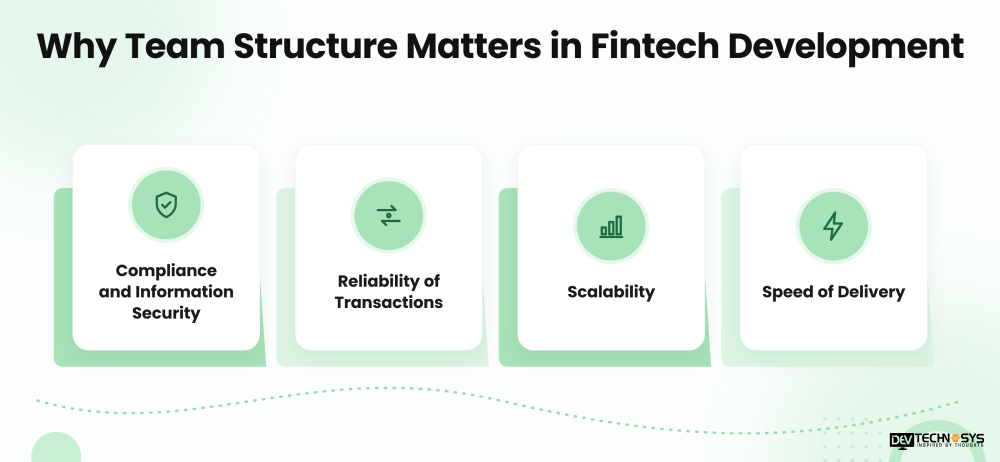
A suitable fintech team structure supports four important objectives:
- Compliance and Information Security: Compliance experts and security professionals work out requirements for data protection, access management, auditing, and applicable financial regulations, including PCI DSS compliance.
- Reliability of Transactions: Backend developers, database developers, and specialists in Quality Assurance guarantee proper transaction processing in case of a system failure.
- Scalability: Technical architects and DevOps engineers build systems capable of handling any increase in transactions.
- Speed of delivery: The clarity of functions eliminates repeated work and enables teams to save time and foresee potential obstacles.
Expert advice
Before starting to develop the fintech application, do not forget to identify which team is responsible for financial operations, transaction processing, security standards, and compliance issues.
Key Roles and Responsibilities in a Fintech Development Team
To build fintech software, team composition depends on the complexity of the product, regulatory exposure, integrations, and expected transaction load. Smaller projects may mesh responsibilities while enterprise platforms may need to employ specialists exclusively for a particular role.
Product Manager
The product manager converts business goals into a product roadmap. They prioritize features, build product specifications, communicate between the various stakeholders, and trade off customer needs against technical feasibility. For a digital wallet, this role would decide which capabilities should be emphasized: onboarding, money transfer, transaction history, and spending controls.
Project Manager
Project manager drafts plans, assembles timetables, manages budgets, allocates resources, appraises risks, and communicates with clients and partners. They are charged with coordinating the interaction between engineering, design, testing, and external vendors. Their task is one of facilitating delivery along a set of agreed milestones without letting schedule pressures unseat security or testing.
Business Analyst
The financial workflows are converted by the business analysts into functional specifications with minute details. The process includes documentation of the transaction specifications, journeys of users, and integration needs. For example, the business analyst, who works in a lending application, defines the qualification criteria for the loan.
UI/UX Designer
The UI/UX designers create intuitive screens for users’ financial transactions. The onboarding, dashboard, money transfer process, and the confirmation screens are all designed so as to confuse the user as little as possible.
Software Developers
Software developers are responsible for implementing the critical fintech app features of the application.
- Frontend Developers: Construct dashboards, forms, transactional interfaces, and customer-facing platforms.
- Backend Developers: Provide business logic, allow authentication and transaction handling, perform database operations, and support APIs.
- Mobile Developers: Produce applications for iOS and Android systems and are responsible for secure sessions and device-related properties.
Normally, the backend developers are responsible for ensuring transaction integrity between financial services and for controlling transactions and managing communication.
QA and Test Engineers
Quality Assurance engineers confirm whether functionalities are working properly under both normal and faulty conditions. Their role includes performance testing, functional testing, API testing, regression testing, and integration testing. In financial technology, QA must also include cases such as double payment requests, network disconnections, incorrect account balances, and parallel transactions.
DevOps and Cloud Engineers
On the other hand, DevOps engineers are responsible for pipelines for deployment, cloud infrastructure, configurations, operational visibility, monitoring, backups, and recovery processes. It also allows teams to develop and update features in a continuous manner.
Cybersecurity Specialists
Security experts analyze hazards and introduce measures such as encryption, access management, secure identification, vulnerability analysis, and monitoring of data security. Additionally, they work on writing procedures related to incident response, as well as evaluating risks associated with third-party integration.
Data Engineers and Compliance Specialists
Data engineers deal with data pipelines, reporting mechanisms, and ensuring continuous data access. Compliance experts study laws and convert them into necessary operational mechanisms. Different projects may also require financial analysts, fraud analysts, blockchain engineers, and database managers.
Essential Technical and Domain Skills for Fintech Teams
A strong fintech team combines software engineering expertise with an understanding of financial operations.
Skill area |
Essential capabilities |
Why it matters |
| Backend development | Java, C#, Python, Node.js, APIs | Implements financial workflows and business logic |
| Database engineering | SQL, transactions, indexing, consistency | Maintains reliable financial records |
| Cloud and DevOps | AWS, Azure, CI/CD, monitoring | Supports deployment, availability, and recovery |
| Security engineering | Encryption, IAM, threat modeling | Protects accounts and sensitive data |
| Financial domain knowledge | Payments, lending, banking, ledgers | Ensures workflows reflect business rules |
| Testing | API, integration, concurrency, security testing | Identifies defects before production |
The technology stack in use should be determined by the transaction needs, the previous systems in place, the abilities of the developers, and the demands of long-term fintech software maintenance cost.
For example, in the situation where there is a lending platform with complicated repayment calculations, the calculation of payments is complex. On the other hand, an investment app for consumers might want to concentrate on the mobile capabilities.
In addition, the teams must develop recommendations in the area of API versioning, audit logging, observability, and incident response, which become more vital with the increased number of financial integrations.
Fintech Team Structure by Project Type
Not every fintech product requires the same combination of specialists. The following matrix can help businesses identify their primary staffing needs.
Project type |
Core roles |
Additional expertise |
| Digital banking | Backend, mobile, QA, security | Core banking integrations, compliance |
| Payment gateway | Backend, QA, DevOps, security | Payment networks, reconciliation, fraud |
| Lending platform | Backend, business analyst, QA | Credit rules, repayment logic, compliance |
| Wealth management | Backend, frontend, data engineering | Portfolio analytics, market data |
| Blockchain platform | Blockchain, backend, security | Smart contract auditing, distributed systems |
Businesses should therefore select roles according to the product’s risk profile and technical requirements, rather than copying the staffing structure of another fintech company.
How to Build an Effective Fintech Development Team
Building the right team starts with defining the product and the decisions the team must make. Here are the steps you can follow to build an effective fintech development team:
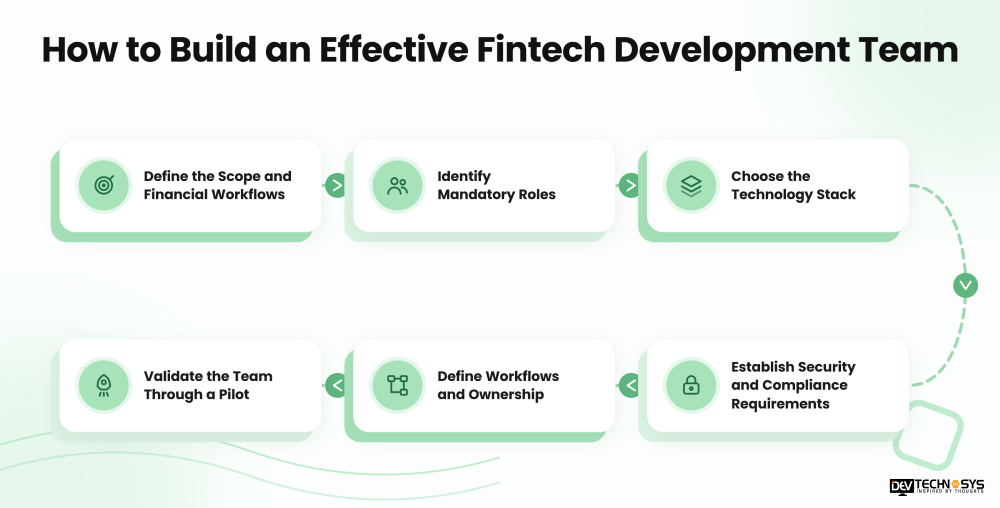
Step 1: Define the scope and financial workflows
Take note of the product’s core characteristics, categories of users, types of transactions, interfaces with outside parties, and politics related to its use. Establish whether the product is designed to initiate payments, protect customer funds, process loan applications, or just provide financial information. These aspects imply different architectures, compliance requirements, and teams.
Step 2: Identify mandatory roles
The main roles of the team members must be distinguished from tasks executable by specialists hired later. If we are building a basic payments application, the core team could consist of a product manager, a business analyst, backend developers, frontend developers, security experts, QA developers, and DevOps. Some roles can be shared, but clear ownership will be required.
Step 3: Choose the technology stack
Assess technology options in terms of their security and support options, compatibility of integration, ease of scaling, and the team’s expertise to operate and maintain them. It is not wise to take popular frameworks just due to their popularity. Keep in mind all important architectural decisions made, alternatives considered, and the reasons for adopting a certain approach.
Step 4: Establish security and compliance requirements
Define what obligations shall be dealt with at the early stage of development and relate them to technical controls. Obligations can include requirements concerning identity verification, encryption, and audit trails, among others. Compliance experts should collaborate with developers throughout the whole process rather than performing a check shortly before the launch.
Step 5: Define workflows and ownership
Stages of development should be clearly defined: requirements, architecture, implementation, testing, security review, deployment, and monitoring. Assign responsible persons for transaction processing, financial calculations, database changes, production incidents, and third-party integration.
Step 6: Validate the team through a pilot
A small workflow should be developed prior to making the team bigger, for instance, user onboarding followed by executing a test transaction. Reliability of integration, testing coverage, readiness for deployment, and coordination of the team should be evaluated using this method, as it helps to identify staffing gaps before they lead to costly architectural issues.
Technical Architecture: How the Team Works Together
The fintech app architecture defines how its different parts work together, handle transactions, guard data, and recover after failures. The team’s responsibilities should match these boundaries.
A simplified payment application might follow this flow:
Customer interface
(Web or mobile application)
↓
API gateway and identity controls
(Authentication, authorization, request validation)
↓
Payment service
(Business rules, transaction states, idempotency)
↓
Ledger and transaction database
(Financial records, consistency, audit trail)
↓
External payment provider or bank
(Payment execution and status confirmation)
An example architecture. In real systems, extra services, queues, reconciliations, and ledgers can be used.
Each component has its own owner. Payment logic is written by backend engineers, identity and access controls are verified by security engineers, and data is managed by database engineers. QA engineers check all the steps of the transaction process.
Why idempotency and ledger design matter
The structure of a fintech app defines how its different parts work together, handle transactions, guard data, and recover after failures. The team’s responsibilities should match these boundaries.
An example architecture. In real systems, extra services, queues, reconciliations, and ledgers can be used.
Each component has its own owner. Payment logic is written by backend engineers, identity and access controls are verified by security engineers, and data is managed by database engineers. QA engineers check all the steps of the transaction process.
Expert advice
Treat an uncertain payment result as a state that requires verification, not an automatic failure. Check the provider’s status or reconcile records before deciding whether another payment attempt is safe.
In-House vs. Outsourced Fintech Development Teams
Businesses can build an in-house team, outsource development, or use a hybrid model.
Factor |
In-house |
Outsourced |
Hybrid |
| Control | Direct | Contract-dependent | Shared |
| Hiring speed | May be slower | Often faster to access specialists | Moderate |
| Internal knowledge | Builds internally | Requires documentation and transfer | Shared |
| Cost structure | Salaries and overhead | Contract or project fees | Combined |
| Flexibility | Depends on hiring capacity | Can scale by engagement | Flexible |
An internal team is preferred when providing continuous product ownership and having internal financial domain knowledge is necessary. Outsourcing allows companies to access specialized engineering talent without needing them hired permanently.
Hybrid arrangements work when internal product owners and compliance experts team up with external fintech software for startups.
Before making a decision, consider issues related to data accessibility, intellectual property, SLAs, security responsibilities, incident management, and ongoing maintenance.
Common Challenges and Failure Recovery Strategies
Fintech teams face challenges that extend beyond ordinary software delivery.
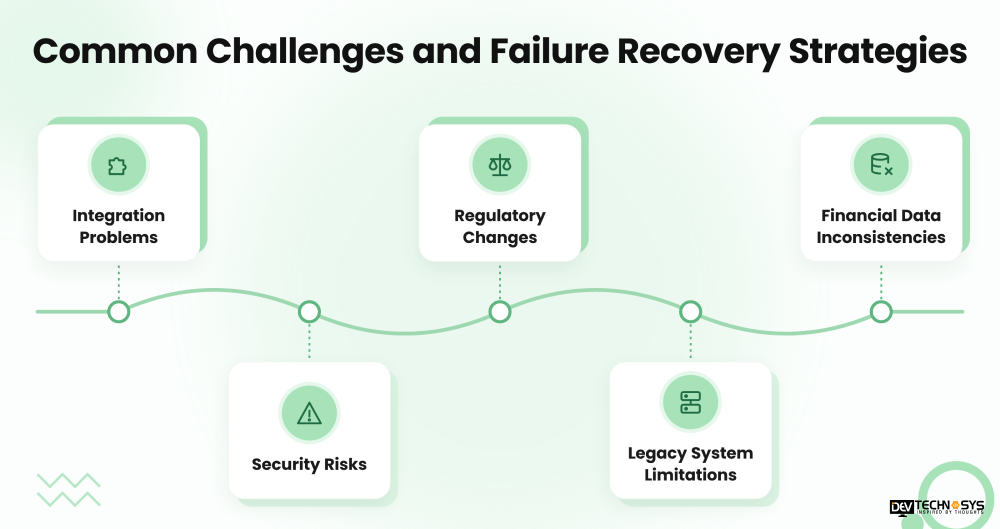
- Integration Problems: External banks and payment processors may go offline, causing slow responses. In particular, teams need to implement retries (for a certain number of times) and/or timeouts, polling, recovery, or reconciliation.
- Security Risks: Security issues may arise as a result of poor access control or credential leakage, resulting in loss of customer information. Threat modeling, security audits, and incident response plans can help reduce these threats.
- Regulatory Changes: Possible issuance of new regulations will require adaptation of proper workflows, reporting formats, and data retention methods. It is better to consult with compliance and engineering departments on this issue.
- Legacy System Limitations: Internal bank infrastructure using legacy systems may feature poorly built interfaces or formats, leading to non-uniform data. Make sure to document necessary mappings and causes of errors with a business analyst or integration engineer.
- Financial Data Inconsistencies: Many cases of excessive requests or wrong transaction processing lead to discrepancies. Validation, reconciliation, or database constraints can be used to detect and correct the issue.
In addition, it is important that the teams document the recovery processes that are implemented in the course of failed, interrupted, or poorly executed projects. The recovery must, however, be performed with due regard to auditability and the financial accuracy of the processes.
For the case of advanced systems, architectural decisions must be documented to reflect a number of technical decisions taken, their advantages and disadvantages, as well as a number of rejected alternatives.
Fintech Team Cost Factors and Budget Planning
The fintech software development cost depends on team size, location, seniority, project duration, and product complexity.
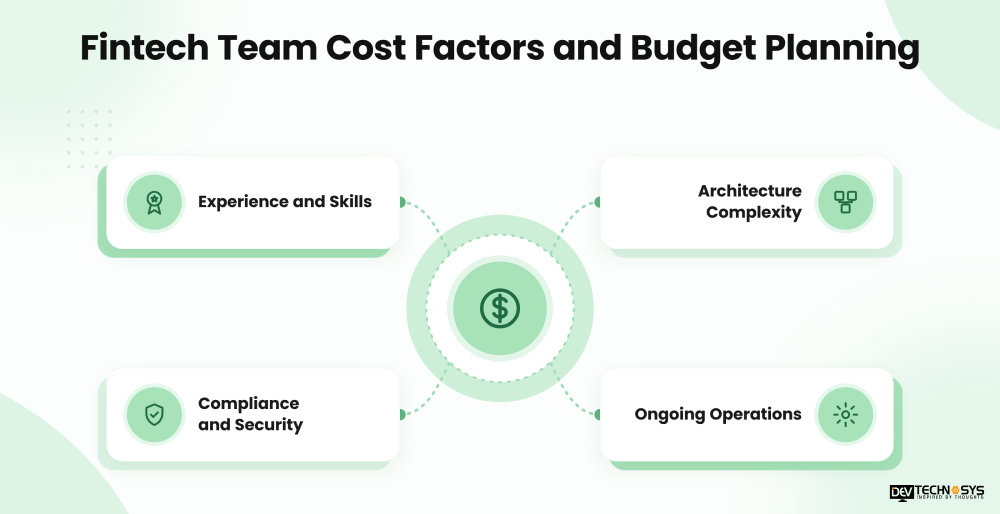
Important cost factors include:
- Experience and skills: Senior back-end engineers, experts in information security, and specialists in the financial field have high budget needs.
- Architecture complexity: The use of ledger systems, payment services, and distributed services will require more effort to implement and test.
- Compliance and Security: From audits to penetration testing, monitoring, and compliance reviews, there are costs associated with all of these activities.
- Ongoing Operations: The cost to build and maintain the cloud infrastructure, handle incidents, and provide updates.
A reasonable budget must distinguish the cost of development from the ongoing running costs. For instance, the budget for an individual external provider payment application will likely differ from that of a multi-provider payment platform that also includes reconciliation, fraud detection, a general ledger, etc.
Estimate effort in roles and workstreams, then add contingency based on integration uncertainty and recovery testing. Don’t just estimate costs from the number of developers.
Best Practices for Managing Fintech Software Development Teams
Effective team management combines delivery discipline with strong engineering controls.
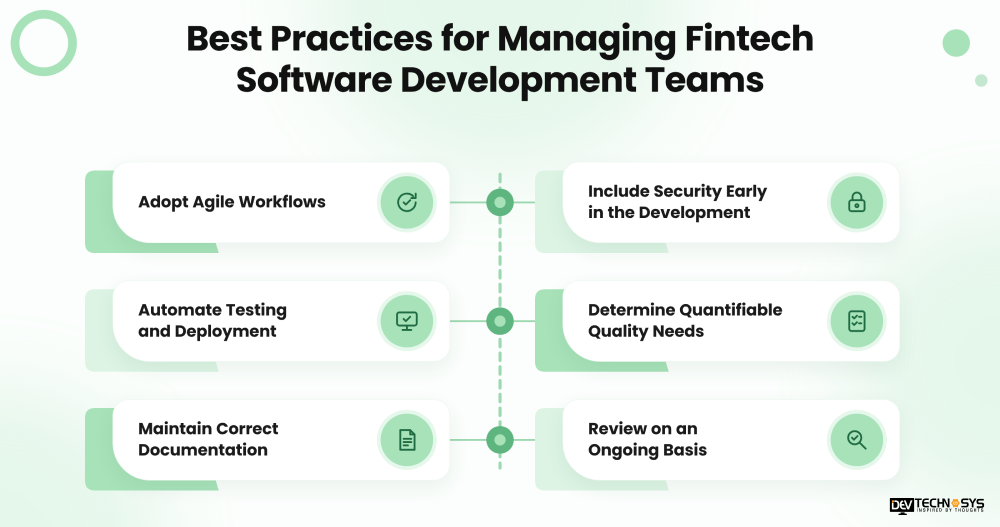
- Adopt agile workflows: Divide work into small iterations and assess progress based on meeting business needs.
- Include security early in the development: Apply secure coding, code review, static and dynamic testing, and threat modeling techniques throughout the entire lifecycle.
- Automate testing and deployment: In addition to pipelines with approval gates, it is possible to set pipelines with appropriate approval gates and auto-deployment.
- Determine quantifiable quality needs: Set business standards for transaction correctness, latency, availability, recovery, and monitoring.
- Maintain correct documentation: Keep an accurate record of API information, data contracts, architectural decisions, operational procedures, and compliance responsibilities.
- Review on an ongoing basis: Review security gaps, failed transactions, production failures, and defects.
For fintech products, release readiness should depend on evidence that critical financial workflows behave correctly, not simply on whether the feature is complete.
Teams should test failure scenarios before production deployment and ensure that monitoring can detect unexpected transaction states, integration errors, and reconciliation discrepancies.

Conclusion
The ultimate fintech software development team structure is comprised of appropriate roles, financial domain knowledge, proper architecture, and clear responsibilities. The company must first define product specifications, assign ownership for essential financial processes to a specific person, and build a team that has everything necessary to guarantee sustainability and development in the long run.
From transaction execution and transaction data to system recovery planning, each step is critical in shaping the final product. An effective strategy helps businesses create high-quality fintech solutions.
If you are also planning to develop fintech software, then you can connect with Dev Technosys, a fintech software development company. They have an experienced team of developers who can build your software while maintaining security and compliance.
Frequently Asked Questions
Find answers to the most common questions related to this article.
The primary roles typically consist of a product manager, a business analyst, software developers, a QA engineer, and experts in DevOps and security. Additional roles will depend on the specific product's financial workflow, integrator-specific requirements, and regulatory issues
A smaller application can start with a lean cross-functional team, whereas larger banking or payments platforms require more complexity in terms of roles involved. The size of the entire team will vary based on scope, requirements for security, the number of integrations, and final dates of delivery.
Fintech applications deal with sensitive financial data and transactions. Implementing strong access control systems, encryption systems, authentication systems, systems for monitoring operations, and systems for security testing is important to protect customers' data against unauthorized access.
Outsourcing can help gain access to the required specific skills and flexibility. However, it is important to check the customer’s requirements in terms of security policies, financial knowledge, documentation, ownership conditions, and ongoing support.