







Key takeaways:
-
- To develop an app like DoorDash, follow crucial steps, such as idea validation, market research, identifying functionalities, choosing the best tech stacks, designing UI/UX, development, security & testing, deployment, and post-maintenance.
- As per Deloitte, food delivery reshapes restaurant economics; platforms control 30-60% urban orders, and cloud kitchens reduce cost and improve scalability.
- The cost to build an app like DoorDash is around $30,000 to $150,000, based on several factors, like premium features, project complexity, backend infrastructure, third-party integrations, tech stacks, and more.
- There are various monetization techniques that help food delivery apps to generate higher revenue, such as subscription plans, freemium models, transaction fees, delivery fees, and more.
Do you remember being able to order an endless amount of delicious food right to your front doorstep?
Apps like DoorDash make it as simple as tapping your screen. You can order food from any restaurant you want without ever leaving your house! If you want to build an app similar to DoorDash, you have to have a unique concept, build it from the ground up, and have a smart plan.
To make ordering food as simple as possible, users should be able to view the available restaurants, select the desired food, and make an order to be delivered securely.
After the food is ordered, a driver must be available to deliver the food to the ordered location as soon as possible.
To build an app like DoorDash that satisfies users’ needs and customers’ expectations. It is essential to have proper planning, sufficient resources, and reliable development.
Market Statistics of Global Food Delivery Applications
Observe the present and future market insights of the worldwide home meal delivery apps market through Statista:
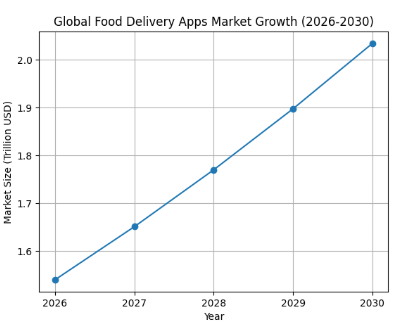
- According to Statista, the global restaurant delivery apps market is valued at around US$1.54 trillion in 2026. It is projected to increase to around US$2.03 trillion by 2030.
- As per the global comparison, China will generate a higher revenue of around US$544.58bn in 2026.
- In a recent survey, the takeout ordering apps market users are expected to grow to around 2.5 billion by the end of 2030.
- In 2026, the user penetration of the meal delivery applications market is around 29.2% and is expected to grow further.
- According to market research, the food delivery industry valuation is expected to grow with a CAGR of 7.20% from 2026 to 2030.
What is DoorDash?
DoorDash is the largest and most famous online food ordering and delivery platform in the United States. It offers convenience and flexibility to users for ordering food and delivering it to their doorsteps.
This application connects with a wide variety of local restaurants, and users can order food from their favorite restaurant. Best food delivery apps like DoorDash include various types of features such as real-time order tracking, food menu, delivery type, secure payment options, and many more.
DoorDash Facts:
- Launched Year: 2013
- Founder: Stanford University students Tony Xu, Stanley Tang, Andy Fang, and Evan Moore.
- Headquarters: Rialto Building, San Francisco, California, USA
- CEO: Tony Xu
- Core service: Connects customers with local restaurants and merchants using a network of delivery workers (Dashers)
- DoorDash Net Worth: $69.96 billion (Feb 13, 2026)
- Number of Employees: 23,700 Employees Worldwide
Planning a Food Delivery Project?
Get a tailored development cost estimate in a few simple steps.
- 3 quick steps
- 100% free
- Reply in 1 business day
2 Minutes Read
How Does DoorDash Work?
Do you have any idea how DoorDash works? If no. Then, look at the steps below that explain the working process of the app.
1. Customer Places an Order Via the DoorDash App
Using their smartphones, customers search through local merchants in the DoorDash application or website for restaurants or stores. After selecting items, customizing their order, making a payment, and choosing the method of receiving their order.
2. Restaurant Sees and Processes the Order
The restaurant partner receives the order on a tablet or through a point-of-sale system. Confirms the order, prepares the food, and updates the system regarding the order being ready for pickup.
3. Dasher Accepts the Delivery
Independent contractors called Dashers (or couriers) receive delivery requests through the DoorDash app. They review the distance and payout of each order and make a decision whether or not to accept an order based on those two criteria. And they then proceed to the restaurant to pick up the prepared food.
4. Real-Time Order Updates
When Dashers deliver the food to customers’ homes, they navigate to the home using a GPS application. While they are delivering the food, customers have real-time tracking of the status of their order and receive notifications.
5. Payments, Fees & Ratings Work
DoorDash takes care of processing payments from customers and transferring payments to the appropriate merchant, collecting the service and delivery fees, and rating the customer’s experience.
Core Business Model of DoorDash
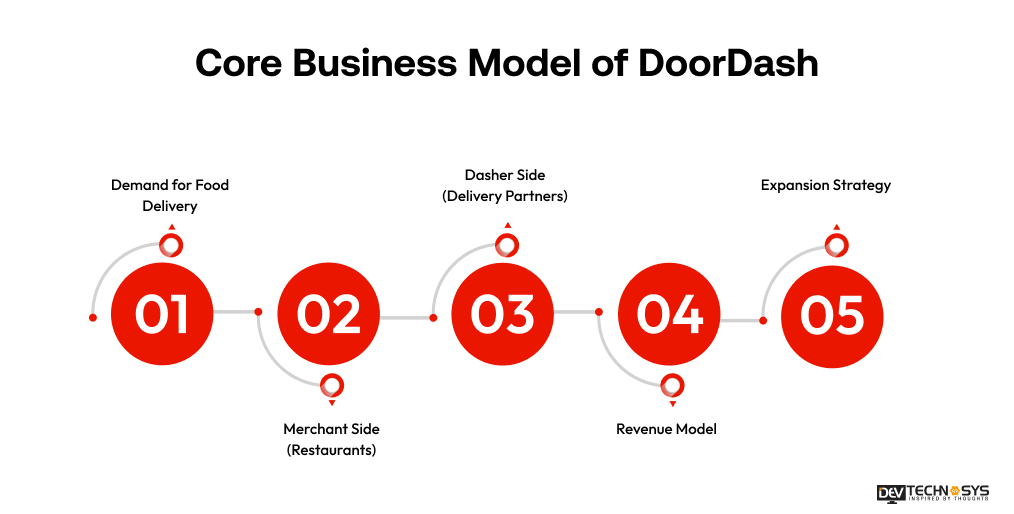
The three-sided marketplace of DoorDash has three parties involved: customers, restaurants, and Dashers, or delivery drivers. Delivery fees, commissions, and subscriptions are all ways in which DoorDash derives revenue from its service offering. By allowing for quick and easy access to food, as well as other forms of local commerce delivery.
1. Demand for Food Delivery
To buy food from local restaurants, customers go to the DoorDash app. Customers pay for food, delivery, and service fees, and the order placement will be convenient to them (it will be delivered quickly), allow them to track their order in real-time, and give them access to a diverse selection of restaurants within urban and suburban areas of the immediate market.
2. Merchant Side (Restaurants)
In order to obtain more online orders, restaurants partner with DoorDash. They pay commission and optional marketing fees in order to access systems that allow them to manage their orders, reach their customers, and have their orders delivered. By doing business with DoorDash, restaurants can grow their business without needing to invest in their own logistics.
3. Dasher Side (Delivery Partners)
Dashers are independent delivery workers who deliver goods using their own vehicles. They make a base pay for each order, plus tips and incentives. Because the Dasher Model allows for worker flexibility, it will give DoorDash the ability to scale deliveries without owning a vehicle fleet.
4. Revenue Model
DoorDash will make revenue from customer delivery fees, customer service fees, restaurant commissions, advertisement revenue, and subscription services. DoorDash will receive additional revenue from promoted listings and will continue to diversify its revenue base by targeting delivery of non-restaurant categories, including grocery and convenience stores, and retail partnerships.
5. Expansion Strategy
DoorDash has transitioned into a wider platform offering local commerce services, incorporating grocery delivery, convenience shop services, alcohol (where allowed) product deliveries, as well as partnering with retailers to become a last-mile logistics company, in addition to providing food delivery service from traditional restaurants.
Industry Insights:
According to Yahoo Finance, DoorDash has achieved GAAP profitability, reporting profits after years of reinvestment, a major credibility milestone for the platform.
Want a chatbot demo or pricing? Fill the form and talk to our experts today.
Pick what you need below — you can select more than one — then tap Get detail to continue.
-
Chatbot demo dashboard
-
Cost to develop an app
-
Industry report
-
Case study
Why Do Businesses Want to Invest in Food Delivery App Development?
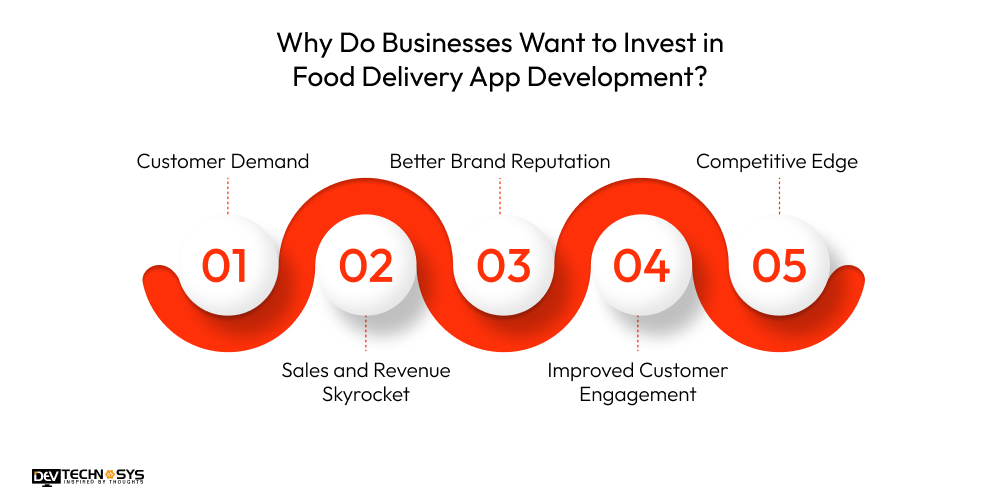
The world of ecommerce continues to grow exponentially due to online ordering being the new normal. Many businesses are now taking notice of this trend and are incorporating fast food delivery platforms into their business models as a way to grow sales and expand their customer base while staying competitive. There is a tremendous amount of potential for growth in the food-on-demand app development solutions.
1. Customer Demand
People now prefer ordering food to eating out. Food delivery apps make ordering food simple. Like DoorDash, companies can now serve customers at home. This traction creates a reason to invest in food delivery apps.
2. Sales and Revenue Skyrocket
More customers can reach the restaurants with the food delivery apps. The physical traffic limitations are now removed. More Daily orders can be achieved without any limitations. Uber Eats is a great example of a digital platform that has worked.
3. Better Brand Reputation
More visibility and reach are the result of a food delivery app like Seamless. The restaurant can be found, and the menu is accessible. All of this creates more customers. Grubhub is a great example of being able to extend its reach a lot more in a digital space.
4. Improved Customer Engagement
Investing in delivery apps like Zomato in Phoenix helps improve customer engagement. When customers can place orders any time and anywhere, it creates ease. They can initiate orders themselves and take control, plus they can track their orders. This helps improve customer satisfaction and builds customer loyalty.
5. Competitive Edge
The grocery delivery app development solutions have endless competition among them. Companies utilizing delivery applications will always be ahead of other competitors that do not provide any type of delivery service in person. Other types of companies provide valid competition because they are creating and utilizing delivery applications like Deliveroo to create a competitive edge in the market.
Planning to Launch an App Like DoorDash? What Steps Should You Follow?
To build an app like DoorDash in Houston, it includes various key steps that enable businesses to observe every process in depth. From gathering project requirements and identifying features to post-launch maintenance services. So, the steps are a guide of food ordering app development process:
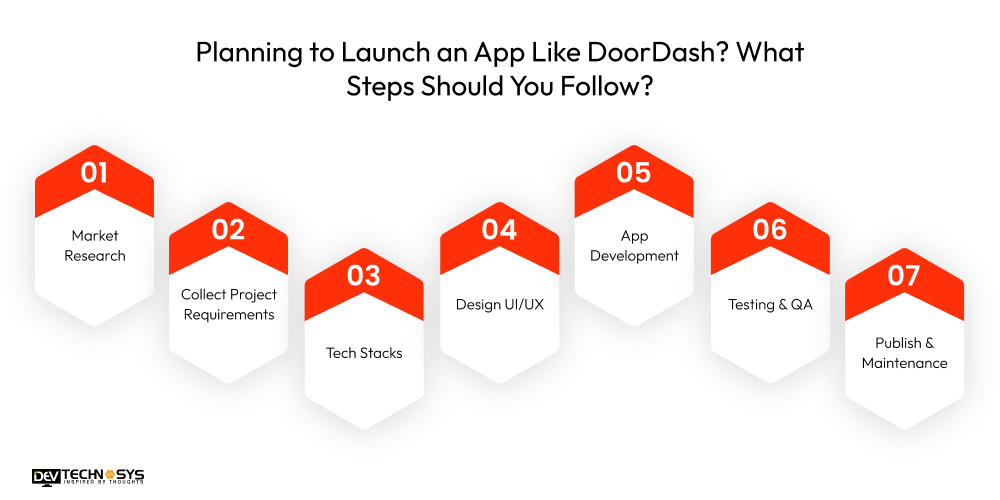
1. Market Research
Conducting market research will help you to identify who your target audience is, what the competition is like, what the trends are in the market, and what opportunities there may be. Additionally, you should look into what users want, which features they want and like, how much they’re willing to pay for those features, and where these users are geographically.
2. Collect Project Requirements
You should work with your project’s stakeholders, potential users, and development team to gather all of your project’s requirements. Hire one of the best food delivery app development companies that include functional requirements, user roles, business requirements, and technical specifications for the app. Once you have clearly organized your requirements, you will minimize scope creep, and you will have a good roadmap for your app.
3. Tech Stacks
There are numerous options available for developing the front-end, back-end, database, API, and third-party integrations of your app. You must select the best technology for each of these functions based on your future scalability needs, performance needs, compatibility with various platforms, development costs, and your development timeline. The technology stack will greatly determine how quickly, reliably, and easily maintaining your app.
4. Design UI/UX
Design visually appealing and easy-to-use interfaces to enhance user experience. Hire an iOS app development company to focus on providing easy navigation, clear workflows, and visual consistency with the brand. Wireframe prototype, receive user feedback, and refine until the design is user-friendly. A well-executed UI/UX can increase user engagement, minimize user drop-off, and increase frequency of use.
5. App Development
Translate design and functional requirements into a working functional application via front-end and back-end development. This includes developing the core functionality of the application, which includes registering users, browsing menus, managing orders, processing payments, and real-time tracking of orders. Build the application with proper data encryption (SSL/TLS) and security methods and ensure that it performs well.
6. Testing & QA
In the second last stage, to build an app like DoorDash, test for bugs, performance issues, and usability issues in the application. Experts who build gig economy delivery platform will conduct unit tests, integration tests, and user acceptance tests to ensure that all application functionality works as expected and is the same across all platforms and devices. Ongoing testing and quality assurance will provide a reliable application with smooth navigation and security to gain user confidence.
7. Publish & Maintenance
Launch your application on both iOS and Android through their respective app stores, following each platform’s submission requirements. Continuously monitor user comments, address any issues, and make updates frequently. Keep an eye on the backend of your application and provide food delivery app maintenance services for any feature enhancements or software patches that may become necessary due to user feedback.
Industry Insights:
According to The Times of India, a deal for DoorDash to purchase SevenRooms for $1.2 billion has been revealed. A leader in hospitality technology worldwide, SevenRooms is a software firm with its headquarters in New York City.
What Features Must Be Integrated in the Panels of a Food Delivery App?
Essential features for each panel of a food delivery app. Must-have functionalities for users, delivery partners, and admins to ensure smooth ordering, tracking, payments, and efficient restaurant management.
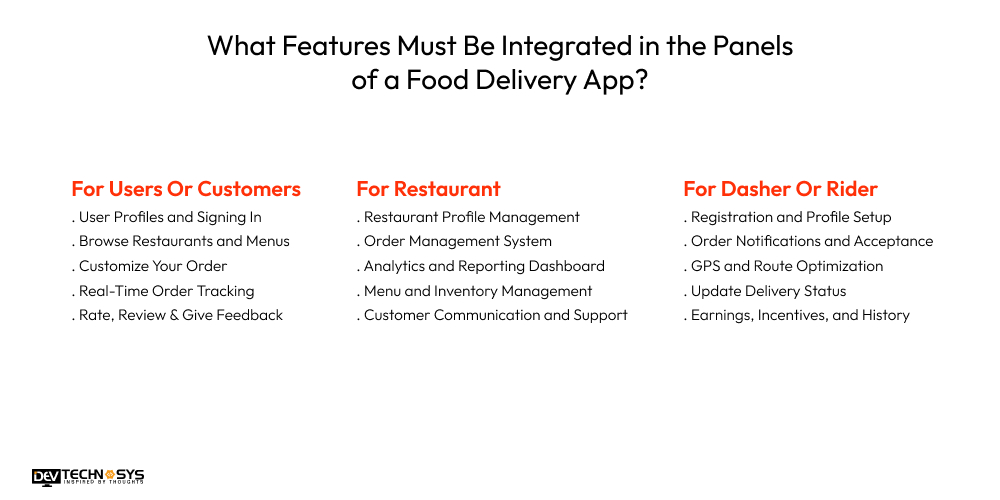
For Users or Customers:
1. User Profiles and Signing In
Create a secure way for users to sign up, update their personal info, add delivery addresses and payment types, and select their account preferences in the app
2. Browse Restaurants and Menus
Find nearby restaurants, see their menu items, menu prices, types of cuisine, menu ratings, and be able to filter restaurant results
3. Customize Your Order
Choose menu items, customize menu item ingredients, add any special notes or instructions to your order, view your cart, and check out using secure payment methods
4. Real-Time Order Tracking
View your restaurant’s preparation time, when your Dasher picks up, where your Dasher is, live tracking, and estimated delivery time.
5. Rate, Review & Give Feedback
Rate the restaurant and the delivery you received at that restaurant, and give additional details about your experience with that restaurant and how to improve the restaurant or delivery service.
For Restaurant:
1. Restaurant Profile Management
Efficiently manage the restaurant profile, including updates to contact details, real-time tracking (GPS + WebSockets), menu items, prices, photos, hours of operation, and promotions.
2. Order Management System
DoorDash clone apps manage order processing by receiving, confirming, preparing, and following up on all order-related activity.
3. Admin Panel with Analytics Dashboard
If restaurant owners build a food ordering app, they use analytical tools to analyze sales and revenue trends and monitor customer preferences in order to.
4. Menu and Inventory Management
Efficiently manage menu items with the option to add, modify, or delete any dish while also tracking stock and managing index based on actual use.
5. Customer Communication and Support
DoorDash alternatives provide customer support and manage customer reviews/ratings to increase customer engagement.
For Dasher or Rider:
1. Registration and Profile Setup
Sign up, verify identity, upload documents, manage profile, and monitor personal performance metrics.
2. Order Notifications and Acceptance
Thanks to its robust ETA prediction engine, it receive local delivery requests, check the order details, accept/decline based on availability and preferences.

3. GPS and Route Optimization
DoorDash alternatives offer GPS system with real-time directions, shortest routes, and traffic-aware directions to accommodate faster and more efficient deliveries.
4. Update Delivery Status
Update order status from picked up to in-transit to delivered so customers can track their orders in real time.
5. Earnings, Incentives, and History
DoorDash clone apps allow riders to view daily/weekly/monthly earnings, bonuses, and total pay history to motivate them.
Real Case Study: WannaEat
A few times ago, we developed a food delivery app, WannaEat, for a UAE-based client, whose name is Ahmed. He wanted to build a food delivery application to run in the US market. We gather all project requirements from the client and evaluate the cost, and the estimated cost is $18,000. But in the middle of the project, the client wants to integrate some advanced features like personalized recommendations, chatbots, and more. So the estimated development cost is influenced.
Client Name: Ahmed
Timeline: 24 Weeks
Development Team Size: 12
Outcome: Premium AI-driven Food Delivery Platform
– Mohit Nag CTO
Which are the Best Food Delivery Apps Like DoorDash?
There are many of the best food delivery apps, such as Swiggy, Zomato, UberEats, Deliveroo, and many more. Do you still think that DoorDash is the only solution for food delivery? No, there are many DoorDash alternatives that are popular in the market.
| App | Estimated Downloads | Avg Rating | Year Launched | Platforms | Headquarters |
| Uber Eats | 100M+ | 4.8/5 | 2014 | iOS, Android, Web | San Francisco, USA |
| Zomato | 100M+ | 4.7/5 | 2008 | iOS, Android, Web | Gurugram, India |
| Grubhub | 10M+ | 4.6/5 | 2004 | iOS, Android, Web | Chicago, USA |
| Swiggy | 100M+ | 4.8/5 | 2014 | iOS, Android, Web | Bengaluru, India |
| FoodPanda | 100M+ | 4.5/5 | 2012 | iOS, Android, Web | Berlin, Germany |
| Deliveroo | 10M+ | 4.7/5 | 2013 | iOS, Android, Web | London, UK |
| Glovo | 50M+ | 4.3/5 | 2015 | iOS, Android, Web | Barcelona, Spain |
| Bolt Food | 10M+ | 4.4/5 | 2019 | iOS, Android | Tallinn, Estonia |
| ChowNow | 1M+ | 4.2/5 | 2012 | iOS, Android, Web | Los Angeles, USA |
| Takeaway.com | 5M+ | 4.5/5 | 2000 | iOS, Android, Web | Amsterdam, Netherlands |
1. Uber Eats
Uber Eats is a top international food delivery service that connects customers with nearby local restaurants. This online food ordering app allow customers can browse restaurant menus, use the Uber Eats app/website to place food orders, use the app/website to track how their order is being delivered, and make a secure digital payment.
2. Zomato
Zomato is an Indian-based online food ordering and restaurant discovery service. An app like Zomato allows users to search for restaurants via the internet, browse restaurant menus, read restaurant reviews, view restaurant ratings, and take advantage of restaurant promotions. for hyperlocal delivery app development like Zomato, consult with a reputable company.
3. Grubhub
Grubhub is one of America’s leading online food ordering and delivery service companies serving consumers. Consumers can search for local restaurants and place customized orders with Grubhub and track their food deliveries via mobile app or website. Grubhub’s primary operating area is the United States, and it offers secure payment methods.
4. Swiggy
Swiggy is one of India’s largest food ordering and delivery services that connects customers with restaurants and grocery stores. An app like Swiggy provides real-time order tracking on its mobile app, fast delivery to customers, multiple payment options, various promotions, and customer support. if you are business wanting to develop a restaurant aggregator platform like swiggy, then contact an experienced devlopment provider.
5. FoodPanda
FoodPanda is an international online service that delivers food and groceries. this food delivery logistics platform let users can search for restaurants, order food, check the status of their order, and pay for the food securely online. The company operates worldwide and has its headquarters in Berlin, Germany, focusing on convenience and customer satisfaction.
Security & Compliance Framework in Food Delivery Apps
Popular food delivery platforms such as DoorDash utilize a variety of security and compliance methods, including encryption of sensitive information, secure methods of payment, and compliance with relevant regulations. Driver identification, fraud prevention, and protection of user privacy and location data to establish trust, safety, and validation, and comply with applicable laws.
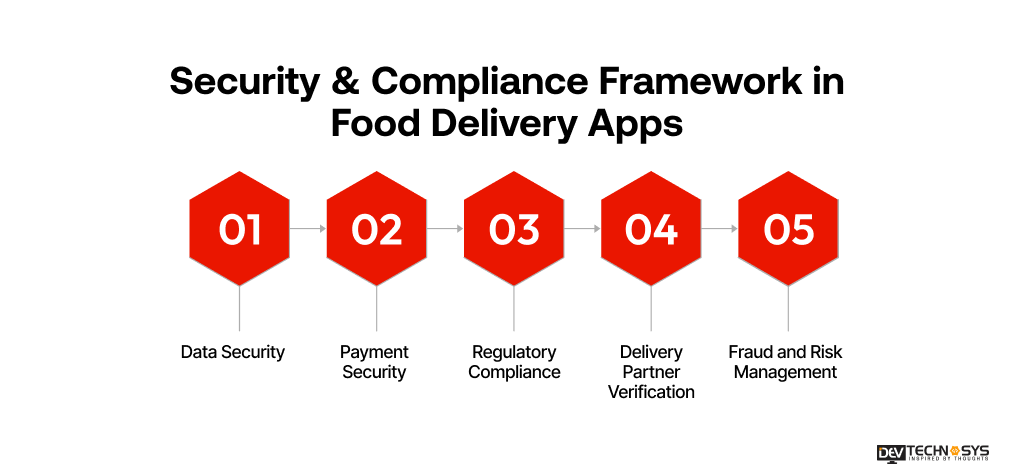
1. Data Security
Food delivery services like DoorDash incorporate encryption techniques, secure cloud computing environments, and access control technologies to provide protection of consumers’ sensitive data and activity records, as well as to help protect consumers from breaches of security and restore service reliability to clients at scale.
2. Payment Security
Food delivery service providers also employ PCI-DSS compliant payment gateways, utilize tokenized payments, and deploy fraud prevention mechanisms to help secure transactions processed by their platforms. These measures reduce the potential for chargebacks, fraudulent transactions, and unauthorized transactions through cards, wallets, and other online payment methods.
3. Regulatory Compliance
Food delivery service providers implement various compliance practices related to GDPR, CCPA, and various local and federal taxation laws. They maintain records that provide transparency into the financial transactions they conduct, adhere to the applicable laws for food safety, and also comply with the various laws and regulations in all the countries where they are present and operate.
4. Delivery Partner Verification
Before becoming a delivery partner with a food delivery service provider, gig workers must go through an identity verification process, a background check, and an onboarding validation process. Ongoing monitoring will be conducted to ensure that all delivery partners are safe and trusted and that they can be held accountable to both the restaurant partners and consumers utilizing the food delivery service provider.
5. Fraud and Risk Management
AI technologies are utilized by food delivery service providers to identify fraud, fake accounts, and suspicious orders. Real-time monitoring helps to prevent the platform from being abused, maintain the integrity of revenues generated through delivery services, and ensure that consumers are not putting themselves at risk when completing millions of deliveries each day.
What is the Cost to Build an App Like DoorDash?
The cost to develop a basic or MVP-based food delivery app like DoorDash lies between $30,000 and $150,000. The mid complex food delivery app development cost is around $50,000 to $90,000. Build an AI-powered or highly complex food delivery app, and it can go higher to $150,000 or more.
The cost can be influenced by various factors such as features, functions, project size, backend infrastructure, deployment platforms, on-demand delivery app development team, and more.
Complexity Level |
Key Features |
Estimated Cost (USD) |
| Basic MVP | User login, restaurant list, cart, basic checkout | $30,000 – $50,000 |
| Standard App | Customer app + delivery app + vendor panel, payments, order tracking (basic) | $50,000 – $90,000 |
| Advanced App | Real-time tracking, notifications, ratings, promo codes, and analytics dashboard | $90,000 – $130,000 |
| DoorDash-Level Clone | Real-time GPS tracking, route optimization, surge pricing, high-load backend, AI dispatch | $130,000 – $150,000+ |
What Types of Factors Can Impact the Food Delivery App Development Cost?
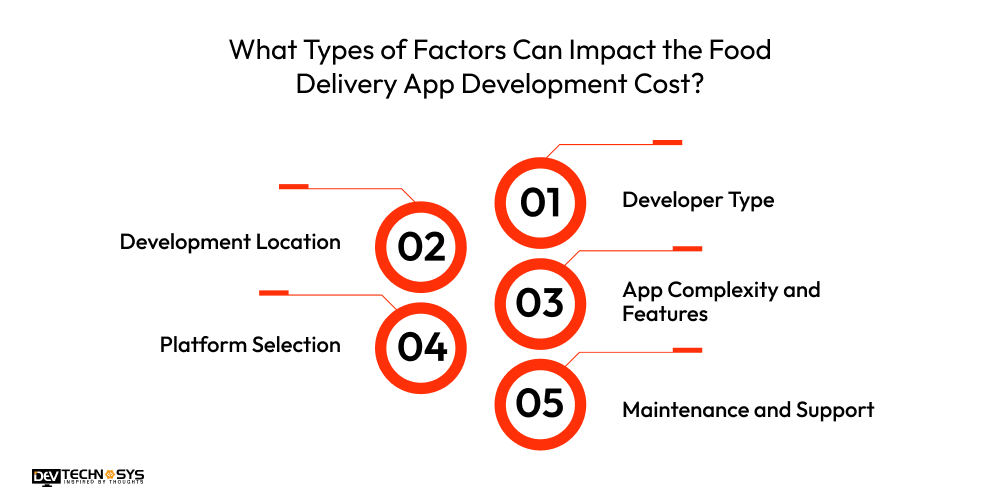
Do you want to build an app like DoorDash within a fixed budget? Before that, you need to know about the crucial factors that can impact the total multi-vendor food delivery app development cost. It includes third-party integrations, tech stacks, design UI/UX, development team, and more.
1. Developer Type
The type of developer you use to build your application. Freelancers tend to charge less than other types. However, they usually require more oversight from you. In-house development teams provide you with added control over your development project, but come at a higher DoorDash app development cost. Established development agencies tend to be more expensive than both groups mentioned earlier. But provide defined processes to follow through all phases of DoorDash alternative app development.
Developer Type |
Cost Impact Level |
Impacted Cost Range |
| Freelancers | Lower cost, flexible but limited coordination | $10,000 – $15,000 |
| In-house team | Higher cost due to salaries, tools, and overhead | $25,000 – $40,000 |
| Development agency | Balanced pricing with structured delivery | $34,000 – $50,000 |
2. Development Location
The cost to develop a mobile app like DoorDash in Los Angeles will also vary according to the geographic location of your development team. Development teams located in North America and Western Europe tend to charge more than those located in Asia or Eastern Europe. Price differences may also reflect differences in skill level, proficiency in communication, time zone alignment, and other aspects.
Location |
Cost Impact Level |
Impacted Cost Range |
| India / South Asia | Most cost-efficient development region | $12,000 – $22,000 |
| Eastern Europe | Mid-range pricing with skilled developers | $25,000 – $35,000 |
| USA / Western Europe | The highest development cost region | $35,000 – $45,000 |
3. App Complexity and Features
The development of an application is based on how complex the application is, as well as what kind of features you want to be included in it. For instance, a simpler app with basic functionality will cost less than one with a more advanced/complex feature set, such as real-time order tracking and contactless delivery app features. Also, many optional levels of custom user interface and design, as well as scalability, will increase your total cost to build a food delivery app like Doordash.
Complexity Level |
Cost Impact Level |
Impacted Cost Range |
| Basic App (ordering, user login, menu display) | Low complexity | $8,000 – $15,000 |
| Medium App (payments, tracking, notifications) | Moderate complexity | $20,000 – $30,000 |
| Advanced App (AI features, analytics, real-time tracking, multi-role system) | High complexity | $30,000 – $40,000 |
4. Platform Selection
Developing for only one platform generally leads to lower costs than developing on both iOS and Android. An intermediate app is going to require code for each platform differently, which increases development time and ultimately, development costs. Using cross-platform frameworks can also bring down the cost of using both iOS and Android platforms, and will likely have an effect on the overall cost to create a mobile app.
Platform Type |
Cost Impact Level |
Impacted Cost Range |
| Single platform (Android or iOS only) | Lowest cost option | $15,000 – $23,000 |
| Cross-platform (Flutter / React Native) | Cost-effective for multi-device support | $24,000 – $35,000 |
| Native apps (separate Android + iOS development) | The highest cost is due to dual development | $30,000 – $45,000 |
5. Maintenance and Support
App development is not just about the initial cost of building, but also has a great deal of costs once it is released. This will include ongoing maintenance and fixes for bugs; regular feature upgrades; continuing server costs for hosting, e.g., running and upgrading. And all the required server security upgrades to keep app data secure. Therefore, app development support is a critical factor of an app’s overall cost in the long term.
Support Type |
Cost Impact Level |
Impacted Cost Range |
| Basic maintenance (bug fixes only) | Minimal ongoing cost | $3,000 – $4,000 |
| Standard support (updates, monitoring, minor improvements) | Moderate ongoing cost | $4,000 – $4,500 |
| Full support (24/7 monitoring, scaling, feature upgrades) | High ongoing investment | $4,500 – $5,000 |
Industry Insights:
According to Grab On, independent statistics estimate DoorDash controls 67 % of the U.S. food delivery market, underlining its dominant role in local demand fulfillment.
Tech Stacks are Required to Build an App Like DoorDash
If you plan to make a new DoorDash-like application, you should use a current technical stack. You will need to have mobile frameworks using the React Native or Flutter framework. Also, you will want to use a backend using either Node.js or Python.
Other technology you’ll want to use would include systems for storing information (such as Postgres databases), real-time services, a cloud provider (like AWS), a way to process secure payments, and APIs for maps, authentication, and notifications.
Layer |
Technology |
Purpose |
| Frontend (Mobile App) | React Native / Flutter | Build customer, restaurant, and delivery apps |
| Backend | Node.js / Python / Java | Handle orders, users, and business logic |
| Database | MySQL / PostgreSQL | Store users, orders, and restaurant data |
| Real-Time Updates | Socket.io / Firebase | Live order tracking and notifications |
| Maps & Location | Google Maps API | Navigation and delivery tracking |
| Payments | Stripe / Razorpay | Secure online payment processing |
| Hosting | AWS / Google Cloud | Deploy and scale the application |
| Authentication | JWT / OAuth |
Secure login and user access control |

How to Create Money From Food Delivery Apps Like DoorDash in New York City?
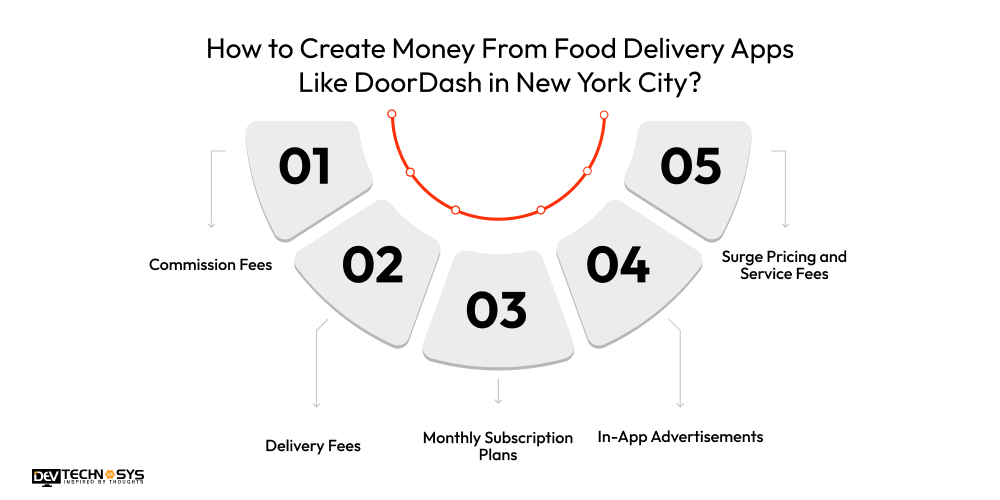
DoorDash and other food delivery services make money in a variety of different ways, including a restaurant commission, delivery fees, subscription options, in-app ads, and surge pricing. As such, these services have multiple revenue streams. Which help create positive cash flow as well as gives consumers an easy way to order from restaurants online.
1. Commission Fees
Food ordering platforms make a profit by taking a commission from each restaurant for every order placed. The app will take a percentage of the bill when a customer places an order through the app. The app receives a commission for every order that is placed through their app, which helps the app’s revenue grow at the same time as the volume of orders grows every day.
2. Delivery Fees
Delivery hybrid app development solutions collect the delivery fee from customers when they deliver food to the customer’s home. The delivery fee may vary depending on how far a customer lives or during peak hours. However, during times of high demand, delivery apps charge higher delivery fees to be able to offer customers convenience and quick service.
3. Monthly Subscription Plans
Some digital food delivery solutions offer monthly or annual subscription plans, where the customer pays a flat fee to receive free delivery or other discounts. This type of subscription service provides the app with recurring revenue and encourages customers to place more orders through that app.
4. In-App Advertisements
Food delivery apps allow restaurants to promote their restaurant in the app by paying for the opportunity. Restaurants have the ability to use sponsored placements and advertisements to attract new customers. According to the mobile app development services provider, a on-demand meal app earns advertisement revenue from the restaurant as a result of the app advertising.
5. Surge Pricing and Service Fees
Price increases based on time and demand via delivery apps. While they pass along additional costs based on the order placed being delivered during peak hours, and additional delivery costs. Due to surge pricing & delivery fees, will increase how much companies can make each month will increase when demand increases.
5 Tips to Build a Food Delivery App Better Than DoorDash
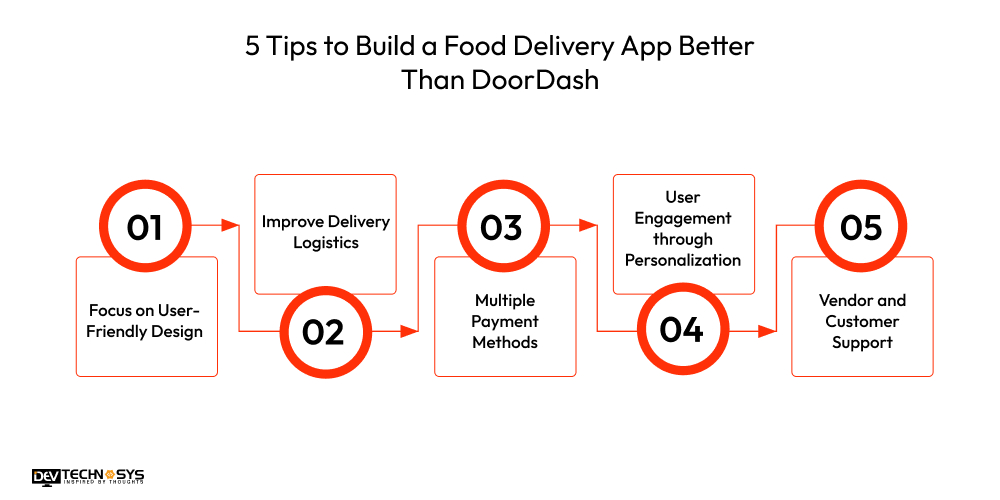
Are you ready to entering in food delivery industry with a new solution? But are you sure that it can gain higher success as compared to others? If not, then observe the following tips that enable businesses to build a better or advanced dining delivery services than DoorDash:
1. Focus on User-Friendly Design
An intuitive, mobile design should provide simple navigation and clear menu options that lead to a quick checkout process. You may consider offering personalized features, such as your users’ order history and favourite items, to make them feel special and encouraged.
2. Improve Delivery Logistics
Implement and utilize real-time tracking, smart route optimization, and predictive analytics in order to cut down delays between the time of dispatch and delivery. Coordinate your delivery drivers in a more efficient manner by providing accurate delivery ETAs.
3. Multiple Payment Methods
Providing secure payment options for your users, including credit/debit cards, mobile payments, and in-app payments, will add an additional layer of convenience for your users. Additional features such as promo codes, one-click payment options, and splitting bills.
4. User Engagement through Personalization
Utilizing AI for customised recommendations for food ordered based on past selections, personal preferences, and geographical location will allow your app to stand out. Utilizing push notification system (FCM/APNs) for loyalty rewards, gamified experiences, and promotional offers will keep consumers engaged.
5. Vendor and Customer Support
Offer reliable in-app messaging or chat capabilities for each of your users, and assist with managing vendor orders. Providing timely and reliable assistance builds trust in your delivery service and maintains customer satisfaction, as well as increases your customer loyalty.
Final Words!
To develop an app like DoorDash, you must build a solid foundation based on thorough planning, user-focused design, dependable backend systems, and seamless coordination.
Utilizing a professional food delivery app development company focused on designing an optimum food delivery application using the latest technology will help you ensure a customized application.
By properly executing your marketing strategy, designing a user-friendly application user interface, and ensuring reliability in all aspects of your platform.