



















Quick Summary:
The logistics app development cost ranges from $8,000 to $25,000+, depending on the overall scope and technical requirements. A basic MVP logistics app typically costs between $8,000 and $15,000, while a moderately advanced solution falls between $15,000 and $25,000. A fully customized, feature-rich logistics platform may cost $25,000 or more.
Cost Impacted by Project or Development Complexity:
-
- Basic/MVP Applications ($8,000 – $15,000): Cover core features such as account creation (admin, driver, customer), and shipment request management.
- Moderate-Level Applications ($15,000 – $20,000): Include capabilities like automated dispatching, real-time vehicle monitoring, and in-app notifications.
- Advanced/Enterprise Solutions ($25,000+): Offer intelligent route planning, centralized fleet control, warehouse synchronization, and performance analytics dashboards.
Cost Based on Logistics App Types:
-
- Last-Mile Delivery App: $10,000 to $18,000
- Fleet Tracking & Management App: $13,000 to $22,000
- Enterprise Supply Chain App: $15,000 to $24,000
- Inventory & Warehouse Control App: $14,000 to $23,000
- Multi-Vendor Delivery Marketplace App: $8,000 to $17,000
Cost Based on the Different Regions/Countries:
-
- Logistics app development cost in USA is approximately $11,000 to $30,000, depending on customization and technical complexity.
- Logistics app development cost in Australia typically ranges from $10,000 to $26,000, based on feature integration and infrastructure needs.
- Logistics app development cost in Canada generally falls between $9,500 and $25,000, influenced by development expertise and system requirements.
Additional Cost:
-
- Ongoing Maintenance: Annual maintenance expenses are usually 10% to 20% of the total development investment, covering updates and optimization.
- Data Security & Compliance: Implementing secure APIs, encrypted databases, regulatory compliance standards, and operational audits.
Over the years, logistics apps have become invaluable, providing vital infrastructure for the entire delivery and transportation industry. They allow employees to quickly and efficiently complete their tasks while increasing accuracy and dependability in almost every aspect of their function.
They are being used to manage and track shipments while also controlling drivers and entire warehouses. The most commonly asked question by every business owner is, what is the cost of developing a logistics app? The final cost of developing a logistics app is determined by multiple aspects. The app’s design and required features are a starting point.
How many features does the app have?
How complex are the features?
Is there a need for the app to have multiple payment gateways?
If the app requires sophisticated features such as Artificial Intelligence (AI) assisted tools, and other elements. Like Global Positioning Satellite (GPS) tracking, live updates, and secure payment systems, the cost will be higher.
Cost can also vary based on who you choose to design and develop the app, as well as the app’s operating system.
Let’s explore the blog to know the actual logistics app development cost in 2026 and other important factors.
What is the Average Cost to Develop a Logistics App in 2026?
The average cost to build an MVP logistics app is around $8,000 to $15,000 or based on the project requirements and needs. For a fully featured or AI-powered logistics app, it costs around $25,000 or higher.
The overall logistics management software development cost can be influenced by various key factors such as project complexity, features, size, tech stacks, backend infrastructure, and more. The timeline of logistics app development takes around 3 to 6 months, depending on the app’s demand, the number of features integrated, and more.
Component |
Cost Range (USD) |
Notes |
| UI/UX Design | $800 – $2,500 | Wireframes, prototypes, branding, user flows |
| User App Development | $2,400 – $7,500 | Core features like sign-in, tracking, and orders |
| Driver/Partner App | $1,600 – $5,000 | Delivery tasks, maps, statuses, notifications |
| Admin Panel & Backend | $1,600 – $5,000 | Dashboard, analytics, role permissions |
| APIs & Integrations | $400 – $1,500 | Maps, payments, SMS/Email, tracking |
| QA & Testing | $800 – $2,500 | Bug fixes, performance, multi-device tests |
| Deployment & Launch | $400 – $1,000 | App Store/Play Store submission |
| Miscellaneous | $400 – $1,000 | Project management, documentation |
Logistics App Development Costs in 2026: What Really Impacts the Cost?
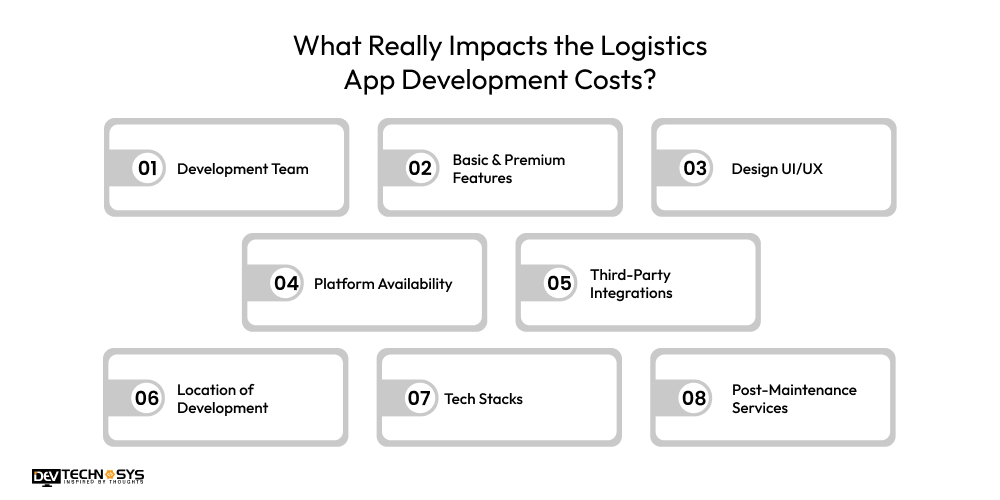
To get the actual cost, one must know about the key factors that affect or influence the total development cost. It involves various factors such as development team, tech stacks, third-party integration, location, and many more. Observe each factor one by one:
1. Development Team
The cost to create a logistics app can be affected by the development team, which involves expertise, experience level, hiring model, and more. Businesses can hire developers as an in-house team, a freelancer, and development agency.
This can impact the cost because every hiring model costs must be different. Hire mobile app developers as per their project budget and requirements.
Team Model |
Description |
Cost Impact (USD) |
| Freelancer | Independent developers for specific tasks | $3,000 – $5,000 |
| In-House Team | Dedicated internal developers and managers | $5,000 – $9,000 |
| Development Agency | Full-cycle team with PM, QA, and support | $10,000 – $14,000 |
2. Basic & Premium Features
The basic and premium features of the transport management system must be integrated, but some of the features are expensive. It involves various types of features such as real-time GPS tracking, AI-based route optimization, analytics, push notifications, and many more. These functionalities have the ability to increase the overall cost to build a logistics management software, as well as the time.
Feature Level |
Description |
Cost Impact (USD) |
| Basic Features | Login, order management, notifications | $1,000 – $2,000 |
| Advanced Features | Live tracking, dashboards, reporting | $2,000 – $4,000 |
| Premium Features | AI routing, automation, forecasting | $4,000 – $5,000 |
3. Design UI/UX
Design a user interface of an app; it can be another cost-affecting factor. There are various UI elements that exist that can affect the cost, such as layouts, templates, themes, forms, fonts, textures, and more.
The simple layouts and themes look cheaper, designing a customized and animated UI looks unique, but it takes more hours and costs. Also includes designing tools that are expensive to use, such as Figma, Sketch, Adobe XD, Marvel, and more.
Design Type |
Description |
Cost Impact (USD) |
| Basic UI | Ready-made templates and standard layouts | $800 – $2,000 |
| Custom UI | Brand-focused design and user flows | $2,000 – $4,000 |
| Advanced UX | Animations, maps, and role-based dashboards | $4,000 – $7,000 |
4. Platform Availability
There are various types of platforms available to build a logistics app, such as Android, iOS, Web, and cross-platform. Building separate apps for drivers, warehouse staff, and customers are most expensive than the cross-platform framework.
They also require multiple maintenance, testing, optimizing performance, and solving bugs. It can increase the overall cost to build a pickup and delivery app like Fetchr.
Platform Scope |
Description |
Cost Impact (USD) |
| Single Platform | Android, iOS, or Web | $2,000 – $5,000 |
| Cross-Platform | Shared codebase for mobile platforms | $4,000 – $8,000 |
| Multi-Platform | Separate apps for users, drivers, and admins | $6,000 – $10,000 |
5. Third-Party Integrations
Third-party tools and applications are integrated to enhance the users’ accessibility and access to the functionality and services. It involves different types of integrations such as social media platforms, communication tools, analytics, CRM, ERP, payment gateways, reporting, and many more. These have higher annual licensing fees, and developers consume more time to implement. This directly affects the cost to make a logistics app.
Integration Level |
Description |
Cost Impact (USD) |
| Basic Integrations | Maps, SMS, email APIs | $500 – $800 |
| Business Integrations | Payment, CRM, ERP systems | $1,000 – $1,500 |
| Advanced Integrations | IoT, AI APIs, real-time data sync | $1,500 – $2,000 |
6. Location of Development
The transportation management app development cost can be influenced by the geographical location of the development team. Hiring developers from North America or Western Europe can charge higher.
Hiring developers from the Asia-Pacific region, it can be more cost-effective than other locations. It involves various other factors such as communication, legal compliance, time zones, and quality standard affect the cost to create a logistics app like Porter.
Location of Development |
Average Hourly Cost (USD / GBP) |
| United States | $40 – $80 |
| United Kingdom | £35 – £65 |
| Southeast Asia | $20 – $40 |
| Eastern Europe | $25 – $50 |
7. Tech Stacks
The choice of technology stack affects both development speed and cost. Modern stacks using AI, blockchain, cloud computing, and IoT increase initial costs but enhance scalability and security.
Open-source tools reduce licensing fees, while proprietary technologies raise expenses. In 2026, future-ready tech stacks are crucial for competitive shipping management apps.
Tech Stack Type |
Description |
Cost Impact (USD) |
| Standard Stack | Open-source frameworks and databases | $1,500 – $2,000 |
| Modern Stack | Cloud-based, scalable architecture | $2,000 – $3,000 |
| Advanced Stack | AI, blockchain, IoT technologies | $3,000 – $4,000 |
8. Post-Maintenance Services
Conducting post-launch maintenance services after the product launch on the live phase. It requires time-to-time maintenance to keep the app up-to-date and optimize performance.
There are various services include such as solving security patches, regular updates, fixing bugs or glitches, and many more. Many of the services are highly expensive, which can impact the cost to develop a mobile app.
Maintenance Level |
Description |
Cost Impact (USD) |
| Basic Maintenance | Bug fixes and minor updates | $500 – $1,000 |
| Ongoing Support | Performance tuning and updates | $1,000 – $1,300 |
| Long-Term Support | Security, scaling, compliance | $1,300 – $1,800 |
Want a chatbot demo or pricing? Fill the form and talk to our experts today.
Pick what you need below — you can select more than one — then tap Get detail to continue.
-
Chatbot demo dashboard
-
Cost to develop an app
-
Industry report
-
Case study
How Much Do Different Types of Logistics Applications Cost in 2026?
There are different types of logistics applications available in the market, such as cargo tracking apps, transportation management systems, and more. But what is the cost of each type?
The cost must be different for each type because of the distinct functionalities and services offered. Consider the cost in detail to get an idea of which type of application you must build:
1. Fleet Management App
The cost to develop a fleet management app is around $8,000 to $20,000, or based on the unique functionality and services. It involves various features such as vehicle tracking, driver behaviour, fuel consumption, GPS tracking, and predictive maintenance. Integrating premium features can raise the total cost.
Complexity Level |
Description |
Cost (USD) |
| Basic | GPS tracking, driver info | $8,000 – $12,000 |
| Medium | Add maintenance, fuel monitoring | $12,000 – $16,000 |
| Advanced | AI routing, telematics, analytics | $16,000 – $20,000 |
2. Warehouse Management System
WMS apps track inventory, storage, and picking/packing operations. Costs in 2026 range from $12,000 to $22,000, influenced by barcode scanning, real-time stock updates, and reporting dashboards.
Advanced features like AI-driven space optimization and automated inventory forecasting increase development complexity. And it can also raise the overall packers and movers app development cost.
Complexity Level |
Description |
Cost (USD) |
| Basic | Stock tracking, basic reporting | $12,000 – $14,000 |
| Medium | Barcode/RFID, automated picking | $14,000 – $18,000 |
| Advanced | AI optimization, multi-warehouse analytics | $18,000 – $22,000 |
3. Order Management System
The order management system applications streamline operations such as tracking, order processing, automation, order handling, and real-time updates.
The cost to develop an order management system starts from $10,000 to $24,000, depending on the specific functionalities. There are various integrations available, such as payment gateways, which can fluctuate the logistics software development services cost.
Complexity Level |
Description |
Cost (USD) |
| Basic | Single-channel orders, simple tracking | $10,000 – $14,000 |
| Medium | Multi-channel orders, inventory integration | $14,000 – $20,000 |
| Advanced | Automation, predictive analytics | $20,000 – $24,000 |
4. Inventory Management App
Inventory management applications help businesses to track stock levels, replenishment, alert messages, and more. The inventory management app development cost lies between $8,000 and $15,000 or higher. The AI-powered inventory management app can incur a higher cost because of advanced features such as forecasting and analytics.
Complexity Level |
Description |
Cost (USD) |
| Basic | Stock updates, alerts | $8,000 – $10,000 |
| Medium | Multi-warehouse, reporting | $10,000 – $12,000 |
| Advanced | AI demand forecasting, analytics | $12,000 – $15,000 |
5. Transportation Management System
The Transportation Management System(TMS) enables users or businesses to manage freight, carrier selection, routes, and more. The cost of development depends on the features like shipment tracking, route optimization, analytics, and real-time status updates. Its cost starts from $11,000 to $25,000, and the AI-powered TMS goes up to a higher price.
Complexity Level |
Description |
Cost (USD) |
| Basic | Route planning, shipment tracking | $11,000 – $14,000 |
| Medium | Carrier management, cost optimization | $14,000 – $18,000 |
| Advanced | AI routing, real-time analytics | $18,000 – $25,000 |
6. Last-Mile Delivery App
The last-mile delivery application mainly focused on the final delivery, route optimization, and proof of delivery. Need to integrate advanced functionalities to build an accurate and reliable application, such as digital signatures, live tracking, and GPS navigation. The last-mile logistics mobile app development cost is around $8,000 to $18,000 or higher.
Complexity Level |
Description |
Cost (USD) |
| Basic | GPS navigation, delivery updates | $8,000 – $12,000 |
| Medium | Proof of delivery, notifications | $12,000 – $16,000 |
| Advanced | AI route optimization, multi-role dashboards | $16,000 – $18,000 |
7. Freight Booking & Marketplace App
The freight booking and marketplace app connects shippers to carriers for the transportation of shipments. It involves various types of advanced features such as instant booking, payment integrations, carrier verification, real-time tracking, bidding, and more complex features. The freight booking app development cost is around $15,000 to $25,000; it can go higher when build AI-powered app.
Complexity Level |
Description |
Cost (USD) |
| Basic | Shipper-carrier connection, basic booking | $15,000 – $18,000 |
| Medium | Online payments, rating system | $18,000 – $22,000 |
| Advanced | Dynamic pricing, real-time tracking, and analytics | $22,000 – $25,000 |

How Much Do Popular Logistics Apps Cost in 2026?
There are many popular logistics apps that have gained higher popularity over the years, and businesses can also make a similar app to achieve success. But before that, knowing the cost is important. This section will provide the cost of popular distribution management software with detailed information.
1. App Like Uber Freight
Uber Freight–style logistics apps involve complex freight marketplaces connecting shippers and carriers. Development cost is influenced by real-time load matching, dynamic pricing logic, carrier verification, secure payment flows, and scalable backend architecture.
Multi-role dashboards, API integrations, data analytics, and high availability requirements significantly increase overall development complexity in 2026.
Industry Insight: In Q3 2025, Uber Freight reported roughly $1.3 billion in revenue, which was relatively flat.
Features |
Estimated Development Time |
Estimated Feature Cost (USD) |
| User Registration & Profiles (Shippers & Carriers) | 60 – 90 hours | $1,200 – $2,500 |
| Freight Listing & Load Posting | 80 – 120 hours | $1,800 – $3,200 |
| Carrier Matching & Load Discovery | 90 – 140 hours | $2,000 – $4,000 |
| Real-Time Shipment Tracking | 100 – 160 hours | $2,500 – $4,500 |
| Pricing & Rate Management | 70 – 110 hours | $1,500 – $3,000 |
| In-App Communication & Notifications | 60 – 90 hours | $1,200 – $2,200 |
| Payment & Invoice Management | 80 – 120 hours | $1,800 – $3,500 |
| Overall Development Cost | 540 – 830 hours | $8,000 – $20,000 |
2. App Like Delhivery
Delhivery-like logistics apps focus on large-scale shipment management and last-mile delivery operations. Cost is driven by real-time tracking, automated sorting workflows, analytics dashboards, and integrations with warehouse and transportation systems. Support for high shipment volumes, regional logistics operations, and system reliability adds to development effort and overall complexity.
Industry Insight: According to pestle-analysis.com, 33% year growth in express parcel volume in late 2025.
Features |
Estimated Development Time |
Estimated Feature Cost (USD) |
| User Registration & Business Accounts | 60 – 90 hours | $1,200 – $2,400 |
| Shipment Booking & Label Generation | 80 – 120 hours | $1,800 – $3,200 |
| Real-Time Shipment Tracking | 100 – 150 hours | $2,400 – $4,200 |
| Warehouse & Hub Management | 90 – 140 hours | $2,000 – $3,800 |
| Last-Mile Delivery Management | 80 – 120 hours | $1,800 – $3,200 |
| Notifications & Status Updates | 50 – 80 hours | $1,000 – $1,800 |
| Analytics & Performance Reports | 70 – 110 hours | $1,500 – $2,800 |
| Overall Development Cost | 530 – 810 hours | $9,000 – $23,000 |
3. App Like FedEx Logistics App
Apps similar to FedEx emphasize shipment tracking, order management, and customer communication. Mobile app development cost depends on real-time tracking accuracy, notification systems, multi-platform availability, and enterprise-level security. Integration with global logistics networks, reporting tools, and scalable infrastructure further increases development complexity in 2026.
Industry Insight: In Q2 2026, FedEx reported a 7% year-over-year revenue increase, reaching $23.5 billion
Features |
Estimated Development Time |
Estimated Feature Cost (USD) |
| User Accounts & Profile Management | 60 – 90 hours | $1,200 – $2,300 |
| Shipment Creation & Management | 80 – 120 hours | $1,800 – $3,100 |
| Global Shipment Tracking | 100 – 160 hours | $2,500 – $4,500 |
| Delivery Scheduling & Alerts | 70 – 110 hours | $1,500 – $2,700 |
| Customer Notifications System | 60 – 90 hours | $1,200 – $2,000 |
| Support & Issue Management | 70 – 100 hours | $1,400 – $2,500 |
| Admin Dashboard & Reporting | 80 – 130 hours | $1,800 – $3,400 |
| Overall Development Cost | ~520 – 800 hours | $8,500 – $22,000 |
4. App Like Amazon Flex
Amazon Flex–style apps are built for on-demand delivery and driver management. Cost is influenced by route optimization, live GPS tracking, driver onboarding, scheduling algorithms, and real-time notifications. Multi-user functionality, performance monitoring, and scalability to handle peak delivery demand significantly increase development complexity.
Features |
Estimated Development Time |
Estimated Feature Cost (USD) |
| Driver Onboarding & Verification | 70 – 110 hours | $1,500 – $2,800 |
| Job Assignment & Scheduling | 90 – 140 hours | $2,000 – $3,800 |
| Route Navigation & GPS Tracking | 100 – 160 hours | $2,500 – $4,500 |
| Earnings & Payout Management | 70 – 110 hours | $1,500 – $2,800 |
| Delivery Status Updates | 60 – 90 hours | $1,200 – $2,000 |
| Performance Tracking | 70 – 110 hours | $1,400 – $2,600 |
| Admin Monitoring Dashboard | 80 – 130 hours | $1,800 – $3,400 |
| Overall Development Cost | 540 – 850 hours | $10,000 – $25,000 |
5. App Like Lalamove
Lalamove-like logistics apps focus on instant delivery and driver matching. Development cost is impacted by real-time booking, GPS navigation, dynamic pricing logic, in-app communication, and push notifications. Supporting multiple user roles, fast performance, and seamless user experience across platforms adds to development complexity in 2026.
Features |
Estimated Development Time |
Estimated Feature Cost (USD) |
| User & Driver Registration | 60 – 90 hours | $1,200 – $2,200 |
| Instant Delivery Booking | 80 – 120 hours | $1,800 – $3,200 |
| Real-Time Driver Matching | 90 – 140 hours | $2,000 – $3,800 |
| Live GPS Tracking | 90 – 140 hours | $2,200 – $4,000 |
| Fare Estimation & Payments | 70 – 110 hours | $1,500 – $2,800 |
| In-App Chat & Notifications | 60 – 90 hours | $1,200 – $2,000 |
| Ratings & Feedback System | 40 – 70 hours | $800 – $1,500 |
| Overall Development Cost | 490 – 760 hours | $8,000 – $20,000 |
You can reach out anytime; we are available 24/7. Our team provides a quick response.

How to Reduce the Logistics App Development Cost in 2026?
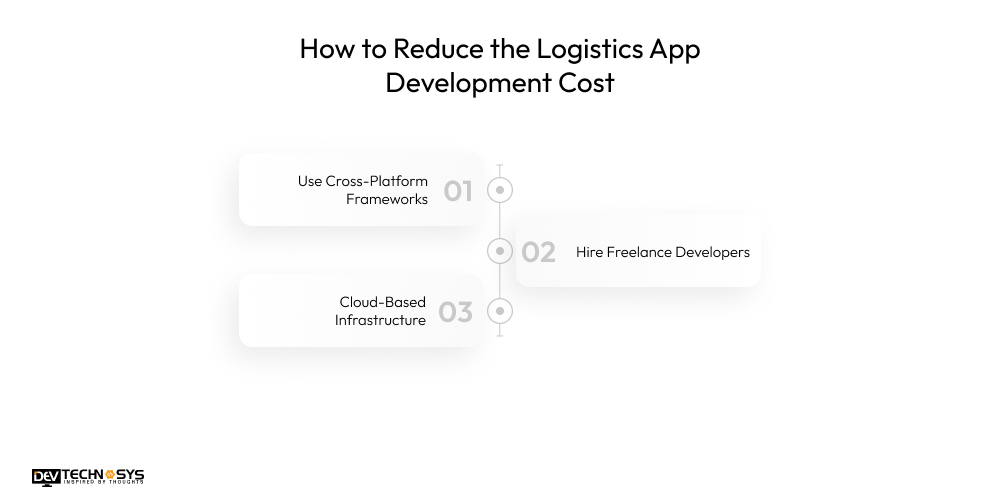
There are many ways available to reduce the logistics app development cost, such as clear project requirements. It also involves developing an MVP, outsourcing development, using open source frameworks, and many more. Reducing costs helps businesses to maintain their fixed project budget.
1. Use Cross-Platform Frameworks
Choose cross-platform development frameworks like Flutter or React Native. Building a single codebase for Android and iOS significantly lowers logistics mobile app development cost.
It speeds up time-to-market, simplifies maintenance, and reduces future upgrade expenses. Making it a cost-effective choice for logistics apps in 2026 while supporting scalability, performance, faster iterations, smaller teams, and leaner budgets.
2. Hire Freelance Developers
Outsource development to experienced logistics app development teams. Skilled partners already understand industry workflows, compliance needs, and integrations, reducing learning curves. Strategic outsourcing offers access to global talent, flexible pricing models, and faster delivery.
Helping businesses control budgets without compromising app quality in 2026. While scaling features, support, innovation, updates, maintenance, testing, security, stability, and long-term support.
3. Cloud-Based Infrastructure
Adopt cloud-based infrastructure instead of on-premise systems. Cloud services offer flexible pricing, scalability, and reduced hardware expenses. You pay only for resources you use, which helps control costs during development and growth. Cloud platforms also improve deployment speed, security updates, and long-term operational efficiency for logistics businesses.
Which Emerging Trends Will Impact Your Logistics Application Development Cost in 2026?
Emerging trends can influence the overall supply chain management app development cost because these technologies are highly expensive. Developers consume more time to implement these emerging trends, such as AI, IoT, cloud computing, and many more.
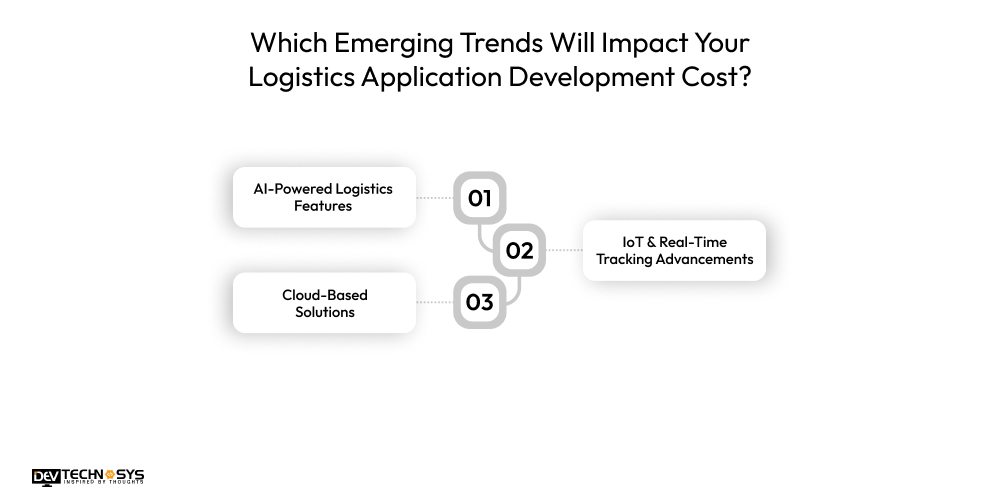
1. AI-Powered Logistics Features
The AI-powered logistics IT solutions features enhance the users’ experience, such as forecasting, analytics, predictive maintenance, route optimization, and more.
While adding upfront costs due to algorithm development and machine learning expertise, AI improves efficiency, reduces delays, and optimizes inventory. Cloud AI services may lower development effort but introduce recurring subscription fees.
2. IoT & Real-Time Tracking Advancements
IoT enables real-time fleet and asset tracking, smart warehouse monitoring, and connected devices for automated reporting. Integration increases complexity, requiring APIs, hardware, and a backend capable of handling continuous data. Security and compliance add extra costs, but IoT significantly improves operational visibility, efficiency, and customer satisfaction.
3. Cloud-Based Solutions
Cloud-based fleet management app development solutions offer scalable infrastructure, centralized data storage, and remote accessibility. Initial setup and migration can be costly, while ongoing pay-as-you-go models add operational expenses. Despite higher upfront costs, cloud architecture enables flexibility, reliability, and efficient handling of traffic spikes.
What are the Ways to Generate Revenue From Logistics Apps?
Generating revenue from any application is one of the most important aspects for businesses or entrepreneurs. There are various monetization techniques available, such as delivery fees, subscription plans, a freemium model, and advertising.
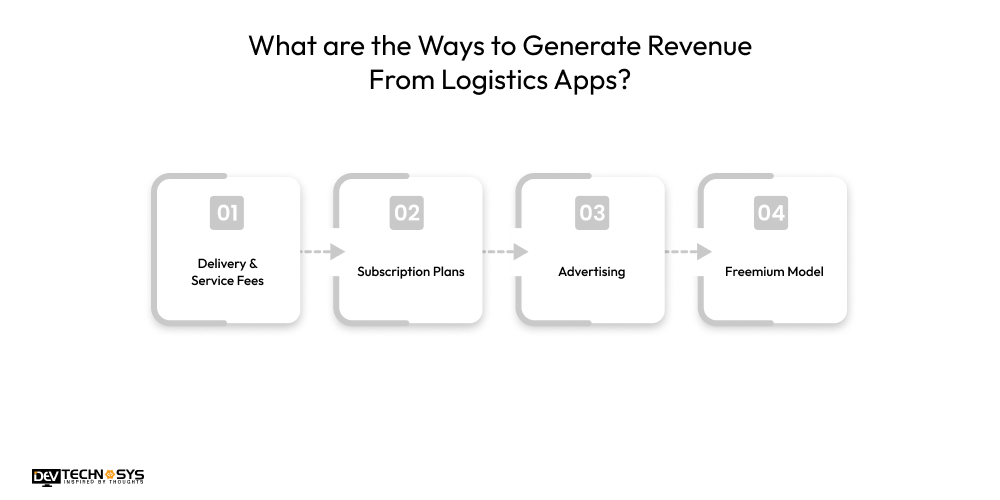
1. Delivery & Service Fees
The distribution management system apps can charge a delivery or service based on the location, order size, urgency, delivery type, and more. It is a straightforward revenue-generating source that provides convenience and reliability for businesses.
According to Fortune Business Insights, the delivery & services fees market is a revenue generating techniques. It grows from $597 billion in 2025 to $1.17 trillion in 2032.
2. Subscription Plans
Offering monthly or annual subscriptions ensures recurring revenue. Subscribers may receive benefits like discounted rates, priority deliveries, or access to analytics dashboards.
Businesses often prefer predictable logistics costs, while frequent individual users enjoy convenience. According to the mobile app development company, this model builds loyalty, improves user retention, and provides a stable income stream.
3. Advertising
The shipment tracking apps can generate revenue through targeted ads from complementary businesses, such as packaging, fuel, or vehicle services. Sponsored listings, promotions, or priority placement can increase visibility for partners.
By using user data responsibly, apps offer relevant promotions, creating an additional monetization stream. As per Dentsu, global advertising revenue is expected to surpass $1 trillion in 2026 for the first time.
4. Freemium Model
A freight management platforms can offer basic services for free while charging for premium features. Advanced tracking, faster delivery, insurance, or enhanced analytics can be part of paid tiers.
The freemium approach attracts a large user base, gradually converting free users into paying customers, increasing overall revenue while maintaining accessibility for occasional users
Conclusion
End this blog with final remarks. This blog discusses in detail the logistics app development cost and what factors can affect the cost. Also offer the cost of different types of logistics apps and popular logistics apps such as Delhivery, Uber Freight, and Lalamove. We hope you now have a clear understanding of the total cost to build a logistics app.
Are you interested in developing a delivery management app? Connect with a logistics software development company to receive a high-quality solution at a lower cost.