










Key Takeaways
The social media app development cost in 2026 typically ranges from $20,000 to $150,000+, depending on feature complexity, platform coverage, backend architecture, security, integrations, scalability, and business requirements.
Cost Based On Social Media App Complexity:
-
- Basic Social Media App ($20,000–$45,000): User profiles, feeds, posts, likes, comments, following, and notifications.
- Mid-Level Social Media App ($45,000–$80,000): Real-time messaging, media sharing, stories, search, moderation, and advanced user interactions.
- Advanced Social Media App ($80,000–$150,000+): Live streaming, AI-powered recommendations, advanced moderation, real-time features, and scalable infrastructure.
Cost Factors On Social Media App Requirements:
-
- Feature Requirements: Profiles, feeds, posts, messaging, stories, live streaming, notifications, and content moderation increase development effort as functionality becomes more advanced.
- Platform Requirements: Android, iOS, cross-platform, or separate native applications affect development, device compatibility, testing, and maintenance costs.
- Backend & Scalability: Real-time communication, database optimization, APIs, cloud infrastructure, media storage, and scalable architecture add to backend development costs.
- Security & Integrations: Authentication, encryption, privacy compliance, payment gateways, analytics, moderation tools, and third-party APIs can increase engineering, testing, and ongoing expenses.
Hinge reported 22% year-over-year revenue growth in the Match Group’s Q2 2026 earnings report, making it the fastest-growing online dating app in the market. More than 50% of adults under 30 have used a dating app at some point, while 380 million active users worldwide in the dating app market. This makes it very lucrative cost to build a dating app like Hinge in 2026.
Hinge provides users with a new perspective on finding their partner by letting them tell their story and reply through profile prompts and photos, making the matching algorithm prioritize compatibility rather than just surface-level attraction. It was founded by Justin McLeod in 2012 and relaunched in 2013 with a tagline, “designed to be deleted.”
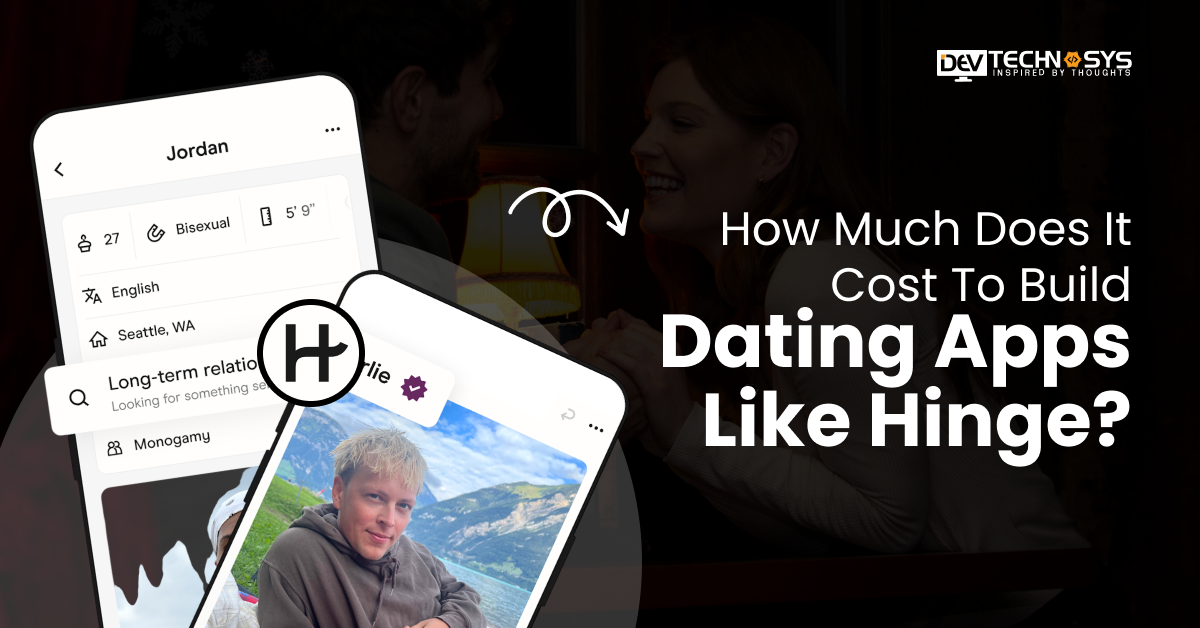
If you want to create a similar ecosystem like Hinge, the major question is what a Hinge-style app costs to build, with a combination of features, platforms, and compliance requirements to consider. Without further ado, let’s get into the Hinge app development cost.
Quote
Hinge founder Justin McLeod said on Vogue that, “The idea is to connect you with the people that you might have met years in the future naturally right now.”
What is the Cost to Build a Dating App Like Hinge: Full Breakdown by Tier
The average cost to develop a dating app like Hinge starts at $30,000 and can rise to more than $140,000. The dating app development cost can vary due to the scope of the app idea, range of features & functionalities, platform choice, your business goals, and many more.
Tier |
Cost Range |
What’s Actually Built |
| MVP | $30,000 – $55,000 | Prompt-based profiles, like/comment on photos and prompts, preference-based matching, 1:1 chat, single platform |
| Mid-tier | $55,000 – $95,000 | Both platforms, behavior-weighted AI matching, curated daily picks feed, video calls, subscription tier |
| Advanced | $95,000 – $140,000+ | ML-refined matching, paid boost/visibility feature, photo/identity verification, moderation suite, multi-region compliance, analytics dashboard |
What Factors Affect the Cost to Build a Dating App Like Hinge?
In the previous section, we discussed the average dating mobile app development budget; it was a very big range, from $30k to more than $140k. This range is so wide because there are 8 major factors that affect the Hinge app development cost, given below:
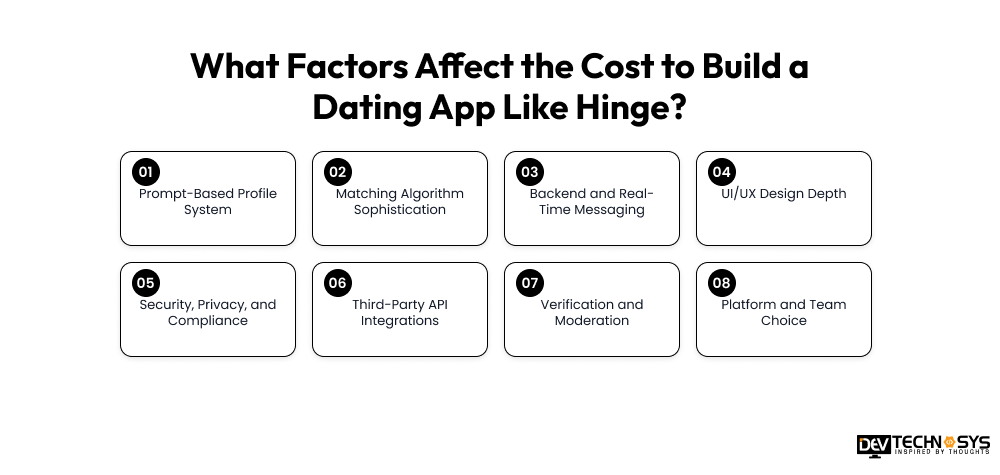
1. Prompt-Based Profile System
The major differentiator for the success of Hinge comes from its prompt-based profiles, not just swiping software. To build this, each prompt needs its own UI, data storage for questions & answers, and display logic for profiles, likes, and comments. Unlike basic bio-input, it needs a rotating system with photo-prompt and comment-on-content interactions, which takes longer hours and resources to build, hence increasing the cost to develop a dating app like Hinge.
2. Matching Algorithm Sophistication
The second major factor comes from its tagline itself, “designed to be deleted”. In-built machine learning matching algorithms in Hinge learn from who you like, skip, and comment on. This cannot be built by a backend engineer; it needs a data scientist or ML engineer to create an AI-powered dating app like Hinge that differentiates from others.
3. Backend and Real-Time Messaging
A robust and scalable cloud-based dating app can look expensive upfront, but by building this you can avoid the hefty reworks later. Features like chat, notifications, and live match updates need to work on real-time technologies like WebSockets and a firewall, with a powerful backend that can handle a high number of concurrent users.
4. UI/UX Design Depth
The simple and engaging design of Hinge, with custom card transitions and prompt-answer animations, requires many more design hours and resources compared to a simple swipe deck design. Users notice these types of designs at once, which they can use easily while maintaining a good-looking interface.
5. Security, Privacy, and Compliance
Dating apps like Hinge collect personal information and other sensitive data like location, orientation signals, private messages, and payment details, which makes building a GDPR-compliant dating app a must. Adding secure authentication and compliant features adds to backend development time and legal review time.
6. Third-Party API Integrations
Third-party integrations add another layer to the cost to develop a dating app like Hinge. Geolocation API for proximity, video calling API integration for in-app dates, and payment gateway APIs increase setup time and subscription fees.
7. Verification and Moderation
Online dating apps are easily accessible, making them very prone to fake profiles and scams in 2026. It becomes non-negotiable to add photo/identity verification and content moderation to your Hinge alternative app.
8. Platform and Team Choice
Last but not least, factors that could affect the cost are platform choice and team choice. Building a native app or cross-platform, hiring an offshore team rather than a local team can add 2 to 4x to your total development budget. Hiring an established dating app development company helps you with a manageable process while providing the best service in dating app development.
Factor |
Cost Impact |
Why It Matters |
| Prompt-Based Profile System | ~18% | Core to Hinge’s identity; requires custom UI and data logic |
| Matching Algorithm Sophistication | ~18% | AI/ML-powered matching requires specialized talent and continuous tuning |
| Backend & Real-Time Messaging | ~15% | Scalable chat, notifications, and real-time infrastructure are technically demanding |
| UI/UX Design Depth | ~12% | High-quality UX directly impacts user engagement and retention |
| Security, Privacy & Compliance | ~12% | Dating apps handle sensitive personal data and require strong encryption and regulatory compliance |
| Third-Party API Integrations | ~10% | Includes geolocation, video, payments, identity verification, and other external services |
| Verification & Moderation | ~10% | Essential for trust, safety, fraud prevention, and maintaining platform quality |
| Platform & Team Choice | ~5% | Development costs vary based on platforms, team structure, and technical expertise |
Expert Note
“The average dating app development cost for Hinge alternatives is predicted based on our experience in building dating apps, as we have built 12+ dating apps at different levels of scope”
Mohit Nag, CTO at Dev Technosys
Planning a Dating App Project?
Get a tailored development cost estimate in a few simple steps.
- 3 quick steps
- 100% free
- Reply in 1 business day
2 Minutes Read
Hinge App Development Cost: Breakdown by Project Stage
Understanding what goes into each stage and how much that stage affects the cost is very important. The table below gives you the spending stage by stage from planning to development and launch when you build a dating app like Tinder or Hinge.
Stage |
Cost Range |
Timeframe |
| Discovery & Planning | $2,000 – $6,000 | 1–2 weeks |
| UI/UX Design (incl. prompt UI) | $5,000 – $15,000 | 2–4 weeks |
| Development (frontend + backend) | $18,000 – $90,000 | 8–16 weeks |
| QA & Testing (incl. matching accuracy) | $3,000 – $12,000 | 2–3 weeks |
| Deployment & Launch | $2,000 – $5,000 | 1 week |
| Post-launch Maintenance (15% – 20% of initial development cost) | $2,000 – $8,000/year | Ongoing |
Industry Insight
According to Pew Research Center, 35% of people who have used dating sites or apps have paid for the service or for premium features.
Hinge App Feature Cost Breakdown: What You’re Actually Paying For
A flat quote hides where your money actually goes. Breaking down dating app development features individually shows exactly what drives your total cost and lets you prioritize the features that matter most for a Hinge-style build.
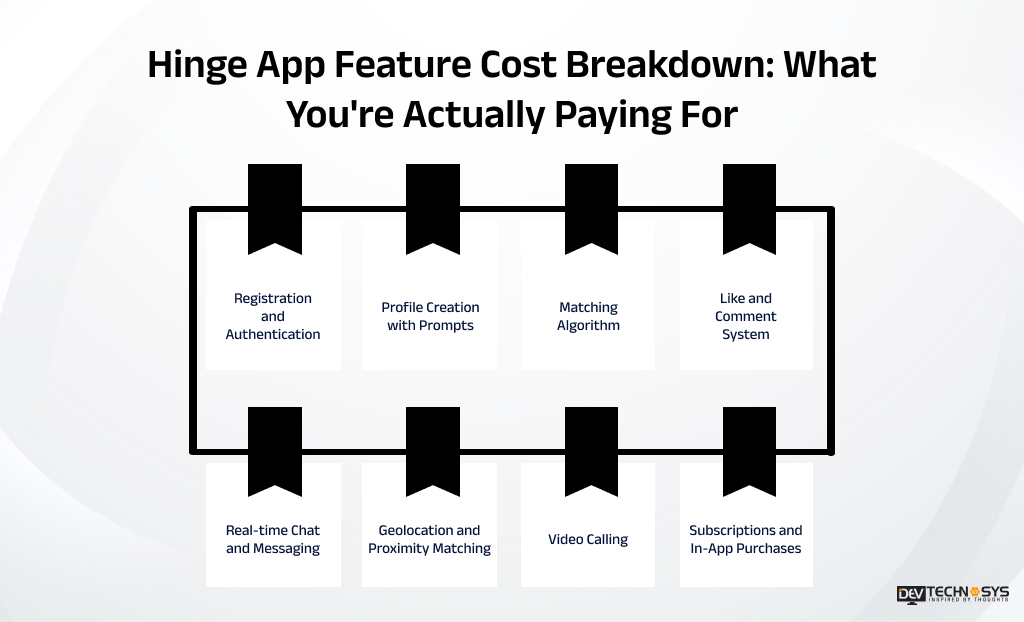
1. Registration and Authentication
Email and phone signup, social login options, and secure user authentication with encrypted password storage and session management form the foundation every other feature depends on.
Estimated cost: $2,000 – $5,000
2. Profile Creation with Prompts
Photo uploads combined with Hinge-style dating profile prompts instead of a plain bio field require prompt rotation logic, answer storage, and display formatting across every screen where profiles appear.
Estimated cost: $4,000 – $10,000
3. Matching Algorithm
Ranges from basic preference filters based on age and distance to a full machine learning matching algorithm that factors in likes, skips, and comments for genuine profile prompt matching and dating app compatibility matching.
Estimated cost: $8,000 – $25,000
4. Like and Comment System
Letting users like or comment on specific photos and individual prompt answers, rather than a blanket swipe, is Hinge’s signature interaction and needs its own dedicated backend logic and UI.
Estimated cost: $3,000 – $8,000
5. Real-time Chat and Messaging
Instant message delivery, read receipts, and typing indicators built on WebSocket real-time messaging or Firebase push notifications require persistent connections and reliable notification handling.
Estimated cost: $5,000 – $15,000
6. Geolocation and Proximity Matching
Distance-based discovery powered by a geolocation API needs accurate location tracking, radius filtering, and privacy controls so users control how precisely their location is shared.
Estimated cost: $2,000 – $6,000
7. Video Calling
In-app video dates before meeting in person require a stable video calling API integration, call scheduling, and safety features like reporting mid-call.
Estimated cost: $4,000 – $10,000
8. Subscriptions and In-App Purchases
Premium tiers, paid boosts, and other in-app purchase dating app features need payment gateway integration, receipt validation, and subscription management across both app stores.
Estimated cost: $3,000 – $9,000
Matching algorithm cost varies the most of any feature here, since it can range from a basic preference filter to a fully learning system that improves with every swipe. If you’re deciding where to invest first, AI in dating app development is usually the feature worth spending on, since it’s what makes a Hinge-style app feel genuinely different from a standard swipe app.
Hidden Costs of Building a Dating App Like Hinge
The numbers above cover development. They don’t cover what shows up after launch, and these hidden costs catch most first-time founders off guard.
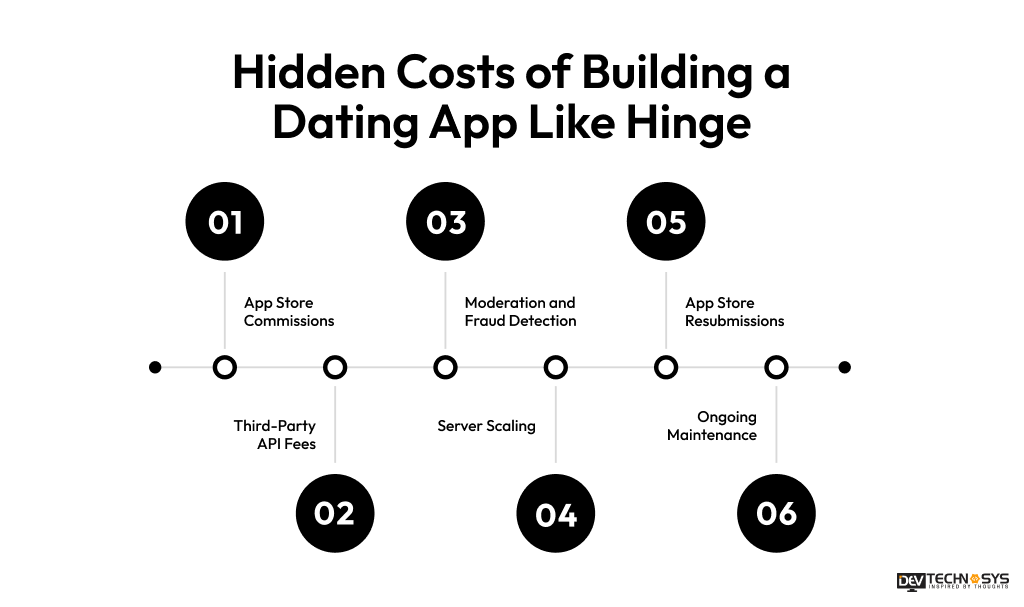
1. App Store Commissions
Apple and Google both take 15 to 30 percent of every in-app purchase, directly cutting into your subscription and boosting revenue from day one. This applies to every transaction indefinitely, not just at launch, so it compounds as your paying user base grows.
2. Third-Party API Fees
Every third-party API integration that relies on geolocation, video calling API integration, SMS verification, and push notification dating app services comes with its own monthly fee that scales with user count. These are recurring costs, not one-time development expenses, and they grow alongside your app’s success.
3. Moderation and Fraud Detection
Content moderation dating app systems, whether AI-assisted or human-staffed, run continuously and grow more expensive as message volume grows. Fraud detection dating app tools, needed to catch fake profiles and bots before they damage user trust, add both software licensing fees and ongoing tuning costs.
4. Server Scaling
A Hinge-style app with real-time chat and location tracking needs far more infrastructure at 50,000 users than it did at 5,000. That jump in server and database costs often surprises founders who budgeted carefully for launch but never planned for growth-stage scaling.
5. App Store Resubmissions
Dating apps face stricter review standards around safety, verification, and user reporting than most app categories. A single resubmission cycle after rejection can add one to three weeks and unplanned developer hours, delaying your launch timeline and increasing overall project cost.
6. Ongoing Maintenance
Bug fixes, OS updates, security patches, and feature refreshes continue long after launch day. Budgeting for mobile app maintenance costs from the start, rather than treating it as an afterthought, keeps a Hinge-style app stable as both your user count and app store requirements evolve over time.
Hidden Cost |
Typical Range |
| App store commission | 15% – 30% of in-app revenue |
| Third-party API fees (monthly) | $200 – $2,000+ |
| Content moderation (ongoing) | $1,500 – $6,000/month |
| Fraud detection tools | $500 – $2,500/month |
| Server scaling (growth-stage) | $1,000 – $5,000+/month |
| App store resubmission delays | 1 – 3 weeks per cycle |
| Ongoing maintenance | $2,000 – $8,000/year |
Security and Compliance: What It Adds to the Cost of a Hinge-Style App
Dating apps handle unusually sensitive data, location history, sexual orientation signals, private messages, and payment details, which makes dating app compliance a real cost driver, not an optional add-on.
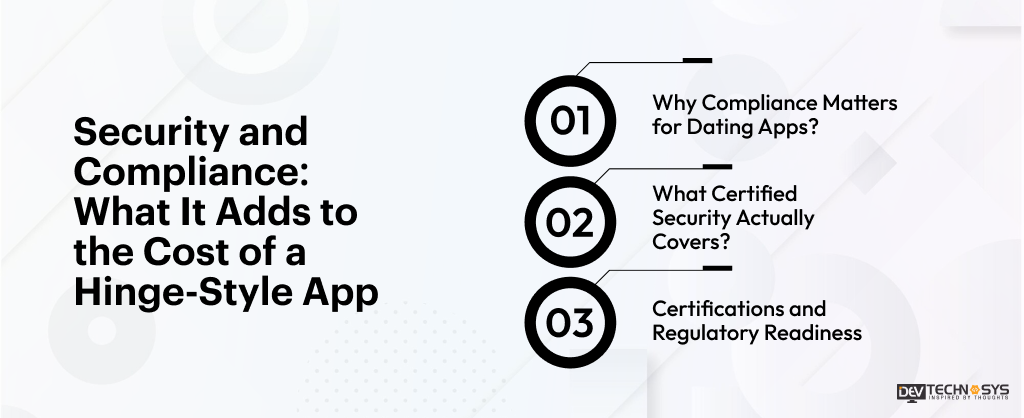
1. Why Compliance Matters for Dating Apps?
A data breach on a dating app is more damaging than most categories, since the data itself who someone is attracted to, where they’ve been, who they’ve messaged can’t simply be reset like a password. GDPR-compliant dating app features and CCPA compliance for dating apps are now baseline expectations from users and app stores alike, not competitive extras.
2. What Certified Security Actually Covers?
We follow enterprise-grade security like ISO 27001, covering information security management, alongside SOC 2 controls for cloud data handling and PCI DSS standards for payment card security. Together, these ensure data encryption, data-handling practices, and secure user authentication are built in from day one, not patched on after launch.
3. Certifications and Regulatory Readiness
Beyond infrastructure, dating app regulatory compliance also covers GDPR data protection for EU users, CPRA compliance for California residents, and age verification compliance to keep minors off the platform. Dev Technosys maintains a full set of compliance certifications, including ISO 9001:2015, CMMI Level 3, and SOC 1, that most competing agencies cannot show.
Certification |
What It Covers |
Cost Impact |
| ISO 27001 | Information security management | Moderate |
| ISO 9001:2015 | Quality management process | Moderate |
| SOC 2 | Cloud data handling controls | High |
| SOC 1 | Financial/transaction controls | High |
| PCI DSS | Payment card data security | High |
| GDPR | EU user data rights | Moderate |
How Dating Apps Like Hinge Make Money?
It’s important to understand the Hinge business model because monetization features aren’t free, and every revenue stream you adopt here comes back to your development costs. When you clone Hinge or when you’re planning to build a virtual dating app, it will always adapt the Hinge business model.
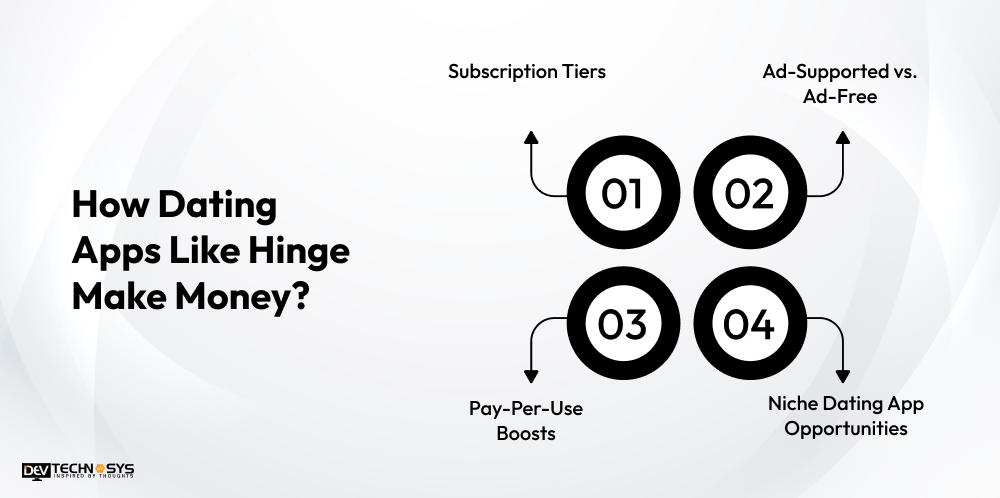
1. Subscription Tiers
The freemium dating app is complimentary swiping and matching with a premium subscription for much more advanced features like seeing who has already liked you, superior filtering abilities, and unlimited likes. This is the main revenue stream and the initial point for most entrepreneurs.
2. Pay-Per-Use Boosts
In addition to subscriptions, users can buy profile boosts and virtual roses one time, granting them a quick visibility boost without the monthly subscription. The features require additional logic on the back end to account for usage and expiration, which adds a minimal development expense to the base application.
3. Niche Dating App Opportunities
Monetization strategy also depends on your niche. An astrology-based dating app can charge for compatibility readings tied to birth charts, appealing to users who want matching based on more than stated preferences. Community platforms and faith-based platforms are a different breed altogether, as they monetize on verified membership and charge higher subscription fees because users are paying for curated and trusted matches.
4. Ad-Supported vs. Ad-Free
Ad-based free tiers are sometimes an effective way to mitigate the financial loss of being free, but most premium dating apps, such as Hinge, don’t do this because ads don’t fit with a curated and thoughtful user experience, and can negatively impact retention among paying customers.
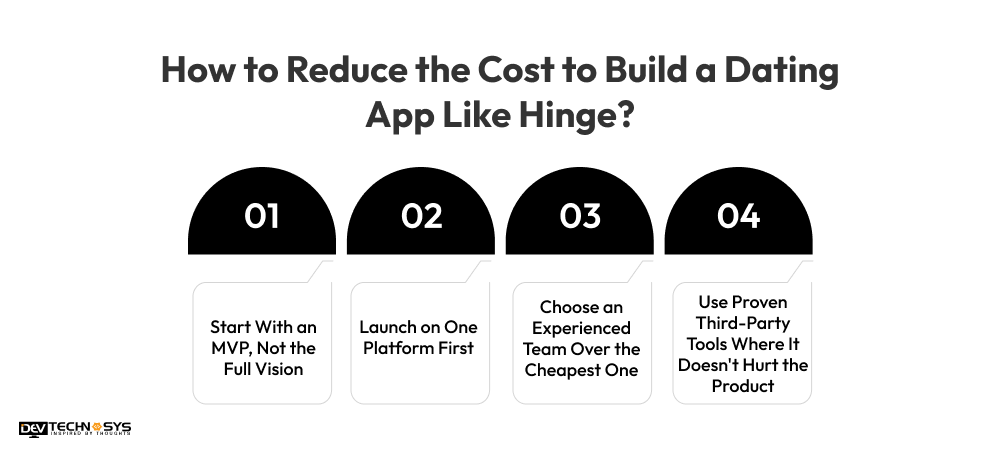
How to Reduce the Cost to Build a Dating App Like Hinge?
The build is not a requirement to start something formidable with a $140k budget. These are the levers that will really help to lower the number without decapitating the app.
1. Start With an MVP, Not the Full Vision
Start with a set of prompt-based profiles, basic matching, and chat; eventually introduce AI matching, video calls, and boosts when you have real user data that justifies the investment. The all-or-nothing approach is the number one reason budgets often exceed necessary requirements; everything must be built before you can determine what people want.
2. Launch on One Platform First
Building for iOS and Android simultaneously roughly doubles frontend development time. Launching on whichever platform your target users prefer first, then expanding once you have traction, is one of the fastest ways to cut initial cost without cutting features.
3. Choose an Experienced Team Over the Cheapest One
Although established dating app development services come at a higher price per hour, it also reduces the cost of rebuilding sophisticated components, such as the matching system and live chat. In this case, it will be more expensive to correct a poor implementation than to design it right the first time.
4. Use Proven Third-Party Tools Where It Doesn’t Hurt the Product
Creating a video calling/push notification system from scratch is often impractical. APIs that provide these features are available and are generally cheaper than creating these features from scratch, and would allow the money that you would be spending on the features that really make your app stand out from the crowd, such as the matching features and prompt system.
Industry Insight
According to Pew Research Center, only 21% of U.S. adults believe dating algorithms can determine whether two people will eventually fall in love, while 43% are unsure.
What is the Cost to Build a Dating App Like Hinge Over Time?
The build price is just the entry fee. Here’s what founders and investors actually need to know before committing budget.
1. The Real Three-Year Price Tag
Total cost of ownership factors in maintenance, hosting, moderation, and compliance renewals stacked on top of the initial build, giving a realistic full-picture number instead of just the day-one figure. Using a mid-tier build at $75,000 as the baseline, ongoing costs typically add $8,000 to $20,000 per year, covering server scaling, third-party API fees, content moderation, and app store compliance renewals.
Year |
Cost |
What It Covers |
| Year 1 | $75,000 | Full build and launch |
| Year 2 | $12,000 – $20,000 | Hosting, moderation, API fees |
| Year 3 | $15,000 – $25,000 | Scaling, compliance renewals |
| 3-Year Total | $102,000 – $120,000 | Full ownership cost |
2. When Does It Actually Pay Off
Return on investment depends on conversion, not downloads. A subscription priced around $20 per month, with even a modest 5 percent of active users converting to paid, generates real recurring revenue fast. At 10,000 monthly active users, that’s roughly 500 paying subscribers, enough to cover ongoing costs within the first year alone.
Monthly Active Users |
Paying Subscribers (5%) |
Monthly Recurring Revenue |
Break-Even Timeline |
| 5,000 | 250 | $5,000 | 24–30 months |
| 10,000 | 500 | $10,000 | 18–24 months |
| 25,000 | 1,250 | $25,000 | 8–12 months |

Conclusion
The cost to build a dating app like Hinge in 2026 ranges between $30,000 and $140,000+, depending on scope, tech stack, team location, and how deep you go on AI-driven matching, security, and compliance. The real number depends less on picking the cheapest option and more on matching your build to your actual launch goals, whether that’s a lean MVP or a fully-featured competitor to Hinge and Bumble.
If you’re ready to turn this research into an actual project plan, Dev Technosys can help you scope a dating app development solution built around your specific features, budget, and timeline. We follow all security and compliance requirements with a quality build so that your dating app achieves success in the long term.
Frequently Asked Questions
Find answers to the most common questions related to this article.
The cost to create a dating app like Hinge ranges from $30,000 to $140,000 or more, based on the features, platform, team location, and the sophistication of your matching algorithm and compliance requirements. For a competitive launch, most founders will fall somewhere between $55,000 and $95,000.
A close Hinge clone app development cost, matching prompts, curated matching, and core features, starts from $55,000 to $95,000, though exact pricing depends on feature parity and platform coverage. Exact pricing depends on how closely you match Hinge's feature set, platform coverage, and matching algorithm sophistication.
Yes, starting with an MVP, core profiles, basic matching, and chat brings cost down to $30,000 to $55,000, letting you validate demand before scaling up. This lets you validate demand and gather real user data before investing in advanced features.
Adding blockchain features like crypto-based identity verification or token-gated matching typically adds 15% to 25% on top of a standard dating app development budget, depending on how deeply Web3 elements are integrated.
Most MVP-stage dating apps cost between $30,000 and $55,000, covering essential features like prompt-based profiles, basic preference matching, and one-on-one chat on a single platform, without video calling or advanced AI matching.