










Key takeaways:
-
- Virtual dating apps in 2026 combine AI, video, and personalization for enhanced user engagement.
- Building virtual dating apps requires niche targeting, strong tech stack, and user-centric design approach.
- Virtual dating app costs range $12k–$30k depending on features, complexity, and development strategy.
- Monetization for AI dating apps relies on subscriptions, in-app purchases, and scalable global audience reach.
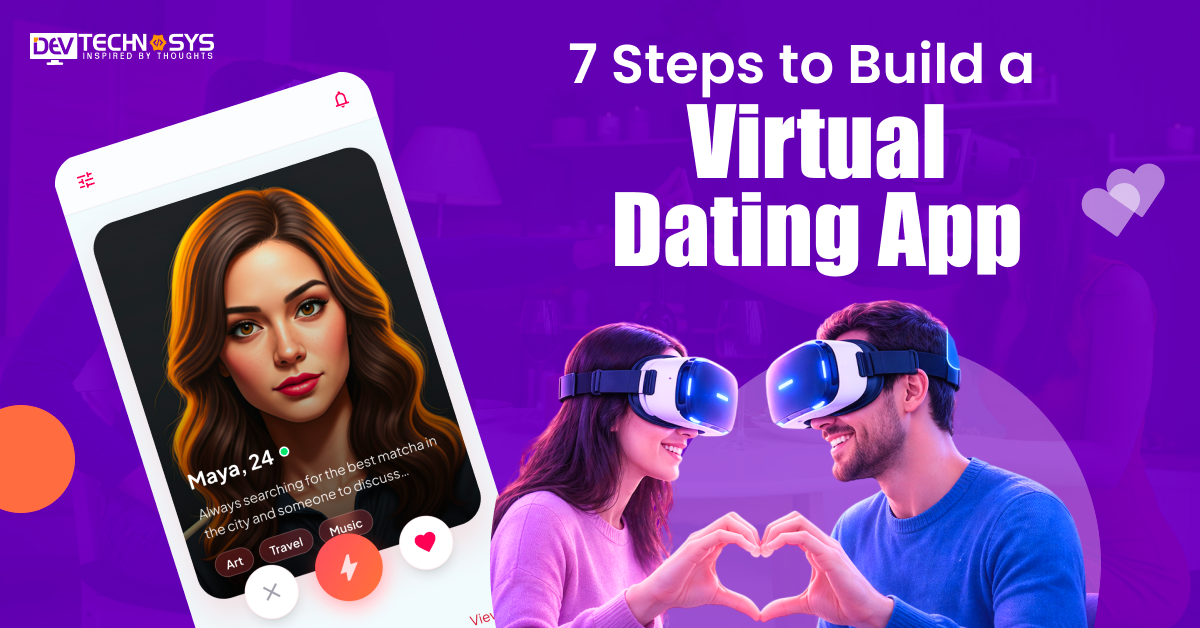
The online dating market is changing rapidly, making 2026 an optimal year to launch a virtual dating app with innovative, user-friendly features.
Worldwide revenues from dating apps are expected to reach $3.24 billion by 2026. This has created a rising interest in creating smarter, safer, and more fun apps.
If you’re somewhat interested to build a virtual dating app, you must know that it involves several key factors, including identifying your target market and implementing advanced features.
In this blog, we will outline the seven steps required to plan, design, and implement an engaging and successful user experience on a crowded virtual dating marketplace.
What is a Virtual Dating App?
A virtual dating application is a platform where users meet each other, communicate in real-time, create solid relationships, develop and grow this connection with each other. The main forms of communication are through the use of a personal profile page, instant messaging, live video, and virtual dating sessions.
Virtual dating applications use an algorithm for matchmaking, the use of avatars to represent the user, and placing users in a virtual environment for a more immersive and engaging experience.
How A Virtual Dating App Works?
If you were wondering how a virtual dating app works, here is an overview of the steps to using a virtual dating app:
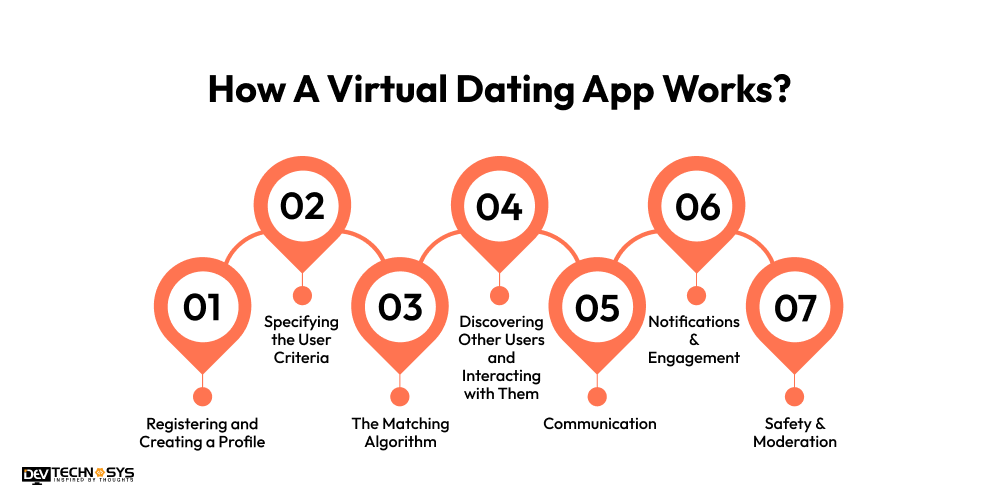
Step 1: Registering and Creating a Profile
A user will register for an application via email, mobile phone, or social media account and then develop their user profile by adding photographs, a brief description of themselves, key interests, and finally their relationship preferences.
Step 2: Specifying the User Criteria
Each user provides the app company information about each user’s preference (e.g., age, geographical location, etc.), which will allow the app to provide more accurate results.
Step 3: The Matching Algorithm
The matching algorithm considers a variety of information about the user, including behavioral factors as they relate to other users of the application and their user profiles.
Step 4: Discovering Other Users and Interacting with Them
Users will be able to swipe right on a profile or filter through the presented list of profiles and find out if anyone has shown a mutual interest in them by using the ‘like’ feature or being matched.
Step 5: Communication
After a match, people can communicate via chat, exchange media, or even make voice/video calls in the app.
Step 6: Notifications & Engagement
Push notifications inform users about new matches, messages, and other app-related activities.
Step 7: Safety & Moderation
The platform supports safe communication through user identity verification, issue reporting, and AI-powered moderation tools.
Market Stats of Virtual Dating App
- By 2026, dating apps are expected to have 380 million users worldwide, showing that dating sites are being widely accepted as an alternative form of dating.
- The global dating industry is forecasted to hit over $6.2 billion in revenue by 2026, which clearly shows that they have a strong capability to be monetized.
- The whole global dating app industry is estimated at around $14.78 billion in 2026 and has been growing cumulatively over the long term.
- The revenue from dating apps is predicted to be $3.24 billion in 2026, with the U.S. alone accounting for nearly $1.45 billion.
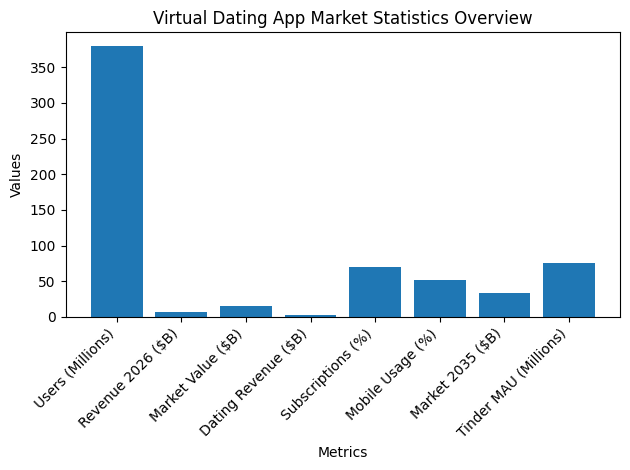
- Paid subscriptions make up around 70% of the total dating app revenue, showing that this is the main monetization model.
- The users of dating apps mostly access their mobile devices, making up more than 52% of all dating app usage and thus showing a clear preference for mobile-centric experiences.
- The dating app market is expected to hit $32.97 billion by 2035, which means an approximate compound annual growth rate (CAGR) of 9% and thus, indicating a chance for scalable long-term growth.
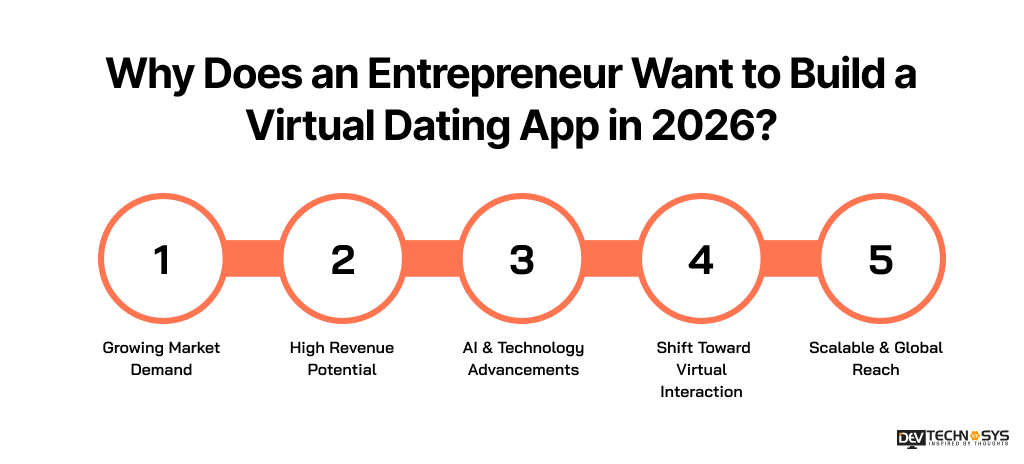
Why Does an Entrepreneur Want to Build a Virtual Dating App in 2026?
With digital relationships becoming mainstream, 2026 presents a lucrative opportunity for entrepreneurs to build virtual dating app like Yubo, driven by rising demand, advanced technologies, evolving user behavior, and the potential for scalable global revenue.
1. Growing Market Demand
Tremendous growth of user base and enhanced user engagement have expanded the dating app industry surface, creating new opportunities for brand partnerships, targeted advertising, and the incorporation of advanced technologies like AI for matchmaking, encryption for privacy, which in turn are helping to rapidly scale the industry.
2. High Revenue Potential
Entrepreneurs are excited to make a virtual dating app because the demand for online relationships is growing at a global level. Smartphone penetration, busy working style, and digital-first mode of communications are the main reasons behind users with millions turning to dating platforms, expanding the horizon of business for growth and revenue over a period.
3. AI & Technology Advancements
Generally, the dating application development solutions generate most of their revenues through subscriptions and in-app purchases, while more and more dating apps are exploring advertising as a new revenue avenue.
Online dating is actively turning premium by introducing attractive and engaging features such as enhanced profiles, augmented reality, video calls, and matchmaking algorithms; these novel features will drive the demand further for the digital business of online dating.
4. Shift Toward Virtual Interaction
Today’s users quite readily form relationships through online video connections, chat, and virtual experiences. In fact, entrepreneurs are using this change in behavior as a main reason to set platforms that will be built on convenience, safety, and accessibility, thus aligning very well with months-long changing user expectations and digital lifestyles. It also means staying at home and still being part of the community.
5. Scalable & Global Reach
Since virtual dating assistants don’t have physical limitations, scaling across regions and demographics can be done quite easily. Business owners can aim at global audiences, improve and add features, provide localization, etc., which together help a business grow quickly and enter the market widely, while operating with far fewer resources than a traditional offline business.
Want a chatbot demo or pricing? Fill the form and talk to our experts today.
Pick what you need below — you can select more than one — then tap Get detail to continue.
-
Chatbot demo dashboard
-
Cost to develop an app
-
Industry report
-
Case study
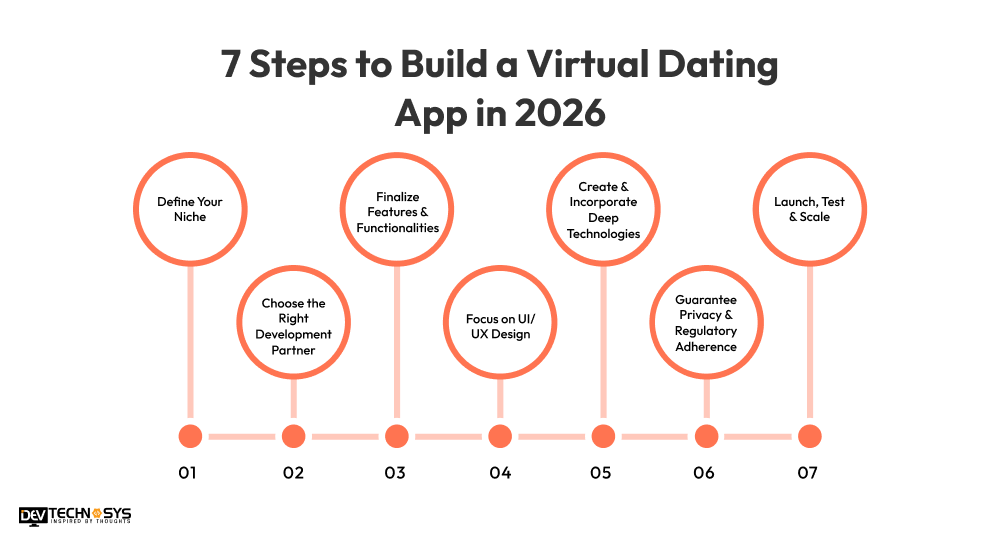
7 Steps to Build a Virtual Dating App in 2026
To develop a virtual dating app in 2026, one must combine strategic planning, sophisticated technology, and features that revolve around the user. These seven steps are essential to build a platform that is scalable, engaging, and competitive in the shrinkingly populated yet fiercely contested dating market.
1. Define Your Niche & Target Audience
Identifying a niche that sets you apart in a competitive virtual dating market is critical. This could be a focus on professionals, hobby-based communities, or users from a specific region.
The choice of niche totally shapes your product. An experienced Virtual dating app development company can be a great help in confirming your concept by conducting market research, competitor analysis, and gaining insights into user behavior. This way you can be sure that you are not only solving a real problem but also attracting the right audience from day one.
2. Choose the Right Development Partner
The decision to pick the best dating app development company is undoubtedly one of the most crucial ones for your app. Going through their portfolios, technical skills, and their ability to develop scalable apps will be extremely helpful.
A reliable Node.js development company would do more than just the coding; they would also apprise you of their knowledge of the tech stack, architecture, and coming trends.
Their understanding of the industry will consequently speed up the app creation process, reduce the likelihood of mistakes, and result in a product that aligns with your long-term business goals.
3. Finalize Features & Functionalities
byour app stand out. Core features include user profiles, matching algorithms, chat, and notifications. Advanced features like video dating, AI-based recommendations, and geolocation will make the experience more fun and engaging for users.
Hire Python developers to examine the features in terms of what users really need, the budget, and the potential for future growth. So that the outcome for you will be a cost-effective, competitive online dating platform.
4. Focus on UI/UX Design
During the user experience phase of the front-end development services, a dating app’s success is primarily determined by how users feel when they use it.
A gay virtual dating development company is committed to designing user interfaces that are both visually appealing and easy to use, thus encouraging users to interact more.
Features such as seamless, quick app navigation, eye-catching images, and a very simple registration process all help make it more likely that users will stick with your app.
5. Create & Incorporate Deep Technologies
A competent Android app development company combines age technologies, for example, AI-based matchmaking, live chat, video calls, and safe payment methods. At the same time, they handle backend scalability and performance tuning.
Utilizing such innovations as cloud computing and data analysis enables your app to offer tailored user experiences, support a growing user base, and remain competitive in the constantly changing virtual dating world.
6. Guarantee Privacy & Regulatory Adherence
Proceed to the second last step in constructing a virtual dating application. Protecting user data is of equal importance to dating applications. Appoint PHP programmers to put into place comprehensive security features such as data encryption, secure authentication, and privacy controls.
They also make sure that their applications are in line with the regulations like GDPR and other regional laws. Strong security measures not only foster trust among the users, but also significantly cut down the risk of data breaches.
7. Launch, Test & Scale
Before the release date, the mobile app medium used for development of your Android and iOS App will carry out several testing to ensure the performance without errors.
After the launch, they will be ready to support your next versions, perform some tracking of the work, and come up with ways of extending your platform. Never-stop-development with the user’s experience not only plays a crucial role in the retention of users but is also vital for the continual growth of your platform.
Basic Features of a Virtual Dating App
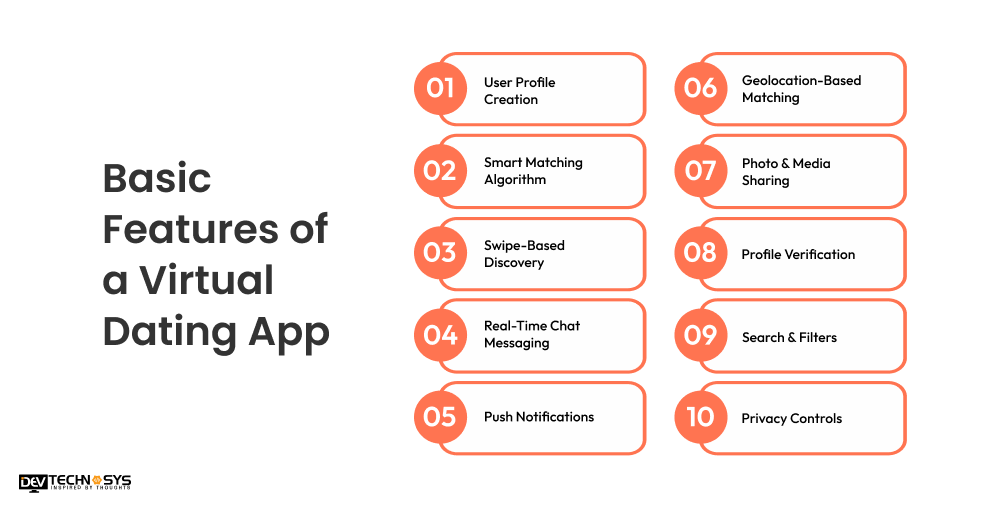
An effective virtual dating app hinges very much on the essential features that lead to more interaction, trust, and engagement. These basic features not only facilitate the creation of wonderful user experiences but also aids the users to connect, communicate, and eventually build deep and meaningful relationships with less effort.
1. User Profile Creation
Users can easily express themselves through well-constructed profiles featuring several images, a short description, and other personal information that would facilitate the disclosure of personality traits and the assessment of compatibility before even starting a dialogue.
2. Smart Matching Algorithm
An intelligent matching system suggests potential partners based on preferences, behavior, and interests, improving connection quality and overall user engagement within the platform.
3. Swipe-Based Discovery
Simple swipe functionality is one of the most popular dating app development features, allowing users to like or pass profiles quickly, making the browsing experience intuitive, engaging, and familiar to modern dating audiences.
4. Real-Time Chat Messaging
Direct in-app communication through instant messaging opens the possibility of ongoing conversations that will lead to the natural development of trust and deeper bonds between matched members of the platform.
5. Push Notifications
Sending alerts about new matches, messages, and other activities updates users on the go. It is a way to engage users and, at the same time, motivate them to regularly use the app and interact with it over time.
6. Geolocation-Based Matching
Users are matched based on their current location. This way, not only can users keep in touch with people nearby, but it also becomes much easier to meet in person. Location-based matching is the key to both relevancy and quick relationships.
7. Photo & Media Sharing
Adult virtual dating game sites allow users to share images and other media types within chats. This not only helps create a better communication atmosphere, but it also makes the channel more authentic and allows for even deeper interactions.
8. Profile Verification
Verification processes, such as verifying users via email, phone, or social accounts, help reduce the number of fake profiles. Also, it will build greater trust within the platform.
9. Search & Filters
Badoo dating service app offers a variety of different filters available; users can narrow their search for potential matches according to their age, location, interests, and preferences. This results in more personalized matches and significantly improved UX.
10. Privacy Controls
It provides options for users to adjust their visibility, block certain profiles, and control what type of personal information they share. All these measures ensure the user’s security, comfort, and a sense of safety while using the platform.

Advanced Features of a Virtual Dating App
Advanced features transform virtual dating apps into immersive, intelligent platforms. From AI matchmaking to video interactions and AR experiences, these innovations boost engagement, improve connections, and deliver highly personalized user journeys.
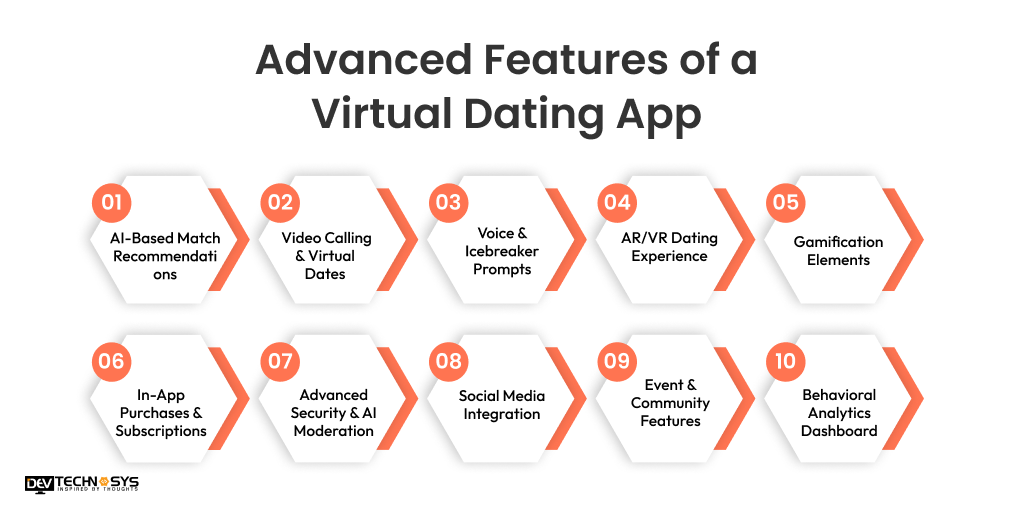
1. AI-Based Match Recommendations
Machine learning techniques are used to process data from users’ behavior, preferences, and communication to produce match suggestions that are more relevant to each user. Increasing the probability of finding the right person and users’ engagement for a longer period of time.
2. Video Calling & Virtual Dates
Users can have video calls without leaving the app. This feature helps build trust and reduce skepticism while also ensuring that users get to know each other better and have better bonding before physically meeting each other in the real world.
3. Voice & Icebreaker Prompts
People can record voice notes, and the app facilitates this by also offering them conversation starters so that they get going. These help tremendously with breaking the ice and lead to very natural conversations.
4. AR/VR Dating Experience
With augmented reality (AR) and virtual reality (VR) features, dating platforms can offer environments that are not only immersive but also interactive, making online dating more fun and innovative.
5. Gamification Elements
By introducing fun elements like rewards, badges, and games in the app, users not only enjoy their dating experiences but also keep coming back, as the app integrates the idea of a ‘fun dating journey’ with the ‘need to constantly engage’.
6. In-App Purchases & Subscriptions
Premium plans unlock features like unlimited swipes, advanced filters, and visibility boosts, helping monetize the app while enhancing user experience significantly.
7. Advanced Security & AI Moderation
AI-based content moderation can not only identify various kinds of suspicious behavior but also detect abusive language and chat, fake profiles, and, consequently, help create a safe environment that protects users from potential threats.
8. Social Media Integration
By connecting to social networks, users cannot only enhance their profile credibility or share content with others, but also build trust within the community through authenticity verification.
9. Event & Community Features
Users can join virtual events, group chats, or communities based on interests, promoting deeper engagement and helping users connect beyond one-on-one interactions.
10. Behavioral Analytics Dashboard
Admins access detailed analytics on user behavior, engagement trends, and app performance, helping improve features, optimize strategies, and drive continuous platform growth.
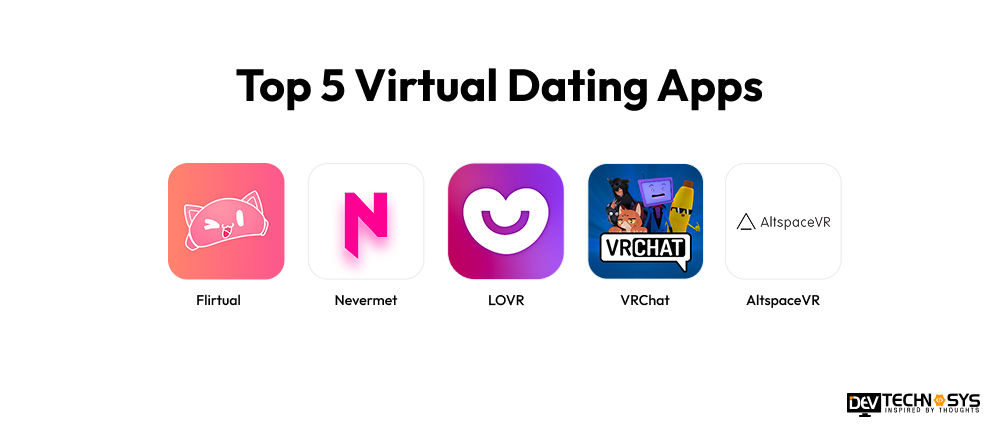
Top 5 Virtual Dating Apps
Explore the top virtual dating apps redefining online connections in 2026, offering innovative features, smarter matchmaking, and engaging experiences that help users build meaningful relationships beyond traditional swipe-based platforms.
App |
Downloads |
USP (Unique Selling Points) |
| Flirtual | 100K+ | • VR-first dating experience
• Avatar-based matching • Works with multiple VR worlds |
| Nevermet | 1L+ | • Avatar-only profiles (no real photos)
• Metaverse-based dating • Personality-first approach |
| LOVR | Prototype | • Virtual dates before real meetings
• Daily match suggestions • Designed for long-distance couples |
| VRChat | 1M+ | • Fully immersive virtual worlds
• Custom avatars • Widely used for virtual relationships |
| AltspaceVR | Discontinued | • Early VR social platform
• Hosted virtual events • Strong community interactions |
1. Flirtual
Flirtual is an innovative dating app that uses virtual reality to connect people. Users can meet as avatars, socialize, and develop relationships in large, immersive VR worlds and then decide to meet in the real world if they like each other.
2. Nevermet
Nevermet is an interesting experiment in dating, where the focus is on finding love in the digital world. Users get to know each other through their avatars in the virtual environment, which paves the way for real-world meetups, often via VRChat or similar platforms.
3. LOVR
LOVR is a futuristic concept app for virtual reality dating. It aims to make the experience of going out together more immersive and real than ever before by providing a digital environment for individuals to meet through their avatars and gradually deepen their connection while still being physically apart.
4. VRChat
VRChat is a great place to hang out online in the virtual universe. Users have their avatars, can visit various virtual locations, and create connections with people. The platform is well-known for being a hub for virtual dates and socializing.
5. AltspaceVR
AltspaceVR was an awesome virtual world where people got together to have fun, celebrate events, and forge new friendships. It offered an ideal setting for virtual social interactions, and now, unfortunately, it is no longer available.
How Much Does It Cost to Build a Virtual Dating App in 2026?
The cost to develop a virtual dating app in 2026 varies from $12,000 to $30,000, depending on a number of technical and business factors. The following are major factors that directly impact the total virtual dating app development cost:
Cost Factor |
Estimated Cost Range |
| App Complexity & Features | $3,000 – $10,000 |
| UI/UX Design | $2,000 – $5,000 |
| Platform Development (iOS/Android) | $3,000 – $8,000 |
| Technology Stack & Integrations | $2,000 – $6,000 |
| Development Team (Based on Location) | $2,000 – $7,000 |
1. App Complexity & Feature Set
The more detailed and complex your virtual reality dating app is, the higher your price will be. Basic apps with fewer features are cheaper, while feature-rich apps with functionalities like AI matchmaking, video calls, and AR/VR require much more time, highly skilled developers, and a bigger investment.
2. UI/UX Design Requirements
Using a plain UI is cheap, but a highly interactive and custom-designed UI/UX may increase the cost to develop different types of dating apps. Beautiful animations, easy yet intuitive navigation, and tailor-made user journeys require top-notch designers, appropriate prototyping tools, and multiple rounds of revisions.
3. Platform Choice (iOS, Android, or Both)
Making a product that can run on one platform really helps in saving your budget, whereas the need to build apps separately for iOS and Android will be more costly.
Using cross-platform solutions such as React Native and Flutter might also help to bring down the cost, but native development is always the best choice for better performance, which again might need more budget allocation.
4. Technology Stack & Integrations
Different programming languages, frameworks, and third-party integrations, such as payment units, geolocation, AI, and cloud services, influence pricing. Top-notch technological stacks and API development services require more skills and hence, will increase the time and total cost to develop a virtual dating app.
5. Development Team Location & Expertise
Hiring developers in markets like Asia from top dating app development companies. Besides being more affordable than in the US or Europe, you can still expect rates to vary depending on the Virtual dating app development company experience. Their skill level, hourly rates, and number of team members are the main cost drivers when you build an app.
How to Monetize a Virtual Dating App?
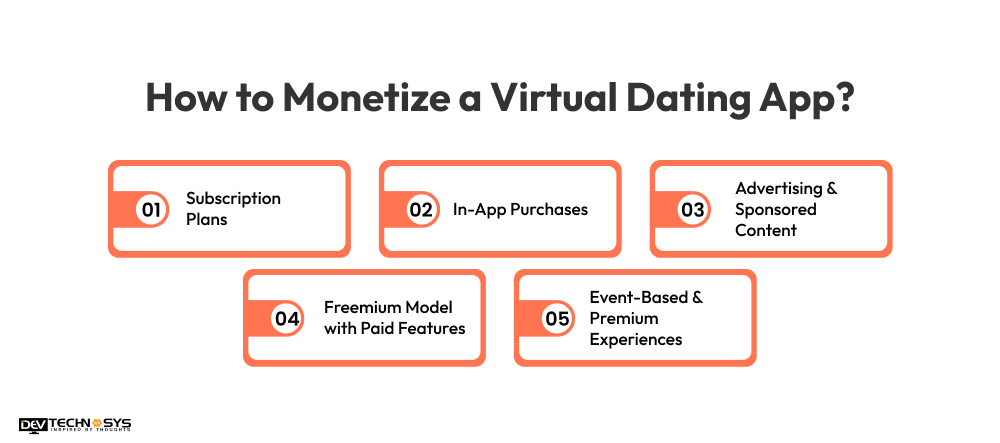
1. Subscription Plans
The virtual dating on-demand app development solutions create a set of subscription plans that feature more premium features, such as unlimited swiping, refined filtering, the ability to see who has read your message, and an ad-free experience.
Monthly and yearly plans are ways to generate new income regularly and they empower users to have more control, see better how things are going, and get a personalized experience on the dating platform.
2. In-App Purchases
The virtual stickers for a dating website, giving customers an opportunity to purchase virtual items, like profile boosts, super likes, or premium stickers, is a great way of driving sales.
The flexibility of the monetization model, in addition to the ability to perform micro transactions, can even be a very successful way of encouraging users to make repeat purchases.
3. Advertising & Sponsored Content
Embed ads that are not intrusively placed, sponsored profiles, and also brand collaborations within the app. Native advertising helps make sure that the user experience is not interrupted and, at the same time, it supports revenue generation from third-party brands that are targeting your user base based on demographics and interests.
4. Freemium Model with Paid Features
You give away some features for free, but make the users pay for advanced stuff such as using AI for matchmaking, making video calls, or getting more information about their profile.
According to the dating app development firm, this approach initially attracts a large population of users, who, over time, are gradually converted from free users into paying customers with value-added upgrades.
5. Event-Based & Premium Experiences
Host virtual events, speed dating sessions, or exclusive matchmaking experiences, where the entry is by paid ticket for access. These premium offerings do not only generate additional revenue streams, but also create unusual engagements, thereby, improving the level of satisfaction of users and the profitability of the business both at the same time.
Technology Stack For Virtual Dating App
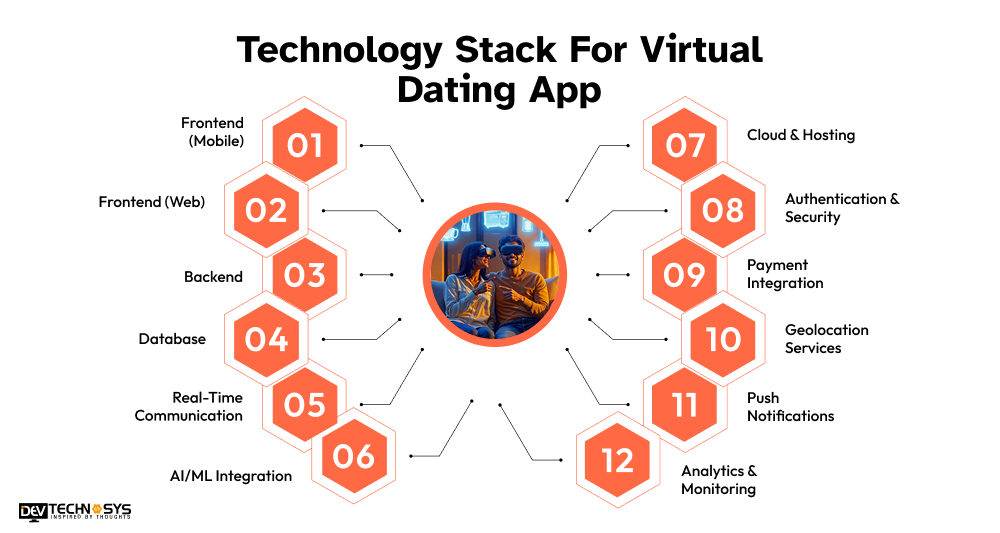
Layer |
Technology |
| Frontend (Mobile) | Flutter / React Native / Swift (iOS) / Kotlin (Android) |
| Frontend (Web) | React.js / Angular / Vue.js |
| Backend | Node.js / Python (Django, Flask) / Ruby on Rails |
| Database | PostgreSQL / MongoDB / MySQL |
| Real-Time Communication | WebRTC / Socket.io / Firebase Realtime Database |
| AI/ML Integration | TensorFlow / OpenAI APIs / Python ML Libraries |
| Cloud & Hosting | AWS / Google Cloud / Microsoft Azure |
| Authentication & Security | OAuth 2.0 / Firebase Auth / JWT |
| Payment Integration | Stripe / PayPal / Razorpay |
| Geolocation Services | Google Maps API / Mapbox |
| Push Notifications | Firebase Cloud Messaging / OneSignal |
| Analytics & Monitoring | Google Analytics / Mixpanel / Firebase Analytics |
Here’s What 2026 Means for Dating App Investors
The virtual dating show app market is no longer just about swipe mechanics; it’s now driven by AI, videos, and immersive technology. Those who understand these changes and are builders will be the ones creating products that can be scaled. Those who choose to ignore it will only end up producing outdated software.
1. AI-Powered Matching Algorithms Replaced Basic Filter Logic
Machine learning models that take into account the tone of voice, behavioral patterns, time of response, and sentiment of the conversation are some of the elements that modern dating apps exploit.
These models provide compatibility scores that are much higher than the ones that checkbox filters produce. Developers nowadays embed NLP and deep learning layers into their main matching engines.
2. Video-First Architecture Became the Industry Standard
Real-time video communication infrastructure based on WebRTC protocols is the backbone of profile creation, live icebreakers, and the in-app virtual date rooms.
Devs who organize video as a fundamental segment of their system from the beginning will release their products much faster and also have fewer technical problems than those who try to add video after the fact.
3. Security and Verification Modules Drive User Retention
Now teams are designing APIs for ID verification, AI creation, photo authentication, and real-time content moderation as an integral part of their technology stack. Infrastructure-level deployment of these security layers by platforms leads to a significant improvement in user trust scores and a decrease in churn rates, according to reports.
4. Niche-Focused Platforms Deliver Higher LTV and Retention Metrics
Vertical-specific dating platforms, that is, platforms that determine their target users based on profession, hobby, or lifestyle community, for example, have been shown to outperform generic platforms in terms of lifetime value, session frequency, and paid conversion rates, according to data. Their dedicated user bases enable these platforms to enjoy lower acquisition costs and higher algorithm accuracy.
5. Spatial and Immersive Tech Is Entering the Core Product Roadmap
Virtual dating app development companies are taking WebXR, 3D environments, and spatial audio APIs as the next stepping stone to implement them in dating app structures. Early adopters cite a noticeable increase in user interaction and longer session durations as a benefit.
The rebuilding teams putting in infrastructure that is ready for immersive experiences at the present time are the ones who will be spared the hassles of architectural overhauls later on, as the adoption increases.
Note
The technology stack is mature. The market demand is measurable. The development opportunity in 2026 is concrete. This is not a trend to watch, it is a technical roadmap to execute.
Conclusion
Understanding user habits and behaviors thoroughly is the very foundation upon which a 2026 virtual dating website or app will be built. Strategy and innovation will invariably be involved at each stage of the planning and development cycle. Besides outlining your unique selling proposition, leveraging modern technology and ensuring security are just a few of the key considerations that significantly contribute to the end result.
Getting in touch with a competent dating app development company and highlighting the features that can be scaled are key steps for entrepreneurs to shape appealing, efficient platforms. With the increasing market demand and changing digital behaviors, it’s a great time to start on a virtual dating app journey that not only delivers value but also keeps users engaged and able to establish meaningful relationships.
How Dev Technosys Can Help You Build a Virtual Dating App in 2026?
Dev Technosys is a major tech company in San Francisco, passionate about helping entrepreneurs turn virtual dating app ideas into scalable, high-performing digital platforms, leveraging its 15+ years of experience.
Our highly skilled team can handle everything from market research and UI/UX design services to advanced development and AI integration. We create robust, feature-packed, and highly secure dating applications that support functionalities such as live chat, video calling, and intelligent matchmaking.
Dev Technosys never neglects client support after launch, ensuring optimal performance and smooth scaling. By merging deep industry knowledge with the latest technologies, they develop customized dating solutions that not only increase user engagement but also drive business growth and establish long-term success.
Frequently Asked Questions
Find answers to the most common questions related to this article.
The time frame to create a virtual dating app is usually 3 to 6 months. It all depends on the level of complexity, the number of features, and the platform(s) in question. A bare-bones MVP can be put together quite quickly, whereas sophisticated apps with AI, video capabilities, and a highly customized UI/UX will require more time to develop, test, and roll out.
Virtual dating apps leverage modern technologies such as React Native or Flutter for the frontend, Node.js or Python for the backend, and cloud infrastructure such as AWS. Highly sophisticated features include AI-based algorithms, real-time WebRTC chat, and APIs for geolocation, payments, and notifications to beef up the app.
Dating apps can generate revenue through various monetization models, such as subscription plans, in-app purchases, advertising, and premium features. Numerous applications adopt a freemium approach, offering free use to attract users and then converting them into a source of income by providing more feature-rich, exclusive experiences.
In 2026, a virtual dating app development cost would normally be within the limits of $12,000 to $30,000, depending on which features are included, the virtual dating app development company's hourly rate, how complicated the design is, and the technology used. While basic apps are cheaper, advanced ones with AI matchmaking, video calling, and custom UI/UX cost a lot as they entail not only development but also testing and deployment.
By hiring an expert IT staff augmentation company, you will benefit from their technical proficiency, development speed, and the ability to produce a product that can be easily scaled. Besides taking you through design development, testing, and deployment, they try to lower risks as much as possible. With their know-how, you can produce a good, safe, and handy virtual dating app that will meet the expectations of the market.