















Key Takeaways:
The job portal development cost typically ranges from $9,000 to $14,000 for an MVP version, while a moderately complex job portal can cost between $14,000 to $24,000. A fully scalable, enterprise-level job portal with advanced recruitment features may cost $28,000 or more, depending on integrations, AI features, and platform scalability.
Cost Impacted by Project or Development Complexity:
-
- Simple/MVP-Based Portals ($9,000 – $14,000): Include essential features such as user registration/login, candidate & recruiter profiles, job posting & listing, basic search functionality, and a simple admin dashboard.
- Mid-Complex Portals ($14,000 – $24,000): Features include advanced job filtering, resume upload & parsing, employer dashboards, application tracking system (ATS), email notifications, and multi-role access.
- Complex/Enterprise Platforms ($28,000+): Include AI-powered job matching, automated resume screening, interview scheduling tools, video interview integration, analytics dashboards, and high-level security & scalability architecture.
Cost Based on Job Portal Types:
-
- General Job Board Platform: $8,000 to $18,000
- Niche Job Portal (IT, Healthcare, etc.): $9,000 to $20,000
- Freelance Marketplace Portal: $15,000 to $25,000
- Corporate Recruitment Portal: $12,000 to $22,000
- AI-Based Job Matching Platform: $20,000 to $28,000+
Cost Based on Different Regions/Countries:
-
- The job portal development cost in USA ranges from $15,000 to $28,000, depending on features, scalability, and integrations.
- The job portal development cost in Australia typically falls between $12,000 to $24,000 based on customization level and technology stack.
- The job portal development cost in Canada ranges from $10,000 to $26,000, depending on system complexity and recruitment automation features.
Additional Cost:
Ongoing expenses include maintenance (15–20% annually), cloud hosting, licensing fees, updates, and marketing.
As you ever hear the names of popular portals like LinkedIn and Naukri.com. And you also know how successful these apps are and how rapidly they grow.
If you are an entrepreneur and break the bridge between job seekers and job recruiters, then you should also build a job portal platform. But worried about the overall development cost, no need to be tense about it. There are various regions or countries where development cost is low as compared to other regions.
As we look at the global market, the job portal market was valued at around $11.48 billion in 2023. This is expected to grow to around $30.87 billion by the end of 2030.
Don’t go anywhere; this blog will connect you through every region’s job portal development cost and provide detailed information.
Let’s explore!
What is Job Portal?
A job portal is a digital platform where recruiters can post job openings and job seekers can search and apply for jobs. It basically helps to companies or organizations to connect with potential candidates quickly and easily.
These job portals include advanced features such as user profiles, uploading resumes, reviewing applications, shortlisting candidates, and many more. LinkedIn and Monster are two of the most popular and famous job portals.
Why Businesses Must Invest in Job Portal Development?
In order to be successful, a company or organization should be committed to investing in the job on-demand app development solutions. An effective online job portal helps to streamline the hiring process, create greater visibility into the total talent pool, and improve overall recruitment efficiencies.
By using a dedicated platform to post jobs, screen candidates, and communicate with them, employers can have greater control over how they use their resources when recruiting.
Additionally, an online job portal can enhance a company’s brand as an employer and reduce reliance on third-party recruiting sites. Furthermore, companies can utilize sophisticated technologies like automation and data analytics to accelerate their decision-making process related to hiring.
What is the Cost to Build a Job Portal in 2026?
The cost to develop a job portal is around $9,000 to $28,000; it can change because of several elements or factors. It includes backend infrastructure, scalability, development team, tech stacks, third-party integrations, deployment platforms, security measures, and many more.
The total project budget can mainly fluctuate due to the types of job portals because every one has unique features and services. Let’s consider the cost table with a full description:
Development Module |
Description |
Estimated Cost |
| UI/UX Design | Wireframes, responsive layouts, and user flow design | $1,500 – $4,000 |
| Frontend Development | User interface, dashboards, job listings UI | $2,000 – $6,000 |
| Backend Development | Database, APIs, authentication, and admin panel | $3,000 – $8,000 |
| Core Features | Job posting, search, profile management, applications | $1,500 – $5,000 |
| API Integration | Email, notifications, payment gateway, third-party tools | $1,000 – $3,000 |
| Testing & QA | Bug fixing, performance testing, security checks | $1,000 – $2,500 |
| Deployment & Hosting Setup | Server setup, cloud deployment, launch support | $500 – $1,500 |
5 Different Types of Job Portal: Cost Breakdown 2026
In this section, you can explore the cost of different types of job portals and get the estimated cost of each type of portal. It includes various types of best job portal apps, such as a general job board platform, a freelance marketplace portal, a corporate recruitment portal, and more.
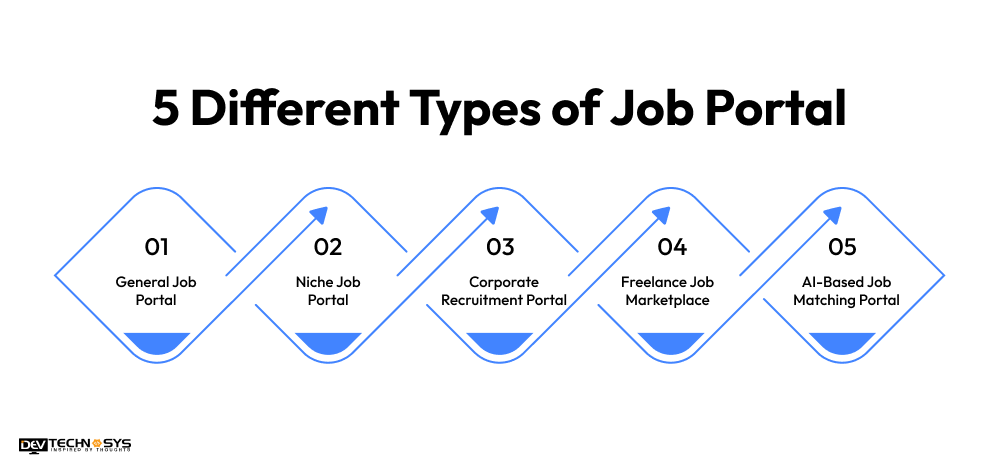
1. General Job Portal ($8,000 – $18,000)
The general job portal connects employers and job seekers across multiple industries and allows them to share their resumes and get updates if the profile is matched as per requirements.
It involves various types of features such as resume uploads, user profiles, job listings, search filters, and more. This is ideal for IT startups and small-sized recruitment businesses.
2. Niche Job Portal ($9,000 – $20,000)
The niche job portal mainly focuses on the specific industries like blockchain, healthcare, IT, and education. These niche job portal app development solutions include industry-specific filters, customized job categories, skill-based matching, and many more.
The niche job portal development cost can go higher because of the customization level, but it offers better targeting and higher user engagement.
3. Corporate Recruitment Portal ($12,000 – $22,000)
A corporate recruitment portal is developed to allow organizations to handle hiring in an efficient way. Features include applicant tracking, resume management, interview scheduling, and internal dashboards. Recruitment portals help streamline recruitment workflows, enhance the candidate experience, and integrate with HR systems.
4. Freelance Job Marketplace ($15,000 – $25,000)
Freelance job marketplace connects clients to a diverse pool of independent workers throughout many different industries. Features include job posting, bid systems, user profiles, user ratings, and secure methods of payment.
Platforms provide flexible opportunities for job seekers and facilitate remote working, while creating competition among independent contractors to showcase their skill set and help employers locate qualified candidates.
5. AI-Based Job Matching Portal ($20,000 – $28,000)
The AI job matching portal uses technology to provide job seekers with accurate job matches as far as job availability is concerned. The portal employs sophisticated algorithms to identify candidates for specific positions by reviewing resumes, skill sets, and job seeker preferences.
By implementing AI technology into their system, recruitment portals greatly improve hiring efficiency, minimize manual review of resumes, and improve user satisfaction.
5 Factors Affect The Job Portal Development Cost
There are various factors that highly affect the job portal development services cost, and those factors have the ability to change the overall development cost.
It includes the development team, maintenance phases, security parameters, design, and others. So, we provide detailed information about factors that impact the cost:
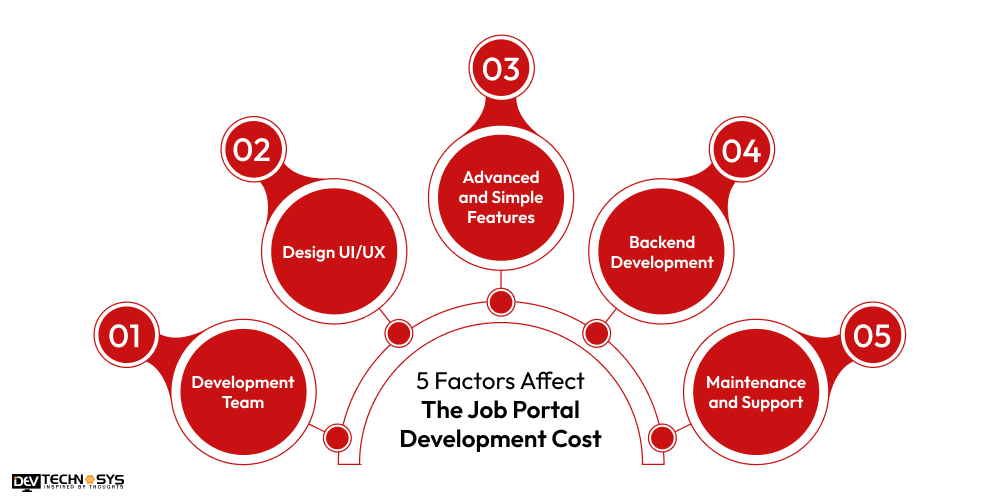
1. Development Team
Let’s move to the first factor; the development team is one of the most common factors that can easily affect the overall development cost. There are many experienced developers who demand higher salary packages, and businesses can’t afford their costs. If your project complexity is high, then you have to hire mobile application developers at hourly rate, but it can increase the overall expenses.
Developer’s Location |
Cost Estimation |
| Western Europe Region | $15,000 – $20,000 |
| North America Region | $16,000 – $20,000 |
| Eastern Europe Region | $14,000 – $19,000 |
| Asia Region | $8,000 – $14,000 |
2. Design UI/UX
The second factor is that the user interface must be user-friendly, allowing users or businesses to instantly access all the services and features. Designing resources include premium themes, complex templates, layouts, inbuilt plugins, and more.
These designing phases are higher-cost, and some of them are highly paid themes to implement in your portal. So, businesses have to choose the basic design to manage the overall cost budget of development.
Design Quality |
Cost Estimation |
| Simple Design | $8,000 – $14,000 |
| Mid-Premium Design | $14,000 – $18,000 |
| High-Premium Design | $19,000 – $21,000 |
3. Advanced and Simple Features
In this third cost-affecting factor, advanced features can affect the overall development because it has a higher cost to integrate. It includes various paid features such as account management, job posting, candidate matching, chat integrations, and personalized recommendations.
So, businesses have to select the features according to their requirements and choose the basic features to manage the fixed budget.
Features |
Cost Estimation |
| Simple Features(job alerts, job posting, and instant messaging) | $5,000 – $10,000 |
| Premium Features(Employers analytics and Interview scheduling) | $12,000 – $18,000 |
4. Backend Development
Let’s connect to the fourth factor: backend development highly impacts the cost of development because it has more resources to integrate for backend processing. It includes many implementation methods, such as third-party integrations, communication channels, and documentation management.
Businesses need to fix the backend integrations to reduce the cost. Otherwise, the cost of overall development is increased. So, let’s take a look at the below cost-affecting table:
Backend Development |
Cost Estimation |
| Simple Backend Process | $7,000 – $12,000 |
| Advanced Backend Process | $14,000 – $18,000 |
5. Maintenance and Support
The last factor is maintenance and support, which are the most common cost-affecting factors that can majorly impact job portal development costing. It includes many maintenance services that can take higher costs, such as updating outdated features, fixing bugs and glitches, add new complex features.
Support services also impact the cost, like the support team charges higher costs to manage the customer queries 24/7.
Maintenance Phase |
Cost Estimation |
| Basic Maintenance Phase | $2,000 – $3,000/year |
| Advance Maintenance Phase | $4,000 – $8,000/year |
What are the Hidden Costs of Job Portal Development?
When create a job portal website, there’s a lot to consider beyond your initial planning phase. The longevity of your job portal will be affected by several unseen factors, including maintenance and integration, security, and marketing.
Each of these elements will need to be addressed on an ongoing basis. If you know the overlooks these elements, you’ll be in a better position to prepare your business for the future and avoid any disruptions.
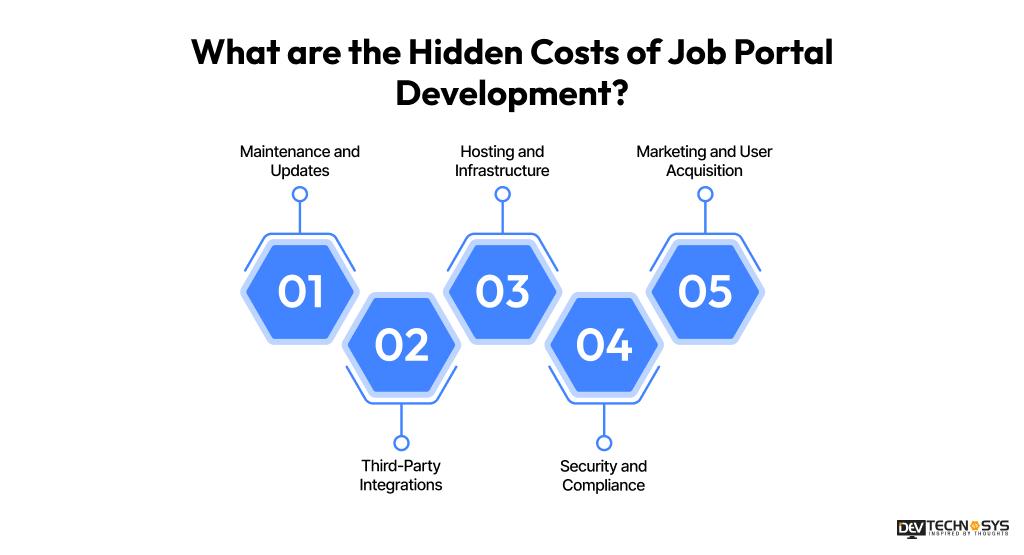
1. Maintenance and Updates
Ongoing maintenance costs are significant when developing a job portal. This includes regular updates to fix bugs, improve performance, and keep up with new technology.
Due to these ongoing costs, the job portal will incur additional expenses associated with security patches, feature enhancements, or monitoring the system. If too much time elapses without properly maintaining your job portal, it will experience a lengthy and painful degradation of efficiency and security.
2. Third-Party Integrations
Many job portals depend on third-party integration to function effectively. Account processing, email services, analytics, and APIs are common examples of these types of service integration.
Many of these services charge additional fees for subscriptions or usage, which will eventually incur additional costs over time. Additionally, additional costs will be incurred by having to manage and make changes to these service integrations.
3. Hosting and Infrastructure
The reliability of hosting services or infrastructure is crucial to the effectiveness of a job portal. As customer activity increases, host expenses also increase.
Additional costs will be incurred if running the job portal on cloud services without sufficient infrastructure planning. If proper infrastructure planning is not followed, the job portal will have decreased effectiveness due to insufficient performance, downtime, etc.
4. Security and Compliance
Data security and adherence to laws are often additional costs associated with running a job portal. Accessing the portal and storing information about individuals are all regulated, and because of that, job portals must encrypt their users, authenticate them with secure passwords, conduct internal and external audits regularly, and constantly monitor them for loss of data. Compliance with data protection takes additional work and expense.
5. Marketing and User Acquisition
Employers and job seekers are attracted to a job portal through ongoing advertising and promotional efforts. The common types of advertising used to acquire users for a job portal are digital ads, search engine optimization, content creation, and social media advertising.
Building a large base of users for a job portal takes time and requires constant investment. If effective marketing initiatives are not implemented on a job portal with a well-thought-out design.
The Cost To Develop a Job Portal in All Regions
The cost to build a job portal in all regions mainly depends on various factors such as features, functions, complexity, and development team. In many regions, there are different costs to create a job portal, and businesses can reach the different development agencies of different regions to build a platform on a cost-effective budget. So, let’s take a look at the many regions development cost:
1. Job Portal Development Cost In UK
Let’s start to discuss the cost to develop a job portal like Indeed in the United Kingdom. In the UK, there are many high-tech cities such as Manchester, Leeds, and Birmingham; there are higher living costs, so their developers demand higher salary packages as compared to small towns in the United Kingdom.
The technology can also impact the overall development cost because there are many tech stacks that charge higher costs to implement.
Portal’s Complexity |
Cost Estimation(in GBP) |
| Simple Portal Development | 6428 GBP to 9642 GBP |
| Mid-Premium Portal Development | 10446 GBP to 16071 GBP |
| High-Premium Portal Development | 20089 GBP+ |
2. Job Portal Development Cost In USA
Now, we talk about the cost to make a job portal in the USA. The cost mainly depends on the various robust factors like features, functions, complexity, development team, size of portal, and infrastructure.
There are many modern cities in the USA, such as San Francisco, New York City, Boston, and Chicago, which have higher costs of development because of higher living costs.
Portal’s Complexity |
Cost Estimation(in USD) |
| Simple Portal Development | $8,000 to $12,000 |
| Mid-Premium Portal Development | $13,000 to $20,000 |
| High-Premium Portal Development | $25,000+ |
3. Job Portal Development Cost In New Zealand
In this third section, the cost to build a job website or portal in New Zealand is based on the client’s specific requirements and needs. In New Zealand, there are many cities where the cost of overall job portal development is high compared to other small cities.
The cost can also depend on the complex design, security measurements, scalability, and testing methods. Let’s check the detailed cost in the table below:
Portal’s Complexity |
Cost Estimation(in NZD) |
| Simple Portal Development | 14152 NZD to 21228 NZD |
| Mid-Premium Portal Development | 22997 NZD to 35381 NZD |
| High-Premium Portal Development | 44226 NZD+ |
4. Job Portal Development Cost In Australia
Let’s connect to the fourth section: the cost to create a job portal website in Australia can fluctuate with various factors such as features, functions, complexity, infrastructure, and deployment platforms.
We discussed the cost of portal development in various cities of Australia, then many cities where the cost of development is too high as compared to small towns. So, let’s look at the cost table to get an idea of total cost estimation:
Portal’s Complexity |
Cost Estimation(in AUD) |
| Simple Portal Development | 12716 NZD to 19074 NZD |
| Mid-Premium Portal Development | 20664 NZD to 31791 NZD |
| High-Premium Portal Development | 39739 NZD+ |
5. Job Portal Development Cost In UAE
The job portal development cost in the UAE is basically based on crucial factors such as premium features, infrastructure, development cost, and many more.
Many high-tech cities in the UAE have higher living costs, which is why the developers demand higher salary packages as compared to small cities. So, businesses have to hire dedicated developers from small towns to build job portals on a cost-effective budget.
Portal’s Complexity |
Cost Estimation(in AED) |
| Simple Portal Development | 29384 AED to 44076 AED |
| Mid-Premium Portal Development | 47749 AED to 73460 AED |
| High-Premium Portal Development | 91825 AED+ |

6. Job Portal Development Cost In Saudi Arabia
In Saudi Arabia, the cost of a job portal is based on the cities of Saudi Arabia because there are many cities that have a higher cost of living. It includes many crucial resources such as security measurements, maintenance, networking, complexity, and infrastructure. Businesses must compare the cost of developers from different cities and, after that, hire developers at a lower cost.
Portal’s Complexity |
Cost Estimation(in SAR) |
| Simple Portal Development | 30000 SAR to 45000 SAR |
| Mid-Premium Portal Development | 48750 SAR to 75001 SAR |
| High-Premium Portal Development | 93751 SAR+ |
7. Job Portal Development Cost In India
Let’s talk about the cost to develop a job portal app like Dice in India; there are many factors that affect the cost of overall development. It involves a higher number of features and functions, the portal’s complexity, security techniques, testing methods, and more.
We offer the many cities in India and there are higher-cost developers, such as Banglore, Mumbai, and Pune. Developers demand higher costs to make a job portal.
Portal’s Complexity |
Cost Estimation(in INR) |
| Simple Portal Development | 693955 INR to 1040932 INR |
| Mid-Premium Portal Development | 1127677 INR to 1734888 INR |
| High-Premium Portal Development | 2168610 INR + |
8. Job Portal Development Cost In Japan
Moving to the eighth section, Japan is one of the countries with the highest technology in developing job portals with futuristic features and specifications. However, the concern is how much it costs to create a job portal.
There are many modern cities in Japan that have a higher living cost, which is why developers charge higher costs. So, hire mobile app developers from small towns to maintain a fixed budget. So, let’s look at the below cost table:
Portal’s Complexity |
Cost Estimation(in JPY) |
| Simple Portal Development | 1229092 JPY to 1843638 JPY |
| Mid-Premium Portal Development | 1997274 JPY to 3072730 JPY |
| High-Premium Portal Development | 3840912 JPY+ |
9. Job Portal Development Cost In Qatar
Qatar has been one of the growing countries in the last few decades. If you are planning to develop a recruitment app in Qatar, then go for it. But the first question that comes to people’s minds is, what is the cost of making a job portal?
There are many popular and high-tech cities in Qatar, and their developers demand higher salary packages because of higher living expenses. Check the below cost table for a detailed explanation of the cost:
Portal’s Complexity |
Cost Estimation(in QAR) |
| Simple Portal Development | 29124 QAR to 43686 QAR |
| Mid-Premium Portal Development | 47326 QAR to 72810 QAR |
| High-Premium Portal Development | 91012 QAR+ |
10. Job Portal Development Cost In Switzerland
As we talk about the cost to develop a job portal like Indeed, then Switzerland is another rapidly growing country with futuristic development solutions.
The cost is mainly based on essential factors such as higher complexity, a rich set of features, security parameters, maintenance services, and more. Many towns in Switzerland have lower development charges than modern cities. Businesses have to look at the below cost table:
Portal’s Complexity |
Cost Estimation(in CHF) |
| Simple Portal Development | 7307 CHF to 10961 CHF |
| Mid-Premium Portal Development | 11875 CHF to 18269 CHF |
| High-Premium Portal Development | 22836 CHF+ |
Planning a Mobile App?
Get a tailored development cost estimate in 3 simple steps — app basics, features, timeline, and your contact details.
- 3 quick steps
- 100% free
- Reply in 1 business day
2 Minutes Read
What is the Development Cost of Popular Job Portals in 2026?
Do you want to build a similar portal that is most popular in the market? But you have no idea what their cost is? This section offers the cost of popular job portals and helps businesses estimate the total job portal app development cost.
1. Job Portal Like LinkedIn
LinkedIn is one of the most popular and famous job portals across the globe. The cost to build a job portal app like LinkedIn is around $15,000 to $25,000; it can be complex due to its functionalities, such as AI recommendations, job listings, real-time feed, job matching, and global infrastructure.
2. Job Portal Like Glassdoor
Glassdoor is the world’s largest recruitment site that also enables employees to share reviews, interview questions, salary data, and other benefit information of a specific company.
The development cost of a job search app like Glassdoor lies between $12,000 and $23,000. It involves various types of features such as data verification, aggregation tools, and a review system.
3. Job Portal Like Naukri.com
Job portal app like Naukri.com is India’s biggest job recruitment portal, where job seekers can find their specific job role by using filters. The cost to build a job portal like Naukri.com ranges from $8,000 to $18,000; it can go higher because of premium features, services, backend processes, tech stacks, integrations, and functions.
4. Job Portal Like Indeed
The cost to develop an employment portal like Indeed is around $10,000 to $20,000 or more. It is a worldwide recruiting hub for recruiters and job hunters.
A job portal app like Indeed provides structured hiring processes, a scalable architecture, and integration with contemporary HR systems to deliver an efficient candidate experience across all sectors. It has many tools, such as enhanced job searching, AI matching, and resume parsing.
5. Job Portal Like Monster
A job portal like Monster is a robust employment marketplace that provides recruitment listings and services to both job seekers and employers. The overall development cost to build a job portal app like Monster starts from $13,000 to $23,000 or based on the requirements.
In addition to allowing potential applicants to upload resumes and set up alerts for new jobs. The platform also includes dashboards for employer recruiters and applicants, job alert notifications, and a variety of filtering options.
How To Reduce The Job Portal Development Cost?
To reduce the cost of job portal development , there are many ways that can easily reduce the overall development cost. Using free, open-source frameworks for robust development and integrating the basic functionalities that can easily complete the requirements. So, let’s look at the various reducing points:
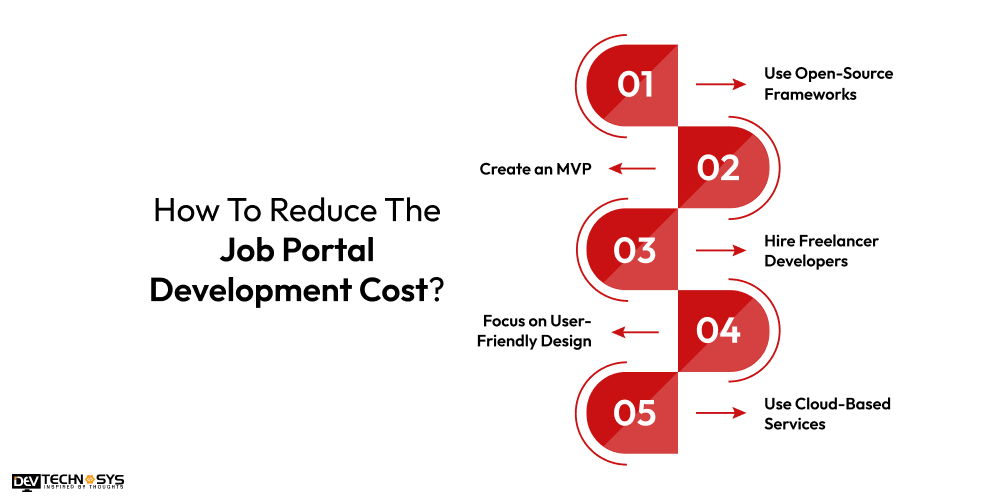
1. Use Open-Source Frameworks
Open-source frameworks help businesses develop their projects free of cost and perform advanced operations. They include various inbuilt tools for testing, development, and more.
These pre-built functions help developers integrate high-tech features easily, which can also save time. According to the Android app development company, open-source frameworks can be used to reduce the overall development cost.
2. Create an MVP
Let’s move to the second reducing factor. A Minimum Viable Product(MVP) mainly focuses on basic features and functions that can easily complete the requirements.
This factor can observe the users’ feedback and reviews before starting the development, and it can reduce the cost by integrating simple features and functions.
3. Hire Freelancer Developers
Hiring freelancer developers from a mobile app development company is one of the most common ways to reduce the overall development cost. You can hire developers as freelancers to complete your project, and first, you check your specific requirements to ensure that they are actually matched to the freelancer developer. Outsourced developers can charge less than professional developers.
4. Focus on User-Friendly Design
Let’s come to the fourth reducing factor, you have to focus on the user-friendly designs to reduce the development cost. Because user-friendly designs are simple and enable users to easily access the functions and services with just one tap. It includes various resources such as inbuilt templates, basic layouts, and plugins.
5. Use Cloud-Based Services
Moving to the last reducing cost factor, use cloud-based services to store users’ or businesses’ sensitive data. Cloud-based storage is cost-effective compared to physical hardware resources.
Users can instantly access the data from anywhere or any devices that are connected through the Internet. So, choose the cloud-based services to reduce the overall development cost.
5 Key Monetization Models of Job Portal
Job portals create revenue from various monetization structures that allow them to grow profitably and sustain continued success financially over time. A few examples of these monetization methods are job posting fees, subscription options, featured listings, access to resume databases, and commission-based hiring methods.
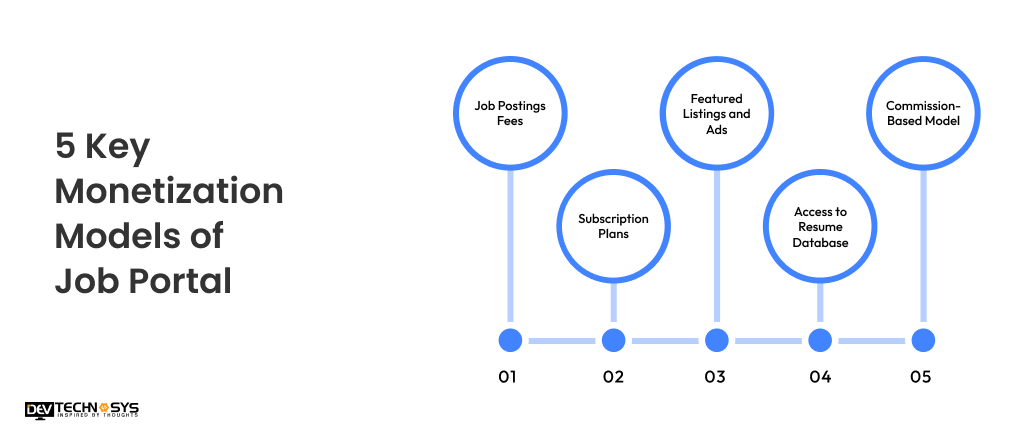
1. Job Postings Fees
Employers are charged a fee to place job ads on a job website. This fee structure provides consistent revenue because the employer will continue posting jobs throughout the year.
Factors such as the length of the job advertisement, the placement of the job advertisement, and the level of visibility associated with the job advertisement all impact how much the employer will pay for that advertisement.
2. Subscription Plans
Job portals have subscription plans available to recruiters for a monthly fee for continual access to job portal service offerings such as unlimited job listings, access to resumes of potential candidates, and other features of the job portal.
These subscription payments provide an in to predictable, recurring revenue, and create the foundation for establishing a long-term relationship between the employer and the job portal.
3. Featured Listings and Ads
Employers can pay to increase the visibility of their job listings (postings) and to advertise their company’s business on the job portal. The featured job listing will have greater visibility; as a result, the potential number of applicants will increase as well. Therefore, it is a win-win for employers and job portals, because both are able to monetize traffic from the job portal.
4. Access to Resume Database
Recruiters pay to access a database of resumes from potential candidates for their job openings. Recruiters can search and screen candidates from the database based on job skills, level of experience, and location.
According to the job portal app development firm, the database allows recruiters to save time in identifying candidates to interview and also provides another source of revenue for the job portal.
5. Commission-Based Model
When employers successfully hire a candidate through the platform, the employer pays a commission fee to the platform. As this fee is based solely upon performance, it creates an alignment between the platform’s success and employer results. Therefore, businesses are drawn to this model because they only pay for results, thereby providing them with a value-driven expenditure.
How Long Does it Take to Build a Job Portal in 2026?
If a job portal is built in 2026, it will take anywhere from a few weeks to several months (3-6) to develop a site, depending on the complexity of the site and the features that need to be included.
A basic version of the site can likely be developed fairly quickly, while an advanced version that includes AI capabilities, integrates with other software, and has room to grow will take more time. Additionally, well-planned projects include sufficient time for all areas of development.
Type of Job Portal |
Key Features Included |
Estimated Time |
| Basic (MVP) | Job posting, user registration, resume upload, search filters | 2 – 3 months |
| Mid-Level Portal | Employer dashboard, notifications, payment integration, analytics | 3 – 6 months |
| Advanced Portal | AI matching, real-time chat, video interviews, ATS integration | 6 – 9 months |
| Enterprise-Level | Multi-platform, high scalability, custom workflows, full ecosystem | 9 – 18 months |
Why is Budgeting Important for Your Job Portal Development?
When develop a recruitment app, budgeting is an essential element of project development, as it facilitates resource allocation and minimizes the potential for overspending. Budgeting provides a clearly defined scope of work, identifies high-priority features, and enables effective planning at each stage of the development process.
The availability of a clear budget allows for improved decision-making in the selection of technology, developers, and tools. Budgeting reduces the risk of financial loss due to delays while ensuring quality.
It is also utilized by businesses to develop future maintenance plans, upgrade plans, and scalability plans to maintain the efficiency, competitiveness, and sustainability of the platform in the future.
You can reach out anytime; we are available 24/7. Our team provides a quick response.

Conclusion
Now, we are in the last phase of this blog. We have provided detailed information about the cost of job portal development in all regions. After reading this blog, businesses can get an idea of how much it costs to build a job portal in all regions and easily build a portal within a cost-effective budget. We have also explored what factors can greatly affect the cost of job portal development and how to reduce the overall development cost.
To know more about the cost of job portal development, you can directly connect with our on-demand app development company to deliver detailed information about the cost.
Frequently Asked Questions
Find answers to the most common questions related to this article.
The cost to create a job portal ranges from $8,000 to $25,000 or more, depending on the specific requirements and needs. It also depends on various factors such as the project’s complexity, premium features, size, infrastructure, development team, and more.
Building a job portal takes 3 to 9 months overall, depending on factors such as the developer's working hours, the number of features, the project’s requirements, and more.
There are many factors that affect the cost to make a job portal; here we provide the list of factors:
Development Team
Design UI/UX
Platform Choice
Technology Stack
Maintenance and Support
Testing and Quality Assurance
To reduce the cost of job portal development there are various ways that are able to reduce the cost; let’s take a look at the below points:
Build an MVP
Hire freelancer developers
Integrate cloud-based services
Use open-source frameworks
Focus on user-friendly design