



















Quick Cost Summary for HIPAA-Compliant Software Development
Overall Cost Range:
HIPAA-compliant software development typically costs $30,000–$1,50,000+, depending on complexity, security requirements, integrations, and compliance needs.
Cost by Complexity:
-
- Basic HIPAA-compliant Software: $30,000–$50,000 (secure login, patient data management, basic dashboards)
- Mid-Level HIPAA-compliant Software: $50,000–$90,000 (EHR/EMR integration, role-based access, audit logging, secure API development)
- Advanced HIPAA-compliant Software: $90,000–$1,50,000+ (advanced analytics, telehealth, AI features, complex integrations)
Key Cost Factors:
-
- Software complexity, HIPAA compliance, security architecture, integrations, UI/UX, cloud infrastructure, and platform selection.
Development Timeline:
-
- A HIPAA-compliant software solution generally takes 4–10 months to design, develop, test, and launch.
Additional Costs:
-
- Budget for compliance audits, security testing, cloud hosting, maintenance, updates, monitoring, and ongoing compliance management.
Imagine a healthcare app working perfectly until a minor security breach puts patient data at risk. This is where HIPAA-compliant software makes a heroic entry.
In this highly digitalized world full of security risks, understanding HIPAA-compliant software development cost is crucial for healthcare businesses. It is not just about coding cost, but about building security, privacy, compliance, and scalability.
The standard cost to develop HIPAA-compliant software is estimated between $30,000 and $1,50,000. It depends on software complexity, required features, integrations, security architecture, and compliance requirements.
This guide walks you through multiple segments beyond development cost to calculate total investment. Join us for a cost breakdown to plan your HIPAA-compliant software development investment with confidence.
HIPAA-Compliant Software: What It Is and Why It Matters
HIPAA-compliant software is a platform storing, processes, and transmits Protected Health Information (PHI). This is done in line with the Health Insurance Portability and Accountability Act. It secures all information related to patients’ identities and health status. It also includes:
- Data encryption
- Access controls
- Secure database
- AES-256 encryption
- TLS encryption
- Audit logs
- Secure authentication
- Regular security monitoring
- Data privacy and integrity
Healthcare businesses with HIPAA compliance create a safer digital environment to build patients’ trust while reducing regulatory risks.
Why it Matters?
With growing technological advancements, security-related issues also rise; therefore, compliance is mandatory, not an option. Every company, whether small or enterprise-level, that handles PHI should comply with HIPAA’s Privacy and Security Rules.
Technically, a HIPAA-compliant software architecture is designed to protect PHI access controls in healthcare software, database, API, and infrastructure layers. A well-planned healthcare software architecture also ensures that security and compliance remain scalable as the platform grows.
Patient data always remains at risk with non-compliant software. HIPAA-compliant EMR software development solutions protect your organization from legal penalties, breach costs, and loss of trust.
What Makes HIPAA-Compliant Software More Expensive Than Regular Apps?
Regular healthcare software has to work on performance, UI/UX, and a user-friendly interface. Whereas HIPAA-compliant healthcare software needs to do the same but also protect patient data. This single difference changes the HIPAA-compliant healthcare app development cost, testing, maintenance, and timeline. It uses role-based access control (RBAC), encrypted communication, single sign-on (SSO), and secure authentication to protect patient data.
HIPAA software development cost and timeline are higher because they include security controls, stricter testing, and ongoing compliance. A normal healthcare app skips these steps; that’s why it can be launched faster and cheaper. Let us understand what exactly adds up to the overall HIPAA-compliant software cost.
- end-to-End Encryption
- Access Controls and Audit Logs
- Secure Hosting
- Data Backup and Disaster Recovery
- Third-Party Risk Management
- Regular Audits and Risk Assessments
- Staff Training
Planning a Healthcare App Project?
Get a tailored development cost estimate in a few simple steps.
- 3 quick steps
- 100% free
- Reply in 1 business day
2 Minutes Read
Average HIPAA-Compliant Software Development Cost by Business Size, Complexity, and Scope
The typical HIPAA-compliant app development cost ranges from $30,000 to $1,50,000. The overall development expense is determined by the platform’s complexity, business size or level, and scope type. Have a look at the HIPAA software development cost breakdown on this basis for a better understanding before investing.
-
HIPAA App Development Cost By Complexity:
The overall cost to develop a hospital management system software that is HIPAA-compliant is influenced by the platform’s complexity. Complexity is determined by integrations, backend infrastructure, platform choice (single-platform vs. cross-platform), the number of features, and other factors. We will explain this through a HIPAA compliance cost table.
Complexity Level |
Cost Range |
Features & Integrations |
Security & Compliance |
Infrastructure & Scalability |
| Basic / MVP | ₹30,000-$70,000 | Limited features, basic APIs | Standard HIPAA safeguards | Basic cloud infrastructure |
| Mid-Level | $70,000-$90,000 | More features, EHR/EMR & third-party integrations | Advanced access controls, audit logs | Scalable backend & cloud setup |
| Advanced / Enterprise | $90,000-$1,50,000 | Complex workflows, AI, telehealth, multiple integrations | Advanced security, activity monitoring & compliance controls | High-performance, multi-system architecture |
-
HIPAA Healthcare Software Cost By Business Size:
A clinic and hospital want different apps because they solve different problems. A clinic manager manages patient data in one location, whereas a hospital manages it across locations and departments. So a HIPAA-certified telehealth software development company develops and prices both differently.
Business Size |
Estimated Cost |
Users & Workflows |
Integration Needs |
Cost Impact |
| Small Clinic / Practice | $35,000-$65,000 | Limited users and simple workflows | Few integrations | Lower |
| Mid-Sized Healthcare Business | $65,000-$1,00,000 | More users and complex workflows | Multiple healthcare integrations | Moderate |
| Large Hospital / Healthcare Network | $1,00,000-$1,50,000+ | Large user base and complex workflows | Multiple systems and locations | Higher |
-
HIPAA-Compliant Healthcare App Cost By Scope Type:
The HIPAA software development pricing by scope type means how much of the app you are building right now. This is different from complexity because even a complex app can be built in stages. We will now understand the cost breakdown by scope type.
Scope Type |
Development Focus |
Estimated Cost |
| Single-Module Scope | One focused healthcare workflow or standalone module developed for a specific use case | 15,000– 30,000 |
| Multi-Module Scope | Several connected workflows developed as one product with shared data and user journeys | 30,000–70,000 |
| End-to-End Scope | Complete healthcare ecosystem covering the full workflow from onboarding to ongoing care management | 70,000–150,000+ |
7 Key Factors Influencing HIPAA-Compliant Software Development Cost
Number of patients’ data, developer’s location, their experience, and third-party API integration are among the major factors affecting HIPAA-compliant software pricing. Understanding these factors will help you plan the development budget more securely and decisively.
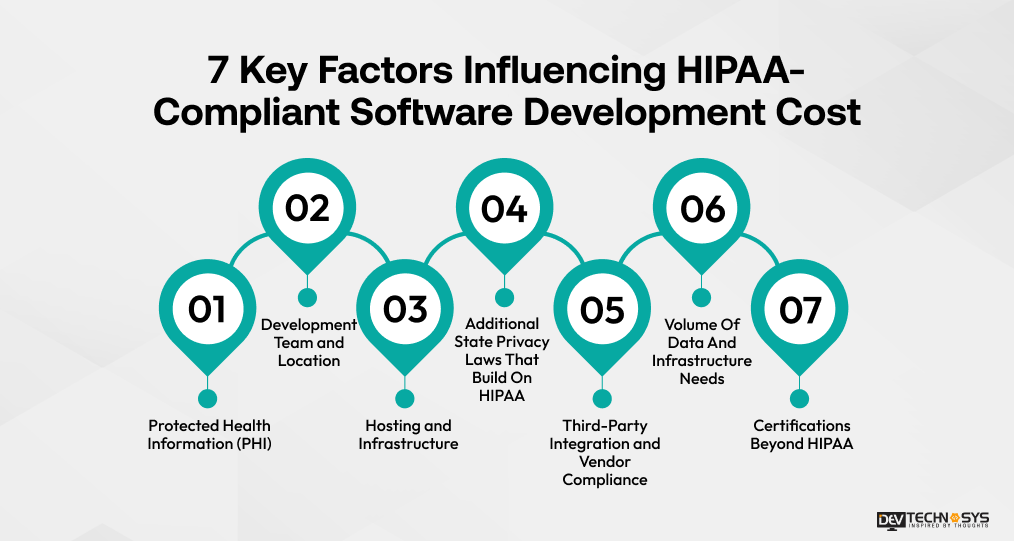
1. Protected Health Information (PHI)
PHI protects the patient’s information, such as names, diagnoses, and medical records. An app that only shows the appointment time is cheaper to secure. Whereas an app that stores more sensitive data, like lab results or therapy notes, requires more security work. This increases the cost of HIPAA-compliant custom software development services.
2. Development Team and Location
It would cost more to hire a US-based internal team than to engage a reliable outsourced or offshore team. Many companies save a lot of money by hiring an experienced outsourcing or offshoring team. This helps avoid rework and compliance issues but raises the HIPAA-compliant software pricing.
3. Hosting and Infrastructure
Regular cloud hosting will not be enough for storing PHI. You have to find a HIPAA-qualified hosting provider like AWS or Azure and sign a Business Associate Agreement (BAA). Cloud computing through HIPAA-compliant cloud hosting can support scalability. Services covered under AWS HIPAA compliance, Microsoft Azure HIPAA compliance, or Google Cloud HIPAA compliance require proper configuration and security controls. This hosting would be more expensive than regular hosting, but it is required.
4. Additional State Privacy Laws That Build On HIPAA
HIPAA serves as a baseline, but there are additional state-level regulations above it. If you have business activities in such states, the scope of your compliance becomes broader.
- Washington’s My Health My Data Act: It covers health-related data not covered by HIPAA. Such data includes applications related to wellness and reproductive health.
- California’s CMIA: It introduces additional requirements for consent and disclosure of medical information by non-covered entities.
- Texas HB300: It expands HIPAA-type obligations on other types of businesses than those introduced by federal law.
These state-wise compliances can elevate the cost to build HIPAA-compliant software.
5. Third-Party Integration and Vendor Compliance
A separate compliance process and a signed BAA for every single API interacting with the PHR, EHR, payments, labs, etc, is needed. According to a healthcare app development company, more integrations mean more vendors to obtain compliance from. These integrations may use a REST API or GraphQL API, while healthcare interoperability may require HL7 integration or FHIR integration.
6. Volume Of Data And Infrastructure Needs
More data stored means you need more backup and retention infrastructure. An application that holds a history of patient records and images increases the cost to build a HIPAA-compliant app. Whereas an application that simply holds the appointment schedule. As data volumes increase, businesses may also require data loss prevention (DLP) and a secure database to protect sensitive healthcare information.
7. Certifications Beyond HIPAA
Sometimes our clients or partners have additional certification requirements beyond HIPAA compliance, such as SOC 2 or HITRUST. While it is optional and not required for HIPAA compliance, it is still very expensive to get if needed.
Factor |
Cost Impact |
When It Costs More |
| PHI Handling & Protection | +10–15% | More sensitive patient data and stricter access controls |
| Team & Development Location | +20–25% | Larger teams or higher-cost development regions |
| Hosting & Infrastructure | +10–18% | HIPAA-ready cloud, backups, activity monitoring, and disaster recovery |
| Additional State Privacy Laws | +5–10% | Compliance with multiple state-level privacy requirements |
| Third-Party Integrations | +10–20% | More EHRs, APIs, payment systems, or external vendors |
| Data Volume & Infrastructure | +10–15% | High patient-data volumes and growing storage requirements |
| Certifications Beyond HIPAA | +5–10% | SOC 2, ISO 27001, HITRUST, or other compliance requirements |
How Much Does HIPAA-Compliant Software Cost by App Type?
The cost to develop a HIPAA-compliant app varies by type. Patient portal, telemedicine, telehealth, and medical billing software are some of the types of healthcare platforms. The HIPAA software development expenses vary because different apps involve different security, integration, and workflow requirements. With the changing types, the features, data flows, integrations, infrastructure, and compliance requirements also change. We will now discuss the different types and their development budget.
App type |
Typical features |
Estimated cost |
| Patient portal | Appointment booking, secure messaging, records access | $30,000 – $90,000 |
| Telehealth app | Video consultations, e-prescriptions, payment integration | $60,000 – $110,000 |
| Mental health/therapy app | Session booking, secure video, mood tracking, provider notes | $40,000 – $1,00,000 |
| Medication management app | Prescription tracking, refill reminders, pharmacy integration | $35,000 – $85,000 |
| Remote patient monitoring | Wearable device integration, real-time alerts | $70,000 – $1,20,000 |
| Medical billing software | Insurance claims, payment processing, compliance reporting | $50,000 – $1,10,000 |
| Health insurance/claims app | Plan management, claims submission, eligibility verification | $60,000 – $1,15,000 |
| EHR/EMR software | Full patient record management, provider access controls | $65,000 – $130,000+ |
| Hospital management system | Multi-department access, EHR integration, staff scheduling | $75,000 – $1,45,000 |
HIPAA Software Total Cost of Ownership: 3-Year Breakdown
The build cost is only one component of HIPAA compliance software total price. There are additional annual costs that occur once the software is launched. Even though they are not accounted for in many cost estimates.
Year |
What it covers |
Estimated cost |
| Year 1 (build) | Development, testing, launch, initial compliance setup | $30,000 – $150,000+ |
| Year 2 (maintenance) | Risk assessments, staff training, minor updates, hosting | $8,000 – $25,000 |
| Year 3 (maintenance) | Risk assessments, BAA renewals, penetration testing, updates | $10,000 – $30,000 |
Additional recurring costs include
- Annual risk assessments
- Employee training
- BAAs with every vendor that has access to PHI
- Cybersecurity insurance
It is very common for companies to prepare a budget for the build cost but not account for annual costs that may amount to 15-20% of the initial build cost.
Are you planning ahead for the full 3-year cost to avoid unpleasant surprises in your budget? Discuss the realistic 3-year compliance budget with our team.
How Do Proposed HIPAA Security Rule Controls Affect Development Costs?
While planning to build HIPAA-compliant software in 2026-2027, businesses should look beyond today’s requirements. The upcoming updates to HIPAA security rules place strong attention to multiple areas. It strengthens risk management, encryption, authentication, incident response, and security monitoring. These controls can significantly influence the HIPAA risk assessment cost, development scope, and timeline.
Proposed Security Control |
Potential Cost Impact |
Why It Matters |
| Risk Analysis & Asset Inventory | +3–7% | Identifies vulnerabilities and tracks systems handling ePHI |
| Encryption & Data Protection | +5–10% | Protects ePHI during storage and transmission |
| Multi-Factor Authentication (MFA) | +3–6% | Strengthens access security for users and administrators |
| Network & System Monitoring | +5–10% | Helps detect suspicious activity and security incidents |
| Incident Response & Recovery | +4–8% | Supports faster response to breaches and system failures |
| Vulnerability & Penetration Testing | +3–7% | Identifies security weaknesses before attackers exploit them |
| Backup & Disaster Recovery | +4–8% | Protects healthcare data against loss and operational disruption |
HIPAA Audit Cost: What Healthcare Businesses Should Know
The HIPAA audit cost in 2026-2027 can range between $5,000 and $20,000. This cost depends on the company’s size, the complexity of its software, and the number of systems to be audited. It is not just an effort to comply; it helps healthcare companies in many ways. It identifies vulnerabilities that may compromise the confidentiality of patient data.
The audit cost is included in the HIPAA-compliant software development pricing model. When it comes to a healthcare software application, the audit can include evaluating:
- PHI processing
- Access controls
- Encryption
- Audit trails
- Risk assessments
- Security policies
- Vulnerability testing
- Integration with third-party solutions
Here is the HIPAA audit cost breakdown explained through a table:
Audit Scope |
Estimated Cost |
Typical Coverage |
| Basic Assessment | $5,000-$10,000 | Policies, risk review, basic security checks |
| Standard Audit | $10,000-$18,000 | Risk assessment, technical safeguards, documentation, testing |
| Comprehensive Audit | $18,000-$25,000+ | Extensive testing, integrations, remediation, detailed compliance review |
Many modern businesses require auditing regularly, at least once a year. It is not just a matter of before launch. According to the U.S. Department of Health and Human Services, roughly 90% of HIPAA security rule enforcement actions. Saving money by skipping this step can be really dangerous for the app’s long-term. The budget for it should be part of your compliance plan, not damage control after something goes wrong.
Planning a Mobile App?
Get a tailored development cost estimate in 3 simple steps — app basics, features, timeline, and your contact details.
- 3 quick steps
- 100% free
- Reply in 1 business day
2 Minutes Read
How Much Can HIPAA Non-Compliance Cost Your Business?
While HIPAA compliance may seem like an additional development cost, making a mistake can prove much more expensive. A violation will lead to fines, a response to a breach, legal fees, upgrades to your system, and loss of patients’ trust. It means your HIPAA compliance budget will become an unexpected extra cost for you.
It is evident from recent cases of enforcement that HIPAA violations are very expensive:
HIPAA Failure |
Potential Consequence |
| Poor Risk Analysis | Higher exposure to breaches, penalties, and corrective actions |
| Weak Access Controls | Unauthorized access to sensitive patient information |
| Inadequate Encryption | Greater impact when data is lost or compromised |
| Delayed Breach Response | Additional investigation, notification, and remediation costs |
| Improper PHI Handling | Regulatory action and potential financial penalties |
| Failure to Address Known Risks | Increased penalties and long-term compliance oversight |
In addition to HIPAA fines, businesses may be required to pay for forensic investigations, notifications to affected individuals, credit monitoring services, legal representation, remediation of security issues, employee training, and ongoing compliance monitoring.
Expert Advice: For healthcare startups, clinics, hospitals, and software developers, the wise solution is to develop your product with HIPAA compliance in mind and avoid spending money on the aftermath of a breach.
Mohit Nag (CTO at Dev Technosys)
How to Reduce HIPAA-Compliant Software Development Costs Without Cutting Corners?
Businesses think the only way to reduce healthcare software development cost is to remove features. According to a healthcare app development company, the HIPAA-compliant SaaS development cost can be reduced by planning compliance from the beginning.
Expensive reworks, data migration, and additional testing are required to retrofit encryption, access controls, audit trails, or a compliant infrastructure. Businesses should prioritize essential features, the right technology, and limit unnecessary integrations.
We have also explained some ways that are really important to follow. This will help you lower your HIPAA-compliant software cost estimate.
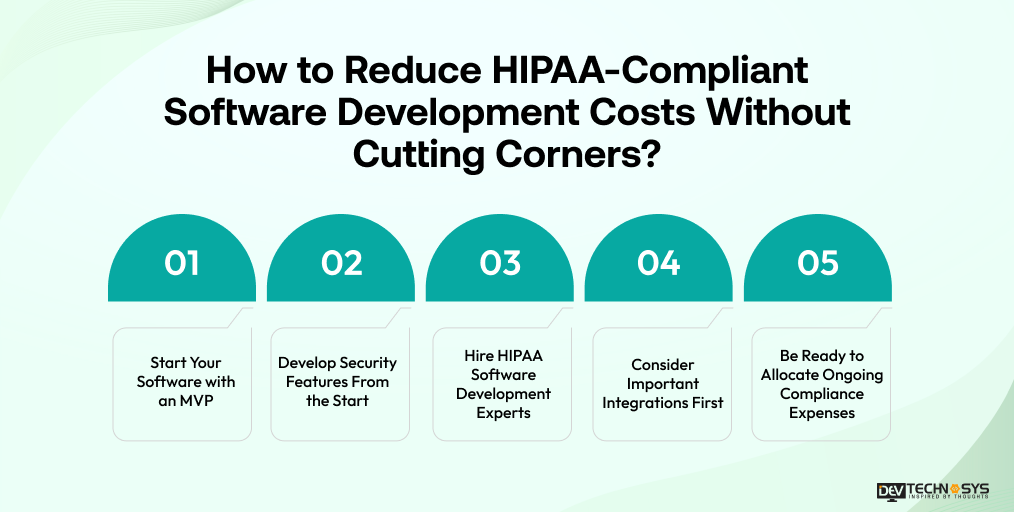
1. Start Your Software with an MVP
Start the development with essential HIPAA-compliant features instead of trying to develop all of them at once. The MVP allows you to minimize upfront development costs. This gives companies the ability to validate their product and gather user feedback.
2. Develop Security Features From the Start
Integrate encryption, access controls, logging, authentication, and other security measures to handle data from the very start of the process. Developing these controls from the beginning will help you avoid expensive architectural changes, data migrations, and security reworks.
3. Hire HIPAA Software Development Experts
The team of HIPAA experts will minimize your risks and unnecessary expenses associated with making compliance mistakes. They have knowledge of compliance and security architectures that will allow you to avoid rework.
4. Consider Important Integrations First
Each new healthcare integration involves development, testing, security, and compliance challenges. Focus on essential integrations for the initial release, adding new EHRs, payments, APIs, or other third-party components as the platform evolves.
5. Be Ready to Allocate Ongoing Compliance Expenses
HIPAA compliance does not end after your software launches. Think about security assessments, monitoring, maintenance, employees’ training, and updates of infrastructure. All of these have to be done continuously in advance.
Award & Recognition
EIN Presswire has recognized Dev Technosys as a top mobile app development company. It states that we emphasize social integration, customization, analytics, user feedback, target audiences, speed, simplicity, competition, downloads, and delivering real user value. The overall focus is creating user-friendly, relevant, and high-performing mobile applications.
Final Words
The real power of HIPAA-compliant software lies not only in its creation. It offers healthcare organizations the ability to innovate without compromising patient privacy. Whether it’s simple clinic software or an entire healthcare enterprise software, every technical decision you make affects security.
Therefore, instead of asking, “How can I make HIPAA software cheaper?”, consider, “How can I make a wise investment without accumulating security or compliance debt?”
With proper architecture, a HIPAA-compliant software development company, and a compliance strategy, you can make your software HIPAA-compliant. But doesn’t end here; it’s also ready to grow with you.
Frequently Asked Questions
Find answers to the most common questions related to this article.
That doesn't always apply. If your healthcare app is developed for a covered entity or business associate and uses Protected Health Information (PHI), it falls under HIPAA. Just storing any health-related data won't make every app subject to HIPAA rules. But if your application is going to process PHI on behalf of some healthcare organization, compliance with HIPAA will be necessary.
Fixing an app that is not HIPAA-compliant to make it HIPAA-ready can be more expensive than planning for HIPAA from scratch. This can add 20-40% to your development budget, depending on the app architecture and current security gaps. You will need to pay for rearchitecture, encryption, access control, audit logging, data migration, testing, and certification of compliance
The easiest way is to create a simple MVP of the app first. Start by building the core features and necessary HIPAA controls, then gradually add functionality. In this case, you will spend less money, but also have a chance to test your product with real users. Avoid unnecessary integrations at the very beginning.
Yes. Not all startups need to build their HIPAA-compliant healthcare platform from scratch. It depends on the functionality, integration options, and required level of protection. The average HIPAA-compliant MVP development cost ranges from $30,000 to $65,000. By starting small, you can manage your expenses while laying a solid foundation that can be scaled as your user base and revenue grow.
No. The usage of such cloud providers as AWS or Azure doesn't ensure that your application will be HIPAA-compliant out-of-the-box. The thing is, these companies offer HIPAA-compliant solutions, but their implementations should be properly configured and secured by your developers. There is also the question of the required agreements and access controls.