











Key takeaways:
-
- To build a food delivery app consists of various steps, such as market research, collecting project requirements, tech stacks, design, development, testing, publishing, and maintenance.
- Popular meal delivery platforms such as Zomato, Deliveroo, DoorDash, Uber Eats, Swiggy, Grubhub, Seamless, and many more.
- Food delivery apps generate higher revenue streams by using legal monetization models such as subscription plans, freemium models, delivery fees, transaction fees, and advertising.
- Implement the advanced features such as order customization, real-time order tracking, multiple payment options, user-friendly interface, secure authentication, and more.
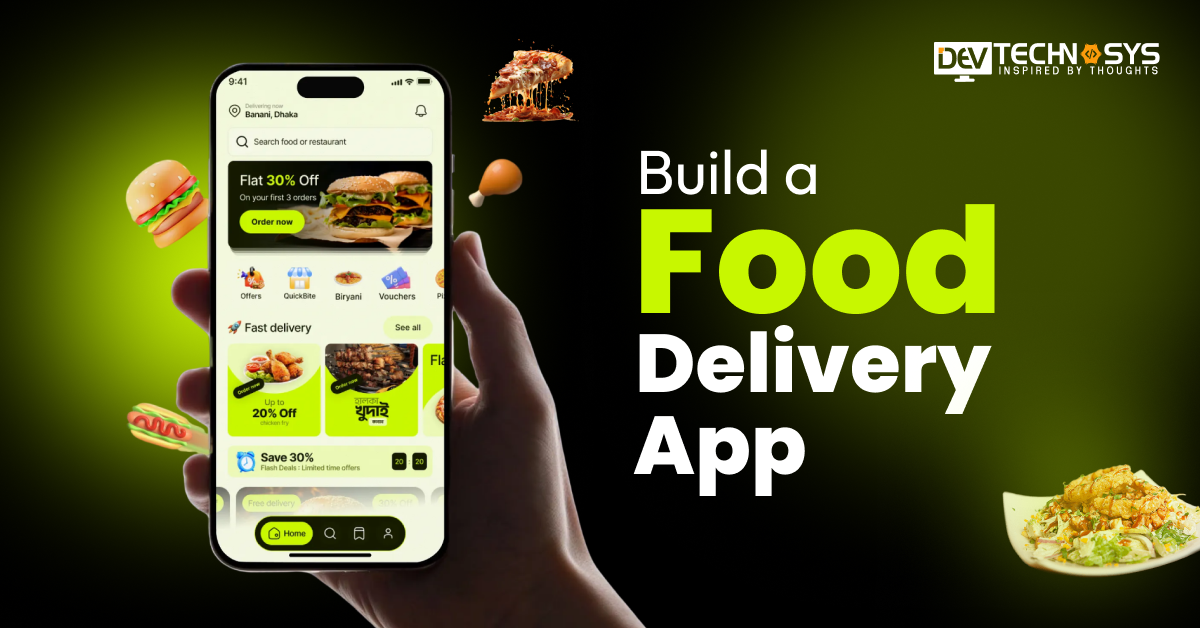
As of 2026, it’s now easier than ever to build a food delivery app that will live up to how quickly things change in today’s fast-paced world. Not only do people order food via apps, but they also demand speed and personalization, along with an easy and seamless user experience from the moment they open your app until they actually receive their order.
One can only imagine how busy we all are. Also, people tend to eat later, and let’s be honest. So convenience is often explored after, and this is what is influencing this modern trend.
Your application may be able to resolve actual issues by offering faster or more personalized delivery, better recommendations, and a greater variety of options that support healthier living. In this blog, we will provide a clear business direction, creativity, and desire to research things, which are all that’s needed to start bringing your food delivery app idea to fruition!
Current & Future Market Projections of Food Delivery Apps
- According to Statista, the food delivery apps market is valued at around $1.51 trillion in 2026. This is projected to increase to around $2.05 trillion by the end of 2031.
- As claimed by Fortune Business Insights, looking at the payment method-wise, the online payments hold around 68% market share of food ordering applications.
- In keeping with Statista, the user penetration in the food delivery apps market is around 29.2% in 2026.
- The worldwide meal delivery service platforms’ revenue shows a rapid growth with a CAGR of 6.24% during the forecast period from 2026 to 2031.
- In agreement with Businessofapps, China is the fastest-growing country or region in the takeout delivery service market, with around $40.02 billion in 2026.
What is a Food Delivery App?
A food delivery application is a mobile or web-based platform where customers can connect with local restaurants, grocery stores, and cafes to order food and deliver it to their doorsteps. Customers can also pick up their order and book a dine-in via the app.
Top food delivery apps offer a wide range of restaurants or cafes for users to order food items from their favorite restaurant. They provide real-time order tracking features that make it easy for users to get the real-time order status.
How Does a Food Delivery App Work?
To use the full potential of a food delivery app, you must know how the application works and what services they actually offer. Let’s take a view at the following steps to know the working criteria:
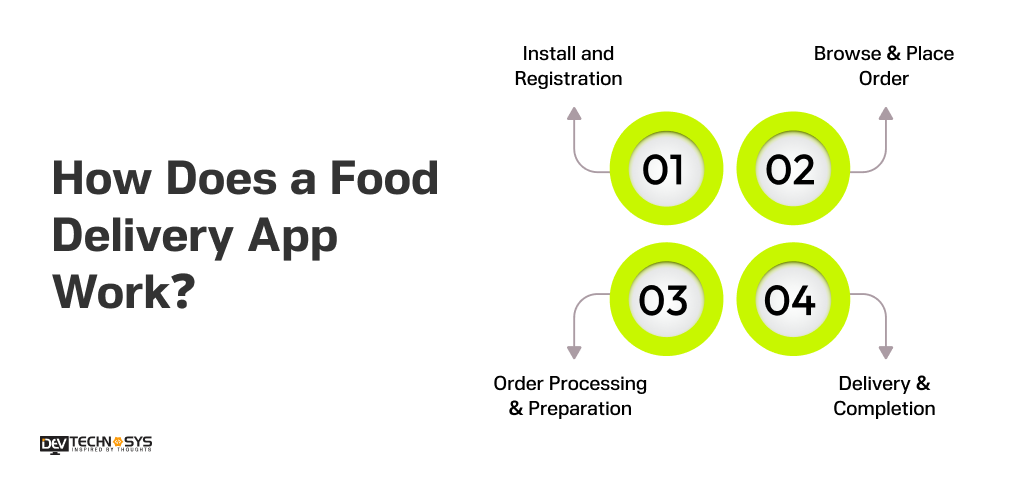
1. Install and Registration
First of all, install the food delivery app as you want and register your account via phone numbers, email address, social media platforms, and more.
2. Browse & Place Order
Users browse the wide range of restaurants and select their favorite restaurant. Choose the food item that users want to order, move to the cart, apply offers or coupons, and complete the payment.
3. Order Processing & Preparation
The food ordering platform sends the order to the restaurant, and they confirm the order and start to prepare the food. The app assigns a delivery partner to deliver the order on time.
4. Delivery & Completion
The delivery partner picks up the order from the restaurant and delivers it to a specific location. Users can track the delivery in real-time and send feedback and ratings.
Industry Insights: According to PW Consulting, around 70% of digital ordering users now prefer mobile apps over phone or website ordering for food delivery, indicating that mobile is the dominant user interface.
5 Different Types of Food Delivery Applications
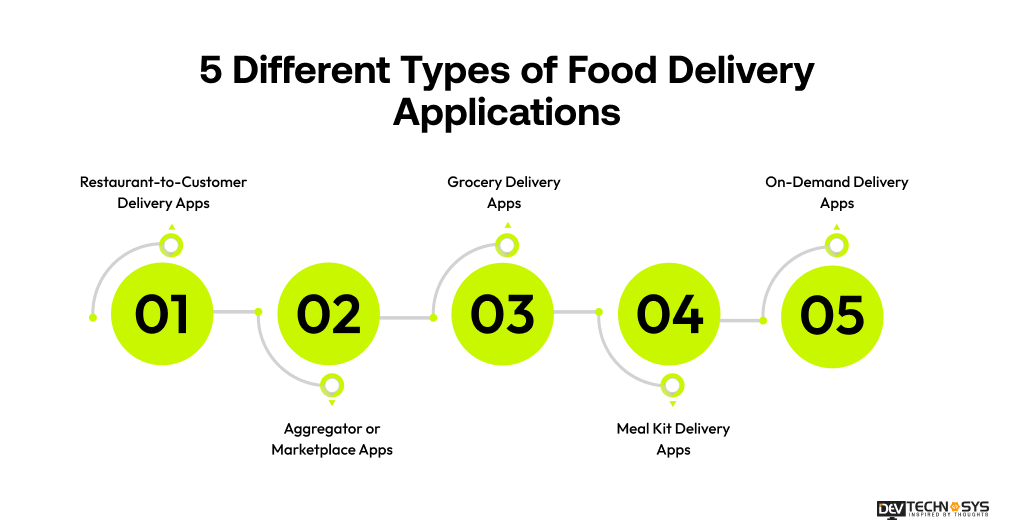
The five major categories of food delivery apps are: restaurant, aggregator-wide delivery, grocery, meal kit, and hyperlocal. These creative applications are changing the way we order, cook, and enjoy food at home conveniently in many ways.
1. Restaurant-to-Customer Delivery Apps
Apps that operate restaurant chains and provide customers with the ability to order from restaurants that are closest to them. Users can browse through the menu, place their orders, and track deliveries, all of which create convenience and give restaurants the ability to control the quality of their food from the time it leaves the restaurant until it arrives at the customer’s door.
2. Aggregator or Marketplace Apps
These apps provide customers with a single point of entry to multiple restaurants from across all types of cuisines by allowing them to place orders and track the delivery of their food through various restaurants. They also provide customers with ratings, reviews, promotions, and order tracking.
3. Grocery Delivery Apps
Grocery delivery app development solutions that allow users to shop for groceries and other basic food products at home without having to visit a physical store. These apps also allow users to view in-store inventory, schedule a delivery, or have their groceries delivered the same day.
4. Meal Kit Delivery Apps
These apps provide users with easy-to-prepare recipes and pre-measured ingredients to use when preparing a meal. Customers can prepare fresh meals with no prior cooking experience required, which decreases food waste and encourages cooking at home while also offering convenience to those who want variety in their cooking.
5. On-Demand Delivery Apps
An app that delivers food, beverages, or snacks to customers quickly within a relatively short distance of the restaurant. The on-demand app development solutions promise quick delivery, often within a matter of minutes, and operate with gig workers or couriers to meet customers’ immediate cravings and/or needs; examples include Uber Eats and DoorDash.
Top 10 Food Delivery Applications
There are thousands of food delivery apps available in the market, but choosing the best one for food ordering services. Offering 10 popular apps for food delivery with their user downloads, launch year, platform availability, and ratings:
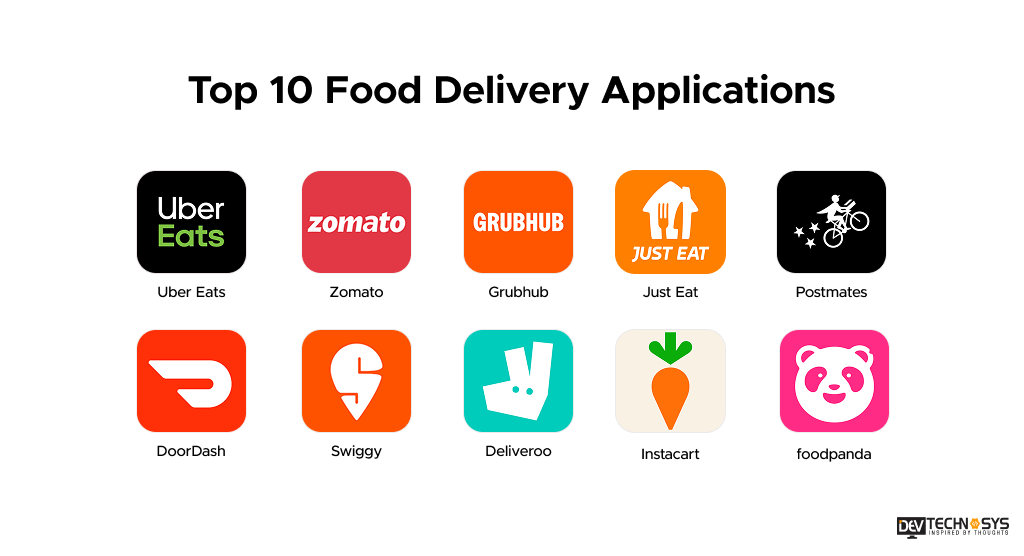
| App Name | Approx. Downloads | Launched Year | Rating | Platform Availability |
| Uber Eats | 100M+ | 2014 | 4.8/5 | iOS, Android, Web |
| DoorDash | 50M+ | 2013 | 4.7/5 | iOS, Android, Web |
| Zomato | 100M+ | 2008 | 4.6/5 | iOS, Android |
| Swiggy | 100M+ | 2013 | 4.7/5 | iOS, Android |
| Grubhub | 10M+ | 2004 | 4.6/5 | iOS, Android, Web |
| Deliveroo | 10M+ | 2013 | 4.7/5 | iOS, Android |
| Just Eat | 10M+ | 2001 | 4.5/5 | iOS, Android |
| Postmates | 10M+ | 2011 | 4.6/5 | iOS, Android |
| Instacart | 10M+ | 2012 | 4.6/5 | iOS, Android |
| foodpanda | 100M+ | 2012 | 4.4/5 | iOS, Android |
1. Uber Eats
Uber Eats is one of the leading and most popular food delivery platforms across the world, and it was launched in 2014 by Travis Kalanick and Garrett Camp. Uber Eats connects users with local restaurants and grocery stores to order food items or meals and delivers them to their preferred location. It includes features like real-time order tracking, delivery options, diverse selection, and more.
2. DoorDash
DoorDash is the biggest American food delivery platform and was founded in 2013. This platform holds 56% share of the USA market, and it serves its services to various countries such as the US, Canada, and Australia. It delivers various types of items such as groceries, alcohol, retail items, and many more. An app like DoorDash provides several features like secure payment options, personalized recommendations, restaurant selection, and more.
3. Zomato
Zomato is one of the most well-known food tech platforms that enable users to discover their favorite restaurants, order meals, and receive them at their specific location. It involves several functionalities such as tracking orders in real-time, restaurant discovery, Zomato Gold, dining out, and more. Zomato was founded in 2013 and provides delivery services to 3 lakh restaurants across different cities.
4. Swiggy
Swiggy is India’s leading and most popular food ordering and delivery platform, where users can order meals and also set the pickup option. Users can also order food from the train and receive their seat number, and provide a local and chain restaurants with no minimum order requirements. An app like Swiggy is available in over 600 cities and also offers grocery delivery services.
5. Grubhub
Grubhub is a US-based food delivery app and has gained higher popularity because of its faster delivery options and connection with local restaurants. It offers a variety of restaurants such as KFC, McDonald’s, Taco Bell, and other cafes. Grubhub supports secure payment options like PayPal, Apple Pay, Venmo, Gift cards, debit, or credit cards. Partnership with 300,000 restaurants in 4,000+ cities.
Why Businesses Want to Build a Food Delivery App in 2026?
Food delivery apps have become more than just a luxury but also essential to a business in 2026, with rising customer demand, the convenience of digital services, and intense competition driving online food delivery services through food delivery apps. By building a professional food delivery app, businesses will benefit from increased revenue potential and establish stronger connections with customers.
1. Rising Need for Convenience
The year 2026 predictions show that consumers across the globe have moved toward using their smartphones for ordering food rather than cooking or dining out. This trend is being driven primarily by the current fast-paced lifestyles of consumers looking for immediate gratification. Many businesses are taking advantage of this opportunity to connect with more potential customers in a quick and easy manner.
2. Increased Revenue Opportunities
With the ability to generate multiple streams of revenue, including delivery fees, subscription plans, and advertising or promotional campaigns. Through the use of a food delivery website development solution, businesses can accelerate growth beyond the confines of their physical location, while also maintaining all hours of operations (24/7).
3. Enhanced Customer Relations
Using mobile app development for food delivery, businesses can engage with customers in ways such as sending them notifications, promotions, personalized recommendations, and more. This ultimately builds customer loyalty, forming a strong relationship between the business and the customer, thus providing a reason to reorder frequently. Through analyzing user data and patterns, businesses can create a more customized experience for the consumer.
4. Data-Driven Decision Making
If businesses build a food waste management app, it provides businesses with data about consumer preferences, including which menu items are most popular, ordering patterns, and busy times of day. Businesses can use the data obtained from food delivery apps to improve their menus and pricing strategies, as well as targeted marketing strategies.
5. Gaining a Competitive Edge
As more restaurants go digital these days, having a food delivery app for your business is no longer an option. If a business has invested in a food delivery app, they are distinctly positioned differently from competing restaurants that do not have meal delivery apps and will continue to remain relevant in today’s economy. In addition, having a food ordering app creates a strong brand presence while providing great service.
How to Build a Food Delivery App in 2026?
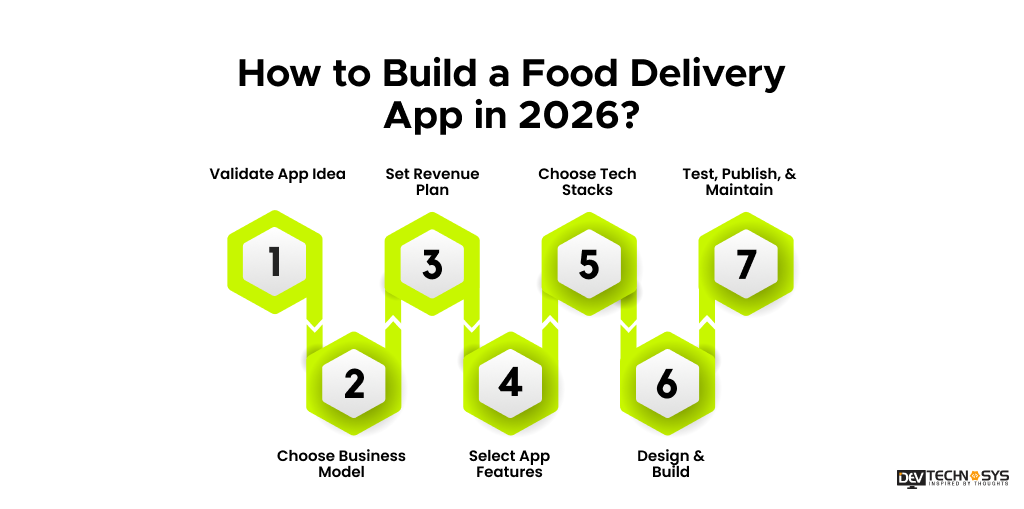
Build a food delivery app in 2026 means verifying that there is an audience for your product. Defining a business model that allows it to scale, planning how you will generate revenue, and defining the core features of the application. Using the most current technology stacks, designing it to look great from all angles, testing it on multiple platforms, and supporting the application through ongoing maintenance.
1. Validate App Idea
The first step in developing a successful app or business is validating your idea through research on the target market, competitors, and users’ needs. Hire a food delivery app development firm to conduct research to identify gaps in the market by reviewing apps such as Uber Eats and DoorDash to determine what they are missing.
You can do this by conducting surveys, gathering user feedback, and defining your unique value proposition. Additionally, you can validate your app idea by conducting a pilot test or creating an MVP to ensure that you have developed a solution to a real problem.
2. Choose Business Model
There are many different types of delivery app business models, including aggregator, order-only, and full-stack delivery. For example, Zomato uses an aggregator business model, while several other food delivery companies manage all aspects of logistics.
Decide whether you want to partner with restaurants or provide delivery services in-house, as these options will affect your delivery app’s operations, costs, and growth potential. Choose a business model that will allow you to manage your resources and target market.
3. Set Revenue Plan
Hire professional consultants from a mobile app development agency to identify how your delivery app will generate revenue and what the revenue streams will be. Many delivery apps generate revenue through delivery fees, commission from restaurants, subscription services, surge pricing, and advertisements.
For example, Swiggy uses multiple methods to generate revenue for the business. You will need to ensure that your pricing structure allows you to remain competitive while generating enough revenue after expenses to be viable.
4. Select App Features
Determine the basic app functionalities such as user sign-up and account creation, restaurant information and menu options, ability to shop using a shopping cart, ability to pay for purchase via secure payment processor, and ability to track the order delivery in real-time.
Optional advanced features can include providing AI-Recommended products, chat features available for contacting customer service, and a contactless delivery option. Perform competitive research on similar apps to identify users’ expectations for these features of an application.
5. Choose Tech Stacks
Find the right technology stack to support the front-end/ back-end of the application and the database. Popular choices of technologies for the front-end for developing cross-platform applications would be either React Native or Flutter.
Employ one of the best food delivery app development companies for developing the back-end, using Node.js or Django, using a cloud service API where applicable for your application. And to ensure secure payment processing through a payment gateway. You want your app to support scalability, safety, and excellent performance.
6. Design & Build
Ensure the UI and UX of the application are user-friendly so users are able to find products easily and can purchase them quickly. You need to include the following three panels: user, restaurants, and delivery partners in the application.
Employ the agile method for developing the app by breaking the project down into smaller iterations while continuing to enhance features. Ensure that every component works together for a seamless experience, such as payment processing and real-time GPS tracking.
7. Test, Publish, & Maintain
In the last stage of food delivery app development services, before launching your app, make sure you have tested it to find bugs, test its performance, and verify its security. After publishing to the app store, gather initial user feedback and keep track of this in order to identify areas that need to be improved within your app.
You will need to regularly add new features and correct problems based on feedback from users. To maintain the competitive status of your app in the extremely competitive field of food delivery service, you need to continue to provide maintenance to your app after launching it.
Industry Insights: In accordance with Reuters, Uber plans to launch or expand food delivery services into several new European markets aimed at adding about USD 1 billion in gross bookings over the next 3 years.
10 Must-Have Features of Food Delivery Applications
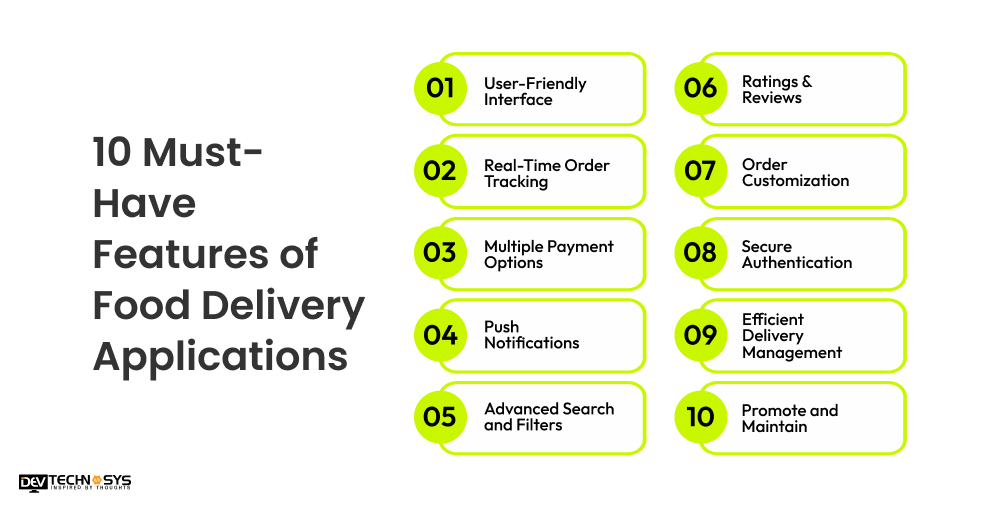
To improve users’ experience, deliver food quickly, make ordering easy, help with security for payments, provide real-time tracking of orders, and create brand loyalty in the increasingly competitive digital marketplace. Observe the food delivery app features list:
1. User-Friendly Interface
The easy-to-use nature of the design of the storefront, as a user who is familiar with each part of the menu through the onboarding process, allows the user to navigate the menus of their local restaurants.
2. Real-Time Order Tracking
Being able to follow along as an order is being prepared, as well as having a map to view where it will arrive from once it leaves the restaurant, can bring a feeling of trust and less worry for the user.
3. Multiple Payment Options
Offering the user flexibility when it comes to payment by providing multiple payment methods can help improve a user’s chances of converting and provide users with options based on their preference for security.
4. Push Notifications
Sending push notifications to users regarding an order they have placed, offers they may be interested in, and reminders of previously ordered items can help connect the user with your brand.
5. Advanced Search and Filters
By enabling a user to search for items by either cuisine, dish type, favorite restaurant, or price range, the user can promptly find what they are looking for, to help reduce the amount of time.
6. Ratings & Reviews
Customers use ratings or reviews to evaluate a restaurant’s menu items based on their experience at each establishment. This allows potential customers to make more informed decisions and provides transparency & quality to the platform.
7. Order Customization
Order customization allows users to modify the menu items by changing the ingredients, providing additional instructions for the food, and customizing their order to fit their individual preferences.
8. Secure Authentication
Using secure authentication methods protects user accounts, increases trust, and secures transactions while reducing the risk of fraud and unauthorized access.
9. Efficient Delivery Management
An effective management process to deliver products using the optimized routing of delivery vehicles, as well as the tracking of drivers and the dispatch system, will improve the speed of delivery.
10. Customer Support
A customer service function that responds quickly through chat, telephone, or email accepts requests for assistance from customers in order to resolve issues effectively and improve customer satisfaction.
How Much Does it Cost to Develop a Food Delivery App in 2026?
The cost to build a food delivery app is around $8,000 to $25,000, depending on the required features and customization. There are many factors that affect the online food ordering app development cost, such as services, API integrations, tech stacks, deployment platform, backend processes, design UI/UX, and development team.
It includes many additional factors that can also impact the cost, such as security measures, testing, maintenance & support services, project complexity, and more. Consider the table to get the estimated cost:
| App Type / Stage | Key Features Included | Estimated Cost (USD) |
| Basic MVP App | Login, restaurant listing, cart, checkout, simple UI | $8,000 – $12,000 |
| Standard App | Payments, order tracking, notifications, better UX | $13,000 – $18,000 |
| Advanced App | Real-time tracking, analytics, loyalty, and integrations | $19,000 – $25,000 |
5 Key Factors that Affect the Food Delivery App Development Cost in 2026
Many different factors will contribute to the cost of developing a restaurant delivery app in 2026. Including the choice of platform, the hiring model used, the UI/UX design, the location of your development team, and whether you will use third-party integrations. All of these factors will affect important areas such as the cost of food donation app development services.

1. Hiring Model
The recruitment approach you select will greatly determine what the overall restaurant delivery app development costs will be. Freelancers tend to cost less, while an in-house development team or an agency will cost more.
An agency can provide a full-service solution; however, it will do so at a higher cost than using freelancers or an in-house development team. The decision regarding which recruitment approach to be used will ultimately depend on the scope of your project.
| Hiring Option | Description | Cost Impact (USD) |
| Freelancers | Individual developers, flexible, low overhead | $1,000 – $3,000 |
| In-House Team | Full-time employees, higher control, higher cost | $3,000 – $5,000 |
| Development Agency | Complete solution, project management included | $5,000 – $7,000 |
2. Platform Type
The choice between using the iOS software platform, the Android software platform, or a cross-platform solution has implications for the total cost of the project. Developing two separate native applications (iOS and Android) will cost much more than implementing a cross-platform application. However, using a cross-platform application may limit your project’s performance compared to using two separate native applications.
| Platform Option | Description | Cost Impact (USD) |
| Single Platform (iOS/Android) | Focused on one OS, faster and cheaper | $2,000 – $5,000 |
| Cross-Platform | One app for both iOS and Android | $3,500 – $7,000 |
| Native Both Platforms | Separate apps for iOS and Android | $5,000 – $8,000 |
3. UI/UX Design
Having an effective UI design will greatly enhance the user’s level of engagement; however, it will also increase the cost of food delivery Android app development services.
Creating a custom UI that contains an animation and provides a seamless experience requires significant amounts of time and development expertise compared to using a basic template. If greater investment is made into developing high-quality UI/UX design, consumers will have greater retention rates.
| Design Level | Description | Cost Impact (USD) |
| Basic Template | Pre-built UI templates, minimal customization | $500 – $1,500 |
| Standard Custom Design | Moderate customization with better user flow | $1,500 – $4,000 |
| Advanced Custom Design | Fully custom UI/UX, animations, brand identity | $4,000 – $5,000 |
4. Location of Development Team
The geographic location of the development team is important; more expensive developers are often in North America and Europe than in Asia or Eastern Europe. Outsourcing to areas with lower costs is a way to save money while still producing a quality product if done correctly and efficiently. This can directly impact the total on-demand food delivery app development cost and time.
| Team Location | Description | Cost Impact (USD) |
| Asia / Eastern Europe | Cost-effective developers, quality depends on the team | $1,000 – $3,500 |
| Latin America | Moderate cost, good communication | $2,000 – $5,000 |
| North America / Europe | High rates, high quality, and experience | $4,000 – $6,000 |
5. Third-Party Integration
Payment gateways, maps, and notifications are all examples of services that require integration into an app, thus increasing the total cost to build a food delivery app. Each service requires setup, testing, and ongoing maintenance.
High costs can come from advanced integration services, such as artificial intelligence analytics or customer relationship management. Which ultimately will increase the application’s function, usability, and efficiency.
| Integration Level | Description | Cost Impact (USD) |
| Basic Integrations | Payment gateway, notifications | $500 – $800 |
| Moderate Integrations | Maps, analytics, loyalty programs | $1,000 – $1,200 |
| Advanced Integrations | AI recommendations, CRM, multi-service APIs | $1,200 – $1,500 |
How to Monetize Food Delivery Applications in 2026?
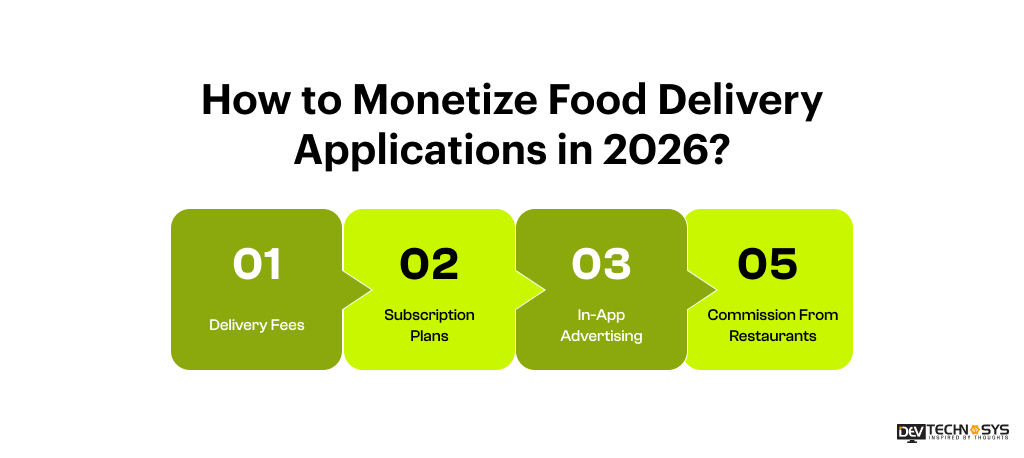
There will be several methods of monetizing custom food delivery app solutions in 2026. These methods will depend on the strategies taken to add value to the customer and the holistic approach taken towards benefiting your customers. You can charge for delivery, recurring fees, sales commissions, and advertising.
1. Delivery Fees
One of the simplest ways for an establishment to generate revenue is by using delivery fees. The delivery fees can be adjusted to accommodate demands, the distance between the business and customer, and peak and non-peak times for each delivery. Customers like the convenience of receiving their purchases quickly.
2. Subscription Plans
Establishments can offer customers either monthly or annual subscription programs, which would provide customers with free delivery, exclusive discounts, or faster shipping. This type of revenue generation allows businesses to have a consistent stream of income while simultaneously increasing customer loyalty, as customers who order food on a regular basis will likely be willing to subscribe.
3. In-App Advertising
Online takeaway apps can utilize advertising revenue and help promote restaurant or brand offerings within the application. There are various ways to do this, including sponsored listings, banner advertisements, and featured offers or placements. According to the iOS app development company, these advertising methods will provide visibility to restaurants or brands while generating additional revenue for the application.
4. Commission From Restaurants
Restaurants can pay a commission to the app every time an order is placed through the food courier app. This enables restaurants to be compensated by the app without having to charge their customers directly. In return, restaurants can receive more visibility and orders, which makes this model a very popular way for restaurants to receive an income.
Conclusion
When building a food delivery application in 2026, careful planning, implementing all of the essential features, and ensuring flawless execution are critical to success.
A successful food delivery app is dependent on having access to a reliable food delivery app development company, skilled developers, a user-friendly interface, secure payment processing, and the ability to produce a product that will grow with the user’s requirements. The key to creating a successful food delivery application is through strategic partnerships.
Frequently Asked Questions
Find answers to the most common questions related to this article.
The cost to develop a food delivery app in California lies between $8,000 and $25,000; it can go to a higher price because of several factors. It includes features, functions, project size & complexity, backend infrastructure, design UI/UX, deployment platforms, development team, and more.
In 2026, it typically takes 3 to 6 months to develop a basic version of an on-demand food service application. If you're looking for additional features such as complex processes, a custom UI/UX design, and the ability to utilize third-party integrations. You will likely find that the time for actual planning and completing the application takes about 6+ months.
Food delivery applications generate revenue from delivery charges, commissions received by the restaurant, and a subscription model, advertising within the app, premium features, etc. The form of monetization to choose will be dependent on your business plan, who your audience is, who your competitors are, and how scalable you believe your app is intended to be in the overall online food marketplace.
Some of the key challenges of developing a meal ordering app are having a seamless UI/UX, safe payment processing, real-time order tracking, and managing a successful delivery process. Providing sufficient server scalability, developing your application with third-party APIs integrations, and complying with regulatory requirements.
There are robust tech stacks used to make a food delivery app in 2026:
Java
React Native
HTML5
PHP
Python
C++
.NET