

















Key takeaways:
-
- The mobile app development timeline in France, it usually takes around 4 to 18 weeks, depending on the various elements.
- There are various factors that can impact the development timeline, such as app complexity, platform choice, backend infrastructure, and more.
- Compare the development timelines between mobile applications and web applications to clear doubts.
Mobile app creation in France has progressed in stages over the years with the development of mobile technology. In the early parts of the 21st century, cell phones were not advanced, and the applications that were available were predominantly simple tools, such as a calendar and a game.
However, the introduction of smartphones changed the entire mobile development game. French developers embraced the opportunity to make diverse and innovative mobile applications for travel, entertainment, education, and shopping with the introduction of app stores in 2007.
In subsequent years, mobile applications became even more functional and sophisticated with the development of new technology, improved internet access, and more innovative ideas. As a result, mobile applications became a vital component of people’s everyday routine.
It is in this context that French mobile application development became a contemporary digital landscape. French mobile applications development embraced the use of innovative technologies such as artificial intelligence, cloud technology, and improved user payment security.
In this blog, we will explore the mobile app development timeline in France and other related information.
How Long Does it Take to Develop a Mobile App in France?
The mobile app development timeline in France is around 4 to 18 weeks, depending on various factors. The timeline can be influence as per the several factors such as project complexity, number of features, backend infrastructure, third-party integrations, and more.
Basically, the total development timeline is based on the mobile app type, such as simple, moderate, and premium. The simple applications can take less time because they have limited functionalities and services. To create a mobile app that is fully-featured, it can take more time due to high-quality design and the number of features.
App Type |
Features |
Estimated Development Time |
| Simple App | Basic features, minimal design, no backend complexity | 2–3 months |
| Moderate App | Standard UI/UX, some integrations (APIs, payments), basic backend | 4–6 months |
| Complex App | Custom UI/UX, advanced features (AI, AR, real-time updates), multiple integrations, robust backend | 6–9+ months |
| Enterprise/High-End App | Scalable backend, multi-platform, advanced security, strict GDPR compliance, extensive testing | 9–12 months or more |
Industry Insights:
According to the Grand View Research, the French mobile application industry is projected to earn USD 19,775.7 million by 2030, up from USD 9,373.4 million in 2025.
What are the Typical Mobile App Development Stages and Timelines?
To get the exact mobile app development timeline in France. There are various steps available with their specific timelines to get an idea of which process takes more time. Let’s consider the total mobile app development timeline step by step:
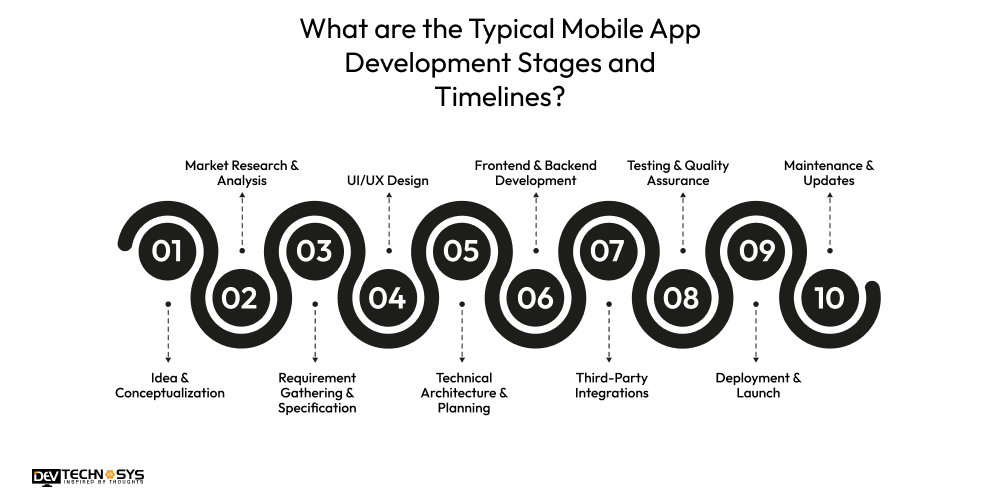
1. Idea & Conceptualization (1–2 weeks)
In the first stage of the mobile app development process, you must clear your project’s scope, purposes, objectives, target audience, and functionalities.
A clear project concept helps businesses focus on their future goals, with no confusion or misunderstandings. It can be time-consuming, and if the project size is big, then it goes to a longer development timeline.
Activity |
Time |
| Brainstorming ideas | 2–3 days |
| Define core purpose | 1–2 days |
| Identify main features | 2 days |
| Initial sketches/concepts | 2 days |
| Total | 1–2 weeks |
2. Market Research & Analysis (1–2 weeks)
Let’s move to the second development stage, research in the market to determine which mobile applications are in high demand and trending. This stage helps businesses to validate their project idea and meet the market needs and demand. In France market, the local users’ behaviours, habits, preferences, and GDPR are also analyzed or considered.
Activity |
Time |
| Competitor analysis | 2–3 days |
| Target audience research | 2–3 days |
| Market trends & validation | 2–3 days |
| Total | 1–2 weeks |
3. Requirement Gathering & Specification (1–2 weeks)
Coming to this phase, collect the project’s technical and functional requirements and make a proper list as a document. Hire dedicated developers to select the basic and advanced functionalities that must be integrated into your project. The clear and straightforward requirements help to avoid scope creep and understand the project functionality.
Activity |
Time |
| Gather functional requirements | 2–3 days |
| Gather non-functional requirements | 1–2 days |
| Create use cases & feature list | 2–3 days |
| Finalize specifications | 1–2 days |
| Total | 1–2 weeks |
4. UI/UX Design (2–4 weeks)
Hire creative designers to design a user-friendly or attractive interface. It involves various UI elements such as themes, templates, layouts, navigation bars, fonts, styles, buttons, and more. In France, clean, modern, and simple user interfaces are more prioritized, mainly for advanced mobile applications.
Activity |
Time |
| Wireframing | 3–4 days |
| Design UI screens | 4–5 days |
| Create prototypes | 3–4 days |
| User flow mapping & iteration | 2–3 days |
| Total | 2–4 weeks |
5. Technical Architecture & Planning (1–2 weeks)
In the fifth stage of iOS and Android app development, the app’s backend structure, technology stack, databases, APIs, and server requirements are defined. Planning ensures scalability, performance, and security while considering platform choice.
Proper architecture reduces future maintenance challenges and supports smooth integration with third-party services. Thorough planning minimizes delays during the coding phase, keeping the project on track.
Activity |
Time |
| Select tech stack | 1–2 days |
| Design frontend/backend structure | 2–3 days |
| Database & API planning | 2–3 days |
| Define roadmap & architecture | 2–3 days |
| Total | 1–2 weeks |

6. Frontend & Backend Development (5-10 weeks)
In this stage, developers develop the frontend and integrate the backend processes such as APIs, server logics, databases, and more. This development stage includes coding, third-party integrations, and features, ensuring seamless communication between frontend and backend. Efficient development practices and skilled teams help maintain deadlines.
Activity |
Time |
| Frontend development | 4–6 weeks |
| Backend development | 4–6 weeks |
| API integration & database setup | 2–3 weeks |
| Iterative builds & adjustments | 1–2 weeks |
| Total | 8–16 weeks |
7. Third-Party Integrations (1–3 weeks)
Apps often require external services such as payment gateways, analytics tools, social logins, or push notifications. Integration involves coding, API management, and security checks.
Compatibility and regional regulations in France, such as GDPR, may affect web app development. Proper integration ensures smooth functionality, enhances user experience, and avoids post-launch issues that could delay the app release.
Activity |
Time |
| Payment gateways | 2–3 days |
| Social logins | 1–2 days |
| Analytics & tracking | 1–2 days |
| Cloud & other services | 2–3 days |
| Total | 1–3 weeks |
8. Testing & Quality Assurance (2–4 weeks)
Move to another development stage before publishing the mobile app on the live phase. Must conduct the testing techniques such as unit, integration, security, functional, user-acceptance, and more. Fix the bugs and glitches that are found during the testing. Quality assurance is a must to deliver a reliable and secure product.
Activity |
Time |
| Functional testing | 3–4 days |
| Usability testing | 2–3 days |
| Performance & load testing | 2–3 days |
| Bug fixes & final QA | 4–5 days |
| Total | 2–4 weeks |
9. Deployment & Launch (1–2 weeks)
The mobile application was submitted to the selected platforms, such as Android and iOS. It involves store optimizations, review process, and compliance checks. The application approval time depends on the store polices. Proper deployment ensures visibility and sets the stage for user adoption and growth.
Activity |
Time |
| Prepare app store assets | 1–2 days |
| Upload & configure app | 1–2 days |
| Monitor early feedback | 2–3 days |
| Total | 1–2 weeks |
10. Maintenance & Updates (Ongoing)
Post-launch, apps require ongoing support, bug fixes, feature enhancements, and performance optimization. User feedback guides improvements, and updates ensure compatibility with OS changes.
In France, GDPR compliance and local regulations necessitate regular monitoring. Hire an experienced cross-platform development company to offer continuous maintenance ensures long-term success, user retention, and adaptability to evolving market trends and technology updates.
Activity |
Time |
| Bug fixes & patches | Ongoing |
| Feature updates & improvements | Ongoing |
| Performance monitoring | Ongoing |
| Total | Ongoing |
Want a chatbot demo or pricing? Fill the form and talk to our experts today.
Pick what you need below — you can select more than one — then tap Get detail to continue.
-
Chatbot demo dashboard
-
Cost to develop an app
-
Industry report
-
Case study
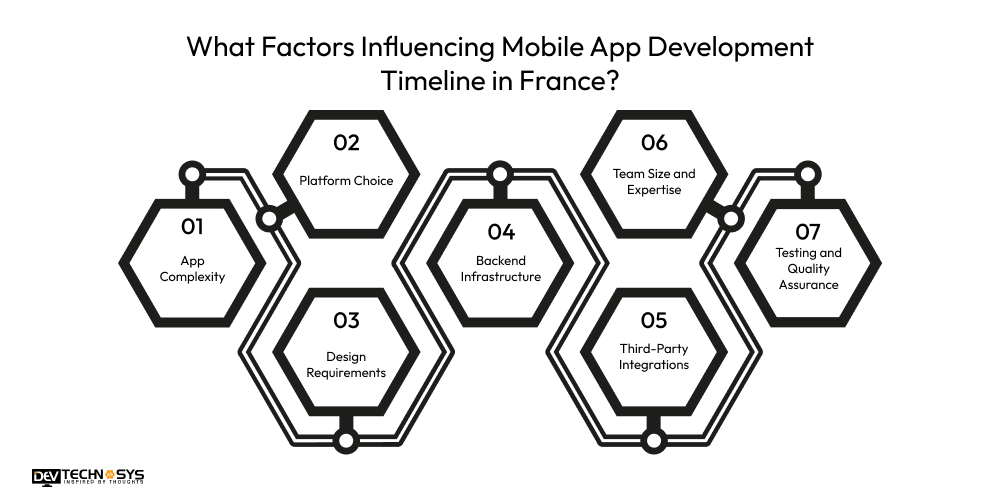
What Factors Influencing Mobile App Development Timeline in France?
The mobile app development timeline in France can be changed due to various factors that can impact the overall timeline. It involves UI/UX, backend infrastructure, third-party integrations, team size, testing, and app complexity. So, observe each factor to avoid them and maintain your project development timeline:
1. App Complexity
The complexity of a mobile app significantly impacts development time. Simple apps with basic features take less time, while complex apps with advanced functionalities, integrations, or AI components require more planning, coding, and testing. Complexity also affects design and backend development, making it a crucial factor in France’s app development timeline.
Factor |
Key Points |
Effect on Timeline |
| App Complexity | – Simple apps with basic features- Complex apps with AI, integrations, or advanced functionality | Simple: shorter timeline. Complex: longer timeline due to coding, testing, and design |
2. Platform Choice
Whether the app targets iOS, Android, or both influences the timeline. Developing for multiple platforms simultaneously requires additional resources, testing, and optimization.
Cross-platform frameworks can speed up development but may introduce limitations. In France, market research often guides platform choice, directly affecting mobile app development cost in France.
Factor |
Key Points |
Effect on Timeline |
| Platform Choice | – iOS, Android, or both- Cross-platform frameworks possible | Single platform: fasterMulti-platform: longer due to extra coding and testing |
3. Design Requirements
High-quality, custom UI/UX design increases development time. User-friendly, visually appealing designs demand iterative prototyping, user testing, and adjustments.
France’s emphasis on modern, clean interfaces often requires detailed design workflows, making design a major timeline factor, especially for apps targeting premium or sophisticated user bases.
Factor |
Key Points |
Effect on Timeline |
| Design Requirements | – Custom UI/UX- Iterative prototyping and user testing | Simple design: shorter timeline. Complex/custom design: longer timeline |
4. Backend Infrastructure
A robust backend is essential for app functionality and scalability. Cloud setup, database management, APIs, and server-side logic can extend development time.
In France, adhering to GDPR and data protection standards may further complicate backend development, requiring additional planning, testing, and compliance checks.
Factor |
Key Points |
Effect on Timeline |
| Backend Infrastructure | – Servers, databases, APIs- GDPR compliance | Basic backend: shorter timelineRobust backend with compliance: longer timeline |
5. Third-Party Integrations
Integrating third-party services like payment gateways, analytics, or social logins can add development hours. Compatibility, security, and API limitations may cause delays.
French developers often prioritize reliable, locally accepted services, which can influence timelines depending on integration complexity and regulatory requirements.
Factor |
Key Points |
Effect on Timeline |
| Third-Party Integrations | – Payment, social, analytics services- Compatibility and security checks | Few integrations: minimal delay. Multiple/complex integrations: longer timeline |
6. Team Size and Expertise
The skill and size of the development team directly impact speed. Experienced developers and designers can deliver faster, while smaller or less specialized teams may take longer. In France, access to talent with expertise in emerging technologies or multilingual applications can influence the overall timeline.
Factor |
Key Points |
Effect on Timeline |
| Team Size and Expertise | – Skilled, larger teams develop faster- Smaller or less experienced teams slower | Experienced team: shorter timeline. Less experienced team: longer timeline |
7. Testing and Quality Assurance
Thorough testing ensures app stability and performance. Functional, usability, performance, and security tests can extend timelines, especially for apps with complex features.
In France, compliance with local regulations and standards increases QA requirements, making it a key factor in estimating realistic development schedules.
Factor |
Key Points |
Effect on Timeline |
| Testing and QA | – Functional, usability, performance testing- Regulatory compliance | Minimal testing: faster. Extensive QA & compliance: longer timeline |
You can reach out anytime; we are available 24/7. Our team provides a quick response.

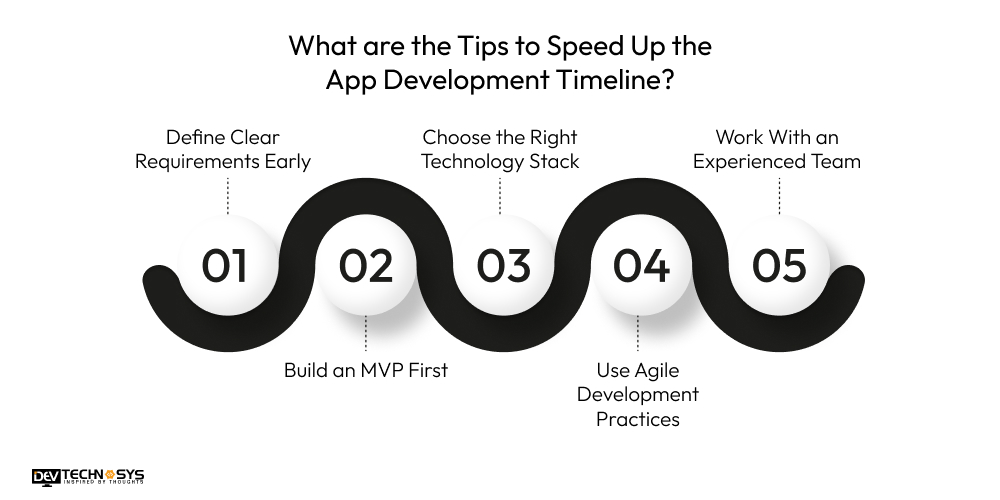
What are the Tips to Speed Up the App Development Timeline?
To speed up the mobile app development timeline, there are various tips available that help businesses with a faster development process. It involves define projects requirements clearly, creating an MVP, selecting the right tech stacks, using agile development services, and working with an experienced team.
1. Define Clear Requirements Early
Clearly defining app goals, features, and user flows at the beginning prevents confusion and costly rework later. Well-documented requirements help developers stay focused, reduce unnecessary revisions, improve communication among stakeholders, and accelerate decisions.
Making across the entire development lifecycle from planning through final deployment stages with clarity, alignment, speed, quality, predictability, confidence, and long term success outcomes.
Industry Insights:
According to the Business of Apps, French users spend a significant amount of time on mobile apps, averaging several hours per day, and download billions of apps annually.
2. Build an MVP First
Starting with a minimum viable product focuses development on essential features only. An MVP reduces build time, enables faster launches, lowers costs, and delivers real user feedback early.
Allowing teams to validate assumptions, prioritize improvements, iterate efficiently, and scale functionality later without major redesigns or delays. While maintaining flexibility, quality, stability, performance, alignment, and future growth goals sustainably.
3. Choose the Right Technology Stack
Choosing the right technology stack early can dramatically shorten development timelines. Proven frameworks, reusable components, and cross-platform tools reduce coding effort, limit bugs, simplify maintenance, and speed up testing, deployment, and updates.
While ensuring performance, scalability, security, and long-term reliability across devices, teams, markets, users, releases, versions, and integrations.
4. Use Agile Development Practices
Using agile development practices breaks projects into manageable sprints with continuous feedback. This approach improves collaboration, highlights issues early, supports rapid adjustments, reduces rework, and keeps progress visible, predictable, and steady.
While maintaining quality, meeting deadlines, and adapting quickly. To changing requirements, business goals, user expectations, technical constraints, priorities, scope, timelines, risks, communication, accountability, and transparency.
5. Work With an Experienced Team
Working with an experienced hybrid app development team significantly accelerates delivery. Skilled professionals anticipate challenges, write efficient code, follow best practices, and make faster decisions. Their expertise reduces errors, streamlines workflows, improves quality, and ensures the app is delivered on time and within budget.
While maintaining scalability, security, performance, reliability, clarity, accountability, communication, trust, consistency, efficiency, value, speed, alignment, and satisfaction.
Comparing Timelines: Mobile Apps vs. Web Apps
Mobile app development typically takes longer than web app development due to platform-specific requirements, multiple device testing, and app store approvals. Web apps are faster to build and deploy, while mobile apps offer deeper device integration but require more time and effort.
Stage |
Mobile App Timeline |
Web App Timeline |
Notes |
| Idea & Conceptualization | 1–2 weeks | 1–2 weeks | Initial concept and feature definition |
| Market Research & Analysis | 1–2 weeks | 1–2 weeks | Competitor & user research |
| Requirement Gathering & Specification | 1–2 weeks | 1–2 weeks | Functional & non-functional requirements |
| UI/UX Design | 2–4 weeks | 1–3 weeks | Mobile needs device-specific UI; web can be responsive |
| Technical Architecture & Planning | 1–2 weeks | 1–2 weeks | Planning backend/frontend and tech stack |
| Frontend & Backend Development | 8–16 weeks | 6–12 weeks | Mobile usually takes longer for iOS & Android platforms |
| Testing & Quality Assurance | 2–4 weeks | 1–3 weeks | Mobile requires multiple devices/OS testing |
| Total Development Timeline | 16–32 weeks | 12–25 weeks | Approximate time from concept to launch |
How Long Does App Development Take? Real-Life Scenarios
Each application have their unique or different functionality. Looking at the real-world examples make easy to understand how long similar apps have been around. There are various real-world examples that make it easy for businesses to find the exact project development timeline:
1. E-commerce App(4-6 Month)
An e-commerce app with product catalogs, carts, payments, and order tracking usually requires 4-6 months. Extra time goes into security, payment gateway integration, performance optimization, and user testing to ensure a smooth shopping experience.
Real-World Examples: Amazon, eBay, Etsy, etc.
2. Healthcare App(6-9 Month)
Healthcare app development takes 6-9 months due to strict compliance, data security, and reliability requirements. Features may include appointment booking, records management, and secure messaging, all needing thorough testing and regulatory checks.
Real-World Examples: Teladoc, Zocdoc, Heal, etc.
3. Fintech App(6-8 Month)
The fintech app development mainly takes around 6 to 8 months, or based on various factors. It includes high-security standards, API integrations, compliance requirements, and more.
Features can also fluctuate the total Android and iOS app development services time, such as instant payment transfer, account management, and many more.
Real-World Examples: Chime, Revolut, Cash App, etc.
4. Social Media App(6-9 Month)
Social media apps with messaging, feeds, notifications, and media sharing take 6-9 months. Complexity increases due to real-time features, scalability planning, moderation tools, and extensive testing to handle high user engagement and data loads.
Real-World Examples: Instagram, Facebook, Snapchat, etc.
5. On-Demand Services App(5-7 Month)
Apps like food delivery or ride booking need 5-7 months. They involve real-time tracking, multiple user roles, payments, notifications, and admin dashboards, requiring careful backend architecture and multiple testing phases. These on-demand service applications can also fluctuate the total cost based on the project complexity.
Real-World Examples: Uber, DoorDash, Doctor on Demand, etc.
Industry Insights:
According to Statista, Gaming, social media, messaging, and utility apps remain among the most downloaded and used categories, with gaming consistently leading.
How Long Does It Take to Develop an AI-Powered Application?
Developing an AI-powered application typically takes 3 to 8 months, depending on complexity, data availability, and features. Simple AI apps with pre-trained models may take 2-4 months, while advanced solutions involving custom models, large datasets, and integrations can take longer.
Proper planning, skilled teams, and iterative testing help ensure accuracy, scalability, and timely delivery.
AI Component |
What It Typically Includes |
Estimated Timeline |
| AI Chatbot | Conversation design, training on FAQs or workflows, tone tuning, and early feedback refinement. | 4–10 weeks |
| AI Recommendation Engine | User data preparation, behavior analysis, and prediction logic development. | 8–14 weeks |
| AI Model Development | Baseline setup, user-response analysis, and iterative accuracy improvements. | 10–20 weeks |
| Computer Vision AI | Image dataset preparation, model training, and multi-condition testing. | 12–24 weeks |
| Training Data Preparation | Data collection, cleaning, labeling, and synthetic data creation. | 2 weeks to several months |
Conclusion
Understanding the mobile app development timeline in France helps businesses plan smarter, budget accurately, and launch with confidence. From discovery and design to development, testing, and deployment, each phase benefits from France’s strong tech ecosystem and regulatory clarity.
Partnering with an experienced mobile app development company ensures efficient coordination, compliance, and quality at every step. With clear milestones, agile collaboration, and post-launch support, organizations can reduce risks and accelerate growth while delivering secure, scalable, and user-centric apps tailored to the French and global markets for startups, enterprises, and public innovators.
Frequently Asked Questions
Find answers to the most common questions related to this article.
A typical mobile app development timeline in France ranges from 3 to 6 months, depending on app complexity, features, platform, and compliance needs. Partnering with a professional mobile app development company helps streamline phases and avoid delays.
Key factors include app complexity, UI/UX design scope, backend infrastructure, third-party integrations, security requirements, GDPR compliance, and team size. Clear requirements and agile processes significantly reduce development time and revisions.
The cost to develop a mobile app in France is around $8,000 to $25,000 or higher. The cost can fluctuate due to various factors such as features, functions, project complexity, backend infrastructure, and many more.
Yes, timelines can be optimized through clear requirements, experienced teams, reusable components, and cross-platform frameworks. Choosing the right mobile app development company is crucial to balancing speed and quality.
Post-launch support is ongoing and typically starts with a 1-3 month stabilization period. It includes bug fixes, performance optimization, updates, and monitoring to ensure the app runs smoothly after release.