



















Key Takeaways:
- The cost to create your own altcoin lies between $8,000 to $30,000+, depending on factors like token complexity, smart contracts, and security. Basic Altcoin development starts from $8,000, while advanced ones can exceed to $30,000 or higher.
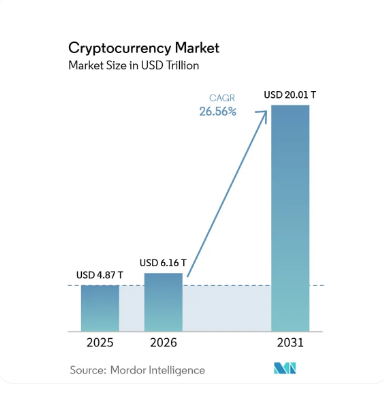
- According to Mordor Intelligence, the cryptocurrency market size is expected to reach USD16 trillion in 2026 and reach USD 20.01 trillion by 2031.
- Token sales, transaction fees, staking rewards, and listing fees on Exchanges are among the most effective monetization strategies for Altcoins.
- Building an altcoin from scratch can take from 2 weeks to 6+ months, depending on whether you are launching a simple token on an existing blockchain or developing a full custom blockchain ecosystem.
In the past few years, Altcoin has shown rapid growth with its unique functions and features. With those functionalities, it has become one of the most popular coins in the cryptocurrency market, and its cost is less compared to other coins like Bitcoin. There are many profitable doors open for businesses that want to invest in Altcoin and foster growth in this competitive market.
According to a recent digital market survey by Fortune Market Insights, the cryptocurrency market is projected to grow from USD 8.47 billion in 2026 to USD 27.02 billion by 2034. It is projected to increase at a compound annual growth rate of 15.60% during the forecast period.
The above data reveals that create your own altcoin is one of the most lucrative opportunities for today’s businesses. Welcome to this dynamic blog. Here, we will explore with you how to create your own Altcoin and why it is a profitable opportunity for businesses.
What Are Altcoins?
Other than Bitcoin, altcoins are digital currencies that are intended to provide different features or enhancements. The abbreviation for “altcoin” is “alternative coin.” The goal of altcoins is to overcome the drawbacks of Bitcoin or offer special advantages like quicker transactions, greater scalability, or improved privacy.
Well-known examples are Ripple (XRP), which focuses on real-time international payments; Ethereum, which allows smart contracts; and Litecoin, which is renowned for speedier transaction speeds. Although some altcoins function as cryptocurrencies, others drive blockchain-based platforms or decentralized apps, each with a unique set of applications and technological innovations.
- Altcoins may employ various consensus methods, such as Proof of Stake or Delegated Proof of Stake, which allow quicker and more energy-efficient transactions than Bitcoin’s Proof of Work.
- Many cryptocurrencies, like Litecoin, improve scalability and user experience by processing transactions faster than Bitcoin.
- Certain altcoins, such as Monero and Zcash, emphasize improved privacy features and use cutting-edge cryptographic algorithms to give users more anonymity.
- A dApps development company’s developers can create decentralized applications (dApps) on their blockchain platforms by using altcoins like Ethereum, which facilitate the formulation and execution of smart contracts.
Cryptocurrency Market Stats
- The cryptocurrency market size is expected to reach USD 6.16 trillion in 2026 and reach USD 20.01 trillion by 2031, growing at a CAGR of 56% over 2026-2031.
- By transaction purpose, Trading and Investment Transfers are forecasted to expand at a 24% CAGR to 2031.
- By user type, retail recorded the fastest projected growth at 33% CAGR through 2031.
- By cryptocurrency, Bitcoin is projected to grow at a 37% CAGR from 2026 to 2031.
- Asia-Pacific is projected to be the fastest-growing region at 24% CAGR through 2031 on the back of payment use cases.
What Motivates Businesses To Invest In Altcoin Development?
The potential advantages of blockchain technology and the changing cryptocurrency landscape are driving businesses to invest more in custom altcoin development for a number of strategic reasons. The following are some of the main reasons why companies are creating or investing in altcoins:
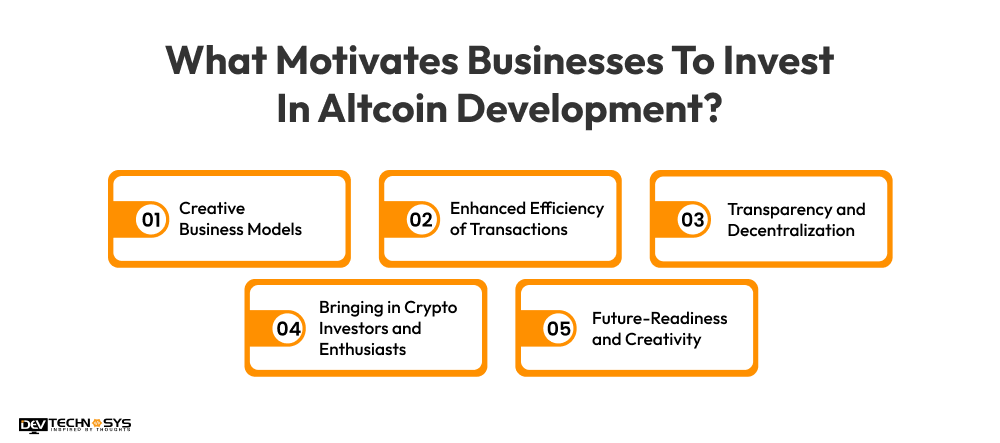
1. Creative Business Models
Altcoins frequently provide special features and applications that go beyond those of conventional cryptocurrencies. Some cryptocurrencies, for instance, make it possible for companies to develop cutting-edge platforms and applications by enabling decentralized finance (DeFi), non-fungible tokens (NFTs), and Altcoins payment gateway integration.
2. Enhanced Efficiency of Transactions
In contrast to Bitcoin and Ethereum, many altcoins, such as Solana and Avalanche, are made to provide quicker transaction times and lower costs. This can result in cheaper operating expenses for firms, particularly when it comes to cross-border payments and financial activities.
3. Transparency and Decentralization
The majority of altcoins use blockchain technology, which offers a transparent and decentralized method of transaction recording. Businesses may function without depending on centralized middlemen thanks to the decentralized cryptocurrency exchange development nature.
4. Bringing in Crypto Investors and Enthusiasts
Businesses can draw in a cryptocurrency exchange development company, altcoin developers, and investors who are keen to get engaged with cutting-edge technology by investing in or developing an altcoin. Businesses can use altcoins as part of their marketing strategy to reach a growing market as the use of cryptocurrencies increases.
5. Future-Readiness and Creativity
Many companies view investing in altcoin development services as a means of future-proofing their operations as the cryptocurrency ecosystem changes. Businesses may keep ahead of industry trends and maintain their competitiveness in a continuously evolving digital market by investigating altcoins and the technologies that underpin them.
Coin vs Token: What Should You Choose Before Creating Your Own Altcoin?
Before creating your own altcoin, it is important to understand the difference between a coin and a token. Coins operate on their own blockchain network, while tokens are built on existing blockchains like Ethereum or BNB Chain. On the other hand, coins offer better control, scalability, and blockchain independence. Here’s the table showcasing coin vs token comparison to help you make the right decision.
Factor |
Coin |
Token |
| Blockchain | Has its own blockchain | Built on existing blockchain |
| Development Cost | Higher | Lower |
| Development Time | Longer | Faster |
| Customization | Full blockchain control | Limited to host blockchain |
| Examples | Bitcoin, Litecoin | USDT, UNI, SHIB |
| Best For | Custom blockchain ecosystems | Quick and cost-effective launches |
Industry Insights: According to CoinGecko, the total crypto market capitalization reached approximately $2.4 trillion in Q1 2026.
How To Create Your Own Altcoin?
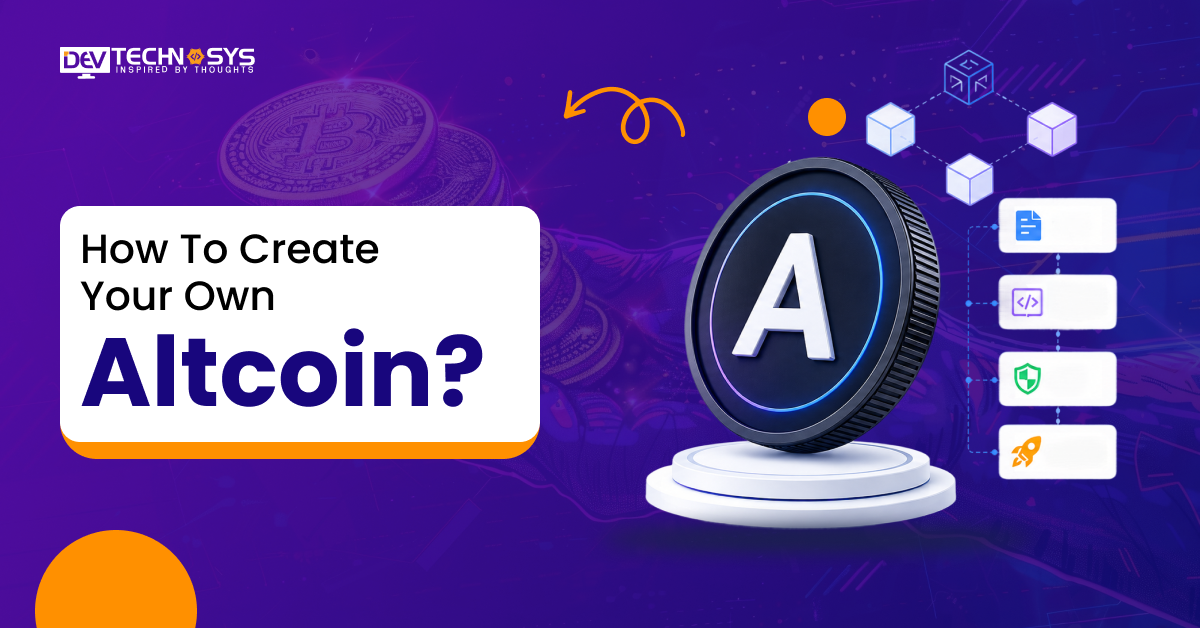
Build your own Altcoin to promote a decentralized application (dApp), develop a new community, or improve a certain industry, creating your own altcoin can be a very fulfilling endeavor. This comprehensive guide outlines seven crucial steps that you must take in order to create your own altcoin:
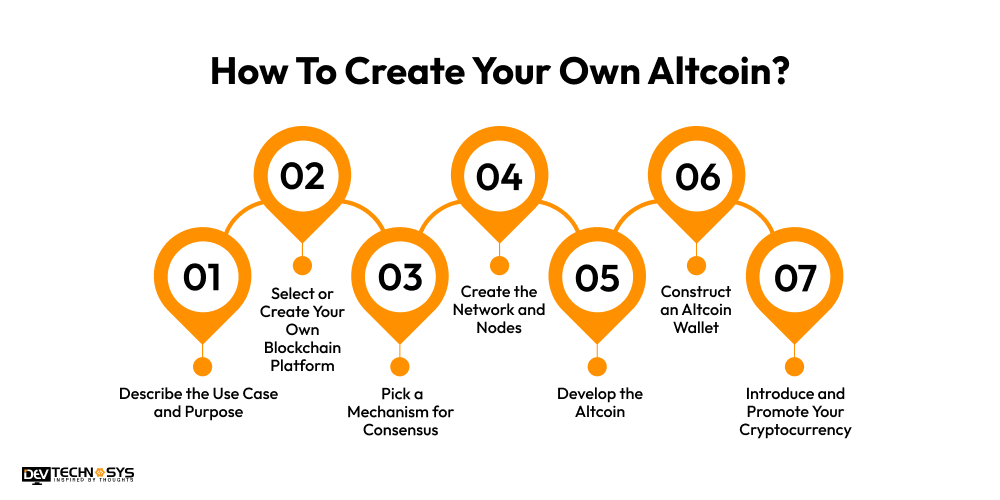
1. Describe the Use Case and Purpose
The first step to build your own Altcoin starter is determining the goal of an altcoin. You must be certain of the issue your altcoin will address or the way it will help its consumers.
Think about whether your altcoin will function as money, a governance token, a utility token for a particular dApp, or whether it will innovate an already-existing industry (such as healthcare or supply chain). Having a well-defined use case aids in the development of your altcoin’s features and attributes.
2. Select or Create Your Own Blockchain Platform
You have the option of developing a brand-new blockchain or creating your altcoin on an already-existing blockchain platform. Hire altcoin developers from a top Dex development company to utilize the blockchain’s current network and security.
You can generate tokens with little infrastructure by using platforms like Ethereum, Binance Smart Chain (BSC), or Solana. This method uses fewer resources and is faster.
3. Pick a Mechanism for Consensus
Your network verifies transactions and comes to a consensus regarding the blockchain’s current state using the consensus mechanism. Typical models of consensus include: Bitcoin uses Proof of Work (PoW), which entails resolving challenging mathematical puzzles to verify transactions.
Although it uses a lot of energy, it is safe. Ethereum 2.0 makes use of Proof of Stake (PoS), which enables validators to stake currency in order to confirm transactions. It is more scalable and energy-efficient.
4. Create the Network and Nodes
Moving to the fourth stage to develop your own Altcoin, the network’s nodes, or individual computers, are in charge of transaction verification. You have to choose whether your blockchain will be private (limited access) or public (available to everybody who wishes to join). To create an ERC1155 token, businesses often utilize private blockchains and optimize their properties.
The control and security of your coin are also impacted by the network’s architecture (centralized vs. decentralized). While private blockchains are more regulated, public blockchains typically provide greater security and transparency.
5. Develop the Altcoin
In the fifth stage, to create your own altcoin, you can start developing the altcoin itself after you’ve decided on the technical specifications. Without creating a separate blockchain, you can quickly create a token using a smart contract on a platform like Ethereum. For instance, you can create ERC20 Token using a straightforward set of instructions thanks to Ethereum’s ERC-20 standard.
Writing and implementing the coin’s software, configuring nodes, and deploying the blockchain are all necessary if you’re starting from scratch. This calls for blockchain developers’ assistance or coding knowledge.
6. Construct an Altcoin Wallet
To store and manage your altcoin after it has been created, you will need a wallet. You have two options: develop a crypto payment gateway like Bitpay or incorporate your altcoin into pre-existing wallets like Trust Wallet or MetaMask.
Users should be able to safely transmit, receive, and store their altcoin in their wallets. Additionally, while you create altcoin wallet, make sure it works with the main operating systems (such as Web, iOS, and Android). Your altcoin’s adoption rate rises with an easy-to-use wallet.
7. Introduce and Promote Your Cryptocurrency
You are ready to launch your own coin now that everything is in order. A marketing and community-building strategy is essential to its success:
- ICO/Token Sale: To raise money for additional development and attract early adopters, start an ICO or token sale. Professional ICO development services help with smart contracts, token distribution, security, compliance, and investor management.
- Exchange Listings: To increase liquidity and enable trading by users, list your altcoin on well-known exchanges.
- Community Engagement: Use social media sites like Twitter, Reddit, and Telegram to interact with cryptocurrency fans and possible investors. To increase adoption, you must create a community around your altcoin.
What Are the Different Types of Altcoin?
Altcoins are alternative cryptocurrencies to Bitcoin, designed with different use cases such as payments, utility, governance, and decentralized applications. Each type serves a specific function within the blockchain ecosystem, contributing to broader crypto adoption and innovation.
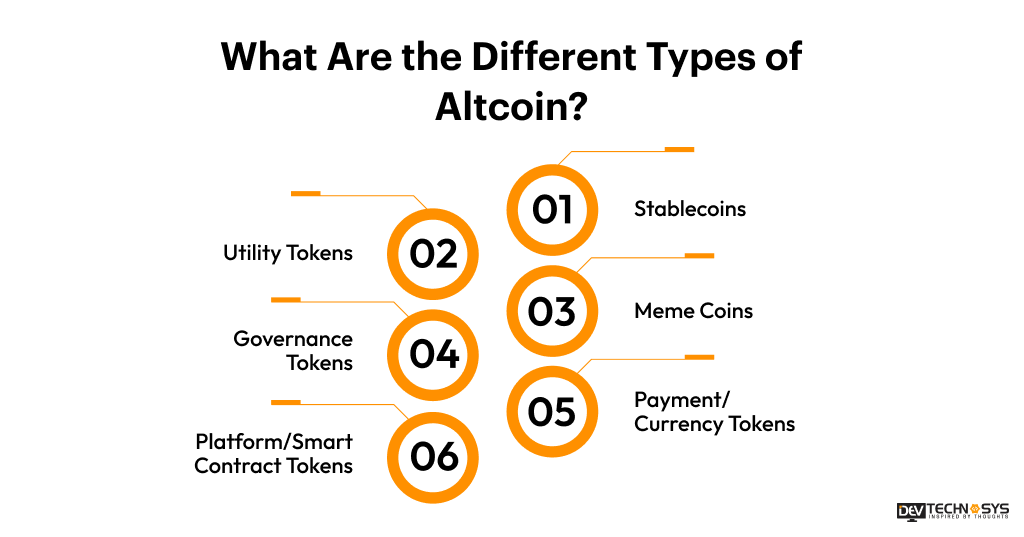
1. Stablecoins
Stablecoins are designed to reduce volatility by pegging their value to stable assets like the US dollar or gold. To build a Stablecoin, you need secure smart contracts, reserve backing, and blockchain integration. Examples include Tether (USDT) and USD Coin (USDC), widely used for trading, remittances, and storing value safely in volatile markets.
2. Utility Tokens
Utility tokens provide access to specific products or services within blockchain ecosystems. They are commonly used for paying fees, accessing features, or powering decentralized platforms like Filecoin (storage) or Ether (ETH) for gas fees.
3. Meme Coins
Meme coins are community-driven cryptocurrencies inspired by internet memes and social trends. They are highly speculative and often gain value through hype and community engagement, with popular examples like Dogecoin (DOGE) and Shiba Inu (SHIB). To create a meme coin for your business, contact a top altcoin development company.
4. Governance Tokens
Governance tokens give holders voting rights to influence decisions within decentralized protocols. They are essential in DAOs (Decentralized Autonomous Organizations), allowing users to vote on upgrades, policies, and platform development, such as Uniswap (UNI).
5. Payment/Currency Tokens
These tokens are designed for fast, low-cost peer-to-peer transactions and everyday payments. They aim to function as digital cash alternatives, with examples including Litecoin (LTC) and Bitcoin Cash (BCH), offering quicker settlement times than Bitcoin.
6. Platform/Smart Contract Tokens
Platform tokens power decentralized applications (dApps) and smart contract ecosystems. They support developers in building blockchain-based solutions, with major examples including Ethereum (ETH), Cardano (ADA), and Solana (SOL), enabling scalable decentralized networks.
Industry Insights: According to Reddit, the DeFi market reached an estimated valuation of $238.54 billion in 2026, with lending and borrowing protocols accounting for nearly 27% of the sector, increasing opportunities for DeFi-based altcoin projects
Top 5 Altcoins In The Crypto Market for 2026
The cryptocurrency market is still developing as 2026 draws near, with many altcoins competing with Bitcoin for users’ attention. Based on their potential for widespread acceptance, use cases, and technological breakthroughs, these seven cryptocurrencies are worth keeping an eye on in 2026. So, here we provide the top 7 Altcoins in the crypto market:
- Ethereum
- Solana (SOL)
- Polkadot (DOT)
- Avalanche (AVAX)
- Cardano (ADA)
1. Ethereum
Ethereum is still one of the most popular altcoins and is frequently used for smart contracts and decentralized apps (dApps). The goal of Ethereum 2.0, which employs a Proof of Stake (PoS) consensus process, is to increase energy efficiency and scalability. According to experts in DeFi development services, Ethereum is still in the lead despite the growth of decentralized finance (DeFi) and NFTs.
2. Solana (SOL)
Because of its reputation for quick transactions and cheap costs, Solana is a well-liked substitute for Ethereum in DeFi and NFT applications. Solana is positioned as a key player in the scalability race thanks to its special Proof of History (PoH) and Proof of Stake (PoS) algorithms, which enable it to execute thousands of transactions per second.
As we discussed earlier with solana blockchain development services provider, it is a serious challenger in 2025 because of its expanding ecosystem and developer support.
3. Polkadot (DOT)
Polkadot wants to establish a multi-chain ecosystem that makes it possible for various blockchains to work together harmoniously. It differs from other platforms in that it prioritizes interoperability and scalability. Polkadot is a strong candidate for 2026 because of its capacity to enable blockchain networks to cooperate while preserving security. To build a similar platform to Polkadot, contact a top cryptocurrency development company.
4. Avalanche (AVAX)
Avalanche is one of the quickest blockchains in terms of transaction finality and is built for high-performance decentralized applications. It makes use of an Avalanche consensus technique, which improves scalability and speed. Avalanche is gaining traction and has the potential to emerge as a major player by 2025 thanks to its emphasis on DeFi and enterprise blockchain solutions.
5. Cardano (ADA)
The blockchain platform Cardano prioritizes scalability, security, and sustainability. Faster and more secure transactions are promised via its energy-efficient Ouroboros PoS technology. Cardano stands apart from other blockchain systems because of its emphasis on formal methodologies and peer-reviewed research.
According to the cardano blockchain development company, it may experience more popularity thanks to important partnerships and development advancements.
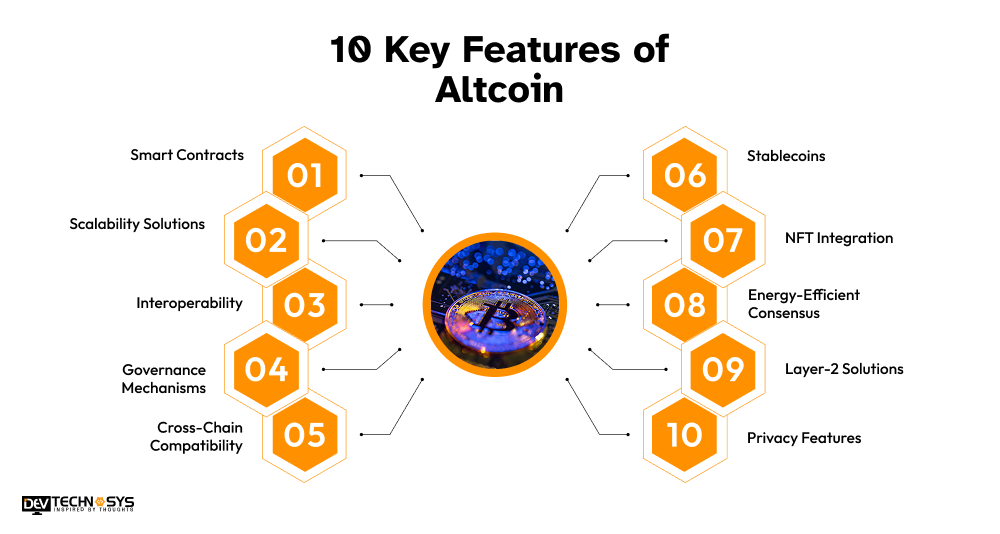
10 Key Features of Altcoin
Altcoins are developing quickly, and many of them have cutting-edge features that enhance user experience, scalability, privacy, and blockchain technology. To differentiate themselves in the crowded cryptocurrency market, altcoins frequently incorporate the following cutting-edge features:
User Panel |
Moderator Panel |
Admin Panel |
| Registration & Login | Ticket Management | Admin Dashboard |
| Wallet Management | Live Chat Support | User Management |
| Real-Time Trading | Dispute Handling | Liquidity Management |
| Portfolio Tracking | Fraud Monitoring | Escrow Management |
| KYC Verification | Transaction Support | Fee Management |
| Payment Integration | Content Moderation | Analytics & Reports |
| Notifications & Alerts | Account Restrictions | Security Management |
| Transaction History | Notification Management | Compliance Monitoring |
| Security Features | Activity Logs & Reports | Platform Configuration |
1. Smart Contracts: Smart contracts, which are supported by altcoins like Ethereum, allow for self-executing contracts with terms put directly into the code. You can integrate these features into your coin by contacting a smart contract development company.
2. Scalability Solutions: It includes various features like Sharding (Ethereum 2.0) or Layer-2 solutions (like Polygon), which increase transaction throughput.
3. Interoperability: Interoperability across several blockchains is made possible by altcoins like Polkadot and Cosmos, which facilitate easy data and value movement between platforms.
4. Governance Mechanisms: As demonstrated by initiatives like Tezos and MakerDAO, governance tokens enable cryptocurrency owners to vote on proposals for protocol updates or modifications.
5. Cross-Chain Compatibility: Cross-chain interoperability, made possible by initiatives like Thorchain, allows several blockchain networks to communicate with one another without the need for a centralized exchange.
6. Stablecoins: Because stablecoins, like Dai or USDT, are based on a reliable asset, like the US dollar, they lower volatility and give consumers who want price stability a choice.
7. NFT Integration: NFTs (Non-Fungible Tokens) can be created, purchased, and sold using altcoins like Ethereum and Flow, allowing for digital ownership and collections.
8. Energy-Efficient Consensus: An app like Binance provides blockchain security, and consensus techniques like Delegated Proof of Stake (DPoS) and Proof of Authority (PoA) provide increased energy efficiency.
9. Layer-2 Solutions: On top of current blockchains, projects like Optimism and Arbitrum provide Layer-2 solutions that increase transaction speed and lower fees.
10. Privacy Features: By using cutting-edge cryptographic techniques, certain altcoins, such as Monero and Zcash, provide increased privacy and guarantee user anonymity during transactions.

What is the Cost to Build an Altcoin?
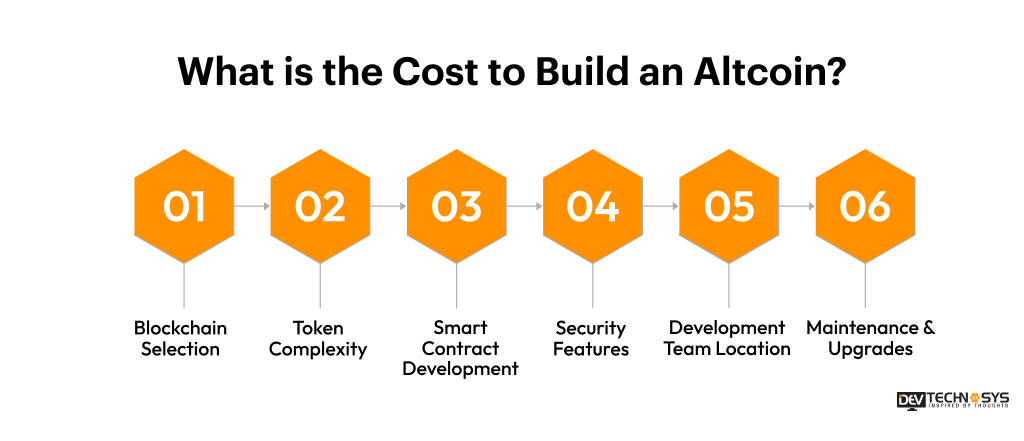
The cost to develop a TRC20 token or altcoin lies between $8,000 to $30,000+, depending on factors like the blockchain platform, features, and development team. Creating a token on existing platforms like Ethereum or Binance Smart Chain development can cost between $8,000 to $15,000. Building a custom blockchain from scratch is significantly more expensive, including additional costs for wallet development, security audits, marketing, and exchange listings. Now let’s take a closer look at the cost affecting factors.
1. Blockchain Selection
Picking a blockchain like Ethereum, BNB Chain, Solana, or Polygon has a direct effect on how much it cost to build an altcoin and the level of complexity. It takes more infrastructure, backend engineering, node setup, and testing to develop a token on Base Blockchain than it does to start a token on an existing blockchain network.
2. Token Complexity
It is easier and cheaper to make simple utility tokens than more complex altcoins that have features like staking, governance, mining, NFT utilities, or DeFi integration. These more complex altcoins need more smart contract logic and server systems. Tokenomics and functions that are more complicated take a lot longer to create and increase the cost to build an Altcoin.
3. Smart Contract Development
In the altcoin environment, custom smart contracts automate tasks like transactions, staking, rewards, and running the system. To make smart contracts that are safe and work well, you need skilled blockchain developers, a lot of testing, and auditing, which increases the cost to develop an altcoin.
4. Security Features
One of the most important development costs affecting factors in altcoins is ensuring security. To keep digital assets protected from cyberattacks or bugs, experts add features like encryption, anti-hack systems, wallet protection, DDoS prevention, and smart contract audits.
5. Development Team Location
The location of the production team has a big impact on prices. The hourly cost to hire dedicated developers in the US and Western Europe is higher. However, hiring developers from India or Eastern Europe can save you money on development without lowering quality as long as it is handled well.
Industry Insights: According to Grand View Research, the U.S. blockchain technology market alone is forecasted to reach approximately $401.9 billion by 2030.
6. Maintenance & Upgrades
Once it’s live, you have to keep an eye out for bugs, update smart contracts, and add new features to make sure everything works well. To keep things safe, scalable, and ready for new blockchain technologies, they need to be maintained. This adds to the cost to develop an Altcoin significantly.
Factor |
Realistic Cost Range |
Timeline |
| Blockchain Selection | $5,000 – $25,000 | 1 – 4 months |
| Token Development | $1,000 – $8,000 | 3 – 10 days |
| Smart Contract Development | $3,000 – $15,000 | 2 – 6 weeks |
| Security & Audit | $2,000 – $12,000 | 1 – 4 weeks |
| Development Team Cost | $5,000 – $30,000 | Full project duration |
| Maintenance & Upgrades | $2,000 – $10,000/year | Ongoing |
How Long Does It Take to Build an Altcoin From Scratch?
Building an altcoin from scratch depends on whether you are launching a simple token on an existing blockchain or developing a full custom blockchain ecosystem. The timeline varies based on complexity, security requirements, and feature set.
Altcoin Type |
Development Timeline |
Key Inclusions |
| Basic Token (ERC-20 / BEP-20) | 1 to 2 weeks | Token creation, deployment on existing blockchain, basic wallet support |
| Standard Altcoin | 3 to 6 weeks | Smart contracts, tokenomics setup, staking basics, security testing |
| Advanced Altcoin Ecosystem | 2 to 4 months | DeFi features, governance, exchange integration, audits, and multi-wallet support |
| Custom Blockchain Altcoin | 4 to 6+ months | Blockchain development, consensus mechanism, nodes, full infrastructure, enterprise security |
The timeline mainly depends on blockchain type, smart contract complexity, security auditing, and ecosystem features. More advanced functionality requires longer development and testing cycles to ensure stability and security.
Technology Stack Required to Build an Altcoin
To create your own Altcoin, you need a strong blockchain-focused technology stack that allows for the creation of smart contracts, safe transfers, scalable infrastructure, and easy user interaction. To ensure performance, transparency, and decentralization, the stack usually has blockchain frameworks, computer languages, development tools, databases, and security layers.
Layer |
Technologies Used |
| Blockchain Platforms | Ethereum, BNB Chain, Solana, Polygon |
| Smart Contract Languages | Solidity, Rust, Vyper |
| Frontend Development | React.js, Vue.js, Angular |
| Backend Development | Node.js, Python, Go |
| Blockchain Tools & Frameworks | Hardhat, Truffle, Web3.js, Ethers.js |
| Databases | MongoDB, PostgreSQL, Redis |
| Wallet Integration | MetaMask, Trust Wallet SDKs |
| Security Tools | OpenZeppelin, CertiK, MythX |
| Cloud & Hosting | AWS, Google Cloud, Azure |
| DevOps Tools | Docker, Kubernetes, CI/CD pipelines |
What are the Monitization Strategies for Altcoin Development?
These are a few of the top monetization techniques that support the development of sustainable ecosystems. Across decentralized networks, these techniques guarantee long-term growth, liquidity, and investor participation.
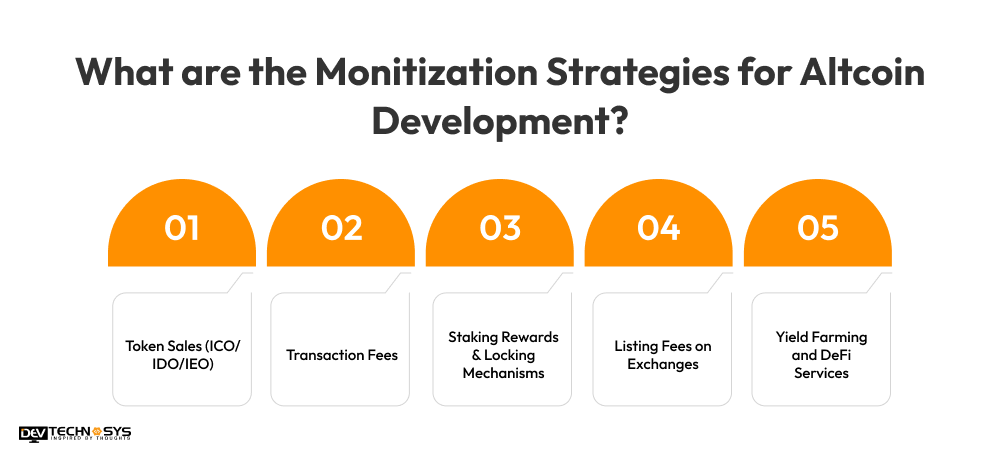
1. Token Sales (ICO/IDO/IEO)
ICO, IDO, or IEO token sales are how altcoin projects generate revenue. Early token purchases by investors help fund the project’s development, marketing, and ecosystem expansion. Additionally, it improves the initial liquidity of the project and promotes early market usage.
2. Transaction Fees
Every time a blockchain exchange takes place in an ecosystem, platforms charge small fees. As the number of users increases, steady income is made, especially in DeFi, games, and utility-based altcoin networks that see a lot of transfers and trades.
3. Staking Rewards & Locking Mechanisms
Users stake tokens to earn rewards, while the platform earns commissions from staking pools. This feature makes the tokens more stable, lowers the number of them in circulation, and gives the project steady inactive income over time.
4. Listing Fees on Exchanges
There are fees that altcoin projects charge to sell tokens on centralized or decentralized markets. Because they increase trust, trade volume, and publicity, premium listings are a good way for blockchain-based startups to make money.
5. Yield Farming and DeFi Services
Lending and borrowing money, cash pools, and yield farming services bring in money. The platform gets a cut of user rewards or protocol fees, which makes it more profitable in the long run in decentralized finance environments.
Conclusion
In this blog, we explored how to create your own altcoin and why it provides benefits for businesses and entrepreneurs. We provide the process that entails identifying the objective of your altcoin, picking the best blockchain platform or creating a bespoke blockchain, selecting a suitable consensus method, and constructing the coin or token. Furthermore, wallet development, security testing, and launching the coin with a strong marketing strategy are critical to success.
So, last, if you want to develop your own altcoin, you can consult with our crypto wallet development company to receive efficient crypto coins.
Frequently Asked Questions
Find answers to the most common questions related to this article.
To create an altcoin, you need a blockchain platform, smart contract development, tokenomics design, wallet integration, and security features. You also require technical expertise in blockchain programming and proper planning for deployment and ecosystem growth.
The cost usually ranges from $5,000 to $25,000 for a basic token. Advanced altcoins with smart contracts, DeFi features, and custom blockchain development can cost $30,000 or more, depending on complexity and security requirements.
A simple altcoin can be developed in 1–2 weeks. However, feature-rich tokens or custom blockchain projects may take 1–6 months depending on smart contract complexity, security audits, and ecosystem integration needs.
Yes, blockchain development skills like Solidity or Rust are required for custom altcoins. However, no-code or low-code platforms and white-label solutions also allow non-technical users to launch basic tokens.
Yes, creating an altcoin is legal in most countries, but regulations like KYC, AML, and securities laws must be followed. Legal compliance depends on how the token is structured and marketed.