









In 2025, healthcare and wellness industry witnessed many incredible transformations in healthcare softwares, and will continue to bring AI-native healthcare interoperability and integration trends in 2026 as well.
These trends in healthcare software development have transformed the shape of medical software, making it more reliable, better, and advanced. Smart healthcare systems enable hospitals, clinics, doctors, and healthcare organizations to streamline operations, manage daily tasks, and access patient records and medical details, ultimately facilitating simplified clinical decision-making.
In this article, we will discuss the latest trends in healthcare software development to look out for in 2025-2026 and beyond. Let’s explore these healthcare technology trends and learn how patients and healthcare providers can benefit from this tech upgrades.
Global Healthcare Software Market Stats
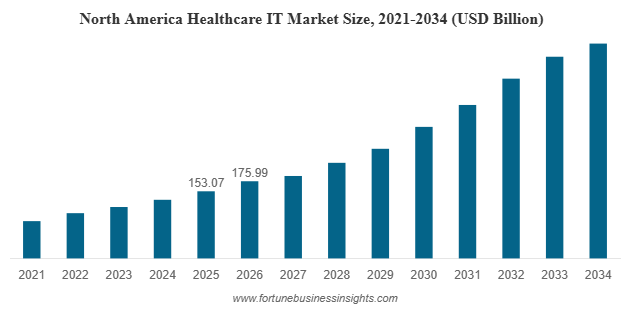
- The global healthcare IT market size was valued at USD 354.04 billion in 2025.
- The market is projected to grow from USD 402.69 billion in 2026 to USD 1380.51 billion by 2034, exhibiting a CAGR of 16.65% during the forecast period.
- North America dominated the market with a 43.23% share in 2025, driven by growing awareness of digital health
- Clinical solutions dominated the market with a share of 70.12% in 2026
- The software & services segment dominated the healthcare IT market, accounting for 66.07% globally in 2026.
What is Healthcare Software?
Healthcare software means healthcare IT solutions that simplify and manage operations, automate processes, and improve healthcare industry processes.
They include a wide range of healthcare applications like Electronic Health Records (EHR), hospital management systems, and telemedicine platforms, which help healthcare providers deliver care more efficiently and safely.
Major Types of HealthTech Software to Consider for Development
Before learning about the trends shaping mobile app development in healthcare industry, let’s explore the types of virtual healthcare platforms. Take a look:
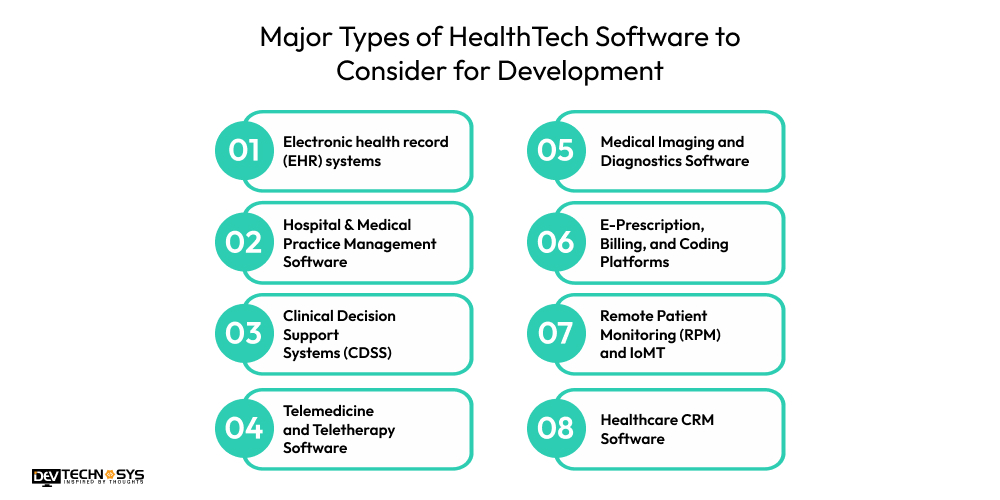
- Electronic health record (EHR) systems: Cloud-based healthcare systems stores and manages patients’ medical histories, lab reports, and treatment data digitally.
- Hospital & Medical Practice Management Software: Automates hospital operations like scheduling, billing, inventory, and patient administration. Offers better efficiency and reduced human error.
- Clinical Decision Support Systems (CDSS): Personalized medicine software with the power of CDSS helps doctors make data-driven clinical decisions using AI and analytics by analyzing patient data, treatment plans, and potential drug interactions.
- Telemedicine and Teletherapy Software: Telemedicine software development enables remote consultations and virtual therapy sessions via video calls, chat, and secure data sharing between doctors and patients.
- Medical Imaging and Diagnostics Software: This patient management software enables advanced image analysis and diagnosis using AI-powered tools for X-rays, CT scans, MRIs, and ultrasound imaging.
- E-Prescription, Billing, and Coding Platforms: Simplifies the prescription process and automates billing and insurance claims with accurate coding and error-free documentation.
- Remote Patient Monitoring (RPM) and IoMT: Collects real-time health data of patients from wearable devices and IoT sensors to track patient vitals remotely, improving proactive care.
- Healthcare CRM Software: Medical device software development with CRM improves personalized care by enhancing patient relationship management, facilitating feedback, supporting marketing campaigns, and improving communication.
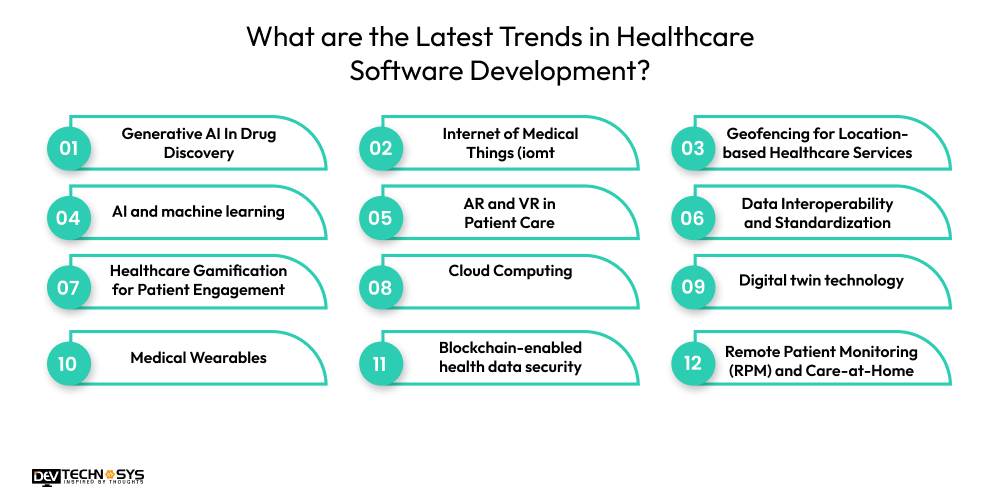
What are the Latest Trends in Healthcare Software Development?
As we progress towards 2026, we encounter numerous emerging technologies and trends that are transforming the way healthcare services are delivered and received. Here are the emerging technologies in healthcare software development that are redefining medical software innovation.
1. Generative AI In Drug Discovery
2025 has seen generative AI achieve numerous milestone breakthroughs, including assisting in the development of new medicines and treatments that have progressed to the clinical trial phase.
Generatie AI is among the top trends in healthcare CRM software development cost that has transformed pharmaceutical R&D by enabling the design of new compounds and the prediction of molecular interactions in a fraction of the time required previously.
It guarantees lower research costs, faster digital health innovation cycles, and an increase in the emergence of AI-driven biotech startups that challenge traditional medicine and treatment methods.
Yet, as the power of AI in HIPAA-compliant software development generates compounds that are better and beyond what people imagined, regulatory bodies are competing to keep pace, making sure that safety, explainability, and ethical validation remain crucial components of the discovery process.
Generative AI helps by:
- Accelerating new drug formulation.
- Reducing R&D costs and timelines.
- Enhancing molecule prediction accuracy.
2. Internet of Medical Things (iomt)
Today’s healthcare is more intelligent and smarter than ever. Internet of Medical Things (IoMT) includes remote patient monitoring software and devices, wearables, and MedTech tools to make delivering medical care a lot easier with real-time decision-making.
From remote patient tracking to automated alerts and optimized workflows, IoT in healthcare is helping hospitals reduce cost of making patient engagement apps and improve patient outcomes.
According to Fortune Business Insights, the Global Internet of Medical Things (IoMT) market size was USD 47.32 billion in 2023. For businesses wanting to build a Medical App Like K Health, integrating IoMT into your healthcare application development strategy is the new norm.
IOMT helps by:
- Connecting smart healthcare devices.
- Enabling real-time patient monitoring.
- Improving diagnosis and treatment precision.
3. Geofencing for Location-based Healthcare Services
Geofencing technology enables custom cloud-based healthcare software developers to allow location-based options, making sure that digital healthcare solutions reach real-world patients and fulfill their needs. It includes features such as interactive street navigation and proximity-based service suggestions.
It is one of the key future healthcare mobile application trends; geofencing enhances interactions between doctors and patients via automated alerts, appointments, and service optimization. The global geofencing market, including healthcare, retail, and smart infrastructure, is expected to reach USD 9.6 billion.
Geofencing technology offers:
- Sends health alerts based on location.
- Tracks patient movements securely.
- Improves emergency response time
4. AI and machine learning
Wondering how AI in healthcare software is transforming the healthcare ecosystem? AI and ML are among the top healthcare software trends for 2025. It is moving beyond a buzzword and into practical applications.
AI algorithms and chatbot development can enhance diagnosis and treatment by analysing medical images (X-rays, MRIs, CT scans) to improve diagnostic accuracy and detect diseases earlier than human physicians in some cases. ML models analyze genetic data, medical history, and lifestyle factors to help doctors create highly personalized treatment plans.
AI and ML Provides:
- Predicts patient outcomes.
- Enhances diagnostic accuracy.
- Automates administrative tasks.
5. AR and VR in Patient Care
AR and VR in healthcare create immersive and interactive environments for medical professionals and patients. These augmented and virtual reality technology has braught digital transformation in hospitals by improving surgical training, support physical rehabilitation, and provide constant guidance for procedures that can be done remotely.
VR allows medical students to safely practice complex surgeries, while AR helps with injury recovery through guided motor function exercises. AR helps surgeons by improving precision, adding digital insights to assist with operations. Hire top app developers from a reputed healthcare software development company to create an advanced medical app software.
AR and VR technology provide:
- Supports surgical training simulations.
- Improves physical therapy outcomes.
- Enhances patient engagement and recovery.
Note: Refer to our Guide to hire healthcare app developers for more information on how to hire the right healthcare app developers.

6. Data Interoperability and Standardization
Healthcare systems are increasingly focusing on interoperable solutions that allow seamless data sharing among hospitals, clinics, and laboratories. We are all aware of the crucial role of big data in healthcare software. Standardization across EHR systems allows easy access to patient information and medical records, improving treatment accuracy. It also promotes collaboration between care providers and improves overall healthcare efficiency.
Interoperability supports predictive analytics and personalized medicine by unifying fragmented data sources. As governments and organizations promote data standardization, the healthcare mobile app development or the healthcare ecosystem in general becomes more connected, precise, and capable of delivering value-based, patient-centric care.
Data Interoperability ensures:
- Enableling seamless data sharing.
- Reduces duplication and errors.
- Supports integrated care delivery.
7. Healthcare Gamification for Patient Engagement
Healthcare systems are focusing a lot on interoperable patient management software and solutions that enable seamless data sharing across hospitals, clinics, and laboratories. Standardization across EHR systems is easily accessible and consistent, reducing redundancy and enhancing treatment accuracy. This also promotes collaboration between care providers and improves overall healthcare efficiency.
Interoperability supports predictive analytics and personalized medicine by unifying fragmented data sources. As governments and organizations push for data standardization, the healthcare ecosystem becomes more connected, transparent, and capable of delivering value-based, patient-centric care.
Healthcar gamification helps by:
- Motivating healthy behavior through rewards.
- Boosts treatment adherence.
- Improves patient satisfaction.
8. Cloud Computing
Cloud computing is among the top medical software development trends that proposes scalable data storage, real-time coalitions, and remote access to medical systems. Hospitals and clinics use cloud-based healthcare software for secure patient data management, integrate EHRs, and run AI-driven predictive analytics in healthcare without costly infrastructure.
Personalized medical software promotes telehealth, research, and mobile health softwares while improving interoperability between healthcare providers. Additionally, cloud solutions in healthcare ensure data backup, disaster recovery, and compliance with privacy guidelines like HIPAA, enhancing accessibility for both patients and providers. Looking for HIPAA compliant software development? Hire software developers from a top company.
Cloud Computing helps by:
- Enabling scalable data storage.
- Improves system accessibility.
- Reduces infrastructure costs.
9. Digital twin technology
Digital twin technology creates a similar virtual model of physical assets, processes, or even human organs to simulate and predict outcomes. In healthcare, it helps model patient-specific conditions, test treatments, and optimize surgeries without physical risk.
By combining AI, IoT, and real-time data, doctors can anticipate complications and personalize care. Digital twins are also used for medical device testing and hospital management, reducing errors and improving clinical decision-making through predictive insights and operational efficiency.
Digital Twin Technology helps with:
- Simulating patient conditions virtually.
- Predicts treatment outcomes.
- Enhances personalized medicine.
10. Medical Wearables
Medical wearable health technology, such as smartwatches, biosensors, and fitness bands, is transforming preventive and personalized healthcare. These digital devices continuously track vital signs like blood pressure, heart rate, oxygen levels, and also track sleep quality. Wearables provide real-time data to both patients and doctors.
Integrated with AI and cloud platforms, wearables detect anomalies early and support chronic disease management. Appointment scheduling software with AI technology encourage healthier lifestyles, enable remote patient monitoring, and empower users to take control of their wellness anytime, anywhere.
Medical wearables helps by:
- Tracks vitals in real-time.
- Enables continuous health monitoring.
- Promotes proactive healthcare.
11. Blockchain-enabled health data security
The impact of blockchain in healthcare systems is immense. Blockchain technology solidifies healthcare data integrity by making secure, decentralized storage and exchange of medical records. It minimizes fraud, ensures traceability, and enhances transparency while maintaining compliance with regulations like HIPAA. Patients also gain more control over how their data is accessed and shared.
Moreover, blockchain enhances trust among healthcare providers, insurers, and patients by providing tamper-proof data logs. It also supports supply chain transparency for pharmaceuticals, preventing the sale of counterfeit drugs and ensuring accountability across the healthcare network.
Blockchain-based data security provides:
- Patient data integrity safety.
- Ensures transparent record access.
- Prevents unauthorized data sharing.
12. Remote Patient Monitoring (RPM) and Care-at-Home
RPM systems backed by IoT and connected devices enable healthcare software product development providers to perform real-time monitoring of vital signs and heart rates. It promotes continuous tracking for chronic disease management and reduces the likelihood of hospital readmissions. Combined with telehealth, it enables convenient and personalized care at home, improving patient satisfaction and outcomes.
With AI integration, RPM systems can predict health risks early, enabling timely intervention. These healthcare CRM solutions empower elderly care, post-surgery recovery, and rural healthcare accessibility, creating a connected, proactive healthcare experience that extends beyond hospital walls.
RPM ensures:
- Monitoring chronic patients remotely.
- Reduces hospital readmissions.
- Enhances convenience and care continuity.
How Much is the Healthcare Software Development Cost?
The healthcare software development cost will be around $8,000 to $25,000. The cost to build a healthcare software with basic features and functionality will be lesser then the advanced app.
However, developing an app using the advanced features and latest trends in healthcare software development that we discussed in above, can cost up to $25,000 and higher. Several factors can impact the healthcare app development cost, including the use of AI diagnostics, IoT-enabled wearables, or AR/VR simulations.
| Software Type | Estimated Cost (USD) | Development Timeline |
| Basic Healthcare Software | $8,000 – $12,000 | 2 – 3 months |
| Mid-Level Healthcare Software | $12,000 – $18,000 | 3 – 5 months |
| Advanced Healthcare Software | $18,000 – $25,000+ | 5 – 8 months |
Why These Types of Medical Software Trends Matter in 2026?
Here’s why the latest trends in healthcare software development matter in 2026.
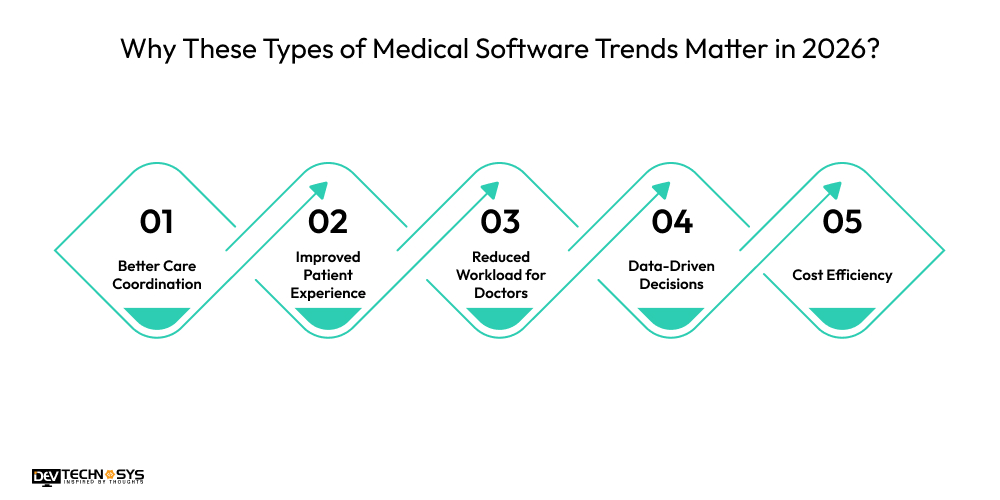
1. Better Care Coordination: These trends improve Healthcare software to seamlessly connect EHR, billing, labs, and pharmacies, ensuring smooth data flow between departments, improved collaboration, and fewer manual errors in patient management.
2. Improved Patient Experience: Telemedicine, patient portals, and mobile health apps empower patients with 24/7 access to care, medical records, and consultations, enhancing convenience and satisfaction.
3. Reduced Workload for Doctors: Automation tools in medical software streamline routine tasks like documentation and scheduling, enabling doctors to focus more on diagnosis and patient care quality.
4. Data-Driven Decisions: AI-powered analytics help healthcare providers identify patterns, predict diseases, and create personalized treatment plans, leading to more accurate and proactive healthcare delivery.
5. Cost Efficiency: Automating billing, scheduling, and inventory management minimizes administrative overheads, prevents revenue leakage, and significantly improves overall healthcare operational efficiency.
Conclusion
In the above blog, we talked about the top trends in healthcare software development in 2026. These innovations not only enhance efficiency and accuracy but also improve patient experiences through personalized, data-driven solutions.
If you want a trendy healthcare app developed with the latest trends and technologies, hire dedicated developers from Dev Technosys, a leading provider of healthcare software development. Stay tuned for informative updates.