




















The travel sector is changing quickly toward digital platforms.Flight booking apps have become very important for today’s travel businesses. These apps provide different services such as facilitating ticket bookings, providing updates on flights in real-time, enabling payments safely, and offering to the users personalised travel experiences in various parts of the world.
The worldwide online travel market was at the level of $622 billion in 2025 and it is likely to grow to $1.4 trillion by 2034. This growth will be mostly due to more people using smartphones and more people traveling digitally.
The flight booking app development cost is affected by the features, the way the app is integrated, the platform chosen, and the complexity of the app. Features like AI-driven suggestions and safe payment facilities, companies should think about the budget and the combination of technologies that they want to use for the creation of a travel application that is not just good in terms of customer experience but at the same time able to grow and be competitive in the market. So lets get this blog started.
What is a Flight Booking App?
A booking app of this kind will allow a user, via their mobile or Web browser, to easily locate the flight company, the price of a ticket, and to book the relevant airline ticket. The user can view up-to-date scheduled flights and prices, and is also enabled to select a seat and to pay securely, in addition to the functions outlined above.
Also, a lot of flight booking apps give hotel booking options, travel insurance, and provide updates about your trip. Corporate clients are increasingly using technologies such as AI and APIs not only for personalized suggestions but also for better user experience and the delivery of global travel planning services.
How Much Does It Cost To Develop A Flight Booking App?
It’s generally expected that flight booking app development costs between 8,000 and 16,000+ to develop a flight booking app. The overall flight booking app development pricing really does vary depending on how complex the app is, which features are used, the APIs, and the platform you choose.
For instance, a simple version of an app with features for flight search and booking could be priced at approximately $16, 000-$30, 000 whereas a full-fledged app with features like AI suggesting flights, tracking flights in real-time, payment gateways, and connections to GDS might go beyond $30, 000.
Besides UI/UX design, backend infrastructure, third-party integrations, and the geographical location team that you hire dedicated developers of are other elements contributing to the cost of the project.
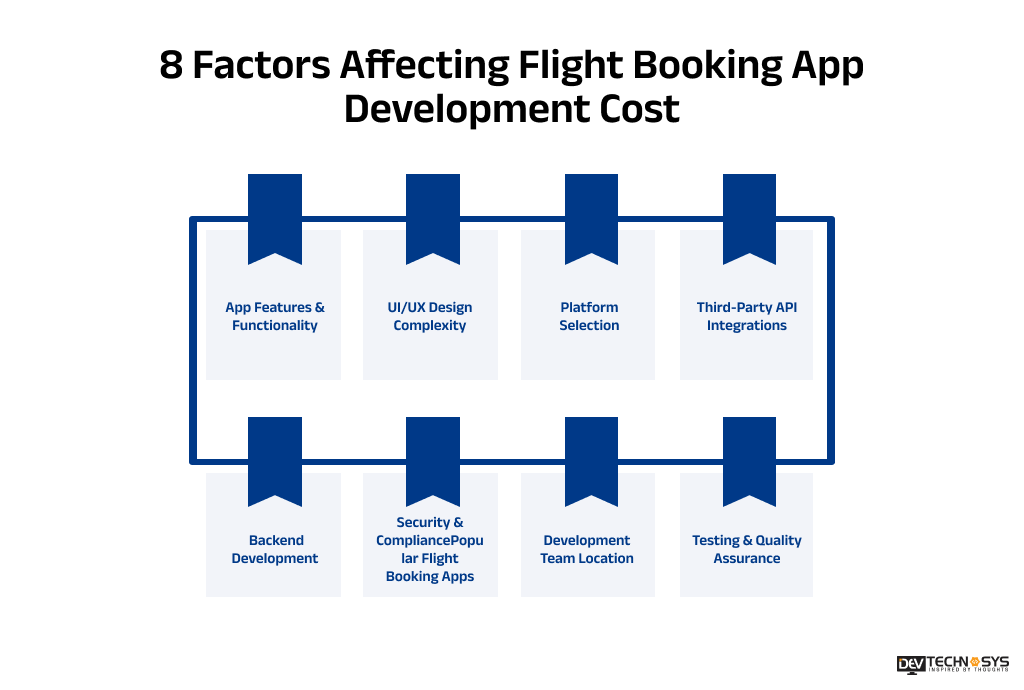
8 Factors Affecting Flight Booking App Development Cost
Apart from features and platform choice, UI/UX design, backend complexity, API integrations, and maintenance requirements are other factors that determine the overall flight booking app development cost. Recognizing these cost factors would allow businesses to plan their budgets efficiently and develop travel booking applications which are not only scalable and user-friendly but also fit within their desired investment range.
1. App Features & Functionality
Basic features such as search for flights, booking, payment integration, cancellation of tickets, and user profiles have a direct impact on the custom flight booking app development cost. Integrating new features like AI advising, loyalty programs, or multilingual support will enhance not only development complexity but also testing efforts, thereby resulting in increased overall flight app development cost.
| Complexity Level | Estimated Cost |
| Basic Features | $800 – $1,500 |
| Moderate Features | $1,500 – $3,000 |
| Advanced Features | $3,000 – $5,000 |
2. UI/UX Design Complexity
A design that is simple to use and aesthetically pleasing will increase customer interaction and the booking experience. However, things like custom animations, interactive components, and complex user flows require the designer and prototyper to put in more work, which can result in a higher overall custom flight booking app development cost.
| Design Type | Estimated Cost |
| Basic UI/UX | $500 – $1,000 |
| Custom Design | $1,000 – $2,000 |
| Premium Interactive Design | $2,000 – $3,500 |
3. Platform Selection
Developing a flight booking app for one or more of the Android and ios app development changes the costs drastically. Compared to native app development requiring writing code separately for each platform, cross-platform frameworks cut down on the time and flight app development cost but still manage to offer a consistent user experience on all devices.
| Platform Type | Estimated Cost |
| Single Platform | $1,000 – $2,500 |
| Cross-Platform | $2,500 – $4,000 |
| Native Android + iOS | $4,000 – $6,000 |
4. Third-Party API Integrations
Flight booking apps use various APIs to gather airline data, handle payments, display maps, give weather updates, and allow bookings. The more and the more complicated the integrations, the bigger the impact on the flight booking app development cost especially when premium APIs or Global Distribution Systems (GDS) are used for managing real-time flight inventory.
| API Integration Type | Estimated Cost |
| Basic APIs | $800 – $1,500 |
| Multiple APIs | $1,500 – $3,000 |
| GDS Integration | $3,000 – $5,000 |
5. Backend Development
The backend handles not only user accounts and bookings but also flight data and payment processing. On one hand, a simple backend is less expensive. On the other hand, a scalable cloud-based architecture having sophisticated databases, admin panels, and security standards that are of the highest level leads to higher costs from additional server-side complexity and maintenance.
| Backend Complexity | Estimated Cost |
| Basic Backend | $1,000 – $2,000 |
| Moderate Backend | $2,000 – $4,000 |
| Advanced Scalable Backend | $4,000 – $6,000 |
6. Security & Compliance
Flight booking apps store personal and payment information that is highly sensitive to the users, so security measures must be very strong. Besides the execution of encrypted payment gateways and secure login systems, the adherence to GDPR and the use of fraud detection systems also contribute to the increase in time and flight booking app development cost. At the same time, these measures are necessary for gaining user trust and protecting data.
| Security Level | Estimated Cost |
| Basic Security | $500 – $1,000 |
| Standard Compliance | $1,000 – $2,000 |
| Advanced Security Setup | $2,000 – $3,500 |
7. Development Team Location
Developer rates per hour differ by locale. travel app development companies located in India usually have lower hourly rates than those teams from the US or Europe. Besides team expertise and project management style, communication methods also affect the total cost of software development.
| Development Region | Estimated Cost |
| India & Asia | $8,000 – $15,000 |
| Eastern Europe | $15,000 – $22,000 |
| US & Western Europe | $22,000 – $30,000 |
8. Testing & Quality Assurance
Proper testing guarantees seamless booking capabilities, safe payments, and a glitch-free operation. Testing manually is quite cheap; however, using automated and performance testing in scenarios of very high volumes of users will increase the flight booking app development price due to the use of sophisticated testing tools and longer quality assurance rechecks.
| Testing Type | Estimated Cost |
| Manual Testing | $500 – $1,000 |
| Automated Testing | $1,000 – $2,000 |
| Advanced QA & Performance Testing | $2,000 – $3,000 |
Popular Flight Booking Apps and Their Development Cost
There are a few very popular flight booking apps in the industry which offer a variety of features, very smooth booking processes and real time system integrations. Getting to know their capabilities and the approximate travel booking app development cost can enable travel businesses to come up with plans for competitive and scalable solutions for travel applications effectively.
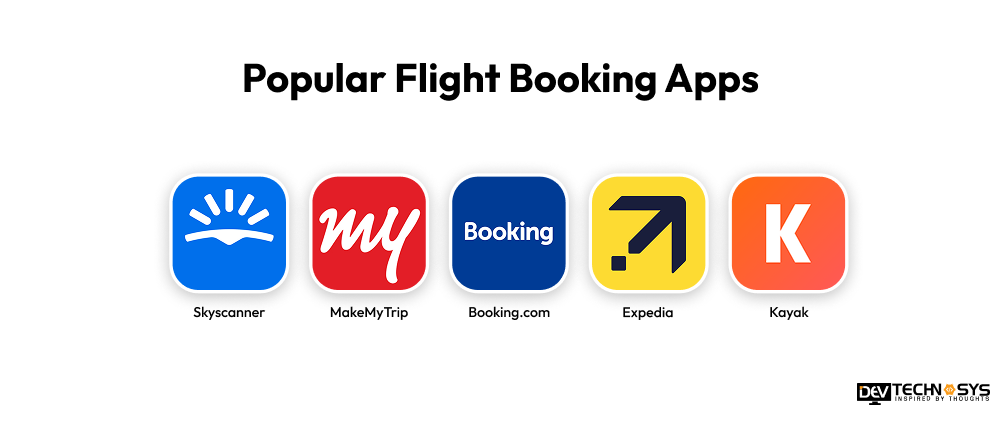
| Flight Booking App | Estimated Development Cost |
| Skyscanner | $20,000 – $30,000 |
| MakeMyTrip | $18,000 – $28,000 |
| Booking.com | $22,000 – $30,000 |
| Expedia | $25,000 – $30,000 |
| Kayak | $20,000 – $29,000 |
Skyscanner
As a popular flight booking app Skyscanner is famous for offering comparisons for flights, hotels, and rental cars through various sources. Such an app requires extensive API integrations, real-time synchronization due to its advanced filtering capabilities, price alerts, and multiple-language support. Creating an app like Skyscanner on a scalable infrastructure with modern UI/UX can cost $20k – $30k.
MakeMyTrip:
It’s a well-rounded travel booking app that lets you book flights, hotels, buses, and vacation packages. The app is designed with security, reliable payment solutions, customer support, reward schemes, and personalized recommendations. An app like MakeMyTrip involves setting up a robust backend system with several third-party integrations. The total travel website development costs are somewhere in the range of $18k – $28k.
Booking.com:
This is a top flight booking application providing all flight bookings, hotel bookings, and transport solutions worldwide. The sophisticated recommendation engine, easy-to-use interface, multi-language support and excellent booking mechanism require substantial cloud infrastructure and AI integration. The total cost to build a booking app like Booking.com can range from $22k – $30k.
Expedia:
The highly functional, feature-rich travel app called Expedia enables customers to book flights, hotels, cars, and holiday packages. The app is considered one of the most highly influential in terms of booking management systems, dynamic pricing, and a robust customer rewards program. Building an app like Expedia can have an estimated cost of around $25k – $30k while involving a scalable backend framework and secure payment gateways.
Kayak:
Kayak is renowned for its highly reliable flight comparison feature and its AI-powered fare prediction system. Such apps offer a customized travel plan, alert schemes, and cross-platform sync. An app like Kayak would cost around $20k – $29k while providing enhanced searching abilities and real-time analytics.
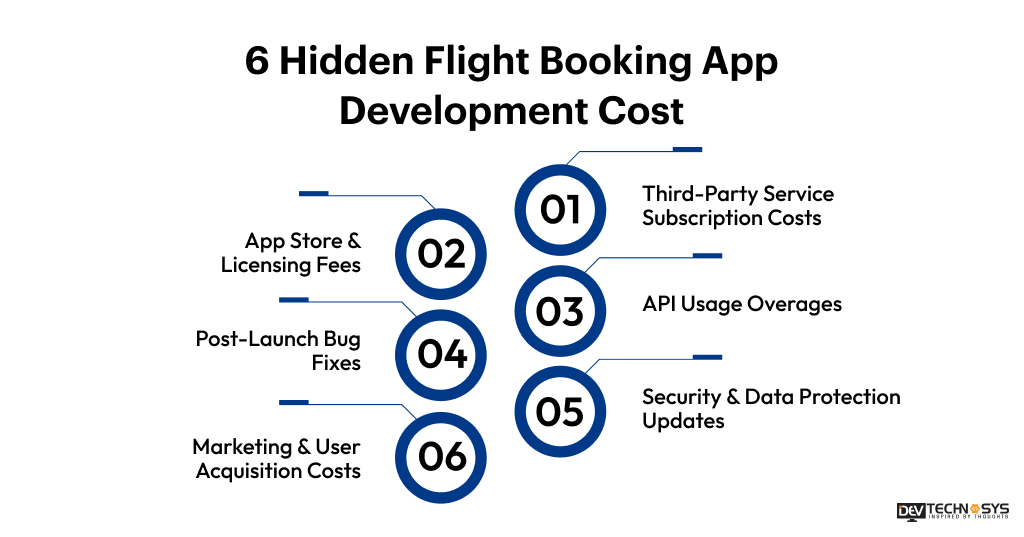
6 Hidden Flight Booking App Development Cost
While considering the flight booking app development cost, most businesses forget about hidden charges. Things such as maintenance, API usage fees, security costs, licensing expenses, marketing efforts, and post-launch technical assistance may all increase the total cost to build a travel booking app like hopper significantly. A business owner can save itself from financial troubles if they’re aware of such charges in advance.
| Hidden Cost Factor | Estimated Hidden Cost |
| Third-Party Service Subscriptions | $500 – $2,000/year |
| App Store & Licensing Fees | $100 – $500/year |
| API Usage Overages | $300 – $1,500/year |
| Post-Launch Bug Fixes | $500 – $2,000 |
| Security & Compliance Updates | $800 – $2,500/year |
| Marketing & User Acquisition | $1,000 – $5,000 |
| Cloud Hosting & Server Scaling | $500 – $3,000/year |
| Customer Support & Maintenance | $1,000 – $4,000/year |
1. Third-Party Service Subscription Costs
Flight booking apps usually include several subscription-based fees. These could include costs for API use, cloud hosting, payment gateway services, analytics tools, and notification systems. Such recurring fees are often forgotten during the early stages of planning, yet they contribute significantly to post-launch maintenance costs.
2. App Store & Licensing Fees
The apps need to be published on the Apple App Store and Google Play Store. Publishing fees for hotel booking app development services providers exist, along with several licensing expenses for tools required during the development process, such as SSL certificates and software necessary for legal app operation.
3. API Usage Overages
Various flight and travel APIs charge based on usage or the number of transactions processed by an app. Increased app traffic could lead to higher charges. If real-time flight data, fare updates, and flight booking notifications require API access, they could become prohibitively expensive as app usage scales.
4. Post-Launch Bug Fixes
Users may still report software bugs, crashes, and performance issues even after the app has gone through testing. Such problems would require flight booking app development companies to undertake additional maintenance work and ensure quality, leading to unseen costs for a business.
5. Security & Data Protection Updates
The payment and personal data of users require continuous updates to the flight booking app’s security architecture. Periodic vulnerability assessment, security updates, encryption enhancements, and compliance verification can all help guard against various cyber threats. However, the cost of maintaining continued security cannot be ignored.
6. Marketing & User Acquisition Costs
Although building the app is only part of the cost, businesses are likely to spend on marketing for the app as well as the cost of search engine optimization, paid advertising, influencer promotion, and referral campaigns to draw customers. The customer acquisition costs can go up, especially in the crowded market for travel.
Top Features That Affect Flight Booking App Development Cost
The final flight booking app development cost would depend on the features. The presence of complex functionalities, live integration, a security system, and a personalized user experience greatly raises development complexity, required infrastructure, and investment in the application.
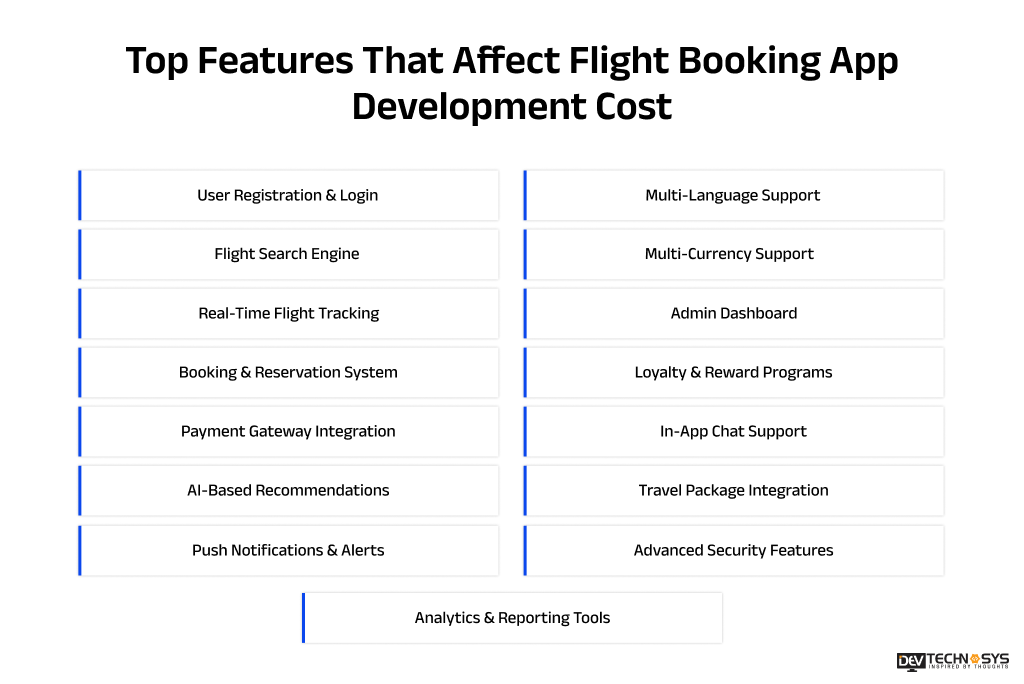
| Feature | Estimated Cost |
| User Registration & Login | $300 – $800 |
| Flight Search Engine | $1,000 – $2,500 |
| Real-Time Flight Tracking | $800 – $2,000 |
| Booking & Reservation System | $1,500 – $3,000 |
| Payment Gateway Integration | $500 – $1,500 |
| AI-Based Recommendations | $1,500 – $3,500 |
| Push Notifications & Alerts | $300 – $800 |
| Multi-Language Support | $500 – $1,200 |
| Multi-Currency Support | $500 – $1,200 |
| Admin Dashboard | $1,000 – $2,500 |
| Loyalty & Reward Programs | $800 – $2,000 |
| In-App Chat Support | $700 – $1,800 |
| Travel Package Integration | $1,000 – $2,500 |
| Advanced Security Features | $1,000 – $2,000 |
| Analytics & Reporting Tools | $800 – $1,500 |
1. User Registration & Login
Features such as secure sign up, social login, OTP verification, user profile management greatly enhance user convenience but also increase authentication cost, database integration cost and the cost for security systems.
2. Flight Search Engine
The use of filters, search queries on airline companies, flight prices, time of departure and journey duration increases development complexity and overall project costs to the application for flight booking due to required integrations with API, real-time data.
3. Real-Time Flight Tracking
Real-time updates of flight status including delays, gate change and departures necessitate stable, consistent integration with APIs, a reliable support system for back-end, and infrastructure for continuous access. This increases the integration and operational flight reservation app development cost.
4. Booking & Reservation System
An efficient flight booking and reservation process including seat selection, ticket generating, flight reservation require a sophisticated database management and solid backend, influencing cost to develop a flight booking app.
5. Payment Gateway Integration
Secure payment gateways supporting a great variety of payment methods and currency types as well as fraud detection systems require additional integration of compliance and security systems, influencing the cost to develop a flight booking app.
6. AI-Based Recommendations
AI features, such as predicted flights and suggested routes and fares, will help improve user experience, yet the use of machine learning algorithms to develop the system will bring an additional cost for the back-end.
7. Push Notifications & Alerts
Real-time flight confirmations, push notifications for ongoing deals, reminders about booking flights and changes, and automatic cancellations will influence flight booking mobile app development cost.
8. Multi-Language Support
Multi language support will make a jet booking app globally accessible but it would increase cost to build a flight ticket booking app due to the UI adjustments, translation process of content and other related requirements.
9. Multi-Currency Support
A multi currency support to present flight prices and process payments in many currencies, and to allow for the real-time exchange of rates to enhance the user experience would largely contribute to the flight booking app development cost.
10. Admin Dashboard
An effective panel for admin can support the tracking and management of customers, bookings, transactions, sales statistics, and all flight related content, boosting the complexity of the back-end and raising flight booking mobile app development cost.
Architecture and Technical Blueprint of a Flight Booking App
The structure of an app to book flights comprises the following: Frontend, Backend, Database, APIs, and Cloud Infrastructure working together to provide users with a hassle-free experience of booking a flight. The Frontend part works on fetching searches and displaying information about flights.
The backend part helps in handling the backend processing that includes managing authentication, performing logic for booking flights, payment gateway processing, sending notifications, and synchronizing information from real-time flight data. The APIs serve as a bridge for integrating with airline companies, Global Distribution Systems(GDS), payment gateways, map systems, and various other analytics services.
Cloud infrastructure serves as the backup and storage for the database of the app and provides the app with a high-performance capability for maximum traffic load. The custom flight booking app development is also equipped with a layer of robust security features and payment transactions, along with an admin dashboard for handling the administrative processes with efficiency, and also managing the user base with effective booking.
6 Smart Ways To Reduce Custom Flight Booking App Development Price While Maintaining Quality
Flight booking app development price does not necessarily entail a heavy investment. By embracing prudent development approaches, a business can cut down on costs and efficiently utilize the funds. The performance, security, user interface, and user experience do not need to be compromised at any flight booking app development cost. It is only when the right approach is chosen that development costs can be managed to best advantage.
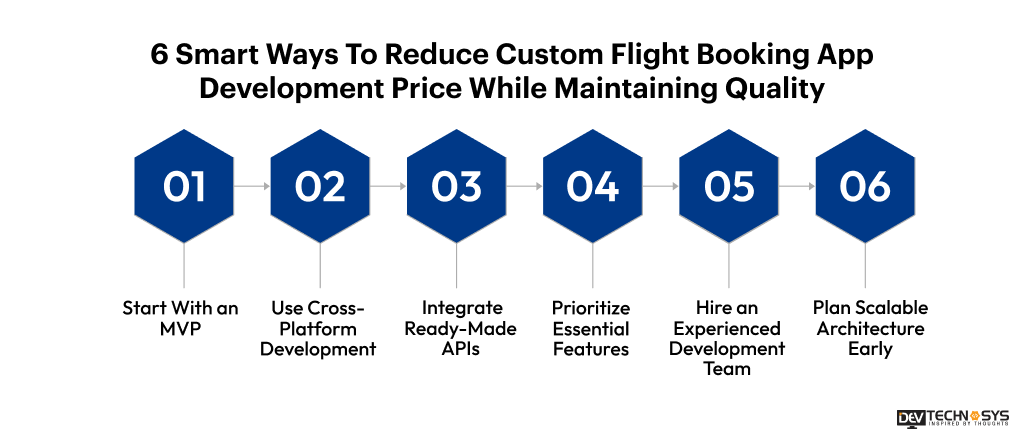
1. Start With an MVP
A business can first develop an MVP and reduce costs to begin with. The MVP has essential features for booking a flight, which will aid a business to get a market value and customer reviews, in order to make changes in the existing feature list in the application development stage later. The flight booking software development cost can thus be controlled.
2. Use Cross-Platform Development
There is also a way of getting a mobile application for Android as well as iOS from one code base only, thereby lowering the airfare reservation system development cost. This can be done using Flutter and React native frameworks. One will be able to gain the benefit of providing an identical user interface.
3. Integrate Ready-Made APIs
One does not have to design and develop the app from scratch. It is a known fact that third-party APIs will enhance the user experience. APIs are already available for searching flights, processing payments, showing the flight data on the map, providing alerts, etc. This makes flight booking software development less expensive.
4. Prioritize Essential Features
Instead of developing each feature right from the start, a business can limit the development only to the core features of the flight booking application, which include payment processing, searching, and booking of flights. Advanced features such as AI flight recommendations, Loyalty programs, etc. This will increase the overall airfare booking app development cost.
5. Hire an Experienced Development Team
By outsourcing the task of designing and developing the flight booking app, businesses will also save on costs. Skilled and proficient vacation planning app development services providers will provide quality services at a lower cost, preventing costly development mistakes in terms of time and money, hence saving the airline booking app development cost.
6. Plan Scalable Architecture Early
Building a scalability plan with development from the beginning can prevent rework later and significant upgrade costs to scale the infrastructure and enhance performance when the user base and number of transactions increase.

Security, Compliance, and Trust Framework in Flight Booking App
It is important to maintain robust security measures in a flight booking application to prevent malicious attacks, safeguard user details, and payment transactions. Key security frameworks for flight booking apps include secure payment gateways, encryption for payment and transactions, secured authentication of users, fraud detection measures, and regularly performed vulnerability checks.
PCI-DSS and GDPR compliance are standards for data protection. Trust-building features that support a secure and safe environment for users include a secure payment system, transparent terms and conditions, alerts to confirm booked flights, real-time notifications, reliable customer support, etc.
Top 3 Flight Booking App Development Trends in 2026
Flight booking is evolving rapidly as innovative technologies make the experience better, safer, and more personalized for users. Emerging trends in 2026 are transforming the way users search, book, and manage their flights.
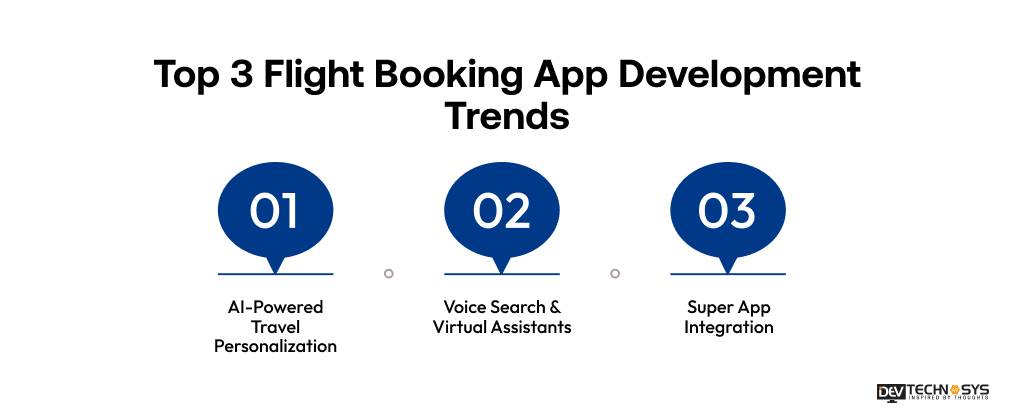
1. AI-Powered Travel Personalization
AI-powered flight booking apps are revolutionizing travel planning by offering users personalized travel recommendations, fare predictions, and smart itineraries based on their travel history and preferences. These advanced systems enhance user satisfaction, improve booking precision, increase customer engagement, boost conversions, and retention. Connect with a leading AI development company that will help you integrate such functions into your flight booking app.
2. Voice Search & Virtual Assistants
Voice-enabled booking and AI virtual assistants are the latest features being integrated into flight booking applications. They allow users to verbally search flights, book tickets, and get travel updates in real time, enhancing customer convenience, improving accessibility, and providing a hands-free experience across all their mobile and smart devices.
3. Super App Integration
Flight booking apps are increasingly transforming into all-encompassing travel super apps by adding services such as hotels, car rentals, travel insurance, local transportation, and tours in one single platform. This holistic ecosystem is a win-win situation as it not only improves convenience for users but also creates a huge revenue-generating opportunity for travel businesses worldwide.
Which Flight Booking Trend Is Right For Your Startup: 3 Ways To Find
The choice of the trend that a startup needs to adopt while designing a flight booking application is a crucial factor in achieving success. Factors such as market demand, customer needs, and future plans need to be considered while incorporating new technologies in the flight booking app for generating more profit and greater engagement from customers.
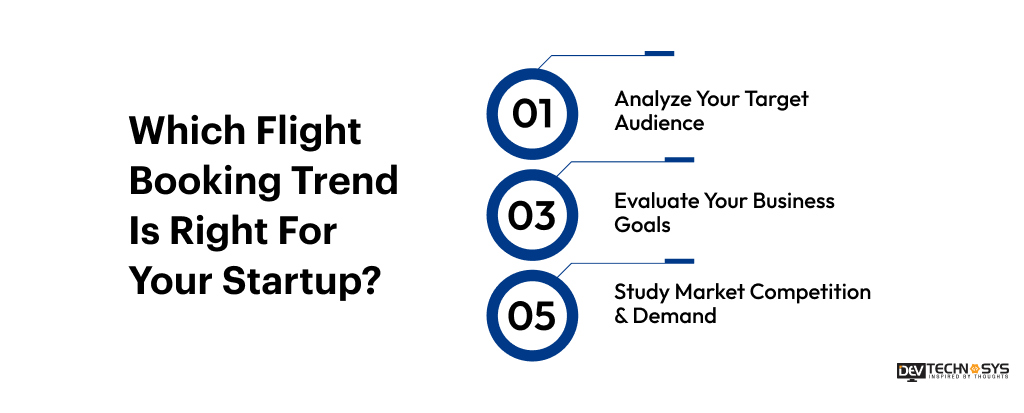
1. Analyze Your Target Audience
It is important to understand your target audience while selecting the appropriate flight booking application trend for a startup. Analyze customer behavior, their buying habits, what they like to read and watch on various digital media, and their current use of technology to determine which particular feature would add the maximum business value, be it an AI personalized search, voice search, or an amalgamation of services in a travel super app.
2. Evaluate Your Business Goals
Every startup has different goals, whether to earn more, ensure more customers purchase through the application, or increase service scope; but to invest in a particular trend, one needs to understand what goal a business wants to fulfill. This understanding helps to select a feature that provides maximum business value and profit for the business within a manageable and cost-efficient framework.
3. Study Market Competition & Demand
In order to make a flight booking application competitive in the market, the technology that is popular needs to be selected in the application after extensive market research, competitor analysis, and understanding of customer needs and expectations. By studying the flight booking application design of popular flight booking platforms, customers’ expectations from them, a business can implement better and more feasible features that give its application a market advantage.
Flight Booking App Development Tech Stack
The key to creating a fully functional flight booking app that is scalable and secure for its users is to have a robust technology stack in place. The different layers, such as front-end, back-end, APIs, databases, cloud technologies, and many others, should be designed strategically by mobile app development firms so that the app runs smoothly and effectively for every user across various platforms.
| Technology Layer | Technologies Used |
| Frontend Development | React Native, Flutter, Swift, Kotlin |
| Backend Development | Node.js, Python, Laravel, Java |
| Database | MySQL, PostgreSQL, MongoDB |
| Cloud & Hosting | AWS, Google Cloud, Microsoft Azure |
| APIs & Integrations | Amadeus API, Skyscanner API, Sabre API, Travelport API |
| Payment Gateway | Stripe, PayPal, Razorpay |
| Authentication & Security | OAuth 2.0, Firebase Authentication, JWT |
| Push Notifications | Firebase Cloud Messaging (FCM), OneSignal |
| Analytics Tools | Google Analytics, Mixpanel |
| DevOps & CI/CD | Docker, Kubernetes, Jenkins |
| AI & Personalization | OpenAI API, TensorFlow, Dialogflow |
| Maps & Navigation | Google Maps API, Mapbox |
| Customer Support | Zendesk, Freshdesk, AI Chatbots |
| Testing Frameworks | Selenium, Appium, Jest |
| Monitoring & Performance | New Relic, Datadog, Firebase Crashlytics |
5 Ways to Monetize Techniques for Flight Booking App
A successful business should have a well-defined monetization strategy in place for their flight booking application, to maintain a healthy and continuous revenue stream for the business. After knowing everything about flight booking platform development pricing business owners must know about monetization techniques. Various income-generating streams may be utilized which not only create good revenue for the business, but are also an added advantage for users of the flight booking app and offer excellent customer engagement.
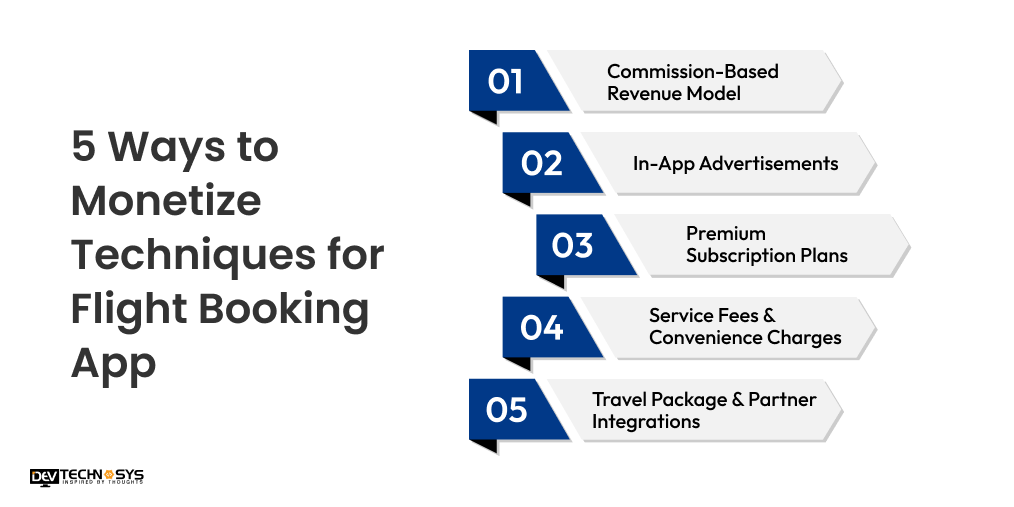
1. Commission-Based Revenue Model
Flight booking applications charge commission on each successful booking that takes place from their portal-either on airline tickets, holiday packages or other travel related services; for every successful booking from the application, the business gains a fraction of that transaction amount. The revenue generated from the application through booking services is the commission that a flight booking business earns.
2. In-App Advertisements
A flight booking app could also choose to include ads in their application; display travel related ads-from airlines, travel insurance agencies, holiday package providers, tourism agencies etc. In the application which would enhance user engagement and also generate revenue in the form of an added advantage from such companies.
3. Premium Subscription Plans
Providing membership programs with special discounts, prioritizing customer support, sending instant alerts for fare drops, and offering ad-free experiences aids businesses in earning repeat revenues. Monetary gain through subscription ensures higher customer retention, offers value added services for regular users, and business class travelers.
4. Service Fees & Convenience Charges
Flight booking applications levy charges like convenience fees for making a booking, cancellations, adding seats, altering tickets, etc. This simple but incremental increase in cost helps travel booking applications grow financially.
5. Travel Package & Partner Integrations
An integration of flights with hotels, car rentals, tour packages and travel insurance allows flight booking applications to benefit from affiliate revenue and partnership commissions. Multi-purpose applications with additional travel related services ensure users a convenient booking experience and a diversified stream of profit for travel businesses.
How Dev Technosys Can Help You Build a Flight Booking App?
A flight booking application must partner with a technology partner having comprehensive understanding of scalable travel applications, secure integration and simple, fast and smooth user interface and user experience.
Dev Technosys offers custom flight booking app development services, and they design all apps with smart features such as real-time flight tracking, AI driven suggestions for traveling to any place with relevant flight deals, secured payment gates, multilingual support and GDS/API integration. Our dedicated flight booking app development services providers create apps that have a very easy to use interface, offer excellent speed, are cost effective, and can handle traffic at any given point, catering to your specific needs.
From conceptualizing to execution and support, we assist you in all the stages of developing the booking app with excellent backend support that can be scaled according to your needs and market demands to remain successful even in this very competitive travel industry. We provide efficient travel solutions based on modern tech standards and unique, innovative methods for all startups and large scale travel companies all over the world.a
Frequently Asked Questions
Find answers to the most common questions related to this article.
Online flight booking app development costs somewhere from $8,000 to $30,000 depending on the complexity and choice of features, platforms chosen, API integrations and other backend integrations like GDS API and payment gate.
It might take somewhere from 3-5 months to develop a basic flight booking application while some custom apps with unique AI-driven features and multiple API integrations may require about 6-12 months depending on its scope and complexity along with adequate testing requirements.
Some of the important features that must be included in a flight booking application include a search engine for flights, management of booking details, payment security, real-time tracking, notifications to the user regarding their booking, support services for customers, multi-lingual support, loyalty points for frequent users and admin panel. Some advanced applications can also include AI-driven suggestions and offer tour packages with flight bookings.
Common technology stacks for developing a flight booking app include, but are not limited to,React Native, Flutter for mobile platforms, Node.js, and Python for backend infrastructure, MySQL for database management, AWS as a cloud hosting provider and travel APIs for managing real-time information. Other services include, a booking system integrated with payment gateways, cloud infrastructure, AI and machine learning tools and security frameworks for optimum efficiency.
A flight booking app is usually a monetization platform based on commissions from ticket booking, additional charges levied from customers on making a reservation, offering a paid premium membership with special discounts, exhibiting advertisements within the app and by establishing affiliate partnerships with tour operators, hotels, and insurance companies for offering bundled deals to their customers.