











Quick Summary:
-
- People adopt BNPL apps because of their speed and trust. This makes Instant KYC and real-time credit decisions matter more than flashy design.
- There is no room for negotiation when it comes to fraud detection. AI-driven fraud detection is now a baseline requirement, not an add-on.
- Merchant tools are as important as consumer tools. A merchant adopts the platform on the basis of dashboards, analytics, and easy integration.
- Transparent fee disclosure and dispute resolution are becoming regulatory requirements, not optional extras.
A modern BNPL app in 2026-2027 is not just a checkout option for users that splits purchases into installments. It is an ecosystem that offers users instant eligibility checks, flexible repayment plans, secure payments, and smooth credit experiences.
Imagine a shopper at the counter with a full cart, concerned about the total. She taps the “Buy Now, Pay Later” option, and it’s approved within seconds. No hassle, no waiting, no paperwork, no friction, and everything is done seamlessly.
Definitely, this is not due to luck, but to a dozen BNPL app features working behind the scenes. From real-time credit checks to fraud models, every feature plays an important role. That single moment of trust is what turned BNPL into serious infrastructure.
The US BNPL market is valued at $198.21 billion in 2026 and is expected to reach $423.08 billion by 2031. So the real question isn’t about app launch, but whether it has the right BNPL application features. This guide breaks down the top 10 priority BNPL app features.
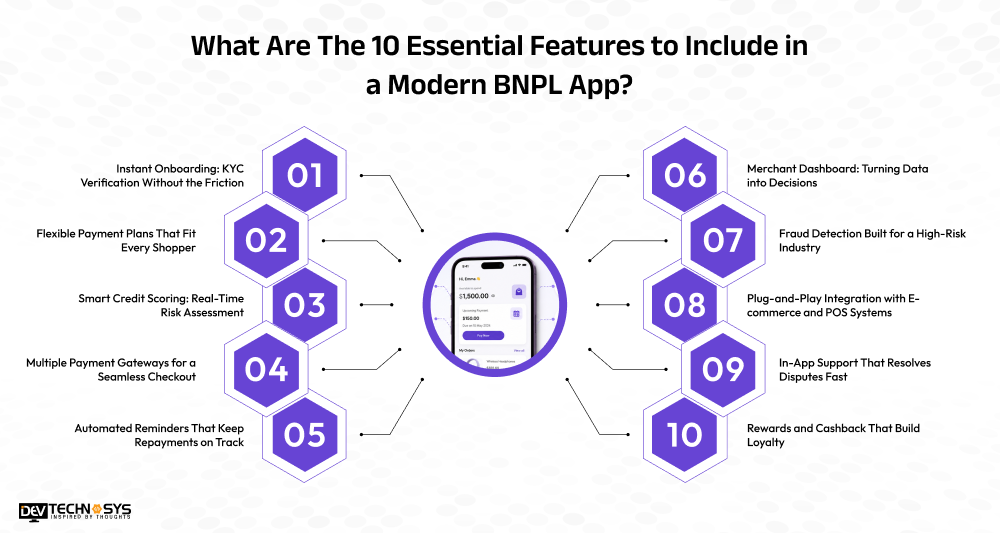
What Are The 10 Essential Features to Include in a Modern BNPL App?
Instant onboarding, flexible payments, smart credit scoring, multiple payment gateways, and automated reminders are among the top BNPL app development features. In this section, we will learn about some of the essential top 10 Buy Now Pay Later app features.
1. Instant Onboarding: KYC Verification Without the Friction
The transaction in a BNPL digital payment app development begins with checking who the user is. Users expect this verification process to be done within seconds, even without showing down payment processes.
If the onboarding flow is strong, it includes:
- Document scanning with OCR for ID verification
- Liveness detection to block spoofed photos
- Instant database checks against credit bureaus and watchlists
- Progressive KYC, where low-value purchases need less verification than large ones
The apps that get this right treat onboarding as the first real test of the product. If you fail it, the user never reaches out again.
2. Flexible Payment Plans That Fit Every Shopper
Shopping for a pair of shoes at $40 is far different from purchasing a $2,000 laptop. So why should both have the same repayment plan?
| Plan Type | Typical Use Case | Repayment Window |
| Pay in 4 | Everyday retail purchases | 6 weeks |
| Monthly installments | Electronics, furniture | 3 to 24 months |
| Interest-bearing loans | Large-ticket items | 6 to 60 months |
Therefore, giving users flexible payment plan BNPL app features is a good idea. It lets users choose a plan that fits their budget. Also, these features of BNPL apps offer convenience to users whether they are making a small everyday purchase or a bigger one.
3. Smart Credit Scoring: Real-Time Risk Assessment
Smart credit scoring in Buy Now Pay Later app development is among the top BNPL app features that drive every approval. The underwriting at Affirm now relies on real-time data like account balances and cash flow patterns. It comes from users who have linked their bank accounts, moving beyond traditional credit scores.
This matters because credit bureaus often ignore younger users and thin-file borrowers, who are key customers for BNPL services. With an alternative, real-time scoring system, an app can approve a loan responsibly without ignoring the people it’s meant to reach. Developing such an in-house system is usually the biggest expense for a BNPL application.
4. Multiple Payment Gateways for a Seamless Checkout
A mobile banking application development that offers BNPL should connect to multiple payment gateways. It should also include major card networks and e-wallets to ensure higher approval rates and lower abandonment. Instead of forcing a single payment option, a multi-gateway feature should match what users already prefer and trust.
5. Automated Reminders That Keep Repayments on Track
Delayed payments affect not only providers but users also, on a serious note. Push notifications, SMS, and email reminders about upcoming due dates reduce late payments with minimal extra effort. Good examples of implementation include:
- Notifications in case a grace period remains before penalties are applied
- ‘Pay Now’ button right in the notification
- Autopay subscription during onboarding process
These reminders are a small feature but are of great importance.
6. Merchant Dashboard: Turning Data into Decisions
However, the merchant dashboard is also a crucial part of BNPL custom fintech software development. Merchants invest in BNPL app development because it helps sell their products, and they stick around because the data shows it works. Merchant customers who use BNPL have shown a 47% jump in average checkout value and a 57% rise in conversion rates.
Merchant dashboards need to show:
- Real-time sales and settlement information
- Conversion and average order value statistics
- Dispute and chargeback status
- Payout schedules
Otherwise, there is no point in keeping the integration at all.
7. Fraud Detection Built for a High-Risk Industry
BNPL fraud is not hypothetical; it is an active, well-funded threat. Klarna uses Google Cloud’s AI hardware and expertise to train and deploy graph neural networks. These networks detect and prevent fraud and money laundering on its platform. They also analyze relationships between users, transactions, and devices to catch anomalies.
Smaller and newer players lean on similar behavioral tools. Fraud-detection platforms increasingly track typing cadence, scroll speed, and copy-paste patterns. It helps catch bots and synthetic identities before they reach checkout. It is an approach built by companies like BioCatch and Sardine. Fraud detection based on behavioral signals is one of the vital BNPL app features becoming standard, not experimental.
8. Plug-and-Play Integration with E-commerce and POS Systems
Great features with poor integration are a recipe for disaster, and easier integration than the competition will always win out. Plugins for major e-commerce sites and an SDK for in-store POS devices can cut onboarding from weeks to days. Such BNPL app features can make or break the scalability of your BNPL app beyond its initial hundred merchants.
9. In-App Support That Resolves Disputes Fast
Disputes are inevitable; wrong charges, returned items, and billing confusion can happen anytime. What separates trustworthy apps is how fast these problems can be resolved.
To solve such disputes effectively, businesses should include:
- In-app chat with real-time agent routing
- Automatic hold on disputed payments during investigation
- Clear timelines communicated to the user at every step
Slow dispute resolution is one of the fastest ways to generate public complaints and regulatory attention.
10. Rewards and Cashback That Build Loyalty
Once trust and functionality are established, rewards turn a simple transactional app into a habitual one. Offer cashback on repeat merchants, loyalty levels, and special offers for installment plans available in advance. This way, users have a reason to use a specific BNPL app instead of looking around every time they shop. This factor works especially well with Generation Z consumers, whose adoption of BNPL comes in at around 44%.
Conclusion
Not a single BNPL app feature works in isolation; they all team up together and support each other. For example, instant onboarding means nothing without fraud detection behind it. Similarly, flexible plans are of no use without a merchant dashboard.
A BNPL custom fintech app development wins the market because it treats every feature as a connected system, not a checklist. A strong BNPL app makes the user journey simple. It keeps credit decisions, payments, fraud checks, and merchant operations connected in the background.
That is what turns a list of features into a reliable BNPL platform that can grow with your business.
Planning a Bnpl Project?
Get a tailored development cost estimate in a few simple steps.
- 3 quick steps
- 100% free
- Reply in 1 business day
2 Minutes Read
Frequently Asked Questions
Find answers to the most common questions related to this article.
Start with features that directly affect approval, repayment, security, and user experience. Digital onboarding, KYC, credit assessment, flexible payment plans, payment processing, fraud detection, repayment tracking, and merchant tools form the core. Advanced features such as AI-driven risk analysis and personalization can be added as your transaction volume grows.
BNPL app development can cost around $30,000 to $150,000+, depending on the feature set, platforms, integrations, security requirements, and customization. A basic MVP costs less, while a full-scale platform with automated credit decisions, fraud detection, merchant dashboards, payment integrations, and compliance workflows requires a larger development budget.
Flexible repayment options, quick onboarding, personalized offers, merchant integrations, and a smooth checkout experience can directly influence adoption. At the same time, fraud detection and accurate credit assessment protect margins as transaction volume increases. Founders should evaluate features based on both customer value and their effect on operational and financial risk.
Plan the architecture around future transaction volume rather than building only for the MVP. Use modular services, secure APIs, scalable payment infrastructure, and integration-ready systems. Your BNPL platform should also support additional merchants, payment methods, markets, and risk models. These are supported without requiring major changes to the core application.
No, because building everything at launch can increase development time and burn budget without proving product-market fit. Start with the features required for your core customer and merchant journey. After that, add advanced analytics, AI-based risk models, loyalty features, and automation based on real user and transaction data. This measure can help you plan your development budget decisively.