
















Key Takeaways:
- Investing in a fintech application like Jar can be a great option in this mobile-first generation. It is because people are searching for accessible ways to save and grow their money.
- Generally, the cost to develop an app like Jar can range from $8,000 to $30,000. This price depends on several factors, including the app’s complexity, features, security, backend, etc.
- From market research to app deployment and feature launch support, each Jar-like app development step required strategic planning.
Investing and saving are no longer complex financial activities, but a part of basic financial planning. But saving money in piggy banks is now replaced by smart and digital investment solutions. It is due to apps like Jar that are transforming even spare change into strategic financial management.
With an app like Jar, investment doesn’t feel risky or complicated. You don’t need large amounts of money or financial expertise; you can simply automate small savings and watch wealth grow. This has also made micro-investment apps a great digital business idea.
As a result, entrepreneurs are increasingly building an app like Jar and entering this competitive market. They aim to make seamless, secure, and intelligent platforms that become a part of users’ daily financial habits.
This blog is designed for entrepreneurs and businesses looking to understand how to build an app like Jar.
What is the Jar App?
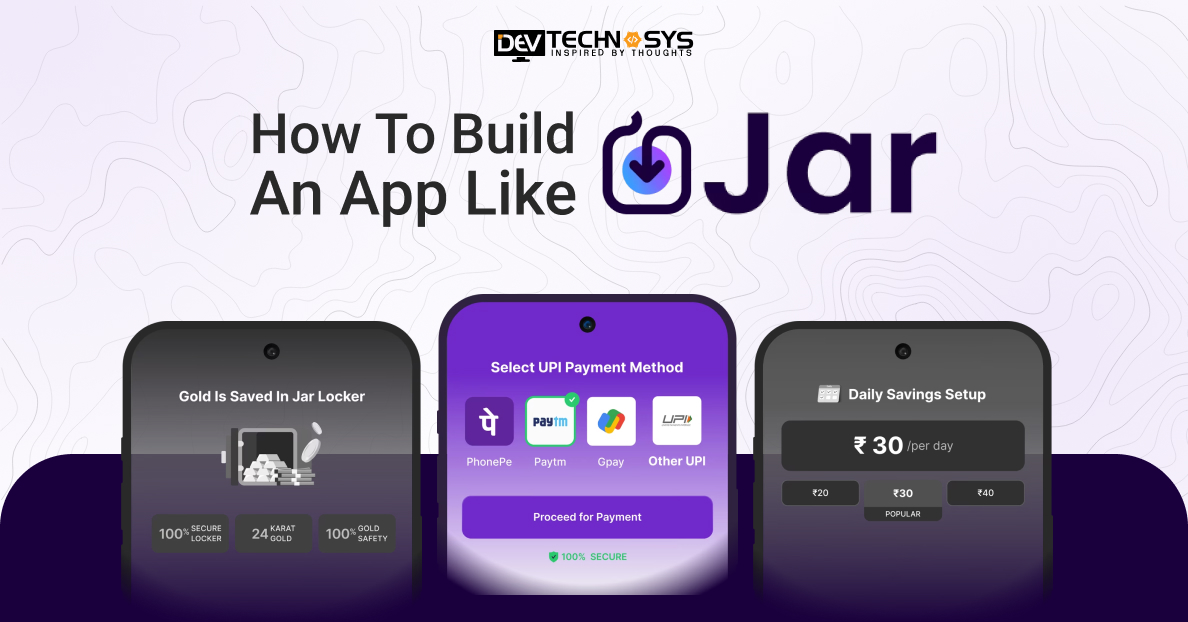
Jar is an India-based fintech application where people can save even a small amount in 24K digital gold. This app was founded by Misbah Ashraf and Nishchay AG in 2021, headquartered in Bangalore, India. It simply automates the daily micro-investment, even starting from $0.11 (₹10 INR).
Basically, Jar is a digital piggy bank that can save and invest small amounts from everyday transactions. Through this app, people save money daily, weekly, or monthly. This app is known for its round-off feature that saves small amounts from UPI transactions automatically.
Some of the key features and functionalities of the Jar app:
- Automatic Daily Savings (Gold SIP)
- Round-Off Transactions
- Digital Gold Storage
- Instant Withdrawal
- Physical Gold Conversion
Industry Insight: Mobile devices now handle 91% of all micro-investment transactions worldwide, according to Market Growth Reports.
How Does the Jar App Work?
You must be wondering how the Jar app can convert daily loose change into a smart investment. We are going to discuss its work, where it automatically makes small amounts into digital gold. It also helps you build savings effortlessly and consistently.
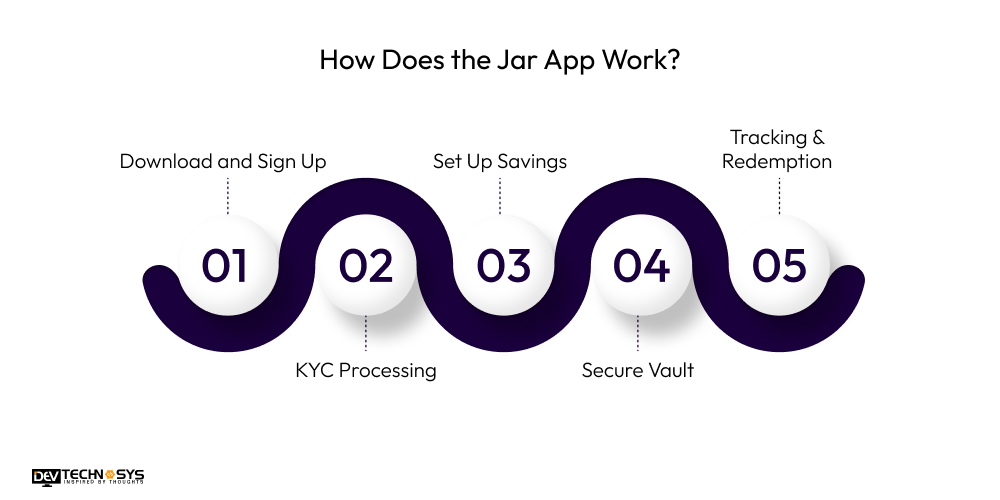
Step 1: Download and Sign Up
First, download the Jar app from app stores (Play Store or App Store) and register your mobile number. Verify the number with OTP and create your profile for personalized savings and investment.
Step 2: KYC Processing
By submitting basic details like PAN and Aadhaar (Indian identification documents), you can complete the KYC. It ensures regulatory compliance, account security, and a legally approved digital gold investment.
Step 3: Set Up Savings
You can now select how much you want to save daily, weekly, or monthly. The app will automatically deduct the amount you mention regularly and convert it into digital gold.
Step 4: Secure Vault
The gold you purchased with the investment is safely stored in an insured vault. The vault is managed by an authorized and trusted person with high security standards.
Step 5: Tracking & Redemption
You can easily track your gold value in real time through the dashboard. Sell the gold anytime, transfer funds to your bank account, or redeem physical gold when your savings grow.
What are the Market Stats of Digital Investment Apps?
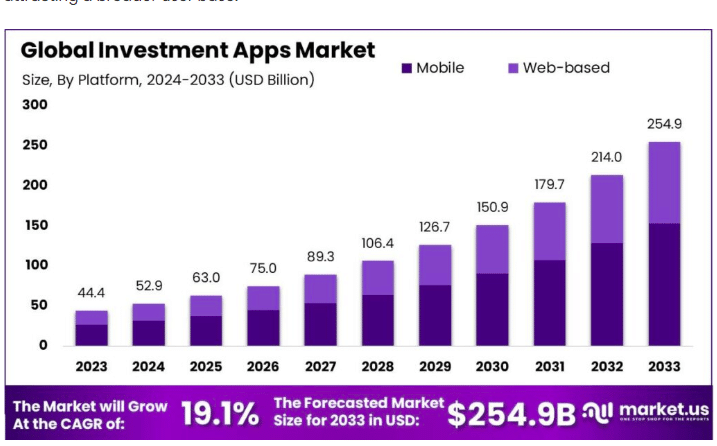
The digital investment market is witnessing extensive growth as digital finances are accessible and user-friendly. The increase in smartphone adoption simplified investing, leading to the significant growth of digital investment apps. Have a look at the market stats analyzed by market.us.
- The global investment apps market is experiencing rapid growth worldwide.
- It is projected to reach USD 254.9 billion by 2033, rising from USD 63.0 billion in 2025.
- The market is expanding at a strong CAGR of 19.1% between 2024 and 2033.
- This growth reflects increasing adoption of digital investing and mobile financial platforms.
- In 2025, North America dominated the market with over 34% share, generating USD 14.96 billion in revenue.
Want to Build an App Like Jar? Here’s How to Get Started!
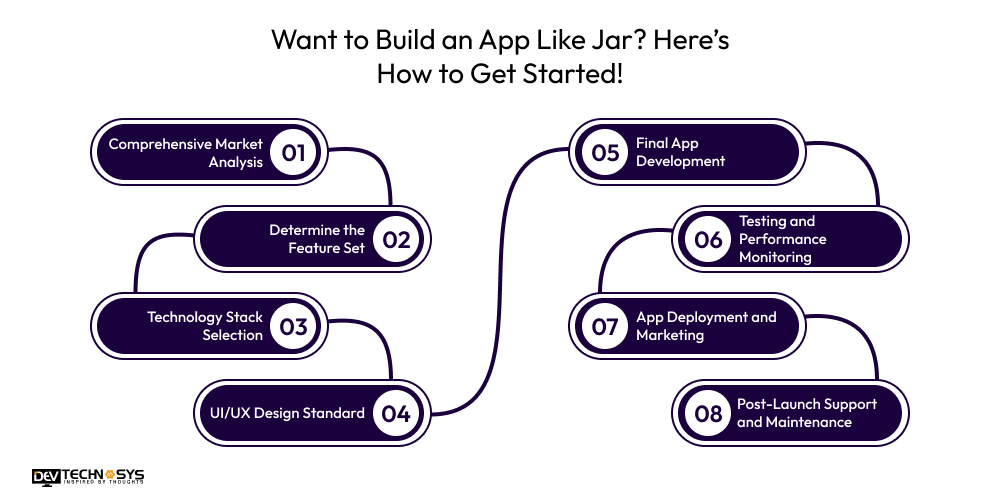
From market research to post-launch support, each stage plays a vital role in the fintech app development process. Combining and meticulously following each step can create an app like Jar secure, scalable, and user-friendly. We will now understand the Jar app clone development steps thoroughly.
1. Comprehensive Market Analysis
Start the micro-savings app development by identifying your target audience, competitors, and the latest fintech trends. Market research helps detect the pain points, spending behaviour, and investment habits of users.
Study your competitors and their strategies, strengths, and weaknesses to identify gaps. With detailed market insight, entrepreneurs can define a unique value proposition to solve real financial problems.
2. Determine the Feature Set
Outline the most essential and user-centric features to add to the Jar app development. The essential feature set includes user registration, KYC verification, automated savings, digital gold integration, payment gateway support, and withdrawal options.
These features are prioritized for MVP digital gold investment app development. Whereas for an advanced app, add features like analytics, rewards, referrals, and notifications.
3. Technology Stack Selection
For frontend, backend, databases, framework, and cloud hosting, pick the most reliable tech stack. A scalable tech stack is always performance-oriented and secured. It ensures smooth transactions, real-time tracking, data protection, and long-term app stability in mobile app development.
Choosing proper technologies can seamlessly integrate third-party APIs without compromising speed, performance, and security, reducing future technical debt.
4. UI/UX Design Standard
Focus on designing a clean, user-friendly, and interactive interface that makes navigation simple and reduces user confusion. It focuses on minimal steps, clear financial understanding, emerging visuals, consistent branding, and accessible layouts.
When the UI and UX are strong and attractive, it enhances user trust and retention. Excellent design standards encourage consistent saving and investing behavior.
5. Final App Development
At this stage, the final digital investment app development, like a Jar clone, should take place. It involves developing the frontend and backend in parallel with API integrations, payment systems, and KYC verification.
During the development, agile methodology is preferred to make sure change flexibility and on-time interactions. It requires maintenance of documentation and code quality to create an app like Jar.

6. Testing and Performance Monitoring
Developers now conduct thorough testing to identify bugs, payment failures, and data vulnerabilities before the app release. It also incorporates functional, usability, security, and performance testing on multiple devices.
Also, platform load testing is done to ensure the app’s stability on several devices during high traffic. Performance monitoring helps maintain smooth operations and prevent security risks or downtime after launch.
7. App Deployment and Marketing
As the app is tested thoroughly, it is all set to be launched. Deploy the application to the Google Play Store and the App Store while following the platform guidelines. To release the app on app stores, App Store Optimization (ASO) is necessary.
But releasing the app is not enough; promote the app to reach the target audience. Launch marketing campaigns through social media, influencer partnerships, and paid ads to attract early users and build brand awareness.
8. Post-Launch Support and Maintenance
After launching the app, continuously monitoring it with regular updates according to user feedback is mandatory. A startup app development company continuously works on an app with bug fixes, security patches, and feature upgrades.
Analyze the analytics that refine the feature and performance improvements. Ongoing maintenance reinforces reliability, enhances user satisfaction, and promotes long-term growth.
Industry Insight: The platform Jar has crossed 35 million users, many saving formally for the first time: TechCrunch.
Which Features Make an App Like Jar Successful?
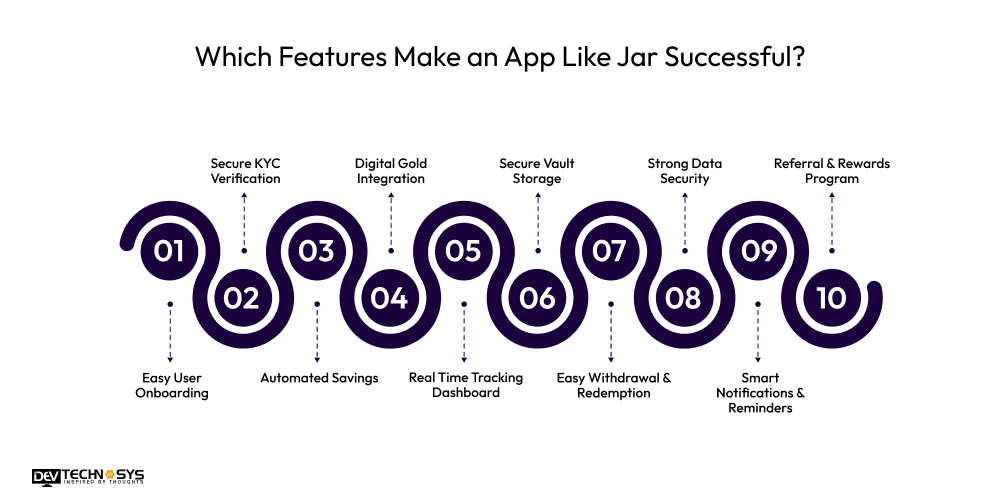
A successful digital gold investment app development requires simple, automated, secure, and trusted features. It demands a combination of smart financial tools and a seamless user experience. Have a look at the automated savings app features that should keep users engaged and encouraged.
-
Easy User Onboarding
With mobile OTP verification and simple profile setup, users can smoothly sign up. It reduces the chances of confusion and friction, making users conveniently onboard the app. This feature focuses on saving or investing within minutes without feeling overwhelmed.
-
Secure KYC Verification
KYC verification is really mandatory to ensure regulatory compliance and build credibility. A secure and quick verification process that increases users’ trust in the app. It also enables safe and legally approved financial transactions.
-
Automated Savings
Automated saving option allows users to invest small amounts through round-ups or daily. It generates a saving habit without requiring any effort. Its main purpose is to make investment effortless and become part of everyday spending behavior.
-
Digital Gold Integration
Digital gold stored in insured vaults ensures the safety of users’ investment. It focuses on secure storage to help build user confidence and trust in the credibility of the app to protect their valuable investments.
-
Real Time Tracking Dashboard
A dashboard that displays gold worth, overall savings, and transaction history in a simple manner. Real-time updates increase transparency and keep people engaged with visible progress.
-
Secure Vault Storage
Digital assets should be stored in insured and assured vaults to provide safety assurance. Highlighting secure storage practices increases user confidence and reinforces the app’s credibility in handling valuable investments.
-
Easy Withdrawal & Redemption
Users buying gold for small investments demand the flexibility to sell digital gold anytime or redeem physical gold. Easy withdrawal puts liquidity and flexibility in the hands of the users. It creates an illusion of liquidity of investments rather than being locked or restricted.
-
Strong Data Security
Strong encryption, secure APIs, and fraud detection systems should be used for user data and user transactions. It is because fintech apps deal with highly sensitive information and are also regulated.
-
Smart Notifications & Reminders
Smart notification and reminder features offer smart reminders to remind users about their savings streak, price alerts, and so on. This helps keep users engaged and boost regular investments, without being too intrusive.
-
Referral & Rewards Program
Provide users with timely incentives through referral bonuses and rewards to increase app growth organically. Gamified benefits motivate users to invite others while strengthening long-term engagement and retention.
Why are Entrepreneurs Investing in Developing an App Like Jar?
Entrepreneurs build an app like Jar because they find it a high-growth, underserved niche in the fintech industry. The growing digital adoption and changing saving habits of users are also attracting them to personal finance app development. We have explained several reasons for entrepreneurs’ interest in micro-investment app development.
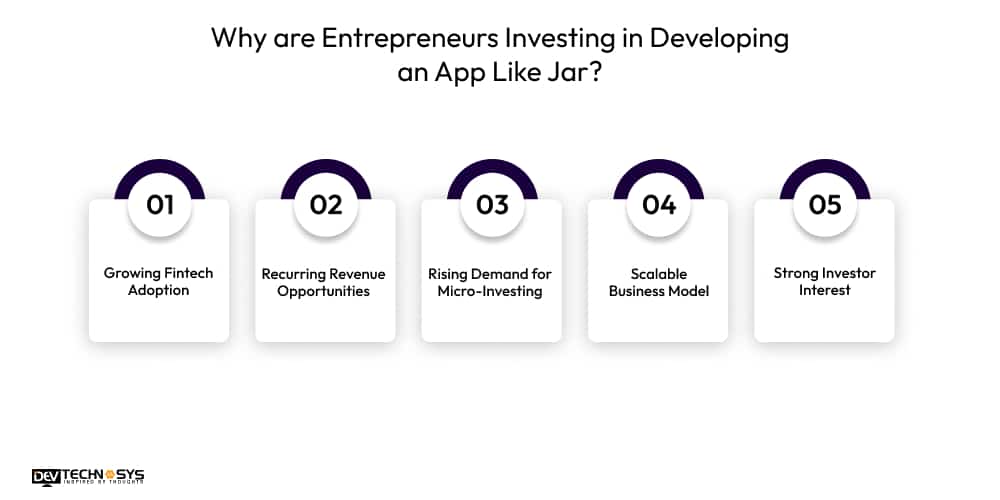
1. Growing Fintech Adoption
Digital payments and online financial services are expanding rapidly, attracting entrepreneurs to invest in them. With increasing smartphone penetration and UPI usage, fintech apps are a popular choice of tech-savvy audience. It helps them feel comfortable and manage money savings digitally instead of traditional savings.
2. Recurring Revenue Opportunities
Gold savings app development, like Jar, can generate revenue through multiple models. It includes monetization strategies like transaction margins, partnerships, and premium features. It automates daily investments and creates consistent user activity, ensuring steady and predictable revenue streams for businesses.
3. Rising Demand for Micro-Investing
Daily earners and spenders generally prefer small, recurring investments over big financial management. These digital solutions for startups standardize wealth building for beginners who have just started saving. However, it helps entrepreneurs to tap into an enormous market with excellent long-term user retention.
4. Scalable Business Model
Fintech apps, including apps for micro-investments, are highly scalable with cloud infrastructure and digital processes. Once these apps are developed, they can expand to new regions and add investment products. Apart from that, it can also grow its user base without proportional cost increases.
5. Strong Investor Interest
Fintech is one of the most preferred and current-favorite sectors for venture capital. Innovative savings platforms and digital gold platforms are attracting bigger investments from small savings. All thanks to the high growth prospects of digital savings and the potential to disrupt traditional financial services.
How Much Does it Cost to Build an App Like Jar?
The average cost to build a digital gold app like Jar can commonly be estimated from $8,000 to $30,000. The final development budget is determined by the complexity of the application. In simple terms:
- A basic app developed with an MVP strategy has limited and simple integrations, design, security, backend, and tech stack. It lowers the app’s complexity and development cost, ranging between $8,000 and $15,000.
- A mid-range app is an amalgamation of simple and advanced features and integrations. This keeps the app’s complexity moderate, leading to mid-level development cost, generally from $15,000 to $22,000.
- Whereas a highly advanced app has high-tech, modern, and next-gen integrations has higher complexity. It elevates the app development expenses, fluctuating from $22,000 to $30,000.
This cost concept will be clearer through this mobile app development cost breakdown table:
| Development Tier | Features Included | Estimated Cost (USD) |
| Basic MVP | Core investment features (saving, gold buying), simple UI, basic user onboarding, and limited analytics | $8,000 – $15,000 |
| Standard App | All MVP features + push notifications, user profile, basic wallet integration, admin panel, enhanced UI/UX | $15,000 – $22,000 |
| Advanced App | Standard features + real-time updates, advanced analytics, referral & rewards, enhanced security & compliance, API integrations | $22,000 – $30,000 |
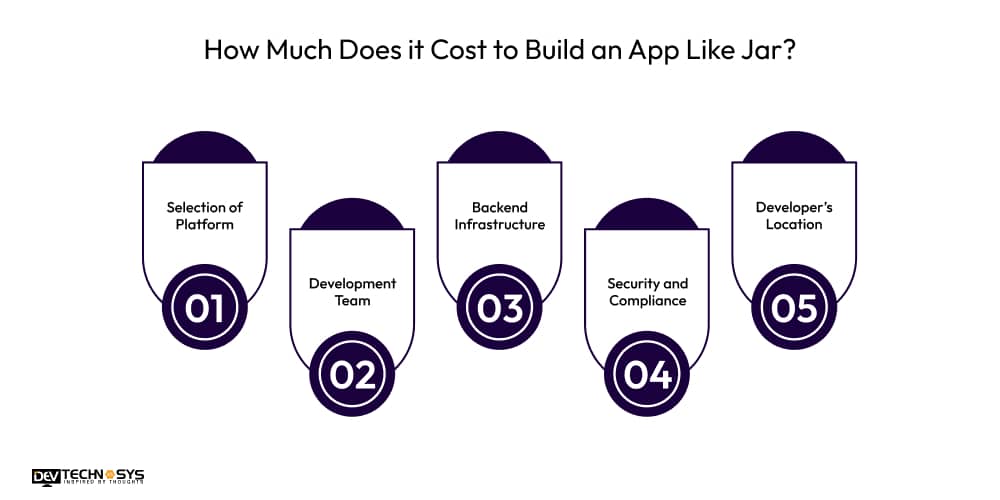
Rather than just complexity, multiple features are present, affecting the mobile app development cost. It includes the app’s features, technology selection, choice of platform, backend infrastructure, development team, and other factors. We will discuss here some of the major factors, along with separate Jar app development cost breakdown tables.
1. Selection of Platform
The decision whether to launch the app on Android, iOS, or cross-platform can directly impact the development budget. Building an app on native platforms demands separate development efforts, timelines, resources, and customization. This can be the reason for the increased digital gold app development cost.
| Platform Type | Description | Estimated Cost |
| Android App | Development for Android devices only | $8,000 – $15,000 |
| iOS App | Development for Apple devices only | $10,000 – $18,000 |
| Cross-Platform | Single codebase for Android & iOS | $15,000 – $25,000 |
| Native (Android + iOS) | Separate apps for both platforms | $20,000 – $30,000 |
2. Development Team
Picking up between freelancers, an in-house team, or a development agency can affect the overall development expense. Freelancers are a budget-friendly option, but harder to manage, and in-house teams offer control but require long-term investment. Selecting development companies provides expertise and structured delivery, but raises the cost to develop an app like Jar.
| Team Type | Description | Estimated Cost |
| Freelancer | Individual developers for small projects | $3,000 – $6,000 |
| In-House Team | Dedicated internal development team | $6,000 – $10,000 |
| Development Company | Full-service professional agency | $10,000 – $15,000 |
3. Backend Infrastructure
A strong server comes with secure servers, cloud hosting, APIs, payment gateways, and real-time data tracking. These integrations lead to a scalable backend infrastructure that ensures the app performs well under heavy load. However, it requires higher initial and maintenance support, which has escalated the Jar app development cost.
| Infrastructure Level | Description | Estimated Cost |
| Basic Backend | User management & basic APIs | $3,500 – $6,000 |
| Scalable Backend | Cloud hosting & database scaling | $6,000 – $10,000 |
| Advanced Backend | Real-time processing & analytics | $10,000 – $15,000 |
4. Security and Compliance
Fintech applications like Jar need strict security measures, encryption, KYC integration, and regulatory compliance. Adding advanced data protection, fraud detection, and legal standards is mandatory for user trust and to avoid penalties. Simultaneously, this could be an essential reason for the higher Jar app clone cost of development.
| Security Level | Description | Estimated Cost |
| Basic Security | SSL, authentication, data encryption | $1,000 – $2,500 |
| Standard Compliance | KYC integration & secure payments | $2,500 – $4,000 |
| Advanced Compliance | Financial regulations & fraud detection | $4,000 – $6,000 |
5. Developer’s Location
The per-hour cost of the developers depends on their geographical location. If you hire dedicated developers from North America or Europe, the app development will become expensive. While developers from Asia or Eastern Europe offer a lower price. Location can influence the cost to build an app like Jar without compromising quality.
| Location | Average Cost Range |
| Asia (India, Southeast Asia) | $1,500 – $3,000 |
| Eastern Europe | $2,500 – $4,500 |
| Western Europe | $4,000 – $5,500 |
| North America | $5,000 – $6,000 |
Industry Insight: Around 78% of global internet users used at least one fintech app in 2025: 360 Research Reports
What Are the Best Alternatives to Jar in 2026?
Are you looking for apps similar to Jar? Here’s a quick overview of popular Jar alternatives that have revolutionized the way people save their money. This table defines apps like Jar, showing their launch year, user rating, number of downloads, and platform availability. This will help you choose the right digital gold investment app.
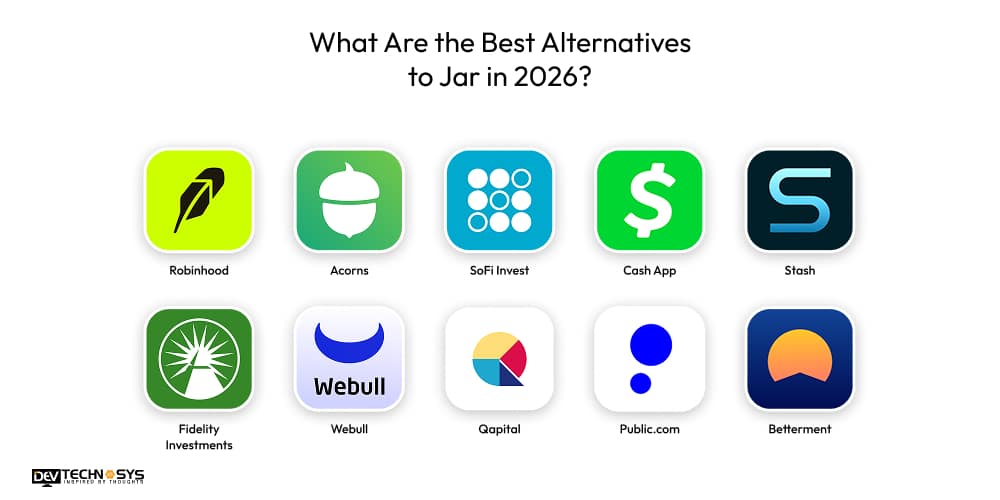
| App Name | Launch Year | Rating | Downloads | Platform Availability |
| Robinhood | 2013 | 4.4/5 | 10M+ | Android, iOS, Web |
| Acorns | 2014 | 4.7/5 | 10M+ | Android, iOS |
| SoFi Invest | 2018 | 4.5/5 | 5M+ | Android, iOS |
| Cash App | 2013 | 4.6/5 | 50M+ | Android, iOS |
| Stash | 2015 | 4.2/5 | 5M+ | Android, iOS |
| Fidelity Investments | 2016 | 4.8/5 | 5M+ | Android, iOS |
| Webull | 2018 | 4.3/5 | 10M+ | Android, iOS |
| Qapital | 2015 | 4.1/5 | 1M+ | Android, iOS |
| Public.com | 2017 | 4.4/5 | 2M+ | Android, iOS |
| Betterment | 2010 | 4.6/5 | 1M+ | Android, iOS, Web |
We are now going to learn about the top 5 Jar alternatives widely used worldwide. These apps offer innovative saving and investment features that attract millions of users across global financial markets.
1. Robinhood
Robinhood is an influencer app that took commission-free investing to the next level. It offers commission-free trading of stocks, ETFs, and crypto with a clean UI and an easy onboarding process that welcomes beginners. Robinhood simplifies stock trading for the younger, mobile-first generation.
2. SoFi Invest
SoFi Invest is known for its automated investing and active trading in one ecosystem. This app goes beyond investing by providing services like financial planning, student loan refinancing, and even banking. That’s why it has become a one-stop super-app for all things finance.
3. Stash
Stash is a unique investment app that’s core function is educating people to save, along with investment options. It offers fractional investing with personalized portfolio guidance. It’s educating beginners on investing and slowly building long-term wealth makes it different from others.
4. Webull
Webull is a unique digital investment app that offers extensive charting and market analysis tools. Unlike the other apps, it’s aimed at the intermediate and active trader who is looking for commission-free trading. It delivers an abundance of technical indicators that help investors in decision-making.
5. Public
Public.com is a unique digital savings app that offers social networking combined with investing. You can follow other investors, view portfolios, and have open discussions with anyone on the platform. The social feed is a unique platform that adds transparency and community to investing.
Which Recurring Revenue Strategies Fit a Micro-Savings App Like Jar?
A micro-savings app like Jar can generate a steady income by combining several money-making models. The purpose of these models is to create recurring revenue streams that feel seamless to app owners. The investment app business model also supports sustainable growth and long-term profitability.
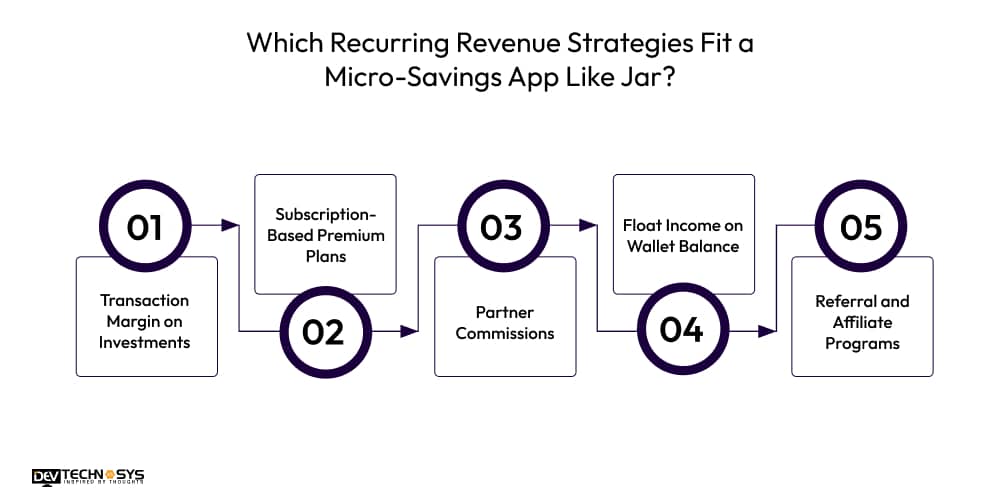
1. Transaction Margin on Investments
App owners can earn a small percentage on every gold purchase or sale. As users are investing regularly, these frequent transactions of small amounts can generate revenue. This income does not affect the user’s savings.
2. Subscription-Based Premium Plans
Provide users with premium memberships with added benefits like higher returns, advanced analytics, priority support, or exclusive rewards. This low monthly annual subscription fees can create predictable revenue and upgrade investing for serious investors.
3. Partner Commissions
Go for partner commission with gold providers and financial institutions to earn a steady income on each referral. This strategic partnership diversifies money-making sources. It also maintains a seamless user experience within the application.
4. Float Income on Wallet Balance
Idle funds that are temporarily stored in a user’s wallet can also generate regular profits. For this, place the pooled amount in secure and interest-bearing accounts. Through this model, the platform can earn additional income without impacting user returns.
5. Referral and Affiliate Programs
Introduce affiliate partnerships for financial products like insurance or mutual funds. When users sign up through in-app recommendations, the platform earns recurring commissions, expanding revenue streams beyond core micro-savings functionality.

What is the User Psychology Behind Micro-Investment Digital Gold Apps?
It is a big question why people save more through apps like Jar by turning spare change into gold. In this section, we will explore the psychology behind digital gold buying app development. It also covers how to turn small financial decisions into long-term habits.
Why Spare Change Savings Work?
Micro-investments or round-off savings usually work because they are effortless and uncomplicated. It includes the deduction of small amounts that are barely noticeable. This reduces the spending resistance of users and motivates them to save consistently. Through this, users can save without actively thinking or participating.
Behavioral Finance Triggers
Loss aversion, instant gratification, and progress visibility are some behavioral finance principles used by minor-investment apps. Features such as rewards, milestones, and visual growth tracking also motivate users to continue saving and investing regularly.
Persuasive and Behavioural Design Pattern
These apps apply habit-building techniques like automation, reminders, streaks, and simple onboarding. Also, regular notifications and easy interactions encourage users to repeat engagement. This can easily transform saving money into a daily financial habit.
Final Words
When you build an app like Jar, it solves the real financial and savings-related needs in a simple way. It helps those with lower incomes who want to save something by investing a small amount daily. Such apps have a clean, friendly interface that ensures strong security with features like automatic savings and smooth payments.
With clear goals, a 24K digital gold app development like Jar can convert daily spending into a smart investment. The main objective of such apps is to make money management simple, accessible, and trustworthy.
Investing in building an app like Jar is beneficial for financial discipline and creates strong opportunities for entrepreneurs in fintech.
Frequently Asked Questions
Find answers to the most common questions related to this article.
The average cost to make an app like Jar for gold investment can range somewhere between $8,000 and 30,000. The overall cost usually depends on the complexity of the application. Several more factors, including the app’s features, security, backend, UI/UX, developers’ location, and others, are responsible for cost fluctuation.
Here we are mentioning some of the most important features an app like Jar should incorporate:
Easy User Onboarding
Secure KYC Verification
Digital Gold Integration
Real Time Tracking Dashboard
Easy Withdrawal & Redemption
Strong Data Security
Smart Notifications & Reminders
These features enhance user experience and make the app work seamlessly while attracting more investors.
By implementing some monetization strategies, an app like Jar can create continuous income. These money-making models include:
Transaction Margin on Investments
Subscription-Based Premium Plans
Partner Commissions
Float Income on Wallet Balance
Referral and Affiliate Programs
These are the highly preferred and implemented revenue-generating models in Jar clones.
Entrepreneurs and enterprises must focus on building a Jar clone app because of the following reasons:
Growing Fintech Adoption
Recurring Revenue Opportunities
Rising Demand for Micro-Investing
Scalable Business Model
Strong Investor Interest
These reasons are perfect enough to invest in the fintech industry and stay competitive in this tech-savvy market.
An app like Jar is an automated micro-saving digital platform where people invest spare change into 24-karat digital gold. Users can choose an automated saving daily, weekly, or monthly SIP options. Typically, its workflow steps are like:
Step 1: Download and Sign Up
Step 2: KYC Processing
Step 3: Set Up Savings
Step 4: Secure Vault
Step 5: Tracking & Redemption